




Abstract
The purpose of this study was to test a hypothesized model that proposes a causal relationship between motivation and academic achievement on the acquisition of jazz theory knowledge. A reliability analysis of the latent variables ranged from .92 to .94. Confirmatory factor analyses of the motivation (standardized root mean square residual [SRMR] = .067) and jazz theory (SRMR = .063) measures indicated a good fit of the predicted model to the observed data. Results of the latent path model indicated good fit (χ2 = 20.08, p = .692, df = 24, N = 102) and large, positive, and statistically significant direct effects of motivation (β = 0.65) and academic achievement (β = 0.56) on jazz theory knowledge acquisition. The successful identification of this proposed model lends enough support for continued investigation into the process surrounding the acquisition of jazz theory knowledge.
Jazz improvisation is a unique art form that necessitates spontaneous performance within a specific musical structure. Experienced jazz improvisers draw information from a well-developed knowledge base of both theory and experience that evolves over a lifetime of practice (Kenny & Gellrich, 2002). Specifically, a well-developed theoretical knowledge base can provide the improviser valuable information necessary for improvisatory performance in both familiar and unfamiliar musical situations (e.g., harmonic function, compositional form, etc.). Iconic jazz musician Miles Davis stressed the importance of an education in jazz theory and held that a jazz musician with a solid knowledge of jazz theory could develop his or her improvisational abilities much further than a jazz musician who uses aural skills alone (Adams, 1988). In addition to anecdotal support, several research studies suggest that acquiring jazz theory knowledge can influence instrumental and vocal improvisation achievement significantly (Ciorba, 2009; Madura, 1992). Unfortunately, no paradigm exists that explains the process of jazz theory knowledge acquisition, which raises the question, how do we acquire jazz theory knowledge necessary for successful improvisation?
Jazz musicians have traditionally learned through a process of trial and error (e.g., jam sessions and live performance). More recently, academia has kept the tradition alive through the development of jazz studies programs. Acquiring a requisite amount of jazz theory understanding within the confines of a specific degree program requires efficiency of instruction. The development of a theoretical model would help to identify the factors that influence the acquisition of jazz theory knowledge. The development of theoretical models has helped to understand complex processes in music, such as (a) extramusical influences (Bergee, 2006), (b) sight-reading (Kopiez & Lee, 2008), (c) music listening (Madsen & Geringer, 2008), (d) jazz improvisation achievement (Ciorba, 2009), and (e) music performance assessment (Russell, 2010). The identification of a theoretical paradigm illustrating the process of acquiring jazz theory knowledge can help students wishing to learn the art of jazz improvisation, while providing important information to music educators pertaining to the teaching and learning of jazz improvisation.
Ciorba (2009) sought to explore a hypothesized model designed to predict jazz improvisation achievement. The results of that study not only supported the hypothesized influence of jazz theory knowledge on improvisation achievement but also demonstrated the significant influence of both motivation and academic achievement on jazz theory knowledge. Research in the area of motivation toward music learning continually has revealed that motivation plays a critical role in the learning process (Asmus, 1985, 1986a, 1986b, 1994; Asmus & Harrison, 1990; Austin, 1988; Austin & Vispoel, 1992; Legette, 1993; McPherson & Hendricks, 2010; Miksza, 2009; Schmidt, 2005; Sichivista, 2004). If a student is not motivated to study music, the learning process most likely will be unsuccessful (Asmus, 1994).
Asmus and Harrison (1990) identified several factors for the assessment of student motivation toward music, which were distributed between the following measures: (a) Motivational Factors (music ability, effort, background, and affect for music) and (b) Magnitude of Motivation (MOM; personal commitment to music, commitment to school music, commitment to music compared to other activities, and self-concept of music ability). Through the creation of a path analytical model, Ciorba (2009) revealed that motivation, as measured by the MOM measure, had a large direct effect on jazz theory knowledge (β = 0.38) and a large indirect effect on jazz improvisation achievement (β = 0.25).
Research in the area of music achievement suggests that academic achievement is a significant predictor of student music ability (Hedden, 1982; Helwig & Thomas, 1973; Hufstader, 1974; Klinedinst, 1991). Research by Helwig and Thomas (1973) reported that students’ IQ scores were a significant predictor of success in high school choir. Klinedinst (1991) suggested that scholastic ability accounted for 24% of the variance in performance achievement of fifth-grade instrumentalists, and Hedden (1982) found academic achievement was the best predictor of music achievement among a group of upper-elementary students. Drawing from a sample of students in Grades 4 through 6, Hufstader (1974) discovered that academic achievement was one of several variables that contributed to students’ success in music. Ciorba (2009) reported that academic achievement had a significant and direct influence on the acquisition of jazz theory knowledge (β = 0.38). It should be noted that such results are not limited to the area of music achievement. Academic achievement also has shown to be a predictor of success in the following cognitive areas outside music: (a) performance in a master of business administration program (Kass & Grandzol, 2012; Sulaiman & Mohezar, 2006), (b) success in accelerated mathematics courses (Young, Worrell, & Gabelko, 2011), (c) completion of a nursing program (Rogers, 2009), (d) success in high school computer courses (Baloglu, Abbassi, & Cevik, 2009), (e) success in a doctor of pharmacy program (McCall, Allen, & Fike, 2006; Sansgiry, Bhosle, & Sail, 2006), (f) total SAT scores (Marchant & Paulson, 2005), (g) admission to medical school (Julian, 2005), and (h) success in college (Harackiewicz, Barron, Tauer, & Elliot, 2002; Watt, Huerta, & Alkan, 2011).
Given the importance of academic achievement and motivation in relation to learning in general and jazz theory knowledge acquisition specifically, a need exists to further investigate these relationships through the development of a latent variable structural equation model. The purpose of this study was to explore a causal model of jazz theory knowledge acquisition. Specifically, we examined the structure of jazz theory knowledge and influence of motivation and academic achievement. The basis for this exploratory paradigm emerged from analysis of previous research conducted by Ciorba (2009).
Our research questions were as follows: (1) Do the observed variables in the data set adequately represent the latent variables of jazz theory knowledge, motivation, and academic achievement? (2) What are the relative contributions of academic achievement and motivation on jazz theory knowledge? (3) Does the analysis of this exploratory model provide enough evidence to warrant further investigation of this proposed paradigm of jazz theory knowledge acquisition?
Method
In the proposed model of jazz theory knowledge acquisition, we explore the assumption that the acquisition of jazz theory knowledge is influenced by both academic achievement and magnitude of student motivation. Participants included freshman (n = 21), sophomore (n = 25), junior (n = 30), and senior (n = 26) high school jazz ensemble students (N = 102). Data collection occurred in the spring of 2006. The intention of the current analysis was to provide a new perspective on the proposed paradigm through a reexamination of the measurement model through confirmatory factor analysis (CFA) and a reestimation of the proposed latent causal model.
The jazz theory knowledge acquisition model consists of two paths and one correlation between three latent variables (see Figure A in the online supplemental material at http://jrme.sagepub.com/supplemental). The latent variables (a) motivation, (b) academic achievement, and (c) jazz theory knowledge were originally estimated from 10 measured variables. Standardized math and verbal test scores from two U.S. states were used to estimate academic achievement. Raw math and verbal scores were converted to z scores in order to standardize the different scoring procedures between both states. Motivation was estimated through the administration of the MOM measure (Asmus, 1994), which utilized the following measured variables: (a) personal commitment to music, (b) commitment to school music, (c) commitment to music compared to other activities, and (d) self-concept of music ability. Participants responded to a series of statements using a Likert-type scale ranging from strongly disagree to strongly agree. Jazz theory knowledge was measured through the administration of the Jazz Theory Assessment Measure (JTAM). This written measure, which included no aural examples, was based on a jazz theory placement test developed by Jamey Aebersold for an annual summer jazz workshop. The measured variables estimating jazz theory knowledge were (a) chord/scale relationships, (b) chord identification, (c) scale construction, and (d) II-V-I chord progression identification in major and minor keys. The items representing chord/scale relationships and chord identification comprised several multiple-choice questions. Open-ended items represented scale construction, which required participants to build a series of scales beginning on the note C. The final section required participants to analyze a sequence of chord progressions and identify II-V-I progressions in major and minor keys.
This jazz theory knowledge acquisition model (Figure 1) illustrates (a) the correlation between academic achievement and motivation and (b) the hypothesized direct effects of academic achievement and motivation on jazz theory knowledge. A two-step process that allows for the analysis of both the measurement and causal portions of the hypothesized paradigm was utilized. Employment of a latent variable framework provides information that is closer to the true relation between latent constructs by separating out both measurement and unique error to obtain a clearer picture of common variance (Keith, 2006).
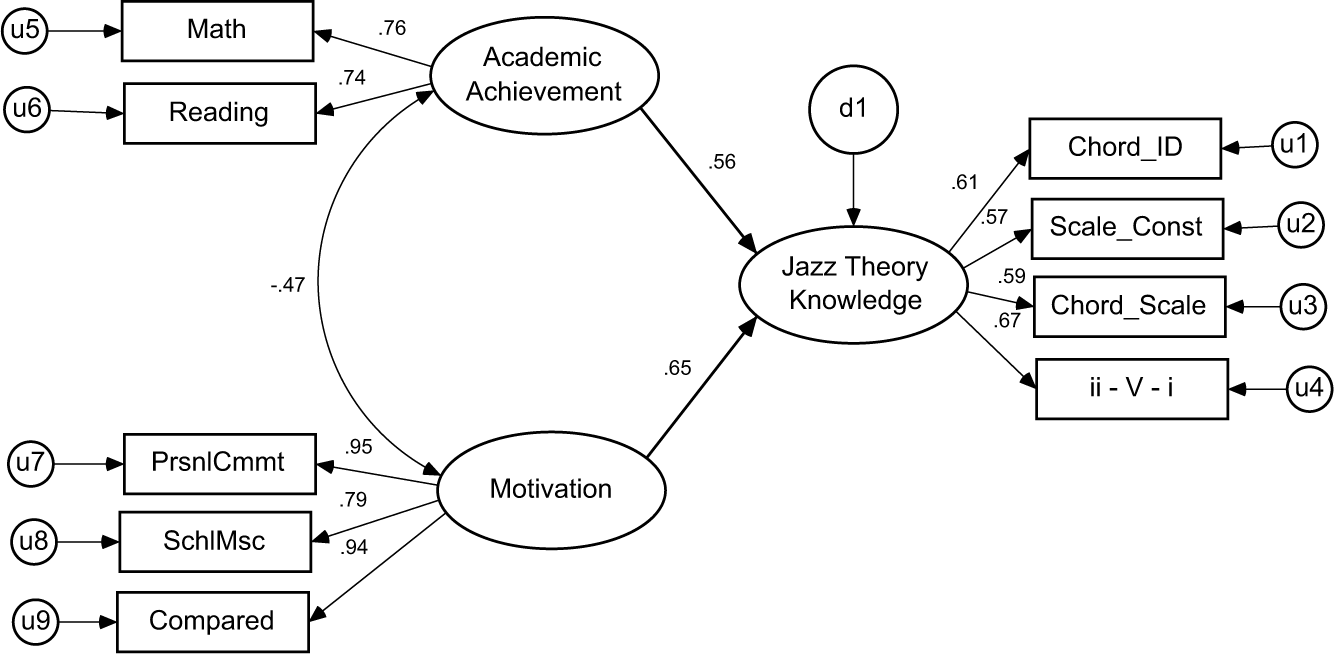
Estimated causal model of jazz theory knowledge acquisition.
Results
We calculated descriptive statistics for all measured variables (Table 1). Data were distributed normally for all variables with the exception of a component variable for the JTAM labeled scale construction. According to West, Finch, and Curran (1995), estimations of skewness (>2) and kurtosis (>7) are of primary concern since non-normal univariate distributions lead to multivariate non-normality. Bootstrapping, a recommended method for dealing with the non-normal distributions, was used in the current study to help correct for the non-normal distribution of the scale construction variable (Fouladi, 1998; Hancock & Nevitt, 1999; Nevitt & Hancock, 2001).
Descriptive Statistics for the Measured Variables.
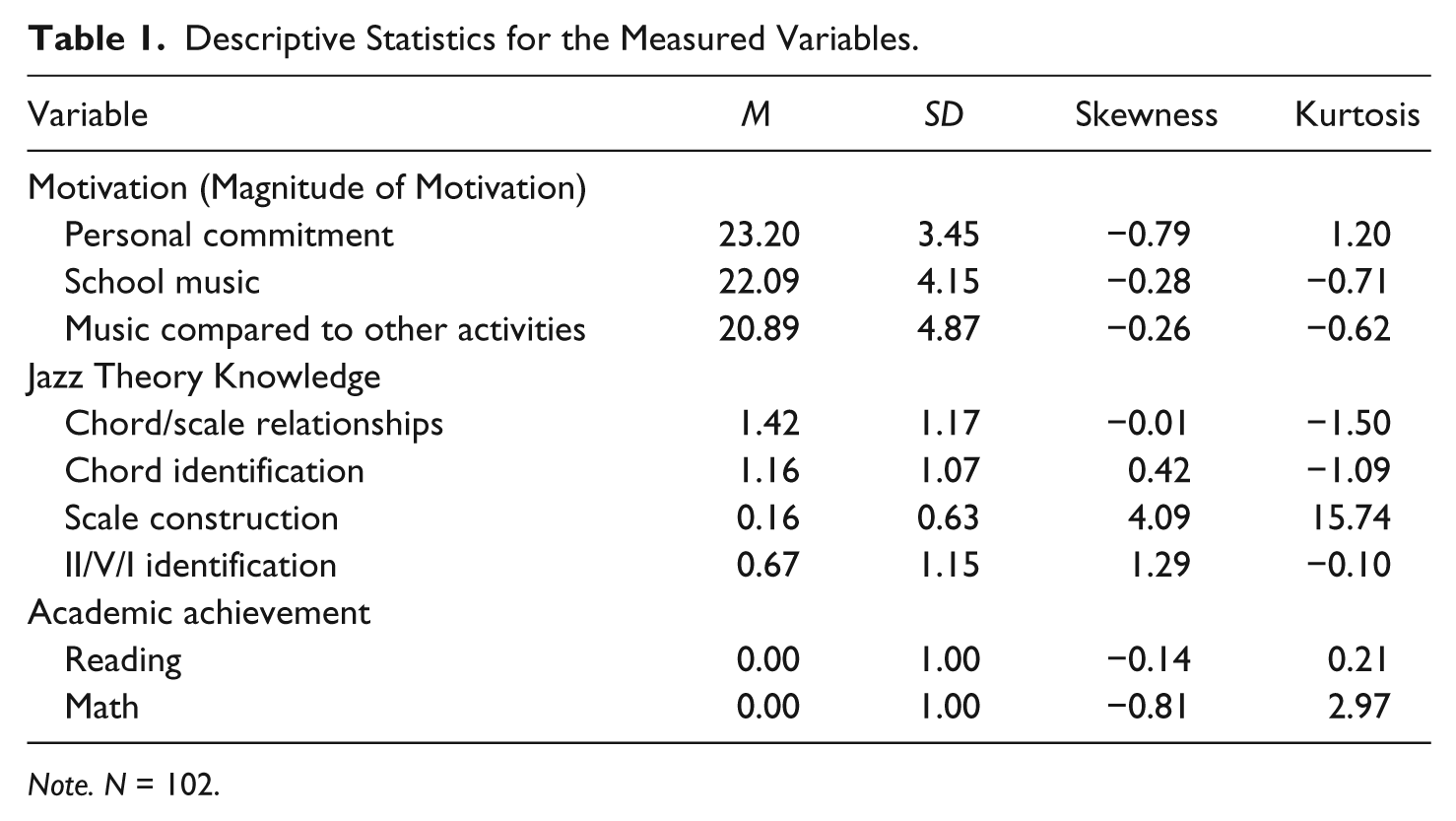
Note. N = 102.
The first research question addressed the issue of measure validity. We conducted a reliability analysis using Cronbach’s alpha. Both motivation (.94) and jazz theory knowledge (.92) measures reported scores that indicated internal consistency. CFAs often are utilized to help establish evidence validity and were employed to determine the adequacy of the measures used to represent the latent constructs depicted in the hypothesized model (Keith, 2006; Russell, 2010). We examined both motivation and jazz theory knowledge variables to initiate the investigation.
The components of the latent motivation variable were measured by the MOM measure. Initial analysis of the MOM measure revealed an inadmissible result as indicated by nonsignificant pattern/structure coefficients (p = .053) and nonsignificant variance (p = .101) on the two items representing the component labeled self-concept of music ability. The description provided with the MOM measure indicated these two items were included as an addendum to provide an index of participants’ self-concept of music ability. The MOM measure was reanalyzed using a CFA after removal of the problematic items. Standardized root mean square residual (SRMR) indicated good fit of the predicted model to the observed data (SRMR = .067). All standardized pattern/structure coefficients ranged from .47 to .85 and were reported as significant (p < .001).
An initial CFA of the JTAM reported poor model fit across all fit indices (root mean square error of approximation [RMSEA] > .10; comparative fit index [CFI] < .90; Tucker-Lewis index [TLI] < .90), indicating problems with the original measure. We employed an exploratory factor analysis (EFA) to investigate the measure further and to identify strong factor simple items with high factor loadings that could measure adequately the variables intended for assessment. A principle axis extraction with a varimax rotation was utilized to identify those items that converged onto one component. The factor rotation was determined by using the a priori structure dictated by the original measure (see Table A in the online supplemental material at http://jrme.sagepub.com/supplemental). Items were selected according to agreement with the a priori structure, factor simple nature, and the strength of factor loadings. Factor loadings for those items selected for inclusion in this analysis ranged from .418 to .867. A total of 12 items, 3 items for each component of the JTAM, were identified to be included in the analysis. Only nonrepetitive items with factor simple structure were chosen for the analysis.
To confirm the structure measured by the JTAM, we conducted a CFA on factor simple items identified in the EFA. The SRMR indicated good fit of the predicted model to the observed data (SRMR = .0625), the CFI and TLI indicated adequate to good improvement of the predicted model over the null model (CFI = .957; TLI = .942), and the RMSEA index indicated a reasonable fit of the model in relation to the degrees of freedom (RMSEA = .075, pclose = .110).
The second research question addressed the relative contributions of academic achievement and motivation on jazz theory knowledge. This was accomplished by following a two-step procedure that consisted of (a) analysis of the measurement model via CFA and (b) estimation of the causal model. Results of the measurement model analysis provided evidence of construct validity by indicating that the nine measured variables provided adequate representation for each construct (Figure 1). Correlations between academic achievement, jazz theory knowledge, and motivation were moderate and are listed as follows: (a) academic achievement and motivation (r = −.47), (b) academic achievement and jazz theory knowledge (r = .25), and (c) motivation and jazz theory knowledge (r = .39) (see Figure B in the online supplemental material at http://jrme.sagepub.com/supplemental). The negative correlation between motivation and academic achievement could be attributed to the specific nature of the MOM measure, which is designed to evaluate participants’ motivation toward music. Absolute indices of model fit revealed a nonsignificant chi-square estimate (χ2 = 20.08, p = .692 df = 24, N = 102), indicating that the model is consistent with the data. Model fit indices indicated good fit of the predicted model to the observed data (SRMR = .042) and reasonable fit of the model in relation to the degrees of freedom (RMSEA = .000, p = .892). The good fit and stability of the CFA suggests that estimation of the causal model is possible.
In the estimation of the causal model, we examine the direct effects of both academic achievement and motivation on jazz theory knowledge. The direct effect of academic achievement on jazz theory knowledge (β = 0.56) was large, positive, and statistically significant, b = 0.57 (0.19), z = 2.98, p = .003, after controlling for the effect of motivation. The direct effect of motivation on jazz theory knowledge (β = 0.65) was large, positive, and statistically significant, b = 0.14 (0.035), z = 3.88, p < .001, after controlling for the effect of academic achievement.
The third research question addressed whether or not the analysis of this exploratory model provides enough evidence to warrant further investigation of this proposed paradigm of jazz theory knowledge acquisition. A combination of both fit indices and standardized direct effects confirmed the existence of the model within the data. Indeed, the results of this exploratory study demonstrate enough stability to proceed with continued examination of the proposed model of jazz theory knowledge acquisition.
Discussion
The purpose of this study was to explore a causal model to determine the influence of motivation and academic achievement on jazz theory knowledge. Results of the CFA provided evidence indicating that the nine measured variables adequately measured each latent construct. The model fit indices provided in the output of the CFA also presented enough evidence to tentatively retain the hypothesized model as one viable representation of the relationships in the data. The path analysis of the latent variable structure illustrated a positive causal relation of academic achievement and motivation on jazz theory knowledge.
An investigation of this model extends the previous research through the assumption that the acquisition of jazz theory knowledge is influenced by both academic achievement and motivation. Analysis of the data indicated the measures adequately represent the latent constructs of academic achievement, motivation, and jazz theory knowledge. The model fit indices provide evidence that improvements over the null model can be attributed to sampling variation.
The hypothesized model provides a viable representation of the relationships in the data, thus supporting the ability to predict a music student’s potential for acquiring jazz theory knowledge through both academic achievement and motivation. Improvements in verbal and math achievement scores have the potential for influencing the ability to acquire jazz theory knowledge, providing additional insight to the previous literature, which has shown that academic achievement is a significant predictor of music achievement (Hedden, 1982; Helwig & Thomas, 1973; Hufstader, 1974; Klinedinst, 1991). McPherson and Hendricks (2010) discovered a significant rise in interest toward school music for U.S. students at the secondary level, which comes at a time when many music students have the opportunity to participate in their school jazz ensemble. These results reinforce the previous research that suggests acquisition of jazz theory knowledge (Ciorba, 2009; Madura, 1992) and proper motivation (Asmus, 1985, 1986a, 1986b, 1994; Asmus & Harrison, 1990; McPherson & Hendricks, 2010) can be of essential importance when teaching and learning jazz improvisation.
Conclusions and Implications
The results of this study further extend the boundaries of jazz improvisation research. The implications provide specific benefits for those who wish to learn jazz improvisation. Attention to positive student musical motivation could result in positive musical outcomes and performance success in jazz. Successful study in the area of jazz theory requires a great deal of time and commitment. The learning process will be impeded if a student is not motivated (Asmus, 1994). Music educators should remain cognizant of students who are motivated to study jazz improvisation. Furthermore, music educators who wish to teach jazz improvisation should be proficient in the area of jazz theory.
Attention to improving academic skills could result in easier absorption of complex music skills and ideas. Since a high degree of cognitive development is required for a student to become academically successful, school music directors can use academic achievement to aid in the identification of those students who could excel in jazz studies. Those who do well in other academic areas may be inclined to excel in the area of jazz theory knowledge.
These results are not limited to those involved in secondary education. Implications for possible screening procedures when recruiting for undergraduate or graduate jazz performance programs could prove beneficial to those teaching jazz improvisation at the collegiate level. Students demonstrating high levels of academic achievement in secondary school may have a higher potential for successful completion of degree programs that include jazz improvisation as part of the curriculum. In addition, the establishment of educational paradigms in music can help to advocate for the inclusion of music in schools by illustrating the mutually beneficial relationship between music and academic achievement. Furthermore, these results help to exemplify that acquisition of music knowledge maybe an indicator of highly motivated and intelligent students.
The results of this study provide ample evidence for continued investigation into the influences of jazz theory knowledge acquisition. In order to confirm the structure of the proposed paradigm, replication of the original design with a larger sample size is recommended. Results of both CFA and EFA were utilized to select items and confirm structure for the JTAM. Since a number of items were discarded as a result of this process, further improvements to the JTAM are recommended. It is also recommended that an improved version of the JTAM be administered to an additional sample population, with the intention of creating a more adequate measure of jazz theory knowledge that can be tested in the original hypothesized model.
A strong background in jazz theory knowledge can provide beginning and novice improvisers with valuable information needed to build a well-developed knowledge base for successful jazz improvisation. Research has shown that the development of theoretical models can help us understand complex processes. The successful identification and testing of a causal model lends support to the ability for understanding the process of jazz theory knowledge acquisition. Educators interested in teaching the art of jazz improvisation can serve aspiring musicians more efficiently through an understanding of the process surrounding the acquisition of jazz theory knowledge.
Footnotes
Declaration of Conflicting Interests
The author(s) declared no potential conflicts of interest with respect to the research, authorship, and/or publication of this article.
Funding
The author(s) disclosed receipt of the following financial support for the research, authorship, and/or publication of this article: Support for this study comes from a dissertation by Dr. Charles R. Ciorba, which is titled The Creation of a Model to Predict Jazz Improvisation Achievement. This dissertation was successfully defended at the University of Miami, Florida, in 2006.

Author Biographies
References
Supplementary Material
Please find the following supplemental material available below.
For Open Access articles published under a Creative Commons License, all supplemental material carries the same license as the article it is associated with.
For non-Open Access articles published, all supplemental material carries a non-exclusive license, and permission requests for re-use of supplemental material or any part of supplemental material shall be sent directly to the copyright owner as specified in the copyright notice associated with the article.
