



Abstract
The purpose of this mixed methods study was to investigate intragroup beliefs regarding participation in a National Collegiate Athletic Association (NCAA) Division II marching band throughout the university’s American football season. Fifty-three undergraduates from an urban midwestern university elected one of two options: (1) focus group only or (2) focus group and surveys. For the quantitative inquiry, it was hypothesized that members would report a downward concavity of group cohesion attributes and collective efficacy beliefs across time. A repeated measures multivariate analysis of variance (MANOVA) found group integration–task (GI-T) and collective efficacy dipped at the midpoint of the season while beliefs regarding members’ attraction to the group, both task and social (ATG-T, ATG-S), and group integration–social (GI-S) remained consistently high. Focus groups data analysis revealed five broad themes: (1) connections, their pride in the band and its connectedness to their school and beyond; (2) family, how the band represents a family environment; (3) acceptance, belonging to the group; (4) music, the role of music in their lives; and (5) time, the temporal beliefs of the group throughout the season. These findings provide insight into the dynamic nature of group beliefs over time with musical ensembles.
Collegiate marching bands serve many functions on campus and contribute to both the musical and social life of the student body. They are visible on athletic fields, in music departments, and at other campus functions and can aide in recruitment, marketing, and the promotion of their universities while broadening the musical and social education of their membership (College Band Directors National Association, 2008). Collegiate marching bands support a variety of sports within the different divisions, from the competitive, highly funded, and visible National Collegiate Athletic Association (NCAA) Division I colleges and universities to smaller NCAA Division II and III schools (National Collegiate Athletic Association, 2015). Traditionally, the marching band, which evolved out of the ceremonial military band, is a specialized course in the American collegiate and secondary school band program (Abril, 2012) and can span both the academic and the extracurricular setting. Musical ensemble participation can afford students a place for musical expression (Adderley, Kennedy, & Berz, 2003), development of self-confidence and leadership skills, and engagement with a supportive network of peers (Abril, 2012; Dagaz, 2012) and can contribute to students’ identity as an important and valued member of the school community (Eccles & Barber, 1999). However, the large ensemble setting is not without criticism and debate as these settings have been censured for excluding marginalized students (Elpus & Abril, 2011), being outdated and culturally irrelevant (Kratus, 2007), endorsing authoritarianism and meritocracy (Allsup & Benedict, 2008), and promoting negative stereotypes (Foley, 2001). More recently, marching bands have come under scrutiny in the national press for hazing and harassment (Perez-Pena, 2014; Winters, 2015). As marching bands have a visible and valuable role in American collegiate life, it is important to understand members’ perceptions of their participation and experiences. It is also beneficial to examine possible changes in these beliefs throughout the duration of a season as there is a clear temporal order to groups’ formation and completion of the undertaking. Therefore, this mixed methods parallel convergent study aims to understand experiences of a Division II collegiate marching band’s members with regard to their intragroup beliefs throughout their football season.
Participation in Musical Ensembles
Students are motivated to participate in musical ensembles for a variety of musical, academic, and social reasons (Dagaz, 2012) as well as personal development (Rothbart & Lewis, 2006). These microcultures can create a sense of identity and encompass the intersection of musical and social practices, traditions, lore, and formal and informal leadership (Morrison, 2001). Students value music-making and performing, the benefits of balancing their other schoolwork with artistic activities (Adderley et al., 2003), and the emotional meaning of music in their lives (Campbell, Connell, & Beegle, 2007). Furthermore, active arts participation can predict intentions to complete schooling and the ability to manage academic setbacks (Martin et al., 2013). Music participation is thus more than simply an entertaining activity but a means by which a host of musical, academic, and social functions are served.
Studies specifically examining collegiate musical ensemble participation have thus far considered stereotypical beliefs (Rothbart & Lewis, 2006), recruitment and retention (Madsen, Plack, & Dunnigan, 2007), members’ perceptions of their conductors (Royston, 2013), and the views and experiences of members (Duchan, 2012; Lamont, 2012). For example, Lamont (2012) examined views regarding performing, finding that university students have positive memories of performing, value these opportunities, and develop a sense of group identity. The participants commented on the confidence they gained from performing and highlighted their social relationships with their fellow performers and audience. Similarly, in an ethnographic study of collegiate a cappella groups, Duchan (2012) found that members appreciated their intragroup relationships and universally referred to their ensembles in terms of a fraternity, a sorority, or, most often, a family. Participation enabled these singers to connect to and create commentary on the world around them through their music.
Research specifically focused on high school and collegiate marching bands has shown that this type of ensemble also provides a place for connection and collaboration for high school and collegiate instrumental musicians. For high school students, participation in extracurricular activities such as marching bands can provide belonging and acceptance. For example, Dagaz’s (2012) ethnography of two high school marching bands highlights the students’ value of friendship and their own developing self-confidence. The members expressed a connection to and sense of community within the ensemble as well as the importance of individual responsibility and the value of group success over individual needs. Through participation, students developed friendships and embodied acceptance and family, giving them a reason to go to school. Furthermore, Eccles and Barber (1999) studied marching bands in comparison to other types of extracurricular activities and noted that students who participated in the performing arts during high school were less likely to engage in risky behavior (especially related to alcohol), experienced a greater enjoyment of school, earned higher grade point averages in their senior year, and were more likely to attend college full-time.
The importance of belonging and the transformative development of leadership that develops within the high school marching band setting are represented in Laine’s (2007) trade book, American Band, and a case study by Abril (2012). American Band chronicles the initial excitement of summer camp waning into the challenge of preparing all aspects of a marching show during the lengthy season, which then turns into the “magic” of the group working together to create the final performance of the season. The collective belief in the importance of overcoming personal and musical struggles, fostering individual responsibility, and working together is highlighted by student leadership interviews and echoed by the director. Similarly, Abril’s case study of senior band members revealed upperclassmen’s belief in the necessity and expectations of assuming leadership roles to mentor and model for less-experienced members, which would in turn (they believe) lead to a more musical and motivated band.
On the collegiate level, Townsend (2004) surveyed marching band members enrolled at three Division I schools and one Division II school and found that members emphasized the importance of being with friends, meeting new people, and being part of the group. Many also mentioned the director’s attitude and interaction with the students as positive factors related to participation. Moreover, Madsen et al. (2007) conducted a case study at a large public university and found that many of the marching band members chose to attend the university due to the reputation of a particular department, followed by the opportunity to be in the marching band and then the reputation of the university.
Two recent studies have examined the social aspects of marching bands with respect to hazing. Focusing on Division I marching bands, Silveira and Hudson (2015) investigated student attitudes toward and experiences with hazing, whether it is reported, and whether students were aware of their school’s policies on such behavior. Nearly 30% of members indicated they had observed some form of hazing, with the most common acts involving public verbal humiliation or degradation. Those who observed hazing generally did not report the incidents either because of fear of social retaliation or because the behaviors were perceived as innocuous and infrequent. Most band members reported learning about their institution’s hazing policy through a marching band orientation and were reminded about it yearly or multiple times a year by their band director. Similarly, Carter (2013) examined how four African American gay men viewed their musical and social experiences in marching band at historically Black colleges. Even though the participants indicated that being gay presented a source of ever-present anxiety in the marching band setting, Carter showed that there was sense of belonging and family within the small group of friends who knew of their sexuality. Their self-identifications as “band member” and as “gay male” were intertwined. Each participant reported experiencing hazing but declined to discuss his experiences as part of the study or with his fellow band members, substantiating Silveira and Hudson’s findings that band members often do not report hazing incidents. These two studies also parallel studies in collegiate sports teams that have similarly found that hazing can negatively affect team beliefs (Van Raalte, Cornelius, Linder, & Brewer, 2007).
Group Cohesion and Collective Efficacy
Marching bands spend many hours preparing for public performance in a setting that includes not only musical elements but also physical and competitive components (Dagaz, 2012). This group setting encompasses many challenges and obstacles that demand sustained cooperative effort, which is influenced by interpersonal and situational factors (Bandura, 1986; George & Feltz, 1995). Specifically, group cohesion, the tendency for group members to unite in the mission of the group and/or for social needs (Carron, Brawley, & Widmeyer, 2002), and collective efficacy, an indicator of the group’s judgment of their combined capabilities to accomplish a task (Bandura, 1986), provide ways to examine the inner workings of groups. These constructs have been shown to impact a team’s performance outcomes (Silver & Bufanio, 1996), sense of affiliation (Jowett, Shanmugam, & Caccoulis, 2012), and motivation (Halbrook, Blom, Hurley, Bell, & Holden, 2012; Matthews & Kitsantas, 2013), as well as dedication to the group and intention to participate in the future (Spink, 1995). Group cohesion has been explored across many varied contexts and disciplines, demonstrating it to be a strong process in team relationships and performance (Greer, 2012).
Group cohesion is characterized by members’ perceptions of the group as a whole (group interaction, or GI) and the members’ personal attraction to the group (individual attractions to the group, or ATG). GI is defined as an individual’s perceptions of within-group attributes such as closeness, bonding, and unity. ATG is explained as an individual’s attraction and sustained participation in the group as well as their sentiments surrounding the group. These dimensions then are divided into task (desire to achieve group goals) and social (personal associations surrounding communal relationships and activities) orientations, garnering four classifications: group interaction–task (GI-T), individual attractions to the group–task (ATG-T), group interaction–social (GI-S), and individual attractions to the group–social (ATG-S).
Several studies have examined perceptions of group cohesion on the collegiate level. For example, Gu, Solmon, Zhang, and Xiang (2011) found that highly cohesive collegiate students attending aerobic exercise classes held positive beliefs about the value of aerobic exercise and their ability to be successful in the class. These beliefs in turn positively influenced attendance. Specifically, these researchers found that ATG-T played an influential role in their motivation. Similar results have been found in both 2- and 4-year collegiate musical ensembles. Matthews and Kitsantas (2016) found consistently high perceptions of task cohesion (ATG-T and GI-T) for both groups but differences in social cohesion (ATG-S and GI-S), with the 4-year students reporting greater feelings of closeness and personal acceptance into the group and its social interactions.
Collective efficacy can influence college students’ group goals (Silver & Bufanio, 1996), interpretation of feedback (Lichacz & Partington, 1996), and performance (Fransen et al., 2015). For example, Silver and Bufanio (1996) asked undergraduate students to construct model trucks from Lego pieces quickly without sacrificing quality. Their findings showed that group efficacy was associated positively with group goals and ensuing task performance. Lichacz and Partington (1996) looked at the effects on collective efficacy via positive and negative feedback and varying performance histories. Drawing from undergraduate members of university sports teams and students with no prior collective performance experiences, students were asked to pull a 20-foot rope that was attached to a Vishay/Ellis Digital Strain indicator, which recorded the weight of the pulls. Prior to the task, students were given fraudulent feedback to simulate different levels of perceived efficacy. Most groups with positive feedback outperformed the negative feedback groups. However, some groups that had prior experience with each other used the negative feedback to develop team strategies and encouragement, which influenced positive performance outcomes.
Influence of Time on Group Beliefs
The majority of studies on group cohesion and collective efficacy have examined these constructs at one point in time after groups have been amassed for a short specific task (e.g., a few hours after assembly, after a group has been together for an extended time, or following interventions). Few longitudinal studies have been conducted (Mathieu, Kukenberger, D’Innocenzo, & Reilly, 2015). Much of this research overlooks the multidimensionality of group cohesion and collective efficacy as they develop over time (Drescher, Burlingame, & Fuhriman, 2012) and the influence of feedback and the ability of groups to adjust their processes as they work toward multiple performances (Pescosolido, 2003).
The few studies that have addressed levels of cohesion throughout the duration of a group’s formation have garnered mixed outcomes. For example, Bartone and Adler (1999) examined cohesion of a Mobile Army Surgical Hospital (MASH) unit before, during, and near the end of deployment. Results found that cohesion rose significantly at midpoint and then declined near the end. However, despite the decline, cohesion was significantly higher at the end of deployment than at the beginning. Dunlop, Falk, and Beauchamp (2013) examined group exercise classes during the second, fifth, and eighth weeks of an 8-week exercise program and found that social cohesion decreased between the first and second assessment and increased slightly between the second and third, whereas cohesion centered around the task of exercising did not fluctuate throughout the 8-week program. Similarly, Mathieu et al. (2015) noted midpoint changes in group cohesion. Their sample included two cohorts of undergraduate college students competing in a 10-week business simulation. Data were collected at three points in the simulation. They found mixed results with Cohort I, beginning at a moderate level, rising significantly at the midpoint, and then tapering off at the end. In contrast, Cohort II began low, rose slightly at the midpoint, and then rose sharply at the end point. The researchers noted that Cohort I had a considerable amount of low performing groups in contrast to Cohort II. Harrison, Price, and Bell (1998) examined surface-level diversity (age, sex, race/ethnicity) and deep-level diversity (attitudes, beliefs, values) to see if these would change over time within two different groups: hospital employees and deli/bakery employees. The study concluded that groups that interacted for a longer time often found surface-level differences less important and deep-level differences more important.
A few studies have examined collective efficacy over time, investigating low and high efficacious groups in relationship to their success in completing tasks. For example, Vera, Le Blanc, Taris, and Salanova (2014) observed university students participating in electronic working groups that collaborated online to perform three tasks. Findings showed that high levels of collective efficacy at the beginning aided students’ engagement throughout the task. Utilizing the Collective Efficacy Questionnaire for Sports (CESQ) developed by Short, Sullivan, and Feltz (2005) with several youth soccer teams, Fransen et al. (2015) found a significant association between players’ collective efficacy during halftime and the team’s perceived performance during the second half (but not at the beginning of) the game. Pescosolido (2003) examined teams of business students engaged in a semester-long research project when group work was just beginning and at the final phase of the project, when they were writing the final report and preparing for a presentation. For these groups, collective efficacy had a positive impact on group duration, individual development, willingness to learn from others, and satisfaction with member roles. Collective efficacy in these groups also positively affected group cohesion.
To understand the value of music ensemble participation for its members, it is important to consider the social and cultural aspects of music (Morrison, 2001). There has been little research into the group beliefs of musical ensembles and even fewer studies examining Division II marching bands. Furthermore, researchers have called for a need of understanding the development and evolution of cohesion (Greer, 2012). Additionally, scant attention has been paid to the influence of time on group beliefs as well as groups that engage in multiple performance situations. Thus, the marching band setting was chosen to examine changes over time as there is a clear temporal order to group formation, multiple performances, and a clear ending as participation in this group is bounded by the American collegiate football season (typically August through December).
I chose a mixed methods approach to this study to provide a richer understanding of the multidimensionality of group beliefs than either a quantitative or qualitative approach alone would garner (Creswell & Plano Clark, 2011). Specifically, this parallel convergent mixed methods design study employs quantitative methodology by utilizing the lenses of group cohesion and collective efficacy at three points in a marching season (beginning, middle, and end) to understand potential changes in these constructs over time. In light of the longitudinal research in both group cohesion and collective efficacy and the assumed demands of the academic collegiate calendar (stress of midterms, etc.), I hypothesized that students would initially report high group cohesion and collective efficacy beliefs and that these beliefs would display a downward concavity across the season. Concurrently, through qualitative focus groups, I explored the following research questions: (1) What are Division II collegiate marching band members’ intragroup beliefs regarding their participation in the ensemble? and (2) Are these beliefs consistent throughout the football marching season?
Method
Participants
Participants included 53 undergraduate wind, percussion, and auxiliary (e.g., color guard, twirlers, etc.) members of a Division II marching band from an urban university. Participating students could elect one of two options: (1) focus group only or (2) focus group and quantitative surveys. The university Internal Review Board approved this study. All members of the ensemble were invited to volunteer to participate; 4 members of the 57-member marching band declined to participate.
Forty students (N = 40) volunteered to participate in the quantitative data collection (surveys). Thirty-eight percent of these were freshman, 30% sophomores, 15% juniors, and 17% seniors. Fifty-two percent of the quantitative participants were male, and 48% were female, and they ranged in age from 18 to 23 years of age (M = 19.41, SD = 1.46). Survey participants self-identified as White American (78% ), African American (8% ), Hispanic American (7%), and Asian American (7%). Music majors were not required to participate in marching band as part of their degree program. Most of the participants indicated they were not music majors (70%), followed by 30% who were studying music in the bachelor of arts degree (2.5%) or in the following concentrations within the bachelor of music degree: music education 12.5%, music business 5.0%, performance 2.5%, music composition 2.5%, music technology 2.5%, or jazz studies 2.5%.
Fifty-three band members (N = 53) participated in at least one focus group, with the majority participating in all three. Of these focus group participants, 35% were freshman, 26% sophomores, 23% juniors, and 16% seniors. Forty-eight percent of the focus group participants were male, and 52% were female, ranging in age from 18 to 24 years of age (M = 19.46, SD = 1.61). The focus group participants identified themselves as White American (77%), Hispanic American (6%), Asian American (8%), and African American (9%). Most focus group participants indicated they were not music majors (77%), followed by 23% who were studying music in the bachelor of arts or the bachelor of music degree with the same breakdown in concentrations as previously described.
Design and Measures
For this mixed methods study, I utilized a convergent parallel design as described by Creswell and Plano Clark (2011). The timing of both the quantitative and qualitative strands were concurrent as the questionnaire distribution and the focus groups occurred at the same three phases of the research project: at the beginning of the football season following the completion of summer band camp (Time 1), in the middle of the season (Time 2), and the last practice before the final performance (Time 3). Qualitative data were gathered three times on either the day of the quantitative assessments or the following day. Furthermore, throughout the study, both the quantitative and qualitative methods had equal priority; after all data were collected, the results were analyzed separately and then blended throughout the interpretation and discussion. This enabled the development of the open-ended interview questions and probes to respond to the qualitative data only, and therefore, the results of the surveys did not affect the development of follow-up throughout the course of the study.
Personal data questionnaire
This questionnaire consisted of items pertaining to participant’s gender, age, ethnicity, and major.
Group Environment Questionnaire (GEQ; adapted from Carron et al., 2002)
This 18-item sport scale was adapted for instrumental ensembles, pilot tested, and used in earlier research (for specific details regarding the pilot testing, see Matthews & Kitsantas, 2007). Responses were measured on a 9-point continuum (1 indicating strong agreement, 9 indicating strong disagreement). Group cohesion is understood as two types of beliefs surrounding the cohesiveness of the group as a whole and the manner in which the group meets the respondent’s personal aspirations (Widmeyer, Brawley, & Carron, 1985). Representative items include “My band is united in trying to reach its goals for performance” and “Members of our band do not stick together outside of rehearsals and concerts.” The Cronbach alpha values for the original sports domain GEQ were ATG-T α = .75, ATG-S α = .64, GI-T, α = .70, and GI-S, α = .76. Based on the sample in this study, Cronbach alpha values for the GEQ taken at Time 1, Time 2, and Time 3 are considered reasonably reliable and in line with prior reliability estimates: ATG-T α = .56, .74, .74; ATG-S α = .63, .63, .68; GI-T α = .64, .75, .74; and GI-S α = .77, .54, .79, respectively.
Collective Efficacy Questionnaire for Sports (CEQS)
This 20-item scale measured the instrumentalists’ perception of collective efficacy through an adaptation of the CEQS developed by Short et al. (2005), which measures team functioning across different sports. As both musical ensembles and sports teams involve both individual and group functions, this measure was adapted for instrumental ensembles, pilot tested, and used in a previous music research study (for specific details, see Mathews & Kitsantas, 2013). Each item was assessed using a 10-point Likert scale that ranged from 0 to 9, with anchor labels of 0 = not at all confident to 9 = extremely confident. Examples of questions included “How confident are you that your ensemble has the ability to persist when obstacles are present?” and “How confident are you that your ensemble has the ability to work effectively in rehearsal?” The Cronbach total alpha value was .96. Pilot testing revealed the acceptable reliability estimate α = .98. Based on the actual sample in this study, Cronbach alpha values were acceptable at Time 1, Time 2, and Time 3, respectively: total scale, α = .97, .98, .98.
Focus groups
Focus group methodology was used to add depth and richness to the quantitative data by further accessing participants’ views, experiences, and attitudes (Krueger & Casey, 2015). The approach of meeting with the participants in a variety of small group configurations provided multiple opportunities for students to tell their own personal and group stories, which in turn enabled them to explain perceptions and express their points of view (Krueger & Casey, 2015). At the beginning of the season, students were randomly assigned to participate in one of six focus groups. The second time the focus groups met, in the middle of the season, they were assigned by instrument family (e.g., high brass, low brass, woodwinds, drum majors, percussion, guard/dancers, etc.). For the third round of focus groups at the end of the season, students participated by academic class (freshmen, seniors, etc.). This resulted in a total of 14 groups of 4 to 15 participants each over a period of 4 months, with members participating in no more than three groups (one per time point). This intentional sampling of the various combinations and social contexts of students throughout the season facilitated rapport among participants and allowed participants to amend and elaborate on their experiences, thereby providing a more refined understanding of their involvement (Hollander, 2004), and aided in discovering themes through saturation (Creswell, 2008). Additionally, the size of these focus groups was sufficient to obtain a variety of viewpoints but small enough to maintain the focus of the participants (Krueger & Casey, 2015).
Each focus group lasted 30 min to an hour depending on the flow of the conversation and was moderated by the author. Interview protocols included sets of open-ended questions and probes that were developed prior to the first focus group, with follow-up questions developed throughout the study in response to the data. The question topics included views of the ensemble, views of their university and local community, reasons for joining the ensemble, band traditions, and so on. Focus groups were audio recorded and transcribed for analysis and the development of subsequent questions and probes.
The analysis of the data was based on principles of grounded theory (Strauss & Corbin, 1998), utilizing constant comparative strategies (Krueger & Casey, 2015), and guided by the six “Framework” analytical process stages for qualitative data analysis: familiarization, identifying a thematic framework, indexing, charting, mapping, and interpretation (Richie & Spencer, 1994). To begin the analysis, the author became immersed in the data by listening to the audio recordings, reading transcripts, reflective memo writing, and engaging in consultations with colleagues. These processes supported the development of follow-up questions between Time 1 and Time 2 and Time 2 and Time 3. One example of this process was the unexpected discussion of traditions (e.g., polishing the football team’s helmets, socializing at the band table in the student union, etc.) that were mentioned in the first focus group. As these traditions were not familiar to the author, the second and third focus groups allowed follow-up questions to investigate the significance behind these activities more deeply. These processes of memo writing and consultation helped address the author’s musical background and potential preformed assumptions regarding musical ensemble participation by making them explicit and in turn enabled the author to be receptive and responsive to the data (Glesne, 1999).
After data were collected and transcribed, the author and two research assistants began independently identifying a theoretical framework by writing short memos in the margins of the text, identifying ideas and potential categories. Preliminary exploration analysis was done by hand after each focus group to get a sense of the data and begin organizing it. An index of codes was created and used to make comparisons within and between groups. At this point, the author and the research assistants met together to assess minor discrepancies, which were resolved through consensus. The fourth stage, charting, involved lifting the quotes and rearranging them under the newly developed themes using the long table approach of Krueger and Casey (2015). In the final stages of analysis, mapping and interpretation, the author examined the data using Krueger and Casey’s constant comparative strategies of examining frequency, specificity, emotion, and extensiveness to guide decisions regarding the weight or emphasis to afford comments or themes.
Validity was established through member checking and external audits (Creswell, 2008). Member checking was done throughout the second and third focus group sessions. As Hollander (2004) suggests, the strength of focus groups is the ability to generate data based on the relatedness of the group interaction. Using already established (e.g., instrumentation, class rank) homogenous groups helped the participants be comfortable with each other and fully engaged in the discussion. Throughout the time frame of the discussion groups, all members contributed to the development of rich data and added to validity. Additionally, two members of the marching band (a sophomore and a junior) commented on the final manuscript (Miles & Huberman, 2014), and two external auditors who were new to the research reviewed the findings at the end of the project.
Results
Quantitative Results
Using G*Power analysis for medium effect size (partial η2 = .10), a significance level of .05, and a priori statistical power at .80 with medium correlation among time points at .30, I determined the necessary sample size to be 24 participants or higher (Faul, Erdfelder, Lang, & Buchner, 2007). As this component of the study had 40 participants, I conducted a one-way within-subjects repeated measures multivariate analysis of variance (MANOVA) with the factor being Time Point (1, 2, or 3), with group cohesion (ATG-T, ATG-S, GI-T, GI-S) and collective efficacy as dependent variables. Table 1 shows the means and the standard deviations for each of the variables; correlations among all variables are shown in Table S1 (available in the online version of the article).
Means and Standard Deviations for Dependent Variables.
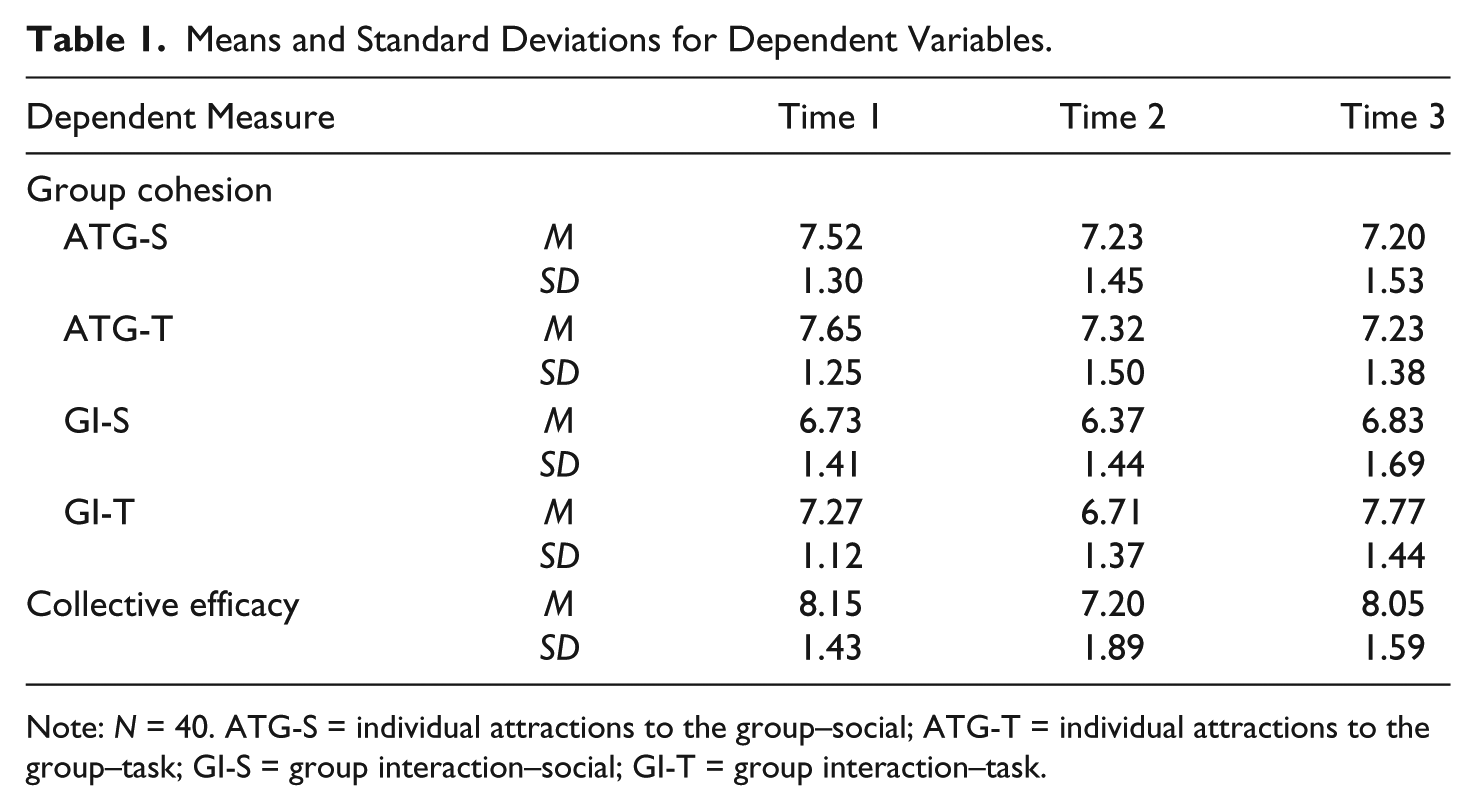
Note: N = 40. ATG-S = individual attractions to the group–social; ATG-T = individual attractions to the group–task; GI-S = group interaction–social; GI-T = group interaction–task.
Correlation analysis indicated there were moderate to high positive correlations among group cohesion (ATG-S, ATG-T, GI-S, GI-T) and collective efficacy at Time 1 (r = .35, p < .05; r = .65, p < .01; r = .62, p < .01; and r = .83, p < .01, respectively). At Time 2, group cohesion (ATG-S, ATG-T, and GI-T) correlated with collective efficacy (r = .38, p < .05; r = .41, p < .01; r = .56, p < .01); however, GI-S did not. Finally, at Time 3, there were nonsignificant correlations between group cohesion and collective efficacy in all types except for GIT-T, which had a high correlation of r = .71, p < .01.
For the one-way within-subjects repeated measures MANOVA, all assumptions were examined and met. Analysis revealed a significant main effect for the time factor, Wilks’ lambda = 0.37, F(10, 30) = 5.04, p < .001, η2 = 0.63. Using the Bonferroni correction procedure, I conducted an analysis of variance (ANOVA) on each dependent variable as a follow-up test to the MANOVA. To control for Type I error, Bonferroni correction yielded an alpha .01 for the five quadratic contrasts. Results indicated no significant time effect for ATG-T and ATG-S. There was significant time effect for GI-T, F(1, 39) = 22.88, p < .001, η2 = .37, and collective efficacy, F(1, 39) = 10.10, p =.003, η2= .21.
Pairwise comparisons showed significant differences between all points in time for GI-T only, with a decrease in average interaction at Time 2. Follow-up higher order polynomial contrasts indicated a significant quadratic effect with the means lower at Time 2 and scores rising higher than the original measure (Time 1) at Time 3. These results suggest that marching band members’ attraction to the group and social group interaction beliefs remain steady throughout the marching season. However, their beliefs regarding the ability for the group to integrate around the task of performing as a marching band dips in the middle of the season before exceeding its original level as the season closes.
Regarding collective efficacy, pairwise comparisons indicated significant differences between Time 1 and Time 2 as well as Time 2 and Time 3 but no significant difference between Time 1 and Time 3. Follow up higher order polynomial contrasts indicated a significant quadratic effect with the means lowering at Time 2 and then in Time 3 rising slightly above Time 1 means. These results suggest that collective efficacy beliefs demonstrate a downward concavity as the season progresses but return to their original level as the season draws to a close.
Qualitative Focus Group Findings
Five broad themes emerged from the focus groups, including: (1) connections, their pride in band and its connectedness to their school and beyond; (2) family, how the band represents a family environment; (3) acceptance, belonging to the group; (4) music, the role of music in their lives; and (5) time, the temporal beliefs of the group throughout the season. Each of the themes is discussed in the following.
Connections
The marching band members saw the ensemble as connecting to many communities: the sports community, the student body, the university, and the city in which the school was situated. First and foremost among participants was their positive relationship to the football coach and team. Many times, the football coach expressed to the band that the football team would not have won the game if not for the band cheering for the football players both musically and verbally. One member expressed that the team was friendly toward the band and appreciated all it did for the team. He continued that this was different from high school, where members of the band had been ridiculed. Another student commented on the reciprocal nature of their relationship to athletics:
I think that our goal since day one is to foster that great relationship with the community, the school, and especially athletics . . . there are football players that will say hi to us and [comment] on our Facebook page and hang out with us at the student center occasionally, because they know we put as much work into what we do as the work they put into what they do. So I think that is a good representation of our effect on the community.
The students also commented on their role in creating game day spirit and school pride and attracting fans to the game through cheering, playing familiar tunes in the stands, or in their halftime show. Many commented that it was important to make a big sound as they support the team and engage the crowd through sufficient volume. They also commented on how having a football team, a marching band, and a student section at the games contributed to their belief of what university athletic environments should be. They made comparisons to nearby Division I universities, explaining that even though they, a Division II band, were smaller, they were just as strong in supporting their team and this was exemplified through their volume whether playing or cheering. This parallels Duchan’s (2012) finding where an a cappella group avoided singing in falsetto to exemplify its power in comparison to a group from a nearby university that had many more members. The importance of volume for both groups represented that they were “more musically potent; they could do more with less” (Duchan, 2012, p. 74). Throughout the season, this belief regarding the importance of volume permutated every focus group discussion. In the following, a student discusses her view of supporting the team:
We are their number one fans. The last game we played; that come back was incredible. We all went nuts. Because we are all into watching the game . . . we were starting those cheers, because we were so loud, they [the student section] were so loud. I’ve heard from several of the football players that’s huge to them. They really appreciate when we get people into it and when we are into it. We make some noise, and that puts some power back to them, too.
Band members participating in the focus groups also felt respected and noticed on campus for their participation individually and as a group. Students commented on how the marching band promotes school pride, contributes to the collegiate atmosphere, and contributes to the outreach of the university. The following two quotes depict the interconnection of relationships:
I would say we boost school spirit. In general [the university] doesn’t have much school spirit. A lot of people commute. They go to class, they go home, and they don’t go to any athletic events. They don’t cheer for our team. So, we really add that. And this year we have a student section behind us. So, that’s kinda a big deal. I think what we represent is the energy of the community in a revitalizing way. You look around to the surrounding community, you see, neighbors popping up and community service groups getting together to clean up areas. And, I think we feed off that energy in a way and give it back to the city as well. In that, our performance in each game is putting that energy back into the city, back into the university, back into the community. And I think that is a big part of where we go to school. It’s an urban university; we are surrounded by the city. There isn’t a strict boundary where the university ends and the city begins. And I think that really is part of why we associate that so heavily here.
Family
Marching band members saw each other as more than just friends. Often, they compared themselves to sororities or fraternities and overwhelmingly referred to themselves as a family. The marching band was seen as a place to fit in. They expressed feelings of being accepted and comfortable with their peers. Many commented on how quickly they were accepted into their band family. Everyone was needed and welcomed. One student commented, “Our community formed because of our acceptance. We don’t turn anybody down. We take with what we can get, and what we can get is really, really good. And being in the community is just like one big family.”
This feeling of belonging through a sense of family can be important to students’ decisions to continue their studies at a university. The marching band members indicated that they believed the other band members supported them, helped them when they were feeling down, and were there for them when they needed each other. This feeling of social support was exemplified in their tradition of having a “band table” in the student union. Here, observers could find anywhere from one band member to a large group hanging out or working on homework. One student described the band table as follows:
We all group together whenever we are not in band anyway. We have the band table or tables depending on how many people are there. But, we’re all one big band family, we are really close with each other. We all help each other out with anything and it’s not very individual, it’s all a big group effort.
Focus group participants expressed their belief that everyone is needed, there are no benchwarmers, and one must be dedicated to the group. They also commented on the importance of being united toward a common goal, exemplified by marching in one style, perfecting the drill (the marching and maneuvering on the football field), familiarizing themselves with the history of the ensemble and their place in it, and emphasizing their selfless willingness to work together for the good of the group. As one student described this phenomenon,
I think that it’s a culture where every one of us is passionate about this ensemble. Every single one of us wants to see this band succeed. I think that even that those that don’t have the title of student leader, still take it upon themselves to say it is my job to make sure that I have everything prepared for game day, therefore the section is prepared; the band is prepared. I think that snowball effect, of starting at the lowest ranks because as a whole, we are very successful because each person takes personal initiative in this ensemble.
Acceptance
This group described the importance of acceptance and embracing the diversity of its membership with respect to musical level, ethnicity, cultures, academic major, geographical origin, former experience, personality, and so on. It was okay to be unique and different; members were welcomed into the band regardless of individual traits. Here a student explains her entry into the band:
I’m also new to this marching band. I’ve been here a week. It reminds me a lot of my high school band; they are very small. I came from a small country town. This is probably the warmest welcome I’ve ever had coming into a group of people just because we all have that similar interest. We make it fun. Sometimes, let’s be honest, it is not fun sometimes; practicing and getting things wrong. But we all make it fun, and I like that.
Focus group participants valued working with diverse groups of people for a common goal. One student commented on the positive aspect of a smaller band, stating that “everybody gets along for the most part, and we have different views on some stuff. Because we’re small we’re able to connect better and become friends.” Another student commented on the relationship between the instrumentalists and auxiliary members:
Communications here include every single part of marching band. It’s just not just the people who actually play the music. They include the color guard and the dancers . . . we are all a group, we all communicate together to get things done, to make sure it looks good, sounds good. Because we enjoy marching band in general, I think, I think it allows us to have a common ground to at least get along on a personal basis, which is really nice.
Music
Another theme that emerged was the value students placed on music in their lives. It served as a creative outlet and a source of individual pride. They also believed music balanced academic requirements; it was a stress relief (musically and socially) and a place to reenergize and be proud of your accomplishments. Marching band was a place to have fun but also to work hard and get the job done.
Their love of music and their passion for marching band were evident throughout all of the focus group permutations. Here, three members express how marching band is their “thing”:
Marching band is just my thing. Freshman year that’s what made me want to become a music major. That’s like the whole thing. I mean, literally, all the friends that I’ve had, have been in band, in marching band. I’ve, I really don’t make any friends outside of band, really. And . . . I’m staying. Marching band, that’s like my thing. I’ve done marching band for four years. I don’t know, I just, I’ve always loved it ever since the first football game, since my first band camp. I’ve just always had a love for marching band. It’s my passion. I wanted to do this since like fourth grade. I’ve always told my grandma, “I’m going to drill in college.”
Time
The final theme that emerged was the students’ understanding of the ebb and flow of the group throughout the season. Here, they discussed how time influenced their feelings of stress in the middle of the season, how they strived to improve the halftime shows throughout the season, and the reasons they would or would not return next year. During the Time 2 focus group, several commented on the stress of the group and the importance of persevering. Two students illustrate this dichotomy:
It’s stressful. There is a lot of stuff to do and not enough time to do it in. It’s there every year. Everyone is ready to eat each other. I feel like focus is just dwindling since, August, September and now we’re getting to the end of October. Feels like everybody is more on edge and stressed out. I think we bring our A game to the performances, anyway. Even if we did have a bad rehearsal or if we had a week of bad rehearsals, we’re still going to bring our A game to a performance. Because we know it’s a performance, it’s a pride thing. Honestly, the only thing that really keeps me coming here is the fact that I don’t want to let you guys down . . . so that’s why I show up.
At the midpoint, many students commented on the stress of midterm exams and of balancing their academic responsibilities outside of music with participation in the band. This was true for both music majors and non–music majors:
It’s a little rough sometimes. I mean stressful wise. Because you know we’re in midterms right now. We’re taking exams and studying for classes. And on top of that we’re learning routines. And it’s demanding, marching band is demanding. There’s a lot of time involved, so finding the right balance is important.
Another thread surrounding time was the importance of improving the halftime shows. Here a student talks about the time it takes improving drill across the course of a season:
I feel like we’ve tried a bunch of different things with getting the drill on the field. And none of them were spectacular. A few of them ended up in mass frustration. And, sometimes it just gets really chaotic and we still haven’t found our zone.
Finally, many students expressed that they would or would not return based on balancing time commitments. Several stated that they planned on returning but might not do so if their academic or outside obligations (usually employment) got in the way. However, echoing the quantitative data, there was an overwhelming consensus that each member would return for the next year as he or she valued the musical and social aspects of the group:
No matter what you do in life, wherever you go, whatever you end up doing, all of us have that one thing in common, which was doing band. We might not be able to take the uniforms with us, but we will be able to take the memories with us. It’s just being able to have those memories of traveling or playing a particular show that makes it more of an impact for us. . . . Because the dynamic in marching band is so much different than say, your normal class or another club. Because, we spend so much time together, and you know, we spend literally hours at a time a day, just rehearsing, that’s not talking about the outside socialization that occurs. And then you add up that all up during the week plus throw in a game, that’s six, seven hours. You know, that’s a lot of hours during the week to spend together. And you’d think that other people would just kind of implode and get mad at each other. But, I think here it’s what drives us to continue to do our best, because, we are so focused and we don’t want to let each other down. Everybody takes that ownership in this band.
Conclusion
As Bandura (1986) asserts, working in groups requires unity and sustained collective efforts, and the strength of a group rests partly in its members’ sense of cohesion and belief that they can solve their problems through working together. Results from this study highlight members’ group beliefs regarding their role as a marching band member, the success of the ensemble, and their relationships to each other throughout the football season.
The quantitative results partially supported the hypothesis that students would report high group cohesion and collective efficacy beliefs and that these beliefs would display a downward concavity across the season. Members demonstrate positive feelings surrounding their personal involvement with the goals of the marching band (e.g., performing halftime shows, etc.) and its ability to fulfill those roles as well as their personal acceptance and social interactions within the group. Specifically, group cohesion results show that attraction to the group both social and task (ATG-S, ATG-T) as well as group integration social (GI-S) beliefs remained steady across the season. In contrast, the marching band members’ beliefs regarding their group integration around the task (GI-T) and collective efficacy dipped during the season but returned to similar or greater values at its end. These results suggest that collegiate marching band members are drawn to the musical purposes and activities of the marching band as well as the social aspects and relationships of the group and that these beliefs are resilient during the season. However, as they work together throughout the season, their confidence in their ability to succeed can drop in the middle of the season, creating moments of discord.
These data correspond to the Concord Marching Band in Laine’s (2007) book, in which students expressed frustrations late in the season regarding members’ lack of commitment to the student-led morning practices, which was counter to the belief that altruistic dedication to the collective is highly valued. These results over time are similar to those reported among business students and group exercise classes (Dunlop et al., 2013; Mathieu et al., 2015) but oppose those of the MASH unit (Bartone & Adler, 1999), which rose at the midpoint and declined as their mission came to an end. The length of the task, the nature of the task performed, and the risks associated with military deployment might explain this difference. The present study’s collective efficacy beliefs were high and similar to electronic working groups examined by Vera et al. (2014) and Pescosolido (2003) in depicting that groups with high collective efficacy are more cohesive and tend to persevere through tasks and tend to persist despite experiencing failure (Hodges & Carron, 1992).
The qualitative data add to the understanding of this ensemble’s intragroup beliefs regarding participation in the ensemble during a football marching season. Students had very strong, highly positive, and consistent beliefs that marching band was part of their identity and a valued aspect of the collegiate community. The five themes that emerged in the qualitative study—connections, family, acceptance, music, and time—highlight the appeal and demands of being part of a Division II collegiate marching band. Here students expressed their pride in band and its connectedness to their school and community. They talked about how the band represents a family environment and the importance of music in their lives. Students commented on how the marching band energizes the fans, supports the student athletes, and entertains through music and visuals. They also discussed how being a member of the marching band was a stress reliever and balance to their day-to-day academic responsibilities. Their social responses embodied acceptance, tolerance of differences, and the willingness to work hard for the group. Across all three focus groups, these musicians frequently explained the importance of belonging to the group and supporting each other. This resonates with Carter’s (2013) and Dagaz’s (2012) findings that marching bands are not only places of music-making but also places of community.
As reflected in the decline of quantitative means at Time 2, the qualitative data identifies how the students intuitively recognized the dip and relied on their connections to each other to find the determination to produce the best performances possible. They expressed how they balanced their time commitments and frustrations and were steadfast in working through their midpoint decline by doing their personal best and empowering the other band members. Specifically, this complemented the quantitative results where three of the four group cohesion dimensions (ATG-T, ATG-S, GI-S) remained constant throughout the season and the concavity of the GI-T and collective efficacy results. The descriptions of the stressors they experienced at the midpoint and the value of persevering to the end of the season resounded in the same manner as the voices of the high school marching bands in both Dagaz’s (2012) ethnography and Laine’s (2007) book.
Even though music-making is central to the purpose of ensembles, motivation is a dynamic force that compels students to participate and master the knowledge and skills central to music (Asmus, 1994). By taking into consideration group cohesion and collective efficacy as part of their pedagogy, faculty can guide how their groups connect around the task of music-making, which in turn can influence the group’s performance and climate and its members’ dedication to the group and willingness to return. Recognizing the cultural aspects of music-making complements our understanding of pedagogy in large ensembles (Morrison, 2001).
As the participants in this study highlighted acceptance and tolerance as salient to their participation, it is important for directors to provide opportunities for new members to integrate themselves into the group early in the season through freshman camps or orientations and social events. Connecting with the members of the collegiate community is especially important to increase college student retention and can facilitate students’ transition to college life (Tinto, 1997). It is important for directors to monitor and respond to the culture of their ensembles and the culture of the multiple communities they reside in for both positive and negative interactions. Specifically, revisiting their institution’s harassment and hazing policies with students during midseason may be advised as there is a potential for tensions to increase at that time. It is also essential for directors to be aware of university testing cycles when planning for rehearsals.
Knowing that there is a potential for a pejorative atmosphere in the middle of the season, directors can plan ways to help students understand their frustrations and provide opportunities for students to develop coping strategies, whether it be team building exercises, social events, or helping students access university resources to help balance academic and personal life outside of the ensemble. Specifically, directors can inspire and reinvigorate the group by taking a more direct hands-on approach midseason by supporting student leadership, inviting motivational guest speakers and professional musicians to work with the group, or planning social or service-learning activities to help students reconnect with each other outside of the responsibilities of the upcoming performances. Peer mentors and student leaders can also aid in this.
Research in sports has shown that leaders have the largest impact on other team members and that an important factor in the failure of teams is inadequate leadership (Taggar & Seijts, 2003). Exhibiting democratic behavior that includes task instruction, social support, and positive feedback will foster higher levels of task cohesion (Gardner, Light Shield, Light Bredemeier, & Bostrum, 1996). This highlights the importance of personal responsibility and working together in creating positive musical outcomes, repeatedly mentioned by participants in this and other studies on musical ensembles. Students in this study took ownership of the ensemble experience in personal ways and were willing to respect and learn from each other. It is important for directors to continue to articulate to their ensemble members as well as music, athletics, and other university departments the value of marching band. This is one of the few places where a mix of college majors comes together to contribute to student life. Furthermore, this and future research can help educators understand, contextualize, and identify strategies to instruct, motivate, and support musicians as they participate in any large ensemble setting.
Limitations of this study include a small sample size for the quantitative data. Additionally, this study does not explore the potential influence of ensemble leadership, the winning and losing streaks for the teams that marching bands support, the effect of time pressure (e.g., how quickly and often a new show needs to be put together), and the importance of prior marching experience (e.g., high school, drum corps, etc.). Studies in sports setting have indicated that leadership (Gardner et al., 1996) and prior experience of teams and individuals can affect an individual’s perceptions and participation (Hodges & Carron, 1992).
Another limitation of this study is that all participants came from one university Division II marching band. Further research is needed to corroborate these results in other division marching bands. Results may differ with marching band members involved in other levels of collegiate participation, including bands at universities that have highly public revenue-generating football programs and subsequently support their marching band through public and financial support such as scholarships. The ensemble in this study was also composed predominantly of non–music majors and experienced a student-run atmosphere that allowed member input in all aspects of the ensemble. Similar to Abril (2012), sectionals were guided by student leadership, and several of the show drills were written by the members. This exemplifies potential of independent musicianship and reciprocity of engagement in large ensembles and stands as a counterargument to the criticism that bands sprung from a military tradition are content and teacher driven (Allsup & Benedict, 2008). Research in this area should examine how formal and informal leaders within the group share the musical and social responsibilities in ensembles. It is especially important for researchers to study how non–music majors participate in arts programs during the college years and how these experiences translate into adult music-making throughout the life span.
In conclusion, music ensembles such as marching bands can help define one’s talents, values, and place in the social fabric of their community (Eccles, Barber, Stone, & Hunt, 2003). This study adds to our understanding of why students choose to participate in musical ensembles during their collegiate years and contributes to the emerging understanding of the ebb and flow of preparing for performances. The results may assist university faculty and staff in creating positive on-campus atmospheres in which students can develop their artistic and interpersonal skills and may add to the understanding of the impact of group beliefs on the ability of groups, in general, to persevere over time. Future research needs to further explore group beliefs in all types and levels of musical ensembles. Furthermore, the findings of this study may lead to an increased understanding of the importance of curricular and extracurricular musical ensembles in campus life and how these ensembles may impact recruitment and retention through offering strong connections to their peers and the university.
Footnotes
Declaration of Conflicting Interests
The author declared no potential conflicts of interest with respect to the research, authorship, and/or publication of this article.
Funding
The author received no financial support for the research, authorship, and/or publication of this article.
Supplemental Material

Author Biography
References
Supplementary Material
Please find the following supplemental material available below.
For Open Access articles published under a Creative Commons License, all supplemental material carries the same license as the article it is associated with.
For non-Open Access articles published, all supplemental material carries a non-exclusive license, and permission requests for re-use of supplemental material or any part of supplemental material shall be sent directly to the copyright owner as specified in the copyright notice associated with the article.
