



Abstract
Music leaders who conduct ensembles in education and community settings, create an ecology of participation depending on their style of leadership. The paradigm of master/apprentice that has long been pilloried in music education academia is still a popular modus operandi for many conductors. Understanding the effect that leadership has on group identity and ensemble cohesion can help participant musicians to continue lifelong engagement with ensemble music making. This exploratory research consists of three phases. First, the relevant literature regarding group work, leadership theories, and musical ensembles was explored. Second, utilizing a purpose-designed questionnaire instrument issued to three musical ensembles. The data was collected and analyzed to determine which leadership factors were considered most important in developing a positive ecology for ensemble members. Data were collected from three musical ensembles, resulting in a convenience sample of n = 73. Some unexpected results emerged from several analytical techniques that explored the cross-tabulation of questionnaire data using Pearson’s kurtosis and skewness coefficients and platykurtic distributions. Finally, this research recommends a more egalitarian ecology in order to maintain a strong interest in ensemble music making for participant musicians.
Introduction
Leadership of music ensembles has been scrutinized in recent decades (Ginsborg, 2017; Seddon & Biasutti, 2009; Sutherland, 2017). Ensemble ecology can impact the degree to which members value their involvement, and continue ensemble music making in the community following university graduation. We consider a set of psychosocial factors related to group work, collaborative learning, and performance to better understand how tertiary music students can be motivated to pursue life-long ensemble participation. Determining the perceived importance of these factors in relation to leadership qualities forms the basis for our understanding of how musical leaders can effectively maintain a healthy ensemble ecology.
Musicians operating in an ecology whereby sharing leadership roles is discouraged, are denied the experience of authentic teamwork or groupwork. Through understanding perceptions of leadership within such an ecology, we seek to explore which aspects of the ensemble experience most effectively provide alternative models to the master/apprentice archetype. We consider a positive ecology to reflect an enthusiasm for the members to maintain active involvement in ensemble music-making.
Music ensembles, group work, and leadership
Music ensembles
Although music ensembles frequently operate within an autocratic paradigm, the literature provides compelling alternatives that enable enhanced agency for members. Music ensembles are “an unusual kind of social group whose mode of interaction involves a degree of intimacy and subtlety possibly not equaled by any other kind of group” (Young & Colman, 1979, pp. 12–13). Music ensemble performances is a “social art form [that] entails multiple individuals pursuing shared aesthetic goals. These goals are typically realized through the nonverbal communication of information . . . to co-performers as well as audience members” (Keller et al., 2016, p. 2). Ensemble practice and performance for the majority of Western ensembles can be considered as two stages in which collaboration related to technical, expressive, and psychological challenges such as those of recognition and communication can occur (Ginsborg, 2017).
Groups of musicians engage in verbal and nonverbal communication such as listening (Ginsborg, 2017; Sicca, 2000). At the outset of rehearsal or practice, verbal communication mostly dominates (Seddon & Biasutti, 2009), giving way to nonverbal communication as social and musical relationships develop. Teamwork, communication, and understanding not only impact the ensemble experience, but also the quality of the music (Sutherland, 2017).
Group work
In considering alternative models to the master/apprentice model prevalent in many institutions, the broad notion of groupwork and teamwork can provide an important foundation. Group work and teamwork are related but not interchangeable terms. Teamwork is the extent to which the members are reliant on each other’s actions, whereas group work does not require a high degree of interdependency (Cordery, 2005). Both group work and teamwork require effective communication between members to achieve positive outcomes and increase productivity (Robins & Judge, 2016). Katzenbach and Smith (2013) argue that the success of a group is determined by the manner of member communication, rather than discussion content.
Teamwork is characterized by a set of two or more people interacting adaptively, interdependently, and dynamically toward a common and valued goal (Salas et al., 1992). Teamwork manifests effectively when members of the team are given specific roles or tasks within the limited life span of the team. By definition, a music ensemble with an autocratic leader and no democratized leadership positions is not a team.
Group work is a teaching strategy promoting academic achievement and socialization (Forslund & Chirac, 2012). It involves interactive individuals who join together to achieve a common goal, and whose interactions are structured by a set of roles and norms (Johnson et al., 2013; Williamon & Davidson, 2002). This shared purpose provides a reason for members to invest in the group, sharing ideas, and creating a sense of unity.
A group successfully communicates when “group flow” is manifest. This is a collective experience of fluid harmony similar to individual experiences of flow that Csikszentmihalyi (1996) observed. In music ensembles, group flow is the ultimate manifestation of a successful ecology, enabling creativity, and high levels of musicianship (Dennett, 2019). Collaborative musical creativity is best achieved with flexibility which embraces novelty (Bishop, 2018; Cottrell, 2017). This is understood as emergence, a phenomenon occurring when the collective output of the group exceeds the sum of individual contributions. Emergence is achieved by creating group cohesion wherein individual contributions form cumulative units with distinct structural meanings (Bishop, 2018), essential in effective music ensembles.
Leadership
Two types of leadership manifest in music ensembles, which when applied to an ecology of participation provide divergent outcomes. The first involves visual leadership that is intricately connected to the traditional master/apprentice model. The second, is auditive leadership, which is synonymous with more participative approaches including all participants (Koivunen, 2006). Visual leadership narrative posits possessive individualism as a core trait. Conductors with visual leadership traits believe their musical ideas are paramount, fully satisfying the needs of the ensemble, whereas those with auditive tendencies draw on the wellspring of knowledge from the ensemble in addition to their own expertise. Leaders are chosen because of their superior characteristics or traits (Dachler & Hosking, 1995).
Organizational attributes and leadership
Group leaders are responsible for three sets of activities that encourage collaborative learning in groups, namely: (a) developing, promoting, and maintaining a group learning climate; (b) helping members develop and use particular learning tools, both individually and collectively; and acting as learning partners for group members at different stages of development (Zaccaro et al., 2008). One responsibility of a group leader is the ability to motivate diverse members, which affects the group’s success (Baumeister et al., 2016).
Research into leadership models in music ensembles is well-established (Faulkner, 1973; Parasuraman & Nachman, 1987; Westby, 1960), more recently from the perspectives of esthetics and psychology (Castañer, 1997; Koivunen, 2003; Koivunen & Wennes, 2011). Many studies have concentrated on interrelationships between ensemble members and conductor. A prevalent theme posits heterogenous leadership styles, and suitable application of most leadership paradigms to the ensemble setting. Leadership roles often remain undefined in music ensembles (Allmendinger & Hackman, 1996), however, Koivunen (2003) observed discursive interactions between group members, noting that an “ecological” way can facilitate contributions and involvement of participants.
Ensemble leaders are responsible for motivating, managing, and directing the group toward agreed goals and objectives (Saylor Academy, 2012; Hunt, et al., 2004), usually at the pace of the leader. The potential for leaders to create a shared identity is an important determinant of the probability that their efforts to instill particular work-related behaviors within the group will be successful (Ellemers et al., 2004). If a leader is efficient at leading, success with a common goal is more likely.
Four styles of leadership comprise the path-goal theory espoused by House (1971): directive, supportive, participative, and achievement oriented. Directive leaders are responsible for guiding subordinates, requiring members to follow instructions (Erkutlu, 2008). Basri et al. (2017) suggest three major areas of focus: creating a friendly working environment, satisfying members’ needs, and showing concern for members. Setiawan et al. (2016) explain that participative leaders consult with subordinates before making important decisions related to the organization, giving their suggestions value. Sunindijo and Zou (2013) state that achievement-oriented leadership provides challenging objectives for members, resulting in higher performance, commensurate with objectives.
Transformational leadership has four characteristics: idealized influence, vision building that relates to the organization’s goals; inspirational motivation, wherein leaders communicate high expectations and important purposes; intellectual stimulation that promotes intelligence, rationality, and problem solving; and individualized consideration where leaders are sensitive to individual needs (Bodenhausen & Curtis, 2016; Lodders & Meijers, 2017; Robins & Judge, 2016). Atik (1994) suggests that the musical community condemns the autocratic leadership style, advocating instead for a dynamic relationship between superior and subordinate. Boerner and Freiherr von Streit (2005) found that a conductor’s transformational leadership style does not necessarily increase artistic quality, however, when combined with a cooperative group climate, can see improved artistic results.
Distributed leadership theory is relevant for music ensembles (Lewis, 2012), and shares similar characteristics with transformational leadership theory. According to Bennett et al. (2003, p. 3), “Distributed leadership is not something ‘done’ by an individual ‘to’ others, . . .[it] is a group activity that works through and within relationships, rather than individual action.” Distributed leadership also focuses on the skills, and behaviors of the leaders. It consists of five dimensions: context, culture, change, relationships, and activity (Jones et al., 2012), and has been compared to leadership-related contents, such as “shared,” “collaborative,” “collective,” “emergent,” and “democratic.” An inverse relationship often exists between team cohesion and an authoritative style (Golabdost & Rezaei, 2016).
The conductor’s willingness to share information concerning the group’s performance, impacts members’ perceptions of success (Binning & Lord, 1980). Feedback on group performance results in one of two effects on group members: (a) motivational effects that increase levels of effort and (b) cuing effects that provided strategies for group task performance (Nadler, 1979). Motivation is determined by the psychological identification with the group and internalization of group norms (Shamir, 1990). Accordingly, the research question asks, what leadership factors determine a successful music ensemble ecology? Consequently, we seek to examine the nexus of leadership and ecology by exploring factors impacting ecology and determining their perceived importance. Ultimately, we consider a successful ecology by indications of ongoing engagement with the music ensemble.
We hypothesize that ensembles managed under more democratic or participatory structures would have significant positive correlations related to statements that can be interpreted under the umbrella of cooperative behavior. For example, we expect that cooperative organizations would show a high level of acceptance toward statements related to setting of objectives, conductor and peer feedback as well as feeling of belonging to the ensemble. Given the leadership categorizations in this paper such results are more likely under transformational or distributed leadership styles as opposed to autocratic structures.
Methodology
This quantitative study involved a purpose-designed questionnaire in two parts, Part One provided demographic information, and Part Two included 35 statements set against a five-point Likert scale; (1) strongly disagree to (5) strongly agree. The statements derived directly from a thorough review of the literature undertaken by Cartwright and Swearing (2020), and were grouped in 14 categories: Objectives, Feedback, Ability, Group work, Collaboration, Standards, External Support, Goals, Climate, Confidence, Leader Proficiency, Priorities, Management, and The Ensemble and Me. These questions are designed to capture a comprehensive view of the ensemble ecology and how they correlate with perceptions of leadership style. All statements in the questionnaire relate to manifestations of leadership style and ecology, allowing examination of participants’ perceived importance of each factor. An example is the first statement, “The conductor gives a clear objective for each rehearsal,” which directly relates to path-goal theory (House, 1971).
Prior to distribution, Conservatoires UK Research Ethics Committee (CUKREC) approved the questionnaire. Initially, a pilot questionnaire was administered to a group of 28 graduate music students from a university in Hong Kong to establish an internal reliability of the instrument. A Cronbach’s Alpha coefficient of .938 was achieved, which is statistically excellent.
Questionnaires were distributed to ensemble leaders, who in turn, distributed them to their membership. The total number of respondents was n = 73. The sample is a convenience (non-probability) sample based on the number of contacts available for participation. The three groups included two university ensembles in the United States and one community ensemble in Australia. The convenience sample results show 31 male and 38 female respondents. Excepting for one female participant, all of the respondents were aged 18 or older. Four respondents chose not to provide demographic information. The various forms of analysis illuminate correlations between statements in the questionnaire to establish how participants valued ecology factors in relation to leadership style.
Results
Table 1 indicates the categories of statements and number of statements per category. Considering responses overall, the statement “I think I will play in a music ensemble throughout my life” scored an average response of 4.67 and a standard deviation of 0.68. Most respondents intend to pursue musical performance over their lifetimes.
Categories in questionnaire with numbers of statement.

Table 2 presents selected descriptive statistics for statements 1 to 35. Based on the hyper-distribution of responses to statements, the estimated grand mean is 4.053 with a standard deviation of 0.480. The median is 4.068. Table 2 suggests upward inertia in the responses as the measures of central tendency indicate respondents’ inclination to drift toward the upper end of the Likert scale.
Selected descriptive statistics, statements 1 to 35.

Based on Pearson’s kurtosis and skewness coefficients, the distributions tend to be platykurtic with a moderate, negative skew. Recall that for kurtosis <0, the distribution is light tail (platykurtic). For kurtosis >0, the distribution is heavy in the tails (leptokurtic). With respect to skewness, a value <0 indicates a distribution that tails off to the left and for a value >0, the distribution tails off to the right.
Figure 1a to e provide added insight into the data structures. Consistent with the observations made regarding Table 2, Figure 1a showing a representative frequency distribution for total number of responses and associated Likert scale categories 1 through 5. Representativeness is based solely on the observation that the mean of the responses is 4.0 approximating the value of the grand mean for responses stated above. With respect to statement 19, the kurtosis is −0.803 and the skewness is −0.507. Both values indicate a platykurtic distribution tailing off to the left.
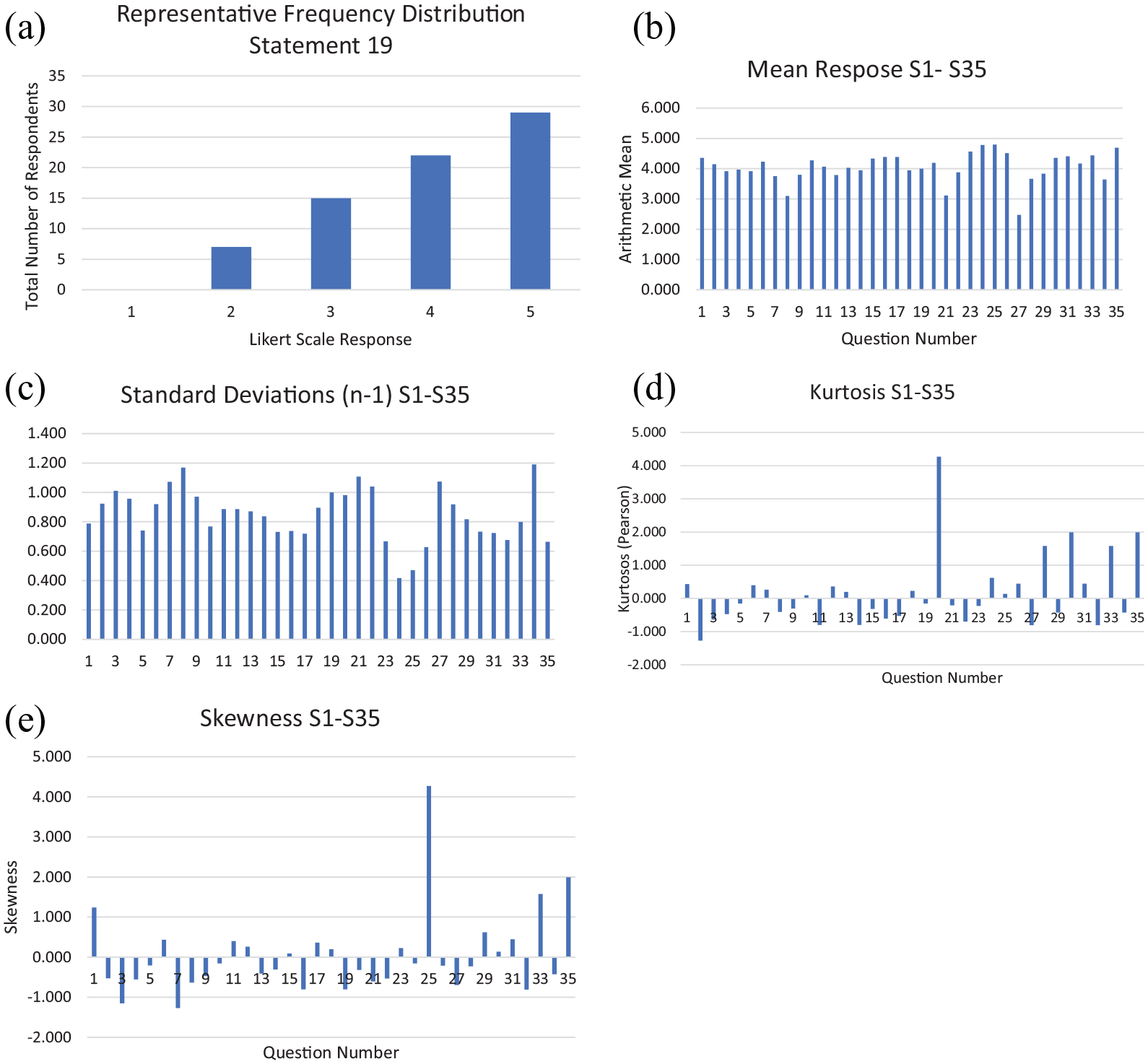
(a) Frequency distribution, representative statement 19. (b) Mean responses, statements 1 to 35. (c) Standard deviations, distributions of responses, statements 1 to 35. (d) Kurtosis, distribution of responses, statements 1 to 35. (e) Skewness, distribution of responses, statements 1 to 35.
Figure 1b and c show meta-results over the responses to the 35 statements. Statement 27, “There are too many priorities for the ensemble,” has the lowest mean value suggestive of a strong focus. Figure 1c shows standard deviations corresponding to mean values in 1a. Statements 24 and 25 refer to leader proficiency with respect to knowledge if instruments and score, respectively. The standard deviations for these cases are low relative to the entire set, while statement 24, “I would like to have a more meaningful role in the ensemble,” exhibits the highest standard deviation.
Figure 1d and e show overall values for kurtosis and skewness. The results are confirmatory of statements made previously concerning these metrics. Kurtosis is negative for 21 of the 35 statements, and similarly, skewness is negative for 21 of 35 measures indicating distributions that tail-off to the left.
A clustering exercise was undertaken, aggregating similar data points together to discover underlying groupings or clusters with respect to statements. The purpose is two-fold. First, the exercise gives insight as to the linkages between categorical statements, if any? Second, beyond the immediate scope of this research, clustering might well serve as a diagnostic for evaluating human resource-like performance issues. An example is given below pertaining to setting of objectives and providing conductor feedback.
Initially the K-means methodology was applied, based on the idea that a center point can represent a cluster. It involves the notion of a centroid; the mean or median point of a group of points. The basic K-means clustering technique is presented below and the algorithm for finding K clusters involves, (1) selecting K points as the initial centroids; (2) assigning all points to the closest centroid; (3) re-computing the centroid of each cluster; and (4) repeating steps 2 and 3 until the centroids remain unchanged.
Application of K-means failed to produce a clear result, with the function comparing with-in class variance with number of cases being flat, making selection of an optimal number of groups difficult. As an alternative, agglomerative hierarchical clustering was applied. The result of a hierarchical clustering algorithm is graphically displayed as a dendrogram, which displays the merging process and the intermediate clusters. The dendrogram for the data shows the 35 statement points merged into a single cluster (see Figure 2). The solid line at approximately 140 indicates the point at which the algorithm determined homogeneity for the two clusters.
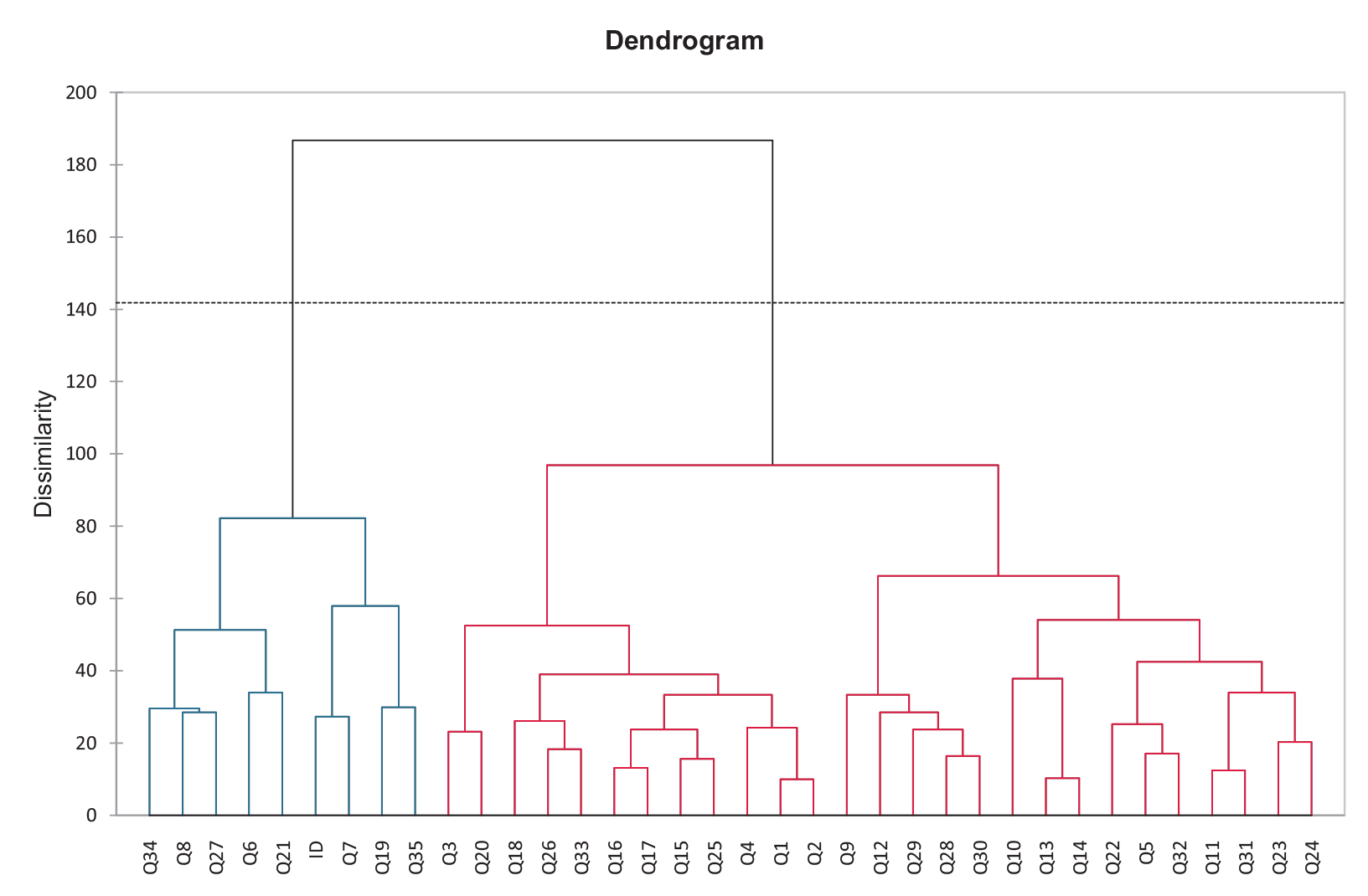
Dendrogram, agglomerative hierarchical clustering.
Interpretation of the dendrogram is based on identifying clusters that are dissimilar, that is, the bigger the distance between links, the bigger the dissimilarity between the statements. The first “level 2” grouping shown in blue indicates {34, 8, 27, 6, 21, 7, 14, 35} are separated by the greatest distance even though both statements belong to the category “The ensemble and me.” This is a reasonable finding, however, as reference is made to the respondent’s current state, that is, wanting more responsibility versus expectations for the future and playing music over the lifetime.
Concerning the groupings shown in red, it is useful to consider the “level 3” groupings. The first grouping contains statements {3, 20,18, 26, 33, 16, 17, 15, 25, 4, 1, 2}. Statements 2 and 3 are at the greatest distance from one another indicating that for the survey results overall, respondents felt the conductor stated clear objectives, but did not provide sufficient feedback. The third grouping is the largest set containing 15 of the statements. Those showing the greatest separation are statements 9 and 24 referring to within ensemble feedback and the conductor’s knowledge of the orchestral instruments.
Given the exploratory nature of this research, it is necessary to clarify that the empirical work is presented as hypothesis-generating. While intuitive relationships between the statement have been considered, such a priori hypotheses must not be confused with the more rigorous standards associated with hypothesis testing in confirmatory quantitative research. As clarification of this intention, Table 3 presents a limited number of examples of such a priori hypotheses as they were considered for this study. The table suggests that a priori the correlation (7, 8) between placing group importance over self-performance and self-performance dominating group performance is negative. Similarly, the correlation (7, 9) between putting the group above self-performance and feeling comfortable giving peer feedback is presumed positive. The correlation between putting the group above self-performance and feeling positive toward receiving peer feedback is thought to be positive. In the case of correlation (8, 9) placing self-performance over group performance and comfort in giving constructive feedback between members is considered indeterminate Pearson correlation coefficients between statements are shown in Table 4. Coefficients shown in bold are different from 0 with a significance level alpha = .05.
Example a priori hypotheses for assessing cross-statement relationships. Statements from survey instruments.

Correlation matrix, Pearson correlation coefficients, Q1–Q35*.

Values in bold are significantly different from 0 and alpha = .05.
The unexpected negative outcome of a low incidence of significant correlation coefficients with respect to statements 7 and 8 is notable. Both statements were hypothesized to indicate the relative importance of group work. In the case of Statement 7 there are no incidents of significant correlation and for Statements 8, only three correlations of significance are evident. Of these, there is a negative correlation with Statement 24, which could be spurious, as the statement pertains to leader proficiency and knowledge of instruments. Statements 27 and 34 show positive and significant coefficients with respect to Statement 8 and there may be meaningful interpretations in these cases. Specifically, Statement 27 pertains to the over-abundance of priorities and Statement 34 pertains to the individual seeking a more meaningful role in the ensemble. It seems likely an overabundance of priorities would result in lack of clarity. Further, if individuals are seeking a more meaningful role, or considered their role of limited importance, low motivation for group work is expected.
Table 4 shows a negative correlation with Statement 24, which may be spurious as the statement pertains to leader proficiency and knowledge of instruments. Statements 27 and 34 show positive and significant coefficients with Statement 8. Possibilities for the absence of significant correlation coefficients in the group work category are (1) group work does not have a meaningful role to play in the context of this study; (2) the “spirit of team cohesion” is captured in other categories and statements such as collaboration; or (3) respondents were unfamiliar with group work although the concept was clearly stated in the text accompanying the questionnaire. Statements 9 and 10, relating to perceptions of group success versus individual success, achieved a mode of 3 indicating “unsure.” This comparatively low result suggests that the success of the group was considered less critical.
Statements 1 and 2 pertaining to conductor objectives, correlate over a broad range of categories. The important exceptions are, ability, group work, collaboration, and the ensemble and me. Statements were posed in such a way that a response of “strongly agree” tends to favor a null hypothesis that the respondent was disinclined toward group work, or alternatively, rejection of the null hypothesis suggesting a favorable inclination toward collaboration. A cross-tabulation of Statement 7, “Success of the group is more important than my personal performance” and all other statements provide a value of “strongly agree” indicating a strong agreement with both statements (see Figure 3).
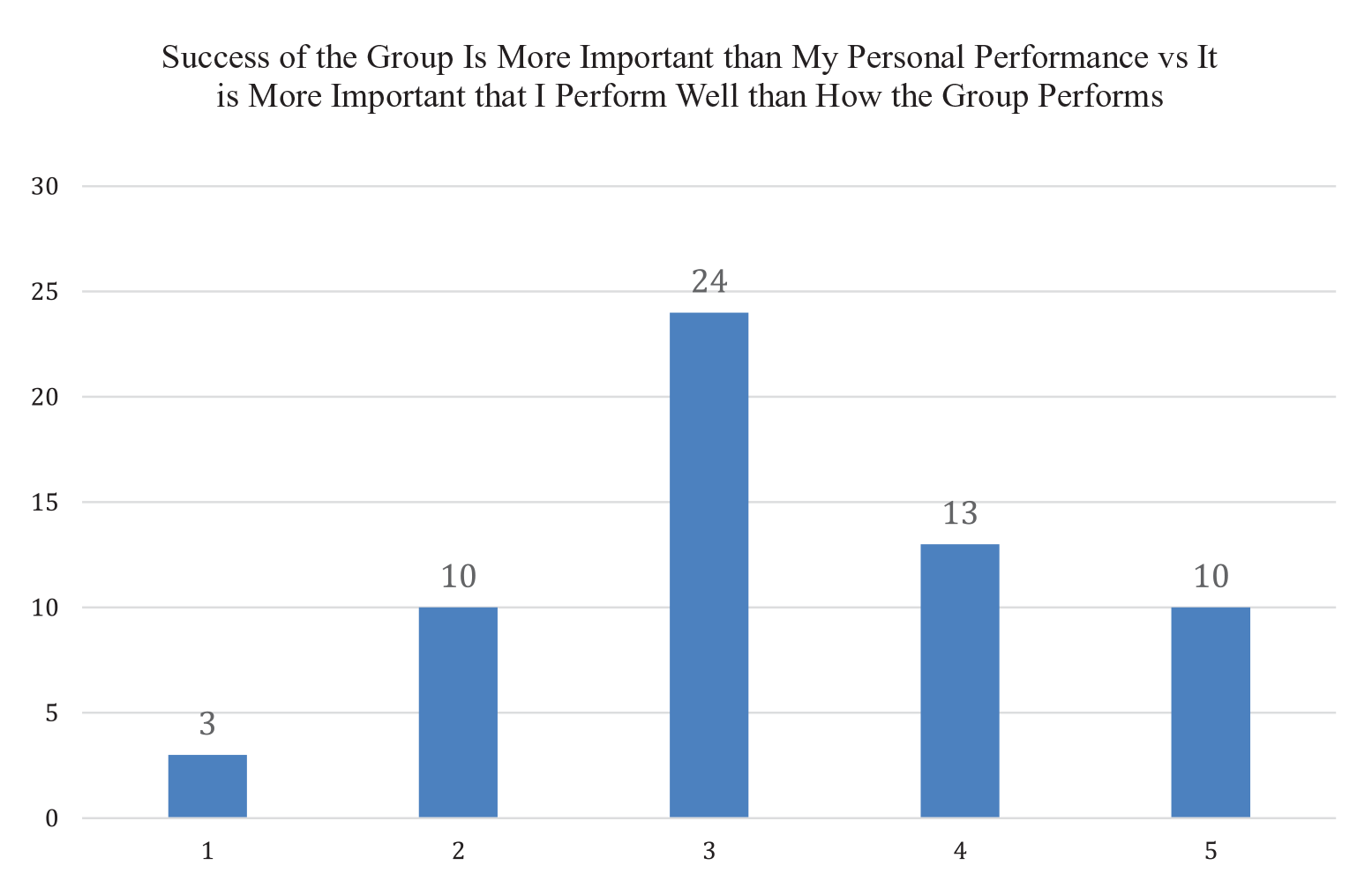
The success of the group is more important than my personal performance.
The distribution of responses suggests that respondents are divergent. Thirteen respondents tended to disagree and 23 respondents tended to agree, while 24 respondents were unsure. Concern for the group performance over self is not evident, suggesting ambivalence, which is consistent with the literature (Binning & Lord, 1980; Nadler, 1979; Zander, 1977).
Discussion
The research question asked, what leadership factors determine a successful music ensemble ecology? The results of this study indicate that although being in a musical ensemble was a gratifying experience, individuals were less interested in the experience of the group, than their own in accord with Clark (2003) and Sutherland (2017). The responses to all statements were almost uniformly high. The descriptive statistics indicate a very favorable assessment of many of the statements, suggesting the presence of upward inertia. This inertia might be explained by the self-selection within the convenience sample, that is, only satisfied persons participated in the questionnaire or there may be some cases in which “moral hazard” became a factor despite guarantees of confidentiality.
The exploratory nature of this study limits transferability of the data. The statements in the survey are not exhaustive and the correlation coefficients are reported on the basis of ceteris paribus, hence, other factors and sources of both sampling and non-sampling error should be considered in future research. The data from this study therefore acts as a provocation for musical leaders.
Significant correlations between certain categories of statements appeared. The correlation between statements regarding conductor feedback and peer feedback are positive, suggesting that individual musicians highly value recognition of their input. Conversely, the negative correlation for statements concerning group work suggest that this was not greatly important for the respondents. Another strong correlation links themes concerning the conductor’s knowledge of instrument function and individual performance being more important than that of the group. Surprisingly, a negative correlation occurred between the conductor’s understanding of the musical instruments with individual performance being valued above group performance. This suggests a lack of emphasis placed on group cohesion and a less unified ecology, imply association rather than causality. Participants may be familiar with leadership styles not focused on group cohesion as discussed by Atik (1994) and Castañer (1997).
Within larger music ensembles, motivation for inherent teamwork may not be a driving force behind individual behaviors. Psychologists document that people are not always predisposed to collaborating effectively, with individual interests sabotaging team spirit (Clark, 2003). Individual competitive instincts can manifest within the group, furthering self-interests. Additionally, creative people are often ambitious and competitive; qualities that can drive success. Traditional master/apprentice structures existing in many musical organizations operate under strict hierarchical constructs, in which participants are unfamiliar with reciprocal communication possibilities.
Ensemble directors operating in a traditional master/apprentice paradigm, and who overlook the leadership contribution students can make to a healthy ensemble ecology, limit the potential of the ensemble as both a performance entity, and an educational platform, (Shamir, 1990). Our data reveals that ensemble members are motivated largely by individual self-interest and this can either be ignored, or harnessed by way of adopting a more democratized leadership style. In addition to benefiting cohesion, this enables student musicians to develop leadership skills which could ultimately be preparation for conductorship (Keller et al., 2016).
This study supports the growing body of research on the nature of musical ensemble ecology by confirming that leadership styles effect teamwork and group identity. Leadership involves creating an environment wherein individuals enjoy personal freedom to present their opinions and are encouraged to think creatively. Furthermore, opportunity for individuals to contribute to the ensemble’s direction can build a stronger sense of team, and members should be challenged to surpass the common wisdom to contribute innovative practice (Boerner & Freiherr von Streit, 2005). With a strengthened sense of belonging and contribution to the direction of an ensemble, musicians are more likely to retain greater interest in life-long participation. This poses an important consideration for ensemble directors who consider unilateral control of artistic merit as more important than the life-long learning of their constituent members.
Footnotes
Acknowledgements
The authors gratefully acknowledge the support of Professor Donald Schleicher, Daniel J. Perrino Chair in Music and Director, Symphony Orchestra and Conducting, University of Illinois, Urbana-Champaign; Professor Neal Stulberg, Conductor and Director, Orchestral Studies and Dr. Dean Anderson, Lecturer, Interim Director, UCLA Philharmonia and Symphony, UCLA, Herb Alpert School of Music. Furthermore, recognition is owed to Dr. Neta Spiro, Research Fellow in Performance Science at the Royal College of Music and honorary Research Fellow at Imperial College London for her guidance in the design and approval of the survey.
Funding
The author(s) received no financial support for the research, authorship, and/or publication of this article.
