




Abstract
The purpose of the study was to investigate how university band students’ (non–music majors) motivational goal orientations toward band and academics differ across participants from Singapore (n = 200) and the United States (n = 227) and examine how they relate to a suite of adaptive dispositions (i.e., flow, grit, and commitment) relevant for 21st-century learning. Data were gathered via a self-report questionnaire that measured achievement goal orientations toward academic major, individual and collective goal orientations toward band, flow during rehearsals, grit while practicing, and commitment to band. An unexpected lack of cross-cultural differences was found, with participants from both cultural groups reporting higher levels of motivation toward their major academic field compared to band, indicating that achievement domain rather than culture accounted for differences in motivational goal orientations. Results also suggest that the optimal motivational profile to cultivate in large ensemble is a combination of individual mastery-approach and collective performance-approach goals.
Across cultural borders, age groups, and achievement domains, motivation is an important area of concern for teachers and students (e.g., Murayama, Zhou, & Nesbit, 2009; Van Yperen, Blaga, & Postmes, 2014). In a literature review of research on motivation in music education, Asmus (1994) noted that as much as 20% of the variance in student achievement can be accounted for by motivation. Unlike some factors that may explain the other 80%, such as aptitude and socioeconomic background, teachers are able to affect motivation (Asmus, 1994; Deci & Ryan, 1985). Theorizing on and researching motivation are therefore meaningful pursuits that can enhance our understanding of best practices for music teaching and learning.
One prominent motivational framework that has warranted much research attention is achievement goal theory: a social-cognitive perspective whereby motivation is explained in terms of task (mastery) and ego (performance) orientations (Dweck & Leggett, 1988; Nicholls, 1984). While task orientation aims to engage in problem solving for its own sake or to gain a better understanding of the task, ego orientation focuses on the evaluation of one’s ability against the performances of others (Dweck, 1999; Nicholls, 1984, 1989). Accordingly, learners who are task oriented are motivated by the activity in and of itself; they are less threatened by the fear of failure and often report higher levels of intrinsic motivation (Dweck & Leggett, 1988; Nicholls, 1984). Learners who are ego oriented, on the other hand, tend to be motivated by the praise that task completion may attract so as to bolster their ego; consequently, they may fear failure and become discouraged when confronted with challenges (Diener & Dweck, 1980; Dweck, 1975; Dweck & Reppucci, 1973).
Researchers initially proposed a trichotomous achievement goal framework that specifies approach and avoidance dimensions for the performance goal construct (Elliot, 1997; Elliot & Harackiewicz, 1996). Later, the approach-avoidance dimensions were added to both the traditional mastery and performance distinction, resulting in a 2 × 2 model of achievement goals, namely, mastery-approach, mastery-avoidance, performance-approach, and performance-avoidance (Elliot & McGregor, 2001). Mastery-approach goals (e.g., “I want to learn as much as possible from this class”) focus on achieving intrapersonal competence through task mastery, self-improvement, and skill development. On the other hand, mastery-avoidance goals (“I am often concerned that I may not learn all that there is to learn in this class”) focus on avoiding not learning or completing the task. Performance-approach goals (“It is important for me to do better than other students”) focus on outperforming others, winning, or showing others that one is best. By contrast, performance-avoidance goals (“My goal in this class is to avoid performing poorly”) focus on avoiding losing or performing worse than others. These four goals are not mutually exclusive. Learners can simultaneously have high or low levels of mastery and performance goals (e.g., Wang et al., 2008), and theorists generally agree that each learner will vary along each of these four dimensions (e.g., Pintrich & Garcia, 1991).
Research has found that the four achievement goals are associated with different educational outcomes and affective states. While mastery-approach and performance-approach orientations typically predict positive outcomes, affects, and adaptive behavioral and cognitive patterns, mastery-avoidance and performance-avoidance goals are associated with maladaptive learning patterns (Ames & Archer, 1988; Elliot & McGregor, 2001; McGregor & Elliot, 2002; Moeller & Elliot, 2006). In particular, several meta-analyses have reported positive relationships between achievement outcomes and both mastery-approach (r = .10 to .17) and performance-approach goals (r = .10 to .13) (Baranik, Stanley, Bynum, & Lance, 2010; Rawsthorne & Elliot, 1999; Van Yperen et al., 2014). These goals have also been identified as “productive 21st century learning dispositions,” adaptive motivational orientations that facilitate deep learning important for the 21st century (J. P. L. Tan & Nie, 2015, p. 19). In contrast, the same meta-analyses have found that performance-avoidance (r = –.18 to –.13) and mastery-avoidance (r = –.09 to –.07) goals are negatively related to achievement outcomes. In addition, results of experiments comparing the effect of mastery conditions to performance-avoidance conditions have shown significantly deleterious effects of the performance-avoidance conditions (d = –.46 to –.29) (Baranik et al., 2010; Rawsthorne & Elliot, 1999; Van Yperen et al., 2014).
Music Research in Achievement Goal Theory
Relative to achievement goal research in academic and sports settings (Duda & Nicholls, 1992; Van Yperen et al., 2014), there are few studies on achievement goal motivation in music education. However, some broad trends can be gathered from this limited body of work. Significant associations have been found between goal orientations and practice behavior. In particular, instrumental students with higher self-report levels of mastery orientations are more likely to engage in strategic practice behaviors than those who report higher performance orientations (Miksza, 2009b, 2011; Nielsen, 2008; Smith, 2005). Studies that have examined links between achievement goals and music performance achievement, though, yielded mixed results. While Miksza (2009b) and Schmidt (2005) found positive associations between mastery goal orientations and performance achievement among secondary instrumental students, other studies have not revealed such a link among collegiate instrumental students (Miksza, 2011; Nielsen, 2008).
Miksza (2009a) examined the validity of the 2 × 2 achievement goal model using self-report data from secondary instrumental students. In line with research conducted in academic and sports settings (Elliot & McGregor, 2001; Elliot & Murayama, 2008; Wang, Biddle, & Elliot, 2007), confirmatory factor analyses indicated that when compared with competing dichotomous and trichotomous models, the 2 × 2 achievement goal model was the best relative fit to the data, a finding replicated in a follow-up study (Miksza, Tan, & Dye, 2016). In both studies, fair amounts of covariance were detected between the approach and avoidance dimensions of both mastery and performance constructs. This recalls other studies in music education where strong correlations were found between approach and avoidance subscales (Lacaille, Koestner, & Gaudreau, 2007; Lacaille, Whipple, & Koestner, 2005; Smith, 2005), suggesting that the discriminant validity of the 2 × 2 model is less clear in the music domain.
Matthews and Kitsantas (2007) investigated if secondary instrumental students’ perceptions of motivational climate (i.e., mastery or performance), collective efficacy, and group cohesion would predict their perceptions of support by their conductor. Findings indicated that students who reported being taught in mastery-oriented environments were more likely to consider their directors as being supportive than those who were taught in performance-oriented environments. Significant, moderately positive correlations were also found between task-oriented motivational climate and collective efficacy, task cohesion, and social cohesion. The authors suggested that conductors should work toward cultivating task-oriented rehearsal climates in their ensembles. In a more recent study with collegiate instrumental students, Matthews and Kitsantas (2013) found that students who were assigned randomly to mastery goal-oriented rehearsal conditions had higher self-reported levels of collective efficacy and self-efficacy than those who were assigned to performance-oriented conditions. Consistent with findings in classroom settings (e.g., Ames & Archer, 1988), students who were taught under the task-oriented condition were more positive about their ability to work together and reported a better understanding of their director’s expectations than those who rehearsed under the performance-oriented condition.
Lacaille et al. (2005) tasked high-level musicians and athletes to recall their motivational goals prior to “catastrophic” and “peak” performing events. While findings from the athletes were consistent with those from the educational domain in that a combination of mastery- and performance-approach goals were linked with optimal functioning (McGregor & Elliot, 2002), results from the musicians indicated that performance goals were detrimental. The authors hypothesized that as music performance is inherently anxiety-provoking, performance goals may further contribute to the stress, thereby rendering them maladaptive. They also found that focusing on intrinsic goals, such as enjoying the act of music performance, was especially helpful for musicians. In a later study with musicians, dancers, and actors, Lacaille et al. (2007) again found that performance goals may harm performers. In particular, positive associations were found between performance-approach orientations and performance anxiety and between performance-avoidance orientations and intentions to quit. It appears that achievement goals may vary according to achievement domains. However, given that there is a lack of research examining such moderation effects (Hulleman, Durik, Schweigert, & Harackiewicz, 2008; Van Yperen et al., 2014), there is a clear need for further research to investigate how achievement goals differ across subject areas.
Flow, Grit, and Commitment
As noted previously, Lacaille et al. (2005) described the potentially harmful effects of performance goals on musicians and recommended a focus, instead, on intrinsic goals such as enjoying the act of music performance. One influential psychological theory on intrinsic enjoyment that has emerged in recent years is flow: a state of intense involvement where individuals are deeply engaged in what they do (Csikszentmihalyi, 1990). People who are “in the flow” lose their sense of self-consciousness, have clear goals, and undertake the activity for its own sake (Csikszentmihalyi, 1990). Although flow experiences can be traced back more than 2,000 years ago across cultures (Csikszentmihalyi, 1990; L. Tan, 2016b), it remains relevant today as a form of “learning with the intensity cranked up” (Lemke, 2011, p. 246) that can lead to adaptive behaviors and unleash creativity (Partnership for 21st Century Skills, 2009; Trilling & Fadel, 2009). Flow therefore appears to be an important disposition underlying 21st-century skills. Research has found that flow may be experienced across age groups and musical settings, including participation in chamber music (Sutton, 2004), marching band (Steckel, 2001), and while practicing (Miksza & Tan, 2015). While significant positive correlations have been found between flow and mastery orientations among American high school instrumental students, no significant correlations were found between performance orientations and flow (Miksza et al., 2016).
Another disposition important for instrumental students is grit: “perseverance and passion for long-term goals” (Duckworth, Peterson, Matthews, & Kelly, 2007, p. 1087). “Gritty” individuals not only complete tasks in the short term but also persist in the face of challenges. Research has found grit to be associated with a range of positive outcomes, including retention in the United States Military Academy and performance at the National Spelling Bee (Duckworth et al., 2007; Duckworth, Kirby, Tsukayama, Berstein, & Ericsson, 2011). Given the adaptive learning patterns with which it is associated, grit has been identified as an important 21st-century skill (Soland, Hamilton, & Stecher, 2013). In the first known study on grit in music education, grit has been found to predict flow, practice efficiency, and self-efficacy for self-regulation among collegiate instrumental students (Miksza & Tan, 2015). This was noteworthy given that students’ practice tendencies, their tendencies toward self-evaluation, and their teachers’ methods of instruction in practicing were not predictive of any of the outcome variables. In a later study, Miksza and colleagues (2016) again found grit to be positively associated with flow; they also found positive associations between grit and mastery-approach orientation among American high school instrumental students.
Commitment to music instruction is one other construct that has been found to relate to musicians’ motivational orientations (Asmus & Harrison, 1990; Schmidt, 2005). American high school instrumental students’ self-reports of commitment have been found to correlate positively with their reports of mastery goals, while no associations were detected for performance goal orientations (Schmidt, 2005). Additionally, Schmidt (2005) found links between commitment and mastery; intrinsic, cooperative, and individual orientations; as well as self-concept. Given its association with adaptive learning behaviors and cognition, commitment to learning is a key disposition relevant to 21st-century learning (Partnership for 21st Century Skills, 2009). More recently, Miksza et al. (2016) found significant positive relationships between mastery-approach and commitment to band among American and Singaporean instrumental students. They also found higher levels of commitment to band among Singaporean students compared to their American counterparts. Further research is needed to determine the precise nature of how commitment may differ in instrumental settings across cultures.
Cross-Cultural Research on Achievement Goal Theory
A number of studies have investigated the use of the 2 × 2 achievement goal framework in non-Western sports and academic contexts (e.g., Sun & Hernandez, 2012; Xiang, Lee, & Shen, 2001). In particular, researchers have sought to determine how achievement goals differ between individualistic Western societies and their collectivistic Asian counterparts (Murayama et al., 2009; Urdan, 2004). While individualistic cultures tend toward construing the self as independent and autonomous, collectivistic cultures view humans as interdependent social beings who acquire meaning through roles and relationships with the family and other social in-groups (Kim, Triandis, Kagitcibasi, Choi, & Yoon, 1994; Markus & Kitayama, 1991; L. Tan, 2016a). The salient achievement question in these cultures is not so much “Am I competent?” as much as “Am I a good member of the family?” (Maehr & Nicholls, 1980, p. 251).
Research has indicated that achievement goals may indeed work differently in collectivistic cultures. While mastery goals are more salient in individualist societies, performance goals are more prominent in collectivistic cultures (e.g., Dekker & Fischer, 2008; King & McInerney, 2014; Kok, 2014; Xiang et al., 2001). This may be because in individualistic cultures, achievement is largely a personal matter as individuals strive to achieve in domains that are personally meaningful to them. By contrast, achievement is often socially embedded in collectivistic cultures. Due to social expectations, individuals are compelled to demonstrate to others that they are indeed achieving, thereby rendering performance goals more prominent (Dekker & Fischer, 2008; King & McInerney, 2014). Furthermore, since Asian students tend to be competitive in schools so as to bring honor to the family (Tao & Hong, 2014), the pursuit of performance goals in Asian cultures may potentially be adaptive (King & McInerney, 2014; Tanaka, Okuno, & Yamauchi, 2002) or at least not maladaptive (Tanaka & Yamauchi, 2001).
A fairly extensive body of research has found that while avoidance goals are generally associated with negative characteristics and outcomes in Western cultures (e.g., Elliot, 1997, 2005), they are less maladaptive in collectivistic cultures (Elliot, Chirkov, Kim, & Sheldon, 2001; King & McInerney, 2014; Murayama et al., 2009). In fact, King (2016) found that among Filipino secondary students with high levels of collectivism, performance-avoidance goals correlated with intrinsic motivation and greater use of adaptive learning strategies. Wang et al. (2007) proposed that in contrast to learners from individualistic cultures like the United States, learners from collectivistic societies like Singapore may benefit from a combination of both approach and avoidance goals. Liu, Wang, Tan, Ee, and Koh (2009) explained that this is because collectivistic people tend to value avoidance so as to avoid group discord. Compared to Western learners, higher correlations between performance-approach and performance-avoidance have also been found among Asians, suggesting that learners from collectivistic cultures tend not to draw sharp distinctions between approach and avoidance goals (e.g., Murayama et al., 2009; Tanaka et al., 2002).
Despite differences in how achievement goals operate across cultures, several studies have validated the 2 × 2 model in non-Western cultural settings (Liu et al., 2009; Murayama et al., 2009; Poondej & Lerdpornkulrat, 2016; Sun & Hernandez, 2012; Wang et al., 2007, 2008), suggesting that the underlying four-factor structure of achievement goals may be universal. In the only known cross-cultural study on achievement goals in the context of instrumental music, Miksza and colleagues (2016) found that the 2 × 2 achievement goal model offered the best relative fit to their data compared with alternative dichotomous and trichotomous models. Participants in their study were high school instrumental students from the United States and their Singaporean polytechnic counterparts who self-reported their motivational goal orientations, flow during band rehearsals, grit in practicing, and commitment to band. In contrast to differences between achievement goal orientations across individualist and collectivistic cultures noted earlier, no differences in achievement goal scale means were reported. Furthermore, for both groups, mastery-approach was the most highly endorsed goal orientation, followed by performance-avoidance. Taken together, findings suggest that the motivational orientations of both cultural groups were more similar than different.
In hypothesizing reasons for the unexpected lack of cross-cultural differences, the authors noted that the nature of learning in large ensembles is different than that in academic and sports settings. Band students learn in groups and are often encouraged to work together so as to achieve unified interpretations. The achievement goal framework, on the other hand, was generated in the academic domain and measures individual (e.g., “It is important for me to do better than other students”) rather than collective goal orientations (e.g., “It is important for our band to do better than other bands”). Accordingly, it would be valuable to pursue a replication and extension of the study that compares participants’ individual and collective motivational orientations toward band. Given that performing in large ensembles is inherently a collectivistic endeavor where individuals conform to the group (Reimer, 2003), it is reasonable to expect that instrumental students in Singapore may report higher levels of collective motivational orientations in comparison to their individual motivational orientations and the motivational orientations of their American counterparts. Furthermore, since there is a paucity of research that compares across achievement domains (Hulleman et al., 2008; Van Yperen et al., 2014), it would be insightful as well to compare participants’ motivational orientations toward band and academics to determine if domain moderates the relationship between culture and achievement motivation. Given Asians’ tendency to be competitive in schools (Tao & Hong, 2014), we might expect higher motivational (especially performance) orientations among participants from Singapore compared to those from the United States.
Purpose
The purpose of the study was to investigate how university band students’ (non–music majors) motivational goal orientations toward band and academics differ across two cultures and examine how they relate to a suite of adaptive dispositions (i.e., flow, grit, and commitment) relevant for 21st-century learning. This study is an extension of the work done by Miksza et al. (2016). The specific research questions were (1) What types of motivational goal orientations do university band students tend to possess? (2) How do their individual motivational goal orientations toward participating in their university band differ from their collective motivational goal orientations toward band and their individual goal orientations toward their academic studies (university major field of study)? (3) How do motivation orientations of university band students differ in the two cultures? and (4) Do relationships between motivation orientations and students’ reports of flow in the act of practicing music, grit with regard to perseverance toward music study, and commitment to band as a field of study vary as a function of culture?
Method
Participants
Participants in this study (N = 427) were volunteer instrumental music students from three Singaporean universities (n = 200) and five American universities (n = 227). The three universities in Singapore were publicly funded institutions that are located in different parts of the city-state. The five American universities were large, publicly funded institutions from the Midwest and Western regions of the United States. All participants were non–music majors participating in concert bands, most of which did not require an audition for participation. The Singaporean sample consisted of 46.5% males and 53.5% females, while the American sample included 41% males and 59% females. A significantly greater proportion of U.S. participants had taken private lessons, 54% compared to 24% of Singapore participants, χ2(1) = 35.57, p < .001. A significantly greater proportion of U.S. participants (81%) also reported taking the band course for credit, χ2(1) = 128.45, p < .001, when compared to the Singapore participants (26%). There were also significant differences by age. The mean age of Singapore participants was 21.66 years (SD = 2.23), whereas the mean age of U.S. participants was 19.39 years (SD = 1.88). Singapore students were approximately 2.25 years older on average, t(391.22) = 11.24, p < .001. Students from both countries practiced, on average, two to three days per week (M = 2.47 for Singapore and M = 2.49 for United States). However, while the participants from Singapore practiced, on average, 1.13 sessions a day for 104.09 minutes per session (SD = 69.35), the participants from the United States practiced 0.88 sessions a day for 50.51 minutes per session (SD = 37.42).
Measures
Data were collected from the participants through a 67-item self-report questionnaire. In Singapore, one of the authors visited each of the university bands and administered the questionnaire at the end of the band rehearsals. Students who volunteered to participate in the study were requested to complete the questionnaires on-site, and the completed questionnaires were subsequently collected by the author. In the United States, the other author either supplied ensemble directors with paper copies of the questionnaire, who then distributed them in rehearsals, or sent links for an online questionnaire to the ensemble directors to be distributed to their band members. The questionnaire consisted of banks of items that measured each of the constructs included in the research questions, as well as participants’ demographic characteristics. The same English-language questionnaire was presented to each group of participants given that students in Singapore customarily speak English. This study was approved by the authors’ university institutional review boards.
Individual achievement goal orientation toward participation in non–music major band was measured using the Revised Achievement Goal Questionnaire (R-AGQ) (Elliot & Murayama, 2008). Participants were instructed to respond to this measure according to their motivational beliefs about their band experience. They responded to 12 statements (e.g., “I am striving to understand the content of this course as thoroughly as possible”) using a 5-point Likert scale that ranged from strongly agree to strongly disagree. Each orientation of the 2 × 2 achievement goal model was captured with three statements. Internal consistency of the items related to each of the four orientations was good (α = .73–.86).
Collective achievement goal orientation toward participation in non–music major band was measured using the same R-AGQ. However, the 12 statements were modified to capture collective rather than individual motivational goal orientations. For example, the statement “My goal is to perform better than the other students” was modified to “My goal is for our band to perform better than other bands.” Similarly, the statement “My goal is to learn as much as possible” was changed to “My goal for my band is for us to learn as much as possible.” The internal consistency of the measures was good (α = .79–.89).
Individual achievement goal orientation toward the participants’ major academic field of study was also measured using the R-AGQ. The wordings were the same as those used to measure individual achievement goal orientation toward participation in non–music major band, and participants were asked to respond to this measure according to their motivational beliefs about their university major field of study (“I am striving to understand the content of my major field courses as thoroughly as possible”). The internal consistency of the measures was good (α = .81–.89).
Experiences of flow during university band rehearsals were measured using the Short Dispositional Flow Scale (Jackson, Martin, & Eklund, 2010), which has been found to have acceptable construct validity and reliability. This nine-item scale corresponded to Csikszentmihalyi’s (1990) nine dimensions of flow: clear goals, concentration on task at hand, challenge-skill balance, action-awareness merging, sense of control, unambiguous feedback, loss of self-consciousness, autotelic experience, and transformation of time. The band members were asked to respond to each dimension with specific reference to their participation in university band rehearsals by circling either always, frequently, sometimes, rarely, or never. The internal consistency of the measures was good (α = .80 for total sample).
Participants’ tendency to exhibit grit while practicing their primary band instrument was measured with an eight-item scale that was adapted from the Short Grit Scale (Duckworth & Quinn, 2009). This scale was found to be internally consistent when used with collegiate instrumental majors (Miksza & Tan, 2015). The participants were tasked to respond to statements such as “I am a hard worker when it comes to practicing on my instrument” using a 5-point scale that ranged from very much like me to not at all like me. The internal consistency of the measure of grit was acceptable (α = .67 for total sample).
Participants’ commitment to band was measured using a six-item scale (Schmidt, 2005) adapted from Asmus and Harrison (1990). The volunteers were asked to respond to statements such as “I want to be involved in band activities more than other activities” using a 5-point Likert scale that ranged from strongly agree to strongly disagree. Internal consistency of the measure was good (α = .88 for total sample).
Results
What Types of Motivational Goal Orientations Do University Band Students Tend to Possess?
Descriptive analyses of the motivation subscales indicated that mastery-approach and performance-avoidance tended to be the most strongly endorsed motivation orientations for both cultural groups regardless of scale perspective (i.e., individual band, collective band, and academic major; Table 1). The U.S. participants’ motivation reports resulted in higher means and somewhat more skewed distributions than the Singapore participants’ reports, although the variability of scores within each subscale was similar between groups, with standard deviations ranging from .50 to .85. Given that there were no means below 3.70 and that the subscales yielded scores on a possible range of 1 to 5, it appears that both groups reported being highly motivated to achieve in general.
Descriptive Statistics for All Psychological Variables.

Note: Map = mastery-approach; MAV = mastery-avoidance; Pap = performance-approach; Pav = performance-avoidance; i = individual band; c = collective band; a = academic major; Com = commitment to band; Sk = skewness.
Regardless of scale perspective, stronger Pearson correlations between performance-approach and performance-avoidance were found among participants from Singapore compared to those from the United States (individual band: Singapore = .63, United States = .44; collective band: Singapore = .77, United States = .71; academic: Singapore = .77, United States = .75; see Table S1 in the online version of the article). However, only the difference between the performance-approach and performance-avoidance correlations from the individual band perspective was significant (z = 2.76, p < .01). Though all pairs were nonsignificant, a reverse of this trend was found between mastery-approach and mastery-avoidance, with higher correlations reported by the participants from United States compared to those from Singapore across all scale perspectives (individual band: United States = .39, Singapore = .28; collective band: United States = .57, Singapore = .44; academic: United States = .46, Singapore = .39).
How Do Participants’ Individual Motivational Goal Orientations Toward Participating in Their University Band Differ From Their Collective Motivational Goal Orientations Toward Band and Their Individual Goal Orientations Toward Their Academic Studies (University Major Field of Study)?
We conducted a repeated measures MANOVA to determine whether motivation ratings for each of the four achievement orientations (i.e., mastery-approach, mastery-avoidance, performance-approach, performance-avoidance) varied as a function of scale perspective (i.e., individual band, collective band, academic major). Assumptions for these statistical analyses as well as all others conducted in this study were examined and met. A strong multivariate effect was found, Pillai’s Trace = .37, F(8, 415) = 31.30, p < .001, h2 = .37. Univariate ANOVAs for each motivation orientation were also significant (p < .001), indicating a moderate effect for performance-avoidance ratings (h2 = .06) and strong effects for the others (h2 = .13–.16). Follow-up contrasts for the univariate effects revealed that ratings from the major academic field perspective for all motivation orientations were significantly stronger than either of the band perspectives (p < .001). The only difference detected between band scale perspectives was found for performance-approach, indicating that the ratings for performance-approach orientation from the collective band scale perspective were stronger than those from the individual band scale perspective (p < .001).
How Do Motivation Orientations of University Band Students Differ in the Two Cultures?
Three MANCOVA analyses were performed with culture as the independent variable and the four motivation orientation variables associated with each respective scale perspective serving as the dependent variables in each. Participants’ age, whether they had taken private lessons, and whether they had enrolled in the ensemble for course credit were also included as covariates in each analysis to adjust for differences between the groups. The MANCOVA for the motivation orientation subscales from the individual band perspective did not yield significant differences by culture. The MANCOVA for the motivation orientation subscales from the collective band perspective did yield a significant multivariate main effect of culture, Pillai’s Trace = .04, F(4, 406) = 4.59, p < .001, h2 = .04. Follow-up, univariate ANCOVAs revealed significant differences for each of the four motivation orientations: mastery-approach, F(1, 409), 12.22, p = .001, h2 = .02; mastery-avoidance, F(1, 409), 5.87, .01, h2 = .01; performance-approach, F(1, 409), 12.38, p < .001, h2 = .02; and performance-avoidance, F(1, 409), 12.06, p = .001, h2 = .02. The U.S. participants had higher mean ratings than the Singapore participants on each motivation orientation disposition from the collective band perspective. However, the effect sizes for the differences were very small. The MANCOVA for the motivation orientation subscales from the academic major perspective also yielded a significant multivariate effect by culture, Pillai’s Trace = .03, F(4, 403) = 3.34, p = .01, h2 = .03. Follow-up, univariate ANOVAs revealed a significant difference only for the mastery-approach orientation, F(1, 422), 12.64, p < .001, h2 = .03, such that U.S. participants again had a higher mean rating. Again, the effect size for this difference was relatively small.
We also sought to examine whether differences in motivation by culture would depend on whether participants were reporting dispositions from an individualistic band, collectivist band, or academic perspective. As such, we used a 2 × 3 mixed-design MANCOVA to determine whether participants’ mastery-approach, mastery-avoidance, performance-approach, and/or performance-avoidance orientation ratings varied as a function of the interaction of culture (i.e., Singapore vs. United States) and scale perspective (i.e., individual band, collective band, academic major). We included private lessons, whether the students were taking the course for credit, and age in the model as covariates. The main effect of culture, Pillai’s Trace = .03, F(4, 402) = 3.29, p = .01, h2 = .03, and the interaction of culture and scale perspective were each found to be significant, Pillai’s Trace = .06, F(8, 398) = 3.33, p = .001, h2 = .06. The follow-up univariate ANCOVAs for the interaction effect indicated that differences in mastery-approach, F(2, 810) = 7.26, p < .01, h2 = .01, and mastery-avoidance, F(2, 810) = 4.06, p < .01, h2 = .01, ratings between culture varied as a function of scale perspective. These significant interaction effects are plotted in Figure 1. It is evident that while both groups had similar ratings for mastery-approach and mastery-avoidance from the individual band perspective, the U.S. participants rated each orientation from the collective band perspective and academic major perspective more strongly than the Singapore participants. However, once again, each of these effects were very small in magnitude.
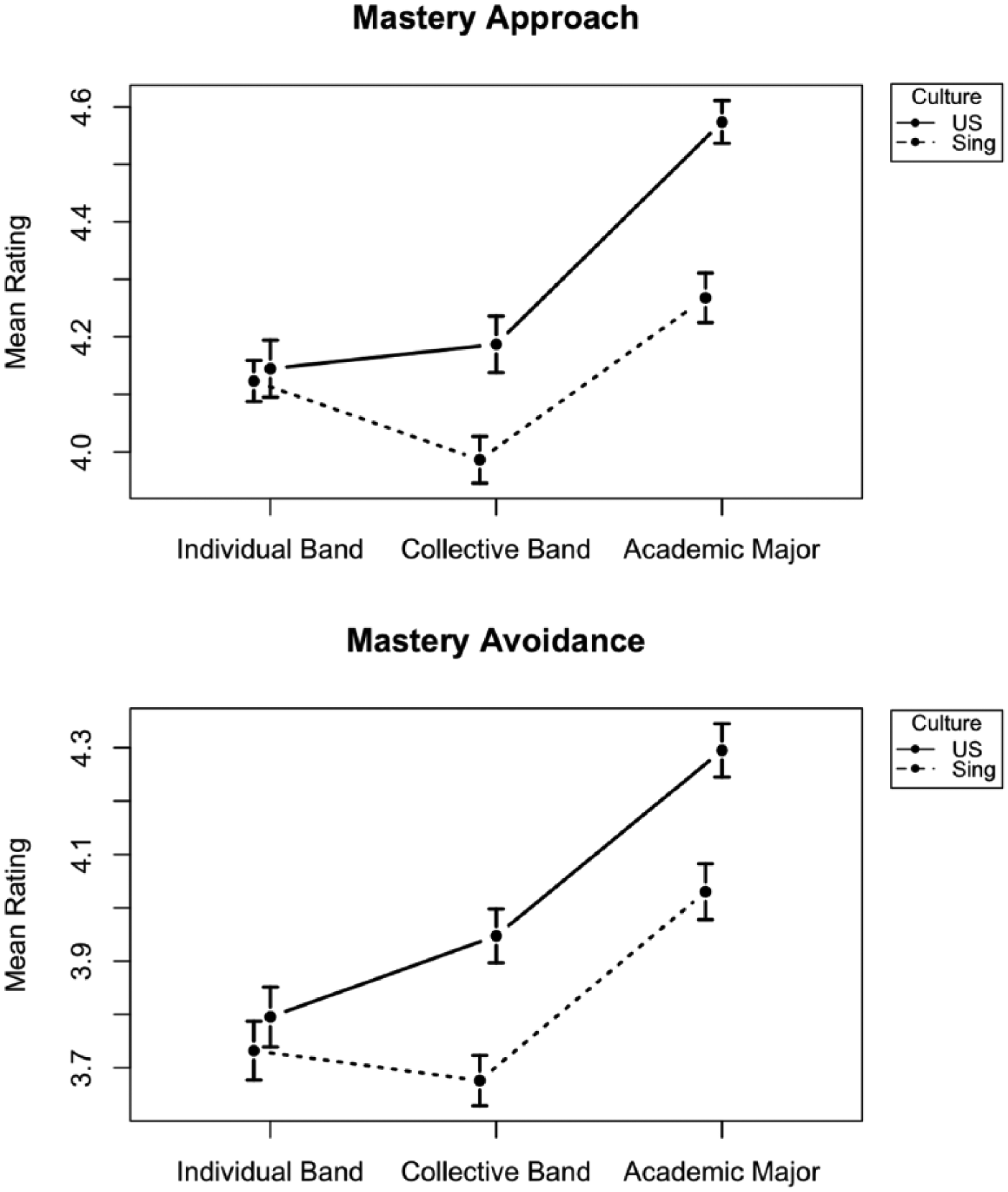
Significant interactions between culture and motivation scale perspective for mastery-approach and mastery-avoidance orientations (range of possible ratings = 1–5). Error bars are indicative of standard error.
Do Relationships Between Motivation Orientations and Students’ Reports of Flow in the Act of Practicing Music, Grit in Regard to Perseverance Toward Music Study, and Commitment to Band as a Field of Study Vary as a Function of Culture?
An additional purpose of this research was to investigate whether the relationships between the motivation orientations from either band perspective (i.e., individual and collective) and flow, grit, and commitment to band varied as a function of culture. Pearson correlations among all of the psychological scales are presented in Table S1 (available in the online version of the article). Small to moderate correlations were detected between flow and grit in both countries (r = .51 for Singapore and r = .25 for United States), between flow and commitment to band in both countries (r = .37 for Singapore and r = .30 for United States), and between grit and commitment to band in Singapore (r = .30). Parallel sets of regression analyses were performed with flow, grit, and commitment to band serving as separate dependent outcomes (Table 2). Two models were estimated and compared for each outcome variable; the first model of each pair included a dummy indicator for culture as well as the motivation orientation variables. Interactions between the motivation orientations and culture were added to the second model of each pair. The motivation orientation variables were mean-centered for these analyses. One multivariate outlier was removed for these analyses. In addition, whether the students took private lessons, whether the students were taking band for credit, and student age were included as covariates in each model.
Regression Models Predicting Flow, Grit, and Commitment to Band.
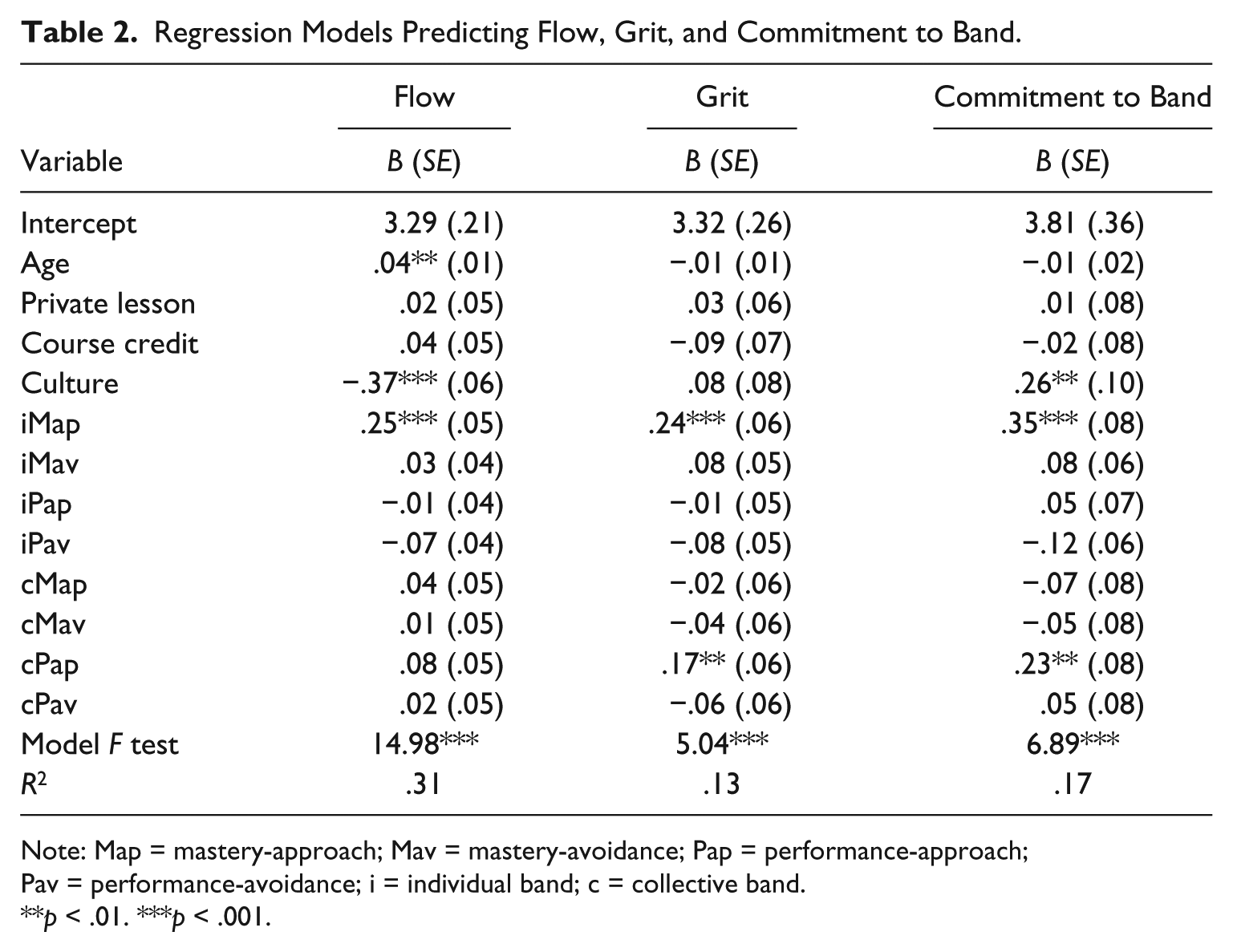
Note: Map = mastery-approach; Mav = mastery-avoidance; Pap = performance-approach; Pav = performance-avoidance; i = individual band; c = collective band.
p < .01. ***p < .001.
Flow and commitment to band varied significantly by culture such that U.S. participants reported relatively greater degrees of flow and Singapore participants reported relatively greater degrees of commitment to band. However, both of these effects were modest in magnitude. Mastery-approach motivation ratings from the individual band perspective were significantly related to each outcome, indicating that those who tended to report relatively stronger mastery-approach orientations also reported greater degrees of flow, grit, and commitment to band. Performance-approach motivation ratings from the collective band perspective were only significantly related to grit and commitment to band. This finding indicated that those who tended to report relatively stronger performance-approach orientations also reported greater degrees of grit and commitment to band. It is important to note that overall, the variance explained in the outcomes by this collection of variables was not large. None of the interaction terms were significant, and the model test comparing the models with and without the interaction terms revealed no significant change in variance accounted for as a result of including the interaction terms. In other words, the relationships between the motivational variables and flow, grit, and commitment to band did not vary as a function of culture. As such, results of the models with interaction terms are not presented in Table 2.
Discussion
The purpose of the study was to investigate how university band students’ (non–music majors) motivational goal orientations toward band and academics differ across two cultures and examine how they relate to a suite of adaptive dispositions (i.e., flow, grit, and commitment) relevant for 21st-century learning. As an extension of Miksza et al. (2016), it is striking that all major anomalous findings in the earlier study were replicated in this present one. In terms of the students’ individual motivational orientations toward band, no significant differences in achievement goal scale means were detected between the two cultures. Any relationship (or lack thereof) between the motivation variables and grit, flow, and commitment was essentially similar across the two countries. Mastery-approach followed by performance-avoidance were once again the most salient goal orientations in both cultural groups (see also Miksza, 2009b; Wang et al., 2007, 2008). Taken together, the findings indicate that the individual band orientations of students from both countries were more similar than different. Given the large sample size for this study, the lack of differences found is not likely due to a lack of statistical power. Both studies stand in contrast to extant cross-cultural research that found differences in goal orientations between individualist societies and collectivistic cultures (e.g., Xiang et al., 2001).
The nature of ensemble learning as a collectivistic endeavor that differs from academics prompted us to extend Miksza et al. (2016) to include collective band and academic major orientations. While we had expected the students from Singapore to report comparatively higher levels of collective band and individual academic orientations, the results did not confirm our expectations. Even when controlling for private lessons, whether the students were taking the course for credit, and age, the American participants gave higher ratings for each orientation from the collective band and academic major perspectives. However, the effect sizes were very small, suggesting that the magnitude of the differences between collective band and academic motivational orientations of both groups was negligible. The potential explanations for the unexpected higher collective band orientations among the American participants may be related to the sheer effort and commitment of time necessary to invest in order to participate in band as a non–music major in the United States. It is a relatively rare thing for U.S. students to continue in concert band as an avocation. It would make sense that only those with the strongest sense of identification with the group and “esprit de corps” would participate, thus accounting for the levels of collective band motivation. Additionally, while the larger Singaporean society may be more collectivistic compared to the United States, American students might well have learned to “think collectively” through enculturation into the practice of large ensembles. Ensemble music-making may simply foster a collective spirit among American band students.
It is interesting to note that students from both cultures rated the major academic field perspective for all motivation orientations significantly stronger than either of the band perspectives. This is consistent with extant research that has found that achievement domains have the potential to moderate achievement goals (Van Yperen et al., 2014). Based on the results of this study, achievement domain rather than culture accounted for differences in motivational goal orientations. In other words, it appears achievement goal orientations are domain specific. Future attempts to replicate and extend this study are needed to test this further.
Although the effects were modest, individual band mastery-approach goals predicted more adaptive behaviors (flow, grit, and commitment to band) than its collective counterpart (which predicted only flow). By contrast, while collective band performance-approach orientation was linked with flow and commitment to band, its individual counterpart did not predict any of the adaptive outcomes. The importance of individual mastery-approach and collective performance-approach goals in this study may be explained by the fact that while the mastery of skill in band settings is primarily an individual matter, competition is more salient between ensembles rather than between individuals. For both cultural groups, ratings for performance-approach orientation from the collective band scale perspective were significantly stronger than those from the individual band scale perspective. The prevalence of school-level band competitions both in Singapore and the United States (L. Tan, 2012) might have contributed to this collectivistic performance-approach orientation. Clearly, performance-approach goals in band are more a matter of “my goal is for our band to perform better than other bands” than “my goal is to perform better than the other students.”
Some other notable similarities between this study and Miksza et al. (2016) were also detected. In both studies, participants from Singapore were more committed to band (which possibly reflects a collectivistic mindset toward an in-group) and practice a lot more than their American counterparts; however, the former group reported lower levels of flow. This offers a sobering reminder that while a strong work ethic is often regarded positively, it does not always equate to desirable psychological states such as flow. Another key similarity with Miksza et al. was that a higher correlation between performance-approach and performance-avoidance goals from the individual band perspective was found in the Singapore sample compared to their U.S. counterparts. This suggests once again that distinctions between approach and avoidance goals are less sharply defined for learners from collectivistic cultures (e.g., Murayama et al., 2009). Further research is needed to ascertain if this emerges as a trend among instrumental students in disparate cultures.
Findings of this study hold several important implications for music education. Mastery- and performance-approach goals have been identified as “productive 21st century learning dispositions” that facilitate deep learning (J. P. L. Tan & Nie, 2015, p. 19). Based on the results of this study, the optimal motivational profile to cultivate in large ensemble settings might well be a combination of individual mastery-approach and collective performance-approach goals. Individual performance goals are perhaps best avoided in large ensemble settings, whereas directors could aid students by emphasizing mastery goals in the rehearsal hall (Matthews & Kitsantas, 2007, 2013); this is particularly important due to mastery-approach goals’ associations with commitment to band and to flow, both of which are valuable dispositions. Given that associations were once again found between grit and flow (Miksza et al., 2016; Miksza & Tan, 2015), teachers should continually encourage their students to persist and persevere in the face of challenges—a desirable disposition to handle the fast-changing landscape of the 21st century. Finally, given that the motivational profiles of band students in Singapore and the United States were au fond more similar than different, it appears that any individualist–collectivist differences that were potentially attributed to culture were possibly overridden by a transnational band or large ensemble culture of sorts. If so, large ensembles like bands and orchestras that have achieved global ubiquity and are essentially transcultural ensembles today (L. Tan, 2012) may well be the conduits through which meaningful musical connections may be made between disparate cultures in the globalized world.
To the authors’ knowledge, this was the first cross-cultural study in music education that has compared instrumental students’ individual and collective band and academic major orientations. While it has made novel contributions to the motivation research in music education, several limitations must be acknowledged. In this study, country was used as a cultural proxy; we assumed based on extant research that preexisting cross-cultural differences were present between the two countries. Although strong justifications can be made for Singapore as a collectivistic country and the United States as an individualistic one, such a generalization may well be simplistic given the cultural porosity of both countries and the possible presence of international students. Future studies may measure individual participants’ levels of individualism and collectivism to more precisely determine how achievement goal motivations differ as a function of individualism and collectivism. In addition, we did not control for item response bias. Accordingly, it remains inconclusive if the higher scores reported by the American students were indeed indicative of higher motivational orientations or if they were merely symptomatic of Western learners’ tendency toward self-enhancement, thereby endorsing all types of achievement goals higher than Asian learners (Heine, Lehman, Markus, & Kitayama, 1999; Murayama et al., 2009).
An additional issue to contend with is that Asians are generally less likely to use extreme scores in Likert-type scales (Chen, Lee, & Stevenson, 1995). Future studies may explore these issues in depth (Sun & Hernandez, 2012) and use qualitative approaches to more richly uncover cross-cultural differences in achievement goal theory (King & McInerney, 2014). It is also important to clarify that like so many psychological and social-psychological studies, the sample for this study consists of volunteers, and as such the findings may include response biases. Controlling for this via random sampling from a distinct population could reveal whether such bias is present. Moreover, we did not include an explicit indicator of whether a student was of resident or international status in our questionnaire. A more systematic method for verifying the cultural makeup of the students would be beneficial for future research.
Whether in Asia or the West, motivation remains worthy of our attention. This study has equipped music educators with a better understanding of how motivation works in academic and band settings across cultures. Further replications and extensions in culturally dissimilar contexts across diverse achievement domains can help determine the precise nature of achievement goals. Gritty endeavors in this line of research are encouraged to further advance the teaching and learning of music in the 21st century.
Footnotes
Declaration of Conflicting Interests
The authors declared no potential conflicts of interest with respect to the research, authorship, and/or publication of this article.
Funding
The authors received no financial support for the research, authorship, and/or publication of this article.

Author Biographies
References
Supplementary Material
Please find the following supplemental material available below.
For Open Access articles published under a Creative Commons License, all supplemental material carries the same license as the article it is associated with.
For non-Open Access articles published, all supplemental material carries a non-exclusive license, and permission requests for re-use of supplemental material or any part of supplemental material shall be sent directly to the copyright owner as specified in the copyright notice associated with the article.
