



Abstract
The purpose of this study was to determine the cross-cultural validity of a collective achievement goal model using a sample of non-music-major college band students from the US and Singapore. The study was situated within a theoretical framework that posited individual and collective achievement goal orientations of mastery-approach, mastery-avoidance, performance-approach, and performance-avoidance. These constructs were also examined in relation to three adaptive learning outcomes: flow, grit, and commitment to band. Confirmatory factor analyses indicated that whether considering the US, the Singapore, or the entire sample, the collective 2 × 2 achievement goal framework yielded a superior fit to the data when compared with four competing dichotomous and trichotomous models. Model invariance testing found that although the collective 2 × 2 achievement goal model appears to fit fairly well to the data from both groups of participants, cross-cultural model invariance can only be claimed conditionally. Hierarchical regression indicated that independent of any variation already explained by achievement goal sub-scales from the individual perspective, scales from the collective perspective explained a small but significant increase in variance for flow.
The importance of working in groups is well documented in the educational literature (e.g., Gold, 1999; Webb & Mastergeorge, 2003). From performing together in a large ensemble to playing soccer as a team, students in educational settings often work together rather than alone (e.g., Kim, Kim, & Svinicki, 2012; Klassen & Krawchuk, 2009). Writing on 21st-century skills, Trilling and Fadel (2009) noted that “communication and collaboration skills to promote learning together” (p. 54) are important in order to prepare students for the future. These skills are equally important in Asia as they are in the West (Tan, 2016). Indeed, people working together possess a “group spirit … which renders possible truly collective volition; this in turn renders the actions of the group much more resolute and effective than they (otherwise) could be” (McDougall, 1920, p. 89).
However, studies in motivational research, such as achievement goal theory, tend to examine an individual’s rather than a group’s collective goal orientations, ignoring the fact that students often function in team contexts (DeShon, Kozlowski, Schmidt, Milner, & Wiechmann, 2004). The language of achievement goal theory attests to this individualistic assumption (e.g., “I want to learn as much as possible from this class”), with proportionately fewer studies on achievement goal theory at the collective level. Collective achievement goal orientations are more than the mere sum of individuals’ personal motivation; rather, they are “climate-like group characteristics that are shared by group members and have important implications for group processes and outcomes” (Van Mierlo & Van Hooft, 2015, p. 777).
In a recent study, Miksza, Tan, and Dye (2016) reported surprising findings that point to the need to examine collective motivation across cultures in the context of large ensembles. Participants were band students from five polytechnics in Singapore and their counterparts from eight American high schools. Consistent with previous music research (Miksza, 2009a), confirmatory factor analyses indicated that the 2 × 2 achievement goal framework offered the best relative fit to their data compared with alternative dichotomous and trichotomous models. However, contrary to the general educational research literature that posit differences in goal orientations between individualist and collectivistic cultures, no differences in achievement goal scale means were found, indicating that the motivational profiles of both samples were more alike than different. The authors hypothesized that the lack of cross-cultural difference may have been due to the collective nature of participation in a band; the achievement goal theory, on the other hand, measures individual goal orientations. It is valuable, therefore, to pursue a replication and extension of this study to include collective goal orientations. This is important as band students often work towards collective musical goals, usually in the form of polished performances.
Accordingly, this present study seeks to determine whether collective motivational goal orientations work differently across Singapore and the US by examining the cross-cultural validity of a collective 2 × 2 achievement goal model. The study was situated within a theoretical framework that posited individual and collective achievement goal orientations of mastery-approach, mastery-avoidance, performance-approach, and performance-avoidance. These constructs were also examined in relation to three adaptive learning outcomes: flow (Csikszentmihalyi, 1990), grit (Duckworth, Peterson, Matthews, & Kelly, 2007), and commitment to band (Schmidt, 2005). Given that flow is a desired psychological state while practicing (Miksza & Tan, 2015), and that students require grit and commitment to succeed (Miksza et al., 2016), it is instructive to examine how collective achievement goals may predict additional variance on top of the amount already explained by individual-level achievement goals in these three outcomes. Such findings can inform music education practices in the context of large ensembles.
Theoretical framework
Individual achievement goals
Among extant motivation theories (e.g., Ormrod, 2011), one influential framework that has generated much attention is achievement goal theory, where motivation is conceived in terms of mastery (task or learning) and performance (ego) orientations (e.g., Nicholls, 1984). While the former is self-referential, intrapersonal, and refers to engaging in an activity for its own sake, the latter seeks to peg one’s knowledge, skills, and abilities against the performance of others (e.g., Dweck, 1999). When achievement goal theory was first formulated, both mastery and performance goals were theorized based on the implicit assumption that they were both approach goals (i.e., individuals were presumed to be directed towards these goals); contrary findings, however, led to the introduction of the avoidance valence (Van Yperen, Blaga, & Postmes, 2014). Initially, scholars proposed a trichotomous achievement goal framework that divided the performance goal construct into performance-approach and performance-avoidance goals (e.g., Elliot, 1997). Subsequently, the approach-avoidance dimensions were used to dichotomize the mastery goal construct as well, which resulted in the 2 × 2 achievement goal framework: mastery-approach, mastery-avoidance, performance-approach, and performance-avoidance (e.g., Elliot & McGregor, 2001). While mastery-approach goals emphasize achieving task mastery and self-improvement, mastery-avoidance goals focus on avoiding not learning. Additionally, while performance-approach goals emphasize performing better than others, performance-avoidance goals focus on avoiding performing worse than others.
Studies have found that while mastery-approach orientations are generally associated with positive outcomes and adaptive learning patterns (e.g., Van Yperen et al., 2014), mastery-avoidance and performance-avoidance goals typically predict maladaptive behavioral and cognitive patterns (e.g., Elliot & McGregor, 2001; McGregor & Elliot, 2002). Findings with performance-approach goals tended to be more mixed, with these goals being found to correlate positively with performance attainment on the one hand (e.g., Van Yperen et al., 2014) and to be associated with maladaptive learning and outcome patterns on the other (e.g., Lacaille, Koestner, & Gaudreau, 2007; Lacaille, Whipple, & Koestner, 2005).
Music research on achievement goal theory has sought to examine it in relation to perceptions of learning climate, learning strategies, and performance achievement. Students who were taught in mastery-oriented rehearsal environments tended to perceive higher levels of support from their directors compared to those who rehearsed in performance-oriented climates; mastery-oriented motivational environments have also been found to correlate to task cohesion, collective efficacy, social cohesion, and self-efficacy (Matthews & Kitsantas, 2007, 2013). A number of studies have investigated relationships between achievement goals and performance achievement. Mixed results have been found. On the one hand, Miksza (2009b) and Schmidt (2005) detected significant positive associations between high school instrumental students’ self-reported levels of mastery goal orientations and performance achievement. On the other hand, no such link was found among collegiate players (Miksza, 2011; Nielsen, 2008). The relationships between motivational goal orientations and practice behavior appeared clearer, with several studies reporting that high school and collegiate participants who had higher levels of mastery orientations also tended to engage in strategic practice behaviors (Miksza, 2009b, 2011; Nielsen, 2008).
Collective achievement goals
The relatively limited research on collective motivation, also known in the literature as “team” and “group” motivation, has indicated that it is worthy of research attention. The collective mastery orientations of management team members were measured by Bunderson and Sutcliffe (2003) using an adaptation of VandeWalle’s (1997) learning goal orientation scale. Findings indicated that the participants’ collective mastery orientation significantly predicted learning-related adaptive behaviors that can improve performance. Similarly, Park and DeShon (2010) modified Elliot and McGregor’s (2001) goal orientation items to measure individuals’ perceptions of their group’s collective mastery orientation. Again, findings indicated that high collective mastery orientation was associated with adaptive behaviors.
Research has also investigated both collective mastery and performance goal orientations. For example, collective mastery goal orientations have been found to positively correlate with team efficacy and commitment to team goals, while collective performance orientations were positively associated with team efficacy only (DeShon et al., 2004). The collective motivational goal orientations of undergraduate business students have also been studied (Porter, Webb, & Gogus, 2010). Confirmatory factor analysis indicated that a two-factor model was a significantly better fit to the data than a one-factor solution.
In a study that employed a trichotomous framework, Dragoni and Kuenzi (2012) examined how leaders’ goal orientations indirectly influence the collective achievement goals of their employees. Findings indicated that the strongest influences were noted in the mastery and performance-approach constructs. In another study that investigated a collective trichotomous framework, Gong, Kim, Lee, and Zhu (2013) found that collective mastery-approach and collective performance-approach positively correlated with team and individual creativity. Negative correlations were found between collective performance-avoidance and team and individual creativity. Drawing on Bunderson and Sutcliffe (2003) to measure collective mastery goals, Mehta, Feild, Armenakis, and Mehta (2009) included collective performance-approach and collective performance-avoidance constructs in their study involving students engaged in complex decision-making tasks. Findings indicated that collective performance-approach influenced the performance of the teams.
Using confirmatory factor analyses, Kim et al. (2012) validated a 3 × 3 achievement goal orientation measure which comprises a trichotomous achievement framework (mastery-approach, performance-approach, and performance-avoidance) examined using three levels of goal orientations (i.e., individual, individual-within-a-group, and group). Findings indicated that while individual performance-approach goal orientation was not associated with several group community constructs (e.g., sense of group community and shared goals), individual-within-a-group and group performance-approach goals were negatively linked to hopelessness. In a follow-up study, Kim, Chung, Kim, and Svinicki (2015) found that individual-within-a-group and group performance-approach goals were positively associated with enjoyment of group work and a greater sense of community.
In the only known study that has examined the 2 × 2 achievement goal framework from both the individual and collective perspectives (Van Mierlo & Van Hooft, 2015), confirmatory factor analyses found that the four-factor model of group achievement goals was a better fit to the data than alternative two-factor and three-factor models. The authors concluded that the 2 × 2 framework meaningfully extends extant research on collective achievement goals. As such, it appears that further exploration of both approach- and avoidance-valence dimensions of the mastery- and performance-goal orientations is warranted. Practically speaking, it is possible that band members as a collective would be interested in preserving their outward facing image as a high achieving ensemble (i.e., performance-avoidance) and that they would be concerned with the possibility of their achievement slipping below a satisfactory level (i.e., mastery-avoidance). Furthermore, collective achievement goals accounted for variance in group task strategy effectiveness, group reflexivity, and collective effort beyond the variance already explained by the individual goals.
Purpose
The purpose of this study was to determine the cross-cultural validity of a collective achievement goal model using a sample of college band students from the US and Singapore. The study was situated within a theoretical framework that posited individual and collective achievement goal orientations of mastery-approach, mastery-avoidance, performance-approach, and performance-avoidance. These constructs were also examined in relation to three adaptive learning outcomes: flow, grit, and commitment to band. The specific research questions were: (a) Is the collective 2 × 2 achievement goal model a better fit to data yielded from college instrumental students from the US and Singapore when compared with competing dichotomous and trichotomous models? (b) Does the collective 2 × 2 achievement goal model demonstrate cross-cultural validity across the two samples? (c) Do collective motivational orientations predict additional variance in flow, grit, and commitment to band independent of any variation already explained by individual achievement goal orientations?
Method
Participants consisted of 427 non-music-major collegiate instrumental students from five college bands in the US (n = 227) and three college bands in Singapore (n = 200). Non-music majors are neither the select group of post-high-school band students who became music majors, nor those who stop playing in college. As the group that enjoys band enough to continue participating in college despite having another academic major, studying non-music majors can help us understand the motivation of amateurs and lifelong music makers, which is important as lifelong participation is one of the important “long-term consequences of music education” (Pitts, 2009, p. 254).
Males comprised 41% of the US sample and 59% were females, while 46.5% of the Singapore (SG) sample were males and 53.5% were females. The Singapore participants were on the whole older than their US counterparts (SG mean age = 21.66, SD = 2.23; US mean age = 19.39, SD = 1.88), and had played their instruments for a longer duration of time (SG mean = 8.80 years, SD = 3.21; US mean = 7.57 years, SD = 2.97). While 54% of the US participants had taken private lessons, only 24% of the Singapore sample had done so. The Singapore instrumentalists reported spending more time practicing per day than their US peers (SG mean = 117.6 minutes, SD = 69.35; US mean = 44.4 minutes, SD = 37.42). The two researchers solicited voluntary consent from the participants and collected data independently in their home countries. The entire study was restricted to a self-report questionnaire. The participants from Singapore completed paper copies of the questionnaire at the end of their college band rehearsals, while their American counterparts answered the questionnaire through either paper copies or its online version.
Measures
Individual achievement goal orientation
The Revised Achievement Goal Questionnaire (Elliot & Murayama, 2008) was used to measure the participants’ individual achievement goal motivation towards participating in their college band. With reference to their motivational beliefs about their band participation, they answered 12 statements (e.g., “My aim is to perform well relative to other students”) using a five-point Likert scale. Three statements were used to measure each of the four motivational orientations from the 2 × 2 achievement goal model. The Cronbach’s alpha reliabilities for the total sample were .80 for mastery-approach, .73 for mastery-avoidance, .76 for performance-approach, and .86 for performance-avoidance.
Collective achievement goal orientation
The same Revised Achievement Goal Questionnaire (Elliot & Murayama, 2008) was used to measure the participants’ collective achievement goals towards their college band participation. The statements were adapted to capture collective motivation (e.g., “I am striving to avoid performing worse than others” was changed to “I am striving to help my band avoid performing worse than others”). The Cronbach’s alpha reliabilities for the total sample were .84 for collective mastery-approach, .79 for collective mastery-avoidance, .82 for performance-approach, and .89 for performance-avoidance.
Flow
The Short Dispositional Flow Scale (Jackson, Martin, & Eklund, 2010) was used to measure participants’ self-report levels of flow during band rehearsals. Each of the nine items in this scale captured each of the nine aspects of flow in Csikszentmihalyi’s (1990) flow theory: clear goals, concentration on task at hand, challenge–skill balance, action–awareness merging, sense of control, unambiguous feedback, loss of self-consciousness, autotelic experience, and transformation of time. A five-point scale consisting of always, frequently, sometimes, rarely, or never was used. The Cronbach’s alpha reliability of the measures was .80 for the total sample.
Grit
The Short Grit Scale (Duckworth & Quinn, 2009) was used to measure participants’ self-reported levels of grit while practicing their college band instrument. The scale was adapted for instrumental practice (e.g., “I am a hard worker” was changed to “I am a hard worker when it comes to practicing on my instrument”) and has been found to be internally consistent in a previous study with collegiate instrumental majors (Miksza & Tan, 2015). A five-point scale (i.e., very much like me, mostly like me, somewhat like me, not much like me, and not like me at all) was used. The Cronbach’s alpha reliability of the scale was .67 for the total sample.
Commitment to band
The Commitment to Band Scale (Schmidt, 2005) was used to measure the participants’ commitment to their respective college bands. This six-item scale was adapted from Asmus and Harrison (1990) and comprised statements such as “Band is a very important part of my life” and “If I had my way, I would spend more time in band class”. Participants responded to the statements using a five-point Likert scale (i.e., strongly agree to strongly disagree). The Cronbach’s alpha reliability of the measure was .88 for the total sample.
Results
Means for the achievement goal sub-scales across both participant groups, and from both individual and collective perspectives, were all fairly high with values ranging from 3.55 to 4.18 (Table 1). Mastery-approach orientations in both individual and collective perspectives were rated the highest by both groups. Although not drastically so, the skewness of the sub-scale scores was somewhat more pronounced for the US participants as compared to the Singapore participants. Means for the flow scale for each group were relatively high as well, although US participants reported flow experiences somewhat more frequently than Singapore participants. US participants’ flow ratings were also slightly negatively skewed. In contrast, mean ratings for grit and commitment to band were more similar between groups and neither group’s scores demonstrated any substantial skew.
Descriptive statistics for all psychological variables.
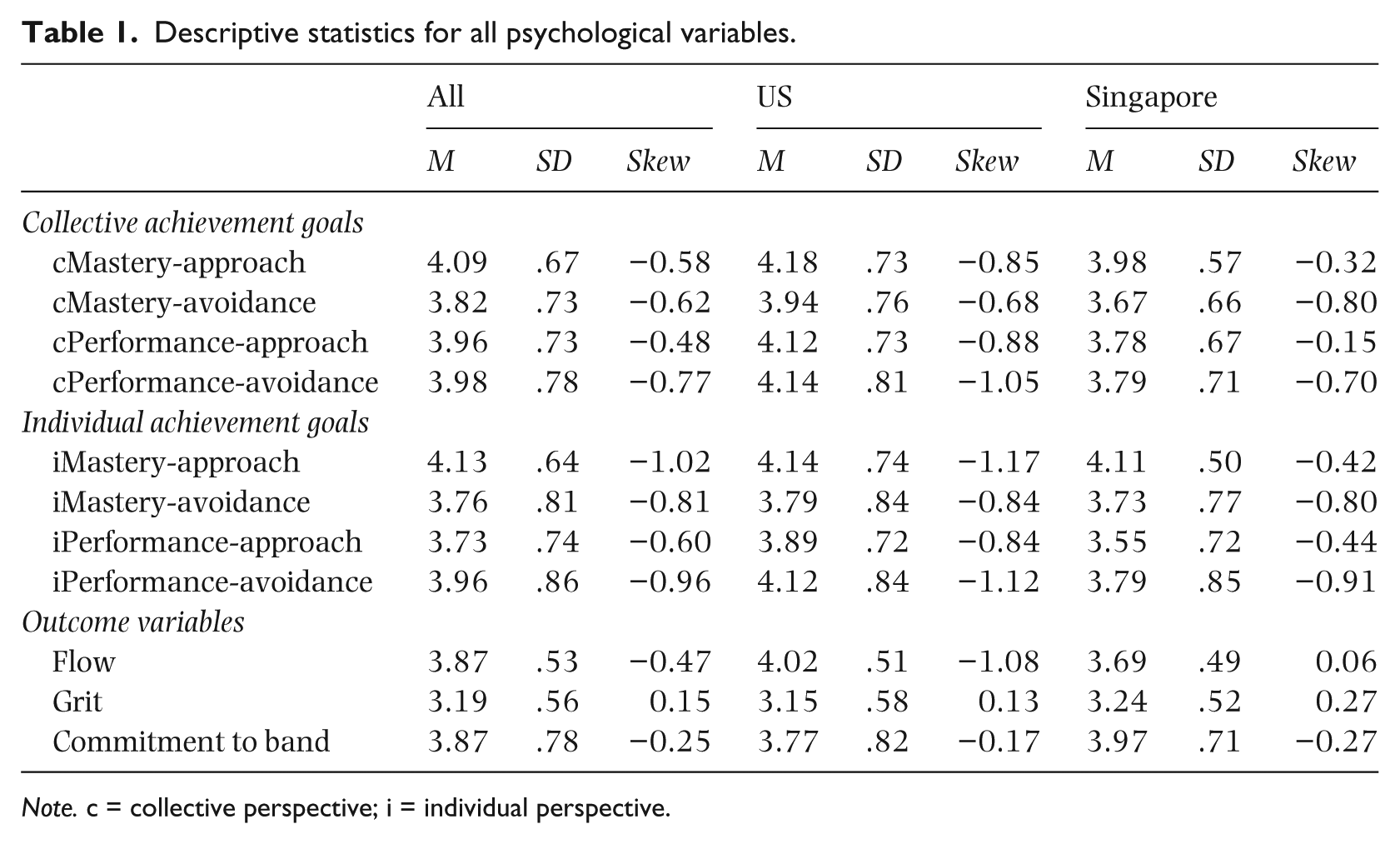
Note. c = collective perspective; i = individual perspective.
Within-network analyses: Goodness of fit of a collective 2 × 2 achievement goal model
A series of confirmatory factor analyses (CFAs) were conducted using the data gathered from the collective achievement goal items to test whether the 2 × 2 model of achievement goal motivation would yield a superior fit when compared with four competing models. The competing models included: (a) a dichotomous model with latent factors representing Approach and Avoidance; (b) a dichotomous model with latent factors representing Mastery and Performance; (c) a trichotomous model with latent factors representing Mastery, Performance-approach and Performance-avoidance; and (d) a trichotomous model with latent factors representing Performance, Mastery-approach, and Mastery-avoidance. This series of models was estimated for the US and Singapore groups of participants alone as well as both groups combined. Fit indices used to assess model fit included model chi-square tests, the root mean square error of approximation (RMSEA) and hypothesis tests of close fit (i.e., p Close), the comparative fit index (CFI), and the standardized root mean square residual (SRMR). Given the nested nature of the series of models estimated, the fit of the 2 × 2 model was compared to each competing model with the chi-square difference test with degrees of freedom equivalent to the difference in parameters estimated between models.
According to the model chi-square tests, none of the models demonstrated perfect fit to the data from either sub-group nor the total sample (see Tables 2, 3, and 4). However, the model chi-square test is known to be especially sensitive to sample size and as such we will focus our interpretation of the model results on the additional fit indices reported. Whether considering the US participants, the Singapore participants, or the entire sample, the 2 × 2 model was found to be a better relative fit to the data than any of the four competing models. The 2 × 2 model yielded the lowest RMSEA values (range .05 to .08) and the highest CFI values (.95 to .96), which were each indicative of close, or at least acceptable, fit. The SRMR values ranging from .04 to .06 were also indicative of good fit. Furthermore, the chi-square difference tests comparing the fit of the 2 × 2 model to the competing models yielded significant results (p < .001) at each point of comparison for both sub-groups as well as all participants combined, demonstrating that the 2 × 2 model was a superior fit to the data in each case.
Fit statistics for all confirmatory factor analyses collective achievement goal models tested – US participants.
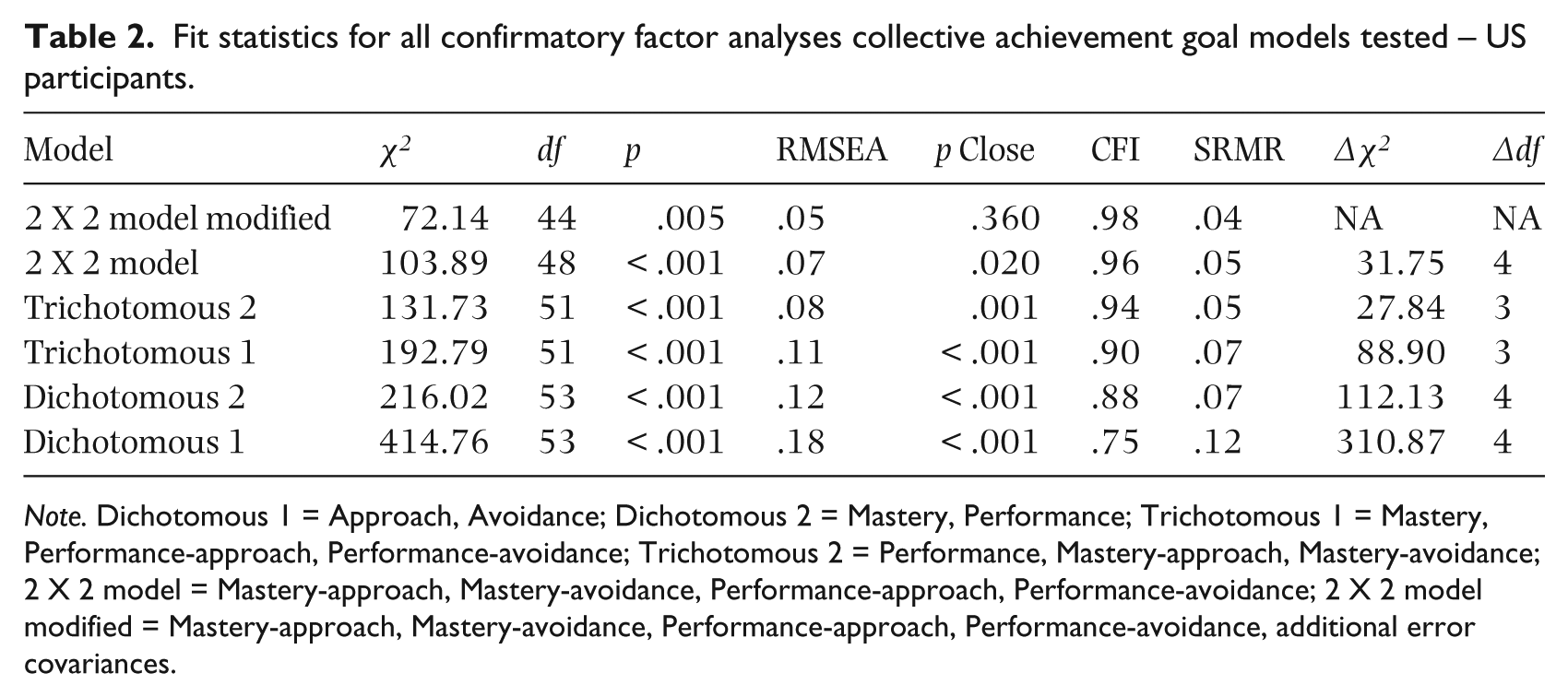
Note. Dichotomous 1 = Approach, Avoidance; Dichotomous 2 = Mastery, Performance; Trichotomous 1 = Mastery, Performance-approach, Performance-avoidance; Trichotomous 2 = Performance, Mastery-approach, Mastery-avoidance; 2 X 2 model = Mastery-approach, Mastery-avoidance, Performance-approach, Performance-avoidance; 2 X 2 model modified = Mastery-approach, Mastery-avoidance, Performance-approach, Performance-avoidance, additional error covariances.
Fit statistics for all confirmatory factor analyses collective achievement goal models tested – Singapore participants.

Note. Dichotomous 1 = Approach, Avoidance; Dichotomous 2 = Mastery, Performance; Trichotomous 1 = Mastery, Performance-approach, Performance-avoidance; Trichotomous 2 = Performance, Mastery-approach, Mastery-avoidance; 2 X 2 model = Mastery-approach, Mastery-avoidance, Performance-approach, Performance-avoidance; 2 X 2 model modified = Mastery-approach, Mastery-avoidance, Performance-approach, Performance-avoidance, additional error covariances.
Fit statistics for all confirmatory factor analyses collective achievement goal models tested – all participants.
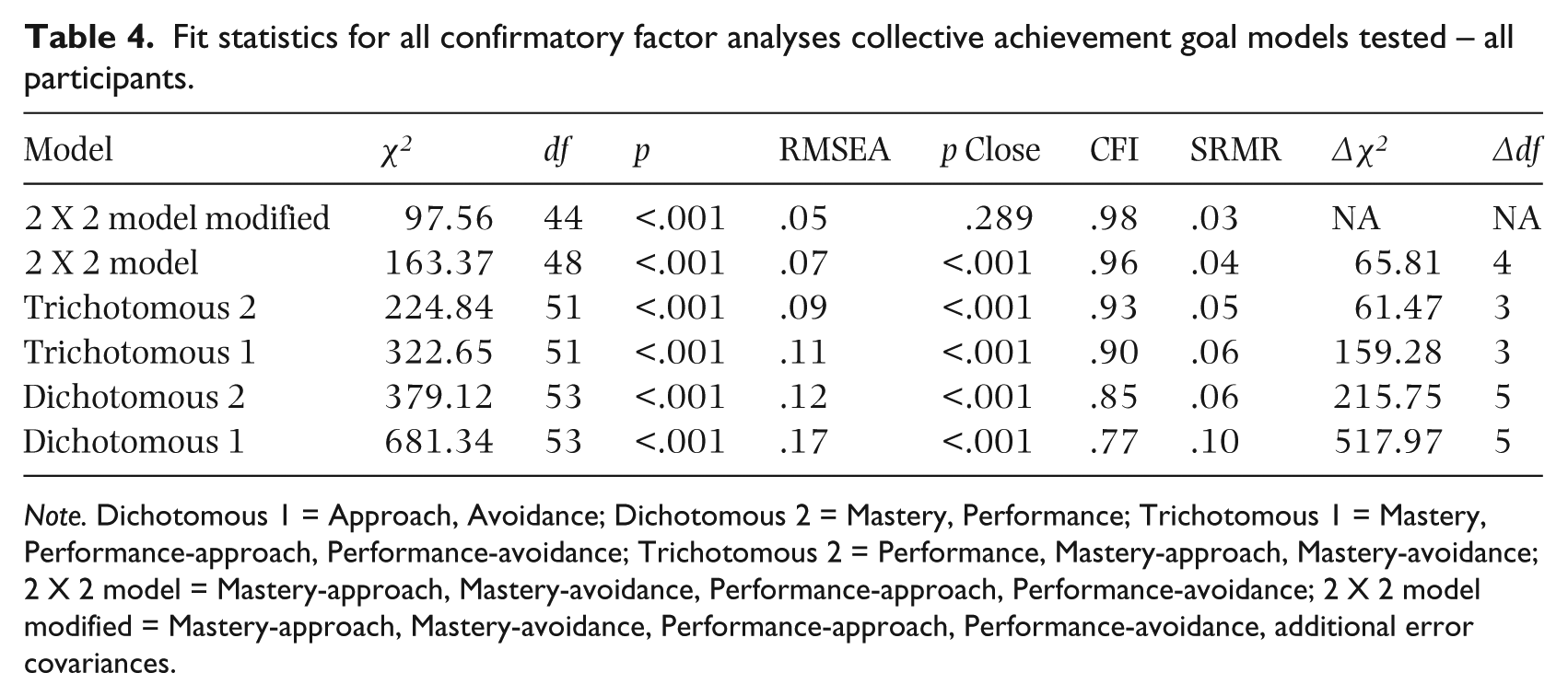
Note. Dichotomous 1 = Approach, Avoidance; Dichotomous 2 = Mastery, Performance; Trichotomous 1 = Mastery, Performance-approach, Performance-avoidance; Trichotomous 2 = Performance, Mastery-approach, Mastery-avoidance; 2 X 2 model = Mastery-approach, Mastery-avoidance, Performance-approach, Performance-avoidance; 2 X 2 model modified = Mastery-approach, Mastery-avoidance, Performance-approach, Performance-avoidance, additional error covariances.
Modification indices were examined for theoretically plausible additions to the 2 × 2 model estimated with the data from the entire sample. The modification indices suggested substantial increases in model fit would occur with the addition of covariance parameters between the error terms (a) among the three mastery-avoidance items, (b) between two of the performance-approach items (“My goal is for our band to perform better than the other bands”, “My aim is that our band will avoid learning less than we possibly could”), and (c) between a pair of mastery-approach and performance-approach items (“My goal for my band is for us to learn as much as possible”, “My aim is that our band will avoid learning less than we possibly could”, respectively). In the cases of the error covariances added between the mastery avoidance items and the two performance approach items, these modifications represent relations between items measuring the same construct. Whereas, the error covariance added between the mastery approach and performance avoidance item represent a relation between responses to two statements that are substantively the semantic inverse of each other. Given that these additions improved model fit and are theoretically plausible, the modifications are theoretically and statistically appropriate. The fit indices for the modified 2 × 2 model were excellent with RMSEA, CFI, and SRMR indicating very close fit (Table 4, Figure 1). In addition, the chi-square difference test indicated that this modified model was a significantly (p < .001) better fit than the 2 × 2 model without the modifications. The modified 2 × 2 model was also tested with the US and Singapore participants’ data alone and in each case, this model proved to be a better fit than the model without modifications (see Tables 2 and 3).
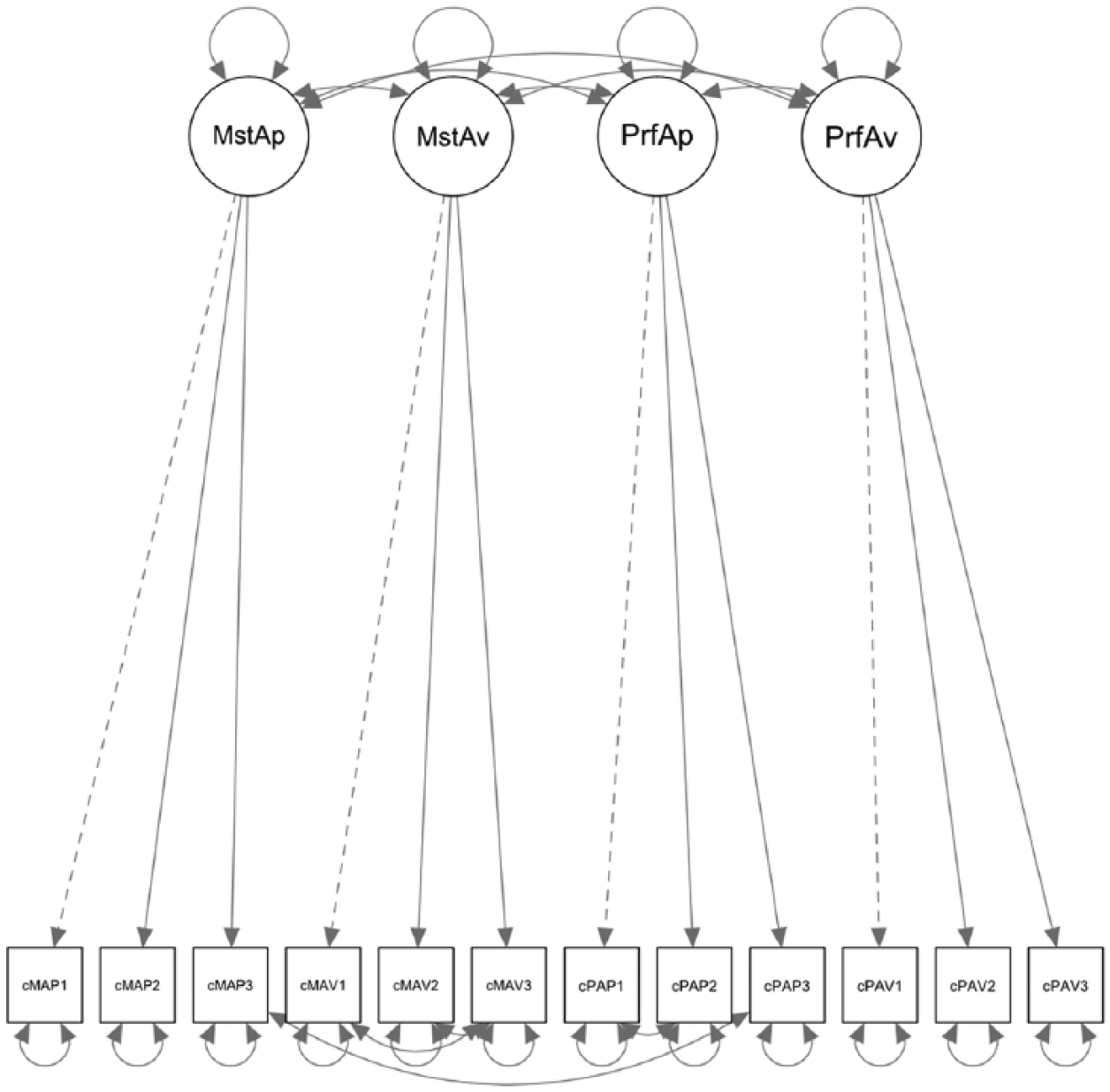
Path diagram depicting the specification of the modified 2 X 2 achievement goal model.
Between network analyses: Goodness of fit of a collective 2 × 2 Achievement goal model
Model invariance testing was carried out to assess the fit of the 2 × 2 collective achievement goal model between US and Singapore participants. We examined a series of multiple-group CFAs to assess the invariance of the model with increasingly stringent criteria (i.e., configural invariance, weak invariance, strong invariance, and strict invariance; Kline, 2016). The CFAs conducted with each sub-group of participants that were discussed above serve to demonstrate configural invariance. In other words, a four-factor modified model with specifications according to the model depicted in Figure 1 was the best relative fit to the data for both groups of participants. This modified 2 × 2 model was also fit to both groups of participants simultaneously to establish model chi-square, RMSEA, and CFI values to be used as a baseline for comparisons to models with stricter invariance constraints (Table 5).
Model invariance tests: Collective achievement goal motivation.
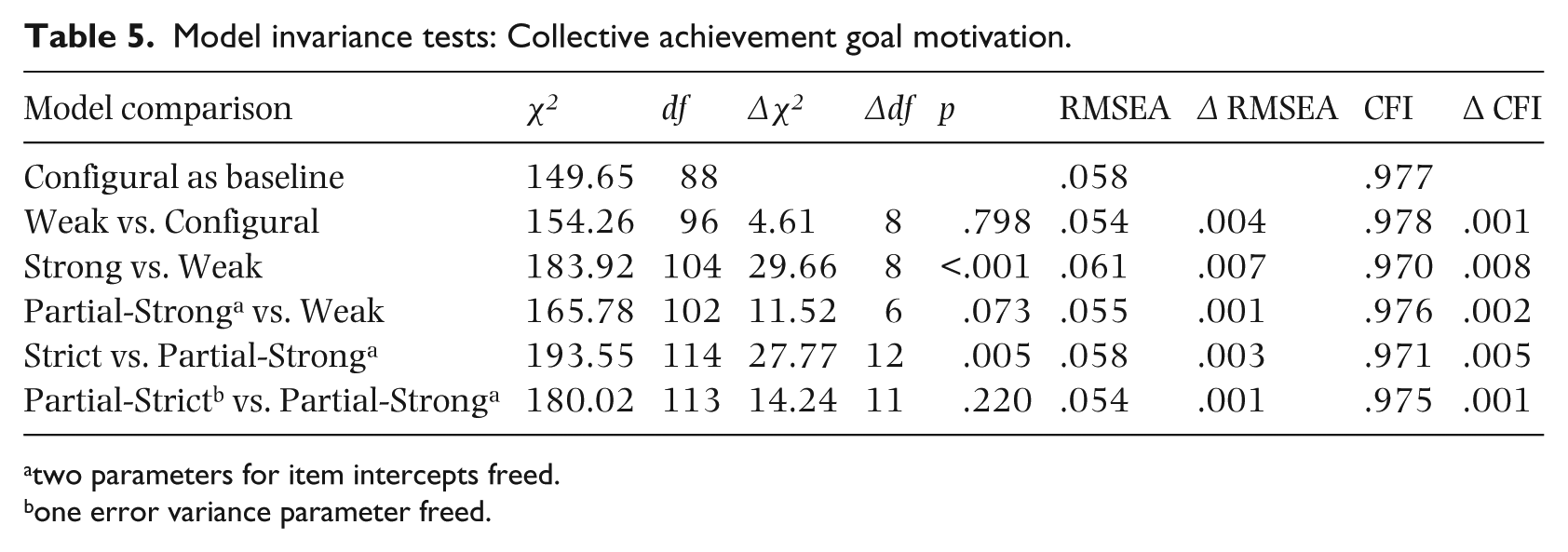
two parameters for item intercepts freed.
one error variance parameter freed.
Weak invariance was tested via a multiple-group CFA with pattern coefficients (e.g., factor loadings) for the modified 2 × 2 model constrained to be equal across groups. Comparisons of the fit statistics of the weak invariance model and the baseline values indicated no significant difference in fit. The chi-square difference test was not significant (p = .798) and only a very small change in RMSEA and CFI values occurred. This result suggests that the assumption of weak invariance holds such that the factors are manifested in somewhat similar ways between groups.
We examined strong invariance by estimating a multiple-group CFA with pattern coefficients as well as item intercepts constrained to be equal across groups. The fit indices for this model were compared with those from the weak invariance model. The comparison revealed that the fit of the strong invariance model was significantly worse than the weak invariance model, indicating that the groups were responding to at least some of the items in different ways. As a result, modification indices were examined to determine whether specific item intercept constraints could be freed to establish partial-strong invariance. Partial-strong invariance was achieved upon releasing the item intercept constraints for a mastery-approach item (“I am striving for our band to understand the content of this course as thoroughly as possible”) and a performance-approach item (“My goal is for our band to perform better than other bands”). No significant difference was found between the model chi-square values for the weak invariance model and this partial-strong invariance model with these altered specifications. In addition, changes in RMSEA and CFI values between the weak invariance model and this partial-strong invariance model were slight.
Finally, strict invariance was assessed by comparing the partial-strong invariance model with a model that also included constraints on error variances and covariances across groups. The chi-square difference test indicated that the fit of the strict invariance model was significantly worse than the partial-strong invariance model. However, the reductions in RMSEA and CFI values were not especially large. Modification indices were examined to determine whether specific error variance and/or covariance constraints could be freed to establish partial-strict invariance. Partial-strict invariance was achieved by freeing the error variance parameter for a performance-approach item (“My goal is for our band to perform better than other bands”).
In sum, the model comparisons indicate that the assumptions of configural and weak model invariance hold, but that only partial-strong and partial-strict invariance can be claimed. The failure to achieve strong and strict model invariance seems to be the result of several items operating somewhat differently across the cultural groups. Although the 2 × 2 model appears to fit fairly well to the data from both groups of participants, cross-cultural model invariance can only be claimed conditionally.
Collective achievement goal orientations as predictors of flow, grit, and commitment to band
We assessed the relative effects of the achievement goal sub-scales from the collective perspective on flow, grit, and commitment to band via regression analyses (see Table 7 below). The scales explained 14% of the variance in flow. Mastery-approach and mastery-avoidance from the collective perspective were significant predictors of flow, indicating that those who endorsed these scales more strongly also tended to report more frequent experiences of flow in band. The scales explained much less of the variance in grit (
Next, hierarchical regression analyses were conducted to determine whether the achievement goal sub-scales from the collective perspective could explain variation in each of the three psychological outcomes (i.e., flow, grit, commitment to band) independent of any variation already explained by achievement goal sub-scales from the individual perspective. Accordingly, a pair of models were fit for each outcome; the first model fitted included the four achievement goal sub-scales from the individual perspective as predictors, whereas the achievement goal sub-scales from the collective perspective were entered as a block of predictors in a second model. Tolerance and variance inflation factor indices were examined for all models and despite some moderately strong correlations among predictors (Table 6), all indices were found to be acceptable.
Pearson correlations among all achievement goal scales and outcome variables.

Note. Coefficients < .11 significant at p < .01; coefficients < .14 significant at p < .001.
The achievement goal scales from the individual perspective explained 17% of the variance in flow scores, with the scales from the collective perspective explaining an additional 2% – a small, yet statistically significant increase in variance explained (p < .01; see Table 8 below). However, none of the coefficients for the sub-scales from the collective perspective were statistically significant (p > .05) and all were very small in magnitude (range of Bs = .04 to .06). In contrast, the achievement goal scales from the collective perspective did not explain a significant amount of variance when added to the models for grit and commitment to band. That said, examination of the coefficients for the individual sub-scales revealed very small, but significant (p < .05) positive relationships between performance-approach ratings from the collective perspective and grit as well as flow. However, these relationships are not representative of large effects and taken together with the non-significant change in model fit, they are likely trivial.
Mastery-approach from the individual perspective was a significant positive predictor of all three outcomes (p < .001) and performance-avoidance from the individual perspective was a small, but significant negative predictor of commitment to band (p < .05). Those with stronger desires to achieve for the sake of demonstrating self-referential improvement also reported relatively more flow experiences, grittiness in practice, and commitment to band. In contrast, those seeking to avoid demonstrating incompetence with respect to others tended to report a weaker degree of commitment to band.
Discussion
Confirmatory factor analyses indicated that whether considering the US participants, their Singapore counterparts, or the entire sample, the collective 2 × 2 achievement goal framework yielded a superior fit to the data when compared with any of the competing dichotomous and trichotomous models. Consistent with Van Mierlo and Van Hooft (2015), findings of this study suggest that the 2 × 2 framework offers theoretical potential to meaningfully extend research on collective achievement goals. From a practical standpoint, findings are relevant to understanding motivation in large ensembles; directors may find it useful to construe the collective motivation of their players in terms of mastery-approach, mastery-avoidance, performance-approach, and performance-avoidance, rather than in terms of mastery and performance goals only (i.e., dichotomously), or mastery, performance-approach, and performance-avoidance goals (i.e., trichotomously). In short, collective avoidance goals from both mastery and performance orientations may be theoretically and practically valuable. Further research on achievement goal theory in large ensembles may build on this study to more comprehensively determine the theoretical and practical ramifications of collective avoidance goals.
Model invariance testing was conducted to assess the fit of the 2 × 2 collective achievement goal model between US and Singapore participants. Findings indicated that although the 2 × 2 model fits reasonably well to the data from both cultural groups, cross-cultural model invariance could only be claimed conditionally. It is worth stressing however, that the model invariance that was observed could be due to unobserved differences in the sample and may not truly be due to cross-cultural differences. Hierarchical regression indicated that independent of any variation already explained by achievement goal sub-scales from the individual perspective, scales from the collective perspective explained a small but significant increase in variance for flow. It is important to note that while the additional variance explained by the collective motivational orientations was small, the finding nonetheless suggests that the collective constructs contributed to the explanation of the outcomes independent of the individual constructs. However, it is also important to note that the individual constructs (independent of the collective constructs) predicted the outcomes to a greater degree than the collective alone. That said, the explanatory effect of the collective constructs is theoretically interesting. The significant increase in variance explained is probably more noteworthy given the fact that flow as measured here was experienced individually, not collectively; in other words, collective motivation orientations appear to have contributed to an individual psychological outcome. Furthermore, as modest effects may accumulate over time (Berndt & Keefe, 1992), the relationship between collective motivation orientations and flow may be more salient over a longer period of time. More research is needed to further test the effects of collective motivational orientations on individual flow. In addition, given our finding that none of the coefficients for the sub-scales from the collective perspective were statistically significant, and all were very small in magnitude, future research may develop theoretical predictions for how individual and collective achievement motivation might interact.
In the general motivational research literature, while individual mastery-approach orientations have been found to predict positive outcomes and adaptive behaviors and outcomes, individual mastery-avoidance goals were associated with maladaptive learning patterns (Ames & Archer, 1988; Elliot & McGregor, 2001; McGregor & Elliot, 2002; Moeller & Elliot, 2006). In this study, we found that collective mastery-approach was a significant predictor of flow, indicating that those who learned for the sake of their band’s learning also tended to report more frequent experiences of flow during band rehearsals. Given that flow is a desirable psychological state that can potentially facilitate creativity – an important 21st-century skill (Lemke, 2011; Trilling & Fadel, 2009) – this study furthers our understanding of how flow may potentially be facilitated via collective mastery-approach goals. Accordingly, when teaching and rehearsing, directors of large ensembles may encourage their students to endorse these goals; to consider ways in which their ensembles may learn for the sake of learning as a collective entity. Surprisingly, collective mastery-avoidance was also a significant predictor of flow, although to a smaller extent (see Table 7). Further research is necessary to ascertain if this emerges as a consistent finding in large ensembles.
Regression models predicting flow, grit, and commitment to band with collective-perspective scales.

Note. c = collective perspective; ns = non-significant.
p < .05, **p < .01, ***p < .001.
Additionally, we found positive relationships between collective performance-approach orientations and grit and commitment to band, indicating that those who were motivated by their desire to have their band outperform other bands also possessed higher self-reported levels of grit and commitment to band. What this seems to suggest is that some degree of healthy competition between ensembles is not necessarily a bad thing – students may well be grittier and display higher commitment, both of which are important learning dispositions relevant and important to the 21st century (Soland, Hamilton, & Stecher, 2013). What seems wise to avoid nurturing is collective performance-avoidance, as those with comparatively stronger collective performance-avoidance dispositions also had lower self-reported levels of grit. While the maladaptive implications of individual performance-avoidance goals have been noted in previous research (e.g., McGregor & Elliot, 2002; Van Yperen et al., 2014), this study has surfaced the potential unbeneficial effects of collective performance-avoidance.
Apart from the significant relationships noted above, several variables were found to be unrelated to one another, such as the lack of associations found between avoidance goals and the three outcome variables (Table 8). As flow, grit, and commitment to band represent relatively private internal states that can be maintained covertly by individuals, this may be the reason why relationships between these particular outcomes and achievement goals with avoidance valence were less prominent. Given the majority of insignificant or very weak regression coefficients found in this study, future research may explore outcomes that could be a better “match” with collective achievement goals, such as collective flow (Salanova, Rodríguez-Sánchez, Schaufeli, & Cifre, 2014; Sawyer, 2008) and other types of group outcomes such as loyalty, collaborative spirit, group potency, and collective efficacy (Salanova et al., 2014; Stajkovic, Lee, & Nyberg, 2009).
Regression models predicting flow, grit, and commitment to band with individual- and collective-perspective scales.

Note. c = collective perspective; i = individual perspective; ns = non-significant.
p < .05, **p < .01, ***p < .001.
A number of limitations in this study should be acknowledged. First, the lack of strong and strict model invariance found in the study suggests limitations for the cross-cultural comparison of the achievement goal constructs as measured in this study. Further research exploring potentially confounding variables, such as the presence of international students, perceived motivational climate, frequency of rehearsals, and musical ambitions of the participants is necessary. In addition, replication with participants that have been selected via stricter sampling criteria would be important in future cross-cultural research on achievement goal constructs. Second, the performance discrepancies among the various bands and their individual players may have also affected the results. For example, musicians from bands that perform at higher levels may be more motivated and vice versa, which may in turn impact the outcome variables. Future research may collect data on the bands’ playing abilities and individuals’ performance achievement to account for these pre-existing differences. Third, the self-report format of the study is necessarily limited, and future research may further explore the content validity of the items through the use of different wordings. Finally, the role of the conductor in influencing both the individual and collective goal orientations was not taken into account and could have been a potentially confounding variable. Researchers may build on the work of others in the field (e.g., Dragoni & Kuenzi, 2012) in examining the effects of the directors’ goal orientations on those of the students.
Across cultures, collective motivation is a meaningful and worthy pursuit in music education. After all, so much of what happens in classrooms and rehearsal halls happen in groups. To the best of our knowledge, this was the first study that has examined a collective 2 × 2 achievement goal framework in the context of large instrumental ensembles. The results from the analyses suggest that the collective 2 × 2 achievement goal framework examined in this study can meaningfully extend extant research on music achievement goals. Accordingly, we encourage other researchers to build on these new terrains to further our understanding of how students are motivated to learn – both when making music alone, and with others.
Footnotes
Funding
The author(s) received no financial support for the research, authorship, and/or publication of this article.