




Abstract
This study tested the effect of the motor learning paradigm of internal and external focus of attention (FOA) with middle school band students. A total of 56 second-year band students (woodwinds n = 28; valved brass n = 18; trombones n = 10) practiced isochronous, alternating pitch patterns (e.g., eighth notes C–A–C–A–C–A–C) in three conditions: control (no FOA), internal (“think about your fingers”), and external (“think about your sound”). At retention testing approximately 24 hr later, students played each stimulus three times with no directed FOA. Performance trials were scored for the average duration of each pitch per trial, or evenness. No significant differences were found between conditions (control, internal, external) on Day 1 or Day 2 (p > .05). Likewise, no significant differences were found within instrument groups from Day 1 to Day 2 (p > .05). When evenness scores were examined at the level of the individual student, more woodwind and valved brass players benefited from the internal (fingers) FOA than from control or external conditions. Individual differences among trombone players were less pronounced, slightly favoring the external (sound) condition. Music teachers should consider implementing both internal and external FOAs with their beginning wind students.
The goal of practice and learning is to develop automaticity, or the ability to play a beautiful phrase without having to consciously attend to the many elements of performance. However, in the early stages of learning to play an instrument, beginning students can be guided to direct their attention to a number of elements: posture, embouchure or stick grip, breath support, fingerings or slide positions, and so forth. The field of motor learning has designated the construct of directing attention as focus of attention (FOA). Perkins-Ceccato, Passmore, and Lee (2003) defined FOA as “the influence of instructions to consciously attend to specific information during the production of action” (p. 593). In the seminal study in this area, Wulf, Höß, and Prinz (1998) identified an internal FOA as attention to one’s own body movements, and an external FOA as attention “away from his or her body movements and to the effects that those movements have on the environment” (p. 170). FOA is a potentially useful paradigm for music teachers and students.
A significant body of motor skills research (for a review, see Wulf, 2013) shows performance advantages resulting from an external FOA. For example, novice adult golfers learned to putt more accurately when attending to the roll of the ball (external FOA) compared to attending to the swing of their arms (internal FOA; Land, Frank, & Schack, 2014.) However, a limited number of studies has tested fine motor skills (Rossettini, Testa, Vincentini, & Manganotti, 2017; Stambaugh, 2017), and results from research with adults should not be generalized to children (Emanuel, Jarus, & Bart, 2008). Furthermore, some differential effects of FOA have been found between experts and novices (Castaneda & Gray, 2007; Duke, Cash, & Allen, 2011; Gray, 2004; Perkins-Ceccato et al., 2003). Finally, investigations of the effects of FOA in music contexts have had mixed results and have included only adult musicians (Atkins, 2013, 2017; Atkins & Duke, 2013; Stambaugh, 2017). Given these exceptions, it would be premature to assume an external FOA will be most effective for beginning band students. The purpose of this study was to address the research question, How does FOA affect performance of beginning wind students?
Related Literature
Motor Learning Theories About FOA
In a review of more than 50 studies, Wulf (2013) noted that “numerous studies have provided converging evidence that an external focus of attention speeds up the learning process so that a higher skill level—characterized by both increased effectiveness and efficiency—is achieved sooner” (p. 78). The most commonly discussed theory to explain this evidence is the constrained action hypothesis, proposed by Wulf, McNevin, and Shea (2001). They argued that an internal FOA disrupts unconscious, automatic control processes, resulting in decreased outcome measures. Lohse, Jones, Healy, and Sherwood (2014) further refined this perspective by situating it in optimal control theory. Employing an internal FOA restricts “individual variability of muscle activations or joints” (p. 931), essentially creating interim goals that have a negative impact on the final outcome measure. External FOAs, by focusing on the goal outcome, “allow individual effectors to compensate for each other in order to reduce variability in the outcome” (p. 931). Wulf and Lewthwaite (2016) offered another revision to the constrained action hypothesis with their Optimizing Performance Through Intrinsic Motivation and Attention for Learning (OPTIMAL) theory of motor learning. The OPTIMAL theory maintains the benefit of an external FOA while adding the parameters of using enhanced performance expectancies and reinforcing the important role of feedback. A recent alternative to constrained action theories is conscious control propensity (Tse & van Ginneken, 2017), which indicates how likely an individual is to use “explicit, verbalizable knowledge [internal FOA] to control their movements” (p. 36). Tse and van Ginneken (2017) suggested the benefit of an external or internal FOA may function at the level of each individual: A person with a high level of conscious control propensity is more likely to benefit from an internal FOA than from an external FOA.
Factors Affecting the Influence of Internal and External FOA
When comparing the effects of internal and external FOAs on novice and expert learners, results have been inconsistent. The same task has been affected differently depending on the experience level of the learner. Adult experts were positively affected by an external FOA when hitting baseball pitches, whereas adult novices benefited more from an internal FOA (Castaneda & Gray, 2007). This same pattern was found when comparing adult expert dart throwers to novice children (Mohamadi, Kordi, & Ghotbi, 2012). In general, results of research with children are less consistent than results of research with adults. An external FOA was more effective for children ages 8 to 12 learning a computer-tracking task (Jarus et al., 2015), children with intellectual disabilities throwing beanbags (Chiviacowsky, Wulf, & Ávila, 2013), children with attention deficit–hyperactivity disorder throwing tennis balls (Saemi, Porter, Wulf, Ghotbi-Varzaneh, & Bakhtiari, 2013), and 12-year-old gymnasts performing a vertical jump and turn (Abdollahipour, Wulf, Psotta, & Nieto, 2015). However, an internal FOA was found to be more effective for children ages 8 to 10 when learning to throw darts (Emanuel et al., 2008; Mohamadi et al., 2012). Conversely, no significant differences among FOA and control conditions were found by Perreault and French (2016) for 9- to 11-year-olds throwing modified basketball free throws and for children ages 8 to 12 with developmental coordination disorder completing a computer tracking task (Jarus et al., 2015).
There could be several explanations for expert/novice and children differences. While methodological approaches remain at the fore (Wulf, 2013), theoretical explanations are also plausible. Emanuel et al. (2008) and Mohamadi et al. (2012) suggested children use different learning strategies than do adults. Children have lower attentional resources and less motor skill automaticity than do adults (Emanuel et al., 2008; Tse & van Ginneken, 2017). Beilock, Carr, MacMahon, and Starkes (2002) suggested expert/novice differences were due to experts’ dechunking already chunked procedural memories. Peh, Chow, and Davids (2011) argued there may be an optimum match between type of FOA and the stage of learning. For example, Newell’s (1985) Model of Motor Learning includes three phases: coordination, control, and skill. With novices (and most children) living in the coordination stage and experts in the skill stage, expert/novice differences could be explained by an interaction between stage of learning and FOA. Mohamadi et al. (2012) supported this hypothesis by stating that an internal FOA may benefit novices while they become familiar with the movement.
FOA in Music Contexts
FOAs have been explored in three music contexts. First, Duke et al. (2011) asked 4 advanced college pianists and 12 nonpiano instrumentalists to play an alternating note pattern while attending to their fingers, the piano keys, the piano hammers, or the piano sound. Retention and transfer testing happened on the same day, 5 min after training. For nonpianists, there was a not-significant trend for the most distal FOA (sound) leading to more even performance. However, expert pianists exhibited no impact from FOA on evenness. For both experts and novices, FOA condition had no effect on volume.
Atkins and Duke (2013) tested a continuum of internal to external FOA conditions plus a baseline no-FOA condition with novice college singers. The best vocal quality was achieved in the conditions far-internal (facial mask) and near-external (a microphone 18 in. away). Next, Atkins (2017) asked vocal majors to sing using a continuum of six internal to external FOAs plus a baseline no-FOA condition. The most distal external FOA conditions of singing to a point on the back wall and filling the room led to significantly higher ratings for ring and overall vocal quality.
The first application of FOA conditions to woodwind performance (Stambaugh, 2017) tested the conditions of baseline no-FOA, internal (fingers), near-external (keys), and far-external (sound). Novice and experienced university woodwind players practiced an alternating note pattern similar to Duke et al.’s (2011), although it required using fingers from both hands. On Day 1 they practiced 20 trials in each condition and then played retention and transfer tests. They played delayed retention and transfer tests 24 hr later. On Day 1, the control condition of no-FOA generally led to less even and less accurate performance than did the three FOA conditions. However, there were no consistent effects among the internal and external FOAs on playing accuracy or evenness. On Day 2, both experts and novices showed a trend for playing more pitch errors as the FOA became more distal, unlike in Duke et al. (2011). While participants were not given explicit instructions about volume, the FOAs did affect breath pressure consistency. When advanced players attended to their fingers, their breath pressure was most even. Conversely, when novice players attended to their sound, they played with more consistent volume. Again, the volume findings were not consistent with the previous research on piano playing.
FOA directions could easily be applied to music education settings. But the inconsistencies in results of applied studies limit generalizing to a beginning band population. Therefore, the purpose of this study was to compare the effects of practice among an internal FOA, external FOA, and a control condition by 2nd-year band students. Because they have established basic embouchures, playing position, music reading skills, and fingering automaticity for a limited pitch set, 2nd-year band students were of interest. The research questions were the following:
What effect do internal and external FOA have on playing evenness of 2nd-year band students?
Which practice paradigm leads to the most even playing: no directions, internal FOA, or external FOA?
Method
Participants (N = 57) were members of their seventh-grade school band program (Mage = 12.4 years), and they had begun playing in sixth grade. Three middle schools participated in this study (School 1 n = 20; School 2 n = 9; School 3 n = 28), coming from two school districts in the southeast United States. The demographics (www.gadoe.org/Pages/Home.aspx) for the total population in School 1 were Hispanic = 5%, Black = 10%, White = 85%; for School 2, Hispanic = 10%, Black = 64%, White = 26%; and for School 3, Hispanic = 6%, Black = 23%, White = 71%. Flute (n = 5), clarinet (n = 10), bass clarinet (n = 3), alto saxophone (n = 7), and tenor saxophone (n = 2) players were assigned to the woodwind group (n = 27). Trumpet (n = 10), French horn (n = 4), euphonium (n = 1), and tuba (n = 3) players were assigned to the valved brass group (n = 18). Trombones (n = 10) were assigned to the trombone group. Trombones were assigned to a separate group from the valved brass instruments because moving fingers to press valves is a fine motor skill, while moving the whole arm to play slide positions is a gross motor skill. Because I tested a motor skill construct, it was important to eliminate the possible confound of grouping fine and gross motor skills together. Only 1 percussionist elected to participate; therefore, those data are not included in this report. The study met the university and school district requirements for institutional review board approval.
Stimuli
I composed a set of four measures, one practice measure and three primary measures (see Figure 1). The music teachers in the participating schools approved the measures as appropriate for their students’ ability levels. In previous piano research (Duke et al., 2011) participants played a 13-note sequence alternating between A and F, using the index and ring fingers of their right hands. I decided to use a bimanual task for the woodwinds to limit the likelihood of a ceiling effect and because very few pitch combinations require using only one hand on a woodwind instrument. To the extent possible, the woodwind fingerings were kept consistent across instruments. For example, in the woodwinds, the same fingers move on flute to play A5-F5 as on the clarinet to play D4-Bb4 and as on the saxophone to play written A5-F5. In the valved brass and trombone groups, the primary consideration was to keep the interval within one partial, to limit the interaction between embouchure/air and fingers or hand.

Music stimuli.
The measures were prepared in Finale. I created an audio file of each measure using the General MIDI Grand Piano 1 timbre, and the metronome for playback tempo was set to 108. For transposing instruments, the audio file played in the transposed key (e.g., clarinets heard pitches a major second lower than the printed notation).
Procedure
Students completed a repeated measures design with acquisition trials on Day 1 and retention trials approximately 24 hr later on Day 2. Participants attended individual study sessions with me in a pull-out format from their regular band rehearsal. A printed copy of their music and a pencil were on the music stand. The sessions were recorded with a Samson QU1 microphone, using Audacity software on a MacBook Pro computer.
Upon entering the study room, students were asked to play anything they wanted to get accustomed to the sound of the room, playing for a microphone, and playing for an unfamiliar person. When they indicated they were ready to proceed with the study, we began with the practice task to learn the study protocol. Students were told they would hear a piano recording of the measure they were about to play (Figure 1, Measure D; see supplemental Figure S1 in the online version of this article for a more complete description of the protocol). Once the audio file had played, they were asked to play the measure “as accurately as possible and like you heard in the recording.” Participants listened to the recording and played the measure. After a few seconds’ wait, I asked them to play the measure again. This concluded the practice task. I asked the students if they had any questions and addressed these before moving on to the primary tasks.
On Day 1, the first set of trials included control trials. Students listened to the model recording and then were told to play “as accurately as possible and like you heard in the recording.” The model recording was played and instructions stated before Trials 1, 3, 5, and 7. They played the control measure a total of eight times. The control condition was always first to prevent students from adopting an internal or external FOA after practicing in one of the experimental conditions. Next, participants were assigned to play in either the internal (fingers/hand) or external (sound) conditions. In the internal condition, they were told to “think about your fingers, the ones that are moving” (woodwind, valved brass groups) or “think about your hand, the one that is moving (trombone group).” They completed eight trials in the internal condition, listening to the recording and instructions before Trials 1, 3, 5, and 7. Finally, in the external condition, participants were told to “think about the sound of your playing.” They completed eight trials in the external condition, listening to the recording and instructions before Trials 1, 3, 5, and 7. The presentation order of the experimental conditions was counterbalanced across participants, and there were three orders for the sequencing of specific measures with FOA conditions.
On Day 2, participants were again allowed to warm up until they indicated they were ready to proceed with the second phase of the study. First, they completed the practice task as on Day 1. Next, they played three trials of each measure in a different order than they had done on the previous day. The recording was played before the first and third trials of each measure. No focus instructions were given. Participants were told to play “as accurately as possible and like you heard in the recording.”
Analysis
Participants’ audio files were cleaned to remove talking and isolate playing trials. In Audacity, the onset of each pitch was located using the Beat Finder plugin. Next, I visually inspected each playing trial (1,683) to remove extra beat markers and to adjust incorrectly placed onsets. The timestamps for the corrected onsets were then extracted to an Excel file, and the interonset interval (IOI), or duration, of each pitch was determined. Next, I calculated the standard deviation of the first six IOIs per trial. The dependent variable was evenness, which I measured as the IOI coefficient of variation in each performance trial.
Results
The data from 5 participants were not used due to students’ having started band more or less than 1 year prior, an incomplete study session, or technology problems. The remaining sample of 51 students included 25 woodwind players, 16 valved brass players, and 10 trombonists. Visual inspection of histograms for evenness showed positive skew from all instruments; they were then log transformed. Based on inspection of boxplots, outliers of more than three standard deviations were removed from all instrument groups.
Table 1 presents the means and standard deviations for IOI coefficient of variation by instrument group per condition, at the end of practice (acquisition) and at 24-hr retention. Smaller numbers represent more even playing. Table 2 presents results of one-way ANOVAs for between conditions (control, internal, external) and within groups (woodwinds, valved brass, trombone) by condition from Day 1 to Day 2. An adjustment was made to limit the likelihood of Type I error experimentwise, p < .01. Omnibus tests between conditions at acquisition and retention and within groups from Day 1 to Day 2 indicated no significant differences for evenness (p > .01).
Mean and Standard Deviation for Interonset Interval Coefficient of Variation by Instrument Group per Condition.
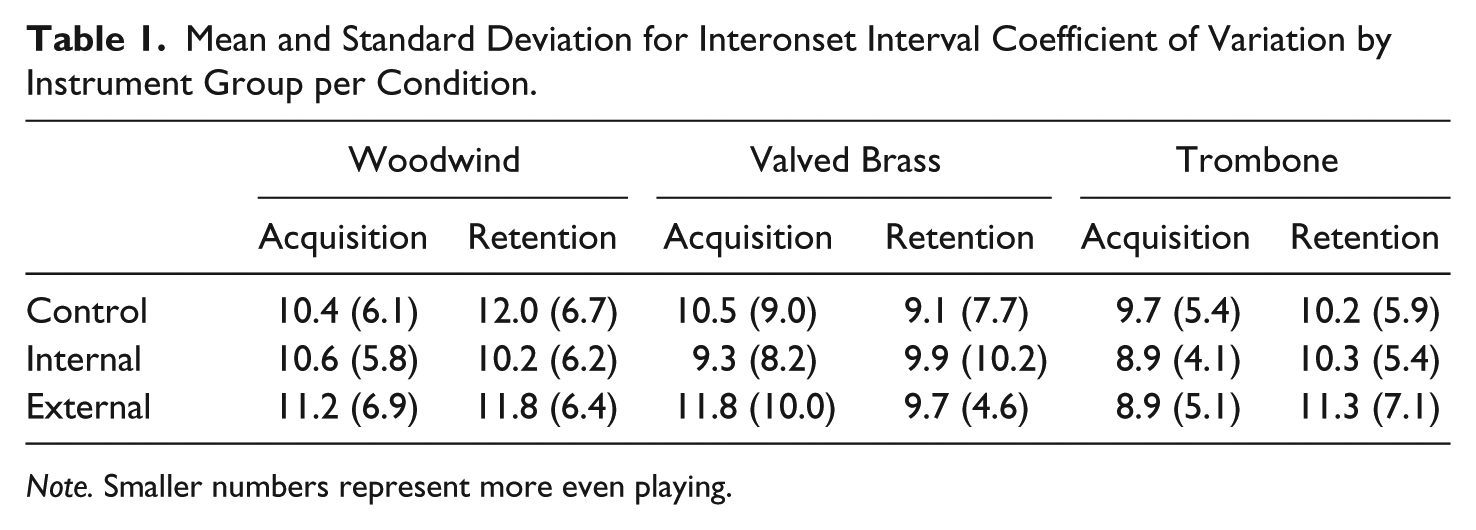
Note. Smaller numbers represent more even playing.
Omnibus ANOVAs.
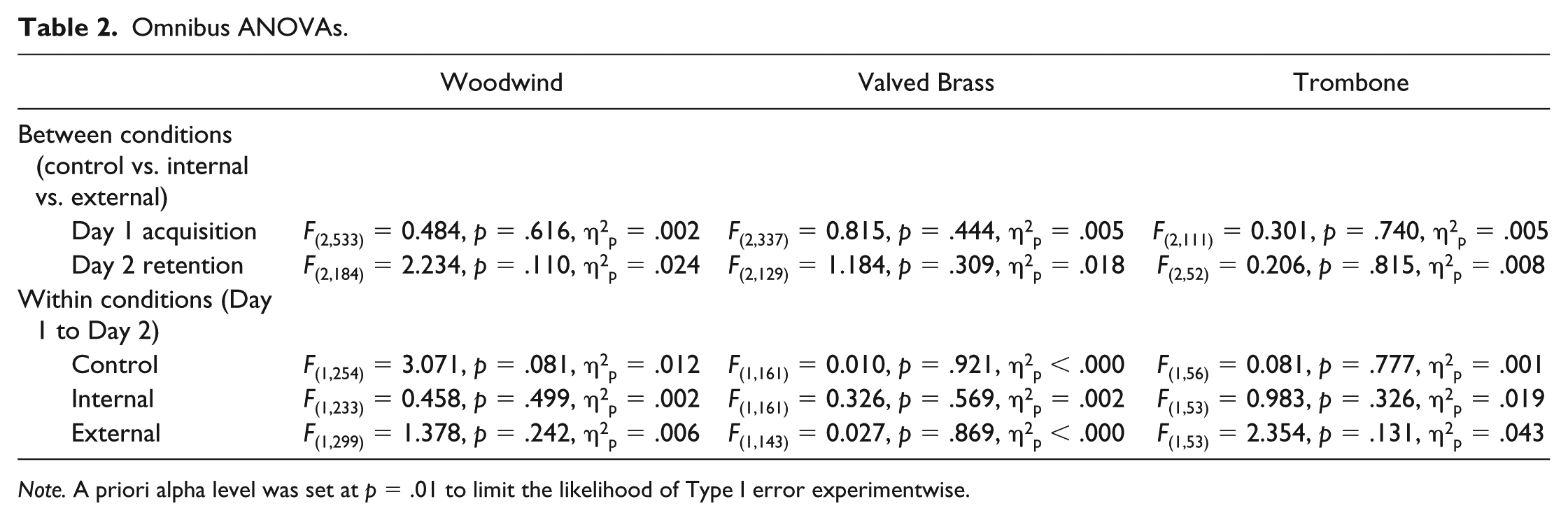
Note. A priori alpha level was set at p = .01 to limit the likelihood of Type I error experimentwise.
An alternate way to explore these results is at the level of the individual student (Atkins & Duke, 2013). At retention testing in the woodwind group, 12 students played most evenly after having practiced on Day 1 in the internal condition, although 7 students played most evenly due to the control and external practice conditions. At retention testing in the valved brass group, 8 students played most evenly resulting from practice in the internal condition, while 4 students played most evenly due to the control and external practice conditions. At retention testing for the trombones, 7 students played most evenly as a result of practice in the external condition, 4 students in the control condition, and 3 students in the internal condition.
Discussion
Grade 7 band students practiced an alternating note pattern under conditions of control, internal FOA, and external FOA. No significant differences in evenness were found between conditions at acquisition and retention, nor within instrument groups from acquisition to retention. At the level of the individual student, more woodwind and valved brass students tended to play most evenly in the internal FOA condition. However, the majority of trombone students tended to play most evenly in the external FOA condition, and the effect size for this condition, while still quite small, was the largest of all comparisons.
An unexpected finding was that evenness in the control condition was no worse than evenness in both of the other FOAs. Generally, any practice structure will be more beneficial than no practice structure (Barry, 1990, 1991; da Costa, 1999). In this study, both the internal and the external FOAs provided very specific practice structures. I expected the control condition, where students were given no explicit attentional directions, would parallel the practice that the students would naturally do on their own. Unfortunately, I failed to consider that I was actually creating a practice structure by telling them to play as evenly and accurately as possible and telling them when to play each trial. The control condition did not truly represent a student’s natural practice habit. Then again, it could be considered a strength that my presence in the room and prompts of when to play were constant in both the control and experimental conditions.
An extensive body of research on FOA in motor skills performed by adults has supported the benefits of external FOAs over internal FOAs. With children, previous research has had less consistent results, and this study also shows contradictions to prior research. The possible external FOA advantage for trombone players is consistent with other large motor skill tests in children (Abdollahipour et al., 2015; Jarus et al., 2015). However, like in Perreault and French (2016), who tested 9- to 11-year-old children on basketball shooting, there were no significant differences among the control, internal FOA, and external FOA conditions. In addition, in speech therapy research, children learned to correct a misarticulated /r/ equally well using internal and external FOAs (Byun, Swartz, Halpin, Szeredi, & Maas, 2016). This is an interesting parallel to the wind nature of the band instruments and tongued notes performed in the current study, even though the internal FOA targeted fingers/hands and not embouchure or tonguing.
There are several possible reasons for the limited differences found between the internal and external conditions. Mohamadi et al. (2012) suggested children use different learning strategies than do adults. Several authors have argued that children have fewer cognitive resources than do adults and that children’s motor skills are less automated (Emanuel et al., 2008; Tse & van Ginneken, 2017). Yet it should be noted that verbal working memory capacity of children ages 8 to 9 and 11 to 12 years was not predictive of ability to learn a golf-putting task (Brocken, Kal, & van der Kamp, 2016). Working memory capacity is only one aspect of executive functions that could interact with FOA. Finally, the general advantage of an external FOA may be mitigated for fine motor skills because tactile feedback, more available in the internal condition, has been beneficial for expert typists (Gordon & Soechting, 1995) and expert clarinet players (Palmer, Koopmans, Loehr, & Carter, 2009).
Theoretical viewpoints offer another vantage point for considering the results of this study. Newell (1985) proposed three stages of motor skills development: coordination, control, and skill. The stages may interact with FOA in such a way that a specific FOA is effective at a specific skill stage (Peh et al., 2011). Evidence supporting this idea is shown through the large number of experts who benefit from an external FOA but are impaired by an internal FOA (Wulf, 2013). Another theory to consider is conscious control propensity (Tse & van Ginneken, 2017). Tse and van Ginneken (2017) suggested an individual’s inclination toward using explicit verbal instructions may capitalize on internal FOAs. Here, this was demonstrated in the analysis of which FOA condition was most effective for individual students (see also Atkins, 2013).
When these results are considered in the context of other music FOA research, the unique contribution of this research is that it included children instead of college students. As a result, the closet relevant literature for comparison are studies with novice college musicians. The external FOA was most beneficial for novice college pianists (Duke et al., 2011), both internal and external FOAs were beneficial for college singers’ tone (Atkins & Duke, 2013), and an internal FOA tended to be most beneficial for college woodwind players’ accuracy (Stambaugh, 2017). The lack of consensus among music studies may be related to the complexity of producing sound: two fingers (piano) versus breathing plus embouchure and fingers (winds) versus breathing plus vocal mechanism (voice). Here, the majority of seventh-grade woodwind players also benefited from an internal FOA. The valved brass players were probably more similar to the woodwind players than to the trombone players because the pitches in the playing tasks remained within the range of one partial.
Limitations and Future Research
An important consideration of the expert/novice paradigm is age. A novice learner can be any age. There may be preexisting cognitive and/or motor skill disparities between differently aged groups of novices. Likewise, it is possible to imagine some children could have skills at expert levels. The present state of FOA research situates experts as adults, adults as either experts or novices, and children as novices. As research in FOA and focus-related fields continues, it will be beneficial to include participants from all the permutations of expert/novice levels and child/adult/senior adult ages.
Next, the musical tasks students played were built directly on previous research (Duke et al., 2011; Stambaugh, 2017) to facilitate comparisons across studies. The tasks were very simple and lacked musical affect. It is possible FOA may affect more complex musical passages in different ways than it did these simple tasks. Future research should include musical tasks comprising more than two pitches.
Also, a potential limitation of the current study was that it included no measurement to check whether students were actually focusing their attention as cued. Perreault and French (2016) suggested children are less capable of adhering to FOA directives because their working memory is more limited than adults’. However, Brocken et al. (2016) found no evidence that verbal working memory capacity interacted with FOA condition for elementary school children. To ensure children were using the cued FOA, I refreshed the FOA directive every other trial. To test the effectiveness of FOA conditions in unmonitored practice, future research should include an adherence check. It also should include an assessment for conscious control propensity that can be used as a covariate.
Implications for Teaching and Learning
FOA was used in a specific way in this study. I applied it to a very restricted type of musical task, and the learners were adolescent, 2nd-year band students. By considering these results in conjunction with results from other music FOA studies, some early recommendations can be offered. Teachers should consider letting middle school students explore both types of FOAs until further research determines whether conscious control propensity is a relevant factor (Tse & van Ginneken, 2017). In particular, novice woodwind and valved brass players should try using an internal FOA because it draws attention to a motor program that is still concatenating. Yet expert vocalists and instrumentalists are less likely to benefit from an internal FOA because it may interrupt already established motor programs. Finally, because teachers cannot be at their students’ homes to help with practice, FOA conditions provide students with a definitive way to use their attention during home practice.
Supplemental Material
DS_10.1177_0022429419835841 – Supplemental material for Effects of Focus of Attention on Performance by Second-Year Band Students
Supplemental material, DS_10.1177_0022429419835841 for Effects of Focus of Attention on Performance by Second-Year Band Students by Laura A. Stambaugh in Journal of Research in Music Education
Footnotes
Declaration of Conflicting Interests
The author declared no potential conflicts of interest with respect to the research, authorship, and/or publication of this article.
Funding
The author received no financial support for the research, authorship, and/or publication of this article.

Supplemental Material
Author Biography
References
Supplementary Material
Please find the following supplemental material available below.
For Open Access articles published under a Creative Commons License, all supplemental material carries the same license as the article it is associated with.
For non-Open Access articles published, all supplemental material carries a non-exclusive license, and permission requests for re-use of supplemental material or any part of supplemental material shall be sent directly to the copyright owner as specified in the copyright notice associated with the article.
