




Abstract
The purpose of this study was to examine the effects of tonic drone accompaniments on the intonation of collegiate wind instrumentalists. Participants (N = 68) played an excerpt of the melody “Long, Long Ago” in three conditions: a mono drone (tonic note only), dyad drone (tonic plus fifth), and a control condition (no drone). Results indicated no significant effects on intonation performance due to drone condition. However, participants’ ratings of their own intonation accuracy differed significantly based on drone condition. The majority of the performances of the melody aligned more closely with equal temperament (n = 159), and fewer aligned more closely with just intonation (n = 45). Most participants believed the dyad drone (59.74%) resulted in their best intonation accuracy, followed by the mono drone (28.57%) and the control condition (11.68%). In response to open-ended questions, participants cited reasons why they preferred particular drone conditions, with the most common themes being “easier to hear and match,” “multiple reference pitches,” and “focused/directed listening.” Given that participants expressed preferences regarding drone use in the absence of performance differences, music educators may consider the role of comfort and familiarity with these instructional tools.
Teaching students to perform with accurate intonation is a goal of instrumental music educators in a variety of settings. Although the need to teach instrumentalists to play in tune seems obvious, intonation remains a difficult concept to teach because it involves the interaction of various subskills, such as pitch discrimination and pitch matching, in different musical contexts (Morrison & Fyk, 2002). Rush (2006) emphasized the difficulties of intonation pedagogy and explained that intonation “is almost impossible to teach” (p. 80). It is not surprising that intonation remains one of the most noticeable areas in need of improvement among developing instrumental ensembles (Johnson & Geringer, 2007; Springer, 2016). By understanding a variety of techniques that can be used to help improve their students’ intonation, instrumental music educators can be better prepared to address this important concept with their students.
Authors of previous intonation research studies have indicated a few common trends. There appears to be an overwhelming preference for and inclination toward sharpness among instrumentalists (Byo & Schlegel, 2016; Geringer, 1978; Madsen & Geringer, 1976; Morrison, 2000; Yarbrough et al., 1997). However, this tendency for playing sharp has not been found consistently. For example, significantly more of the collegiate woodwind musicians in Ely’s (1992) study performed flat versus sharp while listening to recorded examples of other woodwind instruments. Researchers have also reported weak relationships between instrumentalists’ intonation perception and performance (Byo et al., 2011; Morrison, 2000; Silvey et al., 2019; Yarbrough et al., 1995), underscoring Morrison and Fyk’s (2002) assertion that these indeed may be separate abilities that should be learned and refined. Finally, researchers have found that perceptions of intonation differ as a function of timbre. For instance, listeners judged equally mistuned intervals differently on the basis of timbre (violin, trumpet, or voice) in two related studies (Geringer et al., 2015a; Geringer et al., 2015b). Additionally, university and high school musicians confused intonation with timbre because they associated dark timbres with flatness and bright timbres with sharpness (Geringer & Worthy, 1999; Wapnick & Freeman, 1980).
Further complicating the matter is that intonation practices for instrumentalists also differ across various tuning systems (i.e., Pythagorean, just, and equal temperament). Pythagorean tuning is based on fixed ratios for octaves (2:1) and perfect fifths (3:2), which allows for a tuning system that achieves a “pure or perfect fifth” (Wagner, 2009, p. 95). Just temperament is focused on acquiring pure, acoustically beatless consonances, especially the octave, perfect fifth, and major third intervals (Garofalo, 1996). Equal temperament is a tuning system in which all chromatic semitones are separated by 100 cents (Wagner, 2009). University music students and professional musicians participating in Hall and Hess’s (1984) study judged musical intervals generated by a synthesizer (rectangular pulse waves) to be more in tune when the intervals were presented with just temperament than when they used equal temperament. However, in a similar study, Loosen (1995) observed that violinists preferred Pythagorean tuning and that pianists preferred equal temperament. Geringer (2018) found that artist-level violinists demonstrated unique intonational tendencies, but their performances of major thirds revealed a propensity toward Pythagorean tuning. Pedagogues have suggested that wind instrumentalists tend to utilize equal temperament and just intonation systems most often (Feldman et al., 2016; Garofalo, 1996; Rush, 2006). Karrick (1998), however, reported that wind instrumentalists’ performances were aligned more closely to equal temperament compared with just intonation. He also noted that thirds and sixths were performed less in tune than other consonant intervals (fourths, fifths, and octaves). Similarly, in a study of two professional trumpeters, Kopiez (2003) observed that even experts’ intonation performance did not change when playing a melody over equal temperament versus just intonation accompaniment. Kopiez attributed this consistency to an unconscious “burn-in effect” (Kopiez, 2003, p. 404) caused by long-term practice with equal temperament.
To address the challenges of intonation among students, many pedagogues have recommended using singing or humming in their instrumental music classrooms to improve intonation (Colwell et al., 2018; Garofalo, 1996; Rush, 2006). According to Scherber (2014), many public school and collegiate instrumental directors perceived vocalization to be an effective pedagogical technique and used it frequently in their rehearsals with the goal of improving intonation. Despite these pedagogical recommendations and practices, there are mixed findings on the effectiveness of vocalization on intonation. Although some researchers have found vocalization to improve pitch discrimination (Elliott, 1974) and tuning performance (Schlacks, 1981), others reported no improvement in tuning accuracy as a result of vocalization (Bennett, 1994; E. Smith, 1984; South, 2013). Silvey et al. (2019) tested the differential effects of two pretuning vocalization behaviors (singing and humming), and they found no significant differences in tuning accuracy based on those behaviors. Taken together, these varied findings indicate that vocalization may be effective in addressing certain intonation outcomes for instrumentalists, but those effects were not observed consistently across all studies.
The use of chromatic tuners has also been recommended by some pedagogues because of the instantaneous feedback these devices provide (Strickland, 2013). Although some educators advocate for the use of tuners, others caution that their use may cause students to rely on visual feedback rather than aural feedback (Feldman et al., 2016; Griswold, 1988). Nevertheless, researchers have reported that tuners are used frequently by both students and teachers in instrumental rehearsals to improve intonation accuracy (Droe et al., 2011; Scherber, 2014; Silvey, 2013). Researchers who have investigated the effects of tuner usage found that the visual feedback of tuners resulted in improved pitch-matching ability (D. Smith, 2006; Welch et al., 1989). However, musicians’ experience level may influence the degree to which they rely on the visual feedback of a tuner (Schlegel & Springer, 2018).
Drones are another recommended pedagogical strategy for improving instrumentalists’ intonation, as evidenced both by research (Scherber, 2014; Zabanal, 2020) and practitioner sources (Colwell et al., 2018; Griswold, 1988). Results of descriptive studies have indicated that band directors (Scherber, 2014) and collegiate string musicians (Zabanal, 2020) recommended drones as tools to improve intonation. Authors of practitioner articles have corroborated those research findings. For example, Griswold (1988) posited that drones are a universal textural feature of music across various stylistic eras and geographic locations and recommended that students perform scales and arpeggios with sustained tonic drones to improve their intonation. Feldman et al. (2016) suggested that drones are useful in individual, small-ensemble, and large-ensemble settings and encouraged band directors to play unison and perfect fifth drones during sections of the literature that are firmly diatonic. Begin playing a tonic drone before the group enters and keep it going during the entire section, making sure it is loud enough to be heard. (p. 250)
Empirical investigations of the effects of drone accompaniments on instrumentalists’ intonation are scant. In an investigation with beginning violinists and violists, Laux (2015) observed that the use of a tonic drone accompaniment did not affect participants’ intonation while playing major scales. However, participants made significantly more intonation adjustments when performing with a tonic drone accompaniment than when no accompaniment was present (even though those adjustments did not result in more accurate intonation overall). Similarly, Zabanal’s (2019) participants (middle school and high school violinists and violists) demonstrated no significant differences in tuning accuracy among pretest, drone-accompanied posttest, and unaccompanied posttest conditions.
Much remains to be known about how tonic drone accompaniments function as aids in intonation pedagogy, especially how they might affect the intonation of wind instrumentalists and how they might be utilized in more musically complex melodic settings. Because many of the recommendations regarding drone use in instrumental settings are from practitioner articles (e.g., Griswold, 1988) and textbooks (e.g., Colwell et al., 2018; Feldman et al., 2016), there is a need for more empirical research to supplement the research findings reported in previous studies of string musicians (Laux, 2015; Zabanal, 2019). Furthermore, because pedagogues have recommended that drone usage can teach students to “prefer the pure sound to the tempered one” (Feldman et al., 2016, p. 249), it would be beneficial for music educators to understand how the use of a tonic drone accompaniment might influence the performed tuning system (just intonation vs. equal temperament) of a melodic passage. Given that the use of tonic drones is common (Scherber, 2014) and is a recommended practice among instrumental music pedagogues for improving students’ intonation (Colwell et al., 2018; Feldman et al., 2016), it is important to examine the effects of drone usage on wind instrumentalists’ intonation to determine whether these recommendations from practitioner sources can be supported by empirical research findings.
The purpose of this study was to examine the effects of tonic drone accompaniments on the intonation of college wind instrumentalists. Although drones have been utilized extensively in pedagogical contexts, we sought to determine whether there were intonation benefits to this practice and to explore how participants’ performance may have aligned with the research literature on temperament. Additionally, the elements of participant perception and preference had not been explored previously with drone accompaniments. Therefore, we posed the following research questions: (1) What are the effects of tonic drone accompaniments (tonic-only drone, tonic-plus-fifth drone, or control [no drone]) on participants’ intonation performance? (2) What are the effects of tonic drone accompaniments on participants’ perceptions of their intonation? (3) What temperament system (equal temperament or just intonation) is most evident in participants’ performance when playing with tonic drones as demonstrated by their performance of major thirds? (4) What types of drone accompaniments do participants prefer, and for what reasons? (5) How many of our participants had previous experience with drones, and how were they used?
Method
Participants
We sampled from college musicians who played the clarinet and trumpet. We delimited the study to those instruments because both perform in the same octave with the same transpositions, which allowed performances on these instruments to be compared with common pitch targets. Additionally, because previous research findings have indicated that the octave distance above or below a stimulus tone can be an influential factor in pitch performance (Byo et al., 2011), using two instruments that perform in the same octave allowed us to control for the distance above the stimulus drones.
Before recruiting participants, we conducted an a priori power analysis using G*Power software Version 3.1.9.3 (Faul et al., 2007) to determine the necessary sample size for this investigation. Given our planned use of a repeated-measures multivariate analysis of variance (MANOVA; within-between interaction), an intended test power of .80, a significance level of α = .05, and an effect size of f = .33 (Cohen, 1988), the results of the power analysis indicated a minimum sample size of 66. Participants (N = 68) were undergraduate musicians enrolled at a large university in either the Midwest or the Southeast. Demographic data indicated our participants’ gender (male, n = 43; female, n = 24; nonbinary, n = 1), age (M = 20.1 years, SD = 2.8), year in school (freshman, n = 20; sophomore, n = 15; junior, n = 15; senior, n = 12; graduate student, n = 4; no response, n = 2), academic major (music education, n = 35; music performance, n = 8; bachelor of arts in music, n = 5; music therapy, n = 2; commercial music, n = 1; other, n = 17), and years of playing experience on their major instrument (M = 9.4, SD = 2.8). There were 39 clarinet players and 29 trumpet players.
Stimulus Creation
We created two drones for use in this study using Adobe Audition (Version 11) software—one using a tonic note only and the other using both a tonic note and fifth. Hereafter, for clarity and simplicity, we use the terms mono (tonic pitch only) and dyad (open fifth) to refer to these drones (Feldman et al., 2016, p. 250). Because our participants performed in the key of C major, we utilized the pitches C3 (130.81 Hz) and G3 (196.00 Hz). We used the organ timbre of Adobe Audition to create the drones because it most closely represented the timbre of drones that are used in instrumental music settings (e.g., Yamaha Harmony Director and Tonal Energy application). Each drone was 60 s in duration. During pilot testing, we confirmed that this duration was long enough for the study because the pilot participants’ (N = 9) performances of the melody ranged in duration from 11 to 23 s. Drones were exported as .wav files (48000 Hz sampling rate, 32-bit stereo) to be used for subsequent playback to participants.
We selected a four-measure excerpt of the traditional folk song “Long, Long Ago” (Figure 1) because it was a stepwise, diatonic melody that included notes of longer duration on the tonic and third scale degrees that would serve as analysis tones to answer our research questions. Also, because the melody was based on the notes of the tonic triad, it was an appropriate melody to perform with a tonic drone accompaniment. The selection of this type of excerpt was consistent with research protocols found in previous tuning investigations (Geringer et al., 2015b; Morrison, 2000). The excerpt was notated in the key of concert C major (written D major for clarinet and trumpet). We chose to use the key of concert C major because it was a moderately easy key that also included some challenging intonation tendency notes (e.g., the low D in the trumpet and F-sharp in the clarinet; Fabrizio, 1994), which would require participants to use their aural discrimination abilities to make adjustments while playing.

Melody performed by participants.
Procedures
Once participants (who had read and signed institutional review board–approved informed consent documents) arrived at the faculty office at their respective institution, we clipped a Pyle-Pro PMSAX1 condenser microphone to the end of their instrument’s bell, which was connected to a MacBook computer via a Pyle PAD20MXU five-channel audio mixer. By using a clip-on microphone, we were able to record participants’ performances without interference from the drones, which would be sounding simultaneously. When analyzing sound files, we listened to the files to confirm that there was no unintentional recording of the drones. Then, we instructed them to warm up and tune their instruments for approximately 90 s. We provided a chromatic tuner set at A = 440 Hz for this warm-up period, and we tested and adjusted the microphone settings for each participant during this time. We also gave them time to study the excerpt to be performed with a Boss DB90 metronome set at 70 bpm to establish a consistent tempo. We provided a copy of the melody to be performed on a music stand along with a pencil and a response sheet. After the warm-up period was complete, the tuner and the metronome were turned off and removed from sight for the remainder of the research procedures. Then, we read the following instructions to participants: You are about to perform a short, four-measure musical excerpt three separate times. Before and during your performance of the excerpt, you will hear a drone consisting of either (a) the tonic pitch, (b) the tonic pitch plus the fifth, or (c) no drone. At the conclusion of each performance trial, you will hear music and be asked to respond to the following question: “How accurate was your intonation in this excerpt?” We will repeat this process three times, once for each of the three tuning activities.
We used a within-subjects design wherein participants performed the excerpt in a control condition (with no drone), with a mono drone (with participants hearing the mono drone prior to and during their performance), and with a dyad drone (with participants hearing the dyad drone prior to and during their performance). Stimulus drones were initiated from iTunes on a laptop computer that was played through a Bose Soundlink speaker at a loudness level that could be heard easily while the participants performed the melody. To counterbalance the order of conditions, we used a 3 × 3 Latin square design.
In the control condition, we gave the following instructions to participants: “Please perform the melody that you see on your stand now.” In the drone conditions (mono and dyad), we instructed the participants to “please listen to the drone” after the drone began sounding. Then, we asked them to “please perform the melody that you see on your stand now.” Participants were able to begin playing the melody when they were ready after hearing the final instruction. Participants’ performances were recorded individually.
We played 15 s of Edgard Varèse’s Amériques between each of the three performances. Similar to previous research protocols (Nápoles et al., 2019; Silvey et al., 2019), we chose this atonal excerpt to serve as distraction music between each repetition of the tuning task in order to limit participants’ tonal memory. While listening to this 15-s excerpt of distraction music, participants also responded in writing to the question, “How accurate was your intonation in this excerpt?” using a 10-point Likert-type scale anchored by 1 (not accurate) and 10 (very accurate). After participants were finished with all three trials, we asked them, “Which resulted in your most in-tune performance? Why?” on their response sheet, with options for “Tonic drone,” “Tonic and fifth drone,” “No drone,” and “There was no difference in my intonation in each of the trials.” Similar to previous studies (Byo et al., 2011; Byo & Schlegel, 2016; Silvey et al., 2019), we wanted to explore participants’ perceptions of their tuning accuracy with their actual performances. Additionally, participants responded to the question, “Do you use drones during your individual practice or ensemble rehearsals? If so, how are they used?” After giving the participants time to write their responses, we asked them to complete a final demographic questionnaire. Data collection lasted approximately 10 min for each participant.
Data Analyses
We used Praat software (Version 6.0.42) to determine the mean frequency of participants’ performances of each target tone. Those frequency (Hz) values were converted to cent deviation values using a cent deviation calculator (Sengpiel, 2017). For the first research question, we selected two target pitches for analysis (the first note and the last note of the melody) because they were both tonic pitches that occurred on strong beats within the musical phrase. Similar to previous studies (Morrison, 2000; Nápoles et al., 2019), the use of those target pitches allowed us to examine not only how accurate participants were in matching the first note of a melody but also how accurate they were at performing that same note later in the melody. We treated each of the pitches as separate dependent variables in data analyses.
For the third research question, we investigated the temperament system (equal temperament vs. just intonation) that was most evident in participants’ performances in each drone condition. We selected a sustained major third pitch that occurred on a strong beat in the musical phrase for this analysis. We chose that analysis tone because major thirds have been used as target pitches for analysis in previous instrumental tuning studies focused on temperament (Geringer, 2018; Karrick, 1998; Kopiez, 2003). Furthermore, because major third intervals in just intonation are tuned 14 cents lower than major thirds in equal temperament (Colwell et al., 2018; Rush, 2006; Wagner, 2009), this interval could serve as an indicator of equal temperament or just temperament systems. The target tones for analysis are labeled in Figure 1. Because some participants may have audiated a dominant harmony while playing the third measure of the melody, we selected only target pitches that were found in the implied tonic sections of the melody. Participants viewed a “clean copy” of the melody without the annotated target tones for analysis.
Results
We conducted preliminary analyses to investigate effects due to presentation order and institution. We also tested for differences based on participants’ instrument (clarinet vs. trumpet). Results indicated nonsignificant differences for all main effects and interactions (p > .05), so we included all participants in a single data set and conducted data analyses without including those variables (order, institution, and instrument) in the model. Then, we screened the data to determine whether they met the assumptions for a MANOVA. Assumptions for MANOVAs include independent observations, normality, sensitivity to outliers, homogeneity of variance–covariance matrices, and the absence of multicollinearity (Hair et al., 2014). Although we gathered data from 77 students initially, our final sample size of 68 was the result of removing nine outliers whose performances deviated by 1.5 times the interquartile range in any condition, which we determined by using the SPSS Explore function (Parke, 2013). After removing those outliers, we assessed normality by inspecting histograms and normal probability plots as well as standardized skewness and kurtosis values. Correlations among all levels of the dependent variables were ≤.66, indicating the absence of multicollinearity. Results of Box’s test indicated a violation of the homogeneity of variance-covariance matrices assumption, M = 170.65, p = .01, so we used a more robust test statistic (Pillai’s trace criterion) when reporting MANOVA results (Hair et al., 2014).
To address the first research question, we conducted a repeated-measures MANOVA using drone condition (control [no drone], mono drone, or dyad drone) as a within-subjects factor. We calculated the cent deviation of the two tonic target pitches from 261.62 Hz (the frequency of the tonic drone multiplied by 2 to establish octave equivalency), and those cent deviation values expressed in absolute value served as our dependent variables (Tonic 1 and Tonic 2). These dependent variables (Tonic 1 and Tonic 2) represented the construct of intonation accuracy in this multivariate context. Results indicated that the effect of the drone was nonsignificant, Pillai’s trace = 0.03, F(4, 268) = .99, p = .42. Descriptive statistics for all drone conditions are summarized in Table 1.
Absolute Cent Deviation Values by Drone Condition.

Note. Means are reported in cent deviation values expressed in absolute value.
Our second research question concerned participants’ perceptions of their tuning accuracy as a function of drone condition. We conducted a repeated-measures analysis of variance (ANOVA) 1 using drone condition as the independent variable. The dependent variable was participants’ response to the question, “How accurate was your intonation in this excerpt?” which was rated on a 10-point rating scale (1 = not accurate, 10 = very accurate). Results indicated a significant difference in ratings based upon drone condition, F(2, 134) = 7.92, p = .001, η2p = .11, and Bonferroni-adjusted pairwise comparisons indicated significant differences between the dyad drone (M = 7.81, SD = 1.37) and the control condition (M = 7.10, SD = 1.38), p = .001. Ratings of the mono drone condition (M = 7.43, SD = 1.34) were not significantly different from the other conditions.
In order to answer our third research question regarding what temperament system was most evident in participants’ performance of major thirds, we analyzed their results descriptively. We compared participants’ absolute cent deviations on the major third target pitch to the frequency of the pitches in just intonation (327.03 Hz) and equal temperament (329.63 Hz) systems, and we identified whether the performances more closely matched just intonation or equal temperament in each condition. Overall, there were 45 instances (of 204) when participants’ cent deviations more closely matched just intonation and 159 instances when cent deviations more closely matched equal temperament. As shown in Table 2, the resulting temperament systems were similar in all conditions.
Number of Performances That Most Closely Matched Equal Temperament and Just Intonation in Each Condition.
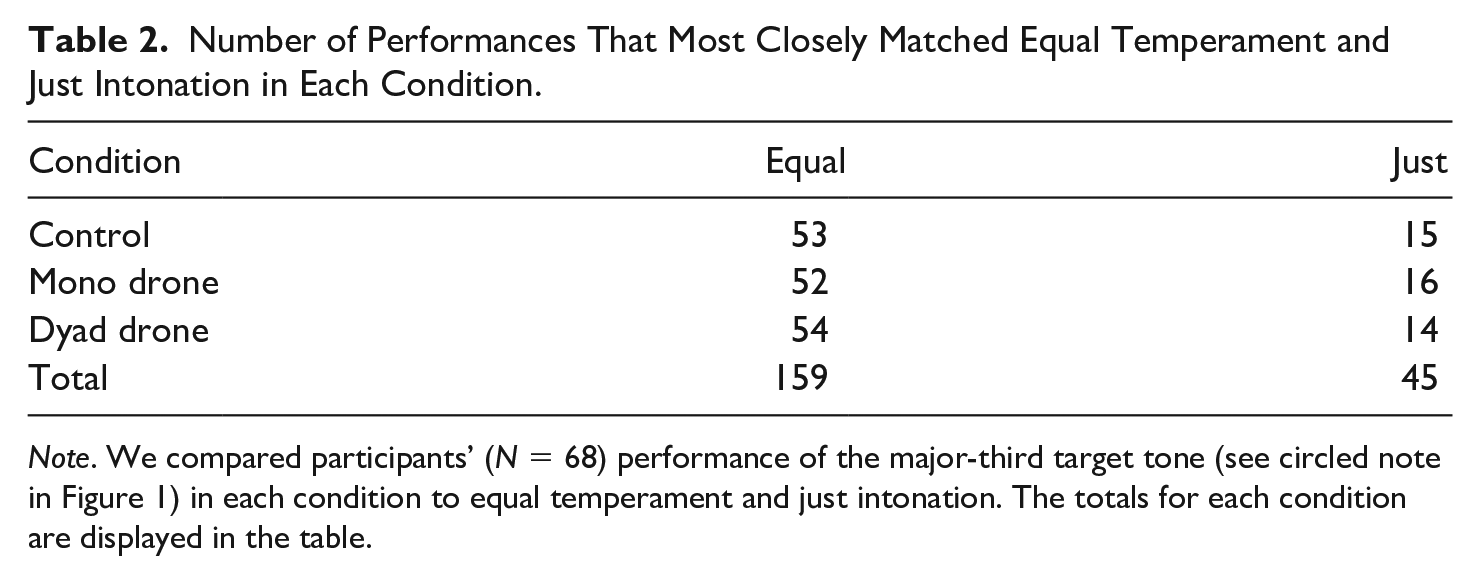
Note. We compared participants’ (N = 68) performance of the major-third target tone (see circled note in Figure 1) in each condition to equal temperament and just intonation. The totals for each condition are displayed in the table.
For the fourth research question, the third author counted the frequency of participants’ responses to the question, “Which resulted in your most in tune performance?” The largest portion of participants (n = 46, 59.76%) selected tonic and fifth drone as their most accurate condition, followed by tonic drone (n = 22, 28.57%) and no drone (n = 9, 11.68%). For the second part of the question, “Why?” the third and fourth authors adopted a content analysis procedure whereby we independently reviewed participants’ responses, assigned codes, and combined codes into themes (Fraenkel et al., 2012). Once coding was complete, we exchanged the list of themes with one another. After consultation, we reduced and renamed our categories, which resulted in five main themes. In order to establish reliability, a music education doctoral student (who was not associated with the project but had prior experience with reliability procedures) examined 20% of the comments. We calculated reliability by dividing the number of agreements by total observations, and results indicated a high interrater reliability of .89. Participants’ responses (N = 79) resulted in the following themes: easier to hear and match (n = 31, 39.24%), multiple reference pitches (n = 29, 36.71%), focused/directed listening (n = 10, 12.66%), order (n = 6, 7.59%), and other (n = 3, 3.80%) (the number of responses exceeds the total sample size because some participants provided multiple responses. In addition, four participants did not provide a written response). Examples of comments for easier to hear and match included “I felt as though I was able to hear the pitches better and hear my sound fit in” and “I can hear where each note fits into the chord.” Sample comments for the second most frequently cited theme of multiple reference pitches included “Multiple reference pitches gave me anchors” and “I think that having two notes helped me in tuning certain pitches in my performance.” Sample comments for the theme of order included “By the third time, I was already gauging my sound better” and “I adjusted to it after the first run-through.” Other comments were those that did not fit into any category, such as “Tonic was a good checkpoint for tonic and 3.”
In order to answer our fifth research question, participants responded to the final open response question: “Do you use drones during your individual practice or ensemble rehearsals? If so, how are they used?” Almost three quarters of our participants indicated that they used drones during individual practice or ensemble rehearsals (n = 56, 72.72%), whereas 21 participants (27.27%) indicated that they did not use drones in either context. We used the same content analysis and reliability procedures that were used for our previous question for those 56 participants who indicated that they did use drones. This process resulted in four themes and a high interrater reliability value of .90. Participants’ use of drones related to individual intonation practice (n = 29, 51.78%), individual warm-ups (n = 14, 25.00%), performing long tones (n = 11, 19.64%), and ensemble intonation practice (n = 8, 14.28%). For those who used drones in their individual practice, sample comments included “Used in warming up in order to stay centered and start off the day in tune” and “I used them some when I am working on notes that have flat or sharp tendencies.” Sample comments written by participants who indicated that they used drones in ensemble settings included “They are used in my ensemble to tune intervals throughout the whole band” and “They are used to tune the ensemble by slowly adding in voices.”
Discussion
The purpose of this study was to examine the effects of tonic drone accompaniments on wind instrumentalists’ intonation. Participants performed a melodic excerpt in three conditions: mono drone (tonic only), dyad drone (tonic plus fifth), and a control condition with no drone. Although many band directors commonly use drones to refine students’ intonation (Scherber, 2014), results of the present study indicated no significant differences in intonation performance based upon drone condition. As shown in Table 1, absolute cent deviation values were similar in each condition. String musicians in previous research also demonstrated no significant differences in performance in drone versus no-drone conditions (Laux, 2015; Zabanal, 2019). These nonsignificant results could be due to the short-term nature of the drone conditions used in these studies. We believe it is important to examine the longitudinal effects of drone use in future research because these tools may have long-term effects on the development of musicians’ intonation skills. Additionally, it would be beneficial for researchers to investigate how drones might influence the directionality (sharp or flat) of instrumentalists’ intonation performance.
Participants’ perceptions of their intonation accuracy varied based on drone condition (p = .001); however, the effect was modest (η2p = .106). Participants rated their own accuracy higher in the dyad condition as compared with the control condition, even though their actual intonation results did not differ between conditions. This result is consistent with previous research findings that indicated weak relationships between intonation perception and performance (Byo et al., 2011; Morrison, 2000; Schlegel & Springer, 2018; Silvey et al., 2019; Yarbrough et al., 1995). Perhaps participants felt more comfortable when performing with the dyad drone or preferred the sound of the open fifth drone, which may have resulted in their higher perceptions of accuracy in that condition. Zabanal (2020) found a positive relationship between frequency of drone use and perceptions of its effectiveness, so this incongruity between intonation perception and performance also could be due to the frequency of drone use among many of the participants.
Although pedagogues have recommended that drones can encourage wind instrumentalists to play in just intonation as compared with equal temperament (Feldman et al., 2016), our participants’ performance of a major third target pitch revealed that they more closely matched equal temperament (159 instances) than just intonation (45 instances). As displayed in Table 2, this trend was consistent across all conditions. This finding is consonant with that of Karrick (1998), who found that college and professional wind instrumentalists’ tuning of intervals most closely aligned with equal temperament, but differed from Loosen’s (1995) and Geringer’s (2018) violinists, whose performances were most representative of Pythagorean tuning. It may be that instrumentalists gravitate toward a particular tuning system based upon the instrument they play (wind vs. string) or the ensemble (band vs. orchestra) in which they perform most frequently. Also, it could be that wind instrumentalists may adjust their intonation according to the context in which they are playing, as different tuning systems may be implied when they are performing with string musicians, other wind musicians, or pianists. We also note that because prior research has indicated a preference for sharpness among instrumentalists (Byo & Schlegel, 2016; Geringer, 1978; Madsen & Geringer, 1976; Morrison, 2000; Yarbrough et al., 1997), the large number of equal temperament instances could be due to a tendency to play sharp in general. Measuring and comparing wind and string instrumentalists’ tendencies while they perform intonation tasks in various contexts (i.e., solo, chamber, ensemble) would provide interesting data about whether musicians’ ability to tune is influenced by those around them or the ensemble in which they perform most frequently.
Nearly 75% of our participants indicated that they used drones during individual practice or ensemble rehearsals. Of those who did use drones, most of their comments related to drone usage during individual practice, not during ensemble rehearsals. Because the use of drones has been advocated by instrumental pedagogues as beneficial for students during ensemble rehearsals (Colwell et al., 2018; Griswold, 1988; Zabanal, 2020), researchers should consider selecting participants for a study based on the consistency and application of their ensemble directors’ usage of drones to determine if there would be significant differences in intonation performance between individuals who have more experience with drones in ensemble contexts versus those who do not.
Limitations
Some limitations of the current study should be considered when interpreting our findings. First, collegiate musicians served as participants in this study, and the skill level of these musicians may have resulted in a high level of success on this intonation task. Future researchers may wish to examine whether including participants with different experience levels would yield the same results. Additionally, participants performed one melody in this experiment. The use of other melodies with different keys/modalities likely would have resulted in differences in intonation performance; these variables were beyond the scope of this investigation. Also, our participants performed individually with one of the researchers in a quiet room using a clip-on microphone. For this reason, we gave participants the opportunity to warm up and tune their instrument before beginning the procedures, which allowed them time to get accustomed to the room acoustics, the clip-on microphone, and the presence of one of the researchers. The clip-on microphone allowed us to record participants’ performance individually without disturbance from the drone and without requiring participants to wear headphones to hear the drones. Still, although we made these efforts to preserve ecological validity, it is important to acknowledge that this experimental setting differs from the way that drones are used in large ensemble rehearsals. A future classroom study of drone usage is needed to corroborate the external validity of these findings.
Finally, we included only trumpet and clarinet players in this study to allow for unison pitch targets. We also made this decision to control for the octave distance above the tonic drone stimuli because researchers have previously identified this to be an influential factor in pitch performance (Byo et al., 2011). In future studies, researchers may wish to examine the effects of drone accompaniment octave level (e.g., one octave below stimulus vs. unison with stimulus) because musicians may perform differently based on the stimulus octave (Byo et al., 2011). Examining performers of other instruments also would be helpful because it would allow researchers to further investigate whether the effects of drones may differ based on the distance above a drone stimulus (e.g., unison with stimulus, one octave above stimulus, two octaves above stimulus). Additionally, because we have observed anecdotally that some directors use tonic drones along with vocalization (also reported by Scherber, 2014), a future exploration of how drones may function as intonation aids while vocalizing in instrumental rehearsals would be beneficial for music educators.
Implications
When examining the cent deviations of our participants in all three conditions, which had a narrow range of 7.42 to 7.81 cents, it is clear that these collegiate instrumentalists’ performances were not influenced by drones. Although our results do not appear to support the use of drone accompaniments for improved intonation of collegiate wind instrumentalists, it is premature to state with certainty that drone accompaniments are not helpful at earlier stages of development. Indeed, it is possible that our participants had experienced success with drones across time, leading to current intonation accuracy. Even though we selected a key signature that intentionally included some challenging intonation tendency notes, participants’ relatively consistent performance across conditions also could be evidence of a ceiling effect. As with other tools (e.g., vocalization and chromatic tuners), it may be the case that while they function well in initial skill building, their use may become less critical across time. It also could be that drones might function as cues for students to attend to their intonation such that the sound of a drone may prime students to focus on a given pitch target before they begin playing.
The lack of congruence between perception and actual performance is not surprising but also may provide evidence of a phenomenological reality of sorts—that because most participants have been used to practicing with drones, they believe it to be contributing to better intonation (Zabanal, 2020). It is also possible that their previous practice with drones actually may have developed their intonation skills over time. The preponderance of comments related to having multiple reference pitches and that it was easier to hear and match with a drone condition lend credence to participants’ beliefs that these accompaniments ought to contribute to better performance even when they do not. Last, it is worth considering the factor of familiarity and the role it may play in musicians’ level of focus and comfort, because those early learning tools may bring a greater sense of confidence to the task. It is incumbent upon music teachers to continue to seek teaching strategies that function well for their students and to determine whether those strategies yield performance benefits or psychological benefits exclusively. Given the need for music educators to teach such complex concepts as intonation to their students (Garofalo, 1983; Rush, 2006), ongoing empirical research is needed to support the development of evidence-based practices regarding intonation pedagogy.
Footnotes
Declaration of Conflicting Interests
The author(s) declared no potential conflicts of interest with respect to the research, authorship, and/or publication of this article.
Funding
The author(s) received no financial support for the research, authorship, and/or publication of this article.
