



Abstract
The purpose of this study was to investigate the effect of tonic drone accompaniment on the intonation of violinists and violists. Twenty-eight middle and high school students performed an ascending diatonic line and a descending dominant 7th arpeggio on the violin or viola in three trials: pretest, posttest accompanied with drone, and posttest unaccompanied. The students were grouped based on age and years of experience. A significant difference in cent deviation scores was found between age groups but not years of experience. Post hoc analysis revealed a significant difference between the middle-age group and the youngest group. No significant difference was found overall between pretest, drone accompanied posttest, and unaccompanied posttest conditions.
The pursuit of accurate intonation is a goal that many musicians endeavor to attain. Intonation in a musical context is described as a musician’s ability to perceive pitch deviations and to adjust appropriately during their own performance (Salzberg, 1980). In addition, intonation is a musical construct that has two levels: pitch discrimination, which is the ability to distinguish differences between two examples of a single pitch, and pitch matching, the ability of a musician to reproduce a given pitch accurately (Morrison & Fyk, 2002). Even though there are a number of other important aspects in music such as rhythm, tone quality, note accuracy, technique, and musicality, accurate intonation has been found to be one of the most salient elements that distinguishes a good musical performance (Geringer & Madsen, 1981, 1989, 1998; Johnson & Geringer, 2007). As such, intonation of string musicians is an area of interest for music scholars which includes preferences for tuning temperaments (e.g., Greene, 1937; Loosen, 1994, 1995), intonation and performance of vibrato on a string instrument (e.g., Geringer & Allen, 2004; Geringer, Allen, & Macleod, 2010; Geringer, MacLeod, & Allen, 2010), descriptive analyses of recordings of professional string musicians (e.g., Carman, 1936; Geringer, 2018; Geringer, Macleod, & Ellis, 2013), and tuning of open strings (e.g., Alexander, 2011; Hamann, Lauver, & Asher, 2006; Hopkins, 2015).
Musicians must work to develop their ability to perform music with accurate intonation (Hovey, 1976; Klotman, 1981). Music pedagogues have attempted to provide techniques that will help musicians improve their intonation. Kohut (1973) suggests that private instructors perform duets with their students to teach their students accurate intonation. Green (2010) advises teachers to use piano accompaniment to provide beginning string students with a good model of intonation for the first year of study. Hamann and Gillespie (2013) recommend to string teachers that they teach students to match a fingered pitch with an open string by performing both notes together as a double stop or to accompany scales and melodies with chords to improve aural skills. Researchers have also attempted to provide answers on how to improve intonation by testing the effectiveness of training programs and methodologies designed to improve intonation. Meyer (1993) created a computer program that was designed to provide violinists an aural and visual feedback of intonation while practicing. An aural-oral pitch-matching training program was found to improve pitch discrimination and performance accuracy of beginning string students compared with students that did not receive the same training (Smith, 1995). Nuñez (2002) examined an aural and an aural-visual methodology used to improve intonation accuracy with seventh grade violinists and violists; he found no significant difference between both methodologies.
Practice with a drone accompaniment appears to be a common technique used by instrumental music teachers to improve intonation of their students (Scherber, 2014). In addition, pedagogues in string education recommend the use of a drone accompaniment to improve intonation (Curry, 2011; Hopkins, 2012; Reel, 2005; Watkins, 2004). Curry (2011) and Hopkins (2012) suggest that students produce a sustained tonic drone against a particular scale. For example, Curry recommended that an E is produced on a tuner while the student performs an E major scale. Watkins (2004) recommends that practicing with a drone accompaniment is an excellent practice technique as it allows students to be more attuned to the variety of consonant relationships between pitches, and students are less likely to perceive dissonant relationships as sounding bad. In a recent study, Laux (2015) investigated the effects of training with a drone accompaniment on pitch accuracy of one-octave major scales of beginning-level violin and viola students. Students were placed in one of three groups: pitch-matching, tonic drone accompaniment, or pitch-matching with tonic drone accompaniment. Students experienced a 7-day training program consisting of warm-up lessons on D- and C-major scales for the first 5 to 10 min of each class. Students assigned to the experimental group were exposed to a tonic drone accompaniment during the warm-up lessons. No significant difference was found in an analysis of pretest and posttest data between groups; therefore, training with a tonic drone accompaniment did not appear to improve students’ intonation. Although string pedagogues recommend the use of drone accompaniments to improve intonation, this investigation by Laux (2015), which focused on beginning violinist and violists, appears to be the only study in the research literature that attempts to measure the effects of a drone accompaniment on the intonation of string players. In addition, researchers have found that age is an influential factor in the ability to tune and match pitch (Geringer, 1983; Geringer & Witt, 1985; Hamann, Frost, & Wieters, 2002; Hopkins, 2014). Therefore, the primary objective of this exploratory study was to investigate the effect of short-term practice with a tonic drone accompaniment on the intonation of middle and high school violinists and violists. A secondary objective was to examine the role of age and years of experience regarding intonation with short-term practice with tonic drone accompaniment.
Method
Participants (N = 28) were violinists (n = 20) and violists (n = 8) who were enrolled in a summer music camp for orchestra. The summer music camp was held at a large university located in the Southeastern United States. The ages of the participants ranged from 13 to 17 years with a mean age of 15.00 (SD = 1.19) years. Years of experience on their primary instruments ranged from 2 to 11 years (M = 5.29, SD = 2.43).
Recording Device
A customized pickup microphone was designed for this study. With an external reference pitch activated in the background, the microphone needed to be placed near the f-holes to pick up the acoustic pitches without interference from the reference pitch. The pickup microphone also needed to be attached to the instrument and removed quickly without noticeably affecting performers’ tone production. The pickup microphone was tested in a pilot study comprised of undergraduate and graduate music majors. Adjustments were made to the microphone as needed, and procedures were changed to facilitate installation expediency. The microphone was attached to a Zoom H2 Handy Recorder that recorded audio in WAV format at 44.1 kHz with 24 bit resolution.
Performance Task
I created a brief excerpt that contained an ascending diatonic line in E major (E, F#, G#, A, and B) and a descending E dominant 7th arpeggio (D, B, G#, and E). Researchers previously examined ascending scales among string players (e.g., Geringer, 1978; Kantorski, 1986; Laux, 2015) as well as arpeggios (Salzberg, 1980). Each pitch was written with a half-note value providing nine notes and 18 beats of sound. The notes were performed on the D and A strings on the violin and viola to promote consistency of pitch classes. This also allowed the first note to be performed with a finger rather than an open-string. The drone accompaniment was produced by an application, Cleartune, on an iPad 2, which was connected to a powered speaker to amplify the drone accompaniment. The drone accompaniment utilized a triangle waveform with the pitch of E4 at 329.6 Hz. Due to the nature of fingering on the violin and viola, the descending E dominant 7th arpeggio caused the string musicians to change their finger pattern on the A string (a regularly placed third finger to perform D) to another finger pattern on the D string (a higher placed third finger to perform G#). The intention of this change in finger pattern was to make the performers more aware of their finger placement and pitches.
Procedure
The study was conducted in a sound-treated room that is used for research in music. Participants entered the room, prepared their instruments and I tuned each string on their instruments with a tuner calibrated to equal temperament (re: A4 = 440 Hz). Afterward, I attached the pickup microphone to the instrument. I returned the instrument to the participant who was placed in front of a music stand containing the excerpt. Each participant was asked to perform a one-octave D-major scale that served three purposes: (a) to serve as a sound check ensuring that the recording equipment was working properly, (b) to allow the participant to become acquainted with the recording equipment, and (c) to serve as a brief warm-up before the performance task.
I instructed each participant to perform the excerpt at a moderate-to-slow tempo without vibrato and that their primary focus should be on intonation. I asked each participant whether there were any questions. After the question period, I activated the recording device and instructed the participants to perform the excerpt. Once the excerpt was performed, participants were then given a 1-min practice period to practice the excerpt with a drone accompaniment, which was determined to be an acceptable amount of time for the 9-note passage after a pilot test with undergraduate violinists and violists. Participants were instructed to tune each note to the drone accompaniment to the best of his or her ability using slow and long tones for the practice period. After the participants practiced the excerpt, they performed the excerpt again under two conditions: with a drone accompaniment condition and without a drone accompaniment. At the conclusion of recording each of the performances, the recording device was disabled and demographic information was collected from each participant. Participants were asked to indicate their primary instrument, their age, and their years of experience performing on their primary instrument.
Data Analysis
Frequency data from the WAV files of the pretest and both posttest performance conditions were analyzed using the audio analysis software, Praat (Boersma & Weenink, 2017). This program has been used in several recent investigations of pitch performance in music (e.g., Geringer, MacLeod, & Sasanfar, 2015; Hopkins, 2015; MacLeod, 2008). The frequency data for each performed note was gathered from each performance and then converted to absolute pitch deviation in cents for data analysis. Average cent deviations relative to equal temperament were calculated for each participant by averaging the absolute cent deviation for each note performed (excluding A4). This note (A4) was omitted to control for the fact that some participants performed the note using a fourth finger, whereas other participants performed the note using an open string. Although they were not instructed to do so, all participants were observed to perform the excerpt in first position. The data were then analyzed in two different sets: by participant age and by reported years of experience performing on their primary instrument.
Results
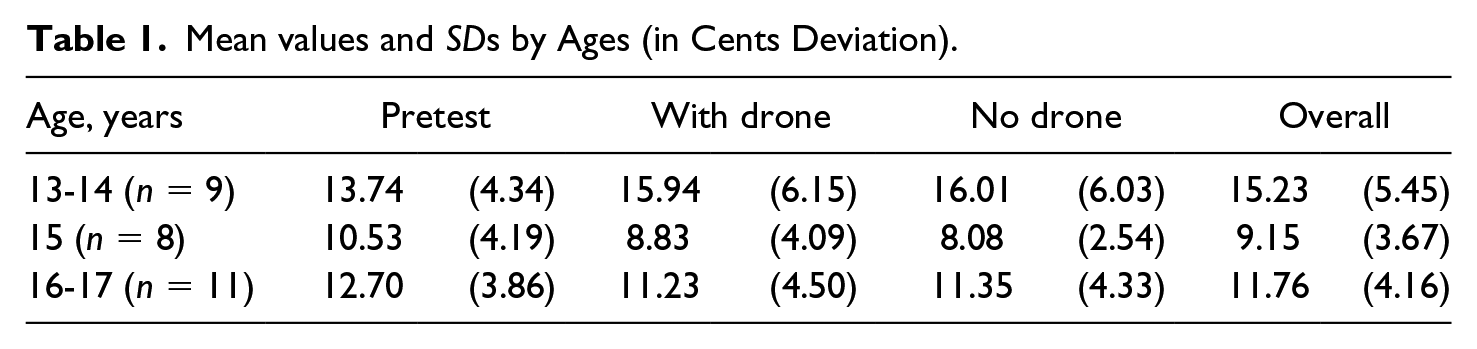
For the first analysis, participants were grouped together by age: 13 to 14 years (n = 9), 15 years (n = 8), and 16 to 17 years (n = 11). The youngest players had the highest overall mean cent deviation (M = 15.23, SD = 5.45). They also had higher cent deviations after treatment conditions compared with the pretest condition, with the intonation accuracy decreasing slightly. The middle age group had the lowest overall mean cent deviation (M = 9.15, SD = 3.67). After treatment, their mean cent deviation decreased indicating improved intonation accuracy. The older students’ mean pretest cent deviations were between the two younger groups and had an overall mean cent deviation of 11.76 (SD = 4.16). Their cent deviations decreased slightly after treatment, which demonstrated only marginal improvement to intonation accuracy. A two-way analysis of variance (ANOVA) with repeated measures on one factor (the three performance conditions) was conducted to examine the effects of a drone accompaniment on performances by violinists and violists. A significant difference was found between the three age groups, F(2, 25) = 5.82, p = .008,
Mean values and SDs by Ages (in Cents Deviation).
The participants were grouped by reported years of experience performing on their primary instrument for the second analysis: 2 to 3.5 years of experience (n = 9), 4 to 6 years of experience (n = 11), and 7 to 11 years of experience (n = 8). Consistent with age, students with the least years of experience had the highest overall mean cent deviation (M = 13.23, SD = 5.46). Their pretest mean cent deviation (M = 12.15, SD = 3.62) increased after treatment with a mean of 13.54 (SD = 5.69) with drone accompaniment and a mean of 13.99 (SD = 7.02) without drone accompaniment. The intermediate students had the lowest overall mean cent deviation (M = 11.04, SD = 3.94). Students with the most experience had an overall mean cent deviation between the least experienced and the intermediate students (M = 12.39, SD = 5.79); however, their mean cent deviation decreased after treatment. No significant difference in mean cent deviation was found using a two-way ANOVA with repeated measures between reported years of experience, F(2, 25) = .58, p > .05. Although mean cent deviation decreased slightly among the most experienced students, mean cent deviation increased for the least experienced students (see Table 2). No significant difference between the three performance conditions was found, F(2, 50) = .27, p >.05. In addition, no significant interaction was found between years of experience and the three performance conditions, F(4, 50) = 2.07, p > .05.
Mean values and SDs by Years of Experience (in Cents Deviation).

Discussion
The present study explored the effects of short-term practice of a tonic drone accompaniment on the intonation of middle and high school violin and viola students. A practice period of 1 min with a tonic drone accompaniment did not affect the intonation of the participants. Even though the practice period used in the current study was shorter than a study by Laux (2015), the results were similar. Although no significant difference was found between performance conditions, intonation for older students and those who had more experience on their instrument improved slightly when using a drone accompaniment. Conversely, intonation for younger students and those with less experience on their instruments tended to deteriorate slightly after practice with a drone accompaniment. Younger and inexperienced students are less likely to be trained to use a drone accompaniment to improve intonation; therefore, the unfamiliarity of this practice task may have distracted them from their regular routine for focusing on and improving intonation. Regardless of the effect, the average magnitude of the changes in cent deviations was below the threshold of a just noticeable difference (JND) between pitches, which is approximately 5 cents (Spiegel & Watson, 1984), rendering this degree of change of minimal importance.
It is of particular interest that a significant difference was found for mean cent deviation when participants were grouped by age and not by reported years of experience. This is consistent with findings by previous researchers who found that age was a significant factor in the ability to tune and match pitch (Geringer, 1983; Geringer & Witt, 1985; Hamann et al., 2002; Hopkins, 2014). Although older students generally have more performing experience on an instrument, years of experience is not necessarily contingent on age—younger students can have more years of experience than older students who started at a later age. Age appears to be a more important factor for the development of pitch acuity even though older students may have had less performing experience than younger students. More research is needed to determine why age appears to be a more dominant factor with pitch accuracy over experience.
Although mean cent deviation between conditions was not different when participants were grouped by age or years of experience, it is interesting that mean cent deviation tended to increase for younger and less experienced students. Researchers determined that string musicians are not usually able to tune their instrument independently until after they have approximately 4.5 years of performing experience (Hamann et al., 2002; Hopkins, 2013). It is possible that many young string musicians are not able to independently perform with high pitch acuity until more than 4 years have passed. Matching a pitch to a unison pitch, such as tuning a string, is one task; however, matching a pitch to dissimilar pitch could be a much more difficult task for younger and less experienced musicians. In the present study, the participants’ mean years of performing experience on their instrument was 5.29 (SD = 2.43), which is not much more than 4.5 years. Although the less experienced participants may be unfamiliar with drone accompaniments, more experienced participants may not have had enough time learning how to use this practice technique, if they were taught how to use it at all. This finding could provide evidence that string musicians may need much more than 5 years of experience before they are ready to practice with a drone accompaniment in an effective manner.
Limitations and Suggestions for Future Research
Although the present study was meant to be exploratory in nature, certain limitations should be considered. The present study utilized middle school and high school students as participants with an overall average of 5.29 years of performing experience. Laux (2015) utilized beginning string students with less than 2 years of performing experience. There are currently no studies that investigate the effect of drone accompaniment on pitch accuracy with older and more experienced musicians. Future research should consider using collegiate or professional musicians as participants to determine whether performing with a drone accompaniment has an effect their intonation.
Short-term practice with a drone accompaniment yielded no significant difference on intonation between the three conditions; however, results should be taken with caution. Performing with accurate intonation requires pitch discrimination and performance ability that may take years to develop. In addition, formally training students to use drone accompaniment to improve intonation may be necessary to implement a positive effect on student performance. The present study provided participants with a 1-min practice period with a drone accompaniment and did not provide any formal instruction beyond telling students to tune their pitches to the drone accompaniment to the best of their ability. Although some participants appeared to recognize this task through previous instruction from their teachers, there were other participants who voiced their unfamiliarity with practicing with a drone accompaniment. Of those who recognized the task, upon further conversation, very few students used a drone accompaniment consistently, whereas a majority of students used it only when instructed to do so by their teacher. Although Laux (2015) used a longer training period, beginning students only received 10 to 15 min of instruction for 10 to 15 school days before data were collected. Allowing experienced students to practice for longer periods of time with a drone accompaniment could yield more evidence of improvement. Future research could also provide participants with formal training that details a specific protocol for practicing with a drone accompaniment. In addition, an investigation that makes use of a longitudinal design could provide more insight on how string musicians practice with a drone accompaniment and its effectiveness on improving their pitch acuity.
Implications for Music Education
Although there was no significant difference between drone accompaniment conditions when participants were grouped by age and experience, a few implications could be derived from the findings. Participants were only given 1 min to practice the excerpt with a drone accompaniment; perhaps more than 1 min is required for students to demonstrate an improvement of intonation. Improving intonation and developing acute listening skills is a lifelong process, and students will need more than 1 min of practice time to demonstrate improvement in pitch acuity, even for the simplest of pieces. In addition, participants were given very little instruction prior to practice with a drone. Younger participants who may have been unfamiliar with using a drone accompaniment could have been confused about the task of matching a pitch with a different pitch. Teachers should train students how to listen to the relationships between notes, whether they are performed as separate intervals or as a chord. Although string pedagogues already recommend that students match pitches with their open strings (Hamann & Gillespie, 2013; Selby, 2017), this task could be transferred to a drone accompaniment provided by an external sound source. Finally, younger and less experienced students may not be ready to use a drone accompaniment to improve intonation. As discussed earlier, the present study may provide evidence that string musicians may need more than 5 years of performing experience before they are ready to practice with a drone accompaniment effectively, which could provide teachers with a guideline for how much time should pass before introducing a drone accompaniment in practice to their students. In addition, it may provide evidence that the prerequisite skill of tuning independence is needed before teaching students how to practice with a drone accompaniment. Until that time has passed, teachers could provide students with other intonation-improving techniques such as playing duets with students (Kohut, 1973), playing a piano accompaniment (Green, 2010), or teaching students how to check pitches with an open string (Hamann & Gillespie, 2013).
Although drone accompaniments are recommended in the pedagogical literature, there are still several other techniques that can be used to improve intonation. This could include singing and vocalization (Elliott, 1974; Schlacks, 1981), contingent verbal feedback (Salzberg, 1980; Sogin, 1997), providing an accompaniment (Brittin, 1993), and computer training programs (Dalby, 1992; Hopkins, 2014). Considering the importance of intonation on good music performance (Geringer & Madsen, 1981, 1989, 1998; Johnson & Geringer, 2007), researchers should continue to examine the effects of common pedagogical practices used to improve intonation. It is critical that researchers and educators work together to find the most effective strategies to assist music students with their development of pitch perception and performance.
Footnotes
Declaration of Conflicting Interests
The author(s) declared no potential conflicts of interest with respect to the research, authorship, and/or publication of this article.
Funding
The author(s) received no financial support for the research, authorship, and/or publication of this article.