



Abstract
This investigation examined the role of the principal in school change during the current era of high-stakes accountability. Qualitative methods were used to conduct a case study of one principal who had a record of success in leading school change efforts and developing a model inclusive program in his school. The results of the case study revealed that the principal viewed his primary role as “lubricating the human machinery,” or providing support for teachers so that they could do their best work. He enacted this role by nurturing and caring for his staff, buffering his faculty from external pressures associated with high-stakes accountability, providing high-quality professional development, and ensuring that teachers had opportunities to assume leadership roles in the school. The implications of these findings for practice are discussed.
As state and federal mandates for accountability and improved achievement outcomes for all students have proliferated over the past decade (e.g., Individuals with Disabilities Education Improvement Act, 2004; No Child Left Behind Act, 2002), schools are being required to improve the quality of teacher practice and significantly increase student outcomes. This increased accountability has led to mandates from many states that have produced systems to evaluate or grade schools based on these outcome measures, resulting in significant pressure on teachers and principals to improve student outcomes or be subjected to punitive measures (Darling-Hammond, 2004).
Coupled with mandates for improved teacher practice and increased student outcomes, schools in the United States also are faced with federal mandates that students with disabilities be educated in general education classrooms whenever possible, have access to the general education curriculum, and make progress with regard to this curriculum (McLeskey, Rosenberg, & Westling, 2010). These mandates have resulted in a dramatic increase in the development of inclusive programs. For example, in 1989–1990, about 34% of these students with disabilities were educated in general education classrooms for most of the school day. This proportion had increased to 58% by 2007–2008 (U.S. Department of Education, 2010). This significant increase in inclusive programs has led some to suggest that in most of the United States the preferred educational model for many students with mild disabilities is now “full inclusion with co-teaching” (Zigmond, Kloo, & Volonino, 2009, p. 196).
Achieving the demands for improved student outcomes for all students and inclusion of increasing numbers of students with disabilities in general education classrooms requires significant changes in schools (McLeskey & Waldron, 2006; Waldron & McLeskey, 2010). Research has identified the school principal as a key participant in directing school change and creating schools that support teachers to meet the needs of all students (Cherian & Daniel, 2008; McLeskey & Waldron, 2002; Pugach, Blanton, Correa, McLeskey, & Langley, 2009). This is especially the case when general education classrooms include a diverse range of students, including those with disabilities (McLeskey & Waldron, 2002; Salisbury, 2006). Research has shown that principals provide many types of support as inclusive programs are developed and sustained (Furney, Aiken, Hasazi, & Clark/Keefe, 2005; Salisbury & McGregor, 2002). For example, Furney and colleagues (2005) found that schools with highly developed inclusive programs had strong leadership from principals, who were engaged in fostering a shared vision, creating collaborative structures, encouraging teacher-centered professional development, using data-based decision making, and understanding policies that facilitate school change. Additional research has shown that the types of activities principals engage in to support inclusive schools include shared decision making, leading by example, and actively promoting learning communities (Salisbury & McGregor, 2002; Waldron & McLeskey, 2010).
Research on school change in general education has resulted in similar findings regarding the importance of the principal’s role in school improvement (Blase & Blase, 1998; Blase & Kirby, 1992; Crow, Hausman, & Paredes-Scribner, 2003; Hallinger & Heck, 1996; Keyes, Hanley-Maxwell, & Capper, 1999; Waldron & McLeskey, 2010). This research indicates that the key elements of effective principal leadership include facilitating the creation of a school culture that is supportive of teachers, developing teachers as leaders within the school (i.e., distributed or shared leadership), and working to develop a collaborative, professional learning community to support teacher learning (Blase & Blase, 1998; Crow et al., 2003; Keyes et al., 1999; Waldron & McLeskey, 2010).
This study was conducted to extend on previous research regarding the role of the principal in school change, as inclusive programs are developed, implemented, and sustained over time. Qualitative methods were used to conduct a case study of one principal who had an extended record of success in leading school change efforts and developing a model inclusive program in his school. It should be noted that this investigation was not conducted as the inclusive program was being developed but was done shortly after the program was implemented. During the year the study was conducted, the principal and school staff were continuing to work to improve their inclusive program and were also working with faculty from a local university to establish a professional development school partnership. This investigation thus addressed the following research question: “How does a principal provide support for school improvement during an era of high-stakes accountability?”
Method
Selection of the Principal
The principal who participated in this investigation, Tom Smith (a pseudonym), was chosen using purposeful sampling (Patton, 2002). More specifically, he showed a strong interest in participating in this study, and previous contact with him by both authors suggested he would be a rich information source who had the potential to provide insight and in-depth understanding of the principal’s role in school improvement. Furthermore, this principal had extensive and successful experience working with reforms for both general and special education.
Tom Smith’s career has spanned almost four decades. Before becoming a principal, Tom served as an elementary teacher, middle school teacher, and high school teacher at an alternative school for 11 years. In addition he held various district staff roles for 9 years, including coordinator of gifted services for 2 years. Prior to beginning his tenure as a principal he served as a principal intern for 1 year. In 1992, Tom assumed the role of principal at Hawk’s Nest Elementary and has remained there for the past 18 years.
Setting
The setting was Hawk’s Nest Elementary (a pseudonym), a school that includes Grades 3–5 that is located in a small town in a rural area in Florida. The school enrolls approximately 460 students and has 27 teachers. Just more than 61% of the students are Caucasian, 25% are African American, 7% are Hispanic, and the remainder are from other ethnic groups. Approximately 54% of the students receive free or reduced-price lunch. In addition, approximately 18% of the students at Hawk’s Nest are identified as having a disability. A breakdown by primary disability category indicates that 65% are students with learning disabilities, 16% are students with speech or language impairments, 10% are identified with other health impairments, 4% are labeled with behavior disorders, 3% are identified with intellectual disabilities, and a small number of students are diagnosed with other disabilities (e.g., autism, orthopedically impaired). Hawk’s Nest Elementary consistently receives A or B grades from the state department of education, is generally recognized as an above average school in the local community, and has a model program for inclusive practice.
Evidence from several sources supports the perspective that Hawk’s Nest Elementary has been successful in including students with disabilities in general education classrooms and improving student academic outcomes for low-achieving students. First, Least Restrictive Environment (LRE) data on student placements from 2006–2007 through 2008–2009 reveal that students with disabilities have been included in general education classrooms for increasing portions of the school day. For instance, the proportion of students with disabilities who were educated in general education placements (special education services outside the general education classroom for less than 21% of the school day) increased from 44% in 2006–2007 to 67% in 2008–2009. During this same time period, resource room placements (special education services outside the general education classroom for 21% to 60% of the school day) declined from 35% to 18%, whereas separate class placements (special education services outside the general education classroom for more than 60% of the school day) decreased from 21% to 11%.
Coupled with this increased placement of students with disabilities in general education classrooms at Hawk’s Nest were student outcome data on the state accountability measure (Florida Comprehensive Achievement Test; FCAT) that demonstrate that Hawk’s Nest has also become a highly effective school. Hawk’s Nest has been successful in increasing student outcomes for low-achieving students or those “at risk” for being labeled with a disability, when compared to local school district averages. For example, 79% of low-achieving students at Hawk’s Nest made learning gains in reading and 77% in math as compared to 56% of low-achieving students across the district in reading and 63% in math. Low-achieving students are defined in Florida as students who are in the lowest quartile (i.e., 25th percentile or below) in reading or math from the previous year’s FCAT results.
In addition, data indicate that not only students with disabilities but also their nondisabled peers have substantially exceeded district and state averages in gain scores for students with disabilities in reading and math. The purpose of the FCAT Developmental Scale Score (DSS) is to determine student learning gains across grade levels, subject areas, and school years by tracking student progress over time. Students can demonstrate learning gains in two ways. First, students can demonstrate learning gains if they achieve proficiency on the corresponding grade-level FCAT math or reading assessment. Alternatively, if students do not meet proficiency standards but demonstrate a year of growth as indicated by their DSS gain or change score they are determined to have made a learning gain for that year. Hawk’s Nest fourth and fifth grade data for the 2008–2009 year indicated that students with disabilities improved an average of 299 points in reading and 136 points in math when using DSS scores. This compares to a 200-point gain for students with disabilities across the state and 199 across the district in reading and 111 points across the state in math and 115 in the district. Furthermore, gains scores for all fourth and fifth grade students at Hawk’s Nest averaged 124 in reading (the state averaged 81, and the district averaged 51) whereas math scores increased on average by 189 points (the state averaged 189, and the district improved by 188 points).
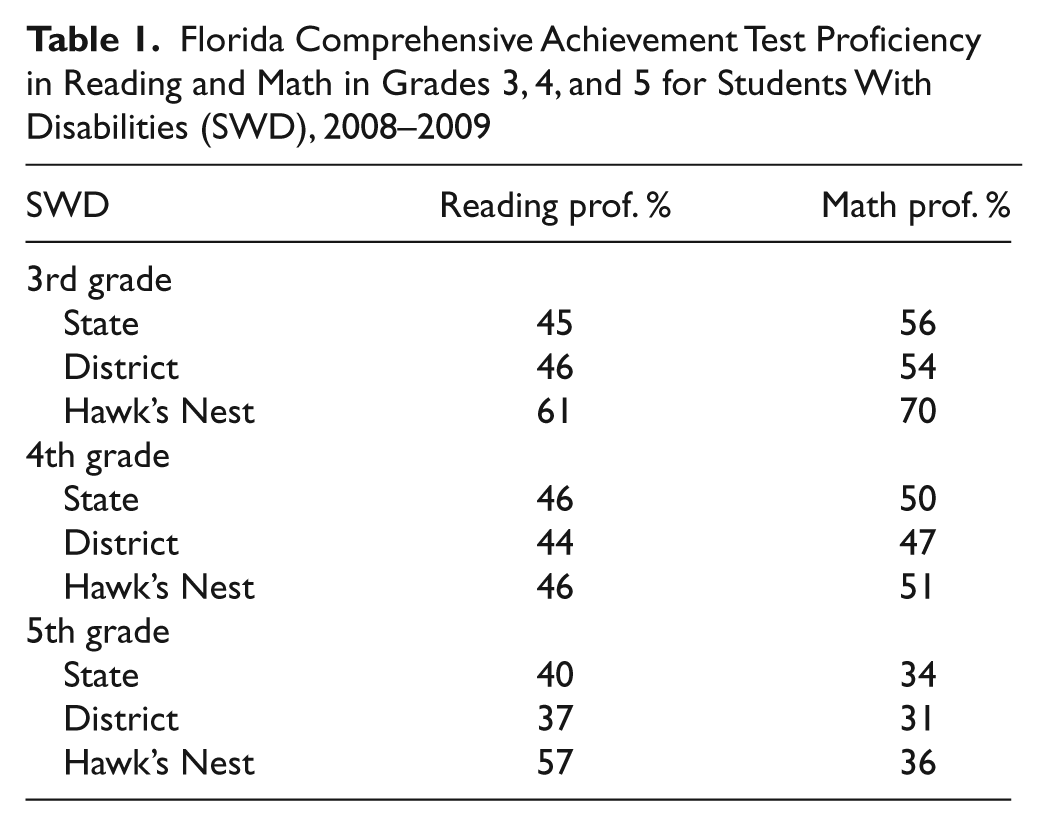
Finally, data on the proportion of students with disabilities who meet proficiency standards reveal that Hawk’s Nest exceeded state and district averages in reading and mathematics across grade levels (see Table 1). In sum, these data support the perspective that Hawk’s Nest has developed a model program for students with disabilities that is both inclusive and effective in improving student outcomes.
Florida Comprehensive Achievement Test Proficiency in Reading and Math in Grades 3, 4, and 5 for Students With Disabilities (SWD), 2008–2009
Design of the Study
This investigation used case study methodology (Merriam, 1998; Yin, 2008) to examine the role of the principal in supporting school improvement during an era of high-stakes accountability. Specifically, this case study took place during one school year and combined ethnographic methods (interviews and observations) with a phenomenological lens to study the lived experience of being a principal from Tom Smith’s point of view (Patton, 2002) and gain an understanding of how one principal conceptualizes, negotiates, and enacts his role in today’s era of high-stakes accountability. This emic or insider’s point of view (Merriam, 1998; Patton, 2002) provided insight into the meaning and interpretations a principal attached to the events that occurred as his school engaged in school improvement.
Data sources
Phenomenological interviews (Seidman, 2006), participant observations (Patton, 2002), and dialogical or informal conversational interviews with the principal (Carspecken, 1997; Patton, 2002) were conducted throughout the school year. Three phenomenological interviews were conducted during the first month of the study. Each of these focused, in-depth interviews lasted approximately 2 hours and explored the principal’s past and present experiences related to the phenomena under study (Rubin & Rubin, 1995; Seidman, 2006). Open-ended questions were used to explore the participant’s experiences as he identified key events and reflected on the meaning of these events as the interviews progressed. Each phenomenological interview built on the previous interview and also addressed critical events or themes that had been identified during informal interviews and observations.
The principal was also observed once weekly during the school year. Initial observations involved shadowing the principal for one complete day per week for the first 6 weeks of the school year and provided in-depth information regarding the types of activities that the principal engaged in during a typical school day. During the remainder of the school year, weekly observations lasting from 1 to 3 hours were conducted that focused on selected critical events or issues. Critical events that arose included Tom Smith’s engagement in public relations activities in the community, meetings in the district that addressed issues that reflected the current “obsession” with standardized test scores, and meetings in which Tom engaged faculty to solve problems and use student data to inform their instruction. These targeted observations were used to document how Tom’s beliefs and knowledge were put into practice in his role as the school leader. In addition, observation data were used to guide dialogical interview questions (Carspecken, 1997).
Finally, following each targeted observation focused, informal dialogical interviews were conducted, lasting from 15 minutes to 1 hour, to gain an in-depth understanding of the principal’s actions, attitudes, beliefs, and understandings about the specific events of the day. Interview questions were developed as events of the day occurred. More specifically, this interviewing technique sought to examine the details of the life of a school administrator as they arose and get important insights into the meanings of the events from the principal’s perspective (Patton, 2002). Therefore, the primary purpose of dialogical interviewing was to generate meanings from a participant’s point of view by discussing how and why the events transpired (Carspecken, 1997).
Data analysis
Formal interviews were audiotaped and shortly thereafter were transcribed, reviewed, and analyzed. Similarly, field notes were taken to document all observations and informal interviews. These notes were transcribed, reviewed, and analyzed immediately after each observation or informal interview. Researcher reflections and analyses were coded in the margins as observer comments and differentiated from interview and observation data.
Analysis of the data entailed a four-step process that involved both the researcher (the senior author) and the principal. First, the data were bracketed or pulled apart by the researcher to examine essential elements and structures that could be used to analyze and define the phenomenon under study (Patton, 2002). After bracketing, the researcher and principal began to develop “imaginative variation” (Moustakas, 1994; Patton, 2002) on each theme, as they sought to see the same data from a variety of perspectives. The researcher then began to write a textural description of the themes or phenomena that had been identified as critical features of the principal’s behavior as he supported school improvement. Finally, the researcher constructed an overall description and framework for the meanings discovered in the study (Patton, 2002), blending the researcher’s and principal’s perspectives on the identified phenomena. The researcher and principal reviewed and reached consensus regarding this information.
Trustworthiness
To ensure the trustworthiness of this investigation, several methods were used. First, the researcher worked closely with the principal to construct themes and write descriptions of these themes, resulting in ongoing member checking of the results of this study. Second, the investigator spent an extended period of time in the setting studying specific phenomena that were identified, resulting in prolonged engagement and persistent observation. Third, triangulation of data was used to cross-check findings from the interviews by observing the principal’s behavior in a natural setting. Finally, the investigator used peer debriefing to discuss the methods and themes as they emerged.
Results
The purpose of this investigation was to determine how Tom Smith supported his school and teachers in school improvement in an era of high-stakes accountability. A pivotal, overarching concept related to Tom’s leadership practice is his perspective that his primary role is “lubricating the human machinery.” This suggests that Tom believes his role is to provide a setting that is supportive of teachers and that helps them to do their best possible work.
Central to Tom Smith’s notion of “lubricating the human machinery” is an ethic of care (Noddings, 1992), as he builds relationships with and supports his staff. By exhibiting care in explicit and meaningful ways, Tom seeks to build and sustain relationships as well as create a community that embraces these values. Tom believes the most important thing he does is “to take care of people.” His “personal investment” in his staff and students is pervasive and “part of a belief system that exists” at Hawk’s Nest. This occurs naturally as he “personally invests and works closely with his teachers.”
Tom’s concept of care emerges from his priority to build relationships with his teachers. However, as the quote above indicates, he also strives to develop a nurturing community as a shared norm at Hawk’s Nest Elementary. Given this commitment, how does Tom support and care for his teachers while also facilitating the development of a shared belief system schoolwide? Three characteristics of his leadership style describe how he facilitates the development of a supportive and caring school community. These include (a) caring for and personally investing in teachers, (b) buffering teachers and staff from external pressure, and (c) promoting teacher growth.
Caring for and Personally Investing in Teachers
Tom Smith cares for and personally invests in his staff in three major ways: (a) displaying trust in teachers; (b) listening to their ideas, concerns, and problems; and (c) treating staff fairly. These behaviors are central characteristics of Tom’s leadership style and demonstrate an ethic of care (Noddings, 1992).
Displaying trust in teachers
Tom Smith supports and personally invests in his teachers by explicitly respecting and trusting them.
I think my teachers or my big people need to believe that I believe in them and I’m invested in their success. Not just because I want them to be happy, [but] because if they are happy, then there is a better chance that they will be professionally successful. And then the payoff is [for] the kids.
In this excerpt Tom uses the word believe (i.e., “believe in them”), but the undertone of the excerpt suggests more. With this comment, Tom is sharing the importance of believing in faculty by acknowledging, respecting, and trusting educators’ ability to be successful.
Possessing this trust requires a faith not only that teachers are motivated to do what is right for the people around them but also that they are able to problem solve solutions to the myriad issues that arise daily in classrooms. Tom “believes in the passion of teachers” and “trusts that if they’re motivated by the right thing and driven by the right ideas, something good is going to come out of it.” For example, Tom tapped into his teachers’ passion and supported a group of teachers who wanted to explore Renaissance Learning, a new computer-based assessment system that assists teachers in making data-based decisions to differentiate instruction. He supported a “pilgrimage” to a math conference for a group of teachers because the faculty “discussed our math data and how we could meet the needs of our students including struggling learners and at the same time our accelerated math students.” Even though the trip was more expensive than initially thought, Tom made the decision to “invest in the people” and spend the money for teacher learning.
It was about their level of understanding of what the problem is and how we’re trying to solve a dilemma. . . . I also am convinced that I will get much more value out of what we do here. Not because of the books and procedures and all this stuff we’ll learn, but because of what they have invested in it and learned. Because they’re committed . . . so I have to trust them and believe it’s going to be successful.
As this comment indicates, Tom Smith also recognizes the reciprocal nature of trust, as he notes “if you want to get trust, you’ve got to give trust.” This is evident in an annual vote of confidence in the principal that Tom developed and conducts annually. Underlying this vote of confidence is Tom’s belief that unless a school leader has the trust of those he leads, he will not be effective. Thus, by asking for a yearly vote of confidence, Tom encourages the teachers and other school leaders to assess their confidence in him. This mutual trust is what allows professionals in an organization to collaboratively work through dilemmas and solve problems:
I’ve got to trust in them to a certain extent and they’ve got to trust me to a certain extent, and the degree to which we trust each other determines the degree to which we can actually get together and solve problems and figure things out.
Listening to faculty ideas, concerns, and problems
Tom Smith also nurtures his faculty and staff by listening to and respecting their ideas and concerns. He conveys this trust and respect in a variety of ways. First, “his door is always open so people can come in.” This policy sets the stage for being available to help at any time. Tom believes this is part of the foundation for forming good relationships, and he “would want people to think that if they needed to talk about something or needed to tell me about something, that they could come in and do it.” Therefore, Tom does not overschedule his calendar, thus ensuring that he is available to meet with his teachers and staff informally for the majority of his workday.
If somebody needs to talk, that happened a couple of times this morning, you know, career decisions and life decisions and I’m mad about this, that stuff is hard to put off until this afternoon. I need to be available so my teachers can bounce ideas off of me and feel supported.
Furthermore, listening to his faculty in both formal and informal ways allows Tom to gather information about what his staff feel is important to their lives and success as teachers.
If you want to know what’s important in an organization, just walk around and listen to what people talk about and that’s what’s important. . . . And I’ve found that to be very true. If people are always bitching about things, then, you know, then that’s important . . . when people are talking about important educational issues in the lounge or the hallway or something then I think that says that’s important. If people are never talking about school, then that says something. If people are talking about kids, that says a whole lot about the school.
Often these informal conversations center on the professional lives of his teachers, and Tom uses the opportunity to seek more specific information from these professionals. This was evident one morning during an impromptu visit that took place with the speech and language therapist about the school’s recent move toward inclusion. This short exchange of ideas began with Tom’s question, “So, how’s the coteaching going?” Over the next few minutes Tom listened to the therapist’s concerns and the inherent challenges of transforming her traditional role in the school to a more collaborative approach for serving her students. She noted that higher caseloads, initial eligibility screenings, and juggling new coteaching roles and responsibilities were overwhelming. After listening, Tom discussed potential proactive solutions including setting aside “sacred” time for collaborative planning, adjusting the screening schedule to allow more time for coteaching in fifth grade, and developing a plan for lobbying the district for more speech and language services.
Finally, Tom Smith carefully chooses when to participate in discussions and often listens for a long period of time before engaging. Furthermore, when he chooses to participate he often raises a question. For example, in a discussion of a mentoring program, he chose to engage in the discussion as the meeting was nearing an end by saying, “It seems that things are going better [this semester than last], any ideas why?” This question publicly elicited teacher reflection to assess the current status of their work and encouraged them to focus on the progress they had made.
Treating staff fairly
Tom Smith seeks to build and strengthen relationships with teachers by treating them fairly. Tom regularly reflects on his practice and uncovers his motives by examining his leadership “from a moral or ethical standpoint to consider whether he is treating somebody fairly.” Thus, Tom’s leadership has an underlying moral obligation to be fair as he supports and nurtures his teachers.
As soon as we stop expecting life and organizations to be fair, then we’ve just contributed to injustice or unfairness. So I think it’s our obligation to create fairness . . . I’ll go out of my way to try to make someone successful.
Tom views how people are treated in the school culture as critical to the school’s long-term success. He believes that the underlying issue is to try and find a way to “maintain a sense of personal interest and humanity.” For example, Tom views providing opportunities for teachers to grow and develop skills as his responsibility.
I think it’s just a matter of fairness that somebody who’s not doing well needs to be given every opportunity to succeed and the barriers to not being successful need to be removed.
This commitment also includes cultivating a collective sense of fairness within the school community.
I just think we have an obligation to create working environments where there is fairness and there is a sense of justice and decency and there’s a right way and a wrong way of treating people.
Tom Smith is committed to creating a work environment where all people are treated with respect. This perspective was evident when the district adopted a new reading series. First, Tom convinced his staff that this was an excellent opportunity to look at the school’s reading program because it had “become fragmented,” as Hawk’s Nest had gradually moved away from using the district-adopted reading series. Instead, “a variety of reading programs were being used in general education and special education classrooms with pockets of student success.” Tom saw the district adoption as an opportunity for “consistency” to occur across both general and special education by “focusing on meeting all students’ needs and getting everyone on the same page.” To accomplish this task, he enlisted his staff to critically examine curriculum to ensure that the necessary components to meet the needs of all students, including students at risk and those with disabilities, were present.
We embraced looking at a new reading program as a means to an end. Although the one that the district chose wasn’t the one that I wanted, it happened to be the one that the teachers liked and they believed it was going to be a solution to aligning curriculum across general and special education . . . and the fact is that any reading program, well implemented is going to work better than either no reading program or a hodgepodge of things. So the adoption at least got us all back on the same page, talking about the same thing and what program we were using was no longer an issue.
Overall, Tom uses listening as a tool, by being easily accessible to his faculty, regularly engaging in both formal and informal interactions, and sharing his own thoughts and opinions. In doing so Tom “lubricates the human machinery” and subsequently builds stronger ties with his faculty.
Buffering Teachers and Staff From External Pressure
Tom Smith has deep concerns that high-stakes testing and the overemphasis on narrowly defined accountability measures are demoralizing for teachers, create undue anxiety for the entire school community, and often are not in the best interest of students. Given these concerns, Tom Smith seeks to buffer his teachers from these negative aspects of his state’s accountability system and support his teachers in developing an accountability system that better fits the needs of their school community. Tom supports his staff in this regard by (a) using data to define goals and standards and (b) building partnerships within the surrounding community.
Using data to define goals and standards
Although Tom Smith feels that a major aspect of his role is to “fend off all the politics” regarding accountability, he also realizes that it is important that his school maintain high standards for all students and reach those standards. Furthermore, Tom and his teachers understand that they must support their students to reach certain accountability standards that are mandated by the state. As Tom stated,
I think that what we need to do to be successful and ultimately change the system to first be successful on somebody else’s terms . . . it needs to be obvious that our kids are good readers or good writers or good arithmeticians, and that’s not really a subject for discussion.
To seek a reasonable balance between mandated standards and school-developed goals, Tom and his faculty work collaboratively to develop their own standards and measures of accountability. More specifically, Tom encourages his faculty to “describe and define what is important to us so we know we are doing a good job.” Tom believes that “to achieve long-term growth, we have to create some meaningful goals that transcend all that stuff, though out goals could include [some of the state standards].”
The faculty and administration at Hawk’s Nest Elementary use a variety of outcome measures to make informed decisions and develop their own standards and goals for student achievement. This approach allows the school faculty and administration to address their collective, deep moral purpose of “educating ALL students to reach their potential” in an inclusive school community. This approach was particularly relevant immediately after the school implemented an inclusive program action plan to transform special education services.
After guiding them through the inclusion process and getting through the initial enthusiasm we had to deal with the implementation gulch. It’s like the end of September and people begin asking why did we do this. I like the other [program] better and our kids aren’t getting it. But that’s just part of any new implementation and you just encourage them through that and start to look for trends in the student data. Even small victories will help sustain any change.
Tom noted that as the teachers at Hawk’s Nest Elementary began examining student data in reading and designing interventions based on these data, they also began transforming their teaching practice. Over time, this practice of using data to make instructional decisions has become “ingrained in the culture” at Hawk’s Nest and is used across curricular areas. This has resulted in more frequent use of evidence-based instructional approaches and the reorganization of the school schedule to allow more time for cotaught classrooms.
Throughout the school year, Tom Smith focuses teachers on the progress students are making on locally determined measures and seeks to downplay the importance of statewide accountability measures. Student progress is measured at least every 9 weeks in reading and math, and these data are used to determine which students need additional support in meeting standards. Furthermore, teachers use these data to adapt instruction and work collaboratively to develop alternative ideas to address student needs.
Building partnerships with the surrounding community
Another approach that Tom Smith uses to buffer and support his teachers is to develop partnerships with the surrounding community. Tom describes this as the “public relations as part of the job,” as he has built professional and personal relationships with many key community members and organizations. Tom enacts this role by frequently sharing the collective vision of Hawk’s Nest Elementary related to building strong classroom communities, developing solid citizens, and making steady academic progress with community groups. He has also been personally involved in a wide range of community organizations and activities. This community engagement has helped to create a natural buffer for Hawk’s Nest Elementary from many of the high-stakes accountability pressures, as key members of the community recognize and value the efforts of the local school and see the many intangible benefits that come with attending Hawk’s Nest Elementary.
A result of developing solid community relationships is that key community leaders serve on the School Advisory Council (SAC). The purpose of the SAC is to assist in preparing and evaluating the school improvement plan and to assist with the annual school budget. Tom uses this forum to inform the community about the overarching goals of the school, to obtain broad-based input regarding these goals, and to seek assistance in helping the school achieve its achievement and budget goals.
Tom contends that developing public confidence in Hawk’s Nest is critical to the long-term success of the school and also shields the school from much of the undue criticism associated with the current era of high-stakes reform. “If you develop trust in the schools, then you help develop a sense of confidence in the schools, particularly from the community. Then they are not as likely to be worried about the No Child Left Behind Act.”
Promoting Teacher Growth
Tom’s beliefs and actions about promoting teacher growth are tied directly to his overall goal of “lubricating the human machinery” so teachers can do their best work. At the same time, Tom recognizes the complexity, tensions, and challenges associated with promoting teacher growth in an era of high-stakes accountability and mandated reforms. Tom describes this as a “simple, but not easy” process of promoting teacher growth that requires him to be flexible as he seeks to support all his teachers in a variety of ways including (a) providing multiple opportunities for high-quality professional development and (b) providing opportunities for teacher leadership.
Providing high-quality professional development
Tom recognizes how his role has evolved from when he was primarily a supervisor who evaluated his teachers and spent much time doing “clinical things like completing teacher competency checklists.” Tom has “redefined my role to be more of a coach and mentor” who “spends the majority of my time growing people.” To do this, he focuses his energy on building collegial relationships with his teachers, encouraging teacher reflection, and providing school-based professional development to improve teacher learning and student achievement.
One of Tom’s major concerns regarding professional development relates to beginning teachers. He recognizes that he does not have sufficient time to provide these teachers with the job-embedded support and coaching they need. Furthermore, the mentoring support provided by the district or state is often directed toward compliance rather than individual teacher needs. To address this need, he has developed a school-based mentoring program for beginning teachers.
Schools as institutions are not very good at bringing in new teachers. We bring them in, chew them up, and spit them out. They are often given undoable jobs. I want them to be in an optimal situation. Thus, we provide them with veteran teachers to mentor them . . . mentors are a big brother or big sister who is invested in them. The mentor helps them to make sure they are set up for success.
Tom also expressed concern regarding the quality of professional development provided for his teachers. Most of these activities address newly mandated reading or math programs and do not address the individual needs of teachers to improve their classroom practice.
[There’s] not much time to do professional development now because of the new mandated reading program and next year’s math adoption. Most of the staff development is dictated from the district office. This makes for some hard choices when I want to focus on school-based work.
Part of Tom’s leadership responsibilities is to ensure that his teachers are engaged in high-quality, job-embedded professional development that “gets away from the high stakes, and focuses on the goals we have [for teachers].” Furthermore, he views professional development as a vehicle for promoting individual and collective growth among teachers around topics that are important to his staff.
Now in order for that to happen, the school has to be successful in very obvious ways, not because of what reading books we have, or curriculum or all these other procedural things. I think all of that’s going to happen because we’ve got a lot of people thinking about good teaching and learning and mastering the craft and that whole professional development thing. . . . If you’ve got people talking about the right things then the solutions will work themselves out.
For example, Tom’s vision to enhance the professional development process for his teachers included participating in professional development activities targeting inclusive school reform. To do this, the school staff agreed to participate in Project INCLUDE, a university-based professional development seminar targeting teacher professional development around the issue of meeting the needs of all students, including students with disabilities. During this semester-long process, teachers assumed various leadership roles and actively debated the salient issues of inclusive school reform with their peers.
I think a good example of this is to look at what happened in Project INCLUDE. It wasn’t about answers. It was about the questions and about inquiry, about reflection and about being honest with ourselves. We need to get that kind of thing happening all the time. Not on a situational basis. But that level of inquiry needs to be what we always do around here.
Project INCLUDE provided support for a team of teachers and administrators to develop and implement action plans for improving inclusive programs in schools. Specifically, the project provided professional development activities to better prepare teachers and administrators to meet the needs of students with disabilities (and other students who needed support) in inclusive settings (McLeskey & Waldron, 2000). During this professional development seminar, teachers engaged in a professional learning community and worked closely to examine their current practice, interview a variety of stakeholders about their beliefs regarding inclusion, visit exemplary inclusive sites, and develop a schoolwide inclusive school improvement plan. Moreover, after this process Tom strongly encouraged teachers to tie their professional development plans to the larger, overarching school improvement plan.
In sum, the purpose of providing this type of professional development is essentially twofold: to focus on developing the individual teacher’s professional growth while simultaneously seeking to establish community norms. Thus, Tom’s underlying purpose (i.e., lubricating the human machinery) bubbles to the surface and is the thread that connects his ideas of promoting teacher growth to the larger issues of school culture and community.
Providing opportunities for teacher leadership
Tom Smith recognizes that a principal does not have sufficient time to provide all of the leadership that is necessary for an elementary school to be successful. Success requires teachers to assume a variety of leadership roles. Over time, teacher leadership has evolved from formal roles such as department chair and curriculum specialist to a new wave of teacher leaders “where teachers are leaders in creating and sustaining a collaborative culture of learning in schools focused on improving instructional practice” (Yendol-Hoppey & Dana, 2010, p. 27). Thus, teacher leadership in an era of heightened accountability highlights how principals can build capacity by simultaneously focusing on teacher and student learning. Given this need, Tom Smith seeks to embed teacher leadership in the collective vision and culture of the Hawk’s Nest Elementary by expecting “everyone on the faculty to be a leader, as all have talents or something to offer to the school.” He states,
The leader’s job is not to develop followers, but more leaders. So how can you create not just a culture valuing change and growth and improvement, but actually a structure or a process that promotes teachers to lead that becomes what you do.
To promote teacher growth, Tom seeks to create natural opportunities for teachers to lead as part professional development activities. For instance, as a result of participating in Project INCLUDE, Tom and his faculty developed a school–university partnership and engaged in several professional development activities. This included talking and collaboratively designing with the local university an advanced degree program focused on teacher leadership for school improvement. Tom also believes that national board certification has a “similar justification as the degree program.”
Developing a reflective cycle is at the core of the [master’s/specialist] program. . . . By reflecting on what and how you teach, what were the results, everyone can improve their teaching practice. Additionally, by collectively developing the program with the university, teachers can easily target areas of interest for them and simultaneously complete national board certification at the same time.
These projects help build capacity for teacher leadership by providing space for his staff to “look outside themselves for new knowledge creation.”
However, Tom also recognizes that developing teacher leaders and change agents is a difficult task. It is his responsibility to assist his teachers by “building relationships and supporting teachers in their growth.” For example, though many of his staff are interested in leadership roles related to school change activities, they have “never been pioneers before,” and they will need his ongoing support as some “people naturally resist change and experience personal frustration of doing something new and not understanding the skepticism of others when they try to help other people move forward.”
As these examples illustrate, Tom Smith consistently promotes teacher growth by improving relationships with his teachers and developing partnerships while simultaneously seeking input on ways to provide meaningful professional development for his faculty. By embedding professional development in the daily work of his teachers, Tom’s goal is to improve student outcomes. This is done by “creating a lot of institutional learning” and has the added benefit of creating future school leaders.
Discussion
This investigation provides insight into how one principal enacted his role to provide support for school improvement during an era of high-stakes accountability. The results of the study indicate that the central metaphor that guides Tom Smith’s leadership is “lubricating the human machinery” to improve the lives of teachers and students so that they can do their best work. Specifically, Tom seeks to nurture and care for his staff and to invest personally in his teachers while simultaneously attempting to buffer them from external high-stakes accountability pressures. Furthermore, Tom seeks to “lubricate the human machinery” by build capacity and moving Hawk’s Nest toward a collective commitment to the education of all students with a focus on students with disabilities. As he does this, it is his underlying moral purpose of improving the lives of teachers and students that steers Tom’s thinking, decision making, and actions. Therefore, not only does Tom’s leadership focus on creating and cultivating relationships that are fueled by making personal connections with people, both internal and external to the school, but also he embraces a deeper moral conviction related to improving his school by helping his teachers and students reach their full potential.
Several of the actions that guide Tom Smith’s leadership at Hawk’s Nest Elementary School are supported by previous research related to the qualities of effective inclusive schools (Dyson, Farrell, Polat, Hutcheson, & Gallannaugh, 2004; Farrell, Dyson, Polat, Hutcheson, & Gallannaugh, 2007) and principal leadership for school change (Fullan, 2007; Waldron & McLeskey, 2010). For example, research has demonstrated that principals are rarely in a position to provide leadership for the numerous activities that are necessary to achieve lasting school change (Waldron & McLeskey, 2010). Given this circumstance, distributed leadership that provides leadership roles for teachers and prepares them for these roles is often a critical component of successful school change (Spillane, 2006; Spillane, Halverson, & Diamond, 2001). Furthermore, effective school change is often supported by teacher-centered, job-embedded professional development (McLeskey & Waldron, 2002; Yendol-Hoppey & Dana, 2010), which was a major goal of Tom Smith as he sought to improve the quality of teaching in classrooms at Hawk’s Nest Elementary.
Similarly, school change that results in inclusive programs, which improve outcomes for all students, is characterized by many components that are similar to those addressed by Tom Smith at Hawk’s Nest Elementary. For example, Dyson and colleagues (Dyson et al., 2004; Farrell et al., 2007) found that effective inclusive schools are characterized by a strong school culture and shared commitment to improving educational outcomes for all students. In addition, these schools often have a school-based system for monitoring student progress and evaluating program outcomes, similar to that of Hawk’s Nest Elementary, and seek to improve the quality of teaching in all classrooms by providing high-quality professional development.
Tom Smith’s efforts to “lubricate the human machinery” through caring for and personally investing in teachers, buffering teachers from external pressure, and promoting teacher growth have served to foster effective inclusive practices and help teachers and students thrive in an environment of accountability. Therefore, this research adds to the limited literature base on effective principals who actively promote inclusive best practices in a time of high-stakes accountability. This can occur if school leaders can focus their energy on developing solid relationships with their staff and concurrently address the issue of accountability by providing a variety of avenues to develop teachers’ capacity for effectively implementing inclusive best practices. For example, this research highlights how by exhibiting care in explicit and meaningful ways, one principal attempts to build and sustain relationships as well as create a shared sense of community that embraces the values of inclusion, collaboration, and collegiality. This belief is evident as he treats his faculty with respect and distributes leadership opportunities by encouraging teachers to participate in a range of professional development opportunities to meet the needs of all students, including students at risk and with disabilities. More importantly, while all this difficult work is occurring at Hawk’s Nest, the principal consciously attempts to buffer his teachers from the myriad outside pressures associated with high-stakes testing by setting school goals. This occurs as the learning community collaboratively uses student data to define yearly goals, design and develop effective instruction, and use ongoing student data to make effective curriculum and instruction decisions. As data presented previously illustrate (see Table 1), the teachers at Hawk’s Nest Elementary have been very successful in meeting accountability demands, as students who struggle to learn reading and math skills as well as students with disabilities make significantly more academic progress than similar students in other schools in the district and the state.
The most obvious implication of this investigation is that serving as principal in the current era of high-stakes accountability has become increasing complex. Although principals continue to be responsible for organizing and managing their schools, they also must assume a range of other roles to ensure that their school meets accountability demands, provide support for teachers, and meet a broad range of student needs. This suggests the need for a high level of rigor in the preparation of principals, especially to ensure that principals have extensive knowledge regarding school change (Fullan, 2007). Principals not only must be prepared for the nuts and bolts of change (e.g., knowledge of high-quality professional development) but also must be well versed in strategies for changing school culture and developing learning communities within schools (Fullan, 2007; Pugach et al., 2009; Waldron & McLeskey, 2010).
Another implication of this investigation relates to the importance of the principal in the school change process as inclusive programs are developed (McLeskey & Waldron, 2006; Waldron & McLeskey, 2010). When considering the results of this case study, it is difficult to imagine that an inclusive program could have been developed in Hawk’s Nest Elementary without the leadership of Tom Smith. Given this level of importance of the principal in developing successful inclusive programs, careful selection of principals and providing high-quality principals for every school should be major priorities for every school district. Principals should be selected who have the knowledge, skills, and dispositions to provide leadership as well as the respect of the school staff. If this does not occur, schools will have great difficulty meeting the complex demands of high-stakes accountability mandates and serving the needs of all students.
Limitations and Directions for Future Research
There are three major limitations that should be taken into account when considering the results of this investigation. First, this case study was limited to one principal, and this severely limits the transferability (Patton, 2002) of the results to the leadership practices of other principals. Although case study research is time intensive and provides a rich description of the phenomena being studied, the reader must be responsible for determining the extent to which the results of this case study are applicable to other principals.
A second, related limitation concerns the fact that the data that were collected and reported in this study do not include perspectives of teachers, parents, and other stakeholders regarding the work of the principal. Adding this information could have provided distinctive perspectives regarding the work of Tom Smith with the school staff and community and could have added valuable insights regarding the particular behaviors Tom Smith engaged in (e.g., his leadership practices) that these stakeholders perceived as critical influences on school improvement.
Third, the findings of this study are contextually bound and particular to one school at a particular point in time. For example, the particular issues related to high-stakes testing and accountability that were addressed in this study are particular to the state in which the study was conducted and to how the local school district interpreted and implemented state mandates. Thus, although this investigation may provide insight regarding how a principal may address certain leadership roles during an era of high-stakes accountability, the reader must decide if any of the particular approaches used by Tom Smith to enact his role are applicable in other settings.
Although this investigation provides a detailed description of how one principal enacts his leadership role, further research is needed to present a more complete understanding of how effective principals conceptualize and enact their roles as school leaders in an era of high-stakes accountability. This research should include individual cases as well as cross-case analyses to investigate possible recurring themes or patterns across settings (e.g., urban, suburban, rural) and school levels (i.e., elementary, middle, and high school). For example, how do principals in high-poverty schools conceptualize and enact their roles, and how does the work of these principals differ from that of principals in low-poverty schools?
Future research should also provide more detailed information regarding how effective principals cross borders and navigate the politics of leading a school in the current era of high-stakes accountability. For example, how do principals negotiate the politics of school change with external audiences while simultaneously buffering their faculty from much of the public scrutiny and policy pressures associated with high-stakes reform? Furthermore, how do principals achieve this buffering while continuing to respect teachers and shared decision making?
Finally, more research is needed to understand how principals conceptualize and enact effective school-based professional development that results in changes in teacher practice and improved outcomes for students. For example, under what conditions do teachers and students benefit from school-based professional development that targets school-identified improvement goals? How do principals create job-embedded professional development opportunities that target school improvement goals?
Footnotes
Declaration of Conflicting Interests
The author(s) declared no potential conflicts of interest with respect to the authorship and/or publication of this article.
Funding
The author(s) received no financial support for the research and/or authorship of this article.