



Abstract
The purpose of this study was to examine the efficacy of the system of least prompts (SLP) for increasing the levels of play behaviors in four young children with disabilities. A multiple probe across participants’ single case research design was used to examine the relation between SLP and child-targeted behaviors. The results demonstrated that the instructional package was functionally related to increased levels of independent play and diversity of targeted play actions. Furthermore, play levels were maintained when intervention was withdrawn.
There are both theoretical and empirical reasons to support teaching play to young children with disabilities. Play serves as a context for embedding evidence-based practices for acquiring, generalizing, and maintaining new skills (Lifter, Mason, & Barton, 2011). Play also predicts later communication and social skills in children with disabilities (Sigman et al., 1999; Toth, Munson, Meltzoff, & Dawson, 2006). In addition, play increases the likelihood of learning in natural, less restrictive settings (Lifter et al., 2011). However, research consistently indicates differences in object play skills of children with and without disabilities. Although typically developing children frequently engage in simple pretend play by 18 months (Belsky & Most, 1981), children with disabilities often have delays in play skills. Specifically, children with disabilities are less likely to engage in object play and display less variety and complexity in their play than typically developing children (Barton & Wolery, 2010; Blasco, Bailey, & Burchinal, 1993; Kasari, Chang, & Patterson, 2013). Children with disabilities also produce fewer symbolic play behaviors (Lifter et al., 2011; Malone, 1997).
Play deficits can be particularly debilitating, because play is a primary context for interactions with caregivers and peers, exploring the environment, and learning new skills (Strain, Schwartz, & Bovey, 2008). Pretend play might be distinctively important for young children as it promotes (a) the use of symbols for thought (e.g., moving a fist in a circle around the top of a bowl as if stirring a substance in the bowl), (b) social interactions among children, (c) experimentation with various social roles, and (d) differentiation between thought and reality (Rutherford & Rogers, 2003). Thus, play is a critical intervention goal for children.
Research indicates that intentional, systematic interventions are necessary to increase play skills in young children with disabilities (Barton & Wolery, 2008). Effective play interventions have included, for example, adult-implemented modeling and prompting (Barton, 2015; Barton & Wolery, 2010), video modeling (Lee, Lo, & Lo, 2017; MacDonald, Sacramone, Mansfield, Wiltz, & Ahearn, 2009), and play expansions (Frey & Kaiser, 2011). Across the play intervention research, adult-implemented modeling and prompting have often been implemented using a least-to-most prompting hierarchy (i.e., the system of least prompts [SLP]; Barton & Wolery, 2008). SLP might be particularly effective in teaching play because it provides multiple opportunities for children to respond independently. Furthermore, it allows the implementer to prompt play actions based on the child’s current repertoire and attention. The SLP procedure begins with the natural antecedent (i.e., typically the presentation of the toys) followed by the adult delivery of increasingly intrusive prompts if the child does not emit the target behavior(s). Most researchers reported using a three-step prompting hierarchy with (a) presentation of the toys, (b) live modeling or verbal prompting, and (c) physical hand-over-hand prompting (Barton, 2015). For example, Barton and Wolery developed and tested an intervention package that included SLP, contingent imitation, and reinforcement (Barton, 2015; Barton & Wolery, 2010). Teacher’s use of the intervention package was functionally related to increases in frequency and diversity of pretend play in children with disabilities. With SLP, the specific prompts within the hierarchy are selected based on the child’s learning history and can be adapted based on the child’s performance (Barton, 2015). In this way, the components of SLP can be tailored to meet the children’s individualized learning needs, which might be useful as children with disabilities have heterogeneous learning histories.
The research studying the efficacy of SLP on play is limited in two aspects (Barton, 2015; Barton & Wolery, 2008; DiCarlo & Reid, 2004; Lifter, Ellis, Cannon, & Anderson, 2005). First, few researchers to date have incorporated toys from a natural setting as the primary instructional stimuli, which might be critical for promoting generalization. Across this research, the primary instructional materials included research-specific toys and objects, which also limit the ecological validity. Second, few researchers included children who were 3 years and younger. Teaching children to engage in increasingly complex play prior to the preschool years might increase the likelihood that children experience the benefits of play earlier. The purpose of this study was to examine the efficacy of SLP on increasing the levels of unprompted targeted play in young children with disabilities. More specifically, the following research questions were addressed:
Method
Participants
Four young children with disabilities were recruited from a University-affiliated preschool in a southeastern state. The inclusion criteria for participants were (a) chronological age between 18 and 48 months at the start of the study (given children begin to engage in pretend play at about 18 months; Belsky & Most, 1981), (b) special education or early intervention eligibility, (c) greater than 80% attendance rate for the previous month, (d) ability to manipulate toys, (e) ability to participate in a one-on-one play activity with an adult for 5 min, and (f) fewer than three different unprompted pretend play behaviors per observation across three 10-min free play observations. Information on age, special education eligibility, and absence rate was collected through teacher report. The remaining criteria were evaluated through direct observation. The implementer observed each participant playing in their classroom on three separate days for 10 min during the regularly scheduled free play routine; all classroom teachers, therapists, and peers were present.
Maxine was a 29-month-old White female who received a diagnosis of cerebral palsy at birth. She received speech therapy (ST), physical therapy (PT), and occupational therapy (OT). She communicated with limited gestures (pointing) and signing (e.g., “more,” “eating,” “all done”). Maxine’s teacher reported that she often engaged in repetitive play actions with kitchen and animal toys, including occasionally pretending to feed the animals and herself (i.e., repeatedly putting her hands at her mouth or at the animal figure’s mouth). She had zero play actions across three 10-min screening observations. John was an 18-month-old White male, who was born 11 weeks premature. His eligibility category was developmental delay, and he received OT and PT. Two weeks before the onset of the study, he started walking, although he needed support to stand up from a seated position on the floor. His teacher reported that he primarily engaged in repetitive play actions by banging together medium-to-large-sized toys (e.g., blocks, trucks, buckets). He had one play action across three 10-min screening observations. Tulsi was a 33-month-old White female with Down syndrome. She received ST, OT, and PT. Her teacher described her play as primarily consisting of repetitively putting toys in and out of containers. Her teacher also reported that she regularly used 12 to 30 words (e.g., “up,” “down,” “this”), but used sign language to communicate more often than verbalizations. She had one play action across three 10-min screening observations. Luis was a 38-month-old White/Latino male with Down syndrome. He received ST, OT, and PT. He was independently mobile with a walker, and communicated using limited vocal words and signs (i.e., “more,” “eat” and “help”). His teacher reported that his play primarily consisted of repetitively pressing buttons on cause–effect toys. He had three play actions across three 10-min screening observations. The implementer was an Asian female graduate student who was pursuing a master’s degree in special education and behavior analysis certification.
Settings and Materials
All experimental sessions were implemented in the participant’s classrooms. Each classroom had 10 to 12 children and three teachers. The sessions occurred in the carpeted dramatic play or block play areas depending on the availability of space, during the regularly scheduled free play time. Typical classroom activities were occurring simultaneously. If other children in the classroom were interested in the play sessions, they were allowed to sit with the participant and interact with toys near the child. The implementer redirected peers who attempted to interact with the target children without affecting his or her implementation of study procedures.
Two toy sets were used during the study—intervention and generalization toy sets. Both toy sets included an equal number of toys, including kitchen toys, baby toys, other toys of more ambiguous functions (e.g., blocks, plastic shapes), and toys from each child’s classroom. The classroom toys added included wooden blocks, animal and people figures, and trucks; these were included to enhance the ecological validity. The two toy sets were functionally equivalent, but objects differed in color, shape, and size (e.g., spoons were smaller and in different colors in the generalization toy set). Duplicates of toys were provided to facilitate contingent imitation and model prompts. Exact lists of toys are available from the authors via email. All play sessions were recorded via a digital camcorder and coded using ProcoderDV (Tapp, 2003).
Response Definitions and Measurement
Timed event recording was used to code all dependent variables. The primary dependent variable was each child’s target play behaviors; frequencies of total target play per session were used to make experimental decisions. The authors determined the target play behaviors based on the child’s current play repertoire and chronological age. Pretend play behaviors were the target play behaviors for Maxine, Tulsi, and Louis. However, John’s target play behaviors included both functional and pretend play behaviors. Each play behavior was further coded using four steps: (a) prompted or unprompted, (b) play type (relational play, functional play, functional play with pretense, object substitution, imagining absent objects, assigning absent attributes), (c) the presence of a sequence, and (d) same or different. Table 1 provides operationalized definitions of all target behaviors. The implementer and the second author—a White female, doctoral-level certified behavior analyst—coded all target behaviors. They achieved 90% interobserver agreement (IOA) on three consecutive non-study videos of children engaging in play.
Definitions of Target Behaviors.
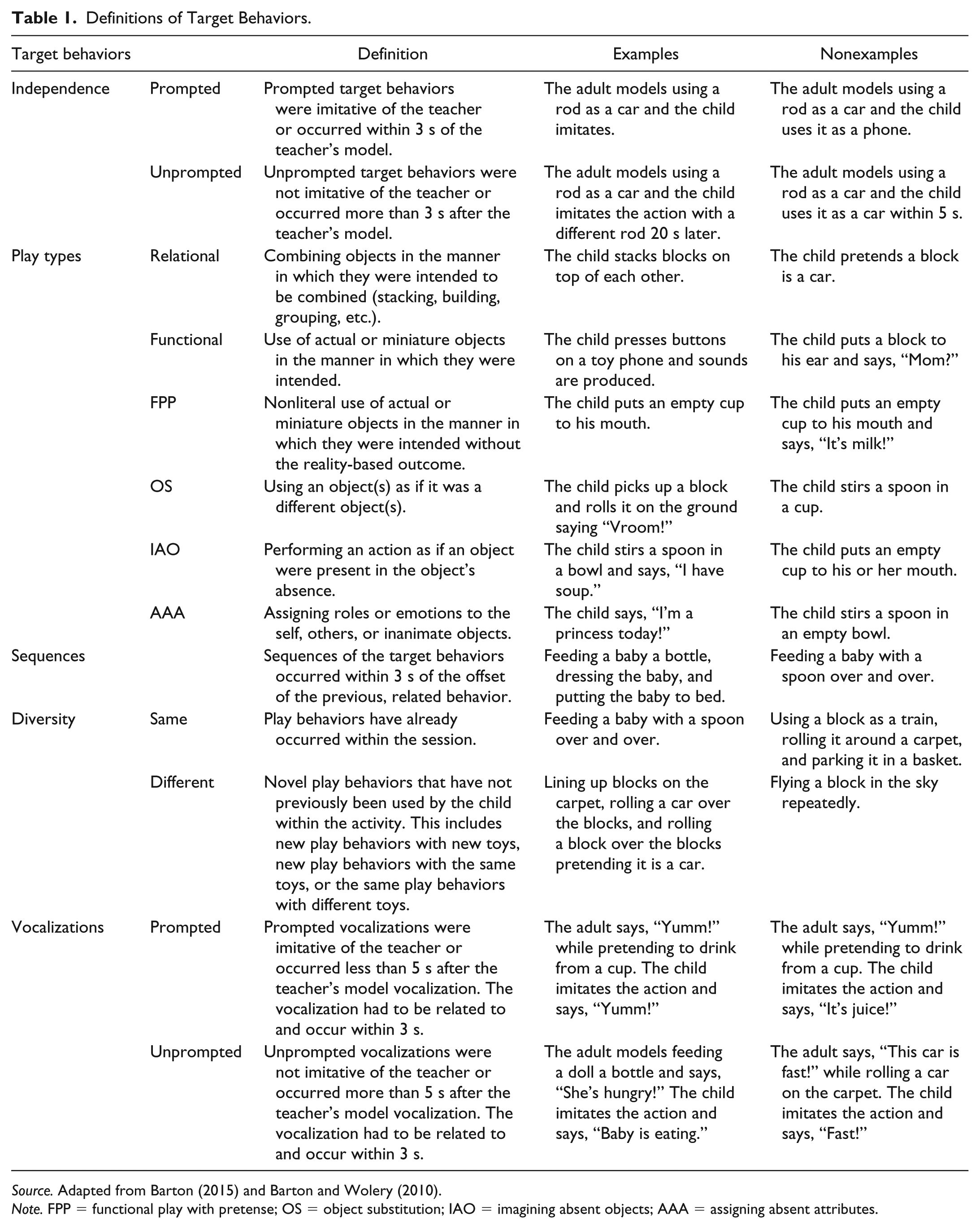
Source. Adapted from Barton (2015) and Barton and Wolery (2010).
Note. FPP = functional play with pretense; OS = object substitution; IAO = imagining absent objects; AAA = assigning absent attributes.
Experimental Design
The multiple probe design (days variation) across participants (Gast, Lloyd, & Ledford, 2014) allowed for multiple demonstrations of the efficacy of SLP on the target play behaviors. The intervention was introduced to each tier in a time-lagged manner—when the baseline level of unprompted play in first tier was stable, the implementer commenced the intervention in that tier; when the data in the first tier stabilized, the intervention began with the next tier showing baseline stability. This continued for each of the four tiers (i.e., participants). The design met What Works Clearinghouse single case research design standards with reservations (Kratochwill et al., 2013), due to having three and four baseline data points for Maxine and John, respectively, rather than five. The predetermined condition change criterion was three consecutive sessions with higher and stable levels of unprompted target play behaviors than prompted target play behaviors. The following visual analysis procedures were used to determine the presence and strength of a functional relation: (a) documentation of a stable baseline, (b) examining within condition patterns, (c) comparing adjacent conditions to assess behavioral change, and (d) analyzing data across conditions and tiers to document at least three demonstrations at three different time points to identify functional relations (Kratochwill et al., 2013).
Procedures
General procedures
All sessions were 5 min. The implementer started every session with a general cue, “Participant’s name, let’s play!” If the child did not initiate play within 10 s of the start cue, the implementer handed a toy to the child. If the child engaged in play, the implementer contingently imitated and verbally mapped the child’s play. The implementer also delivered descriptive praise for staying in the play area at least twice per session. If the child attempted to leave the play area, the implementer used verbal prompting and physical guidance to help him or her stay. If the child had three attempted elopements, the session was terminated. These procedures were followed during all experimental sessions.
Baseline sessions
During baseline sessions, the implementer used contingent imitation and verbal mapping to build a play rapport with the child and keep the child engaged in the play interaction. For example, if a child rolled a car on the carpet for 30 s, the implementer imitated the child by rolling an identical car and mapping language, “You are rolling the car.” These procedures have been used in previous, effective play interventions and are necessary for avoiding aversive associations (Barton, 2015; Barton, Choi, & Mauldin, 2018). The implementer did not use prompting (e.g., verbal prompting, modeling, physical guidance) or reinforcement.
Instructional sessions
During instructional sessions, the implementer continued to use contingent imitation and verbal mapping as in baseline conditions. The implementer also used SLP, which includes contingent reinforcement for target behaviors. SLP consisted of a hierarchy of prompts with three levels (Barton, 2015). The independent level (first level) included the presentation of the materials and the verbal statement “Let’s play” at the beginning of the session. The teacher waited 15 s to 30 s while contingently imitating and verbally mapping the child’s play. If the child did not display any play behaviors for 30 s or repeated one play behavior over and over, the implementer modeled a target play behavior (the second level) and verbally labeled the action. If the child did not imitate the model or display a pretend play behavior within 5 s, the implementer used full physical, hand-over-hand prompts (the controlling prompt). This type of controlling prompt was used for all children and was individually identified as a potential controlling prompt based on teacher report. The time interval used was established in previous research (Barton & Wolery, 2010). The time intervals allow the child an initial opportunity to play with the toys and reduce opportunities for errors throughout the session. Descriptive praise was used when the child completed prompted or unprompted target play behaviors. Edible reinforcers (e.g., Cheerios™) were used with descriptive praise given low rates of responding during initial intervention sessions for John, Tulsi, and Luis. Edibles were selected based on teacher and parent reports of their preferences.
Maintenance and generalization
Maintenance and generalization sessions were the same as baseline conditions. A generalization toy set was used during generalization sessions.
Procedural Fidelity
The implementer’s correct use of experimental procedures was measured throughout the study across all experimental conditions using ProcoderDV. The coder measured procedures during all conditions using the procedures and definitions used in previous studies (Barton, 2015; Barton & Wolery, 2010 these also are available via email from the corresponding author). The coder used 10 s momentary time sampling to code the use of contingent imitation and event recording to code the implementation of the intervention package across all conditions. This measured adherence to the procedures across conditions and differentiation of procedures across conditions. Procedural fidelity results are provided in Table 2. Prompt and reinforcement procedures were implemented with high fidelity (average range = 89%–100%). Lower percentages of contingent imitation were expected during the intervention condition (the criterion was 50%) as the implementer was using more prompts and delivering reinforcement rather than using contingent imitation (average range = 65%–100%).
Percentage of Procedural Fidelity.
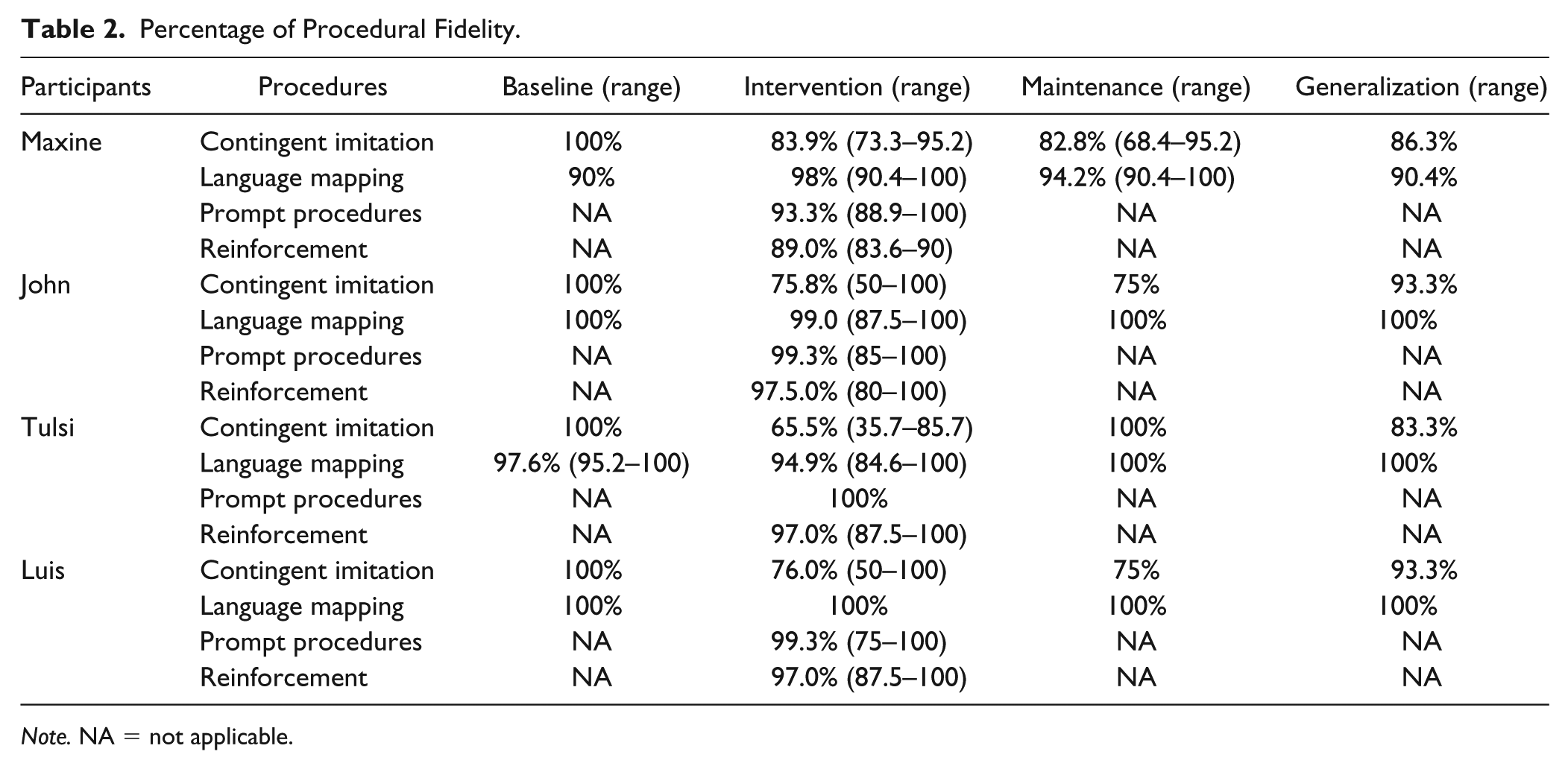
Note. NA = not applicable.
IOA
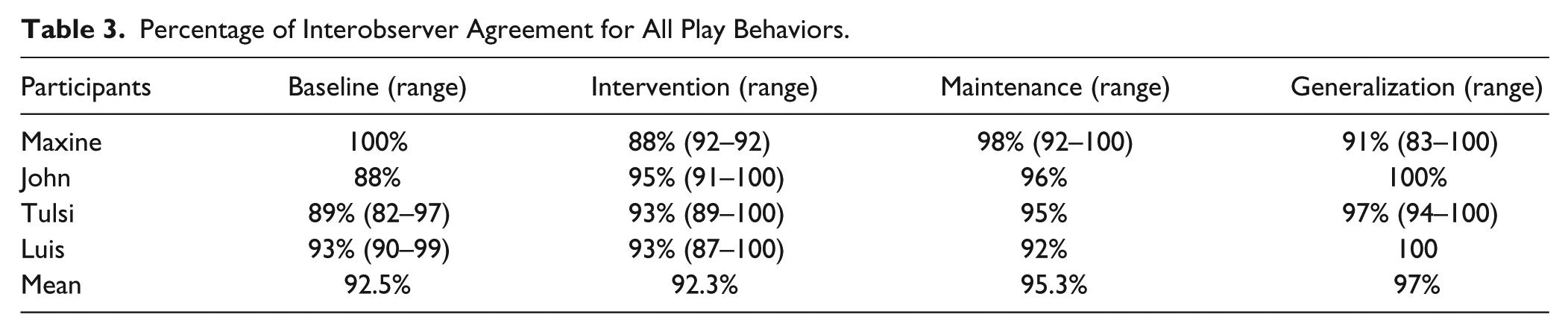
The second observer independently coded 37% of the sessions across all participants and conditions. Point-by-point procedures were used to calculate IOA by (a) counting the number of agreements (occurrences matched within a window of 5 s), (b) dividing that by the number of agreements plus disagreements (occurrences with no match), (c) multiplying this number by 100 to get the percentage agreement (Ayres & Ledford, 2014). IOA results are provided in Table 3. The average IOA across play behaviors, conditions, and participants was above 85%, which meets design standards (Kratochwill et al., 2013).
Percentage of Interobserver Agreement for All Play Behaviors.
Social Validity
Naïve raters—eight graduate students in special education—evaluated randomly selected 1-min video clips from baseline and maintenance conditions for each participant (see Table 4). They were asked to evaluate pretend play frequency and diversity on a scale of 1 (little to no play) to 5 (frequent, diverse play). The results showed naïve raters observed fewer and less diverse pretend play in baseline conditions than after intervention. This observation was consistent across participants, although the difference was minimal for John.
Social Validity Measurement by Naïve Raters.

Note. The scale was 1 = minimal pretend play behavior observed to 5 = frequent pretend play observed.
Results
Play Behaviors
Compared to baseline, the levels of target play behaviors notably increased during intervention conditions across all participants. The level of total and different unprompted play was low and stable for three of the four participants (except Tulsi) before intervention, but increased and stabilized at levels higher than baseline for all four participants. Furthermore, high levels of unprompted play behaviors maintained during maintenance conditions. A functional relation was established between the intervention and target play behaviors given there were three concurrent demonstrations of effect for unprompted total and different play. The results for total and different unprompted target play are shown in Figure 1. Graphed data for pretend play sequences and types of pretend play are not provided given there were minimal changes across conditions; these data are available from the first or second author via email. The limited generalization data preclude determining a functional relation across participants.
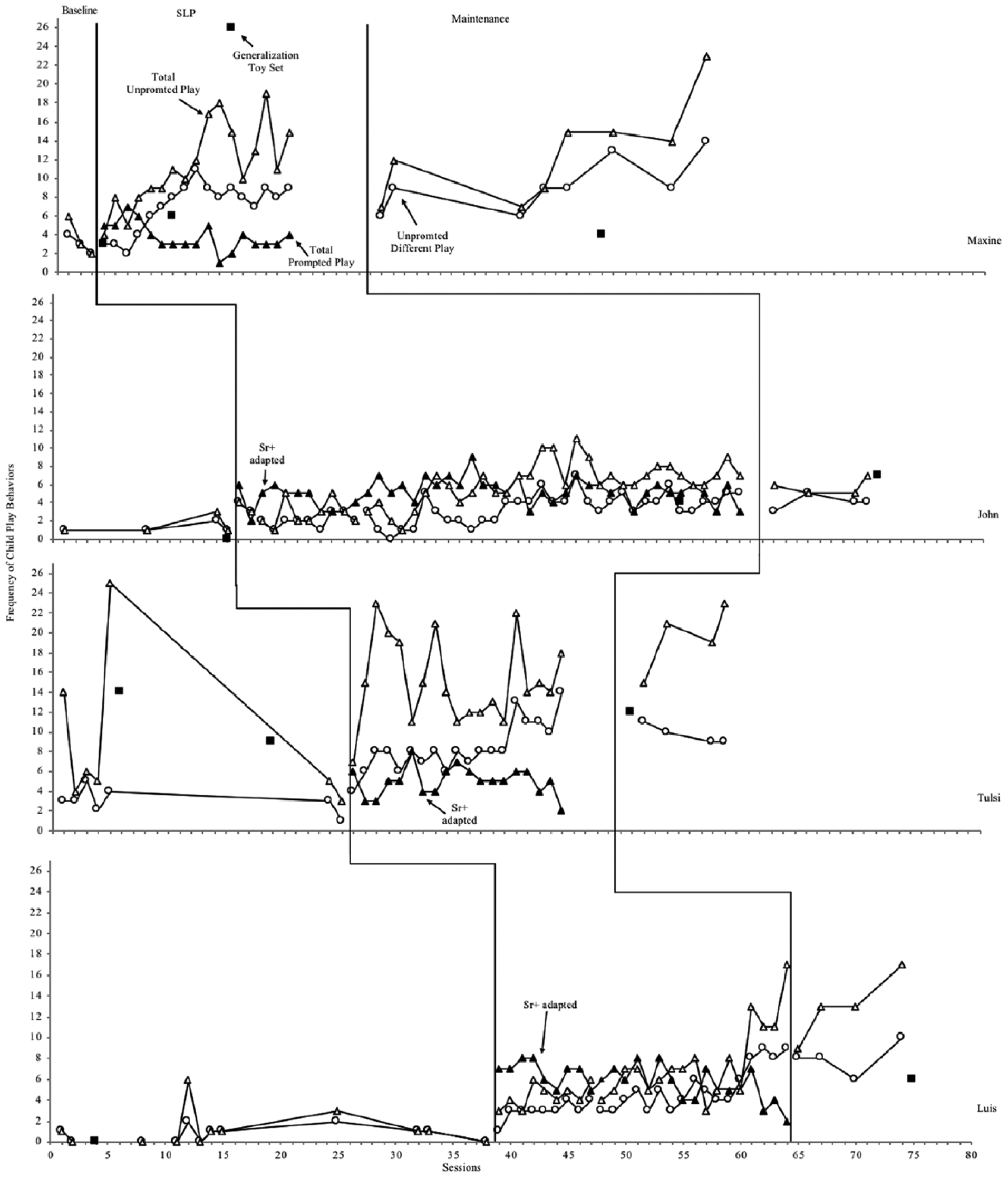
The frequency of child play behaviors for Maxine (tier 1), John (tier 2), Tulsi (tier 3), and Luis (tier 4).
Maxine
Maxine engaged in some repetitive pretend play behaviors during baseline, but demonstrated relatively low levels and a decreasing trend. Upon intervention, Maxine exhibited an immediate increase in the level of total unprompted pretend play. She had an increasing trend with minimal overlap (two sessions) of the preceding baseline conditions. Although she had slow increases in the first eight sessions (range = 5–11), she had an accelerating trend from the ninth to the 17th session. In general, the level during intervention was higher than during baseline, particularly after the ninth session (i.e., after six intervention sessions). Prompted play behaviors were stable across the intervention condition (range = 1–7). During maintenance, her level of pretend play immediately decreased, but eventually increased. Her unprompted different pretend play was consistently low during baseline (range = 2–4). After the fourth intervention session, her unprompted different pretend play data had an increasing trend and stabilized near eight unprompted different play behaviors per session, which maintained. The frequency of play during the generalization sessions was low in baseline, and increased during intervention, which suggests a generalized effect. However, the increased level did not maintain.
John
John had low and stable unprompted play during baseline (range = 1–3). He had a moderate increase during the first intervention session, and a decreasing trend over the subsequent three sessions. An edible reinforcer was then introduced, but data remained low with substantial variability. After 24 sessions, his level of unprompted play increased and stabilized at a level higher than during baseline. Prompted play behaviors were stable across the intervention condition (range = 2–9). During maintenance, he engaged in fewer play behaviors than during intervention, but more than during baseline. During baseline, he had low levels of unprompted different play behaviors and an immediate increase upon intervention. Starting with the 24th intervention session, his unprompted different play remained differentially higher than baseline with minimal overlap. The dearth of generalization data for him precludes visual analysis.
Tulsi
Tulsi’s baseline data on total unprompted pretend play had considerable variability, ranging from 3 to 25. However, during all sessions, and particularly during the fifth baseline session, she repeated the same one or two actions (i.e., pretending to eat). An immediate increase occurred in the first intervention session, and an increasing trend occurred in the following two sessions. During the seventh session, an edible reinforcer was introduced and Tulsi’s unprompted pretend play eventually stabilized and maintained. Prompted play behaviors were stable across the intervention condition (range = 2–8). Tulsi’s unprompted different play showed a decreasing trend in baseline. Upon intervention, her different play evidenced an immediate increase from 1 to 4 and showed a pattern similar to unprompted play. In the final five sessions, she had a large increase in level. During maintenance, her unprompted different play maintained with a slight decreasing trend (range = 9–11). The dearth of generalization data for her precludes visual analysis.
Luis
Luis experienced the longest baseline duration. For 10 of the 12 baseline sessions, the frequency of unprompted pretend play mostly remained low, between 0 and 1. In the beginning of the intervention condition, his unprompted play increased slightly to a higher level, but had considerable overlap with baseline. On the fourth intervention session, edible reinforcers were introduced, which was followed by an immediate decrease in level and then an increasing trend. He had a week absence due to illness after the 18th intervention session, and his subsequent data had some variability. The final four sessions had range of 11 to 17 unprompted play behaviors. Prompted play behaviors were stable across the intervention condition (range = 2–8) with a decreasing trend for the final four sessions. Maintenance sessions were collected 1 and 2 weeks after the intervention and had some variability. The frequency of play during the generalization sessions was low in baseline, and increased after intervention, which suggests a generalized effect, but data should be interpreted with caution given the scarcity.
Discussion
This study investigated the functional relation between the SLPs and pretend play behaviors in young children with disabilities. Given there were consistent changes across participants after the intervention was introduced, a functional relation was identified between SLP (with contingent imitation and reinforcement) and unprompted target play. Specifically, the SLP intervention was functionally related to an increase in the total number of target play for all participants during intervention phase, and the effect maintained when intervention was removed; there were four demonstrations across four participants. However, the delayed behavior change for John and substantial variability for Tulsi limits conclusions regarding their behavior change. For all participants in this study, the level of target play in the final intervention sessions were at least twice the levels produced during baseline conditions. In fact, for Maxine and Luis, the level of the last three instructional sessions was 3 or 4 times. This supports the use of adult-implemented systematic prompting to increase play complexity in children with disabilities, and specifically supports the use of SLP (Barton, 2015; Lifter et al., 2005).
Second, the intervention consistently produced higher levels of different pretend play across all the participants. The increase in different pretend play behaviors showed that children increased their diversity of pretend play; that is, children generated more, different play actions over the course of the study (e.g., feeding a doll, rocking a doll, putting clothes on a doll, assigning attributes to the doll within the same session). For example, out of 25 play behaviors, Tulsi displayed five different play behaviors in one baseline session; in her final instructional session, she had 13 different pretend play behaviors out of 17. The former session, albeit with a higher frequency in total play, showed less diversity in play behaviors compared with the latter. Similar patterns were produced across the other three participants as well. There is general consensus that delays in play are related to the ability of children with disabilities, including autism, to generate new play behaviors rather than delays in the ability to use symbols (cf. Lewis & Boucher, 1988). This form of response generalization has rarely been specifically examined in the play research (Barton, 2015; Barton & Wolery, 2008).
Third, the use of the SLPs and contingent imitation supports and extends previous research. In the current study, the implementer followed the children’s lead and imitated his or her actions with the same toy. This ensured that the implementer prompted new behaviors with the toy the child was using. For example, the child might pretend to eat from a spoon, and the implementer might model using the spoon to stir foods. The SLPs has been used in this manner in previous research (Barton, 2015; DiCarlo & Reid, 2004; Lifter et al., 2005). For example, DiCarlo and Reid (2004) taught toddlers to engage in pretend object play behaviors by using choices and a least-to-most prompting hierarchy. Similarly, although Frey and Kaiser (2011) did not report using a least-to-most prompting hierarchy, they taught children new play behaviors by expanding the existing action to create a play sequence. The adult imitated the child’s play action and added another play action that was closely related to the preceding action. The current study supports and extends this research by showing that children produced higher frequencies of play, increased their overall play complexity, and generated new play behaviors with the use of SLP. Future research should continue to examine the use of SLP with young children with disabilities.
Limitations
There are four major limitations in this study. First, the implementer did not systematically thin reinforcement during intervention sessions as participants target behavior increased. Gradually and systematically thinning the amount or frequency of reinforcement during instruction might have supported increased levels during maintenance. Second, the implementer was not indigenous to the setting, which reduces the ecological validity of the study. However, previous research has demonstrated that teachers can implement this intervention with fidelity with ongoing coaching (Barton, Chen, Pribble, Pomes, & Kim, 2013). Third, the implementer used classroom toys within the toy sets, which limits the internal validity of the study, but, theoretically, is likely to increase the generalization of play skills. We did not differentially analyze whether the children used toys from the classroom during experimental conditions, which should be recorded in future replications. Finally, generalization, sequences, and types of pretend play did not change in this study. This is consistent with previous research demonstrating generalized play, sequences, and types of pretend play do not change unless systematically targeted and taught (Barton, 2015; Barton et al., 2018; Barton & Wolery, 2010), This was outside the scope of the current study, but should continue to be examined in future replications.
Conclusion
This study suggested that SLP is effective in teaching targeted play to young children with disabilities. This intervention package was related to overall increases in pretend play and diversity of play behaviors, which supports previous research (Lifter et al., 2005). The current study expanded previous research by showing the intervention package is effective for very young children, which should be used to promote adult use of systematic prompting to increase play behaviors in toddlers with disabilities.
Footnotes
Acknowledgements
The authors would like to acknowledge the children, families, teachers, and staff of the Susan Gray School, and the Special Education graduate students at Peabody College whose participation and support made this study possible.
Declaration of Conflicting Interests
The author(s) declared no potential conflicts of interest with respect to the research, authorship, and/or publication of this article.
Funding
The author(s) received no financial support for the research, authorship, and/or publication of this article.