



Abstract
Children with disabilities demonstrate fewer complex pretend play behaviors than children with typical development, which might limit their social participation in early childhood settings. A multiple-probe design was used to examine the relation between a single prompt procedure—constant time delay—and the acquisition, maintenance, and generalization of sequences of pretend play by children with disabilities. Results indicated systematic instruction was functionally related to increased levels of unprompted and different sequences of pretend play in all three participants. However, individual adaptations were required for two of three participants. The findings replicate previous research on adult systematic instruction using response-prompting strategies to teach pretend play and extend the literature by measuring and reporting generalized sequences of pretend play. Overall, this study supports systematic, individualized instruction using response-prompting strategies to teach sequences of pretend play to children who do not display such behaviors.
Introduction
Increasing Sequences of Pretend Play in Children With Disabilities
Children engage in pretend play by acting out routines and themes, taking on roles, assigning attributes to inanimate objects, and using or talking about objects as if they were something else. This type of play is typical of preschool-age children across a variety of settings, materials, and skill levels (Pierce-Jordan & Lifter, 2005). However, children with disabilities often have delays in their play skills, which might affect their engagement and social participation in early childhood settings (Lifter, Mason, & Barton, 2011; Mills, Beecher, Dale, Cole, & Jenkins, 2014), performance in interventions focused on other skills (e.g., communication; Yoder & Stone, 2006), and relationships with caregivers (Cohn, 1990; Henry, 1990) and peers (Coolahan, Fantuzzo, Mendez, & McDermott, 2000; Raver & Zigler, 1997). Children with disabilities engage in less complex and fewer play behaviors than their typically developing peers (Barton, 2015; Kasari, Chang, & Patterson, 2013).
Over the past several decades, significant advances in the play intervention research have been documented (Lifter et al., 2011). For example, the play intervention research has evolved such that promising intervention packages (Barton & Wolery, 2008; Jung & Sainato, 2013; Lang et al., 2009; Lifter, Ellis, Cannon, & Anderson, 2005) and effective strategies for training teachers (Barton, Chen, Pribble, Pomes, & Kim, 2013) have been identified. However, there are several limitations in this research including (a) limited empirical studies examining complex sequences—consecutive, related play actions—of pretend play with children with disabilities (Dupere, MacDonald, & Ahearn, 2013; Lillard et al., 2013; MacManus, MacDonald, & Ahearn, 2015); (b) an inequitable proportion of studies focused on children with autism spectrum disorder (ASD) versus other disabilities (Barton & Wolery, 2008; Lang et al., 2009); and (c) a focus on least to most prompting or nonerrorless learning rather than single prompt or errorless learning procedures (Barton & Wolery, 2008; Jung & Sainato, 2013).
Complex Play Behaviors
There are inconsistencies in the measurement and conceptualization of complex play across the play research. For example, some researchers reported measuring discrete play behaviors across increasingly sophisticated play categories (e.g., from simple functional play with pretense behaviors to assigning attributes to themselves and others); others measured the use of consecutive sequences of related play behaviors (e.g., giving the baby a bottle and then rocking the baby, stirring with a spoon in a bowl and then putting the spoon to your mouth) as indicators of complexity (Barton, 2010). Although there is limited research on the normative rates of play for young children in natural settings, preschool-age children typically use multiple related play behaviors and engage in increasingly complex types of play (Lillard et al., 2013).
Given intervention goals for children with disabilities should focus on functional skills of their peers, play targets should teach children the skills that replicate how typical children play. For example, D’Ateno, Mangiapanello, and Taylor (2003) used video modeling to teach play sequences to a child with ASD; however, pretend play did not generalize across toy sets or settings. Stahmer (1995) and Thorp, Stahmer, and Schreibman (1995) used variations of pivotal response training to teach children with ASD complex pretend play behaviors. Researchers in both studies measured sequences of play; however, they used disparate definitions requiring three or four consecutive play actions, respectively, and did not report procedural fidelity. These limitations make comparisons and replications difficult. Barton and Wolery (2010) examined the use of the system of least prompts (SLP) to increase unprompted pretend play in young children with disabilities, but did not specifically target sequences; although children increased their overall frequency of pretend play, none of the children increased his or her use of play sequences. Similarly, Barton (2015) examined the use of the SLP to increase unprompted pretend play in young children with disabilities. She targeted sequences of pretend play for two participants, and both children increased their use of sequences, but only when intentionally taught. Additional, rigorous replications focused specifically on teaching play sequences are needed.
Children With ASD and Other Disabilities
Research has shown children with ASD are likely to engage in repetitive, restrictive play behaviors, which aligns with ASD symptomatology. Perhaps, as a result of the symptomatology, a greater proportion of the play intervention research has focused on children with ASD, rather than children with other disabilities or developmental delays (Barton & Wolery, 2008; Jung & Sainato, 2013; Lifter et al., 2011). This is problematic given responses to interventions might vary by population characteristics. Thus, although evidence supports using systematic instruction to teach play behaviors to children with ASD (Barton & Wolery, 2008; Wong et al., 2015), the research on children with disabilities other than ASD is limited and additional replications across populations and participant characteristics are needed.
Fox and Hanline taught a 4-year-old boy with Down syndrome to engage in toy play using a naturalistic teaching procedure with model and verbal prompting. The child maintained target object play behaviors; however, the researchers did not measure or report the child’s response generalization or complexity of play, which might be important given the simple, discrete nature of the target behaviors. Frey and Kaiser (2011) used contingent imitation, modeled play expansions, and used verbal mapping to increase different play actions for three children with disabilities (i.e., two had language delays and one had Down syndrome). Although the intervention procedures were similar to those used by Fox and Hanline (1993), their results were variable across conditions and children, which precluded the identification of functional relations. VanDerHeyden, Snyder, DiCarlo, Stricklin, and Vagianos (2002) used SLP to teach toy play to two children (one with Down syndrome and one with ASD). Increases in toy play were identified; however, toy play did not maintain in the absence of adult prompts. In sum, the play intervention research regarding children with disabilities other than ASD is promising, but additional research is needed addressing these methodological and procedural limitations.
Effective Interventions
Two primary recommended practices in early childhood special education require the use of (a) systematic procedures and (b) data to individualize and adapt practices to promote children’s learning (Division for Early Childhood, 2014). Some of the most widely researched systematic instructional strategies are response-prompting procedures (Barton & Wolery, 2008; Ledford, Lane, Elam, & Wolery, 2012). Response-prompting procedures include, for example, constant time delay (CTD), progressive time delay, simultaneous prompting, and SLP (Wolery, Ault, & Doyle, 1992). Several researchers have successfully used one specific response-prompting procedure—SLP—to increase unprompted pretend play behaviors in young children with disabilities (Barton, 2015; Barton & Wolery, 2010; Lang et al., 2014; Lifter et al., 2005). The SLP procedure begins with a typical antecedent (i.e., presentation of toys) and the adult delivers increasingly intrusive prompts only if the child does not demonstrate the target behaviors. Most studies using the SLP to teach play described used a three-step prompting hierarchy with (a) presentation of the toys, (b) live modeling or verbal prompting, and (3) physical hand-over-hand prompting (Barton & Wolery, 2008; Lifter et al., 2005).
CTD is a response-prompting procedure designed to result in errorless learning using a single prompt rather than the hierarchy of prompts used with SLP. With both SLP and CTD, a controlling prompt (e.g., hand-over-hand prompting) is identified that ensures the child will perform the behavior and access reinforcement. With SLP procedures, the implementer uses at least one or two less intrusive prompts (e.g., modeling, choices) after delivering the task direction and prior to delivering the controlling prompt. SLP is designed such that the child will require the controlling prompt during fewer trials and gradually emit the target behavior without prompting. With CTD procedures, the controlling prompt is delivered immediately after the task direction (i.e., 0 s trials) for a set number of sessions (e.g., one or two sessions). After the 0 s trial sessions, the implementer waits a predetermined amount of time (e.g., 5 s) after delivering the task direction for the child to respond and uses the controlling prompt only if the child does not respond accurately. CTD procedures have been shown to be more effective and efficient than SLP when teaching chained and discrete behaviors to children (Wolery, Griffen, Ault, Gast, & Doyle, 1990). Furthermore, SLP is complex and might require intensive coaching (Barton et al., 2013). SLP, however, allows the adult to build off the child’s play, which complements, rather than interrupts, the play interaction (Barton & Wolery, 2008). Conversely, CTD procedures constitute a single prompt and might be more feasible for early childhood professionals. Current research does not delineate specific procedural variations that should be implemented when using response-prompting procedures with individual children, and no researchers have examined the use of CTD to teach play skills.
Play interventions should also consider that play is flexible and occurs across settings, materials, peers, and skills. Furthermore, play provides an ideal context for practicing and generalizing new skills (Lifter et al., 2011) and might have reinforcing properties for other skills (Morrison, Sainato, Benchaaban, & Endo, 2002). Given (a) the variety of antecedents under which play behaviors occur, (b) the likelihood for individual learning histories with toys or play, and (c) the variety of maintaining consequences for play behaviors are expected to vary across children, idiosyncratic differences in individual responses to play interventions are predictable. Additional research is needed using response-prompting procedures—CTD in particular—to teach children with disabilities more complex play behaviors (e.g., play sequences) and the individual adaptations that might be required.
Current Study
The current study was designed to address the aforementioned limitations in the play intervention research. The research questions guiding this study were as follows:
Method
Participants and Implementers
Three children with disabilities were recruited from an inclusive, university-based early childhood program in a southeastern state after obtaining approval by the appropriate institutional review board (IRB). Inclusion criteria for children were (a) educational eligibility for special education services, (b) chronological age between 24 and 72 months, (c) greater than 80% attendance rate for the previous month, (d) play-related individualized education program (IEP) goal(s), (e) ability to participate in a one-on-one play activity with an adult for 5 min, and (f) fewer than five different unprompted pretend play behaviors and no sequences of pretend play behaviors during a 10-min observation. All criteria except (f) were established based on teacher report; (f) was measured during an observation of the child in his or her classroom during a free play context when he or she would be expected to engage in pretend play. All recruitment activities began after obtaining parent and teacher consents.
Joey was a 53-month-old male with Down syndrome. His teacher reported he had limited communication skills, but regularly used gestures and about five different signs. His play was severely limited and he engaged primarily with puzzles and books. Trevor was a 60-month-old male with Down syndrome. His teacher reported he had limited communication skills, but regularly used 10 different words to communicate. His play consisted primarily of lining up objects, spinning toys, and dump and fill activities. Tessa was a 55-month-old female with a seizure disorder and global developmental delays. Her teacher reported that she regularly used one-word phrases to communicate. Tessa’s play consisted primarily of repetitive actions with figurines. All three children were White. Three female graduate students in special education graduate program served as implementers and coders; two were White and one was Asian.
Setting and Materials
All baseline, intervention, and generalization sessions occurred in the child’s classroom during the school day. Two of the participants, Trevor and Tessa, transitioned to new classrooms within the same program prior to the completion of the study. Sessions typically occurred during designated free play time and in a carpeted play area or table within the classroom. Classroom staff and peers were present during all sessions. If a peer attempted to engage with the target toys, he or she was directed to alternative toys, but allowed to play nearby.
Three research-designed toy sets were used in this study: baby, kitchen, and vehicles. The baby toy set included two life-size baby dolls and baby clothes; the kitchen toy set included plates, cups, and utensils; and the vehicle toy set included trucks, cars, and airplanes. All toy sets also included small animal and people figures and vague toy objects (e.g., cloth, sponges, pipe cleaners) similar to the toys found in the classrooms. There was no overlap in toys between the sets. Exact information about toy sets is available via email from the first author. Each set contained duplicates of every toy for imitation purposes. A Canon VIXIA video camera was used to record all sessions, and ProCoderDV (Tapp, 2003) was used to code all sessions.
Experimental Design and Analysis
A multiple-probe single case design across behaviors was replicated across three children with disabilities (Gast, Lloyd, & Ledford, 2014). Instructional conditions were introduced across toy sets in a time-lagged manner. The research team made the decision to change conditions (i.e., intervene in subsequent tiers/behaviors) when three consecutive sessions with more unprompted than prompted play sequences occurred (i.e., mastery criterion). Researchers established experimental control using multiple-probe designs with stable baseline conditions when commencement of the intervention results in an immediate change in level, trend, or stability of data patterns, and if commencement of the intervention does not coincide with changes in data patterns in subsequent tiers (Gast & Ledford, 2014).
Effects of the intervention and the presence of experimental control were examined using visual analysis (Gast & Spriggs, 2014). The four-step visual analysis process outlined by Kratochwill and colleagues (2013) was used: (a) documenting stable baselines, (b) examining within condition patterns, (c) comparing adjacent conditions to assess behavioral change, and (d) analyzing data across conditions and tiers to document at least three demonstrations and three different points in time to determine whether a functional relation exists.
The study met What Works Clearinghouse Single Case Design Standards with reservations (Kratochwill et al., 2013). There were three intraparticipant attempts to document behavior change (i.e., across three toy sets), and three interparticipant replications. Interobserver agreement (IOA) was collected for greater than 20% of sessions across conditions, participants, and target behaviors, and IOA estimates were greater than 80%. One condition, for Tessa only, had three, albeit stable, data points; thus, the study met “with reservations.” In this case, Tessa met a priori determined mastery criterion during the final tier of intervention in three sessions, which precluded the need for additional data and initiated the maintenance condition.
Dependent Variable, Data Collection, and Reliability
The primary dependent variable for this study was the number of unprompted pretend play sequences (US). These included, for example, stirring a spoon in a bowl, then putting the spoon to your mouth; giving a baby a bottle, then rocking the baby; and flying a block as an airplane, then rolling it on the ground and flying it back up in the air. US were used to make all experimental decisions; condition changes occurred when US reached mastery criterion (i.e., three consecutive sessions with more unprompted than prompted play sequences occurred). A taxonomy of pretend play described by Barton (2010, 2015) was used to define the target behaviors and sequences. ProCoderDV was used to code video recordings for dependent variables, IOA, and procedural fidelity. Coders used timed event recording to count child target behaviors using a 3-s agreement window. IOA data were collected for at least 20% of sessions across all participants, conditions, and behaviors. IOA estimates were calculated using the point-by-point method with the following formula: ([agreements] / [agreements + disagreements] × 100; Ayers & Ledford, 2014). The implementer for each child also served as the primary coder; other implementers coded randomly selected sessions for IOA. Coders were initially trained to more than 90% IOA for all dependent variables using nonstudy videos. The total IOA across all conditions was 97% (range = 81%-100%) for Joey, 97% (range = 88%-100%) for Trevor, and 93% (range = 80%-100%) for Tessa. Overall, average IOA was above 80% across dependent variables, conditions, and children.
Procedures
Probe conditions (enhanced baseline)
Sessions during the probe conditions lasted for 5 min and were identical for all three participants. During these sessions, the implementer sat next to or across from the child with the toys in front of him or her. The implementer said, Let’s play! to begin each session, then engaged in contingent imitation and verbal mapping of the participant’s play behaviors. For contingent imitation, the implementer immediately imitated all the child’s play-related actions using a duplicate toy or the closest approximation. For verbal mapping, the implementer narrated the participant’s play actions using short phrases. Implementers did not contingently imitate or verbally map instances of challenging behavior, such as throwing toys or stereotypy. These procedures also were used during all probe conditions, adult generalization sessions, and maintenance sessions. At least one and no more than three sessions occurred per day with at least 5 min in between each session.
Withdrawal
A brief withdrawal condition was introduced between baseline sessions for two of the participants, Joey and Trevor, for their first toy sets. This condition was initiated because their rates of pretend play were higher than expected. Sessions were identical to those during the probe condition, except the implementer did not use contingent imitation or verbal mapping. The implementer sat with the participant and provided intermittent verbal praise approximately once per minute for staying in the area and engaging with the toy sets. The implementers redirected the children back to the toys if they attempted to leave the area.
Instruction
The intervention condition began for each participant with 5-min sessions using CTD procedures. These sessions were the same as baseline, except if the child did not engage in sequences of pretend play for five consecutive seconds, the implementer delivered the task direction, What’s next? then waited the appropriate delay interval. The delay interval for the first two CTD sessions with each toy set was 0 s, and for all subsequent sessions was 5 s for all three children. If the child began or completed a pretend play sequence during the delay, the trial ended and the implementer provided praise. If the participant did not engage in a pretend play sequence, the implementer used a controlling prompt to assist the child in completing a pretend play sequence based off their last action and known interests. The controlling prompts were selected based on teacher report and observation. For Joey, the controlling prompt was first a physical hand-over-hand prompt and then changed to model prompt at Session 19 of Tier 1 (i.e., baby). For Trevor, the controlling prompt was a physical prompt through all tiers. For Tessa, the controlling prompt was a physical prompt and then changed to model prompt at Session 30 of Tier 1 (i.e., vehicles). The implementer also praised prompted correct responses.
Instructional adaptations for Joey
Although a physical prompt was originally chosen as the controlling prompt, noncompliance and behavioral indicators of distress (e.g., crying, pulling away) resulted in a switch to a less intrusive model prompt. However, to ensure his success with the model prompt, his primary implementer conducted a brief imitation training program prior to Session 19 of Tier 1. During this program, the implementer secured his attention, modeled one of several motor actions with objects, and said, Do this. If Joey failed to imitate independently, the implementer used hand-over-hand prompting. Reinforcement in the form of social praise was provided after every prompted or unprompted imitation. When Joey met mastery with 100% unprompted correct imitations for three consecutive sessions, the implementer restarted the CTD instructional sessions using the model prompt. Due to low levels of the target behaviors, the model prompt was adapted to a model plus give prompt at Session 28 (i.e., the implementer modeled the target play sequence and immediately handed relevant toys to him). However, Joey did not exhibit consistent compliance with model plus give prompts, and a reinforcement system was introduced at Session 30. Reinforcement (i.e., stickers) was provided contingent on imitation of model prompts and unprompted pretend play sequences; reinforcers were identified based on teacher report. At Session 32, tokens were provided with the stickers; when Joey earned six tokens in one session, he could watch a 1-min video clip of a preferred movie. This continued through subsequent sessions and tiers.
Instructional adaptations for Tessa
Tessa’s rate of unprompted pretend play did not demonstrate hypothesized data patterns when the implementer used CTD. Thus, an edible reinforcement was identified (i.e., through parent and teacher reports) and provided contingent on all prompted and US of pretend play (Session 31). However, levels of US remained low; thus, the research team changed the instructional procedure to SLP. SLP has been shown to be functionally related to increases in pretend play (Barton, 2010, 2015; Barton & Wolery, 2008). The prompting hierarchy for SLP included three levels of prompts. The first level was the presence of the toys and the statement, Let’s play! The second level was a physical model. That is, if Tessa did not perform a pretend play sequence 10 to 20 s after the trial was started, the implementer secured her attention and modeled a sequence. The third level, the controlling prompt, was hand-over-hand physical prompting. The implementer waited 3 to 8 s after the presentation of the visual schedule to provide the controlling prompt. An edible reinforcement was presented for prompted and unprompted pretend play sequences on a fixed ratio one (FR1) schedule. The SLP procedures were used with all subsequent tiers/toy sets. Edible reinforcement was thinned to a fixed ratio three (FR3) schedule (i.e., every third target behavior) during the second tier/toy set and removed prior to starting the third tier.
Generalization across adults
Generalization across adult sessions were identical to probe sessions; the instructor imitated and mapped the child’s actions, and no adult prompting occurred. Sessions were 5 min, and began with the implementer stating, Let’s play! without additional prompts. The generalization adults (i.e., graduate students in special education) were occasionally present in the participants’ classrooms, but were not the participants’ teachers.
Free play generalization
Free play generalization sessions were 5 min and conducted in the classroom in the dramatic play or block free play centers. The implementers provided no attentional cues, did not imitate the child’s actions, and did not verbally map the child’s actions. The implementer stayed within 5 feet of the participants, and occasionally provided verbal reinforcement for staying in the area. If the child tried to leave the area, the implementer guided him or her back to the area, but did not prompt him or her to play with specific toys.
Procedural Fidelity
The implementer’s correct use of experimental procedures was measured throughout the study across all experimental conditions. The trained coders coded procedural fidelity for more than 30% of the sessions in each condition for each participant and toy set. The coder measured procedures during all conditions using procedures and definitions used in previous studies (Barton, 2015; Barton & Wolery, 2010); these also are available via email from the corresponding author. The coder used 10 s momentary time sampling to code the use of contingent imitation and event recording to code the implementation of the intervention package across all conditions. Fidelity scores represent the percentage of correct implementation out of total available opportunities. Procedural fidelity results demonstrated that implementers implemented the intervention with high fidelity across all participants and toy sets and did not implement the intervention during baseline, maintenance, or generalization conditions. Procedural fidelity data are shown in Table 1.
Procedural Fidelity Across Conditions and Children.

Note. TS = toy set; SLP = system of least prompts; CTD = constant time delay.
Results
Play Sequences
Joey
Joey performed higher than expected levels of US during the initial baseline sessions with a range of four to 11 (see Figure 1). When imitation and verbal mapping were withdrawn, his US decreased to zero. US increased with the reintroduction of imitation and verbal mapping. US remained low and stable in subsequent tiers prior to the introduction of the intervention. When the intervention commenced with Tier 1 (baby), US increased in variability but eventually decreased to zero or near zero levels. Unprompted different sequences (UDS) remained low throughout all conditions in Tier 1. When the intervention commenced with Tier 2 (kitchen), US showed an immediate increase and he met mastery criterion in six sessions. During maintenance with this toy set, US increased in variability. UDS remained low prior to starting intervention, increased slightly during intervention, and showed an increasing trend during maintenance. When intervention commenced with Tier 3 (vehicles), US immediately increased and he met mastery criterion in three sessions. During maintenance with this toy set, US remained at levels similar to intervention. UDS remained low prior to starting intervention and increased during intervention. In sum, Joey’s US increased with the use of CTD and maintained when instruction was not used for two of the three toys sets.
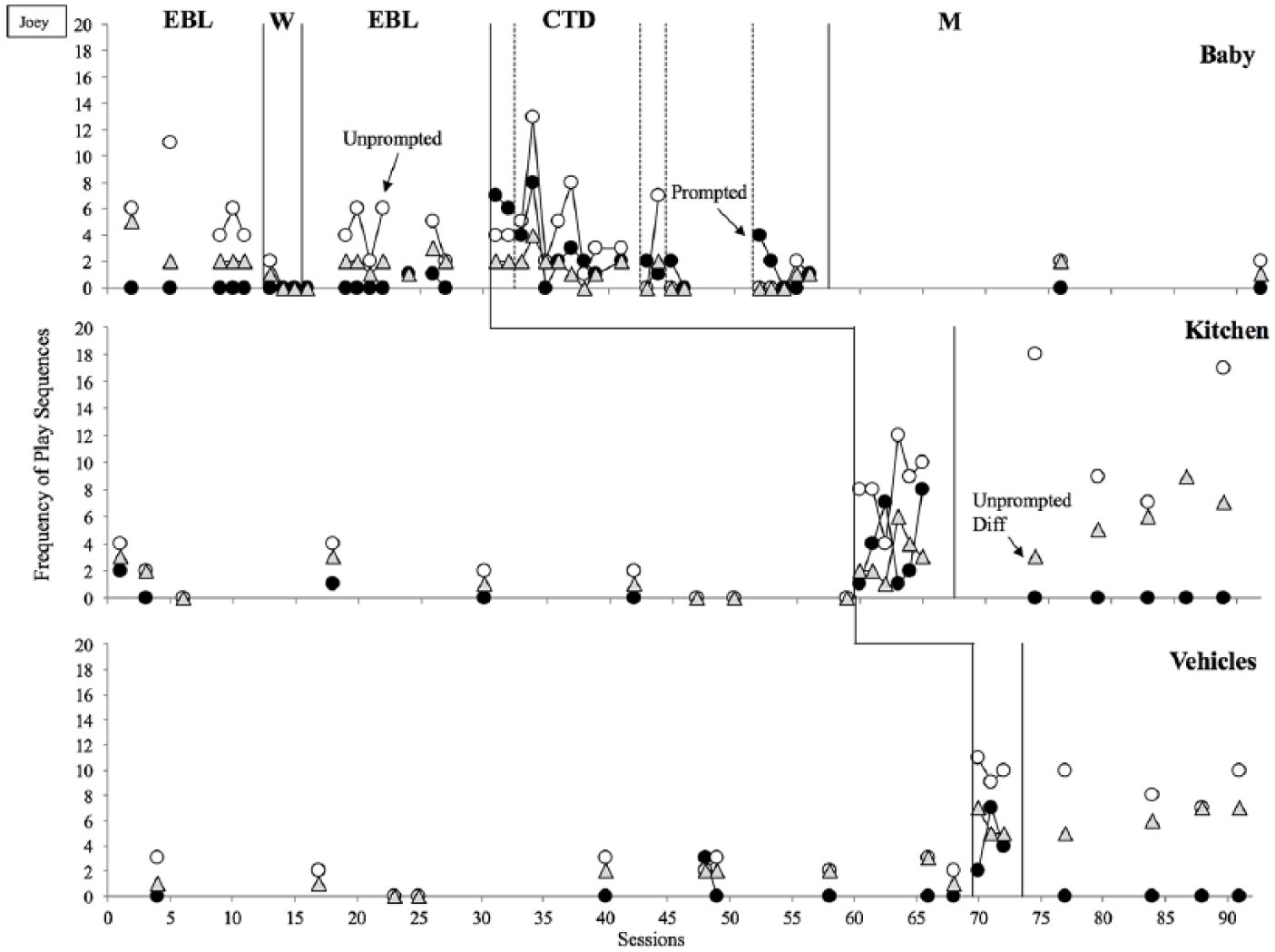
Joey’s frequency of play sequences across baby (top tier), kitchen (middle tier), and vehicles (bottom tier) toy sets.
Trevor
Trevor performed higher than expected levels of US of pretend play during the initial baseline sessions with a range of two to 10 US (see Figure 2). When imitation and verbal mapping were withdrawn, the variability of his US increased. However, US decreased to zero or near zero levels with the reintroduction of contingent imitation and verbal mapping. US remained low with some variability in subsequent tiers prior to the introduction of the intervention. When the intervention commenced with Tier 1 (vehicles), US displayed an increasing trend and met criterion in 13 sessions. UDS remained low prior to starting intervention and eventually showed a slight increase in level and trend during the fifth intervention session. When the intervention commenced with Tier 2 (baby), US immediately increased and he met mastery criterion in six sessions. During maintenance with this toy set, US decreased slightly and showed some overlap with the baseline condition. UDS remained low prior to starting intervention, but increased slightly throughout the intervention and maintained after the intervention was withdrawn. When intervention commenced with Tier 3 (kitchen), US immediately increased and he met mastery criterion in 10 sessions. During maintenance with this toy set, US immediately increased but eventually maintained at levels similar to the intervention condition. UDS remained low prior to starting intervention, increased in level during intervention, and increased in level again during the maintenance condition. In sum, Trevor’s US increased with the use of CTD and maintained when instruction was withdrawn for all three toys sets; experimental control was established and a functional relation was present.

Trevor’s frequency of play sequences across vehicles (top tier), baby (middle tier), and kitchen (bottom tier) toy sets.
Tessa
Tessa performed low levels of US of pretend play during the initial baseline sessions across all tiers (see Figure 3). When intervention commenced with Tier 1 (vehicles), US increased slightly, but did not meet mastery criterion until the instructional procedures were changed to SLP. UDS remained low prior to starting intervention and eventually showed a slight increase and variability with CTD, which maintained with SLP. Levels of US and UDS maintained during the maintenance condition. When the intervention commenced with Tier 2 (kitchen), US displayed an immediate increase, and she met mastery criterion in five sessions. During maintenance with this toy set, US decreased slightly and had some overlap with the baseline condition. UDS remained low prior to starting intervention and showed an increasing trend during intervention. During maintenance, UDS stabilized at a level higher than baseline with no overlap. When intervention commenced with Tier 3 (baby), US demonstrated an immediate increase, and she met mastery criterion in three sessions. During maintenance with this toy set, US and UDS maintained at levels similar to the intervention condition. In sum, Tessa’s US increased with the use of SLP and maintained across all three toys sets; experimental control was established and a functional relation was present.

Tessa’s frequency of play sequences across vehicles (top tier), kitchen (middle tier), and baby (bottom tier) toy sets.
Generalization
US and UDS were low for all children during the adult generalization and free play generalization sessions during baseline conditions across toy sets (see Table 2). In fact, Joey and Tessa had zero US and UDS; Trevor had fewer than two. With the introduction of the intervention, Joey used more US and UDS. Trevor and Tessa also used more US and UDS with the introduction of the intervention; the magnitude of their increases were higher than Joey’s.
Mean and Range of Unprompted Sequences and Unprompted Different Sequences in Generalization Sessions.

Note. TS = toy set; B = baseline; I = intervention.
Discussion
This study was conducted to evaluate the efficacy of CTD in teaching sequences of pretend play to children with disabilities. Overall, the results of this study indicate a functional relation between systematic instruction and increased US and UDS of pretend play. CTD was effective for teaching sequences of pretend play to two children (Joey and Trevor). There was a clear functional relation for Trevor, but the lack of behavioral change in Tier 1 with Joey precludes identification of a functional relation. Likewise, CTD was not effective in Tier 1 for Tessa. However, SLP was effective for increasing Tessa’s US and UDS and a clear functional relation was identified. In sum, substantial changes in responding occurred across children that corresponded to the implementation of the interventions.
Teaching Complex Play
Few studies have focused on teaching complex play to young children with disabilities. The current study used evidence-based prompting procedures to increase the sequences of pretend play rather than discrete pretend play behaviors. This is important because children with typical development engage in complex play; that is, teaching increasingly complex play behaviors (e.g., sequences) might be ecologically valid (Lillard et al., 2013). Previous research on sequences of play are limited, in that, studies have found mixed results (D’Ateno et al., 2003), methodological limitations (Stahmer, 1995), or no changes in sequences of play (Barton & Wolery, 2010). Barton (2015) demonstrated increases in US for two children with disabilities, but only when sequences were specifically targeted. Our study replicates and extends these studies because children increased their use of US and UDS. These results are promising and suggest teachers should use systematic prompting focused on increasingly complex play behaviors with children with disabilities. Future research should continue to examine and extend these findings; direct and systematic replications are needed.
Individual Responses
Response-prompting procedures were effective across the participants, which supports the use of systematic adult modeling and prompting for teaching play (Barton & Wolery, 2008; Lifter et al., 2011). There were clear differences in individual responses to the intervention package, and the individual adaptations ensured the children benefited from the intervention, and supported the need for ongoing, data-based decisions (Barton et al., 2016). Thus, future research should continue to examine effective strategies for teaching pretend play to children from diverse populations and with heterogeneous characteristics (Dupere et al., 2013). Furthermore, these findings contribute to the research supporting systematic instruction to teach play to children with developmental delays and disabilities other than ASD. Although additional research is needed examining the use of CTD and SLP to teach sequences by indigenous implementers (Barton et al., 2013), in the current study, the implementer used the procedures in the child’s classroom during the typical daily routines. This supports previous findings; for example, VanDerHeyden and colleagues (2002) used SLP during typical center times with two preschool children with disabilities. Children increased their toy play with systematic adult prompting and stimulus alterations, respectively, in their typical preschool classrooms.
The individual differences noted in the children’s responses to the interventions in the current study—one child’s toy play increased with adult prompting, the other with stimulus alterations—also further support the use of individual instructional adaptations when teaching play. These idiosyncratic findings are important, although often overlooked in single case research. In recent years, there has been an increased focus in special education on evidence-based practices. This has occurred parallel with an increased focus on experimental control in single case research (Kratochwill et al., 2013). Perhaps, as a result, research findings have suggested a file drawer effect or publication bias has occurred for single case research, which means studies with noneffects are disproportionately unlikely to be published (Shadish, Zelinsky, Vevea, & Kratochwill, 2016; Sham & Smith, 2014; Tincani & Travers, 2018). This has a significant impact on the identification of evidence-based practices and suggests overstated intervention effects might be present in meta-analyses and systematic reviews of single case research (Travers, Cook, Therrien, & Coyne, 2016). Unfortunately, the disproportionate publication of studies with clear, robust behavior change threatens the validity of specific interventions and has a negative impact on future replication studies, particularly studies with more complex or unpredictable variables (Cook & Therrien, 2017; Tincani & Travers, 2018). Publication bias can be prevented by publishing studies based on their methodological rigor, rather than the presence or magnitude of behavior change (Cook & Therrien, 2017). The findings in the current study demonstrated CTD was effective for two of the three participants, which might be important for ensuring “complete and balanced research base is available to guide future research, policy, and practice in special education,” specifically with regard to the play intervention research (Cook & Therrien, 2017, p. 7).
Generalization and Maintenance
We facilitated generalization by prompting multiple exemplars of pretend play sequences. Generalized responding occurred across adults, toys, and settings, which correlated with exposure to the intervention. We measured both response and stimulus generalization, which might be important to ensure children learn an adequate repertoire of play schemes. Our measure of UDS could be considered an assessment of the child’s response generalization (i.e., use of different play behaviors within the same response class). We also measured generalization across settings and toys during the free play generalization context and across adults, which is stimulus generalization. All children generalized pretend play to nonintervention contexts, which is significant and suggests the children were generalizing pretend play to contexts that will occasion positive interactions with peers and adults (McConnell, 2002).
Furthermore, the children maintained levels of pretend play behaviors in probe sessions immediately after intervention as well as several weeks after intervention ceased. Previous implementers have reported increases in stimulus generalization (Barton, 2015), although few have measured maintenance (Barton & Wolery, 2008). For example, researchers have generalized pretend play across toys with video modeling (Dupere et al., 2013), peers with iPad® social story (Murdock, Ganz, & Crittendon, 2013), and settings using simultaneous prompting (Colozzi, Ward, & Crotty, 2008). However, these researchers primarily focused on specific, discrete play behaviors, and reported limited or a total lack of maintenance and response generalization. Conversely, using SLP and teaching multiple exemplars of play were related to stimulus and response generalization of play skills, which generalized and maintained, in a manner similar to the current findings (Barton, 2015). Although more research is needed, this suggests systematic adult prompting of play behaviors as a response class—rather than specific, discrete play behaviors—might be related to robust, lasting changes in children’s play.
Measuring Play
The overarching goal of play interventions should be that children independently engage in increasingly complex and social play behaviors. Thus, careful consideration also should be taken in designing baseline conditions. The current findings suggested that not playing with the child during baseline might create an aversive context. We used the withdrawal conditions with Joey and Trevor because they engaged in higher than expected rates—although mostly repetitive play actions—of play with the enhanced baseline. Both children reduced play levels to zero or near zero during or immediately after the condition. Anecdotally, Joey put his head down and did not interact with the toys at all by the third session, and Trevor refused to sit with the implementer and hid when she walked in the classroom. With the return to the enhanced baseline, Joey returned to previous play levels and engaged in the similar repetitive play with the toys; however, he did not respond to prompts and, despite multiple adaptations to the procedures, never increased play. Trevor returned to previous levels but continued to attempt to avoid playing with the implementer. Baseline conditions should be designed to provide an accurate and reliable measure of the child’s play prior to intervention, while maintaining the child’s motivation to play with the toys and the adult or peers.
Limitations
There were several limitations in the conduct of this study. First, the intended intervention, CTD, was not effective for the first toy set with Joey or Tessa. The dynamic nature of the experimental design used allowed for adaptations to ensure that Tessa benefited from the intervention, while maintaining experimental control and identifying a functional relation. However, we did not identify a functional relation for Joey. Single case designs might be particularly useful for identifying individual responses to the intervention and making data-based adaptations (Barton et al., 2016) in future replications. Second, the implementers were trained graduate students—not indigenous to the classroom, which limits the ecological validity of the study. Finally, we did not measure the social validity of the results; thus, conclusions about the importance of the outcomes and the feasibility of the procedures are limited.
Conclusion
Overall, this study provided a strong argument for engaging in systematic instruction using multiple exemplars of sequences of play, which supports and extends previous research (Barton, 2015; MacManus et al., 2015). Play provides children with multiple opportunities to learn and engage with the environment, including promoting meaningful interactions across people and contexts (Barton, 2010; Lifter et al., 2011; McConnell, 2002). Play should be a primary goal for children with disabilities who play less often and demonstrate fewer complex and diverse pretend play behaviors than children with typical development. Teaching the child new and more sophisticated ways to play might occasion more learning opportunities across settings and activities. In this manner, complex play might be a behavioral cusp and allow them to access additional and previously unavailable learning opportunities, particularly around social skills.
Footnotes
Acknowledgements
The authors wish to acknowledge the assistance provided by Lillian Stiff, Jia Qiu, and Rebecca Murray in the conduct of this study and the preparation of this article.
Declaration of Conflicting Interests
The author(s) declared no potential conflicts of interest with respect to the research, authorship, and/or publication of this article.
Funding
The author(s) disclosed receipt of the following financial support for the research, authorship, and/or publication of this article: Preparation of this article was supported in part by the U.S. Department of Education, Office of Special Education and Rehabilitative Services, Grant H325K140110. However, the opinions expressed do not necessarily reflect the policy of the U.S. Department of Education and no official endorsement should be inferred.