




Abstract
The present study examined the role of language capacities in explaining differences in social information processing (SIP) among three school-age groups: high-functioning children with autism spectrum disorder (ASD, IQ > 75), children with specific learning disorder (SLD), and children with typical development (TD). Participants were 96 boys in Grades 3 to 6, comprising 25 boys with ASD, 38 with SLD, and 33 with TD. SIP measures included two peer vignettes (group entry, ambiguous provocation) to highlight influences of social context. Both clinical groups (SLD, ASD) differed significantly from the nonclinical (TD) group in total language capacities and in five of six SIP measures. As hypothesized, language capacities also significantly mediated the two disorders’ associations with children’s deficits along SIP stages. Findings from this novel comparative study call for consideration of semantic-pragmatic language’s role when planning interventions that target social cognition in both clinical populations as well as further empirical exploration.
Keywords
Social cognition mechanisms lead to social behaviors, which are assumed to serve as the foundation for social adjustment (e.g., Crick & Dodge, 1994; Gifford-Smith & Rabiner, 2004). Most research to date on social-cognitive functioning has utilized the social information processing (SIP) model (e.g., Crick & Dodge, 1994). The SIP model conceptualizes the mental processes that underlie children’s processing of social interactions, detailing how children process and interpret cues in social situations and how they arrive at a behavioral or emotional decision regarding these cues.
This SIP model’s six stages (e.g., Crick & Dodge, 1994) comprise the following: (a) encoding social cues (i.e., attending to appropriate cues, chunking/storing information), (b) mentally representing and interpreting the cues (i.e., integrating cues with past experiences, arriving at meaningful understanding, considering one’s own and others’ perspectives on situations), (c) clarifying social goals (e.g., joining a group game, maintaining ongoing conversation), (d) searching for possible social responses, (e) making a response decision after evaluating various responses’ consequences and estimating the probability of favorable outcomes, and (f) acting out a selected response while monitoring its effects on the environment and regulating behavior accordingly.
Difficulties in SIP have been documented for children with autism spectrum disorder (ASD) who are high-functioning (i.e., IQ > 75) as well as for children with specific learning disorders (SLDs). However, comparative studies have not yet delineated the unique characteristics of SIP patterns in each disorder, nor the possible role played by these children’s language capabilities in contributing to their SIP deficits. The present study aimed to narrow these gaps in the research literature by further exploring the mechanisms possibly underlying individual differences in SIP among children with ASD, with SLD, or with typical development (TD).
Specifically, this study focused on the possible mediating role of language capacities in understanding individual differences in SIP. This exploration may be of particular interest in high-risk populations with ASD or SLD, for several reasons. First, each of these high-incidence populations reveals a unique SIP profile characterized by specific SIP deficits (see review on SLD in Al-Yagon & Margalit, 2013 and on ASD in Bauminger-Zviely, 2013). Second, language difficulties characterize each of these at-risk populations, both ASD (Boucher, 2012; Stefanatos & Baron, 2011) and SLD (Schmitt, Justice, & Pentimonti, 2013; Siegal & Mazabel, 2013). As suggested by prior studies on multiple risk factors, an increase in the quantity of risk factors experienced by children (i.e., deficits both in SIP and in language) dramatically increases the likelihood of adjustment problems (Greenberg, Speltz, DeKlyen, & Jones, 2001). Third, although the associations between language capacities and SIP patterns have rarely been examined among these populations, the few available studies suggested the possible important role of language capacities in predicting better social functioning, both in ASD (e.g., Seltzer et al., 2003) and in SLD (e.g., Bryan, Sullivan-Burstein, & Mathur, 1998), thus calling for a comparative mediational model. Fourth, comparative examination of the two disorders may lead to broader understanding of the unique SIP profiles and their possible language-related antecedents, which may enable the design of better tailored social interventions.
Processing of Social Information in Children With ASD
ASD is a neurobiological disorder that significantly impairs reciprocal social relations and verbal and nonverbal communication. It is also characterized by atypical repetitive stereotyped behaviors (American Psychiatric Association [APA], 2013).
Research on SIP Patterns in ASD Versus TD
Studies on this population have highlighted impairments in various social-cognitive capabilities, including major difficulties in SIP, even for the more cognitively able high-functioning individuals with ASD who function above the level of intellectual disability (IQ > 75; e.g., Channon, Charman, Heap, Crawford, & Rios, 2001; Embregts & van Nieuwenhuijzen, 2009; Flood, Hare, & Wallis, 2011; Goddard, Howlin, Dritschel, & Patel, 2007; Meyer, Mundy, Van Hecke, & Durocher, 2006). These studies revealed consistently greater difficulty in ASD versus TD on several SIP stages, such as adding nonrelevant information (encoding), preferring passive and withdrawn but not assertive responses (searching), misunderstanding responses’ social appropriateness (deciding), and showing difficulty in executing assertiveness (acting out). However, they understood that aggressive and submissive responses were inadequate. Taken together, research to date indicates that even if not all SIP stages are impaired in high-functioning children, adolescents, and adults with ASD, this population does demonstrate a major deficit in providing appropriate solutions to different social situations, as well as in their ability to evaluate solutions’ social appropriateness.
Research on SIP and Language in ASD
Language may play an important role in social performance for individuals with ASD. For example, higher vocabulary capabilities and functional use of language have been associated with higher levels of social participation and social play among children with ASD during social interactions with peers (e.g., Hauck, Fein, Waterhouse, & Feinstein, 1995; Sigman & Ruskin, 1999). Yet, only two studies to date have specifically examined the possible role of language for these individuals’ SIP. Meyer et al. (2006) found that children with higher language abilities (per Wechsler’s, 1991, information and vocabulary subscales) made fewer hostile-intent attributions and responded with more assertively competent behavior. Ziv, Hadad, and Khateeb (2014) found that preschoolers with ASD (mean age = 5.25 years) who showed higher expressive vocabulary (per Kaufman & Kaufman’s, 2004, expressive vocabulary subtest) more frequently evaluated aggressive responses as inadequate.
Processing of Social Information in Children With SLD
SLD is a common disorder in school-age children, across different languages and cultures (Diagnostic and Statistical Manual of Mental Disorders [5th ed.; DSM-5]; APA, 2013). The Diagnostic and Statistical Manual of Mental Disorders (4th ed., text rev.; DSM-IV-TR; APA, 2000) diagnosis for learning disorder (LD) was used in the current study’s administration and in other studies reviewed here that were conducted before DSM-5 publication. Children receiving the DSM-IV-TR diagnosis for LD manifested substantially lower achievements on standardized tests (in reading, writing, and/or mathematics) than expected for age, schooling, and level of intelligence. Alongside investigation of LD’s effects on academic skills and functioning, studies have also documented these children’s diverse deficits in the social and emotional domains (e.g., Al-Yagon, 2010, 2012; Estell et al., 2008). One major approach toward conceptualizing these children’s individual differences in social adjustment has been the study of social cognition (e.g., Al-Yagon & Margalit, 2013).
Research on SIP Patterns in SLD Versus TD
Using the SIP model (Crick & Dodge, 1994) as a conceptual framework for social cognition, a body of research has indicated that many youngsters with SLD manifest a unique SIP profile with a performance-knowledge discrepancy (e.g., Bauminger & Kimhi-Kind, 2008; Bryan, Burstein, & Ergul, 2004; Bryan et al., 1998; Medan & Halle, 2004; Tur-Kaspa & Bryan, 1994). Thus, children with SLD manifested significantly lower performance on all SIP stages (e.g., encoding, representing, response searching, enactment) compared to average-achievers with TD (e.g., Al-Yagon & Margalit, 2013; Galway & Metsala, 2011; Tur-Kaspa, 2004). Although the social knowledge of children with SLD resembled that of their peers with TD, they failed to utilize this knowledge in their solutions—making less appropriate decisions, eliciting fewer social goals, and less often linking elicited goals with response decisions (e.g., Bauminger, Schorr-Edelsztein, & Morash, 2005).
Together, the empirical literature scrutinizing social cognition among children with SLD highlighted significant differences in SIP patterns between children with SLD and their peers with TD. Overall, these results have supported the “primary-cause hypothesis,” suggesting that these children’s internal neurological factors (e.g., information-processing disorders, impulsivity, performance and production deficits, deficits in visual-spatial abilities, and linguistic difficulties), which affect their academic skills, may also affect their social and emotional perceptions and interpretations which, in turn, may impair their social, emotional, and behavioral skills (e.g., Al-Yagon & Margalit, 2013; Galway & Metsala, 2011).
SIP and Language in SLD
Little research has explored the possible contribution of language capacities to SIP among youngsters with SLD. Rare data from Bryan et al. (1998) revealed no significant group differences in SIP patterns between adolescents with and without SLD; however, adolescents’ difficulties in language capacities did play a role for several SIP stages. Thus, youngsters scoring equal to or above the language median scores were able to generate significantly more solutions and interpreted social scenarios as less hostile, compared with those scoring below the median.
Language Capacities in ASD, SLD, and TD
As mentioned, language difficulties are characteristic of both clinical populations (ASD: Boucher, 2012; Stefanatos & Baron, 2011; SLD: Schmitt et al., 2013; Siegal & Mazabel, 2013). Indeed, the hallmark of the language deficit in ASD is the pragmatic deficit, where children exhibit unusual or inadequate expression and understanding of ideas and a variety of oddities in verbal interaction indicative of impaired understanding of social norms and expectations (see review in Stefanatos & Baron, 2011, and related results for preschoolers in Bauminger-Zviely, Karin, Kimhi, & Agam-Ben-Artzi, 2014). However, the pragmatic deficit in ASD is closely related with a semantic deficit. For example, idiosyncratic words and neologisms may be used to describe events, feelings, or thoughts. Vocabulary is smaller in ASD than in TD, especially for words referring to emotions or mental states (e.g., Boucher, 2012). Children with ASD may also interpret statements in an excessively literal way, failing to grasp the meaning of figurative language such as idioms, metaphors, irony, or sarcasm (e.g., Qualls, Lantz, Pietrzyk, Blood, & Hammer, 2004; Stefanatos & Baron, 2011). The semantic deficit in ASD is most prominent at school ages (e.g., Boucher, 2012), which may affect their SIP performance.
Interestingly, prior comparative studies that examined semantic language capacities, especially with regard to figurative language, found that the ASD and SLD groups did not differ significantly from one another, but both performed lower than the TD group (e.g., Mashal & Kasirer, 2011; Qualls et al., 2004; Stothers & Cardy, 2012). Others studies (e.g., Qualls et al., 2004; Stothers & Cardy, 2012) supported a common semantic profile for both ASD and SLD, pinpointing a strong vocabulary breadth but with limited depth and organization as well as problems in higher order semantic organization (e.g., awareness of words’ multiple meanings and uses, knowing how to use language in context) that may be closely linked with children’s pragmatic deficit. Altogether, for both clinical groups, the literature has shown a close link between language deficits (mainly semantic) and communicative-pragmatic capacities. In the current study, we aimed to focus in on how language, specifically semantic capacities, may contribute to an important aspect of social communication in particular—SIP.
The Current Study
This study aimed to examine the following: (a) group differences (ASD vs. SLD vs. TD) on those SIP stages related to social adjustment and (b) the possible mediating role of children’s language capacities in explaining the association between children’s clinical disorders and SIP deficits. Thus, we sampled Hebrew-speaking children with formally diagnosed ASD or SLD and a comparison group of children with TD, to test three general hypotheses:
To be noted, no specific predictions were formulated for ASD versus SLD groups, due to the exploratory nature of this initial study on an infrequently examined set of questions.
Method
Participants
The sample consisted of 96 boys (Grades 3–6) in three study groups: 25 with high-functioning ASD (verbal IQ > 75), 38 with SLD, and 33 with TD. As seen on Table 1, all three groups were matched by chronological age, but the control group (TD) significantly outperformed both clinical groups on language capabilities using the nationally normed MAASE Test (Rom, Morag, & Peleg, 2007). All study participants attended large public elementary schools in central and southern Israel, which serve students of middle socioeconomic status.
Sample Characteristics for Children With High-Functioning ASD, SLD, and TD.

Note. ASD = autism spectrum disorder; SLD = specific learning disorder; TD = typical development.
p < .001.
ASD group
All 25 boys were previously diagnosed by licensed psychologists unassociated with the current study, based on the DSM-IV-TR (APA, 2000). To verify an autism diagnosis, we administered the Social Communication Scale (SCQ; Rutter, Bailey, & Lord, 2003), a 40-item parent-report screening tool using the items from the Autism Diagnostic Interview–Revised (ADI-R; Rutter, Le Couteur, & Lord, 2003) that were found to be most discriminative of the disorder. All children except one met criteria for autism on the SCQ. The diagnosis of the remaining children was verified by the ADI-R. To designate high-functioning for the autism sample, we administered the Peabody Picture Vocabulary Test (PPVT; Dunn & Dunn, 1997), a single-word receptive vocabulary task that can be administered from age 2.5 to 90+ years. The PPVT’s verbal language scores correlate very highly with other general measures of language and cognitive ability (Sattler, 1988). Children in this group demonstrated a verbal IQ of 80 or above on the PPVT (M = 98.80, SD = 11.90, range: 80–120), thus confirming high-functioning status. All children in this group attended inclusive educational settings. In line with the new DSM-5 (APA, 2013), children in this group are termed ASD in the current article.
SLD group
Based on the educational policy of the Israeli Ministry of Education, all 38 boys in the SLD group had undergone previous psycho-educational evaluations that yielded an LD diagnosis using the DSM-IV-TR (APA, 2000). These LD criteria comprised the following: (a) two or more standard deviations below average on standardized tests in reading, writing, and/or mathematics and (b) an otherwise normal level of intellectual functioning defined as average IQ scores. These children’s prior DSM-based diagnosis also underwent a validation process by the school psycho-educational team and by the national Ministry of Education committee. In line with the new DSM-5 (APA, 2013), children in this group are termed SLD in the current article.
TD group
The control group included 33 average-achieving students from the same schools as the two clinical groups. Based on teacher reports, boys with TD who evidenced average grades and did not reveal any specific or consistent learning or behavioral problems were matched for age to the boys in the clinical groups (see Table 1 for age and language data).
Measures
Language capacities
Language was evaluated via the MAASE Test (Rom et al., 2007), a nationally normed standard Hebrew language test developed to evaluate language difficulties from early childhood to preadolescence. It mainly examines Hebrew’s semantic components and also morpho-syntactic components, retrieval, naming, and verbal organization of sentences and utterances. To complete the MAASE’s five subtests (categorization, similarities, differences, double meaning, and description), participants must pass two pretest language tasks. In the object/noun naming pretest, children were asked to name pictures of objects (e.g., watch, cake, horse). In the verb pretest, children were asked what they could do with various objects (e.g., a shoe). All participants passed both pretests. The five subtests (each with a score of 0–20) and total language capacities measure (scored as a mean of the five subtests) are described next. This scale has demonstrated discriminant validity and moderate to high reliability (Rom et al., 2007), indicated that the Cronbach’s alphas of the five subtests were .68 to .85.
Categorization subtest
Children were asked to verbally provide examples of three appropriate items belonging to each of 10 different categories (e.g., “Name three musical instruments”). Scoring for each category was as follows: 2 = naming three correct items, 1 = naming two correct items, 0 = naming one or no items.
Similarities subtest
For each of 10 pairs, children were asked to tell in what way the two items were alike (e.g., “How are a dog and a cat alike?”). Scoring for each pair was as follows: 2 = full explanation including the shared category’s name (e.g., “they both are animals”), 1 = less specific explanation (e.g., “they both have tails”), 0 = vague, overly general, or lacking explanation (e.g., “they both run”).
Differences subtest
For the same 10 pairs as in the similarities subtest, children were asked to name a difference between the two items (e.g., “How do a dog and cat differ?”). Scoring for each pair was as follows: 2 = correct full response (e.g., “the dog barks and the cat meows”), 1 = less specific response (e.g., “the dog runs after the cat”), 0 = vague, overly general, or lacking response (e.g., “they have different colors”).
Double meaning subtest
For each of 10 homophones, children were asked to provide two different meanings based on the word’s context in two sentences. A hypothetical example in English would be as follows: “Please give me two possible meanings of the word ‘break’ according to the following sentences: (1) If the vase falls on the floor, it will ‘break,’ and (2) The children went outside to play during the ‘break.’” In the MAASE Test in Hebrew, an example was the word “sipra,” which could mean “she cut hair” or “she told.” Scoring for each homophone was as follows: 2 = two correct full explanations, 1 = one correct explanation, 0 = incorrect or no explanation.
Description subtest
Children were asked to provide as full a semantic description as possible (“Tell me everything you know about X”) for each of five items (i.e., watermelons, bicycles, bags, telephones, and butterflies). Children were first given a practice item (cars) that included instructions to provide four types of responses, referring to the object’s category (e.g., transportation), function (e.g., they can take you from one place to another), activities (e.g., you can ride in them), and main characteristics (e.g., “they have tires,” “they have a steering wheel”). To encourage all four types of detailed description for this subtest’s five items, after children provided their first description of each item, they were asked “What else?” repeatedly. Scoring for each item was calculated as 0 to 2 points for each of the four descriptive types (i.e., category, functions, activities, and characteristics), yielding a range of 0 to 8 points per item. This subtest’s possible total score ranged from 0 to 40 (5 items × up to 8 points); therefore, we divided the total sum by 2 to yield a 0 to 20 range resembling the other subtests.
Total language capacities score
We calculated the mean of the five MAASE subtests for each child. Higher scores indicated a higher language level. High correlations emerged between the five MAASE subtests and the total language capacities score (with r values ranging .63–.79, p < .001); therefore, all further analyses related to the total language capacities score.
Interrater agreement
Two raters, experts in special education, coded 40% of children’s responses (randomly selected from each of the three groups). Interrater agreement obtained 96% agreement on categorization, 87% on similarities, 80% on differences, 81% on double meaning words, and 96% on description.
Social information processing
To tap SIP in both clinical groups, this study utilized two short social vignettes (peer entry, ambiguous provocation) used for children with SLD in Bauminger and Kimhi-Kind (2008), based on Crick and Dodge’s (1994) SIP model. In their extensive review, Crick and Dodge (1994) provided theoretical support for the link between the SIP model’s sequential stages (as utilized in the current study) and children’s social adaptation level. Various forms of the SIP measure have also been successfully implemented for children with ASD (e.g., Embregts & van Nieuwenhuijzen, 2009; Flood et al., 2011; Meyer et al., 2006) and for children with SLD (e.g., Bauminger et al., 2005; Tur-Kaspa, 2004; Tur-Kaspa & Bryan, 1994).
The examiner read each of the two vignettes aloud to the child individually. The peer entry vignette was told from the point of view of the child attempting group entry: “One afternoon Dan walked outside and saw children from his neighborhood playing soccer ball. He was very eager to play with them. He walked up to them. They continued to play.” The ambiguous provocation (aggressive provocation) vignette was told from the point of view of a child being provoked without any explicit hostile intention on the provoker’s part: “During a technology lesson, Ron was almost finished building a tall tower made of matchsticks. He was very pleased with what he built, but then Guy came over and bumped into the tower and knocked it over.” After each vignette, the examiner asked children a series of questions aiming to assess SIP as described in Crick and Dodge’s (1994) model, emphasizing the SIP stages and substages that may contribute to individual’s well-adjusted social functioning, as follows:
Stage 1: Encoding social cues
After asking the child to recall aloud everything he or she remembered about the story, we summed all core informational units that each child provided for each of the stories (9 maximum information units per story).
Stage 2: Representing/interpreting social cues
Problem identification
We asked “What is the problem here?” and coded answers on a 3-point scale: 0 = incorrect identification of the problem, 1 = identification of the problem with no attribution or inclusion of social aspects (e.g., “Dan was bored,” “The tower got knocked over”), and 2 = definition of the problem relating to social aspects (e.g., “The kids ignored him,” “Guy destroyed Ron’s tower and Ron was not happy”).
Context attribution
We asked children to interpret social cues, which would require integrating cues with past experience and arriving at meaningful understanding of scenarios’ multiple contextual and situational aspects. We asked as follows: “Why do you think the children kept on playing without inviting Dan to join them?” (peer entry) and “Why do you think Guy knocked the tower over?” (provocation). Scoring was either 1 = child provided more than one assumption about situation’s causality or 0 = child provided only one clear assumption about the situation.
Stage 3. Clarifying goals
We asked as follows: “If you were in the same situation as Dan/Ron, what would you like to have happen?” Prosocial context was coded on a 4-point scale: 0 = antisocial goals (e.g., “for Guy to get punished”), 1 = efficient goals without social attributes (e.g., “to rebuild the destroyed model”), 2 = goals that included a third party (e.g., “to tell my teacher or my parents”), 3 = clearly provided prosocial goal (e.g., “for the kids to let me in their game”).
Stage 4. Response generation
We asked as follows: “Tell me all the different ways you can think of that Dan/Ron could deal with this situation . . . What else? . . . What else?” We executed content analysis of children’s solutions and calculated the frequency of children’s suggestions of competent solutions (e.g., politely asking the soccer-playing children if he could join them).
Stage 5. Response decision
We asked as follows: “You’ve suggested several solutions to this problem. Let’s pretend that you’re in the same situation as Dan/Ron. Which of these solutions would you choose?” The selected choice was coded as either a competent solution or an incompetent solution. For the purpose of current study, only efficient solutions were considered.
Interrater agreement
Two trained raters who are experts in special education (the third and fourth authors) coded all of children’s responses for SIP stage, obtaining an average of 90% interobserver agreement. All disagreements were discussed until raters reached consensus.
Procedure
This study was part of a larger project investigating social cognition in boys with ASD, SLD, and TD. School staff confirmed prior DSM diagnoses for the ASD and SLD students and the ensuing validation processes for the SLD students. After receiving permission from the Israeli Ministry of Education, parents were contacted through their child’s teachers to obtain written parental consent. Next, we interviewed parents of children in the ASD group on their child’s diagnosis using the SCQ. The study instruments were administered to children in counterbalanced order, over three meetings held in a quiet room in children’s schools.
Data Analysis
To examine language capacities as possibly mediating the association between children’s disorders and SIP deficits (including its stages and substages), we utilized Baron and Kenny’s (1986) analytical steps examining whether (a) children’s disorders (SLD, ASD) would significantly associate with SIP deficits, (b) disorders (SLD, ASD) would significantly associate with the hypothesized mediating factor (language capacities), (c) this mediating factor would significantly associate with SIP deficits, and (d) individual variations in total language capacities score would explain the link between children’s disorders (SLD, ASD) and their SIP deficits.
Results
Step 1: Associations Between Disorders and SIP Patterns
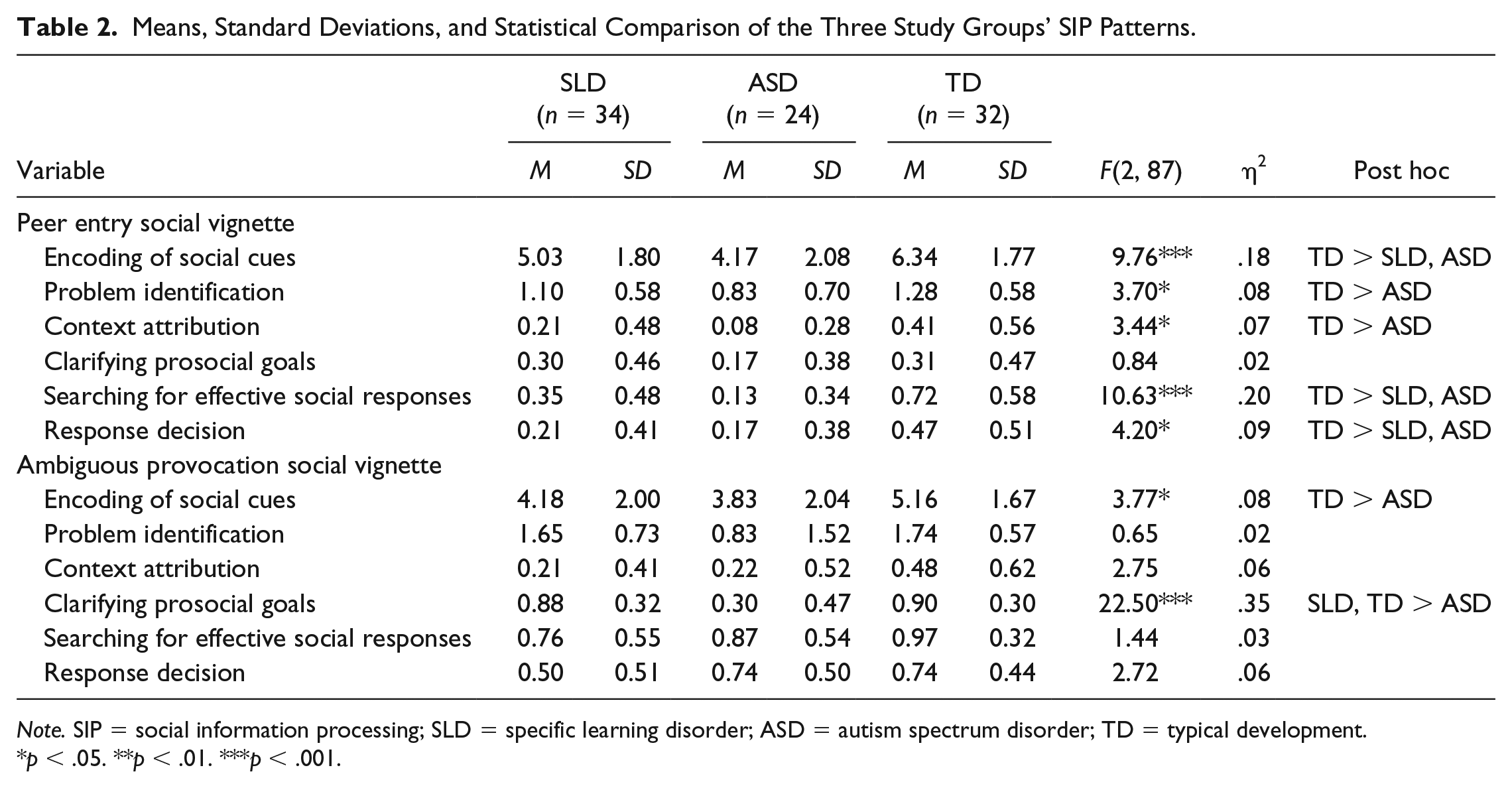
In the first analytic step, examining associations between children’s disorders (SLD or ASD, vs. TD) and SIP patterns, a separate multivariate analysis of variance (MANOVA) was conducted to test group effects for each of the two social vignettes, with scores for the six SIP stages as the dependent variables: encoding of social cues, the two measures of representing/ interpreting social cues (i.e., problem identification and context attribution), clarifying goals (i.e., specifically prosocial goals), searching for possible effective social responses, and the response decision (i.e., specifically the chosen competent solution). Table 2 presents means, standard deviations, and statistical comparisons for the three groups’ SIP patterns.
Means, Standard Deviations, and Statistical Comparison of the Three Study Groups’ SIP Patterns.
Note. SIP = social information processing; SLD = specific learning disorder; ASD = autism spectrum disorder; TD = typical development.
p < .05. **p < .01. ***p < .001.
Peer entry vignette
The MANOVA for this social vignette yielded a significant main effect for study group (ASD, SLD, TD), F(12, 164) = 4.10, p < .001, η2 = .23. Univariate ANOVAs revealed significant main effects for study group on five of the six SIP measures—all except clarifying prosocial goals—regarding the peer entry social vignette. As expected, the Scheffe procedure revealed significant differences between both clinical groups (SLD and ASD) and the nonclinical group (children with TD) on three of these five SIP measures: encoding, response search, and response decision. Moreover, the ASD group also functioned lower than the TD group on both dimensions of representation/interpretation (i.e., problem identification and context attribution; see Table 2). However, unexpectedly, nonsignificant differences emerged between the two disorder groups (SLD and ASD) regarding these SIP measures for peer entry.
Ambiguous provocation vignette
The MANOVA for this social vignette yielded a significant main effect for study group (ASD, SLD, TD), F(12, 160) = 5.10, p < .001, η2 = .28. As seen in Table 2, univariate ANOVAs revealed significant main effects for study group only on two of the six SIP measures for the ambiguous provocation social vignette: encoding of social cues and clarification of prosocial goals. The Scheffe procedure revealed lower scores in the ASD group than the TD group only for encoding social cues and clarifying prosocial goals for the provocation vignette. In addition, the ASD group demonstrated lower clarification of prosocial goals on the provocation vignette than the SLD group. However, no significant differences emerged between the SLD and TD groups regarding any SIP stage for this vignette.
Step 2: Associations Between Disorders and Language Capacities
In this second step of analysis, examining associations between children’s disorders (SLD and ASD, vs. TD) and their language capacities, a univariate analysis of variance (ANOVA) was conducted with the total language capacities score as the dependent variable. Analysis yielded a significant main effect for study group, F(2, 93) = 34.41, p < .001, η2 = .43. As predicted, Scheffe procedure revealed significant differences between children with disabilities (i.e., LD, ASD) and children with TD. Those in the TD group showed a significantly higher total language capacities score (M = 14.33, SD = 1.51) compared with the SLD group (M = 11.24, SD = 1.99) and compared with the ASD group (M = 10.54, SD = 2.50). However, no significant differences emerged between the two disorder groups—SLD versus ASD—regarding their total language capacities score.
Step 3: Associations Between Language Capacities and SIP Patterns
In the third analytic step, examining children’s language capacities’ associations with SIP patterns, Pearson correlations were calculated separately for each of the two social vignettes.
Peer entry vignette
The total language capacities score revealed significant Pearson correlations with four of the six SIP stages for the peer entry vignette: social cue encoding, r(96) = .49, p < .001; representing social cues (i.e., problem identification), r(96) = .38, p < .001; interpreting social cues (i.e., context attribution) r(96) = .21, p < .05; and searching for effective social responses, r(96) = .51,p < .001. The two stages of prosocial goal clarification and response decision for this vignette did not significantly correlate with language capacities.
Ambiguous provocation vignette
The total language capacities score revealed significant Pearson correlations with three SIP stages for the provocation social vignette: encoding of social cues, r(96) = .39, p < .001; one aspect of representing/interpreting social cues, namely problem identification, r(96) = .27, p < .01; and the clarification of prosocial goals, r(96) = .29, p < .01. The other three SIP stages for this vignette (context attribution, response search, and response decision) did not demonstrate significant correlations with the total language capacities score.
Step 4: The Mediating Role of Language Capacities
In this last step of analysis, we examined our hypothesis concerning the mediating role of the language capacities factor between children’s disorders and their SIP patterns. According to Baron and Kenny’s (1986) analytical strategy, a variable functions as a mediator if the following three statements hold true: (a) Variations in the independent variable (disorder status) account for variations in the mediator (language capacities), that is, Path A, (b) Variations in the mediator (language capacities) significantly account for variations in the dependent variable (SIP), that is, Path B, (c) When Paths A and B are controlled, a previously significant relation between the independent and dependent variables is no longer significant.
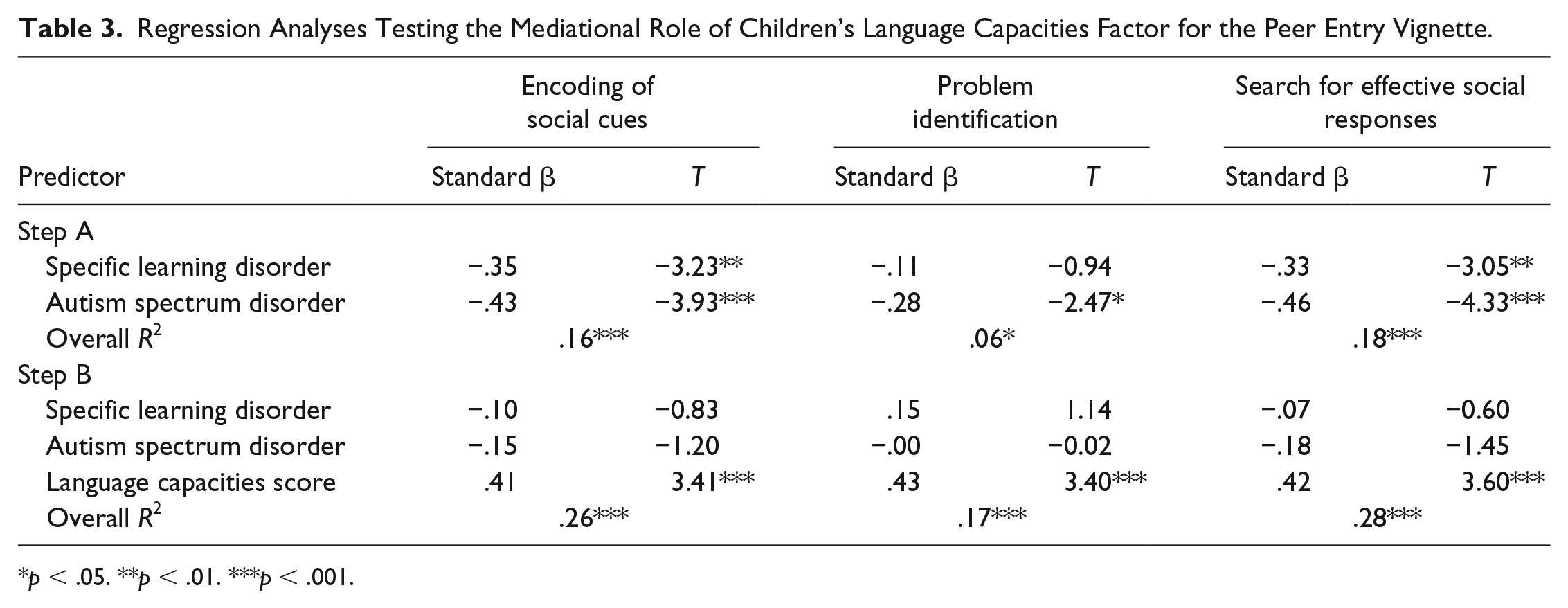
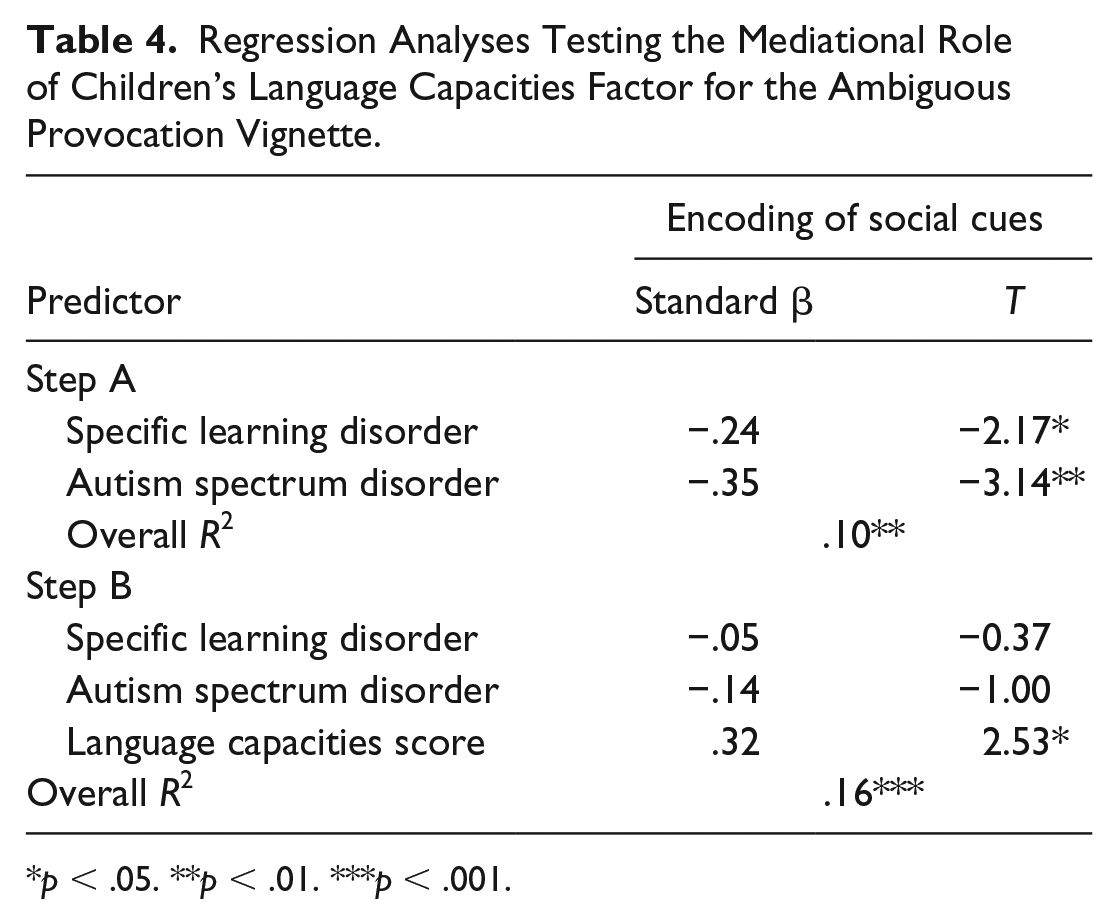
Applying these criteria, we analyzed the mediating role of language capacities between children’s disorders and their SIP patterns, investigating only those SIP stages to which children’s disorders and language abilities significantly contributed in our third step of analysis. Thus, we conducted the following linear regression analyses separately for the two vignettes: for five SIP stages in the peer entry vignette (all except clarification of prosocial goals) and for two SIP stages in the ambiguous provocation vignette (encoding of social cues and clarification of prosocial goals). Step A of each regression included two dummy variables as predictors of the SIP stages: “LD” was a dummy variable contrasting children with LD to children with ASD and to children with TD, and “ASD” was a dummy variable contrasting children with ASD to children with LD and to children with TD. Step B of each regression included the total language capacities score as an additional predictor. Tables 3 and 4 present the betas and t tests for these analyses, separately for the two social vignettes.
Regression Analyses Testing the Mediational Role of Children’s Language Capacities Factor for the Peer Entry Vignette.
p < .05. **p < .01. ***p < .001.
Regression Analyses Testing the Mediational Role of Children’s Language Capacities Factor for the Ambiguous Provocation Vignette.
p < .05. **p < .01. ***p < .001.
Peer entry vignette
As partially hypothesized, the findings indicated that the language capacities factor did significantly mediate the contribution of children’s disorders but only regarding three of their SIP stages for the peer entry social vignette: encoding of social cues, problem identification, and search for effective social responses. With regard to these three SIP stages, the original significant contribution of children’s disorders at Step A was no longer significant at Step B, after controlling for variation in the language capacities factor. As seen in Table 3, children’s total language capacities score significantly contributed to these SIP stages and acted as a significant mediator of the contribution of children’s disorders to their SIP stages.
Ambiguous provocation vignette
With regard to this social vignette, the findings were partially at odds with our hypothesis. Thus, the language capacities factor was found to significantly mediate the contribution of children disorders to only one of their SIP stages for the provocation vignette, namely the encoding of social cues. With regard to this SIP stage, the original significant contribution of children’s disorders at Step A was no longer significant at Step B, after controlling for variation in the language capacities factor. As seen in Table 4, children’s total language capacities score significantly contributed to this SIP stage and acted as a significant mediator of the contribution of children’s disorders to their encoding of social cues.
Discussion
Overall, our results revealed that while effective SIP processes are vital to well-adjusted social functioning, difficulties in SIP characterize both children with ASD and children with SLD. As far as we know, this study is the first comparative examination of SIP between these two clinical populations, yielding novel findings regarding the two clinical groups and the nonclinical (TD) group. Furthermore, unique to the current study, the separate analyses of these school-age boys’ processing of the two different peer vignettes (group entry and ambiguous provocation) enabled investigation of the influence of the social context on children’s SIP performance. In addition, language capacities did significantly mediate some of the associations between the children’s disorders and their SIP deficits.
Comparing SIP in the ASD Versus TD Groups
Of the three groups, the high-functioning children with ASD were found to be at greatest risk for SIP difficulties, showing poorer performance than the TD group for all six of the studied SIP stages (in at least one of the two social vignettes). Most prominently, the current boys with ASD showed pronounced difficulties in encoding appropriate cues to make sense of both the peer entry and the ambiguous provocation social situations, thus substantiating prior studies that examined SIP in school-age children and preschoolers with ASD (e.g., Channon et al., 2001; Embregts & van Nieuwenhuijzen, 2009; Flood et al., 2011; Meyer et al., 2006; Ziv et al., 2014). Encoding difficulties seem to correspond with this population’s difficulties in attending to social stimuli during dynamic social interactions as well as with their generally inadequate processing of such stimuli (e.g., Bauminger, Shulman, & Agam, 2004). Future research should attempt to determine whether such encoding deficits are linked to faulty cognitive aspects in ASD—such as attention, executive functions, or weak central coherence (i.e., fixation on details at the expense of the whole picture)—or are linked to a lack of social understanding per se.
Beyond encoding deficits, the high-functioning children with ASD in our study demonstrated additional multiple SIP deficits compared to their peers with TD, indicating that social situations in general and peer entry situations in particular may pose a tremendous challenge. Specifically, this group’s difficulties in identifying social problems from given cues and in clarifying prosocial goals both relate to defining situations’ desired interpersonal outcomes. Researchers of social cognition concur that difficulties in stating a situation’s social goal are an important aspect of social incompetency in children (e.g., Beer & Ochsner, 2006). Faulty interpretation of situations’ causality (context attribution stage), as also demonstrated by the current school-age ASD group, was also found by Ziv et al. (2014), where preschoolers with ASD attributed more hostile intentions to others. Furthermore, in line with previous research, the current study found consistent deficiencies in ASD with regard to both generating (searching for) social responses and choosing a competent one (e.g., Channon et al., 2001; Ziv et al., 2014). The latter two SIP deficits in children with ASD may both be linked to a lack of social knowledge, difficulties in making social judgments (e.g., Flood et al., 2011; Meyer et al., 2006), and well-documented deficiencies in peer interaction (Gifford-Smith & Rabiner, 2004).
Comparing SIP in the SLD Versus TD Groups
Surprisingly, overall, the boys with SLD in the current study demonstrated relatively more intact SIP processes than reported in previous studies. However, the SLD group did exhibit poorer performance than the TD group for three SIP stages in the peer entry vignette only: encoding, response search, and response decision. The findings for these stages coincide with prior research that examined the full SIP model (e.g., Bauminger & Kimhi-Kind, 2008; Bauminger et al., 2005; Tur-Kaspa & Bryan, 1994). Deficient encoding compared to peers with TD was evidenced consistently across these studies, with the SLD group recalling fewer information units and adding more extraneous information that was not originally presented in the social vignettes. As Tur-Kaspa and Bryan (1994) suggested deficits in perceptual capabilities may provide the basis for faulty encoding processes in SLD.
With regard to the response search stage, the current findings corroborated all three former studies showing that children with SLD produced a smaller repertoire of solutions than children with TD (Bauminger & Kimhi-Kind, 2008; Bauminger et al., 2005; Tur-Kaspa & Bryan, 1994). With regard to the response decision stage, the current results substantiated two prior studies (Bauminger & Kimhi-Kind, 2008; Bauminger et al., 2005) demonstrating that children with SLD revealed an impairment in their ability to generate a feasible competent solution on their own. Nevertheless, careful examination of the current results shows that in most SIP stages, the SLD group mean fell in between the means for the TD and ASD groups. The only four exceptions, all from the ambiguous provocation scenario, were as follows: clarification of Ron’s prosocial goals (where the SLD and TD group means were equivalent), context attribution to account for cues explaining Ron’s thoughts about Guy’s act (where the SLD group mean resembled that of the ASD group), and the response generation and response decision stages (where the SLD group mean was slightly but not significantly higher than that of the ASD group). Thus, overall, children with SLD revealed better SIP processes than children with ASD but performed less well on important SIP stages than children with TD.
Comparing SIP in the Two Clinical Groups in Relation to Social Context
Interestingly, the SIP performance of the two clinical groups differed significantly only for one stage of processing in one of the two social scenarios: The SLD group was better able than the ASD group to clarify Ron’s prosocial goals when Guy knocked his tower over in the ambiguous provocation vignette. However, a careful look at SIP patterns revealed that, overall, the SLD group performed lower than the TD group only during the peer entry vignette; whereas, the ASD group performed lower than the TD group on both vignettes. This pinpoints a unique difficulty shared by both clinical groups regarding the initiation of social interactions with peers.
It appears that comparative analysis of these two vignettes was performed in only one prior study, which examined preschoolers with ASD versus with TD (Ziv et al., 2014). Interestingly, Ziv et al.’s results indicated that the peer entry situation is more challenging than the provocation one, even for preschoolers with TD. Although our study utilized different vignettes from Ziv et al. and older ages (which may explain the TD preschool sample’s difficulties), the direction of findings was similar, emphasizing the challenging nature of peer entry situations for both clinical groups. Deficits in SIP abilities for initiating social interactions do not preclude a performance deficit as well, inasmuch as social action was not directly tested in the current study.
Language Capacities in ASD and SLD and Their Associations With SIP
The two clinical groups did not differ significantly in their performance on the MAASE language test (except for double meaning); yet, as predicted, both groups revealed significantly lower language capacities than the TD group. The MAASE mainly assesses children’s semantic abilities such as grouping items by category, finding differences and similarities between items and characteristics, understanding homophones by providing two meanings for the same word, and supplying descriptions of various objects, but as described above, the semantic and pragmatic deficits are closely related, at least for ASD (Stefanatos & Baron, 2011).
Partially supporting our expectation that semantic-pragmatic difficulties would affect children’s SIP performance, some significant associations did emerge between language capacities and SIP. For example, compared with their lower scoring peers, boys with a higher language score were better able to attend to, chunk, and store more informational cues from the scenario (i.e., encoding) and better able to pinpoint the protagonist’s social problem (i.e., problem identification). Although direct associations between language capacities and SIP patterns were rarely examined previously, the present findings do coincide with the few existing studies—both those reporting these two factors’ possible associations (e.g., Bryan et al., 1998, for SLD; Meyer et al., 2006, for ASD) and those indicating that the capacity to use language functionally links with higher levels of social participation and social play during peer social interactions (e.g., Sigman & Ruskin, 1999, for ASD). Thus, our outcomes regarding language capacities’ connections with SIP domains may shed light on an underexplored research area, which may be particularly important for children with language deficits in ASD or SLD ASD, calling for additional exploration.
The Mediating Role of the Language Capacities Factor
With regard to our hypothesized mediating role for language capacities, the current findings suggest the merit of adding a language capacities explanation to the documented association between children’s ASD or SLD and their difficulties in SIP functioning (Al-Yagon & Margalit, 2013; Bauminger-Zviely, 2013). Specifically, the results underscored the significant role of language capacities as a mediator of the contribution of children’s disorders to three stages of SIP in the peer entry vignette (encoding of social cues, problem identification, and search for possible effective social responses) and to one of the SIP stages in the provocation vignette (encoding). These outcomes may highlight the role of higher language capacities as a protective factor in explaining better processing of social information in these children with ASD or SLD. Prior studies suggested that children with ASD and SLD demonstrated difficulties in oral language pragmatic skills, such as conversational turn-taking, maintaining topics, politeness, prosody, and awareness of listeners’ responses (see Stothers & Cardy’s, 2012, review). Moreover, data from such studies also highlighted that weaknesses in structural language (e.g., morphology, syntax) may contribute to pragmatic impairments (Volden, Coolican, Garon, White, & Bryson, 2009) and also suggested possible overlap with semantic capacities as investigated here.
Implications, Limitations, and Directions for Future Studies
Altogether, this study is novel in several ways: by comparing SIP in two clinical populations, by evaluating SIP in relation to two different social tasks (initiation and provocation), and by exploring the role that language may play in SIP for these populations with language deficits. Overall, although both clinical groups showed a deficient SIP profile in comparison to their peers with TD, the in-depth comparison of the two social tasks uncovered some subtle differences between the two clinical groups. Findings highlighted the need to plan specific interventions to support children’s acquisition of skills for initiating and entering peer interactions, for both children with ASD and children with SLD. Moreover, language emerged as an important factor leading to more appropriate SIP functioning for both groups. Specifically, findings call for consideration of semantic-pragmatic language’s role when planning interventions that target social cognition in both clinical populations. For example, such intervention may do well to include “concept clarifications” of various social concepts such as, collaboration, social conversation, double meaning words, idioms, irony, and metaphors. Also, future studies would do well to expand on the current study by examining the links between social knowledge deficits and actual performance deficits in social functioning, both for ASD and SLD groups.
Nevertheless, this study has several limitations. First, language capacities were assessed via the nationally normed MAASE language test, which provided a comprehensive assessment of language but mainly examined semantic linguistic components. Thus, researchers should further investigate other aspects of language (e.g., pragmatics, morpho-syntax) to obtain a more comprehensive picture of each group’s difficulties in social cognition. Also, qualitative analyses of children’s responses on the MAASE could be helpful in clarifying each clinical population’s unique language profile. Second, the current SIP measure required participants to answer a series of questions and describe verbally presented vignettes, thereby relying on verbal language production and processing. To fully examine the role of language in social cognition, it may be valuable to assess SIP while using nonverbal tasks, which would enable separation of children’s SIP from their production difficulties. Third, the current descriptive study offered cross-sectional data. Future research should adopt longitudinal designs that follow up on these at-risk children, to elucidate language capacities’ role in explaining SIP for these populations. Fourth, we used the total language capacities score to limit the number of variables in our analyses; however, additional studies should systematically examine the influence of each MAASE subscale to obtain a more comprehensive picture of language–SIP links.
Conclusion
Overall, results indicated that both clinical groups (SLD, ASD) differed significantly from the nonclinical (TD) group in total language capacities and in five of six SIP measures. Language capacities also significantly mediated the two disorders’ associations with children’s deficits along SIP stages. Findings call for consideration of semantic-pragmatic language’s role when planning interventions that target social cognition in both clinical populations.
Footnotes
Declaration of Conflicting Interests
The author(s) declared no potential conflicts of interest with respect to the research, authorship, and/or publication of this article.
Funding
The author(s) received no financial support for the research, authorship, and/or publication of this article.