



Abstract
Enrollment in K-12 online learning is growing at an exponential rate throughout the United States. Currently, all 50 states offer K-12 online learning opportunities. Some states such as Michigan, Alabama, New Mexico, and Idaho have passed legislative measures requiring K-12 students to complete at least one online learning experience by the time they graduate high school. Because of this growth, 21st century educators need to be prepared to teach online. This study shares the results of a national survey targeting teacher education programs’ efforts to help prepare preservice teachers for K-12 online learning. Data show that only 1.3% of responding teacher education programs are addressing this need via field experiences in virtual schools. Implications for policy and practice in the field of teacher education are examined.
Introduction
Enrollment in K-12 online learning continues to grow exponentially in the United States. Watson, Murin, Vashaw, Gemin, and Rapp (2011) report that all 50 states and the District of Columbia offer their K-12 students online learning experiences. These programs, whether fully online, blended, or hybrid, offer all or part of students’ education through Web-based instruction. Some states have passed laws requiring or recommending K-12 students to complete at least one online learning experience by the time they graduate high school. Growth in online learning requires that future educators know how to teach in this environment and that teacher education programs prepare them to do so (Archambault, 2011).
This study shares the results of a national survey that targeted teacher education programs to examine alternative field experiences in virtual schools. The following sections provide a literature review, including a brief history and current status of K-12 online learning, as well as an overview of existing literature on traditional and virtual school field experiences (VSFE). After the methodology is discussed, the “Results” section describes an overview of the models of VSFEs that exist, followed by the discussion and implications directed at teacher education programs and K-12 online programs.
Literature Review
Brief History of K-12 Online Learning
In 1891, the University of Chicago began offering distance education to K-12 students, taking the form of correspondence courses where learning materials were delivered via postal mail (Greenway & Vanourek, 2006). Correspondence courses gave way to radio and television delivery. During the 1990s, the age of the Internet sparked the advent of K-12 online learning through the expansion of virtual schools. “They [virtual schools] . . . can be understood as a form of schooling that uses online computers to provide some or all of a student’s education” (Russell, 2004, p. 2). In the case of virtual high schools, students earn their diplomas via online programs. This differs from school districts that offer isolated online courses for the purposes of dealing with issues such as limited space, scheduling conflicts, and credit recovery.
The first virtual high school, Laurel Springs, opened in California in 1991. By 1994, this private preparatory school offered a complete high school curriculum in a 100% online format. The mid- to late-1990s welcomed Florida Virtual School (FLVS) and Utah’s Electronic High School, two state-level virtual schools. Around the same time, Virtual High School (VHS) opened in Massachusetts. Unique from statewide virtual schools, VHS started a consortium model, whereby traditional schools interested in partnering with VHS provide one teacher to teach a VHS course. In return, the teacher’s school is granted a given number of student seats in all VHS online courses. Although VHS started as a local entity, it now functions internationally as the VHS Global Consortium.
These virtual schools paved the way for other K-12 online learning programs (Clark, 2007). As of 2010, nearly a half million enrollments were recorded in statewide virtual schools, and there were more than two million enrollments in online learning courses (Watson, Murin, Vashaw, Gemin, & Rapp, 2010). FLVS, one of the leaders in K-12 online learning, reported 220,000 course enrollments, which was close to half of the total course enrollments reported by all state-level virtual schools combined (450,000; Watson et al., 2010).
Current K-12 Online Learning Policy
During the last 5 years, state education policy has evolved concerning the field of K-12 online learning. Michigan Department of Education (2006), New Mexico Public Education Department (2007), Alabama State Board of Education (2008), and most recently, Idaho (Idaho Senate, 2011) require K-12 students to complete an online learning experience before they graduate high school. Florida Senate (2011) requires all school districts to offer some form of online learning, either homegrown or outsourced, to all K-12 students. Credit based on content mastery rather than seat time is being measured in Alabama and Florida (Watson et al., 2010). In 2010, the Idaho State Board of Education adopted online teacher standards, while Connecticut State Board of Education (2010) now allows for teachers to be certified in any state. This is an important development because it begins to advocate for licensing reciprocity, potentially allowing teachers licensed and living outside of one state to teach students in another. The Connecticut law also requires all school districts to offer online credit recovery to diminish dropout rates. In addition, Wisconsin requires that teachers interested in teaching online complete 30 hr of professional development. Currently, Georgia (2008) and Idaho (Idaho State Board of Education, 2011) offer state-level endorsements in online teaching.
As is evident from the growing national, state, and district-level trends, emerging blended programs, and increasing requirement laws, K-12 online learning is continuing to expand and transform today’s educational landscape. Growth trends are abundant, including an increase in blended learning and school-district-level online learning programs (Watson et al., 2011). Therefore, it is essential that teachers be prepared in their teacher education programs to serve the rapidly escalating number of online students. Teacher education programs will need to consider creating relevant coursework and practica to prepare teachers entering 21st century classrooms, a growing number of which will not have walls.
Preparing Teachers
Teacher education programs and practica
In the 19th century, theorists and practitioners introduced many different processes of preparing teachers (Beijaard, Verloop, & Vermunt, 2000; Borrowman, 1956; Walkington, 2005). One of the common practices includes requiring preservice teachers to participate in practica (Cattley, 2007). Numerous models of practica exist, including observational learning (Koran, Snow, & McDonald, 1971), internships (Gardner & Henry, 1968), microteaching (Allen & Eve, 1968), field experiences (Zeichner, 1984), self-evaluations (Beijaard et al., 2000), reflection (Hatton & Smith, 1995), immersion (Wiggins, Follo, & Eberly, 2007), and mentoring (Ballantyne & Hansford, 1995).
Practica are a vital part of teacher education (Aiken & Day, 1999; Buck, Morsink, Griffin, Hines, & Lenk, 1992; Harlin, 1999; Joyce, Yarger, Howey, Harbeck, & Kluwin, 1977; Wiggins & Follo, 1999). In the 1970s, practica were mandated by the U.S. state departments of education as part of the certification process (C. Moore, 1979). In these traditional practica, the dispositions required of the preservice teacher include but are not limited to social justice, responsibility, academic honesty, professionalism, fairness, equality, caring, and empathy (National Council for Accreditation of Teacher Education [NCATE], 2002). Desired skills include classroom management, motivation, reflective teaching, and differentiation.
Despite practica traditionally occurring in face-to-face, brick-and-mortar classrooms, a few programs have begun to offer field experiences in K-12 online learning. The dispositions involved in traditional practica also exist in online learning programs. However, the skills change in the virtual learning environment (Ko & Rossen, 2010). For instance, how does one manage an online classroom? How do students interact with one another, with the instructor, and with other learning support personnel? In terms of motivation, how does an online instructor motivate a student who they do not see on a regular basis? How does teaching itself translate in the online classroom? Is there a curriculum designer who puts together the lessons, freeing up the instructor’s time to build relationships with students and differentiate instruction, or do the instructors create their own content, and what does that content look like? (International Association for K-12 Online Learning [iNACOL], 2008). These are important skills that must be addressed when learning to teach online. While the NCATE mandates standards for education colleges to follow to prepare teachers for their profession (NCATE, 2007), these standards do not acknowledge the need for preservice teachers to learn methods of online learning/ teaching (NCATE, 2008). Although there is an expressed need to prepare teachers for the 21st century, “online” learning is only referenced to require teacher educators to use “multimedia tools, digital resources, and distance learning systems” in their teaching (NCATE, 2008, p. 52). The Teacher Education Accreditation Council (TEAC) also makes no mention of preparing preservice teachers for online teaching (TEAC, 2010). As a result, professional organizations have created standards to guide the quality preparation of teachers to teach online, including the following:
International Society for Technology in Education’s (ISTE) National Educational Technology Standards for Teachers (NETS*T; ISTE, 2008)
Southern Regional Education Board’s (SREB) Essential Principles for High-Quality Online Teaching (SREB, 2006)
National Education Association’s (NEA) Guide to Teaching Online Courses (NEA, 2006)
International Association for K-12 Online Learning’s (iNACOL) National Standards for Quality Online Teaching (iNACOL, 2008)
These standards exhibit some overlap while maintaining unique qualities (Kennedy, 2010). Although they do not have jurisdiction over teacher education programs, as do accreditation organizations, they can and do influence policy.
Theoretical Framework
Situated Cognition
Practica in teacher education stems from the theory of situated cognition, where learning requires a contextualized, authentic setting in which the participant engages in direct interaction and reflection within the environment (Brown, Collins, & Duguid, 1989). Situated cognition values practical, hands-on experience as a primary mechanism of learning. Being in an authentic teaching setting allows preservice teachers to apply their pedagogical content knowledge (Shulman, 1986) acquired during the course of their program.
An important aspect of situated cognition is the cognitive apprenticeship, which “supports learning in a domain by enabling students to acquire, develop, and use cognitive tools in authentic domain activity” (Brown et al., 1989, p. 39). Through a cognitive apprenticeship, preservice teachers directly observe what happens in the classroom, model the practice of their mentor teacher, and identify and reflect on the ideas they learn, including addressing any related misconceptions. Mentor teachers encourage the development of preservice teachers by making expert tacit knowledge explicit, modeling effective teaching strategies, providing scaffolded support during instruction, and offering specific feedback for improvement (Collins, Brown, & Newman, 1989). This apprenticeship is vitally important for the “transfer of what is presumably learned in teacher education programs to actual classroom practice” (R. Moore, 2003, p. 32).
Situated Cognition in Online Settings
To be prepared to teach virtually, the authentic learning environment needs to be an online, Web-based setting. The apprenticeship occurs in concert with an expert online teacher who is able to make visible all strategies, techniques, and approaches to teaching and who is not constrained by the confines of the brick and mortar classroom or by traditional school hours. The preservice teacher in this context must observe, perhaps from a computer screen using a web camera, how the mentor teacher is able to engage and motivate students from a distance, monitor students’ progress using real-time data, and manage the volume of email sent on a daily basis. Through the cognitive apprenticeship in this context, the preservice teacher must confront his or her beliefs about the role of the teacher in a virtual setting and decide whether this form of instruction represents a good fit.
Teacher Education Programs and K-12 Online Learning
In 2003, Irvine, Mappin, and Code (2003) documented a need for teacher education programs to prepare preservice teachers to teach online; however, the majority of teacher education programs were not even aware of K-12 online learning. To address this, the iNACOL moved toward a “new vision of the future of education” (Davis & Rose, 2007, p. v), acknowledging the need for teacher training in online pedagogy and support strategies (Lowes, 2007).
Bringing the issue to the national forefront, a Fund for the Improvement of Postsecondary Education (FIPSE) grant was awarded to the Iowa State University (ISU) for Teacher Education Goes Into Virtual Schooling (TEGIVS; Davis et al., 2007). As part of the TEGIVS project, the ISU research team reported on a VSFE that they conducted in the fall of 2007 (Compton, Davis, & Mackey, 2009).
The ISU experience paired two preservice teachers with one Iowa Learning Online (ILO) teacher. The ILO teacher walked the preservice teachers through the K-12 online learning environment using guided observation. The experience was aligned with a one-credit course at ISU, and this course required preservice teachers to keep a reflection journal, answer discussion forum questions, and participate in interviews. The preservice teachers’ experiences resulted in a growth of their understanding and formation of new personal theories about K-12 online learning (Compton et al., 2009).
In addition to ISU, the University of Central Florida (UCF) and the University of Florida (UF) began offering their preservice teachers VSFEs in spring 2009. These programs lasted 7 weeks and 4 weeks, respectively. The UCF experience catered to undergraduate-level preservice teachers, whereas the UF experience served graduate-level preservice teachers (Kennedy, Cavanaugh, & Dawson, 2011). Both institutions collaborated with FLVS. In addition to UCF and UF, the University of South Florida offered their first pilot of a VSFE in fall 2009, and by spring 2010, this pilot was expanded to a college-wide program. With these types of field experiences beginning to develop, the purpose of the current study is to examine models of field experiences taking place in online settings.
Method
Because the current study represents a large set of data that examines a specific population, a survey methodology was used (Czaja & Blair, 2005) to answer the following research question:
Research Question: What models of field experiences exist to help prepare preservice teachers for K-12 online learning environments?
Data Collection
An appropriate instrument did not exist in the literature; thus, the researchers developed a Web-based questionnaire designed for teacher education program personnel, including faculty and staff. It consisted of closed and open-ended items intended to elicit information regarding field experiences occurring in virtual school settings. To establish content validity, the instrument was sent to three expert reviewers in the field, and suggested revisions were made.
While the survey was being designed and reviewed, the names, titles, and email addresses of field experience contacts were collected. The teacher education programs listed on the NCATE and American Association of Colleges for Teacher Education (AACTE) websites were compiled, and two to three contacts from each program were identified by searching each institution’s website. Individuals who could answer relevant questions, such as field experience office personnel, administrators in charge of teacher education programs, and/or education technology faculty were targeted. A total of 1,528 possible respondents were identified.
The survey deployment followed a schedule based on the Tailored Method Design (Dillman, 2010). Three days prior to launching the survey, notification emails were sent to potential respondents. The 3 days following the notification email were used to resolve issues with inactive email accounts or incorrect recipients. If the original recipient indicated that he or she was someone who could not respond to the survey because they lacked the necessary information to complete it, either he or she suggested another potential recipient, or the researchers returned to the institution’s website to find another potential recipient. A total of 122 changes were made to the contact list prior to launch. On the day of the survey launch, the survey link was sent out to 1,525 potential respondents. During the survey administration, three subsequent follow-up reminders were sent to maximize the response rate (Dillman, 2010). Respondents were given 3 weeks to complete the survey.
Data Analysis
A mixed data approach was used to gather and analyze quantitative and qualitative data. Quantitative data were analyzed using descriptive statistical measures to present general findings. These data were used to create a narrative depiction of teacher education programs that are currently offering VSFEs. Qualitative data were gathered by asking open-ended questions. Thematic analysis was used to identify recurring themes within the qualitative data set (Hatch, 2002). Validity in qualitative research requires that the findings represent the participants’ data (Schwandt, 1997) and be dependable, confirmable, and credible (Patton, 2002). Data were validated using an audit trail (Rodgers & Cowles, 1993), including survey email responses, and peer debriefing by disseminating the manuscript to survey participants, allowing them to report bias-related, logistical, and/or methodological flaws (Maxwell, 1998). The only responses received back from peer debriefing were requests for the sharing of subsequent results from the researchers’ work.
Limitations
Although the design of this study has benefits, including the use of technology to gather data, the speed with which the surveys can be completed and results calculated, the minimal cost, and the ability to ask a consistent set of questions intended to measure a specific variable, it also has drawbacks. There are inherent accuracy issues because it relies heavily on self-report data gathered via an emailed survey, restricting the researchers’ ability to verify the precision of the responses (Fowler, 2002). Email addresses for the participants of this study were gathered via public Web pages, so potential respondents were only able to complete the survey if their email address was accurately listed and if they checked their inboxes on a regular basis. Faculty receive many such requests for participation, are quite busy, and without an incentive, other than the intrinsic value of assisting the research, this potentially results in a lower response rate. This significantly limits the ability of the researchers to generalize to the overall population of teacher education programs, which is a primary limitation. Accordingly, it should be noted that although every attempt was made to elicit responses from as many teacher education programs as possible, the reporting of results from the current study reflects a sample of programs and does not necessarily reflect the field as a whole.
Results
A total of 522 responses were gathered from the survey, representing a 34% response rate, which is considered acceptable for Web-based instruments (Manfreda, Bosnjak, Berzelak, Haas, & Vehovar, 2008; Shih & Fan, 2008). To provide pertinent background information, data regarding size, location, and the individual’s role within the teacher education program were collected. These results are reported in the next section.
Location, Size, and Role Within the Teacher Education Programs
The distribution of respondents by state includes the highest numbers from New York (33), Ohio (31), North Carolina (30), and Texas (29; Figure 1). The only state not represented was Maine.

Map of respondents’ locations by state
In terms of the size of universities, smaller institutions were the most represented, with 52.6% reporting that their university had 0 to 5,000 students. This was followed by those with 5,000 to 10,000 (20%), 10,000 to 20,000 (16.7%), and 20,000 to 30,000 (6.2%). The remaining represented the largest institutions with more than 30,000 (1.7 %; Figure 2).

Number of students enrolled at responding universities
To describe their background, participants were asked, “What is/are your position(s) with this program?” Placement coordinators comprised the largest (34.4%), followed closely by administrative positions (dean, chair, director; 33.1%). Professors at varying levels of tenure (assistant: 25.6%, associate: 26.2%, full: 19.8%) were also represented, along with coordinators at various levels (graduate: 6.7%, undergraduate: 7.1%, and program: 1.3%), adjunct faculty (4%), support staff (2.7%), and advisors (0.7%). Individuals often indicated having more than one role (Figure 3).
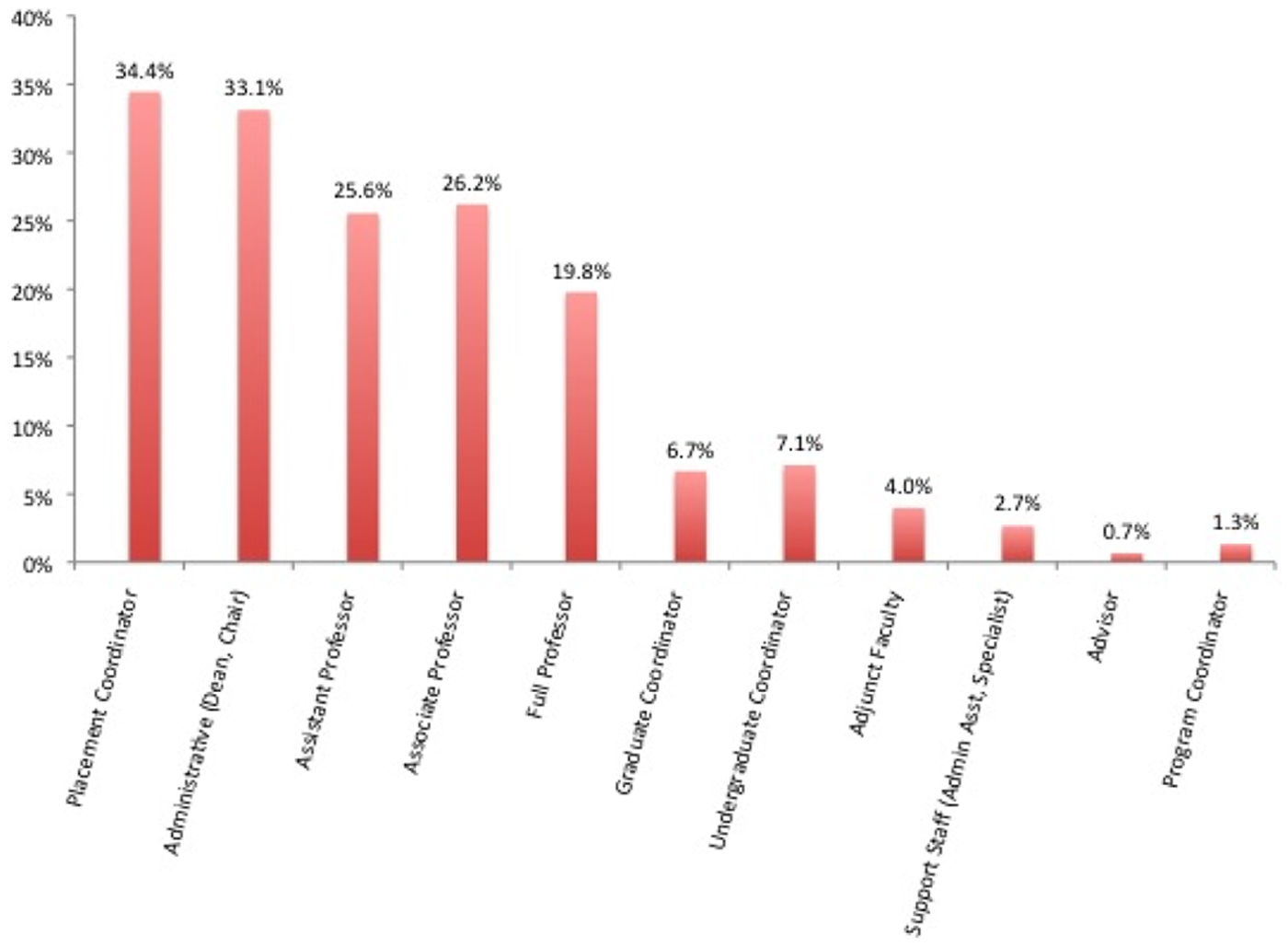
Job titles of respondents
When asked if their teacher education program offered preservice teachers field experiences in K-12 online learning programs, 404 (78.7%) reported that their programs did not, but 109 (21.3%) indicated that they did. However, in examining responses, including actual descriptions of the VSFE, only 7 (1.3%) reported partnering with a K-12 online learning program and shared what was required of the preservice teachers during the placement. This is a more accurate depiction of what is currently happening nationally. In Kennedy and Archambault (2011), 31 were reported, and this number included the teacher education programs that were in the process of planning and preparing for VSFE pilots.
For those who reported not offering these experiences, they were asked if they feel that their program should. A total of 49% reported “yes” whereas 51% indicated “no.” When asked if their teacher education program was currently planning such an experience, 13% reported “yes” whereas 87% indicated “no.”
Seven models were explicitly described in the collected data. Included are four models from the state of Florida, two from the state of South Dakota, and one from North Dakota. Figure 4 shows the reported total student enrollment of each of the teacher education programs’ universities reporting a VSFE.

Number of enrollments at universities reporting virtual school field experiences
Florida represents the majority in VSFE as it has one of the largest virtual schools in the nation, FLVS, and state policy grants access to online programs for all students. Several universities in Florida recognize that cognitive apprenticeships can take place under the mentorship of expert online teachers. According to the partnership coordinator for FLVS, the VSFE follows the Florida Educator Accomplished Practices standards (B. Miller, personal communication, August 25, 2011). It offers preservice teachers an authentic online teaching environment that situates learning in the virtual classroom.
Seven Models of VSFEs
Each model is described in Table 1. Included in this table are relevant grade levels in which the field experiences are completed as well as the average number of preservice teachers who participate in the experience. Also included in the table is/are the process(es) used to match cooperating and preservice teachers and the set of standards used to design the VSFE.
Breakdown of VSFE Models

Note: VSFE = virtual school field experience; ISTE = International Society for Technology in Education; SREB = Southern Regional Education Board.
In Figure 5, the various communication tools used by the cooperating and preservice teachers are displayed.

Communication tools used by cooperating and preservice teachers
Table 2 includes the level of supervision involved in the experience, whereas Table 3 reports activities that each program requires of their preservice teachers during the experience.
Levels of Supervision in the VSFE
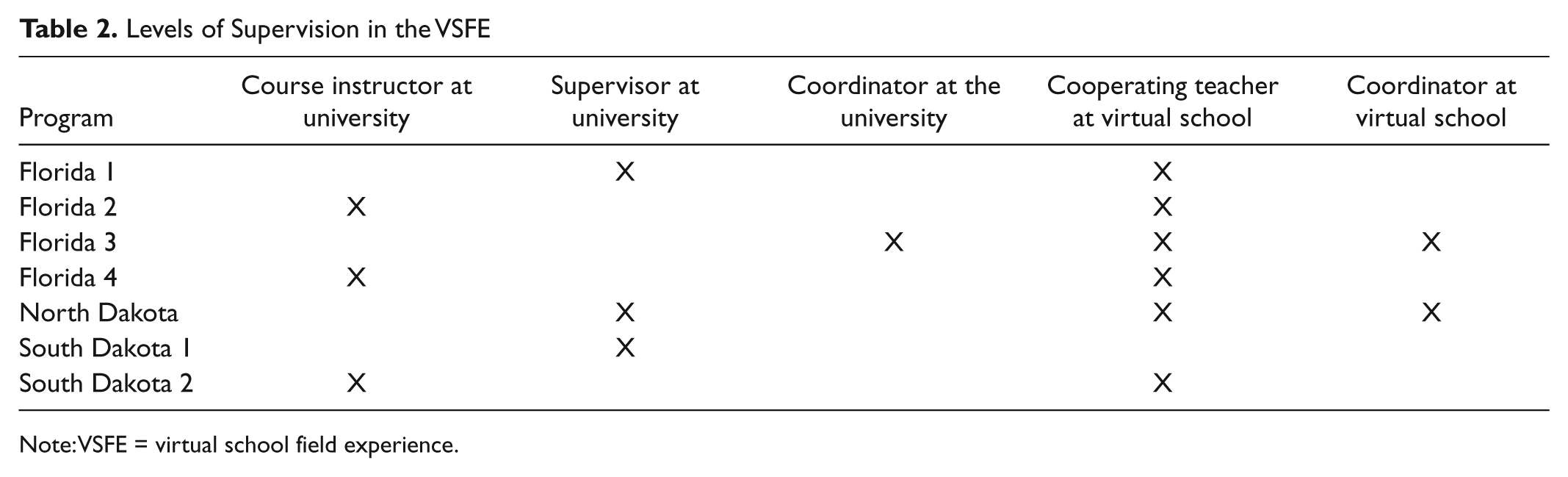
Note: VSFE = virtual school field experience.
Preservice Teacher Activities in VSFE
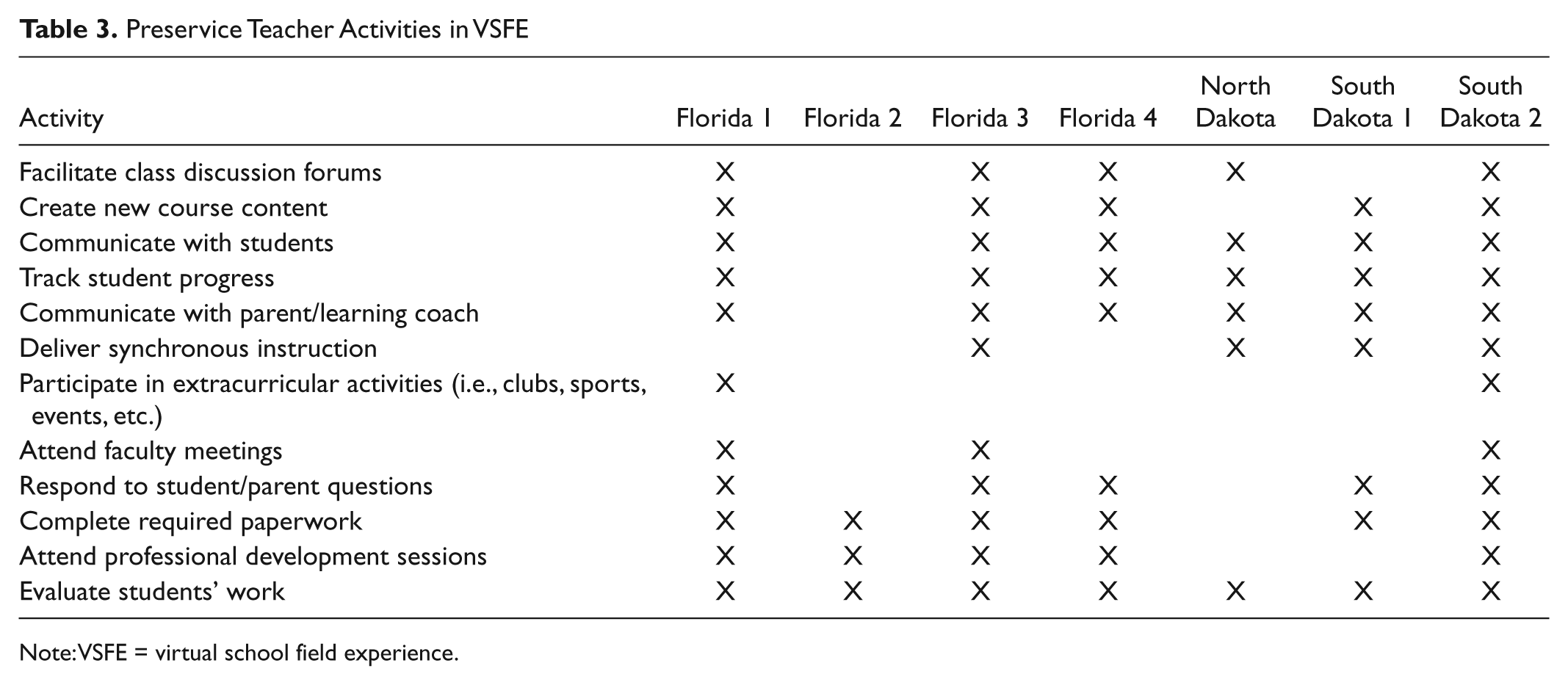
Note: VSFE = virtual school field experience.
Each program also provided additional information that is presented in the sections below.
Florida 1
Preservice teachers complete 14 weeks of internship. The cooperating teacher must have at least 3 years of teaching experience and state-documented clinical education training. The preservice teachers must pass all general and core courses with a grade of “C” or above to participate in the field experience. They must also have demonstrated knowledge of Florida Educator Accomplished Practices at “Competent” or above. Finally, preservice teachers are required to be fingerprinted, approved by the advisor of the practicum, assigned a coordinator, and have a completed application for the internship.
Florida 2
Florida 2’s preservice teachers are placed with cooperating teachers at a state-level virtual school. The experiences are 4 weeks in length and are associated with a graduate-level, university-based course. The structure of the experience is mostly determined by the virtual school with a small amount of input from the university. The preservice teachers and cooperating teachers meet face-to-face for an orientation before the practicum starts. Preservice teachers must be specializing in educational technology to take part in the VSFE, and they shadow the cooperating teacher to learn about the content management system (CMS). As with traditional placements, these students are required to reflect on their experiences throughout the practicum. The cooperating teacher is required to have clinical education training to serve as a mentor.
Florida 3
Like Florida 2, Florida 3 partners with a state-level virtual school. The preservice teachers choose a junior-level or senior-level VSFE. If they choose junior level, they complete 7 weeks in brick-and-mortar (traditional, face-to-face) schools and the other 7 weeks in a virtual school. Senior interns complete a 16-week internship in a virtual school. Cooperating teachers at the state-led virtual school are required to have knowledge related to their content area, online learning, as well as academic, technological, and socioemotional skills. This model provides preservice teacher training and professional development related to K-12 online learning. The preservice teachers reflect on their experience throughout the semester and complete specific coursework related to K-12 online learning. They are also tracked by log-in data and observed by their university coordinator.
Florida 4
For Florida 4, not all students in the college of education are able to participate in VSFEs. Over the last 2 years, Florida 4 has been piloting a program with physical education (PE) preservice teachers who are assigned to a VSFE for 7 weeks, while they assist in teaching high school students required PE health and fitness courses. The preservice teachers assist with the development of online content, create lesson activities, assess student learning, and communicate with parents and students. The virtual school identifies cooperating teachers to participate, and the university instructor pairs the cooperating teacher with preservice teachers who are required to document their experiences via ongoing reflections. In addition, through this model, a small group of school counselors learn about K-12 online learning through required course training modules.
South Dakota 1
South Dakota 1’s program partners with a school that is not completely virtual. The school offers individual online courses through a statewide network to schools that do not have a family and consumer sciences program. Typically, one online course is offered, and preservice teachers who are student teaching in that school teach the course to students at other sites using a Web-based course platform. Preservice teachers who are given this placement must have some technological skills for setting up the course feed. Preservice teachers observe cooperating teachers at the school and journal their reflections during the practicum. This program reported that their state does have a virtual high school, but their preservice teachers have not worked with it yet. The program faculty is currently considering the inclusion of online course development for preservice teachers.
South Dakota 2
South Dakota 2’s preservice teachers assist in teaching state and private vendor courses that are offered online. These experiences are optional to the teacher education candidate. Through their coursework, they are given opportunities to volunteer to assist in the K-12 online learning courses, and must log their activity for credit.
North Dakota
In North Dakota, program faculty reported that only one student has worked in a virtual school thus far, and it was a voluntary experience, completed in addition to a face-to-face practicum. The preservice teacher taught 2 hr per day at the virtual school and was observed by a cooperating teacher. This program has an educational technology endorsement in which students receive a minor in the area of technology.
Thirteen Models-in-Planning
In addition to the seven models described above, there were an additional 13 teacher education programs that reported they were in the process of planning VSFEs. Ten of the states offered enough information to be included in Table 4 below.
Teacher Education Programs That Are Planning VSFEs
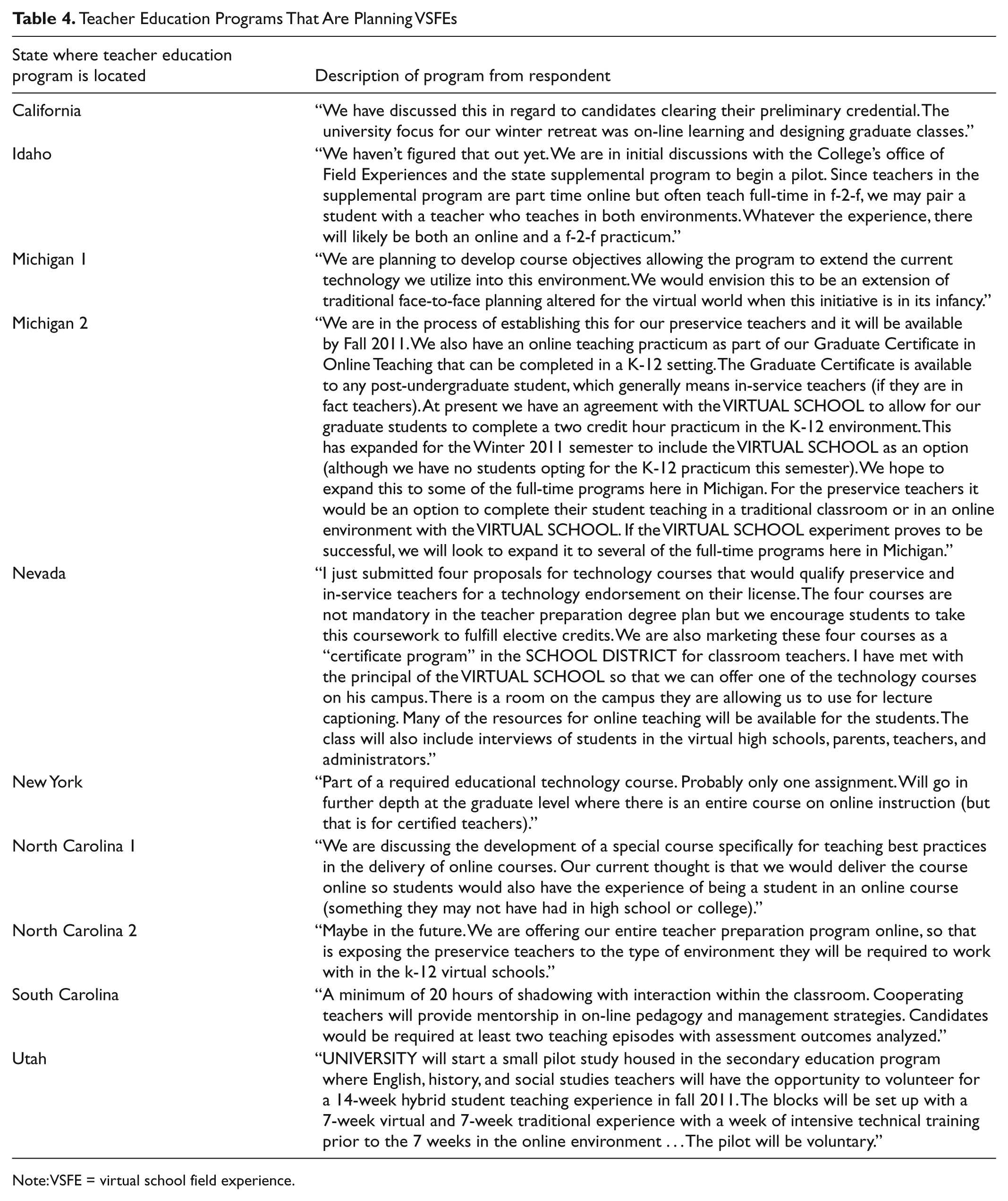
Note: VSFE = virtual school field experience.
The other three programs—Delaware, Kansas, and Nebraska—conveyed that they were in the early process of planning but did not provide specific information concerning these experiences.
Themes Within the Data
Qualitative, open responses were also gathered concerning whether participants felt that VSFEs should or should not be offered. The following themes were identified: a positive outlook toward VSFE (pro-VSFE), a lack of knowledge/ a need for additional information, the survey as impetus for change, the notion that online learning equals online teaching, certification/policy/curriculum alignment, and a more positive view of face-to-face field experiences. These themes are expounded on below.
Pro-VSFE
Many phrases were coded as pro-VSFE, signifying those teacher education programs that believe a field experience in a K-12 online learning setting should be part of their program. Respondents agreed that “we need to move in this direction to prepare new teachers for this new methodology” because “teaching in an online environment requires a different skill set than in a traditional face-to-face classroom,” including “different content delivery, different classroom management, and different interaction options,” and “not just additional technology skills, but appropriate pedagogy for an online classroom.” Another respondent acknowledged, “12% of brand new teachers are employed as online teachers—This number will continue to grow.” Additional reasons for wanting field experiences in K-12 online learning programs included the following: preparing graduates to “teach in a variety of school settings”; enhancing competitiveness of program; acknowledging growth of K-12 online learning around country/world; assisting “preservice teachers in keeping up with technological advances and the latest learning options”; responding to recent K-12 online teaching endorsement or requirement law; providing “more student interaction” for preservice teachers, “no matter what the forum or medium”; maintaining a connection to job market needs; and answering requests from preservice teachers who want to find out about K-12 online learning.
A few respondents emphasized a need for offering both traditional field experiences and those offered in other emerging learning environments, such as virtual schools. Although some were not completely in agreement that a VSFE was necessary for their program now, it was mentioned often that “it [K-12 online learning] is the wave of the future and will eventually need to become a significant part of the teacher education experience.” One of the comments that highlighted the pro-VSFE code was “K-12 online learning is a growing field and we need to prepare teachers for their future—not our past.”
Lack of knowledge/need more information
Many respondents did not know that K-12 online learning existed, or they lacked the necessary information to start offering experiences. These were coded “lack of knowledge/need more information.” This theme is illustrated by the direct quotations that follow: “I do not really know much about field experiences in a virtual setting,” “I don’t know enough about how virtual school field experiences work and the research on them to suggest whether they should be offered or not,” and “We are in discussion about it and would like to hear about examples and models that use it successfully.”
Survey as impetus
Some respondents are using this survey as the impetus to talk with colleagues about preparing preservice teachers to teach online. Included are two examples: “I will be bringing this to the attention of our Teacher Ed Council and we will begin conversations about what this might look like. I am intrigued with the idea that this has not even been tossed around by my colleagues” and “Actually, we have not even had conversations about this phenomenon but the survey makes me realize the importance of preparing for this type of teaching.”
Online learning equals online teaching
Some of the responding programs reported being delivered in an online format, so they felt that they are at least preparing their teachers to see online learning from the student perspective. However, if the preservice teachers are only experiencing online learning as a student in their program, this could result in either a positive or negative outcome. If the design of online courses is not of high standard in the program, then preservice teachers may not see the merits of online learning.
Certification/policy/curricula alignment
Certain programs mentioned that their state certification requirements and/or their curricula did not warrant the need for these experiences. Indicative comments are shared: “Not currently designing a virtual school field experience, but if the STATE Board of Regents initiates such a directive, I am sure SCHOOL will be at the forefront of the pilot program or full implementation”; “Our certification programs are not designed for online teaching. Our students would not be prepared to effectively teach and assess online learners”; and “Since our program is relatively small, our institution believes that our resources would be best spent preparing excellent teachers for traditional school settings.”
Pro-face-to-face preparation
A large number of the responses were coded as “pro-face-to-face preparation,” representing those teacher educators who do not support online learning. “Real” and “actual” were found in most of the responses. Some responses are illustrated here: “Real experiences are more valuable”; “We do not use virtual schools . . . only real school settings”; “Preservice teachers learn best to teach by teaching real children in real classrooms in real schools”; “At the moment, since there does not seem to be such a thing as a virtual teaching job, only ones in actual schools with real-live students, I don’t know how close a virtual school field experience would be to the real setting”; and “Good teaching must happen in person.”
Also within this code, the ideas of interaction and socialization were raised. Participants shared: “Our students need to be able to interact with people/students and not machines”; “Education is about interacting with human beings”; and “Teaching is not a virtual profession, it requires prospective teachers to interact with peers and students face-to-face in the learning process.”
Discussion and Implications
This study brings to light interesting implications for the field of education. Only 1.3% of teacher education programs are addressing the need to prepare educators for settings other than the traditional, brick and mortar classroom. Approximately half of the surveyed teacher education programs thought that they should start offering preservice teachers field experiences in virtual schools. Just 13% of programs indicated that they were currently planning such an experience. Because teacher education programs are responsible for preparing the future generations of teachers, it is important that programs begin preparing educators for an ever-growing and expanding field of K-12 online learning in all of its forms, including blended, hybrid, and fully online.
Although this is not currently the goal of many teacher education programs, it is becoming an increasing reality and necessity. Following current trends, in 6 years, 10% of all high school classes will be offered online, and by 2020, this figure is projected to be 50% (Christensen, Horn, & Johnson, 2010). This statistic alone speaks to the themes within the data regarding K-12 online learning lacking “alignment with policy and curriculum.” With trends showing the number of K-12 online student enrollments growing at a rapid pace (Watson et al., 2010, 2011), in addition to changing national and state education policy, teacher educators and education policy makers need to consider updating and reconceptualizing teacher preparation to include the need for training in this exponentially rising area of education.
The teacher education programs that believe a VSFE is important for their program understand the changing needs of their candidates, who must be prepared to meaningfully approach new learning environments for today’s K-12 students. These multifaceted environments require today’s teachers to discern what future educational environments warrant which pedagogical approaches.
Perceptions Concerning K-12 Online Education
Data from this study highlighted perceptions concerning K-12 online learning. One of the perceptions was, “Effective teaching in the classroom translates to effective teaching online.” While certain principles of effective teaching transcend the medium, online teaching is different from face-to-face teaching (Brennan, 2003). Although there are comparisons that can be drawn between these environments, the implementation can be significantly different. For example, not seeing a student’s body language and facial expressions means there is a need for constant and meaningful communication with students, whether it is through email, Web 2.0 tools, web-conferencing tools, and/or telephone. K-12 online instructors must find ways to touch base with their students and their students’ support system at home (Watson et al., 2010).
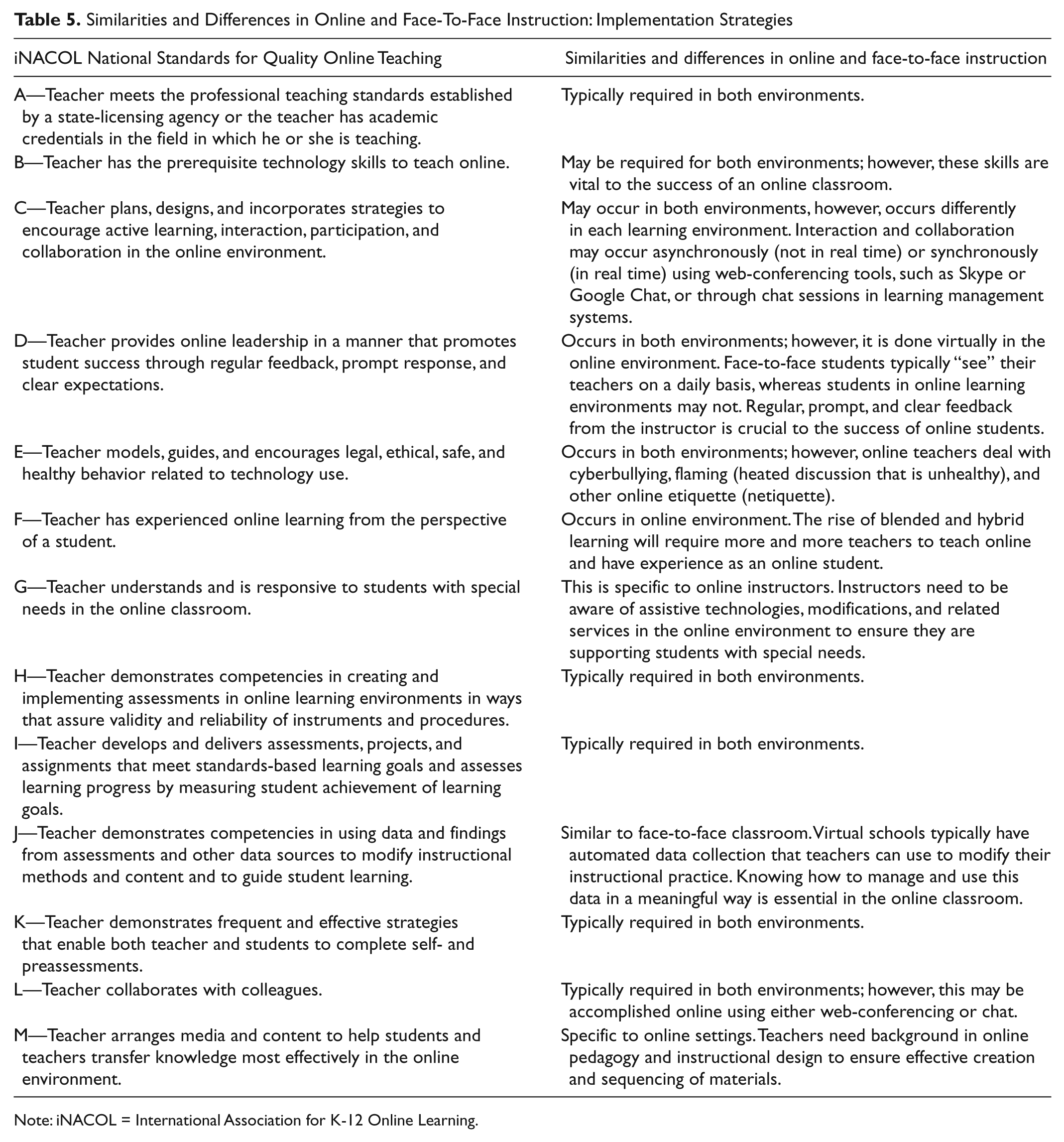
Using the iNACOL National Standards for Quality Online Teaching, Table 5 below illustrates the differences and similarities between online and face-to-face instruction.
Similarities and Differences in Online and Face-To-Face Instruction: Implementation Strategies
Note: iNACOL = International Association for K-12 Online Learning.
Another perception stated, “There are not many virtual schools for our preservice teachers to teach at,” and “It’s problematic locating virtual schools to work with.” Although teacher educators may not be aware of virtual school programs to partner with, these virtual schools exist and are more than willing to work with universities. There needs to be a way to foster that connection, and to address this issue, the authors have begun a national contact exchange to connect teacher education and K-12 online learning programs.
Some responses put emphasis on training for online learning based solely on technology, which is only a small component. Rather, there is a need to focus on the pedagogy of online learning (Brennan, 2003; Ko & Rossen, 2010). Preservice teachers need a solid foundation in online pedagogy, instructional design for online learning environments, and online learning theory to be successful in the online classroom (Archambault, 2011).
One respondent commented, “We are in elementary schools,” suggesting that their preservice teachers are only being placed in elementary schools and therefore do not have to worry about K-12 online learning. However, many virtual schools have begun offering online learning experiences to K-5 students (Watson et al., 2010, 2011). Thus, all teacher educators, including those preparing primary grade teachers, need to prepare their teachers for K-12 online learning.
Another participant relayed, “While I believe a field experience in a virtual school would benefit our students, most will not work in this environment.” It is important for all teachers to learn online pedagogy especially since there are numerous blended and hybrid models emerging (Watson et al., 2011), and future teachers will need to be prepared for these unique learning environments.
Open-ended data suggested that some teacher educators assume that virtual schools are not “real” and neither are the students who attend them. This perception also suggests that teachers working in those schools are not “real” teachers with “real” jobs. Beyond that, respondents expressed concern about interaction and socialization not occurring in K-12 online learning programs. In reality, they do occur, and to assume that they do not is a myth that needs to be debunked (Watson & Gemin, 2008). For instance, face-to-face interactions can occur courtesy of Skype, Elluminate, Wimba, Google Talk, and other online web-conferencing/collaboration tools.
One teacher educator explained that they are teaching preservice teachers who are going into face-to-face teaching: “If we were training teachers for virtual schools, virtual field experiences would be appropriate.” This is a limited view in terms of where teacher educators assume candidates will be teaching, as there is a great and growing possibility that candidates will find job opportunities in virtual settings.
Another teacher educator commented, “That [online learning] isn’t the way I learn. I don’t understand how people can learn something without human contact—or why they would even want to.” This view limits preservice teachers’ preparation based on the respondent’s own learning experiences, which is problematic. Another respondent said, “Online learning isn’t learning.” A similar statement was made by another participant: “I don’t particularly support ‘virtual’ school experiences for teachers in training.” Although the movement toward alternative education experiences, such as K-12 online learning, can be viewed as drastically different, and this change is daunting, as demonstrated throughout the open-ended responses, the online learning format is clearly one that continues to expand (Watson et al., 2011). Teacher educators may not be familiar or comfortable with its advancement; however, this sentiment needs to be addressed if teacher education programs hope to stay relevant and progressive in the 21st century.
These perceptions may permeate throughout the education field at large, especially for those who do not have a connection with research concerning K-12 online learning, and they pose major implications for K-12 online learning advocates and researchers. There needs to be more effective dissemination of information and research concerning K-12 online learning to teacher education programs (Kennedy et al., 2011).
Role of Research in K-12 Online Education
Implications concerning disseminating information about K-12 online learning also relate to the open data coded as “lack of knowledge/need more information” and “survey as impetus.” Because researchers in a given field often publish results of a study in venues that are closely related to the field, results are being “preached to the choir,” rather than shared with those for whom the results have implications. With regard to this study, the authors wanted to target a wide teacher education audience because they themselves are teacher educators who are advocates for moving the field forward. As mentioned above, the researchers felt it important to connect K-12 online learning and teacher education programs that are interested in partnering to provide practical learning experiences for preservice teachers. The authors hope that their work will spark more collaborations of this nature.
As researchers in the field of educational technology, it is understandable that the adoption of innovation takes time (Hall & Hord, 1987). K-12 online education is not presented as something that will completely replace traditional face-to-face learning, but the education system is changing to include blended and hybrid models of learning (Watson et al., 2011). This means that the most positive aspects of traditional and online learning can be combined to provide the best educational experience possible for K-12 students. However, future teachers must be prepared for these various learning environments, including those that encompass some form of Web-based instruction.
The need for K-12 online teachers will continue to rise, and so too will the number of preservice teachers who are recruited directly from teacher education programs. Teacher accreditation organizations, such as NCATE, are currently not addressing this need, so professional organizations, like iNACOL, are creating standards that highlight what skills teachers need to possess to become quality online instructors. Teacher education programs need to recognize this need and begin preparing candidates for 21st century teaching and learning environments, providing them the necessary skills and dispositions for the ever-evolving field of education.
Footnotes
The author(s) declared no potential conflicts of interest with respect to the research, authorship, and/or publication of this article.
The author(s) received no financial support for the research, authorship, and/or publication of this article.