



Abstract
This exploratory study, based on a content analysis of program descriptions, course syllabi, and related program documents, examined the curricula of three fully merged teacher education programs that were redesigned to better prepare teachers for the full range of diversity in their student populations. In these programs, graduates earn a general and special education elementary license simultaneously. Results suggest that attention to disability is more prevalent than attention to other social identity markers such as race, class, culture, or language.
Keywords
To advance meaningful education in today’s schools, teachers are expected to work successfully in classrooms and communities made up of students from multiple and intersecting diversities. Likewise, teacher educators are challenged to assure that among the multiple diversities they will address, the needs of students who have disabilities will be met (Blanton, Pugach, & Florian, 2011). However, despite the fact that many teacher education programs have long required a course or courses in special education for general education teachers (Holland, Detgen, & Gutekunst, 2008; Jones & Messenheimer-Young, 1989; Voltz, 2003), the achievement of students who have disabilities—the majority of whom receive a high proportion of their education in general education classrooms—continues to fall behind that of their peers (McLaughlin, 2010).
Increasingly, a common response to the persistent low achievement of students who have disabilities by teacher educators at the preservice level is to develop collaborative programs of teacher education. This term refers to program redesigns that bring together teacher preparation for general and special education, often leading to graduates obtaining licenses in general and special education, or dual licensure (Blanton & Pugach, 2007, 2011), although the way dual licensure is earned can vary widely and reflects varying degrees of program redesign (Blanton & Pugach, 2011; Young, 2011). The development of collaborative preservice programs has been stimulated by the teacher education provisions of federal legislation (e.g., No Child Left Behind [NCLB], Individuals With Disabilities Education Act) and, more recently, with direct federal funding by the Office of Special Education Programs in the U.S. Department of Education, for approximately 70 preservice programs to engage in curriculum redesign via a set of “325T” project grants (National Center for Improving Personnel Preparation in Special Education, 2012).
The rhetoric surrounding collaborative programs often suggests that they are designed not only to improve education for students who have disabilities, but more broadly to respond to the multiple diversities of students in the schools. As such, collaborative teacher education programs seem to be predicated on better preparing teachers for the complex and diverse ecologies of their classrooms and school communities. How the rhetoric of diversity, inclusivity, and “all students” plays out within teacher education curricula that have been combined to achieve this goal, however, has not been investigated systematically.
In keeping with the theme of this special issue, the purpose of this exploratory, descriptive study was to illustrate and look critically at the preservice curricula of a small number of early adopters of collaborative programs, focusing on the ways they address the relationship between diversity and disability. In particular, the study begins to interrogate the meaning of these collaborative teacher education reforms through an analysis of the curricula of three long-standing teacher education programs in the United States that have fully merged the preparation of general and special education teachers. In the typology of collaborative programs developed by Blanton and Pugach (2007, 2011), such merged programs are defined as a single, fully combined curriculum for all candidates, and all graduates earn a general and special education license on completion. This contrasts with integrated programs, where a redesign of the general education preservice curriculum occurs to assure a stronger base of preparation for all candidates, but only those who are expressly interested in seeking special education licensure continue on for that purpose, built intentionally on the redesigned base program. Using program information located on institutional websites and course syllabi as principal data sources, the analysis focused on how these merged programs have inscribed three central concepts: (a) diversity, (b) inclusivity, and (c) the boundaries of general and special education.
How program faculties frame these concepts may influence various features—for example, courses and field requirements—of a collaboratively redesigned curriculum. Analyzing program features as exemplified in curriculum documents has the potential to help clarify how the rhetoric of inclusion and diversity are enacted within a program. For example, do such programs situate disability within a larger framework of diversity—stretching and making more complex the concept of inclusion? Or do they view disability more traditionally, that is, as structurally distinct from other social markers of diversity? Likewise, are the knowledge, skills, and dispositions identified by state and national standards groups included in ways that suggest that content has been organized to allow for and encourage a fundamental rethinking of key concepts and the relationship between general and special education? Calling a program inclusive or collaborative, or defining it as a dual-licensure program, does not necessarily mean that such fundamental rethinking has taken place (Blanton & Pugach, 2007; Young, 2011), especially around social markers of diversity other than disability.
The core concepts of diversity, inclusivity, and the boundaries between general and special education were identified to assist in understanding the extent to which the trend toward preservice collaboration in these programs represents a response to diversity broadly defined. Do these fully merged programs indicate a significant rethinking of disability beyond the addition of special education and therefore represent a transformation in teacher education, or do they suggest more of a tinkering around the edges of teacher education—appending additional special education information and experiences to existing programs and conceptions of general teacher education in the absence of a larger framework within which to place special education in relationship to diversity (Pugach & Blanton, 2009)?
Context of the Study
Collaborative teacher education programs have been in place since the late 1980s and, in recent years, the number of these programs has expanded rapidly (Pugach, Blanton, & Correa, 2011). The literature on collaborative teacher education to date consists primarily of individual program descriptions that provide information about the steps taken by faculty in the development and implementation of redesigned programs (Blanton & Pugach, 2011). More recent descriptions have included the results of formative and summative program evaluations conducted throughout the process of restructuring programs or as a means to examine and improve existing programs (e.g., Fullerton, McBride, Bert, & Ruben, 2010; Jenkins, Pateman, & Black, 2002; Sands, Duffield, & Parsons, 2006; Sobel, Iceman-Sands, & Basile, 2007; Stoddard, Braun, Hewitt, & Koorland, 2006). Most such program descriptions, as well as other studies of collaboration across preservice general and special education, make note of the increasing diversity of the PK-12 student population, but few directly address diversity other than disability except by setting the context generally (Pugach, Blanton, & Boveda, in press). Some programs foreground more than one marker of diversity in their program work, such as disability and English language learners (ELL; Sands et al., 2006; Sobel et al., 2007).
Examining the effectiveness of specific program components as opposed to complete program redesign, such as collaborative methods courses or collaboration in field experiences, has also been the topic of several studies (e.g., Brown, Welsh, Hill, & Cipko, 2008; Kamens, 2007; Marshall & Herrmann, 1990; Nowacek & Blanton, 1996; Van Laarhoven et al., 2007). For example, Van Laarhoven et al. (2007) found that teacher candidates who participated in a course enhanced with specific collaborative experiences (i.e., experience in inclusive classrooms where coplanning and coteaching were required) showed more positive attitudes and improved instructional abilities in targeted areas compared with teacher candidates in a traditional course. One recent study (Utley, 2009) focused on how the learning gains of students with a disability compared with the gains of students without a disability when they were taught a curriculum unit by teacher candidates in the final internship of a collaborative teacher education program. Learning gains were measured by an existing performance-based assessment used by the program. Findings revealed that students with disabilities achieved similarly to their peers. In addition, cooperative learning was found to be the approach most frequently used by candidates when teaching their units. These studies do not directly address the question of diversity except defined as disability, nor do they typically include information beyond demographics that might pertain to the intersection of disability, race, class, culture, or language.
National surveys have also been used to describe specific aspects of collaboration across existing general and special education teacher education programs (e.g., Harvey, Yssel, Bauserman, & Merbler, 2010; McKenzie, 2009; Miller & Stayton, 1998; Voltz, 2003; Voltz & Elliott, 1997). McKenzie (2009) and Voltz and Elliott (1997) were specifically concerned with preparing candidates for collaboration and coteaching. Preservice students in special education were almost always required to complete a course on collaboration, whereas only 16% of general education preservice students were required to do so (McKenzie, 2009). Voltz and Elliott surveyed special education programs in 25 states to examine the approaches being used to address disability and found that faculty in special education in the 25 states that were represented in the study believed there was a need to increase the emphasis on collaboration for general and special educators. These studies did not address social markers of diversity other than disability in terms of the range of collaboration that may be required in teacher education to develop programs that help candidates respond to the needs of all students who are struggling in school.
Finally with regard to survey studies, a study by Miller and Stayton (1998) focused specifically on early childhood education programs that were identified as “blended” and that incorporated standards for special education and early childhood education. One important finding was that some faculty members expressed concern that special education content might be overemphasized, having the effect of reducing available program space for other, equally important issues.
Holland et al. (2008) documented the integration of content related to students who have disabilities into elementary teacher education programs in several states in the Southeast by analyzing the curricula of elementary teacher education programs through an examination of course catalogs, syllabi, and other program documents. Thirty-six randomly selected programs were included; analysis of program materials and syllabi were supplemented with interviews of six faculty members in elementary education. Among the results, Holland and her colleagues found that nearly one third of mission statements indicate a connection between disability and diversity, but “seldom was the relationship between disability and diversity clearly articulated” (p. ii).
Research on collaborative teacher education is still a relatively young area for study, as is much of the research on teacher education more generally (Borko, Liston, & Whitcomb, 2007; Cochran-Smith & Fries, 2005). Moreover, although collaborative programs have been in existence for decades, it was only in 2007 that a classification system was developed to define models of collaborative preservice programs currently in use across general and special education and to organize and understand the concepts, assumptions, and varied terminology existing in practice and in the literature, and provide for common discourse (Blanton & Pugach, 2007, 2011). This study is situated within the research on collaborative teacher education, and within the broader paradigm of teacher education research that focuses on understanding the complexity of teacher education (Cochran-Smith & Fries, 2005). Among the multiple approaches used by researchers to inquire more deeply into teacher education, examining program descriptions and syllabi is one research tradition for potentially uncovering how faculties frame and conceptualize their programs. Such studies have been conducted in other related areas of teacher education, for example, in multicultural teacher education. Gorski (2009) used snowball sampling to gather 45 multicultural course syllabi and analyzed the descriptions, objectives, and other text in the syllabi to gain an understanding of how multicultural philosophies are revealed in these materials. His findings showed that courses were designed to equip teacher candidates with pragmatic skills and personal awareness but not with deeper concepts such as social justice and addressing educational inequities.
Consistent with Gorski’s work, as well as in response to Zeichner’s (2005) call for research on the curriculum of teacher education, this study focuses on the curricula of three merged collaborative programs to describe how the relationship between diversity defined as race, class, culture, and language, and diversity defined as disability, is represented. Program descriptions and syllabi were examined to consider how the broader concepts of inclusivity, diversity, and the boundaries of general and special education are revealed beyond the rhetoric of “diversity.” In other words, how are collaborative programs helping teacher education move toward the important goal of meeting the needs of the full range of students—whose diversities are intersecting and complex—and many of whom are struggling to achieve in school?
Method
This study falls within the qualitative research tradition in describing three merged teacher education programs. Specifically, it draws on content analysis (Ezzy, 2002) to portray how curriculum documents from selected collaborative programs of teacher education inscribe the concepts of inclusivity, diversity, and the boundaries of general and special education.
Sample
The three collaborative teacher education programs identified for this exploratory study were selected purposefully and can be viewed as critical case sampling according to Patton’s (2002) sampling scheme. Given the recent rapid increase in such programs, those identified for analysis in this study are all relatively long-standing elementary programs that predated the current surge in collaborative teacher education and dual licensure. The rationale for selecting long-standing programs was that faculty affiliated with such programs are more likely to have had greater opportunities to work out philosophical and practical issues associated with merging the preparation of general and special educators and the ways they address diversity. Finally, with regard to sampling, although many collaborative preservice programs exist in early childhood (Stayton & McCollum, 2002), this study is focused on elementary-level programs because of the degree to which issues of student achievement reveal themselves once the academic curriculum becomes more demanding and NCLB testing requirements become more challenging.
The three institutions whose programs were included in the study vary by geographic location; they are each in large or midsized cities, one in the west and two in the east. Program A is located in a small, private denominational college in a city in the northeast. Program B is located in a large public, multipurpose university in a large city in the west. Program C is located in a large private research university in an industrial city in the northeast. All offer initial teacher education licensure at the undergraduate level, and all students graduate eligible for a general and special education license, consistent with the definition of a merged program. The special education licenses graduates of these programs earned were all in mild to moderate disabilities and did not include certification for teaching in the areas of vision or hearing impairment, or more significant disabilities.
Data Sources and Analysis
Data sources for this study included the following program and curricular documents: general program descriptions, program mission statements, course catalog descriptions, advising documents, student program handbooks, clinical experience descriptions and handbooks, and syllabi for required education courses. Documents were collected between 2008 and 2010 via postsecondary institution websites, as well as directly from program directors and/or key faculty or administrative contacts. Course syllabi constituted the major data source and were analyzed for (a) short course descriptions, goals, and objectives; (b) state and/or national standards addressed in the course; (c) distribution of course topics; (d) course assignments; and (e) required textbooks. A total of 44 syllabi were analyzed, including 10 from Program A, 18 from Program B, and 16 from Program C. Where necessary, clarifications and program updates were sought from key faculty or administrative contacts, chiefly via email, but no formal faculty interviews were conducted for this study.
Each complete data set was analyzed by one of the two principal researchers, both of whom are senior faculty members in teacher education in large urban communities, one in special education with primary responsibility for the preparation of special education teachers and graduate students in a state that requires preparation in issues of ELL for all teachers, and for preparing doctoral students in special education, and one in general education with primary responsibility for the preparation of masters level general education teachers for urban schools and doctoral students in urban education. These different experiential bases were viewed as important in bringing multiple perspectives to the analysis of the preservice curricula. The identification and development of categories for analysis were completed as a joint task.
Hatch (2002) described data analysis “as a process of asking questions of the data,” and that “important information is in the data, and by systematically asking the right questions of the data, that information can be revealed” (p. 148). The overarching analytic question in this study was how these programs were conceptualized in terms of the relationship between preparing teachers for diversity of race, class, culture, and language, and diversity as represented by disability. A set of more specific questions spanning general descriptions of programs and specific content related to course and field experience requirements helped focus the analysis and included the following:
What conceptions of teaching are communicated in program descriptions?
To what extent are programs framed by a duality of general and special education as two distinct areas of study, or by inclusive education more broadly defined?
How broadly or narrowly do the programs address diversity? What is communicated about disability in relationship to other diversities?
What proportion of courses can be identified as having a major focus on “general” or “special” education? How does the selection of textbooks reflect the relationship between the two?
How is “inclusion,” or “inclusivity” portrayed?
How do course assignments, as evidenced in course syllabi, reflect conceptions of inclusion and conceptions of disability in relationship to other diversities?
Data were analyzed by reading each document multiple times to identify patterns across various aspects of the curriculum as represented in course syllabi and other descriptive program material. Several parts of the data were analyzed with simple frequency counts, a common practice in content analysis (Ezzy, 2002). Where categorization of various aspects of the materials was required to enable frequency counts, for example, in determining whether a course had a primary focus on general or special education, or inclusive education, the authors set general decision rules after discussion. For example, a syllabus was judged in terms of whether it was more recognizable in content as a relatively traditional general education course (e.g., learning and development or literacy methods or mathematics methods), or a relatively traditional course in special education (e.g., an introduction to categories of special education or a course on learning disabilities), or a course that reflected a much higher degree of inclusion—whether or not the course title itself conveyed a more expansive and inclusive focus.
After broad program descriptions, syllabi and textbooks were analyzed, and results placed into matrix form, a second level of content analysis was completed based primarily on the distribution of course topics and assignments in course syllabi. Based on this analysis, an individual diversity profile was developed for each program to capture variations in the ways diversity was addressed across programs and specifically to compare attention with diversity of race, class, culture, and language with diversity defined as disability. These diversity profiles included the following:
How the programmatic commitment to diversity is represented in introductory program material
The contrast between references to diversity from required standards and those generated independently by the faculty member teaching the course
The specific distribution of topics related to diversity across class sessions and assignments
Results
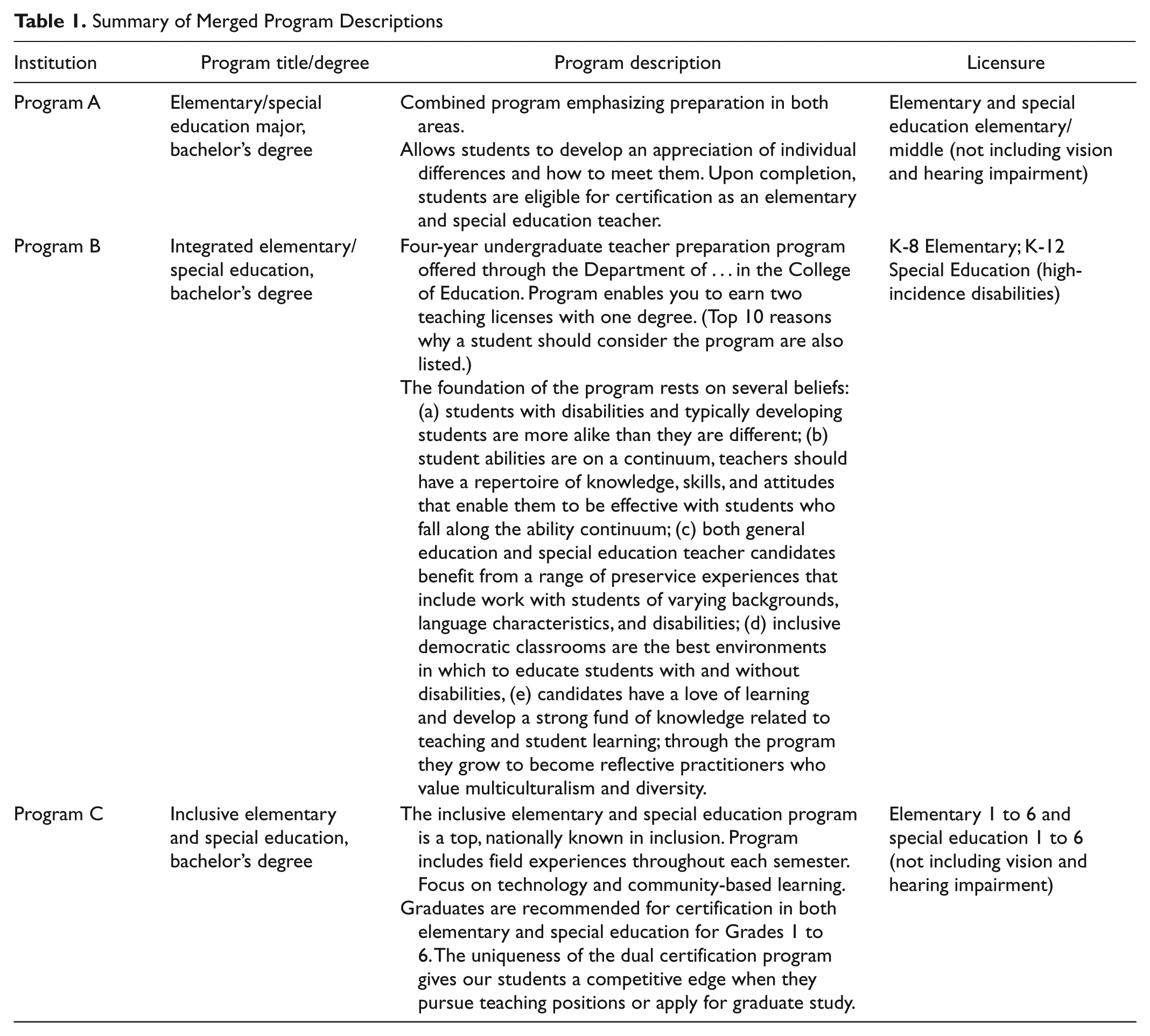
Results are presented in Tables 1 to 4 and Figures 1 to 3. As indicated, Table 1 displays the primary points conveyed in short program descriptions available in locations such as program websites and program overviews in course catalogs. Descriptions such as these may often be the first information prospective students see when they consider choosing a major. All three programs feature dual licensure, and all three convey a philosophical framework related either to meeting individual needs or inclusivity.
Summary of Merged Program Descriptions
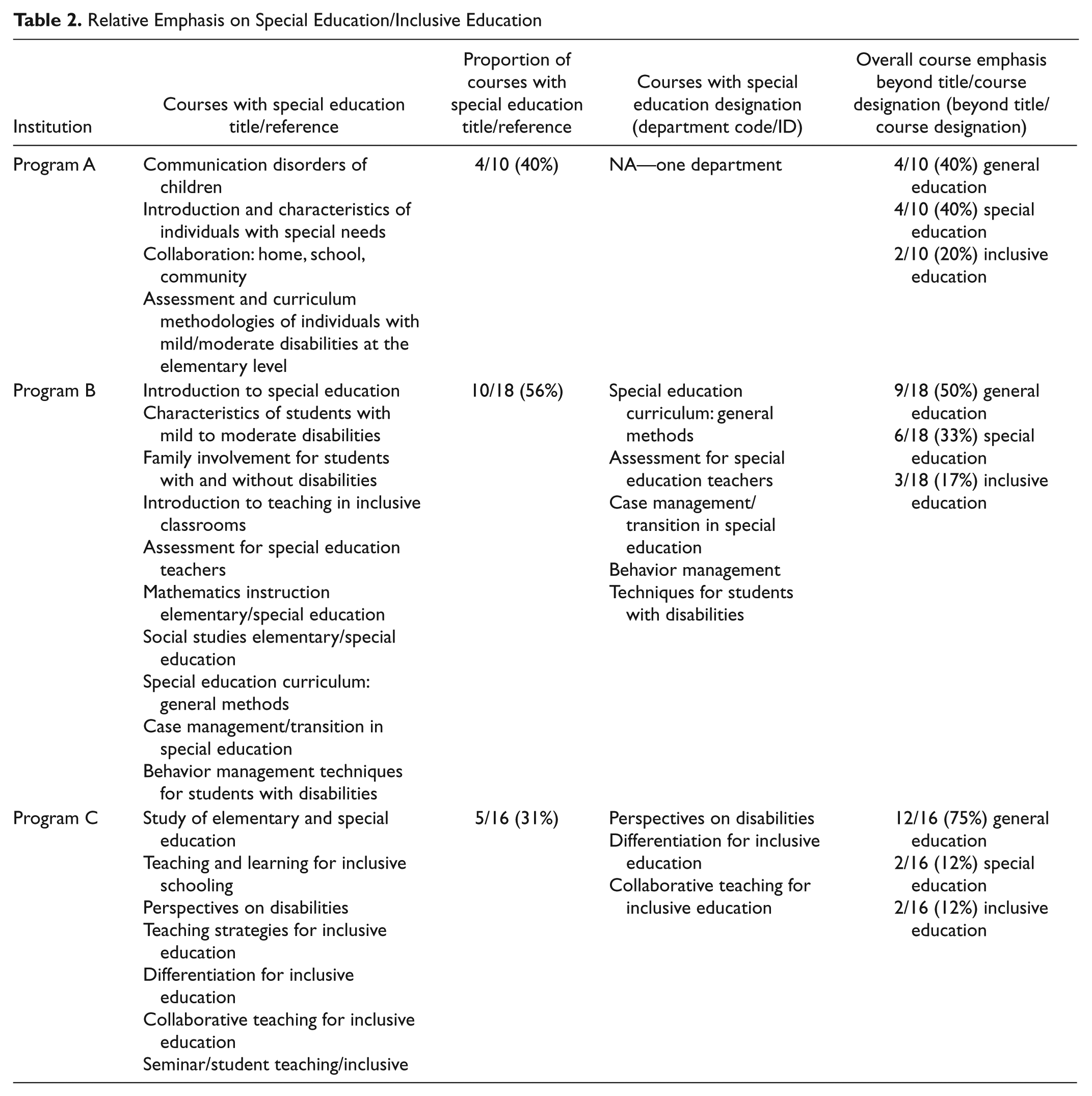
Relative Emphasis on Special Education/Inclusive Education
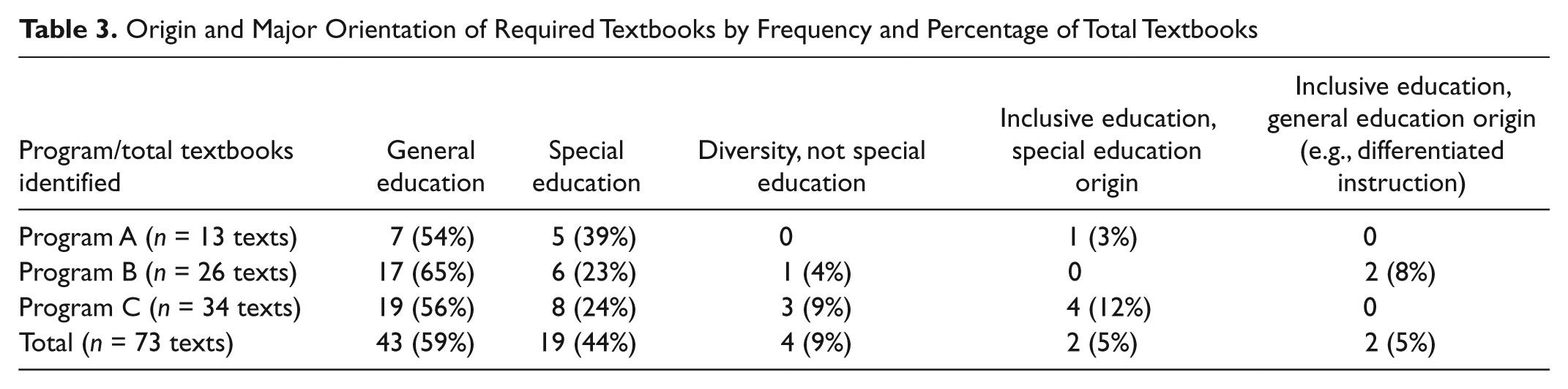
Origin and Major Orientation of Required Textbooks by Frequency and Percentage of Total Textbooks
How Collaboration Is Addressed

Note: IEP = individualized education program; INTASC = Interstate Teacher Assessment and Support Consortium.

Diversity profile, Program A
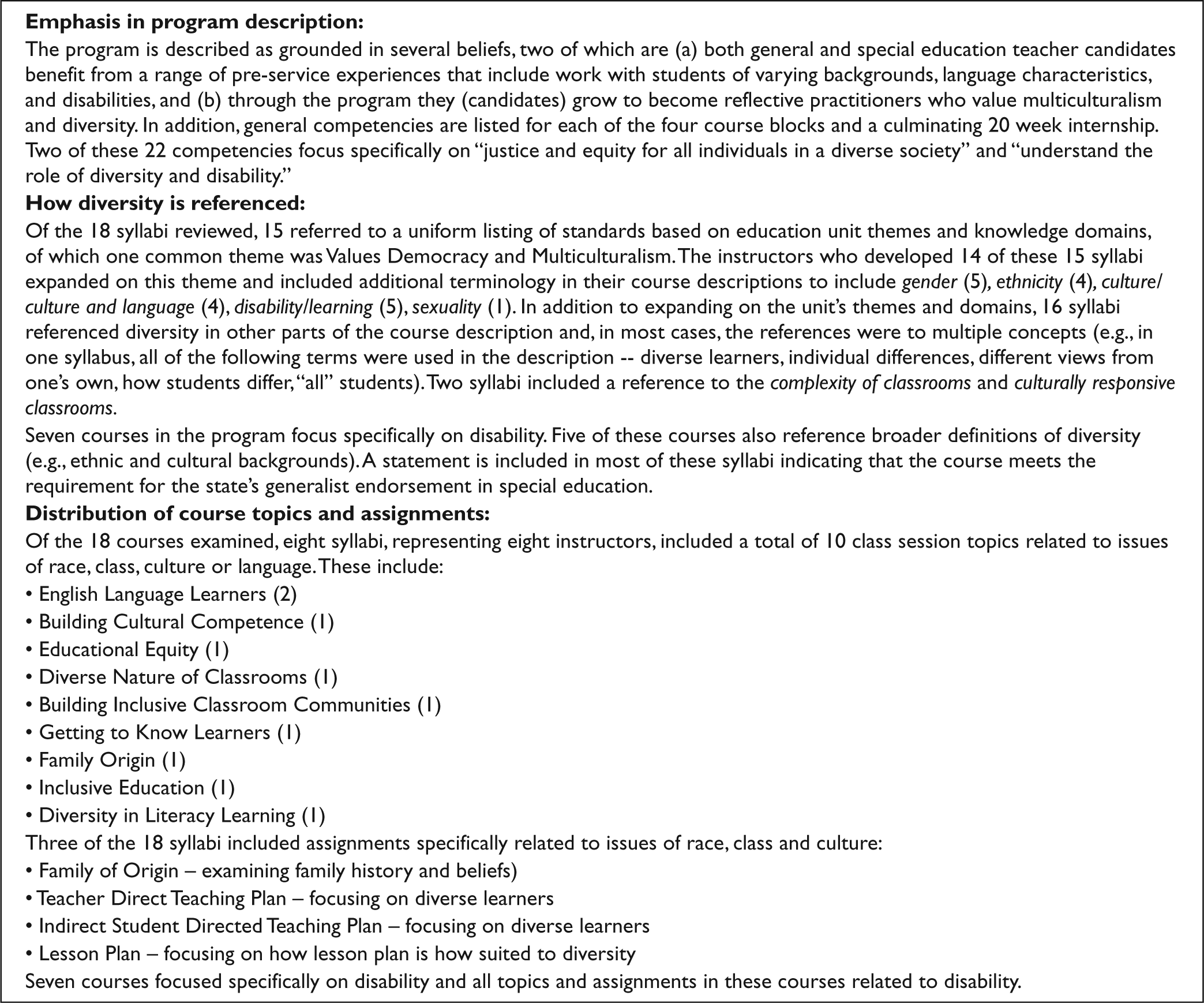
Diversity profile, Program B
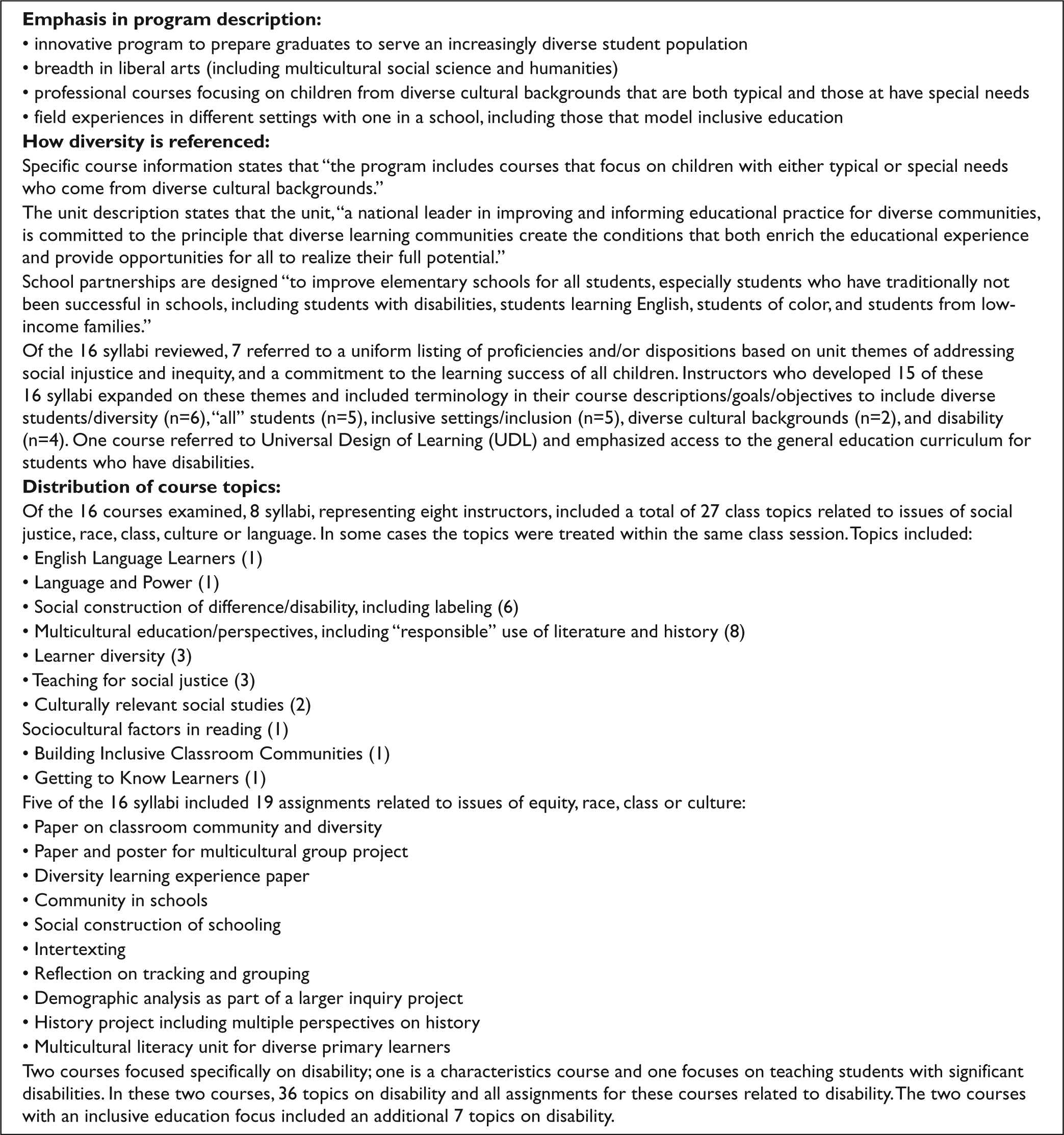
Diversity profile, Program C
Table 2 displays course characteristics that are related more specifically to issues of disability. As this table illustrates, programs differ in the number of courses that can be readily identified with special education. At least one third of course titles across all three programs include reference to special education, with one, Program B, referencing it in course titles more than 50% of the time. Although course titles may refer either to special education or inclusivity, when looked at in detail they may actually reflect a more traditional approach to either general or special education (e.g., a course that is essentially a standard course in mathematics education but has a course title with the word inclusion), or they may reflect a substantive integration of the two, title notwithstanding. As shown in the last column of Table 2, for example, when courses were examined for their actual emphasis on general, special, or inclusive education beyond course titles, course titles and course emphases were not necessarily aligned.
The origin and major orientation of required textbooks are shown in Table 3. Across all three programs, 59% of the total required textbooks were general education in orientation (e.g., a typical science methods textbook), 44% were special education in orientation, 9% represented diversity that is not of special education origin (e.g., Ladson-Billings’ The Dreamkeepers), an additional 9% represented inclusivity broadly defined but whose authors originate and are often identified with special education. Finally, 5%, all from one program, represent inclusive education broadly defined but whose authors originate and are generally identified with some field in general education.
Collaboration in PK-12 practice has been viewed for some time as one of the cornerstones of the integrated preparation of general and special education teachers as a means of supporting inclusive education (Brownell, Sindelar, Kiely, & Danielson, 2010; Pugach, Johnson, Drame, & Williamson, 2012). Therefore, how these merged programs addressed collaboration was an important consideration. As shown in Table 4, collaboration was addressed relatively infrequently in practice as represented in syllabi, by course topic and assignments. Program C addressed it most frequently in course topics but, in this program, collaboration was more closely linked with working with families. Although there appears to be an implicit valuing of collaboration in terms of candidate participation in group projects, and being a participatory member of the class, and although two classes that were partially cotaught describe this as modeling the collaboration graduates will be expected to practice, explicit references to collaboration were relatively infrequent.
Figures 1 to 3 illustrate the composite diversity profiles for each of the three programs and indicate the different ways each treats diversity. What seems to be common across programs as represented by topics listed in course schedules and course assignments was a great deal of attention to disability as a marker of diversity, and relatively less attention to markers of diversity such as race, class, culture, and language. This situation existed despite the overarching commitment to diversity within mission and program statements. Of the three programs, Program C addressed diversity in the context of social justice and in general addressed diversity more frequently compared with Programs A and B. However, disability remained a more frequent topic in the actual class schedules across all three programs.
As noted by Gorski (2009), what is available publicly may not reflect what is actually communicated by faculty or experienced by candidates; this constitutes a limitation of the study. However, what is communicated publicly in these merged programs sets the tone for program philosophy and purpose and can shape the expectations students may have for what it means to learn to teach every student well and for how they view diversity. In other words, a consideration of the underlying assumptions and philosophies that characterize the public, official preservice curriculum as represented in program documents was central to this study.
Discussion
This exploratory study helps begin to answer questions related to the relationship between diversity and disability within merged preservice programs. With the increase in collaborative programs that either mandate or facilitate graduates obtaining dual licensure in general and special education, the significance of this study relates to what teacher education is making of the unique opportunities afforded by such collaboration at the preservice level to reconsider the meaning of inclusion and its relationship to diversity writ large. In other words, in what ways are collaborative programs of teaching enacting the commitments voiced in teacher education to prepare graduates to teach all students effectively?
Diversity
All three programs refer to diversity and, either explicitly or implicitly, convey the belief that the program is committed to preparing its graduates to teach across a wide range of diversities—in program or unit descriptions, in references to diversity requirements, and/or in references to diversity in specific course descriptions or lists of standards. However, especially with regard to course topics and assignments, diversity appears to be defined more frequently as disability, with fewer assignments specifically exploring issues such as race, class, culture, or language. All three of these programs exist in urban areas of various sizes, where the likelihood of having a diverse student body is at its greatest. It is noteworthy that neither issues of working with English language learners, nor issues of language and power are addressed in greater depth. A faulty assumption that may be underlying this approach to the curriculum could be that if preservice students are well versed in issues related to disability, this knowledge will transfer to the complexity of the interrelationships among race, class, culture, language, and disability.
For two of the three programs, preservice students complete at least some of their field experiences in urban school contexts. This suggests the need for teacher candidates to have structured opportunities to participate in mediated discussions (Seidl et al., 2008) and to use tools of inquiry (Zamudio, Rios, & Jaime, 2008) to foster a critical consciousness with regard to issues of race, class, language, and culture in their practice settings. In other words, the commitment to diversity in these programs requires more than placing preservice students in culturally, ethnically, socioeconomically, linguistically, and ability-diverse classrooms and schools; it requires purposeful deliberation about these experiences—and especially about how diversities intersect. The diversity profile for Program C may suggest some degree of greater opportunity to engage in such mediated discussions, primarily due to the greater number of class topics devoted to issues of equity. It may also be the case that programs do engage students in mediated conversations during, for example, seminars taken concurrently with field experience and/or student teaching. However, it is not readily apparent from syllabi and related course materials that this is taking place.
The question of how merged programs address diversity raises a fundamental issue in the reform of teacher education. If diversity is conceptualized as a series of independent, unconnected social identity markers, paying much greater attention to one such marker relative to another may create an imbalance in the preservice curriculum that has real consequences for how graduates are prepared to work in educational settings that are in fact highly diverse. Most importantly, the PK-12 students these program graduates will teach are not defined by only a single social identity marker of diversity. If students have more experience in practice and in mediated debriefings with disability in comparison with diversity of race, class, culture, or language, for example, it does not seem likely that they are being well prepared for teaching in diverse settings. Further, how might program graduates be contextualizing disability within the larger issues of institutional forces that maintain inequity and marginalize groups of students, forces that place students in the position of becoming vulnerable for failure in school (Seidl & Pugach, 2009)? A construct such as disability itself exists within a larger framework of race, class, culture, language, and socioeconomic class that characterize all students (Pugach & Seidl, 1998). In this regard, Artiles, Kozleski, Trent, Osher, and Ortiz (2010) have suggested that special education has adhered to color-blind explanations of dynamics such as the disproportionate representation of minorities in special education in ways that do not “honor the complexities of racial inequities in special education” (p. 280)—rather than situate the disproportional representation of African American males and Hispanic students, for example, within larger cultural frameworks that acknowledge societal and institutional forces that are always at work in schools and communities. An assumption underlying this study was that programs that are committed to combining the preparation of special and general education would have addressed these issues more substantively and in ways that would contribute to graduates’ clearer understandings of the larger context of racial inequity, the place of disability within these overarching sociocultural and institutional frameworks, and the intersectionality of diversities.
The need to include and strongly emphasize disability in the preparation of teachers is not in question here. Rather, what is in question is (a) why disability seems to be disproportionately addressed in relationship to other diversities and (b) why it is not adequately situated within these larger conversations to acknowledge and interrogate its complexity.
Inclusivity
Related to the issue of diversity is the issue of inclusivity. Although the roots of the term and philosophy of inclusion are tied to individuals who have disabilities, increasingly it is viewed as embracing the need for educational equity and access across all students who are marginalized on many counts—not only those with disabilities (Artiles, Kozleski, & Waitoller, 2011). An assumption in this study is that when programs have been redesigned as a result of greater levels of collaboration across general and special education, the concept of inclusion itself might have been reshaped to reflect this broader conception of diversity and how disability is nested within other social markers of diversity, and not be limited primarily to special education.
Yet evidence that such a reshaping has occurred in these programs is not readily apparent in these data. In Programs A and B, for example, inclusivity seems to be defined as responding to students’ individual differences. Beyond occasional references, the language of inclusion is used infrequently. In Program A, the commitment to meeting individual differences is located in the program mission and appears in courses on, for example, assessment, which emphasize practices such as curriculum-based measurement embedded in systems such as Response to Intervention. The skills of ongoing assessment and progress monitoring are clearly important for teachers to master to support student learning and yet, it seems reasonable to question whether “meeting individual differences” in the absence of greater attention to diversity of race, class, culture, and language is a powerful enough conceptual framework within which to overcome long-standing institutional inequities and situate inclusivity within its larger sociocultural framework. Program C uses the language of inclusion throughout its materials. However, the emphasis on special education and disability continues to be greater than the emphasis on issues of race, class, culture, and language in this preservice curriculum, raising questions about which diversities may be privileged, whether consciously or not, in the practice of developing inclusive programs of teacher preparation.
The Boundaries of Special and General Education
How sharp or blurred are the boundaries between general and special education in these programs? The data suggest several important issues in this regard.
First, when programs are initially portrayed to students in brief program descriptions, such as those on college wide or departmental websites or introductory sections of course catalogs, the instrumentality of emphasizing dual certification as increasing the likelihood of employment may work to perpetuate sharp boundaries between the two. Although programs may be described philosophically as being committed to preparing all graduates for working with diverse groups of learners in inclusive classrooms, the increased marketability of a graduate who possesses a general and special education license appears to hold a prominent place in how such merged programs are identified. This may potentially trump philosophical shifts and perhaps—inadvertently—reify the fundamental duality of general and special education. The assumption operating seems to be that graduates will want to take on the role of either a general or special education teacher—at the same time, the program may make important claims about working in inclusive settings. The realities of the job market and the shortage of special education teachers suggests that those who hold a special education license could find themselves pressured to accept a position as a special education teacher, even if their goal is to work as a general education teacher who practices inclusive education.
Second, it appears that traditional categorical/medical model philosophies of disability, and inclusive philosophies of disability that are based more on the social construction of disability, may coexist within a single merged program, raising the question about whether these conflicting worldviews are adequately problematized by faculty and with students as they move through their preparation. All three programs house traditional categorical special education courses (e.g., Introduction and Characteristics of Individuals with Special Needs, Perspectives on Disabilities, or Characteristics of Students with Mild to Moderate Disabilities) alongside courses with titles such as Introduction to Teaching in Inclusive Classrooms or Teaching and Learning for Inclusive Schooling. If it is the case that such merged programs are meant to be harbingers of more inclusive practice, what is the significance of an apparent reluctance to address this conflict philosophically and programmatically, or to create language (and by extension, preservice discourse and courses or experiences) that might reflect a less dualistic view?
There may be several explanations for this situation. For example, there may be faculty members who are firmly planted in a medical model of disability and who are comfortable teaching only from that perspective; simultaneous offerings from both perspectives may be a practical way of “keeping the peace.” Furthermore, the pressure to respond to state certification requirements and national standards for a general and special education license may be constraining a broader vision of inclusivity (Blanton & Pugach, 2011)—and this may represent an unintended outcome in the development of merged programs of dual licensure. States may require courses with specific reference to special education in their titles and short course descriptions, and specific standards and/or competencies may be grounded in a traditional view of disability.
Finally, as noted above, the language of collaboration, which has signaled a blurring of the boundaries between general and special education, is sparse in these program materials and course syllabi. This raises questions about the relationship between the discourse of inclusive education and the discourse of collaboration. Brownell et al. (2010) have questioned whether collaboration among professionals is an appropriate framework for teacher education to be responsive to students who have disabilities. It is unclear why these programs seem to be downplaying collaboration—or whether it is so firmly embedded within the processes of teacher education that it is not as readily visible as other issues.
Conclusion
To what degree do collaborative programs of teacher education, and specifically for this study, programs that are fully merged and in which students graduate with two licenses, move teacher education toward a more integrated vision of diversity and inclusivity? To what extent might these programs represent progress? In other words, are these redesign efforts being viewed and utilized as critical opportunities to rethink the relationship between general and special education teachers and the role of special education itself in the schools and, as such, represent a chance to reframe some of the debates on the reform of teacher education with respect to diversity and meeting the needs of all students?
In light of the results reported here, these three merged programs do not appear to offer an easily discernible new framework for the consideration of diversity. In these well-intended early attempts to rethink the boundaries between general and special education, the programs may best be understood as transitional rather than transformational—that is, programs that reflect a willingness to take steps toward becoming more responsive to diversity, but that could benefit significantly from greater creativity and imagination in how that is to be accomplished. In moving toward transformation, the curricula of such programs will need to move away from an additive approach, where special education content has simply been placed within or appended to an existing curriculum (Pugach & Blanton, 2009), and address more fully how to situate content related to disability within multiple, intersecting diversity communities. This requires a more thorough rethinking of the curriculum’s underpinnings.
Nevertheless, these merged programs appear to be operating, in name and no doubt in basic commitments, from a vision of education that is beginning to be more inclusive of diversity. But how diversities are nested within one another, and how they interact reciprocally, is less evident. It is certainly not the case that these programs do not represent progress. Certain courses are beginning to push at the boundaries of general education and at the least some special and general education faculty seem to be participating together in ways that were uncommon just two decades ago.
In fact, these faculties may even be considered somewhat bold in that they have pushed these boundaries while navigating state certification requirements and national standards that may constrain the intended scope of their work and that could be contributing to the unintended consequence of developing more additive rather than transformative approaches to preservice curriculum change. Yet for teacher education to make good on its commitment to preparing teachers for the full range of students they encounter, nothing less than such a transformation is needed—not only by faculty, but also by state and national groups that guide and are designed to hold teacher education programs accountable for preparing their graduates to be responsive to the students whose education they provide.
Footnotes
Declaration of Conflicting Interests
The author(s) declared no potential conflicts of interest with respect to the research, authorship, and/or publication of this article.
Funding
The author(s) received no financial support for the research, authorship, and/or publication of this article.