



Abstract
This study explores the interaction between transformative processes in which a group of teacher educators became a professional development community (PDC) and the individual progress of these instructors through the professional development course on the topic of thinking education. Twelve teacher educators who participated in one of three yearlong programs were each interviewed three times. Other data sources include reflective writing of the participants, field notes, and recordings of the PDC meetings. Findings show that both breaking of isolation in the group and talk about student learning were essential in promoting individual progression toward change that entailed developing awareness of the possibility of infusing thinking into college-level teaching and the development of dispositions to do so in their courses. Factors that enhanced and hindered dispositional change are explicated in the findings and discussion.
Keywords
Introduction
Professional development of teachers is increasingly important in promoting and advancing educational practice. Collaboration and learning in groups has proved to be a major avenue for supporting this development and change (Lohman, 2005). However, results from many studies indicate a wide variation in the effectiveness of group formats to advance the individual learner (Meirink, Imants, Meijer, & Verloop, 2010; Shulman, & Gamoran Sherin, 2004). Group processes are dynamic and thought to effect pedagogic change, while individuals within the professional development group often exhibit different levels of receptivity to change and innovation (Meirink, Meijer, Verloop, & Bergen, 2009; Yerrick, Parke, & Nugent, 1997). In these contexts, the interrelationship between group and individual processes accounts for both growth and stagnation. This study examines the touch points between the two processes in the context of professional development of teaching thinking in higher education.
Professional Development in the Context of Thinking Education
Much attention has been given recently to integrating thinking education with the teacher preparation curriculum (Harpaz, 2007; Marzano & Kendall, 2006; Perkins, 2009; Perkins & Ritchhart, 2008; Zohar, 2008). Developing better thinkers involves preparing teacher educators to support higher order thinking among their students. Professional development in the teaching of thinking is viewed in these projects as the lynchpin to their success. Our understanding of teaching thinking includes two major components that Costa (2001) refers to as teaching for thinking and teaching of thinking. The first step in integrating the dimension of thinking into curriculum involves professional development in thinking education for the teacher educators themselves (Martin & Michelli, 2001). A collaboration model for professional development is particularly appropriate for thinking education because of the importance of shared knowledge and expertise in the development of thinking (Chen, 2012; Perkins, 1995; Ritchhart, Church, & Morrison, 2011). Research focused on collaboration as a frame for professional development indicates that interaction among participants leads to discussion of teaching practice and results in change as “an ongoing, collective responsibility” (Opfer & Pedder, 2011, p. 385). In our teachers training college in Israel, professional development in thinking education uses a sociocultural learning perspective focused on community formation (ten Dam & Blom, 2006) and emphasizes professional growth through interpersonal relations and activities among teacher educators (Stevens, Kahne, & Cooper, 2006).
Community of Learners and Group Processes
The participation metaphor characterizes this communal conception of learning (Reynolds, Murrill, & Whitt, 2006; Salomon & Perkins, 1998; Sfard, 1998), assuming its inextricable bond with identity formation. Involvement in a community enables individuals to develop their own professional identity as a result of each participant’s unique contribution. The notion of distributed cognition (Salomon, 1993; Vrasidas & Zembylas, 2004) assumes that new knowledge emanates from interaction. Moreover, collaboration creates a culture stimulating further learning. Theories of college improvement and organizational development link learning with participation in institutional activities, suggesting that teacher educators must learn as well as teach (Hutchinson & Hadjioannou, 2011; Jones, Stanley, McNamara, & Murray, 2011; Kabakci, Odabasi, & Kilicer, 2010). Both domains stress integration of work and learning as necessary conditions for individual and organizational development (Choi & Ruona, 2011; King & Newmann, 2000; Lester & Costley, 2010; Livneh & Livneh, 1999; Moore & Shaw, 2005).
Effective participation in society is enhanced by acquiring knowledge and skills as well as becoming a member of a community of practice (Lave, 1993; Lave & Wenger, 1991), which is defined as a group of practitioners sharing common concerns, sets of problems, or passions about a topic, who deepen their knowledge and expertise by ongoing interaction toward a common goal (Wenger, McDermott, & Snyder, 2002). Wenger’s theory of social learning suggests that professionals grow, change, and develop as they negotiate meaning through interaction with others. Identity formation relates directly to how the individual deals with the common practice generated by the community. These concepts of meaning and identity are central to professional learning in a community (Wenger, n.d.). Essential features of effective professional development within a community of learners include teacher involvement, collaborative problem solving, continuity, and support (Borko, 2004; Lave, 1993; Opfer & Pedder, 2011). Because learning and teaching are major activities in a teachers college, the community of practice functions as a community of learners in which members engage in teaching and learning. In such a community, the relationship between what teachers learn and what students learn is important, while the community builds outward from this essential connection (Curry, 2008; Shulman & Shulman, 2004). Following research on teacher learning (Achinstein, 2002; Grossman, Wineburg, & Woolworth, 2001; Little, 1990, 1999, 2002), the community of learners approach and the need to connect teacher and student learning provided a useful model for our professional development community (PDC) on thinking education.
Group processes and formation of community are important factors influencing professional development outcomes. However, due to the contextual character of any professional development, the effects of personal factors cannot be ignored (Borko, 2004). In their review study on effective professional development, Opfer and Pedder (2011) identified subsystems that include both individual and group factors affecting the development of teachers involved in professional development programs. Building on these findings, we recognize that any professional development process involves interplay between the individual and the group.
Aspects of Professional Development
Progressive stages of career development can be identified both at the macro level when examining teacher careers longitudinally over extended periods of time (Kinchin & Cabot, 2010) and at the micro level when examining teachers’ professional development within the confines of inservice training lasting 1 to 2 years. At the micro level, teachers have been found to follow particular paths in their adopting new methods that parallel longitudinal pathways at the macro level (Hadar & Brody, 2010; Lown, Davies, Cordingley, Bundy, & Braidman, 2009). In this path, they can experience both progression and regression while developing an expertise in the content that is the object of the professional development endeavor.
In a previous study (Hadar & Brody, 2010), we examined how the PDC works on the group level in terms of breaking isolation, attitudes toward improvement of teaching, and professional development. We defined professional development as not only participation in a process to improve teaching (Guskey, 2000) but also incorporating changes into current practice. A second study (Brody & Hadar, 2011) identified participants’ individual trajectories of development within the community. This study builds on the two previous ones by focusing on two aspects of professional development, the social and the personal, identified by Opfer and Pedder (2011) as significant factors in teachers’ professional development. We aim to go beyond our previous work by investigating the interaction between these two important domains. Specifically, we explore how group processes within the community interrelate with personal and professional development of participants. This study’s added value lies in the careful attention paid to circumstances under which individuals develop or fail to develop professionally within the community of learners, a perspective that goes beyond current research documenting teacher learning in groups (Meirink et al., 2009; Meirink et al., 2010; Shulman & Gamoran Sherin, 2004; Yerrick et al., 1997). This study offers a new conceptualization of the dynamics of the interrelationship between individual learners and the context of the learning process. Understanding how group processes interrelate with individual professional development exposes the power of communities of learners for developing new dispositions to achieve educational advancement. These interrelationships between group processes and individual processes might in some cases be unidirectional in which group processes hinder or promote individual growth, or can be reciprocal in which individuals at various stages of their own development contribute to or be influenced by group processes.
Focusing on the interplay between group processes and individual development within a PDC, we present below our models of group and individual development separately. We will subsequently explore the relationship between the two.
Development of the Community in the PDC
In our previous study (Hadar & Brody, 2010), we identified four significance components in the group process, which are viewed as layers, building one on the next. Breaking of isolation formed the basis for further group development and became the driving force behind professional development of PDC members. Following their deepening acquaintance with colleagues, teacher educators engaged in discourse focused on student learning, which in turn enabled dispositional change. This discourse marked significant development and constituted the second layer in the group process. The resultant collaboration served as a foundation for the third layer, improvement of teaching, which includes skill acquisition, classroom implementation, documentation, and collegial reflection. The initial layers of breaking isolation and improving teaching were driven by talk about student learning. A fourth layer, professional development, included higher order functioning and acquiring dispositions toward teaching thinking and feelings of efficacy.
Our model of group processes in the PDC is illustrated in Figure 1, which specifies not only the process layers but also the role of talk about student learning as a connector between breaking of isolation and improvement of teaching. In the figure, each process layer is elaborated with component factors.
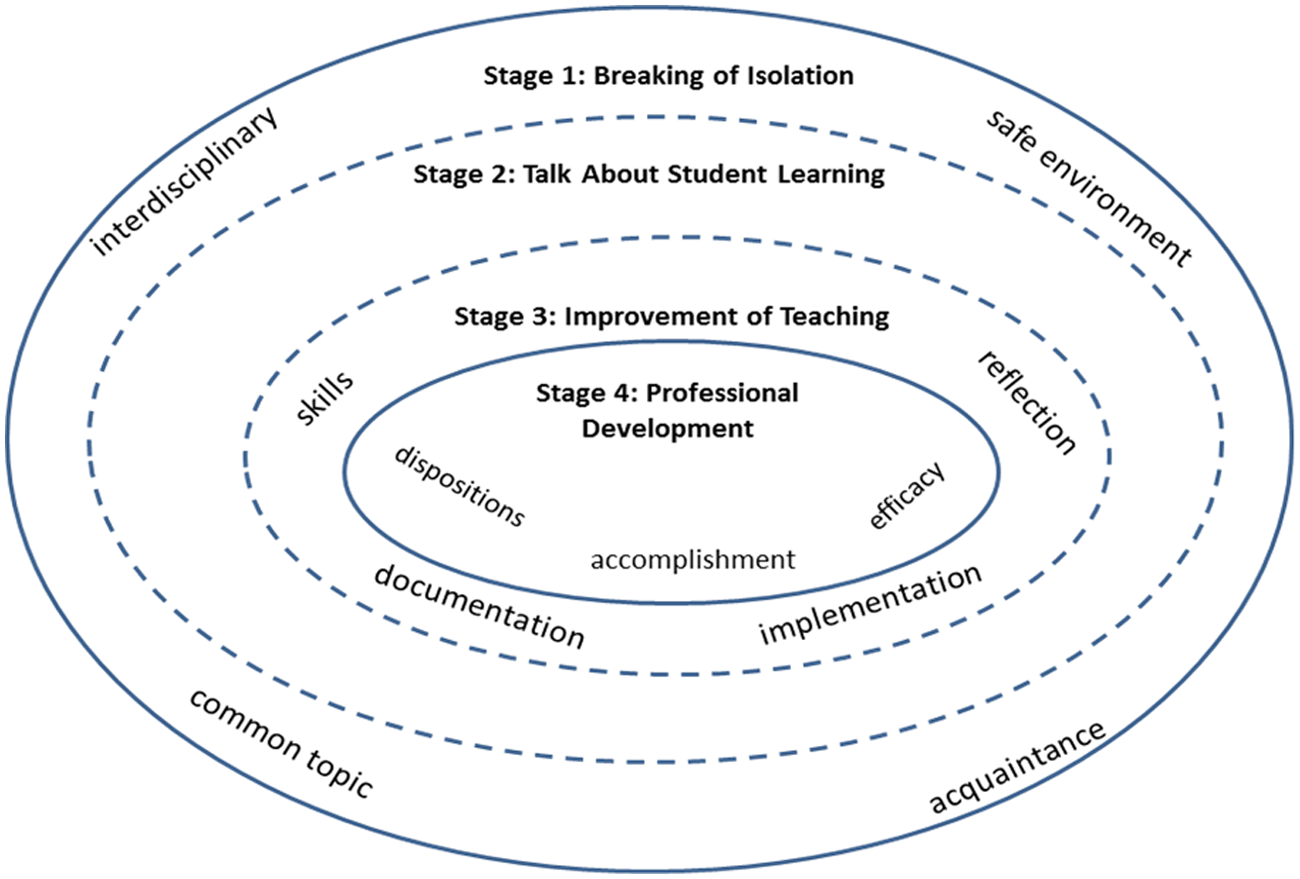
Layered model of professional development based on the professional development community paradigm
Personal Professional Developmental Paths
A second analysis (Brody & Hadar, 2011) describes individual professional development trajectories. In this analysis, we explored personal developmental pathways within the PDC. This analysis includes four professional development stages: anticipation and curiosity, withdrawal, awareness, and change. In the beginning stage of anticipation and curiosity, teacher educators expressed enthusiasm about the program. However, they very quickly moved to a stage of withdrawal from the goals of the PDC, claiming that past pedagogic practices were identical to those presented in the meetings. Withdrawal is characterized by resistance to adopting new ideas while constructing various protective mechanisms that prevent significant learning. Some participants persisted in withdrawal while others moved to the next stage of awareness, becoming consciousness of potential value in these innovative practices. Awareness was a necessary precursor to the final stage of change, as evidenced by developing a disposition toward teaching thinking. Although the same trajectory was common to all participants, each teacher educator experienced different movement along the trajectory path (Brody & Hadar, 2011). Although some achieved change within a 1-year PDC, others reached only the stage of awareness, dropped out, or remained in stasis.
The personal professional trajectory model is illustrated in Figure 2, showing various pathways taken by teacher educators through their participation in the PDC. Characteristics of each stage in the trajectory are elaborated, and nonlinear pathways are presented with arrows showing movement between stages.
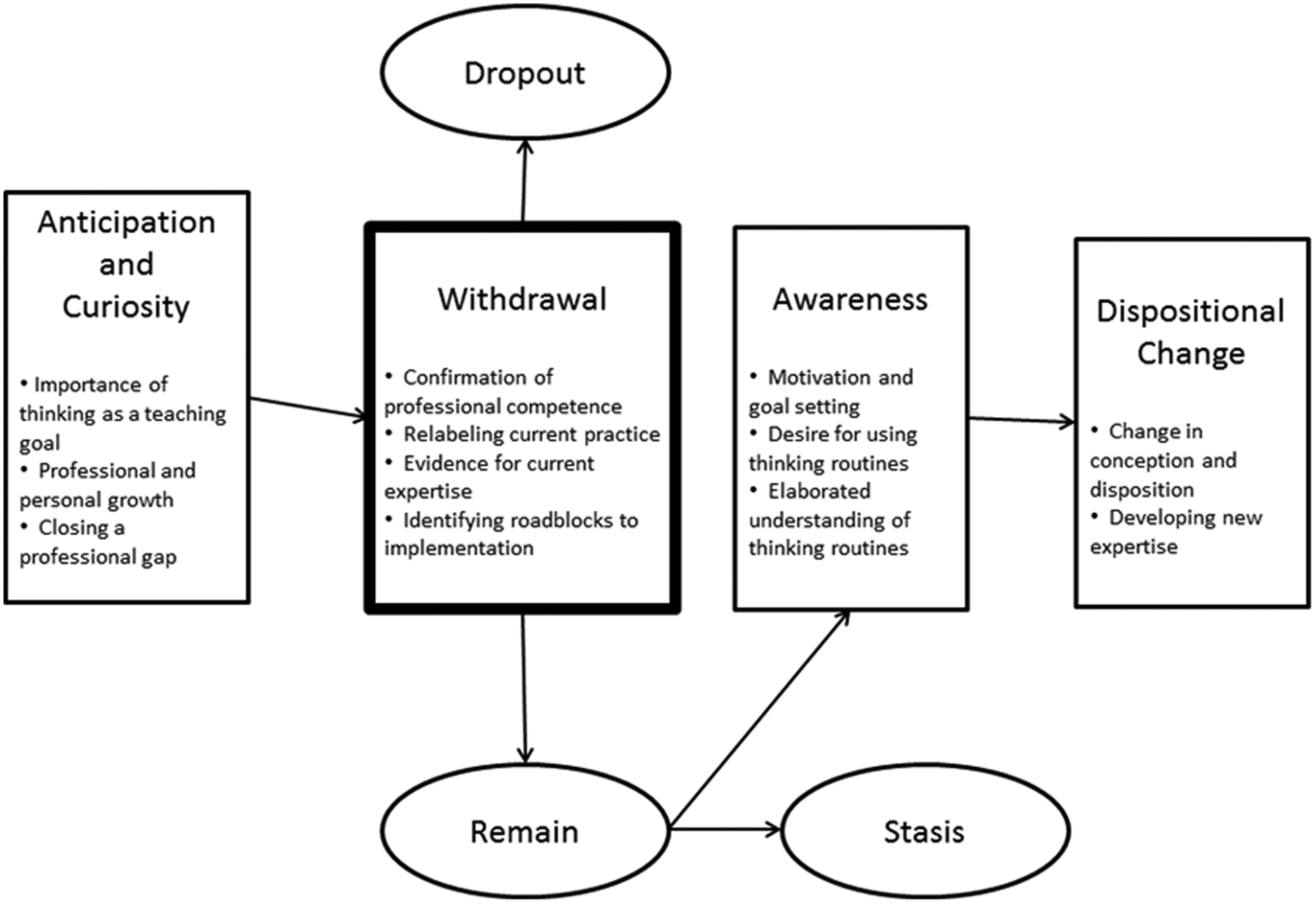
Dynamic four-stage model of personal professional trajectories
Although our previous studies examined separately the factors influencing professional development through group and individual lenses, the current study explores the interplay between group and personal professional development processes to better understand the interrelationship between the community’s formation and the individual participants’ developmental trajectories. Specifically, our research question is how do group and individual processes interact to enhance or impede professional development of teacher educators in a PDC?
Method and Data Sources
Context of the Study
The project consisted of three separate yearlong PDCs for teacher educators to infuse thinking into college-level teaching. The first phase of each PDC consisted of exposure to aspects of teaching thinking (Ritchhart et al., 2011). Initially, participants explored current theories in thinking education, read research and case material from the field, and explored possible implementations in their own courses in a variety of disciplines. In the second phase, participants were expected to incorporate thinking education into their college teaching by including thinking skills (Presseisen, 2001), thinking frames (Perkins, 1986), thinking routines, and the language of thinking (Ritchhart, 2002). The teacher educators documented these teaching experiences for the group as a basis for analysis and collegial discourse. The process encouraged the application of new pedagogies and nurtured interactive feedback. The final phase of the PDC consisted of joint investigation of the pedagogy and practice of teaching thinking through group reflection. Over the year, we expected teacher educators to initiate changes in teaching methodologies. We did not observe or measure actual teaching in the college classrooms; rather, our findings indicate self-reported infusion of thinking in the college teaching as well as reflections indicating movement or stasis with regard to the development of thinking-oriented dispositions. In addition, the findings include documentation and artifacts of implementation, which the participants brought to the PDC.
Each of these PDCs met monthly for a total of 10 sessions of 2.5-hr duration at the end of the teaching day. Voluntary participants were recruited from a variety of academic departments and varied from year to year (see Table 1). Each PDC group was unique in its composition, though some teacher educators joined the project for more than 1 year. Out of a total of 20 participating faculty over the 3 years, 60% participated in a PDC for 1 year and 25% participated for 2 years. Over the three PDCs, there was a 16% dropout rate.
Academic Department of Participation Teacher Educators by Year
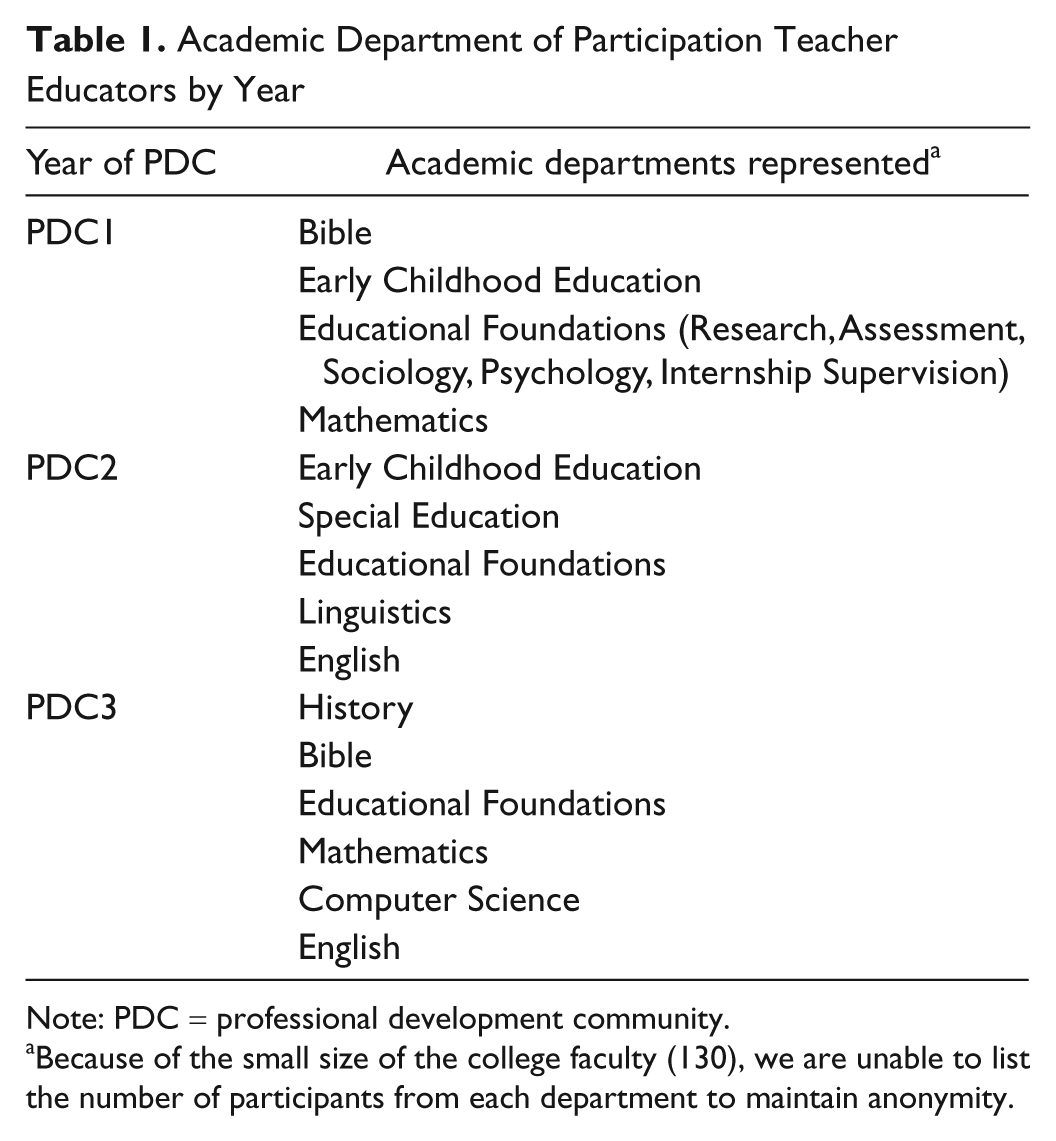
Note: PDC = professional development community.
Because of the small size of the college faculty (130), we are unable to list the number of participants from each department to maintain anonymity.
Both researchers took part in the PDC, the group leader being an outside expert in thinking education and the other a college faculty member who initiated the project and participated in the context of his own professional development. The group members agreed to all research procedures, and some read the research findings and our data interpretation. The positioning of the two researchers created an insider and outsider view on both community and individual processes.
A qualitative methodology was used to assess the PDC’s effects on how teacher educators dealt with the challenges of learning about new and innovative teaching practices as well as to understand individual professional development trajectories. Data were collected from three PDCs, each functioning over a 1-year period. These groups will be referred to by year: PDC1, PDC2, and PDC3. Both individuals and groups were monitored each year, using a variety of methods. A repeated interview design was used over each 1-year period, in which the interview protocol changed as the PDC process unfolded. Beginning of the year data collection served as baseline, and subsequent data were used to understand change.
Method of data collection:
Twelve educators (four in each project) were interviewed. The same four informants were interviewed at the beginning, middle, and end of each yearlong project to track changes over time (see appendix). Teachers in PDC1 and PDC2 were interviewed again 1 year after the project’s end. In addition, we conducted a group interview at each project’s conclusion.
Throughout these interviews, teachers were asked specifically to reflect on the influence of the PDC experience on their conceptions of teaching and on their actual practice.
At the final meeting of each project, the participants wrote reflectively about their yearlong experience, relating it to their conceptions of thinking education in theory and practice.
All sessions of PDC2 and PDC3 were recorded to provide evidence for dispositional change or lack thereof and to document teachers’ self-reported implementation. In PDC1, we maintained written records of the meetings. Realizing that these notes failed to document the discourse’s richness, we recorded all meetings in PDC2 and PDC3.
During PDC1, we asked participants to reflect verbally about the meetings, and we recorded these reflections in our written field notes. At the end of the year, we realized the value of these reflections for research purposes and for teachers’ own learning; therefore, we added a written reflective component in PDC2 and PDC3.
After each meeting, both researchers prepared field notes about the session as well as long-term project developments.
Teachers’ attendance at the monthly sessions was monitored.
Data Analysis Method
In our previous studies, data were analyzed qualitatively, identifying professional development processes and individual changes relating to thinking education. We used the form-based mode of analysis, which looks at the structure of the narrative material as described by Lieblich, Tuval-Mashiach, and Zilber (2004). This method investigates narrative meaning by tracking its development over time rather than focusing on content analysis. In our case, we investigated teachers’ professional development processes, including awareness of changes and steps taken toward adapting new methods rather than looking at how they actually infused thinking into their teaching, which is the content of the PDC. Concentration on aspects of form enables monitoring of development and change in professional development (Gergen & Gergen, 2000).
In the initial studies, grounded theory analysis (Strauss & Corbin, 2008) was used for open coding of interview data, generating preliminary categories. After abstracting these categories from the interviews, other data sources were analyzed using these same criteria. The final scheme for categorizing group processes and teachers’ professional development path was abstracted at a second phase.
In this study, we engaged in secondary analysis of our previous findings, identifying each layer of group formation as well as evidence of individual progress or regression in the various data sources. The basis for this analysis was a matrix with the group process layers on one axis and stages of individual development on the other. We then examined interview data according to group layers, searching for evidence of individual development within each layer. We copied into the matrix the relevant quotes as evidence of the presence of individuals’ trajectory stage according to the group layer. This process organized data of individual participants by group layer. We then synchronized these two bodies of evidence by tracking individual movement within clearly articulated layers of group formation. A close examination of these data sets enabled us to identify the interdependencies between group processes and individual development.
By mapping personal development within the phases of group formation, we were able to reveal how the two processes related to each other over the time line of each PDC. After locating those interactions, all raw data sets were reexamined to identify similarities, differences, and complementarities across and within the multiple sources. Trustworthiness was obtained by a dual method in which each of the two researchers independently engaged in this synchronization, followed by comparison and revision to achieve alignment. This process enabled us to understand the interaction between group and individual processes.
This methodology is illustrated in Table 2, which places group layers on the horizontal axis and individual trajectory stages on the vertical. Cells show characteristics of interaction between these factors. Empty cells represent trajectory stages that were not found present at particular group layers. The arrows within cells indicate influences on movement within the individual trajectories.
Interaction Between the PDC Group Model and the Personal Professional Trajectory Model

Note: PDC = professional development community.
Triangulation was achieved by corroborating incidences of individual and group development found in the interviews and group session transcriptions with other data sources. Quotes from interviews and meetings were identified to illustrate interactions between the two processes.
Findings
The four-layer group model of professional development within the PDC serves as a basis for reporting our findings. The PDC changed over time, as members interacted and the group moved from breaking isolation to change marked by adapting new dispositions. Although there is clear evidence that the group moved forward in supporting professional development, individuals followed their own trajectories, which although similar in sequence, differed in pacing and dynamics of progression and regression. Interdependencies between group process and individual movement along the trajectory will be documented, as each of the four group process layers will be examined in terms of individuals and their own trajectories.
A visual representation of the relationship between the two models is presented in Figure 3 and will serve as a reference for the findings presented afterward.
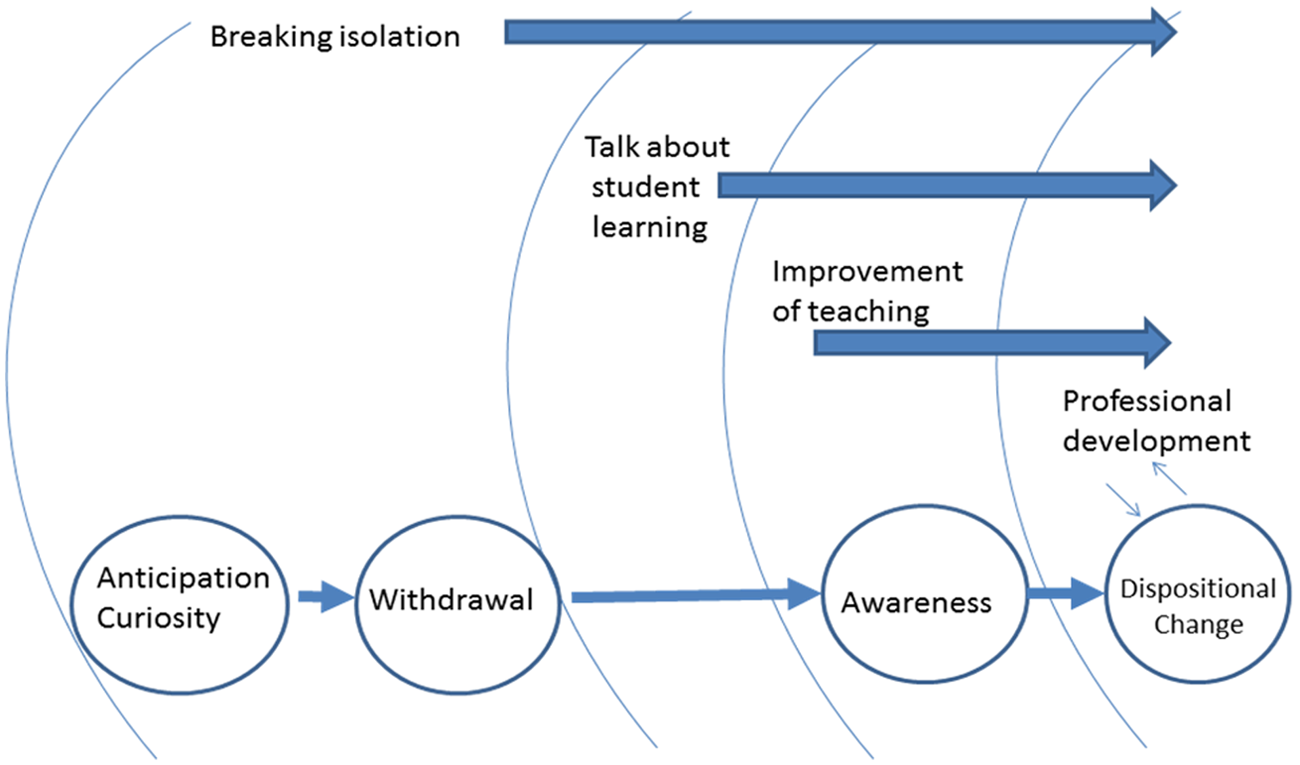
Relationship of the professional development community model and the personal trajectory model of professional development
In this figure, group development over time reveals the context in which individuals develop professionally along their own trajectories. Thus, the four layers of the group model represent fields through which individuals pass. These group layers occur consecutively and interrelate with individual progress and regression. The individual trajectory model is superimposed on these fields, with attention paid to the interaction between group and individual processes at particular points in time. For example, “talk about student learning” does not occur at the two initial trajectory stages, rather at the stage of awareness, and it continues to manifest itself through the stage of dispositional change.
Breaking Isolation
The phenomenon of breaking isolation was not only a motivating factor for teacher educators to join the group but also a benefit of participation in the PDC. This factor was found in all four stages of personal trajectories.
Breaking isolation in the anticipation and curiosity stage
Breaking of isolation was an integral part of the stage of anticipation and curiosity. Although participants were genuinely interested in learning about thinking education, they also held a social agenda. Some teachers joined the PDC because they had heard about it the previous year, when participation was limited by invitation, engendering a sense of exclusion. In the 2nd year when registration was opened, some joined due to the group’s prestige. We include the sense of exclusion in our definition of isolation, as it enriches our understanding of the different ways in which teachers experience separation from their peers. The teacher educators’ curiosity about professional development in the PDC connects the group process model, which begins with breaking of isolation, to the trajectory model, which begins with curiosity and anticipation. This touch point between the two models shows the dependence of one process on the other without manifesting a direct influence in either direction.
The connection between breaking isolation and initial curiosity can be seen in Rina’s first interview in which she explained her decision to join the group, partly because of its reputation. Her isolation is contextual, expressed by her separation from an important faculty activity.
I decided to join the group for a few reasons. First, I heard some very positive things about the group from last year; second, I was looking for a course and this one fell on the right day when I’m at the college anyway, and I connect to what I heard about this course.
Rina’s decision to join the group was motivated not only by her interest in the subject but also by what others said about it. This focus on the relational aspect of the PDC illustrates how the breaking of isolation was present as a factor from the outset.
Some participants understood their joining the PDC as an opportunity to connect with other faculty members. Talia describes her deep feeling of isolation in her initial interview.
I feel that many times I need feedback for what I’m doing. Because in my years of being a kindergarten teacher I am rather on my own. I don’t have any peers that I can consult with and who I can get feedback from. I don’t have a supervisor on a regular basis or a director, an administrative assistant, or a guidance counselor. I am rather isolated in (my) work.
She expected to break her isolation through meaningful discourse with teachers in the PDC. She added thoughts about becoming part of the group:
I also thought to myself, “Great, I will join this group of pedagogic supervisors, I will feel more connected . . . .” Actually I am an outsider to the college, so this will help me to feel more inside the academic faculty.
Breaking of isolation at the stage of withdrawal
Despite the salience of breaking of isolation, all participants entered the personal trajectory stage of withdrawal. Breaking isolation did not cause the shift into the withdrawal phase; however, it supported remaining there as some teacher educators formed alliances with others who were also comfortably situated in their own withdrawal. For these individuals, breaking isolation prevented emergence from withdrawal.
This alliance with other group members strengthened the teachers’ belief that they are already doing a good job and that their current practice reflects techniques taught in the group. Thus, teacher educators shield themselves from conceptual or dispositional change by reinforcing each other’s current practice. Rina illustrates this point in her insistence that the PDC failed to offer new teaching methods, a stance supported by her department colleagues, all of whom were found to move into withdrawal and remain there until the year’s end. Rina was absent at one meeting and reported from colleagues that no new ground was covered. The alliance she formed with teachers from her department prevented each of them from progressing, as they supported each other in withdrawing from the PDC’s goals. Her withdrawal is illustrated in the following quote:
In my case, as I have heard from others, it’s what I’ve been doing (in my class). The entire first half of the year I teach Bloom’s taxonomy from the viewpoint that you can’t teach in the classroom without developing thinking skills, even if it’s in special ed. What we teach is how we do this in different formats, and in every topic. I can’t say that the students love it. I can honestly say that I make it really interesting . . . There’s something very difficult about teaching the students this topic of developing thinking. When I came to this course I thought that there must be something beyond Bloom. I feel that these are the same things only with different terminology.
In reflecting on her experience in the group, Rina refers to her teaching in isolation, making no attempt to connect to the others’ practice or to their discourse.
Her criticism of dialogue in the PDC about experiences in trying out thinking routines expresses a mismatch between her own sense of purpose and her frustrations with the PDC: “The discussions come from all sorts of people who are engaged in all sorts of things with different emphases, and I don’t think that these discussions move us forward.” In contrast to her alliance with faculty from her department in the PDC, Rina does not allow herself to connect with other group members who are implementing activities that enhance students’ thinking. By forming alliances with some group members and closing herself to others, Rina maintains stasis in withdrawal. Interdependence between individual and group processes characterizes the formation of alliances that break isolation on the one hand and strengthen withdrawal on the other. In turn, the withdrawal of alliance members strengthens their breaking isolation.
Breaking isolation at the stage of awareness
Although breaking isolation in the group model does not account for individuals moving into withdrawal, it was found to play a critical factor for moving out of this stage into awareness. For example, Helen’s identification with the group became a major factor in her budding awareness of possibilities of using thinking routines. When she dropped out of the PDC in the 2nd year, she no longer maintained this awareness, thus reverting to withdrawal. When interviewed during this “dropout” year, she stated,
I know that I need a support group because when you work with a group it helps you to constantly think about it. You get encouraged, the excitement that passes from one to another, and I don’t have that this year.
Sandra participated in the PDC in the 1st year, dropped out in the 2nd, and then returned in the 3rd. Her statement about group support is indicative of her positive assessment of the group experience as a means of breaking isolation.
Just being in the group helps me to think about (teaching thinking) a lot, to try to implement it, where can we stick it in? The experience of being in the group, reading the article and hearing other people doing it . . . I forget about it if I’m not (part of the group).
The relationship between breaking of isolation and withdrawal is complex. As mentioned above, formation of new alliances reinforces withdrawal. In addition, the persistence of isolation and failure of individuals within the PDC to break their isolation can also lead to stasis within withdrawal. For example, Trudy never reached out to others in the group; rather, she maintained her distance as the only language teacher in the PDC. In this interview excerpt, she speaks about her own teaching, unable to connect to the flow of the group discussion or to identify methods for gaining empathy and mutual support.
Those are things that were done last year. I did them. Actually it seems to me that I did them 2 years ago. But now I feel their importance more. I am aware of them more, and actually I think that this is the most important thing that this course has given me. To see, to understand the processes of how thinking works . . . What I used to do intuitively is clearer to me. The stages are clear . . . and the broader perspective.
In contrast to Helen and Sandra who speak passionately about the importance of the group and thereby signal breaking isolation, Trudy maintains her isolation by ignoring group learning and focusing on her own nonlearning (Meijer & Oolbekkink, 2011). Sandra and Helen move into true awareness while Trudy uses the term awareness to refer to new understandings that elucidate her current practice rather than show consciousness of how to use new teaching skills. For Trudy, awareness seems to be a ruse for not changing her practice and for not opening herself to adapting new pedagogic opportunities.
Breaking of isolation at the stage of dispositional change
Breaking of isolation continued to play a crucial role in development along individual trajectories, including the final stage of dispositional change. Mandy showed considerable evidence of reaching genuine change by the middle of her 2nd year in the PDC. In an interview, she complained about other teachers focusing too much on themselves, showing a lack of sensitivity to group needs. This quote illustrates how breaking of isolation served as a critical factor for those who had reached dispositional change. When asked how the group helps her, Mandy answered,
It is definitely hearing everybody else’s reflection, hearing what it looks like in other fields . . . It forces me to think more about what this looks like for me . . . Sometimes I feel that we are all so enamored of our reflections. I should be more conscious of this. Reflection should really be of value to others in the group. It steals time because we don’t talk about the other parts (of thinking routines).
For Mandy as well as others in the PDC, breaking isolation not only supports awareness about teaching thinking but also serves as the basis on which dispositional change can occur. Breaking isolation paved the way for significant professional development.
Talk About Student Learning
After an initial breaking of isolation and a continued emphasis on this social aspect of the PDC, we found that teacher educators began to talk about student learning. Although such discourse was crucial in the later trajectory stages, we found no evidence of talk about student learning in the initial phases of curiosity and withdrawal. Its function was particularly salient at the transition from withdrawal to awareness, and then to change.
Teacher educators began to talk about student learning as they emerged from withdrawal to awareness. Although causality between this talk and the emergence from withdrawal cannot be established, it was clear that this discourse played a critical role in the transition. This role points to the complex interdependencies between the two processes. The discussion included examples of students’ actual thinking processes and activities in class, their difficulties with higher order thinking, and the teacher educators’ views about engaging students in thinking. In a PDC meeting, Mollie analyzed a student’s thinking in a history lesson.
I was sitting with a student today. They had to give three characteristics that were new for agricultural Zionist settlements in the first and second aliya (a historical phenomenon in Israel’s history). So she was saying something about the “disturbances” and . . . “naturalistic ideals” and she couldn’t see that she made no connection between the two.
Mollie’s talk about this student’s learning pushed forward the PDC discussion, as it contributed to her own awareness of how a thinking routine could have been used effectively in this problematic learning situation. After listening to advice from her colleagues at the meeting, Mollie continued,
This is why the strategy that we are trying to apply here is not to tell her, but to ask her, so it would force her to work the gray cells in order to try and deal with it . . . And I like that approach.
As teacher educators ventured forth from withdrawal to awareness, they experimented with various thinking routines. At the PDC meetings, they presented these attempts at integrating thinking into teaching. At this stage, two typologies became apparent. Some teachers remained in withdrawal and spoke solely about their own teaching of thinking, whereas others who were moving out of withdrawal spoke not only about their own development but also about concomitant student learning. These typologies are elaborated below.
Teachers talking about their own teaching
Linda’s presentation to the group of her activity illustrating talk about teaching rather than student learning exemplifies the first typology.
I teach a course about biblical language and the language of the sages, and in the framework of that class we speak about differences between biblical vocabulary and that of the sages, and we see that (when) there are words in biblical language with one meaning and in the language of the sages, they take on an additional meaning . . . The question is, why did this happen? Here I could have relied on requesting that the students try to ask themselves what are the differences between certain words.
Teacher talk about contextualized student learning
Sandra provides an example of the second typology involving talk about classroom activities as context for talk about student learning. Having used the thinking routine “claim, support, wonder” in a lesson based on biblical texts, Sandra noted how the structure of the routine influenced the students’ thinking.
No one has finished talking until they have gotten a chance to say all three (components of the thinking routine). Whenever someone says, “Ok I will say what I think then the others will understand . . . They had to be quiet, which is hard in this group. The culture of speaking was on a much higher level than in regular classes. They also wrote it and they had to react to each other, and it also made them focus much more on where they are getting that from. They like to talk and to throw claims in the air. They were very attentive and responsive, so when someone would give a claim relating to a different part of the story they said “We didn’t get to this yet.” And this came from them.
In this quote, Sandra uses talk about student learning both to understand the advantages of the thinking routine and to understand her students’ progress in learning how to think.
Teacher talk about the importance of student learning and thinking
As teachers moved along their trajectories from withdrawal to awareness, they utilized the online forum of the PDC to reflect on teaching thinking. These online discussions included a focus on how students responded to thinking routines as well as reflections on their expressions of higher order thinking or lack thereof in the classroom. For example, in an online forum, Sandra described using a thinking routine and then continued:
After that I passed out a sheet explaining the thinking routine and we read it together. One of the students pointed out that it is easy for the pupils to formulate expressions of “see” and “think” (part of the routine), but difficult for them to achieve “wonder” or a question about what they are thinking. I explained to her that she is absolutely correct—and this is one of the goals of teaching the development of thinking—to support thinking about thinking, to ask questions about what you really think, and about what others think—and to express it in a respectable fashion.
Along with these thoughts about student learning, the teacher educators expressed awareness of the importance of using thinking routines in teaching, couching their ideas in terms of talk about student learning. Their sharing of these experiences with colleagues became a catalyst for moving out of withdrawal into awareness. For example, in a PDC meeting, Mandy described a math class in which a student challenged the efficacy of the spiral curriculum, noting how the thinking routine promoted a high level of discussion. The following quote illustrates Mandy’s movement from withdrawal to awareness as her understanding of student learning underscores her insight into class discussions and the students’ reaching a higher discourse level.
My student was very much against this idea of the spiral curriculum and she couldn’t verbalize . . . she couldn’t dialogue with the teacher about it, and over the course of the discussion she finally (realized) that her assumption was that she views spiral learning as underestimation of the students . . . It wasn’t until this assumption was made visible that they could actually discuss it and they could come to see the reasoning behind a spiral curriculum. So there was nothing for them to reason about until they had the words, until it was out on the table. I think that thinking routines bring that structure. You know some people say that there is no thinking without words.
Dispositional change was achieved by only a few members of the PDC; however, several teacher educators showed signs of moving in that direction. Their talk about student learning enabled this transition to occur.
Improvement of Teaching
In the group model, the improvement of teaching followed breaking isolation and talk about student learning. Interest in improving teaching found expression in the first three trajectory stages. The interplay between this factor and each of the trajectory stages will be examined below.
Improvement of teaching and anticipation
Many teacher educators noted a desire to improve teaching by learning about thinking education, and this occurred during the initial trajectory stage of anticipation and curiosity. Although rhetoric about improving teaching is far removed from actually achieving the goal, this discourse motivated teachers to join the PDC. For example, Rhonda, an English teacher, saw such improvement as a primary reason for participation. She stated in an initial interview,
I would really like to get tools. If this is actually going to be a course which will sharpen my tools in terms of working with students—that’s one of my expectations. I’m always a very practical person. I want to know how I can take what is going to be done here and use it if indeed it is something different from what I have been doing up ’til now.
Rhonda dropped out of the PDC early on, as she entered withdrawal from engaging in the tasks of implementation. Therefore, the improvement of teaching that she initially spoke of was unrealized.
Improvement of teaching and withdrawal
A prevalent aspect of improvement of teaching at the withdrawal stage is the intentional choice of some teachers to learn more about thinking pedagogy by entering a moratorium from classroom implementation and from participating fully in PDC discussions. By taking a back seat, these teachers choose passive learning while gaining confidence through consolidating what they hear. These teacher educators decided not to actively try out new ideas before they learned more about them. In these cases, passive learning substituted for active change in practice. Talia exemplifies this approach.
The truth is I felt quite new on the staff, and I felt a bit of lack of self-confidence to bring my thoughts (to the group), to put them on the table. I think that on some level I made a mistake. I should have had more courage.
In the same interview, she spoke of later implementing thinking routines in her kindergarten class as well as with family members; however, she was unable to recall more than two incidences of using these routines in her college teaching. This delayed pedagogic change seemed connected to her self-imposed moratorium, which she used as a time to collect more information before reaching awareness and change.
Improvement of teaching and awareness
In contrast to Talia, Mandy emerged from withdrawal through talk about student learning. She moved to awareness by using thinking routines she had learned in the PDC. In the following quote, Mandy explains how acquiring tools actually improves her own and her students’ teaching. In this case, individual advancement contributes to the group’s progression, which points to the reciprocity of the relations between group and individual processes.
I feel like I am adding to my tool bag, right? I’m getting more and more ways to think about thinking . . . It works like this. (My students) learn a new routine and skill, something to try and they have an assignment to go and do it in the class. I consciously do it in the (college) class and it works sometimes.
Mandy is not afraid of failure; rather, she assiduously tries out new techniques in a persistent effort to improve her teaching. For her, acquiring teaching tools is important. As the group moves into the layer of improvement of teaching, Mandy is characterized by a high level of awareness of how thinking education contributes to her professional development. In the following quote, she explains how one thinking routine manifests itself in her teaching:
My brain keeps thinking about this thinking routine (“connect, extend, challenge”). I’ll find myself saying, “Oh, so how does that connect to . . . ?” And with all of the thinking routines I have trouble getting to the (stage of) “what comes next?” The challenge, the wonder, the question.
Her view of improving teaching relates to her awareness of a thinking routine’s potential, as well as her incomplete understanding. In this example, Mandy emphasizes the group’s influence on her awareness. This unrealized expectation has become a goal for her continued self-improvement.
Professional Development
The group and individual models coincide at the final stages, which are termed professional development in the group model and dispositional change in the individual trajectory paradigm. Both stages consist of acquiring dispositions for engaging in new and different strategies in college teaching. The spontaneous use of thinking routines was a valued goal for some teachers who were pleased to have achieved this level of functioning. For example, Mandy spoke of spontaneity in using aspects of thinking routines learned in the PDC.
Somehow in between the first time where I force it out and (at a later time when) it was very unnatural, and then I don’t think about it and it just starts coming out, and sometimes I keep trying it consciously, and I would say that trying it consciously it never works as well as when it comes out of my mouth (spontaneously).
Her vivid use of the mouth metaphor indicates her pleasure in having developed a disposition for using thinking routines naturally.
Some members of the PDC achieved change. Talia speaks of her personal learning in the group, relating to ease and comfort with the use of thinking routines. In a reflective interview summarizing her participation in the yearlong PDC, she comments retrospectively:
When I feel that something which I learn is relevant to me, it becomes a part of me. I can’t put it aside and think about it once in a while. It simply becomes a part of me, and it comes out. It comes out of me naturally because I went through a certain process and I thought that it was good and positive and I thought that it is truly helpful, so I pull it out automatically, without thinking about it beforehand.
Another manifestation of dispositional change is found in teacher educators speaking of their value orientations in instruction and learning. These expressions signaled paradigm changes in how teachers view classroom learning, including new realizations about student learning. Mandy exhibits such insight about mathematical thinking in the following quote from a PDC discussion.
As I am hearing you talk . . . I always ask myself, so what does it mean for math? But now after our discussion I think that I have changed my question to what does it means to learn? What does it meant when you know the derivative? How do students come to know what is it used for, beyond just the formula that they do?
Mandy’s paradigm shift extends beyond awareness; it is indicative of a disposition for broadening her definition of what it means for teachers to teach and for students to learn. This level of professional development is significant for her teaching practice. In a similar vein, Mollie expresses a priority for higher order thinking over shallow practice. In the following quote, she engages other teachers in the PDC in her own worldview.
I tell (my students) that I can help them with questions . . . Asking the question and looking for the answer, I really feel that it is much more important than the answer. Asking the question is a way to connect with the text or with whatever you are learning.
Moving from awareness to dispositional change is also accompanied by talk about student learning, as mentioned above. Mandy struggles with this transition, claiming that she began using thinking routines in a forced way. At some point, she began to see how thinking routines could enhance teaching. As she moved toward developing a disposition for incorporating higher order thinking in her teaching, she spoke about using thinking routines automatically, which signaled dispositional change.
It works like this. We learn a new routine and skill, something to try and they have an assignment to go and do it in the class . . . I never achieve what I wanted to achieve the first time that I try it, and then I get busy so I don’t remember to do it all the time, and then suddenly . . . in my brain I keep thinking about it. I’ll find myself saying, “Oh, so how does that connect?” (laughs) So somehow (I come to use it) between the first time where I force it out and it was very unnatural, and (a later time when) I don’t think about it.
The interaction between the group and the individual models is complex. As the group moves toward professional development, individuals progress toward dispositional change. Although advancement on both individual and group levels occurs, we see many reciprocal influences, touch points and interdependencies between the two processes, which point to the tight intertwining of the individual learner and the group within a PDC.
Discussion
This study is about professional development in a college community, showing the interaction between group and individual development processes. The data reveal stories of individual growth through group process and coalescence of the group into a community. Our analysis of the interaction between the PDC and individual trajectories of teacher educators explores community as a context in which teacher learning occurs. The added value of this study over previous research lies in the dynamic model of analysis of group and individual change. Earlier studies explored individual professional development, such as change in teacher beliefs (Meirink et al., 2010) and understandings of curriculum content knowledge (Shulman & Gamoran Sherin, 2004). These changes were characterized by their static nature, as each professional development endeavor was examined for outcomes. In contrast, our study monitors teacher change throughout the group process, a dynamic approach in which personal advancement and regression developed over time and were found to be interrelated with group processes. In addition, our study’s focus on learning among teacher educators brings to the fore the particular contexts of this population and their needs to grow and develop professionally.
Our findings show two processes that mutually support the other’s advancement. Individual teacher educators joined the group not only because it matched their personal goals for professional development but also because it initially provided opportunities to connect with other faculty based on shared concerns and visions. At subsequent stages in their personal development trajectories, the teacher educators moved toward dispositional change while being influenced and at the same time influencing the group processes. Talk about student learning is a group process correlating with movement on the trajectory toward dispositional change. We show how those interdependencies retard as well as advance professional development. These findings concur with the interactional viewpoint proposed by Wenger’s theory of social learning (Wenger et al., 2002), which presupposes a unidirectional approach of the group’s influence on the learner.
Our major finding is that various pathways through the professional development experience led to different outcomes. Although the desired goal is dispositional change toward thinking education, which meets the agenda of the course’s initiators, only some of the participants reached this end. Others remained in withdrawal, dropped out, or progressed and regressed into and out of awareness. Those who achieved change were found to have adopted a disposition for using thinking education techniques on a regular basis. Dispositions are an integral component of effective teaching (Dottin, 2010; Murrell, Diez, Fieman-Nemser, & Schussler, 2010). As Dewey (1916/1944) noted, “active habits involve thought, invention and initiative in applying capacities to new aims. They are opposed to routine which marks an arrest of growth” (pp. 52-53). This study identifies the antecedents and the prerequisites to achieving dispositional change, which are closely identified with habits as Dewey refers to them.
Although we initially considered the layer of breaking isolation as the first in a four-stage group process, we found this phenomenon to accompany the process of professional development from the beginning to the desired end of dispositional change. Consistent with other findings concerning learning in groups, the social context was a starting point for successive individual learning (Meirink, Meijer, & Verloop, 2007) and a supporting factor throughout the learning process (Wenger, n.d.). As seen in the findings, teacher educators sought to break their isolation by joining the group and then viewed this community as a major contribution to their ongoing learning and development. Previous research about communities of learners among teachers in school settings identified three primary outcomes: improvement of teaching, opportunities of personal professional development, and breaking isolation (McLaughlin & Talbert, 2001). In this study, breaking isolation is shown to be not only an outcome but also a driving force in teacher educators’ movement toward dispositional change.
Theorizing about the significance of professional community entails demonstrating how communities achieve their effects (Little, 2002). In our case, talk about student learning was a catalyst for the move out of withdrawal and enabled individuals to progress toward change. This discourse was the glue that held together collaboration and instructional improvement. When talking about student learning in a serious fashion, teacher educators were able to fully examine implications of their varied attempts to implement thinking routines.
Conclusion
To achieve dispositional change, participants in the professional development endeavor must be allowed to follow a rational and comfortable path toward change. For example, when initial anticipation and curiosity turn into withdrawal, the teacher educator may be seeking to maintain comfort. In this safe zone, some teachers establish a moratorium on innovation, consolidate what is already known, and passively learn new strategies. As the community engages in talk about student learning, individuals may choose to emerge from withdrawal into awareness by trying out newly learned teaching strategies, thereby moving to the next stage in group development: improvement of teaching. Although group processes maintain breaking of isolation through collaboration, individuals meet the challenges of continued innovation with unfamiliar teaching practices. Researchers and practitioners increasingly call for more collaboration to stimulate teacher learning (Jenlink & Kinnucan-Welsch, 2000; King & Newmann, 2000; Lieberman, 1996; Little, 1993; McLaughlin, 1997; Opfer & Pedder, 2011; Rosenholtz, 1989). Our study suggests that in some circumstances, individuals benefit from collaboration to encourage personal professional development, whereas in others, group cohesion inhibits development through alliances that strengthen withdrawal. This understanding expands on cohesion as a contributing factor, as reported by Meirink et al. (2009).
Such collaboration, however, involves much more than simply belonging to the group or engaging in verbal exchange while sitting around a conference table. It is a special kind of “sharing” (Little, 1990; Meirink et al., 2010) that entails talk about student learning. This sharing is a core process for enabling change among individuals in the community and shows the power of the community of learners to support significant professional development.
The PDC provides a means for individuals to extend their capacity to achieve desired teaching results, nurturing new and expansive patterns of thinking, voicing collective aspirations, and enabling teachers to learn how to learn together. These factors form a powerful composite that drives institutional advancement. Our focus on actual understandings and behaviors of teacher educators who choose to participate in a professional development project can help policy makers appreciate not only resistance to the adaptation of proposed innovations but also successful incorporation of innovation into teaching practice.
The major implication of this research relates to the mechanisms by which the group processes within a community interact with individual professional growth. For example, talk about student learning within the community breaks through resistance to change and enables teacher educators to move beyond their preconceived notions about their own practice. Safety within the community promotes attempts at implementation as teacher educators try out unfamiliar methods to improve their own teaching and report back to the group. However, the community can also nurture alliances based on collegial support for resistance to learning and professional growth. In our case, those alliances helped some participants to protect their existing practice against outside encouragement to change. Policy planners interested in the improvement of teaching through communal methods need to take into account the actual power of the community when it interacts with the individual learner.
Our study was conducted at a small teachers college with well-articulated professional development goals for teacher educators. Participation in the PDC was voluntary, as was attendance at meetings and implementation in the college courses. Thus, our community of learners was located within the context of a larger existing community within a defined college culture. In such circumstances, our findings may be limited to the particularities of this college culture and may not be applicable to situations in which teachers in higher education are required to participate in teaching improvement courses and in university environments that lack a professional development culture as described in this study. These characteristics of our research venue may limit the applicability of our findings to institutions of higher learning with different cultural contexts.
We have identified individual trajectories unfolding throughout the group process and have tracked differential development while paying close attention to salient factors in the interaction. Our understanding of individual professional development in the group context would be enhanced by further research focusing on the role of peer mentoring as a possible catalyst to promote individual development in the community and as a possible antidote to the powerful detrimental effect of alliances that support extended withdrawal. In addition, further research attention should focus on the nature of defense mechanisms to learning and the community’s role in their establishment. Moreover, future research could explore how group processes can help teachers overcome these defensive factors to strengthen their professional growth.
If we think of professional development as a process of coming to know, think, feel, and act on a desired change, then acquiring the disposition for the proposed change focuses our attention on how individuals put it all together—how they integrate new knowledge and skills into a coherent professional identity. To provide the conditions and learning opportunities that foster desirable professional dispositions, the field of teacher education needs a theory of disposition development (Murrell et al., 2010). This study provides an explicit discussion of how teacher educators develop dispositions expressed as particular habits of thought and action. Although previous research has identified important processes existing within professional development endeavors (Opfer & Pedder, 2011), they have not examined how those processes promote or hinder dispositional change. Moreover, the possible interaction between these processes was not considered crucial in achieving the outcome. Our focus on obstacles and opportunities afforded by the PDC in promoting those habits contributes to a deeper understanding of the interaction between group processes and individual trajectories. As such, this study provides a first step in developing a theory connecting the community of learners with the acquiring of dispositions for the improvement of teaching.
Footnotes
Appendix
Declaration of Conflicting Interests
The author(s) declared no potential conflicts of interest with respect to the research, authorship, and/or publication of this article.
Funding
The author(s) received no financial support for the research, authorship, and/or publication of this article.