




Abstract
We describe the process and outcomes of a project aimed at bringing together a set of diverse experts to generate a set of design recommendations for what should be considered when creating, sustaining, and assessing professional development systems to support the Common Core State Standards in mathematics. Although the recommendations were generated in mathematics, the underlying guiding principles for professional development are generalizable to other disciplines. As such, we discuss implications for professional development more broadly.
Many states are preparing for a landmark shift in expectations for students as the nation transitions to a more robust set of standards of what students must understand and be able to do for college and career readiness in today’s world. Such transition underscores the central role teachers play in ensuring student success in light of the new standards. As teachers lead the nation’s way into this new era, schools and districts are challenged to offer quality professional development at scale that provides teachers the opportunity to take charge of the change process. Positioning ourselves for this transition requires grappling with the question of how teachers are best supported to lead the nation and promote student learning.
The Common Core State Standards (CCSS) in English/language arts and mathematics, as these new expectations are known, grew out of a process led by governors, educators, and public school leaders to establish norms across states of how best to prepare students for the demands of postsecondary education and modern workplaces. This state-led effort was coordinated by the National Governors Association Center for Best Practices (NGA Center) and the Council of Chief State School Officers (CCSSO). The standards were designed to include rigorous content and application of knowledge through higher order skills, focusing on giving students a deep understanding of the most important concepts in the subjects they are studying.
The transition to the CCSS is both immediate—as it must be implemented in the next two years—and widespread—as it affects virtually every aspect of public school curriculum, instruction, and assessment. With new standards in place, assessment and curriculum are being developed to both push and support teachers. But without strong teacher engagement and preparation, the transition to the CCSS will bring more challenges and disappointments than actual changes. As Phil Daro noted, “At the end of the last mile on the journey from the noble intentions of common standards to the reality of students learning, our hopes are in the hands of the teachers” (Sztajn, Marrongelle, Smith, & Melton, 2012, p. 2).
To date, 46 states, two territories, and the District of Columbia have adopted the CCSS and have committed to fully implementing these standards in English/language arts and mathematics by 2014 to 2015, when new assessments of students’ knowledge and skills in these domains will be used. For many states, the adoption of the CCSS requires collaboration across systems and institutions of higher education, state education agencies, and community colleges to prepare teachers for the transition to the new standards and to focus on college and career transitions. In particular, regional collaborations will need to capitalize on existing partnerships to align expectations, provide quality education for preservice and inservice teachers/instructors in the implementation of CCSS, and to help ensure success for students. The CCSS provides an unprecedented opportunity for K-12 school districts, community colleges, and universities to increase the percentage of students prepared to succeed in college and careers, reduce the percentage of students who need remediation in college, and align high school and college curricula to better support student persistence and success.
As teachers lead the way into the new Common Core, professional development becomes integral to the successful implementation of standards. In fact, the implementation of the CCSS hinges on the success of professional development. As such, the response to the CCSS in English/language arts and mathematics and future standards initiatives in other disciplines must be fundamentally different from previous responses to standards. In particular, we must find concrete answers to questions such as “How do teachers position and prepare themselves to enact these new standards in ways that support the intended student learning outcomes?” and “What is the nature of the professional development needed for teachers throughout the nation to lead the way?” For too long, we have had pockets of success and excellence but have struggled to bring small-scale professional development projects to a larger scale. The time has come to figure out how to bring professional development to scale so that teachers across the nation can lead the movement and work together to ensure all students have the desired learning opportunities.
To address the question of what it will take to bring the pockets of excellence and success in professional development to scale, we undertook a project to initiate and support collaborative work in generating a set of recommendations that addressed the nationwide problem of needing to provide high-quality mathematics professional development at scale to support the implementation of the Common Core State Standards for Mathematics (CCSSM). We began with two assumptions: First, that for scalable professional development to exist, it is necessary to make sure current knowledge and research results from diverse fields are available to key stakeholders in the CCSS implementation process; and second, that collaboration across fields is necessary for researchers to answer the question of what are the best ways to bring mathematics professional development to scale to support the implementation of the CCSS mathematics content and practices. We were guided by the thinking that, to support practice, research results from diverse fields had to be articulated into a coherent framework and a set of recommendations, creating possible paths for successful large-scale, system-level implementation of mathematics professional development. We further considered that our assumptions about the work and the process that we undertook to generate the recommendations could be replicated in any discipline.
Our undertaking was unique in that brought together experts who, from their different perspectives, brainstormed solutions to the problem of delivering professional development at scale. These experts—representing practitioners as well as researchers from the fields of mathematics, mathematics education, equity, assessment, policy, and systems research—worked collaboratively to create a single set of design recommendations that should be considered when creating, sustaining, and assessing professional development systems. Issues of scale and scalability, in particular, are difficult issues to tackle whether in mathematics, science, or social studies professional development. It was clear that experts from the field of mathematics education alone could not provide the totality of expertise needed to tackle the massive professional development task ahead of the nation.
A three-phased approach was used to develop the recommendations. This process is described next, followed by a discussion about the recommendations, themselves, and then comment on the applicability of the process for other disciplines, policy development, and defining research directions.
Generating Recommendations
Phase 1: Building on Results and Gathering Experts
Our work of initiating and supporting collaboration among scholars from diverse fields to generate a set of recommendations for professional development was guided by three questions:
How can current knowledge from existing research be best used to design and deliver high-quality, effective mathematics professional development at scale, addressing both the CCSSM content and practices?
How can different fields of knowledge such as mathematics, mathematics education, policy studies, and systems research contribute to addressing the emergent national need of providing high-quality, effective mathematics professional development at scale?
What are meaningful ways of assessing the progress in implementing high-quality professional development and systematically communicating that information to providers?
In short, the problem that we set out to solve was how to provide high-quality mathematics professional development at scale to support the implementation of the CCSSM into a set of recommendations for what should be considered when creating, sustaining, and assessing professional development systems.
We recognized that the research on professional development design features was robust and provided a sensible starting point for our work. In fact, there is general agreement across different content domains on the features of effective professional development (e.g., Desimone, 2009; Elmore, 2002; Guskey, 2000; Guskey & Yoon, 2009). This agreement served as a basis for generating professional development design recommendations, offering four research-based principles as a starting point for designing professional development (Darling-Hammond, Wei, Andree, Richardson, & Orphanos, 2009). These principles state that professional development should (a) be intensive, ongoing, and connected to practice; (b) focus on student learning and address the teaching of specific content; (c) align with school improvement priorities and goals; and (d) build strong working relationships among teachers. These general principles were not developed specifically for mathematics professional development and, as such, can readily be used as a foundation for thinking about system-level professional development in other content areas such as science, history, and English/Language Arts.
With the design principles from Darling-Hammond et al. (2009) in hand, we selected a group of experts to work through a set of activities intended to integrate various perspectives on the problem. Participants were selected because of the contributions their specific knowledge within their fields could make to mathematics teacher education. All invited participants submitted a two-page brief prior to coming together, in which they (a) described, based on their expertise and knowledge of research, what it would take to design, implement, or assess the quality of mathematics professional development that would support the implementation of the CCSSM content and practices; (b) described, in some detail, one idea they had for how professional development could be done at scale (i.e., with a whole district or entire state) to support the implementation of the CCSSM; and (c) identified a small number of articles that influenced their thinking.
The collection of briefs generated through this process provided the basis for the ideas to be discussed and synthesized over a 2-day, face-to-face meeting of all experts. Representatives from five national professional organizations whose missions address aspects of mathematics teachers’ professional development (Association of Mathematics Teacher Educators [AMTE], Association of State Supervisors of Mathematics [ASSM], Mathematics Association of America [MAA], National Council of Supervisors of Mathematics [NCSM], and National Council of Teachers of Mathematics [NCTM]) were also invited to participate in the 2-day, face-to-face meeting, but were not asked to write briefs.
Prior to the face-to-face meeting, all meeting participants, including the professional organization representatives, were assigned to mixed-expertise small groups and received all the two-page briefs written by members of their small groups. They were asked to carefully read the set of briefs prior to the meeting and identify common recommendations for professional development as well as conflicting points of view. Participants were expected to come to the meeting prepared to engage in conversations among researchers and practitioners with diverse perspectives.
Phase 2: 2-Day Meeting of Experts
Researchers and practitioners came together for a 2-day meeting, held at the Friday Institute for Educational Innovation, North Carolina State University, Raleigh, North Carolina. The meeting convened approximately 40 research experts, as well as representatives from participating professional organizations (AMTE, ASSM, MAA, NCSM, and NCTM), the U.S. Department of Education, and the North Carolina Department of Public Instruction. The event was designed to allow for considerable interaction between participants.
On the first day, meeting participants met in their mixed-expertise small groups to brainstorm, elaborate, prioritize, and finalize recommendations. The use of groups with mixed expertise was important at this point because it allowed researchers to embrace the various perspectives present at the meeting and carefully consider what each field of knowledge could contribute to the generation of recommendations for professional development at scale.
Each group was asked to create a list of recommendations and, ultimately, to comment on the recommendations produced by other groups. Groups were encouraged to look for similarities and differences across recommendations and to identify recommendations that seemed particularly important. In addition, participants were asked to consider the extent to which their recommendations were applicable to working at scale and the extent to which their recommendations specifically supported the CCSSM.
To conclude events of the first day, Dr. Michael Lach (special assistant in science, mathematics, engineering, and technology education at the U.S. Department of Education) and Dr. Dan Heck (senior research associate at Horizon Research) were asked to provide commentaries. The purpose of the commentaries was to help participants consider the challenges of the work in which they were engaged as well as the importance of the work in changing the status quo. Specifically, Lach and Heck reminded participants about the need for building capacity in providing professional development, the need to develop the teaching profession and not just teaching professionals, the fact that money is spent on professional development every year with no clear effect, and the fact that thinking of professional development as a system would require a fundamental change in perspective. The floor was then opened to participating experts and other meeting observers to share their thoughts, comments, and questions in a public forum. Some issues that were raised during the open discussion included an observation that the groups’ recommendations were easy to agree with, but that it was difficult to distinguish the most important recommendations; a reminder that the work of teaching and professional development must be reconceived to embed professional development in classroom teaching; a question about the motivation for teachers to change their practice and how the CCSS can tap into teachers’ motivation to change; and a reminder that implementation of large-scale professional development is complex and involves organizational components, resource systems, and institutions that need to cooperate. The issues raised during the open discussion encompass thinking broadly about how all professional development in a school, district, or state is coordinated and carried out. These comments challenge professional development providers across content areas to consider how to come together to share resources, strategies, and research.
On the second day, the meeting began with a synthesis of emerging issues from the previous day. The group was challenged to think about how recommendations made the previous day could be made more specific to the new issues raised by the CCSSM, and the challenge of implementing the CCSSM-focused professional development programs.
Unlike the groupings on Day 1, which, by design, brought participants with different perspectives together, the intent of Day 2 was to give participants with similar expertise an opportunity to review the emerging recommendations from their professional perspectives. Therefore, participants were grouped by areas of expertise and asked to prioritize recommendations and consider how the recommendations would be useful to their peers. Recommendations that emerged from these similar-expertise groups were then shared and discussed with the entire group.
A panel presentation by the representatives from the participating professional associations followed. Each representative shared the perspectives about and current activities related to professional development and the CCSSM as they related to each organization’s constituents. The meeting concluded with a final discussion and Q&A session.
Phase 3: Follow-Up Work and Generating the Recommendations
After the meeting, recorders who had been assigned to small groups during both meeting days prepared a summary of the major discussion points from their groups, as well as a list of issues discussed in the groups, but not included in the final list of recommendations. They also compiled the recommendations that were listed in each of the group posters from the first day, indicating the extent to which each group viewed the recommendations as important. Recommendations from the second day were also compiled in a list.
Drawing on these materials, the project “Principal Investigators” analyzed the recommendations and organized them into categories, first individually and then collectively, looking for emerging common themes and categories among the work of the various groups. After a cycle of creation and refinement, the Principal Investigators crafted a set of initial recommendations that included a research-based elaboration and a set of specific action steps for different actors in the educational system. The initial recommendations were sent to all project participants, who were encouraged to send feedback and suggestions to the Principal Investigators. In addition, four participants with different areas of expertise were invited to provide a more detailed review of the recommendations, answering a set of specific questions. The final set of nine recommendations resulted from the analysis of the feedback and detailed commentary. This set was then sent to the partner professional associations for their final comments and was reviewed one more time to address potential issues raised by representatives from the professional associations.
Overview of Recommendations for Professional Development Aligned With the CCSSM
The above-described work generated nine recommendations intended to support large-scale, system-level implementation of professional development initiative aligned with the CCSSM. These recommendations emerged from the work done by experts from diverse fields who collaboratively addressed the challenge of providing high-quality mathematics professional development at scale to support the implementation of the CCSSM. Generated from the coordination of research-based knowledge in different but related fields, these recommendations build on state-of-the-art research findings from mathematics education, professional development, organizational theory, and policy. The process used to generate these recommendations can be replicated to address system-level professional development in a variety of content areas. Figure 1 displays the recommendations that were generated as a result of the process of bringing together various experts. In the following section, we discuss some of pertinent recommendations in more detail.
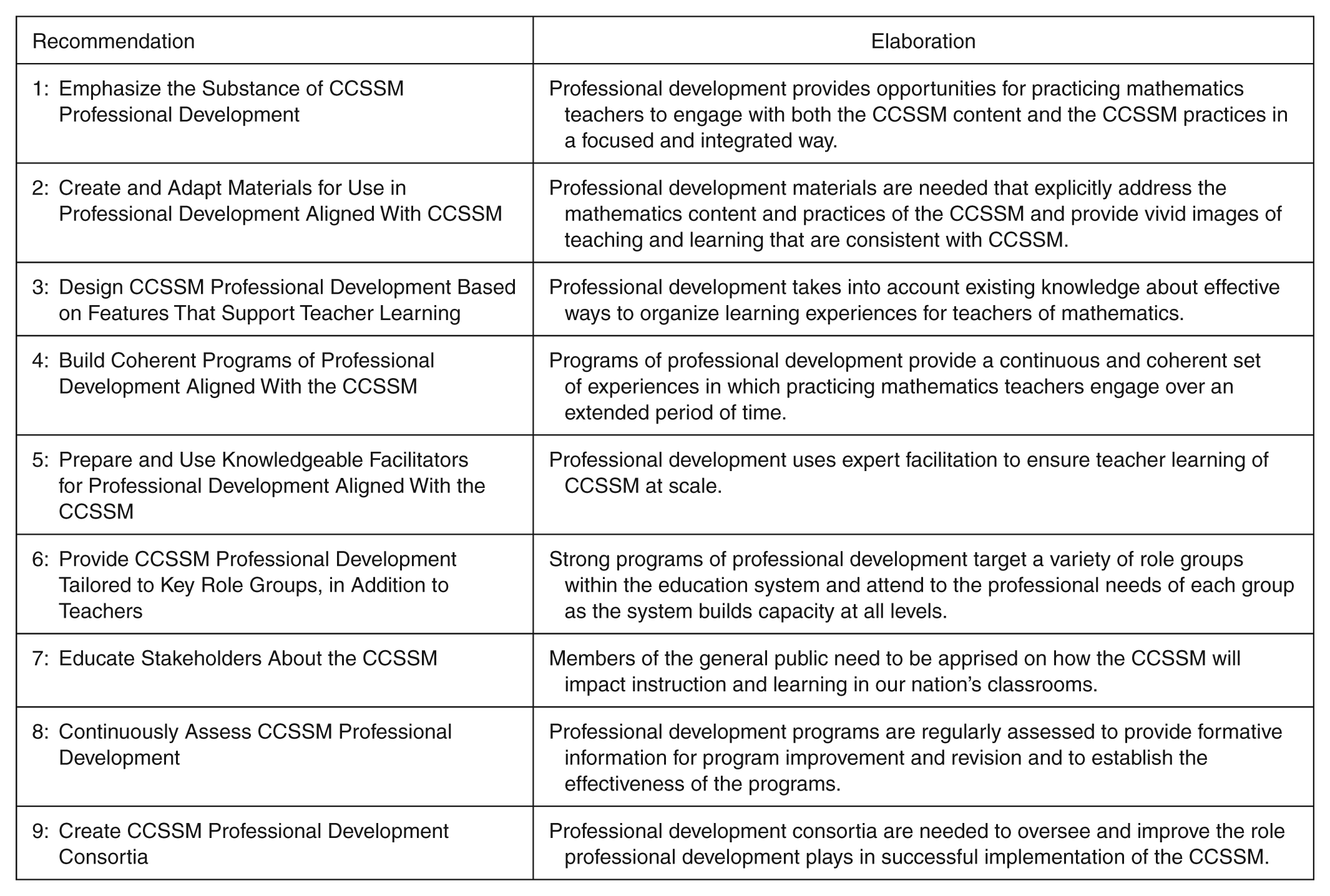
Recommendations for professional development supporting the implementation of the CCSSM
Recommendations Elaborated
The recommendations were elaborated with expanded descriptions and suggested action steps for different constituents (e.g., teachers, district- and state-level personnel, funding agencies) in a report of the work that was subsequently published on the NCTM website (Sztajn et al., 2012) and disseminated through the five partner professional organizations. We now highlight a few of the specific recommendations, with an eye toward what makes the recommendations mathematics specific and how the recommendation might be adapted for other content areas. 1 We first highlight Recommendation 3: Design CCSSM Professional Development Based on Features That Support Teacher Learning. We begin with this recommendation to showcase both how the recommendation can be applicable to fields beyond mathematics and how, though the elaboration of the recommendation, we capitalized on mathematics education-specific research to tailor the recommendation to the mathematics education community. Next, we discuss three recommendations (Recommendations 7, 8, and 9) that are the most broad based and also present particular implementation challenges.
Recommendation 3: Design CCSSM Professional Development Based on Features That Support Teacher Learning. This recommendation states that professional development aligned with the CCSSM takes into account existing knowledge about effective ways to organize learning experiences for teachers of mathematics.
Substantial evidence has been amassed about features of professional development that make certain initiatives more effective (e.g., Darling-Hammond et al., 2009; Garet, Porter, Desimone, Birman, & Yoon, 2001; Guskey & Yoon, 2009). These features include the following: Professional development should (a) be intensive, ongoing, and connected to practice; (b) focus on student learning and address the teaching of specific content; (c) align with school improvement priorities and goals; and (d) build strong working relationships among teachers. Whereas two of these features were highlighted in Recommendations 1 and 2 due to their importance (emphasis on substance of professional development and connections to teaching practices), and the design of professional development that supports the CCSSM takes into account all other features that relate to the ways in which professional development promotes teacher learning, such as offering a substantial number of professional development hours, spreading these hours over time, aligning the professional development goals with school improvement priorities, attending to student learning, and fostering strong working relationships among teachers.
Features of effective professional development do not prescribe the means through which professional development is delivered. Using a variety of delivery mechanisms to make professional development available to teachers assures that such initiatives fit a myriad of teacher schedules and working conditions. Combinations of summer and year-round work, face-to-face and virtual meetings, job-embedded and course-based activities, within-school and outside-of-school experiences allow professional development to be compatible with teachers’ time and availability.
Recent research indicates that although necessary, these features alone many not be sufficient to affect instruction (Garet et al., 2010; Garet et al., 2011), suggesting that professional development in support of the CCSSM must also incorporate practices the field has begun to see as promising, such as attention to discourse (Chapin, O’Connor, & Anderson, 2009; Smith & Stein, 2011), development of high-leverage practices (Grossman et al., 2009; Lampert, Beasley, Ghousseini, Kazemi, & Franke, 2010), student thinking (Carpenter, Fennema, Peterson, Chiang, & Loef, 1989), formative assessment (Wiliam & Thompson, 2007), and cognitively challenging mathematical tasks (Smith & Stein, 1998). By focusing on practices that are directly connected to the work that teachers do in their classrooms, teachers have the opportunity to develop knowledge needed for teaching by investigating aspects of teaching itself.
Many of the features identified in the elaboration of this recommendation are not content specific: offering a substantial number of professional development hours, aligning the professional development goals with school improvement priorities, and fostering strong working relationships among teachers. These are all things that any professional development program, regardless of the content, should be doing and can be a starting point for similar recommendations in other content disciplines. There are, however, mathematics-specific recommendations along with the more general principles of professional development in this recommendation, such as attention to mathematical discourse and the use of cognitively challenging mathematical tasks. These aspects of the recommendation draw on mathematics education research to add specificity to the more general principles cited. We imagine that other disciplines, such as literacy, will be able to build on the general principles (e.g., offering sufficient number of hours of professional development) but replace the mathematics-specific principles (e.g., use of cognitively challenging mathematical tasks) with those components of professional development shown to be effective for literacy teachers.
We hope that sharing such processes and recommendations will encourage cross-discipline discourse and resource sharing. For instance, in our elaboration of Recommendation 4: Build Coherent Programs of CCSSM Professional Development, we draw on the mathematics education research of Cobb and Smith (2008), which shows that offering isolated professional development opportunities that are not articulated into a coherent program ignores the need for teachers’ experiences in professional development to logically build on one another so that teachers can accumulate knowledge over time. Although this finding was generated within a mathematics education research program, we think that such a result is a likely candidate to serve disciplines other than mathematics. Conversely, there are likely a number of professional development results in other disciplines that are applicable to mathematics, but to which we were not privy when we were developing this set of recommendations for professional development in light of the CCSSM.
In particular, three of the nine recommendations—Recommendation 7: Educate Stakeholders About the CCSSM, Recommendation 8: Continuously Assess CCSSM Professional Development, and Recommendation 9: Create CCSSM Professional Development Consortia—are easily transferred to other disciplines and are at the same time some of the most challenging to implement. A common theme that emerged in the meeting of our experts was that stakeholders outside of the educational system, such as politicians, business partners, and industry representatives, must be apprised of how mathematics teaching will be transformed as the CCSSM is implemented. In particular, parents need to understand what their children are working on in school and be better positioned to support children’s learning. We strategically framed this idea as a recommendation for professional development, as we envision professional development not only to be directed toward teachers but also other school personnel (administrators, counselors, etc.) and members of the public.
From Recommendations to Policy: Researching CCSS-Focused Professional Development
Mathematics educators have had over two decades of experience with the implementation of standards for curriculum and instruction; we have much to share with other disciplines based on our long history supporting teachers in the implementation of standards and will continue to have lessons learned to share as we study the implementation of the CCSSM. A question that remains for us is how to ensure that this set of nine recommendations will have traction with district and state policy makers. We partnered with the NCTM to publicize the recommendations and provided links to the recommendations on high-traffic CCSSM websites (e.g., McCallum, 2011). Yet, the question still remains: “Have districts and states changed their approach to providing professional development as a result of these recommendations?” We do not yet know the answer to this question. What we can offer are suggestions for practice and policy changes that can be made to incorporate these recommendations.
Universities must reexamine how they offer professional development that is aligned with Recommendations 1 to 5. The current “business as usual” at most universities involves individual faculty offering boutique professional development programs, often grant funded, to K-12 teacher volunteers. Universities need to consider how to partner with K-12 districts and state education agencies to create new paradigms of collaboration and support.
Teacher educators, teachers, and administrators must advocate for a policy agenda around these recommendations that includes state-level leadership. This might include framing the agenda in terms of college and career readiness for students, closing the achievement gap, or providing effective teachers for all learners.
Universities, school districts, and state education agencies must reenvision how to use technology to connect teachers, especially in remote areas, and involve them in professional development experiences aligned with these recommendations.
Universities and school districts must advocate for state and federal resources that allow for the research and evaluation of professional development programs aligned with these recommendations.
Developing teachers’ capacity to enact new standards in ways that support the intended student learning outcomes will require considerable changes in mathematics instruction in our nation’s classrooms. Such changes are likely to occur only through sustained and focused professional development opportunities for those who teach mathematics. The recommendations generated through this project provide a first but important step in setting the agenda for what needs to occur to make this a reality.
As these recommendations are enacted, we need to study what works and what does not. A recent plan for researching the influence of the CCSSM calls for studies of how teachers respond to the CCSSM and professional development related to the CCSSM, and how states and districts respond to the CCSSM (Heck, Weiss, & Pasley, 2011). Based on our experience developing the recommendations, we suggest the following issues are the most timely to study and the results of which can inform a wide range of disciplines:
Policies that promote professional development consistent with the recommendations. We know little about local or state policies related to the Common Core State Standards, and, in particular, professional development policies that support teachers in the implementation of the CCSS. Although scholars are studying effective practices associated with bringing professional development to scale (e.g., Borko, Koellner, & Jacobs, 2011), research must also address policies that guide the development of professional development opportunities. For example, how do states and districts make decisions about which professional development opportunities to offer? How do these policies differ in local control versus centralized control states? How are professional development programs judged as effectively addressing the CCSS by decision makers? What mechanisms support states sharing information about effective professional development now that the majority of states have adopted the Common Core State Standards in mathematics and English/Language Arts? What can we learn from other countries, which have longer histories with common standards, about the way their policies affect teacher professional development? Such questions about the policy context are important to understand so that effective professional development programs can be scaled up.
Barriers to scaling up high-quality professional development aligned with the recommendations. Knowing what makes professional development effective is only one part of the work. The other side is knowing what prevents high-quality professional development from being implemented at scale. Thus, understanding how to bring effective professional development to scale involves a whole set of unique research questions: What forms of professional development are most scalable? How do you adapt the features of effective professional development for scale? What roles do school- and district-level leaders play in supporting professional development at scale and what happens when these roles are not enacted? How does work in remote locations affect access to professional development and how can teachers in these locations be supported and reached? Are certain components of effective professional development systems placed in jeopardy when scaling up programs to greater numbers of participants?
The role of emerging technologies in delivering high-quality professional development at scale. It is incumbent on the field to capitalize on emerging technologies in the design and delivery of effective professional development. Technology may address multiple aspects of scaling: cost, reaching isolated populations, and collecting real-time assessment information. Dede, Ketelhut, Whitehouse, Breit, and McCloskey (2009) presented some advantages of online professional development such as fitting teachers’ schedules, drawing on powerful nonlocal resources, opportunity for asynchronous reflection, and increased contributions by participants who might be quiet on face-to-face environments. However, they also noted that more rigorous research in the area was needed, particularly research that focused on teacher learning in these environments.
Models for partnerships to provide coherent programs of professional development. As increased attention is being paid to Schools and Colleges of Education and clinical practice experiences are being rethought to capitalize on university–school partnerships, universities must consider not only preservice education but also how coordinated support is provided to educators throughout their careers. Universities provide state-of-the-art learning experiences, aligned with the CCSS, for prospective educators, deploying them to the field with new knowledge of content and instructional strategies. We must study and disseminate models of universities partnering with state agencies and school districts to provide coherent, coordinated education to educators throughout their careers.
The role of classroom teachers and administrators in initiating and delivering professional development at scale. Teachers and administrators play an important role in delivering professional development at scale and we must better understand how they are prepared to facilitate and support the implementation of school-based professional development. There is an emerging body of research on mathematics leaders that begins to identify how to cultivate teacher-leaders to support instruction aligned with the CCSSM mathematical practices (e.g., Elliott et al., 2009). We must continue such lines of research and further these lines of inquiry to better understand what works, for whom, and under what conditions.
Studies of the implementation of high-quality professional development at scale. Heck et al. (2011) prioritized studying the effectiveness of professional development programs in enhancing teachers’ knowledge and skills and the connection to teaching practice and student outcomes for teachers in various contexts. We also need to reconcile results of research studies on professional development that are not convergent. For instance, Hill and Ball (2004) demonstrated that teachers can learn mathematical knowledge for teaching in summer institutes. Garet et al. (2011) showed that professional development programs can have all the characteristics of successful professional development yet not lead to significant improvements in teacher knowledge or student learning. While each study is provocative in its own way, we have no insight into what led to effective professional development in one case (Hill & Ball, 2004) and ineffective professional development in the other (Garet et al., 2011). We need studies that open the black box of professional development and provide rich descriptions of the nature of the work in which teachers engage that does or does not lead to improved knowledge, beliefs, or habits of practice.
The development of common standards of evidence for the effectiveness of professional development. How do we know when a professional development program is effective? What tools do we use to measure effectiveness in professional development? What is the right mix of outcomes (e.g., observed teacher practice, student achievement) to gauge the effectiveness of professional development programs? Looking at student outcomes alone is not sufficient to judge the effectiveness of professional development programs. Changes in student outcomes are not likely to happen immediately and thus will not provide timely data. Further, in addition to student outcomes, we need measures of teachers’ knowledge—“Did teachers learn what was intended in the professional development and has their practice changed so that it is more aligned with the CCSSM?”
In light of the CCSS and the Next Generation Science Standards, we urgently need to understand how to deliver high-quality professional development at scale: Who is involved in the delivery? What are effectively delivery models? How do current delivery models and funding structures change? The results of such studies will enable the field to refine approaches to meet the needs of teachers and their students.
The recommendations for supporting professional development aligned with the CCSSM focus on the important role that professional development plays in ensuring the successful implementation of standards. However, like making a major purchase such as an automobile, we know as consumers “caveat emptor”: buyer beware! Not all cars are created equally and there is great variation in the quality and performance of different cars. Likewise, not all professional development is created equally and we must ensure the highest quality of professional development is delivered to our nation’s teachers. The nine recommendations we developed for mathematics professional development seek to address ensuring high quality in professional development for mathematics teachers and doing so at scale. The process of starting from common, research-supported characteristics of high-quality, high-impact professional development and convening a diverse group of experts to weigh in on the necessary elements of scaling up professional development in support of common state standards is a process that can be replicated in other disciplines. We emphasize the importance of the diversity in the experts we convened; without a diversity of viewpoints and experiences, we would not have been able to produce recommendations with the scope and quality that we did. We also point out that developing and publishing recommendations is one step in the process of changing the way professional development rolls out in our nation’s schools and school districts. The next step is getting the recommendations into the hands of decision makers and policy makers, a task of considerable difficulty. Partnering with the professional organizations is one avenue to make progress, but more work remains. Our vision is a transformation of professional development across the nation and we hope that this vision can spread beyond mathematics.
Footnotes
Authors’ Note
Opinions, findings, and conclusions or recommendations expressed are those of the authors and do not necessarily reflect the views of the National Science Foundation.
Declaration of Conflicting Interests
The author(s) declared no potential conflicts of interest with respect to the research, authorship, and/or publication of this article.
Funding
The author(s) disclosed receipt of the following financial support for the research, authorship, and/or publication of this article: The work reported was conducted under the auspices of the National Science Foundation RAPID Grant 1114933.