




Abstract
Within the current federal, state, and local contexts of educational reform, teachers must be recognized as central actors in policy work, but rarely do we explicitly consider preparing teachers to become policy actors. Understanding these implications for teacher education, we investigate teacher candidates’ learning of the complexity and dynamism of educational policy through a field-based teacher preparation program. Situated across four unique school contexts in the diverse neighborhoods of Chicago, Illinois, we qualitatively study the cases of eight teacher candidates as they explore policy in practice. We found that candidates developed enduring understandings about policy as complex, situated, and multilayered, as well as the central role of the teacher. This learning was mediated by multiple facets of the field-based module, including readings, panels, and observations. Implications center on the use of field-based teacher education to support policy-related learning and development.
The early-21st-century educational policy landscape is fraught with debates causing divides within prekindergarten through Grade 12 (PK-12) and teacher education (Darling-Hammond, 2006; Labaree, 2010). From No Child Left Behind (NCLB) in 2001 to Race to the Top in 2009, federal policies have taken center stage in top-down efforts to reform American education (Duncan, 2011). Similar to the national level, stakeholders within states, districts, and schools have enacted policies in attempt to “fix” U.S. classrooms, typically situating the classroom teacher as the problem needing repair (Cuban, 2013; Datnow, Hubbard, & Mehan, 2002; Honig, 2006). State and local stakeholders have adopted teacher evaluation systems, which use observation data from instruments such as the Danielson Framework and student test scores to make high-stakes judgments related to teachers (Darling-Hammond, Amrein-Beardsley, Haertel, & Rothstein, 2012). In addition, many states have adopted the Common Core Standards (CCS) and standardized tests, such as those developed by Partnership for Assessment of Readiness for College and Careers (PARCC), to measure, evaluate, and compare school, teacher, and student performance (Briggs, 2011).
These macro-level policy shifts in PK-12 education, and the corresponding demands for teachers who can deliver quantifiable results, have given way to criticisms of teacher education. In response, some teacher education programs have pushed back against critiques (S. J. Ball, Maguire, Braun, & Hoskins, 2011; Ryan et al., 2014), whereas national organizations, such as the Council for the Accreditation of Educator Preparation (CAEP) and the American Association of Colleges of Teacher Education (AACTE), have encouraged particular reforms that prepare teachers for the complex demands of 21st-century teaching (AACTE, 2010; National Council for Accreditation of Teacher Education [NCATE], 2010). Both CAEP and AACTE have promoted field-based approaches to teacher education and the use of performance-based assessments, such as the Education Teacher Performance Assessment (edTPA) to assess candidates (AACTE, 2010; NCATE, 2010). These organizations, in part, have pressed for these measures due to critiques over the quality of teacher preparation programs from Secretary of Education Arne Duncan and the National Council on Teacher Quality (NCTQ; 2013), a high profile and self-proclaimed watchdog of traditional teacher education (Duncan, 2011).
Following the historical trend in the United States of situating the teacher as the passive target in educational reform efforts (Mehta, 2013), few of these policy discussions recognize the central and active role of the classroom teacher in implementing policy in practice (Hornberger & Johnson, 2007; Menken & García, 2010; Ricento & Hornberger, 1996). Instead, in the spirit of reforming American education, particularly in urban settings with high numbers of students from marginalized backgrounds, these top-down policies frame teachers as problem in need of fixing (Datnow et al., 2002; Honig, 2006). Nevertheless, as sociocultural theorists and researchers of educational policy have been asserting for two decades, teachers are not passive policy targets, but active policy agents who make daily decisions when implementing policy in practice in attempt to meet the needs of diverse students (Heineke & Cameron, 2011, 2013; Ricento & Hornberger, 1996; Varghese, 2008).
Despite growing attention in some academic circles about the central role of teachers in educational policy, few have made the connection between the PK-12 teacher as policy actor and teacher preparation (Heineke & Cameron, 2013; Labaree, 2010). In this way, key actors notably absent from these debates on educational reform are teacher candidates. More aptly stated, they are there, but merely talked about, rather than engaged in the debate. Recognizing the importance of teacher education in preparing effective teachers for the realities of contemporary classrooms, teacher education programs should mediate learning and development around teachers’ active roles in policy while engaging candidates in the policy dialogue (Darling-Hammond, 2006; Grossman et al., 2009; Zeichner, 2006, 2010). We utilize the term policy actor preparation to denote intentional, explicit instruction and supported field experiences to prepare candidates as effective, principled policy implementers, interpreters, and negotiators as part of their professional capacity. While teacher educators mediate this important facet of contemporary teacher learning, we must examine how candidates understand and engage with policy as they do the important work of becoming teachers (S. J. Ball, 2012). This is especially the case given that they will now enter a profession being fundamentally reshaped by policy initiatives, such as teacher evaluations tied to student achievement (Darling-Hammond et al., 2012).
Extant literature probes policy for teacher preparation, but not preparation for teachers as policy actors (e.g., Darling-Hammond & Baratz-Snowden, 2005; Wideen & Grimmett, 2013). Indeed, teacher education faculty acknowledge the need for candidates to know the history and sociology of education; typically disconnected from teacher education programs in a foundations course, policy-related learning remains university based with little reference to experiences in schools (Floden & Meniketti, 2005; Ryan, 2006). In times of high-stakes accountability at national, state, and local levels, we argue the need to research programs that integrate the central role of the teacher in educational policy (Darling-Hammond et al., 2012). This study addresses the dearth of research by examining the integration of policy in a field-based teacher education program. We begin with an overview of our program, followed by our framework for studying field-based teacher preparation.
Background: Teaching, Learning, and Leading With Schools and Communities (TLLSC)
Teacher education faculty of Loyola University Chicago’s School of Education designed the Teaching, Learning, and Leading with Schools and Communities (TLLSC) program to respond to the needs of schools and communities with the goal to prepare all teachers for all students (Ryan, Ensminger, et al., 2014). The product of 3 years of purposeful backward design (Wiggins & McTighe, 2005) including faculty spanning bilingual, early childhood, elementary, secondary, and special education, TLLSC was implemented in partnership with school and community leaders in 2013. Through a field-based apprenticeship model (Rogoff, 1995) across 4 years of undergraduate studies, candidates progress through three developmental phases with scaffolded experiences teaching and learning with diverse students in urban schools. In this model, candidates do not engage in university-based coursework, followed by separate and distinct field experiences. Instead, the field-based teacher education model engages teacher educators, teachers, and candidates in integrated professional learning as embedded in classrooms, schools, and communities. In this way, the coteacher educators (e.g., university faculty and classroom teachers) collaborate to apprentice candidates in field-based modules using interconnected course-based discussion and field-based experiences in urban schools.
Serving as the culminating experience of the beginning phase of teacher development, Sequence 3 engages first-semester sophomores in field-based learning in elementary and high schools in diverse communities in Chicago. Sequence 3 is a semester-long experience titled Policy and Practice in Urban Schools. It brings together two clinically embedded modules (courses) and a summative assessment where candidates explore how macro-level policies manifest in practice in urban classrooms (Table 1). The sequence begins with the macro lens of educational policy (e.g., language policy historically at federal, state, and district levels) and ends with the micro lens of current students in classrooms (e.g., English learners or ELs). As the modules shift in focus from broader policy to classroom practice with diverse students, the experiences emphasize the connection between all layers, processes, and actors in the educational system—specifically highlighting the central role of the teacher in decision making and advocating on behalf of diverse children (Ricento & Hornberger, 1996).
Policy Module Curriculum.
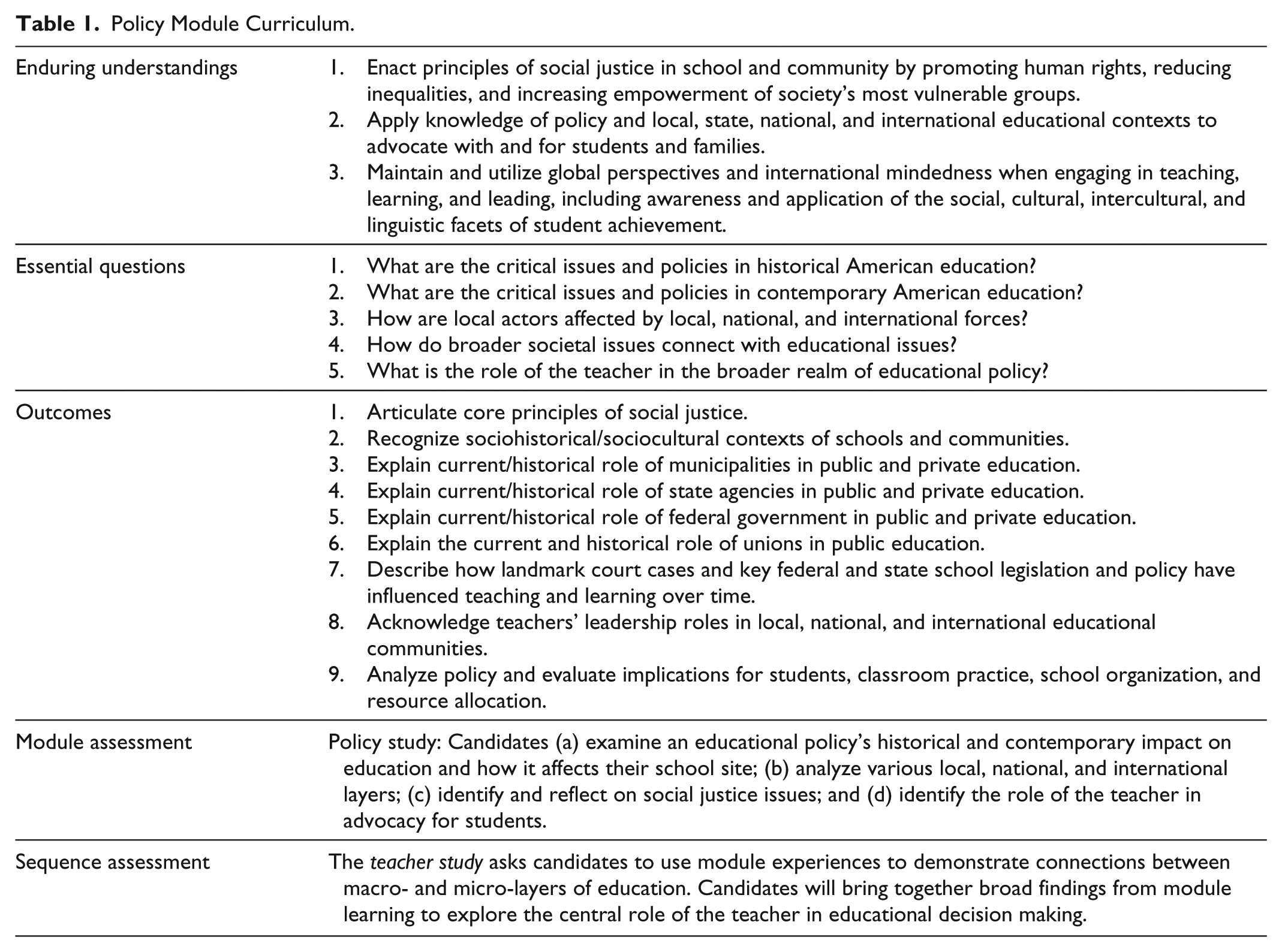
To begin Sequence 3, candidates engage in the 4-week module titled Educational Policy for Diverse Students. This module focuses on the policy and practice in urban classrooms by addressing multiple perspectives on diversity, including students’ backgrounds (e.g., culture, language, ability) and classroom and school contexts (e.g., bilingual education, special education). With all experiences taking place in urban school settings, the module first engages candidates in looking at the range of policies teachers engage on a daily basis and then directs candidates to examine how specific policies manifest within the local context. The specific policy sets include special education, bilingual and EL, and curriculum standards such as CCS and International Baccalaureate (IB; Ryan, Heineke, & Steindam, 2014). In this way, co-teacher-educators partner to support candidates in (a) defining policies, laws, and court cases pertinent to urban education; (b) recognizing how policies are enacted into practice to support students; and (c) making suggestions on ways to improve achievement of diverse students.
Following the first module is an 8-week module titled Individualized Instruction for Diverse Students, which centers on student case studies utilizing authentic assessments. In the final weeks of the semester, candidates participate in professional learning communities and complete a summative assessment to bring together, reflect on, and apply learning. Through completion of the Teacher Study, the summative assessment for Sequence 3, candidates synthesize and apply learning from the two case studies done in the modules in the sequence (i.e., policy, students) to demonstrate connections between macro- and micro-layers of education. Candidates bring together broad findings from each study to explore the central role of the teacher in educational decision making (Ricento & Hornberger, 1996). Through these strategically designed experiences for first-semester sophomores, the field-based modules and summative assessment provide candidates early exposure to urban schools, diverse students, and the role of the teacher as advocate.
Framework for Studying Field-Based Teacher Preparation
Sociocultural theory recognizes the co-construction of knowledge through participation in social and cultural activity (Rogoff, 2003; Vygotsky, 1978). First, this paradigm recognizes the biological and social nature of learning where an individual’s development is facilitated by interaction and higher level thinking with more-advanced peers (Vygotsky, 1978). Second, as cultural processes both define and are defined by individuals, an individual’s development and learning “must be understood in, and cannot be separated from, its social and cultural-historical context” (Rogoff, 2003, p. 50). Applied to the study of field-based teacher preparation, we perceive candidates as actively involved in their own learning, simultaneously impacting and impacted by social interaction with others and the specific settings where learning occurs (Grossman et al., 2009). Candidates, such as classroom teachers, school leaders, and other educational actors, actively change their involvement, including their understanding of and responsibility for various school-based activities and practices. Through this process of appropriation (Levinson & Sutton, 2001; Rogoff, 1995), candidates interpret and make meaning of educational policies and practices based on their local contexts and using personal histories, experiences, and backgrounds (Datnow et al., 2002).
Grounded in sociocultural theory, we utilize the conceptual framework for teaching practice (Grossman et al., 2009) to support our investigation into field-based teacher learning. Focused on educational policy in practice, a three-facet conceptual scheme provides specific ways to approach professional learning: (a) representations of practice, (b) decompositions of practice, and (c) approximations of practice (Grossman et al., 2009). Representations of practice ask candidates to passively probe and understand professional practice, such as reading about a school reform effort. Decompositions of practice allow candidates to consider the smaller elements that encompass the complexity of authentic teaching and learning, such as observing and discussing modifications for ELs. Approximations of practice engage candidates in actual practice with a particular aspect of teaching (Grossman et al., 2009). Recognizing all three as pertinent to preparing teachers, we use this conceptual scheme to make meaning of teacher learning in the school-based setting, specifically how candidates represent, decompose, and approximate learning around educational policy in practice.
In this study, we utilize sociocultural theory (Rogoff, 2003; Vygotsky, 1978) and the conceptual framework for teaching practice (Grossman et al., 2009) to investigate how field-based teacher preparation supports candidates’ evolving understanding and learning about the complex, situated, and dynamic nature of educational policy in practice. We utilize two research questions to guide our study:
In the next section, we share the qualitative methods of data collection and analysis to support the holistic multiple case study (Yin, 2009) to make meaning of field-based teacher learning around educational policy.
Method
We conducted this study in fall 2013, the first semester of the TLLSC program. Sequence 3, the first semester of the sophomore year of the 4-year program, was housed in urban schools on the north side of Chicago. In this way, we situated teacher learning in four unique school-based contexts, including one Catholic school and three public schools, ranging from PK-12 (Table 2).
School-Based Contexts for Teacher Learning.
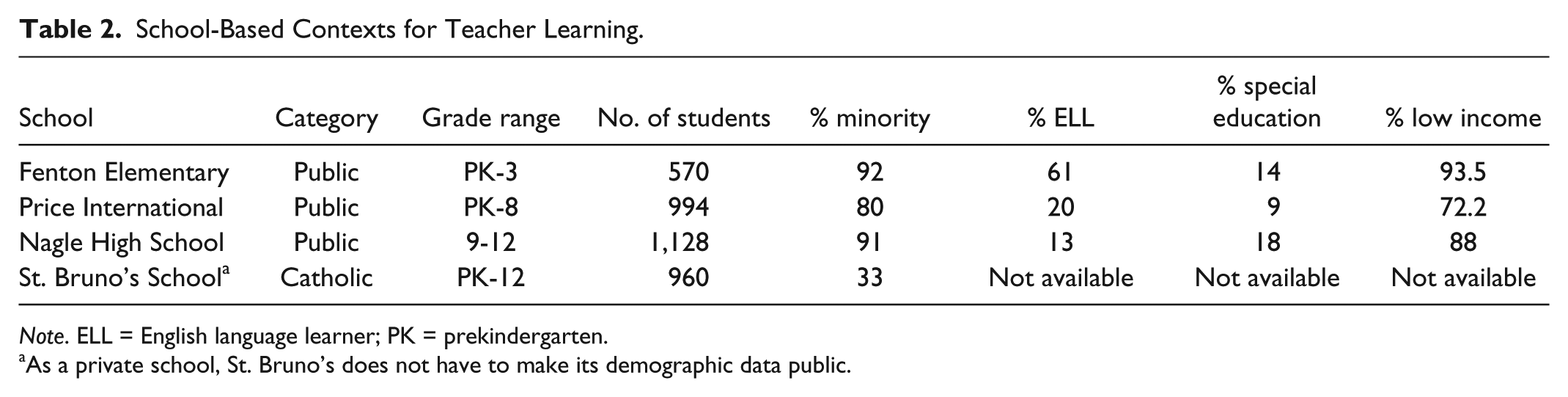
Note. ELL = English language learner; PK = prekindergarten.
As a private school, St. Bruno’s does not have to make its demographic data public.
Although situated in the same geographic region, schools differed in key ways. Fenton Elementary, located in a Latino enclave, housed predominantly Spanish-speaking students with 65% of students labeled as ELs. Price International and Nagle High Schools served the same neighborhood and therefore had similar student demographics, a culturally diverse community with more than 40 languages represented. With middle school students from Price feeding into high school at Nagle, paired with both schools offering IB for all students, PK-12 school actors collaborated frequently. St. Bruno’s School provided the unique context of a Catholic school that housed elementary, middle, and high school students from diverse backgrounds.
Between 8 and 10 candidates enrolled in each field-based module, facilitated by instructors with expertise in educational policy and classroom practice. All university sophomores, the sample of study participants, provided an array of cultural and linguistic backgrounds (e.g., White, Latino, Asian) and programs of study (e.g., early childhood, elementary, secondary, special education) representative across the student population in the School of Education (Table 3).
Teacher Candidate Cases.
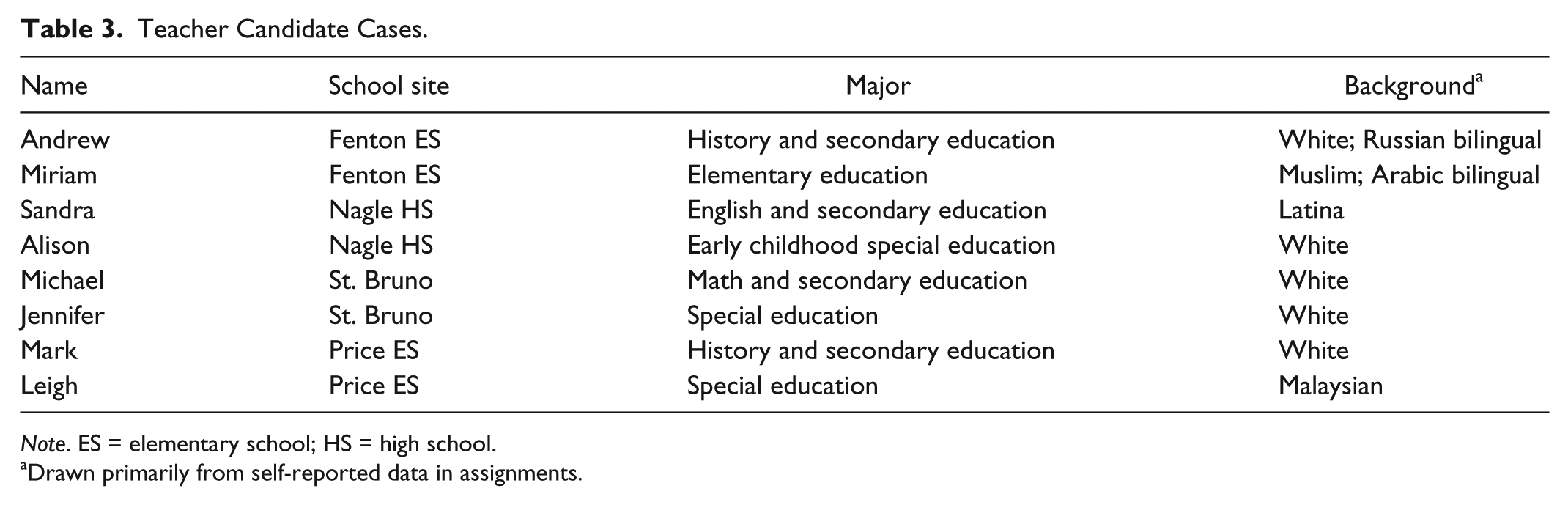
Note. ES = elementary school; HS = high school.
Drawn primarily from self-reported data in assignments.
To amass a rich qualitative data corpus (Erickson, 1986), we collected candidate-produced assignments and assessments throughout the sequence of learning. We chose to use candidates’ work in field-based modules as the core of our data corpus to capture the evolving understandings of policy and practice across the semester. Data sources included (a) reflections on policy in practice throughout the first module, (b) policy study to close the first module, and (c) teacher study to close the sequence. In reflections, candidates reflected on learning and experiences at school sites, specifically considering policy in practice and the role of teachers and other policy actors. In policy studies, candidates selected a policy to research its historical and contemporary impact on education, analyze the layers of policy in practice, and examine impact on and of school and community actors. At the close of the semester, candidates completed teacher studies in which they explored the role of the teacher in decision making, reflecting on how policies manifested in teachers’ and students’ practice. Candidates uploaded work to the university’s electronic platform, and we accessed data from those who gave consent to participate in the research.
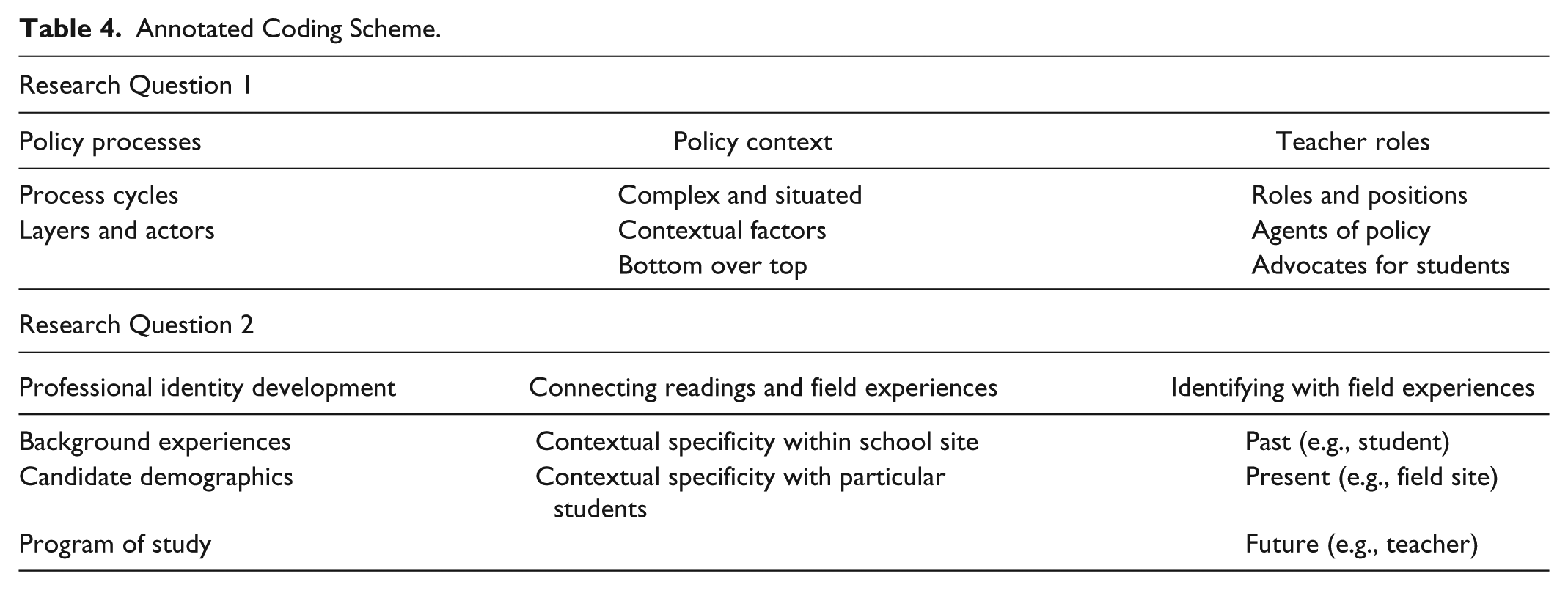
We engaged in iterative thematic analysis (Erickson, 1986) to code the narrative data, write assertions from emergent coding, test assertions in iterative readings, and make meaning of resulting themes in response to research questions. We first completed holistic analysis of data from all candidates across the four sites; each researcher individually read and coded for emergent themes. We then met to (a) triangulate emergent codes to develop a shared coding scheme with which to approach our second iteration of analysis and (b) determine cases to study in depth to comprise a holistic multiple case study (Yin, 2009). Using the criteria of having all data points uploaded to the electronic platform, we strategically selected eight cases to have a representative sample of school site, gender, cultural and linguistic background, program of study, and policy study focus (Table 4).
Annotated Coding Scheme.
After selecting candidates, we chose one case for all researchers to code. Using the coding scheme, we individually coded all data points using Nudist Vivo 10. We merged individual projects to test for interrater reliability and came together to qualitatively share experiences with coding. We utilized the interrater reliability tests and reflective memos from the second iteration of data analysis to fine-tune codes to ensure clarity and accuracy. We then returned to the data for additional iterations using the final coding scheme, merging all analyses on Nudist Vivo 10 to finalize codes, assertions, and results. Multiple iterations of analyses and corresponding points of triangulation across researchers and data points contributed to the overall validity and trustworthiness of our results, which are presented in the next section.
Findings
In this section, we share findings from our study on policy actor preparation for teachers. In the first subsection, we respond to the first research question by exploring candidates’ understandings of policy and practice. In the second subsection, we respond to the second research question to consider the specific experiences that supported the development of these enduring understandings of policy and practice.
Enduring Understandings of Educational Policy and Classroom Practice
We first examine our findings on candidates’ understandings of the relationship between educational policy and classroom practice. We discovered that candidates developed conceptual understandings of policy as a broad construct, as well as practical understandings of specific policies impacting daily classroom practice. Drawing from both conceptual and practical understandings, we organize findings by four emergent themes and aligned with extant literature: (a) various actors have an impact on education policies (Johnson & Freeman, 2010), (b) policies look different across educational contexts (Cuban, 2013; Darling-Hammond, 1990; Varghese & Stritikus, 2005), (c) multiple policies impact daily classroom practice (Cuban, 2013; Varghese & Stritikus, 2005), and (d) teachers appropriate policies to support student learning (S. J. Ball, 2012; Varghese, 2008).
Various actors shape educational policies
Through our field-based curriculum, candidates developed understandings related to the complexity of educational policy, including the many actors involved in policy design, interpretation, and implementation. Candidates recognized the diverse individuals and groups involved in policy at local, state, and federal levels. Leigh noted this in reference to the broad concept of policy implementation in her teacher study: Findings suggest that legislators, policy makers, teachers union[s], principals’ associations, and parents influence policy implementation at the macro-level and also affect the perceptions and decision making undertaken by teachers, parents, and principals at the micro-level. Policy implementation is viewed as a process involving dynamic relationship[s] in which changes occur simultaneously in both the macro- and the micro-level.
In terms of the impact of policy on practice, Mark argued the connection between one specific federal policy and school curriculum in one reflection.
NCLB has had enormous implications for the current state of education today . . . Standardized testing has made the focus of education narrower, as schools need to focus more on math, science, and reading. This has led to significant cuts to programs in arts, social sciences, and other areas of study. Even more, the math, science, and reading students are taught is typically not applicable, useful content, but oftentimes content that will only be useful on a test. This narrows the purpose of education and does not account for different types of intelligence.
Other candidates echoed Mark’s sentiments about the ongoing impact of NCLB, including CCS and its impact on PK-12 curriculum. Mark expressed, “With CCS it is not policymakers with little experience in the classroom arbitrarily deciding what is best for students, but teachers who are in classrooms every day deciding” (Michigan Coalition for High Student Standards, 2013). Candidates, such as Mark in this instance, supported arguments with course readings and classroom experiences.
These first several examples of candidates working to understand policy would likely be found in most teacher education programs; however, Michael provided an example of how field-based teacher preparation supported distinctive ways for candidates to make meaning of specific policies guiding practice with students labeled as having special needs and ELs. In his teacher study, Michael asserted, By first observing for evidence of policy implementation in [St. Bruno’s] classrooms, and then taking part in the implementation of ELL and SPED policy ourselves, we became aware of the complicated [policy] layers that a teacher must work with in order to create a classroom of equality and growth for all students.
Beyond extant court cases and specific laws requiring teachers to meet the needs of all learners, Michael considered the broader conceptual implications of teachers’ roles in policy in practice to meet students’ needs. After reflecting on his charge to be more aware of multiple policies, he stated, “Policy cannot be properly written, distributed, and implemented without educated and informed teachers. The job of keeping educated and informed falls upon the teacher just as much as it falls upon the policy makers.” In this early stage, he recognized the importance of teachers’ voices and the value of educational experience to policy making.
Similarly, in her final reflection of the policy module, Sandra used her experiences of interviewing a range of Nagle school and community members to determine “that a community can be the driving force behind creating a ‘good’ school.” Having access to community members in this diverse urban context, as well as teachers and administrators who worked together to impact change at the school, offered a new way to think about the range of actors involved in the intersection of educational policies in practice at the local level.
Policies look different across educational contexts
As candidates identified and investigated policy issues in schools, they developed understandings that similar policies are implemented differently across schools. Furthermore, candidates related the variation in implementation to differences in school contexts: institutional history, surrounding community, and student population. Michael, who conducted his policy study at St. Bruno’s, examined the increase in school uniform policies in the 1980s and 1990s: During the 1960s-70s the baby-boomer generation helped to define what a public school could enforce through Tinker v. Des Moines Independent School District. Students were given the right to express themselves through their clothing so long as classroom activities were not disrupted. Governmental influences such as A Nation at Risk, or President Clinton’s State of the Union, sparked movement in schools to try uniforms as a means of lowering violence and raising test scores.
Finding a similar interest at distinct school sites, Sandra also provided history of uniform policy and situated her policy study at Nagle High School. She first set the wider context.
Many people are against their school’s uniform policy because they feel it is a threat to their individuality, but not many people think about the policy itself and how it came to be. Federal courts have heard cases pertaining to uniform and dress code policies, but do not directly interfere with schools’ right to implement a dress code or not implement a dress code.
Sandra then asserted, Overall, it is easy for policies to get lost among the many policies a school must follow. However, Nagle works to ensure its students abide by the dress code for their own safety and well-being. Although in the past studies have found uniforms have had negative or no effects on students’ success or safety, it seems uniforms have become an important aspect of American schooling. In [their neighborhood], students are walking billboards for their school and represent Nagle in their community.
Both Michael and Sandra researched the history of uniforms to understand local school policies as grounded in historical origins and current rationales. Michael and Sandra offered compelling cases for uniforms in terms of safety and equalizing socioeconomic disparity, but Sandra provided unique insight regarding uniforms as a way for students to carry the school symbol in the neighborhood. Stemming from a panel discussion with school and community leaders describing shared efforts to improve the school–community relationship, Sandra saw school uniforms as a way of signaling Nagle pride to community members.
Candidates also grappled with inconsistency in policy implementation at local and state levels. At the state level, candidates pondered the specific impacts of implementing CCS; in light of that, Leigh reflected that some states have “decreased their proficiency level [on state tests] to avoid sanction under NCLB.” At the local level, candidates negotiated implications when classroom and school actors made decisions about policy implementation. Alison at Nagle raised this broader conceptual policy issue in her teacher study.
I learned from some of the teachers that they often loosely interpret the policies they are required to follow depending on their opinion and how they believe it will impact their ability to teach. This leeway with applying policies in the classroom can make collaboration between teachers difficult; it also creates discrepancies in student learning and development.
Using classroom observations and multiple school-based perspectives, candidates recognized the variance of policy across contexts, including possible implications.
Multiple policies impact daily classroom practice
Candidates articulated observations of policy influencing practice, but this was not in simple ways. They noted teachers’ engagement with policy as complex, as teachers attended to and navigated through multiple policies authored by multiple layers of governance simultaneously within the dynamic environment of the classroom. Reflecting the deep and situated teacher learning driving the TLLSC program, Alison utilized her teacher study to consider the broad conceptual understanding of policy in practice.
The TLLSC courses I participated in this semester were intense, but they gave me a colossal insight into the complexities of teaching. I was never one to enjoy discussing politics, but educational policy is now something very interesting and important to me.
Alison came to understand teaching as having a complex relationship with educational policy, an essential idea for teachers to know and bring forward into practice. In her teacher study, Sandra described the critical connection between educational policy and classroom teaching: It was extremely helpful to hear from teachers, administrators, and policy makers to learn from their experiences in dealing with policies they may not agree with and to understand the reasoning behind the implementation of certain policies. As a student, many of these policies and ideas go unnoticed, so it was interesting to learn all of the hard work and planning that goes into incorporating a great amount of educational policies in lessons.
Placing value on teacher knowledge, candidates expressed desire for teacher representation in policy processes. Alison argued, “Teachers face a complex challenge with merging the policies enacted through the different levels of government while meeting all the diverse needs of students.” Sandra, Miriam, and Andrew made similar comments about teachers’ role in navigating policies simultaneous to meeting the needs of diverse students, including ELs and students with special needs.
Candidates’ evolving understandings also included the complexity of the many policies at unique school sites. Based on field experiences, candidates selected one policy to analyze for the summative policy study. Of our eight candidate cases, four selected macro-level policies, including NCLB, CCS, Lau v. Nichols (i.e., EL), and inclusion (i.e., special education), whereas four selected micro-level policies, including dress code, student uniforms, school safety, and arts education. The culmination of the module brought together all candidates from across sections to share diverse macro- and micro-level policy studies impacting practice in schools. In this way, candidates saw the breadth and depth of policies, as they engaged in dialogue with invited guests and their peers through poster presentations of policy studies to discuss how policies played out across field sites.
Teachers’ appropriate policies to support student learning
Candidates did not lose sight of teacher agency among various factors, site specificities, and policy layers shaping classroom practice. They developed understandings that teachers (a) needed opportunities to share expertise to shape policy design and (b) actively interpreted, appropriated, and mediated policy in classrooms in service of student learning.
All candidates identified importance of incorporating teachers in policy processes, cognizantly framing discussions within the current policy climate. Leigh understood negative implications of excluding teachers and positive implications for including teachers in policy design and implementation. She wrote, “When teachers’ work becomes excessively regulated, it can lead to undesirable consequences such as job dissatisfaction, reduced commitment, superficial responses to administration goals and even early departure from the profession.” Leigh recognized the consequences of shortsighted policies not offering Price teachers autonomy in efforts to support students. Similarly, she called for teachers to “have more opportunities to collaborate on powerful lessons with teachers across the nation. Professional development conferences and professional learning communities will be more meaningful for teachers as they focus collectively to improve students’ learning.”
In addition to policy processes, candidates emphasized the role of teachers in impacting and advocating for student learning. In her teacher study, Alison reflected, “Teachers play an enormous role with regards to balancing the requirements of educational policies and the diverse needs of students, and they must also be an advocate for social justice and change.” She challenged herself by committing “to find ways I can become involved in shaping educational policy, if even it is at a school or district level.” Sandra also identified how teachers negotiate policy: It was important to understand the different levels that policies come from, what those policies mean for teachers and students, and the balance between what teachers must follow versus what they agree with and what is best for their students. . . . We learned that as teachers we must follow educational policies from the international, national, and local levels, while doing what is best for the students, which includes differentiating instruction to accommodate to the needs of a diverse population.
As a first-semester sophomore, Sandra demonstrated a sophisticated conceptual understanding of the multiple layers and actors involved in educational policy in practice, as well as the role of the teacher in balancing best practice for all students.
Structures to Support Field-Based Teacher Learning of Policy and Practice
In this subsection, we respond to the second research question—attending to structures and supports within the field-based program that facilitated candidates’ learning. Building on the previous subsection that explored how candidates conceptualized both broad and specific policies in practice, we use this subsection to investigate what facets of the field-based module supported candidates’ developing understandings over the course of the semester. We organize the subsection using our conceptual framework on teaching practice, approaching learning through the three-facet conceptual scheme of representations, decompositions, and approximations of practice (Grossman et al., 2009). In this way, we outline structures and supports that emerged as integral to candidate learning, including (a) module readings, discussion, and reflections; (b) educational stakeholder panels and perspectives; and (c) educational policy engagement in classrooms and schools.
Module readings, reflections, and observations
Academic texts have long been used to mediate candidates’ learning, with traditional teacher preparation focused on readings and discussions at the university setting. Grossman and colleagues (2009) defined representations of practice as candidates passively probing professional practice, such as reading and discussing textbooks. In this study, we conceptualized representations of practice as informing candidates’ understanding of policy in practice through strategically selected readings connected to PK-12 practice at the field site. Distinct from the original definition (Grossman et al., 2009), we did not find candidates’ representations of practice to be static or passive, as readings directly connected to classroom observations. Due to the field-based setting, we found that candidates actively made connections between readings and observations, using texts to mediate understanding of what they observed and experienced in classrooms and schools.
Emergent from reflections and teacher studies across cases and sites, candidates utilized and made connections with the primary text for this module titled Inside the Black Box of Classroom Practice: Change Without Reform in American Education (Cuban, 2013). Taking a historical lens on the problematic interplay between policy and practice, Cuban’s text provided a framework for understanding the connection between policy and practice, as well as case studies of particular reform efforts. Couched in the metaphor of the classroom as the black box (Cuban, 2013), three interrelated themes emerged in candidates’ connections between the text and field-site observations and experiences: (a) teacher-centered practice versus student-centered practice, (b) approaches to student discipline and classroom management, and (c) issues related to test preparation and teaching to the test. In reflections, candidates did not only utilize Cuban’s ideas to represent practice but also directly connected to field experiences, such as Michael’s description of a classroom at St. Bruno’s.
For this class, the students and teacher came up with their own theory to experiment with . . . The class was a wonderful opportunity to observe what Cuban describes as a primarily student-centered learning style. As Cuban argues, “for nearly a century and a half, U.S. Reformers . . . have tried hard to turn teacher-centered classroom practices into more flexible student-centered pedagogies” (Cuban, 2013, p. 6). This style of having a more student run classroom is typically difficult to achieve because of usually higher bodied classrooms . . . In asking the students about how they felt in having such a small class, that they all loved having the full attention of their teacher. They never had to battle for attention, and this really sheds light on Cuban’s opinion of student-centered teaching being a strong and more needed policy.
With the Cuban text serving as a broad conceptual framework, candidates also read supplemental articles to hone in on focal policies, including CCS, EL, IB, and special education. By learning about specific policies, candidates had lenses to make observations about how teachers utilized policies in practice. After the Cuban text, the most commonly cited reading across candidate cases was Hakuta’s (2011) article on EL policy and research. In a reflection, Jennifer considered her experiences in a high school classroom at St. Bruno’s using Hakuta’s ideas around EL education.
Throughout the rest of the [class] period, I did not experience anything to observe pertaining to ELL. I thought back to our reading on bilingual education by Hakuta, and wondered if these students’ learning would be enhanced if the lesson were taught partially in Spanish. It is hard to know [what language to use] when they [students] are not classified as ELL.
Situated at a Catholic school lacking clear procedures to identify and support ELs, Jennifer utilized Hakuta’s points about equity and language of instruction to consider what she was seeing in the classroom. In addition to federal policy articles such as Hakuta (2011), candidates also connected classroom observations to state- and district-level readings, such as CCS and IB implementation (Karp, 2012; Michigan Coalition for High Student Standards, 2013).
Educational stakeholder panels and perspectives
While representations of practice through readings and discussion have long mediated the traditional education coursework, the field-based setting of the TLLSC program allowed emphasis on decompositions and approximations of practice. Grossman and colleagues (2009) defined decompositions of practice as providing candidates opportunities to consider smaller elements that combine to encompass the complexity of authentic teaching and learning. In this study, we conceptualized decompositions of practice as allowing candidates to engage with multiple policy actors across the local context of education. Seeking to move beyond policy as written on paper, instructors provided multiple roles and perspectives on policy, such as classroom, school, district, and community leaders, aiming to mediate candidates’ understanding of the complexity of policy—with multiple layers and actors engaged in policy work. Instructors at two of the four school sites utilized multiple stakeholders’ perspectives through panels and interviews, which came through as poignant in our analyses of the four candidates at those sites.
At Fenton, candidates engaged in dialogue with classroom teachers and school leaders around policy implementation for diverse students. In their reflections, Andrew and Miriam utilized interviews with cooperating teachers, panels with school leaders, and community walks to consider the local context of policy in practice. At a culturally and linguistically diverse school with 65% of students labeled as ELs, Andrew and Miriam utilized collaborative experiences with Fenton policy actors to reflect about the role of ELs and diversity in the implementation of policy, particularly CCS. When considering the classroom level, both referenced conversations with cooperating teachers, as they negotiated the demands of CCS with students still learning English. At the school level, a school leader panel supported Andrew’s thinking about bilingual complex texts and Miriam’s discussion on tapping into students’ background knowledge. A neighborhood walk continued to shape their value of diversity and community in implementing policy. In addition, Andrew extended learning from Fenton to his future practice, noting plans to utilize students’ and parents’ cultural backgrounds through speaker panels, historical events, and community fairs that emphasized the “celebration of diversity and equality.”
At Nagle, candidates participated in panels with school, district, and community leaders connected to policy work, as well as faculty and staff interviews. In reflections and teacher studies, Sandra and Alison drew from school and community stakeholder lenses. Sandra utilized various perspectives to mediate her understanding of neighborhood schools and the broader community.
From speaking with Nagle’s principal, the Alderman representing Nagle, and the education liaison, it is apparent that for a school to succeed the entire community needs to be involved. I liked that the Alderman and education liaison encouraged members of the community to attend LSC [Local School Council] meetings to inform themselves of what goes on behind school walls. I agreed with them when they stated that many community members are skeptical of neighborhood schools because they are either misinformed or uninformed. With Nagle’s increasing progress, I hope parents, students, and community members will take pride in the school and strive to make it better . . . Nagle has made tremendous progress and continues to make improvements to better the quality of education it provides. Together the [neighborhood] community, along with Nagle administrators, teachers, and students can create an effective and safe learning environment for all.
But the ongoing policy dialogue did not always result in positive responses from candidates, as evidenced from Alison’s critique of the EL program at Nagle after a question-and-answer session with the lead English as a second language (ESL) teacher.
I have two main concerns; the lack of communication with regards to mainstreaming ELL students and not having enough staff to support them seems like it will negatively affect their education. I was shocked when we learned that something with the [online database] system had crashed and teachers were not notified that some of their students were enrolled in the ELL program. While instances like this occur, this is one with bad consequences. Some of these students might be new to American schooling, and their first impression of it is that they are forced to sit in rooms where they will not understand anything. It must be a very traumatic experience; it is one every school should strive to eradicate completely. It was also disheartening to hear that Nagle only has two ELL teachers staffed currently. Their workload has grown considerably due to this system malfunction and must be impacting their ability to teach.
Through hearing from multiple policy actors, candidates decomposed teaching to consider how policies impacted teachers’ daily practice and ability to educate diverse students.
Educational policy engagement in classrooms and schools
While representations and decompositions of practice served as beneficial, the most integral mediating structure was engaging with policy in the context of classrooms. Grossman and colleagues (2009) defined approximations of practice as candidates participating in practice with a particular aspect of teaching. In this study, we conceptualized approximations of practice as candidates engaging with micro-level policy in practice through observing, experiencing, and collaborating with teachers. As teachers made daily decisions about how to implement federal, state, and local policies to meet diverse student needs, candidates collaborated with teachers to play direct roles in policy in practice—the moment-to-moment decisions that teachers make (Menken & García, 2010). Candidates honed in on specific policies across the semester while considering the complexity of teaching due to the merging of multiple policies within classrooms.
Candidates tended toward particular policies, often returning to that policy in reflections and teacher studies to extend understanding through deepening approximations of practice. Placed in a bilingual classroom at the linguistically diverse school of Fenton, Andrew continually returned to his developing understanding of policy in practice for ELs. Here, this bilingual teacher candidate considered his “bilingual” placement classroom where bilingual instruction did not occur.
It is important to analyze policy and look at how it impacts practice in the classroom. In local settings such as Fenton Elementary we see the self-contained classrooms, where teachers are faced with decisions on classroom management and implementing new ways to target language issues while also developing relationships. For every 20 students who speak a different language there is aide for those students . . . However, students do not learn through those [monolingual] pretenses. Living in a single language country we must push [bilingual] policy in schooling to help create better regulations for those who speak the norm.
Alison, a special education major, highlighted special education policies in practice at Nagle High School.
I was concerned about the lack of devices and [assistive] technology available but enjoyed seeing policies in place during the observation. During the Q & A session, we learned that Nagle only really offers a couple of software program for students with disabilities and limited [assistive] devices. It was also mentioned that not all of the teachers received formal training on these [special education] software programs; it was more along the lines of they use it if they know how. It is issues like these that force me to see how vicious the cycle of politics and educational funding can be. Government expects certain standards to be met but often do not have the means to provide enough financial support for them.
Alison described entering the TLLSC program with a passion for special education, which she used as her primary lens as while critically considering policy in practice during field experiences.
In addition to mediating learning around individual policies in practice, approximations of practice supported understanding of the complexity of the profession of teaching, as teachers utilized local, state, and federal policies simultaneously to do the daily work of teaching. This occurred with candidates across schools and was dependent on the school setting. At Fenton, Miriam considered how teachers supported academic language in CCS-based instruction in primary classrooms with multiple abilities, languages, and backgrounds. At St. Bruno’s, Jennifer reflected on the unique policy context of Catholic schools that lacked structures to identify and support ELs in content-based, high school classrooms. At Price, an IB elementary school, Mark explored how fine arts integration impacted the teaching and learning of diverse students in a gentrifying community. Also at an IB school, Sandra probed the complexities of Nagle High School where teachers must utilize IB curriculum while still responsible for federal EL and special education policies, state-level standards through CCS, and school-based policies such as dress code and discipline. By engaging in a field-based module, candidates approximated practice to consider the complexities of teaching and learning and the active role of the teacher in policy.
Discussion
To begin to shift the negative discourse on teaching and move away from conceptualizing teachers as passive targets for reform efforts, we must prepare future teachers for active and constructive roles in educational policy. In this study, we demonstrated how participation in field-based teacher education supported candidates’ learning about policy in practice. In a module designed for candidates to engage with policy in urban classrooms and schools, candidates developed understandings related to the complex and situated nature of policy in practice, as well as the teachers’ central role among multiple policy layers and actors. With various approaches designed to represent, decompose, and approximate practice (Grossman et al., 2009), these first-semester sophomores began to develop as future classroom-based policy makers who leverage policy to advocate for students. To conclude, we use our findings to draw conclusions, share significance, make recommendations, and discuss future research to further our understanding of the important connection between teacher preparation and educational policy (Heineke & Cameron, 2013).
Findings from the first research question indicate that candidates developed enduring understandings regarding the relationship between educational policy and classroom practice through the field-based module. These central understandings include the complex and situated nature of policy in practice in urban classrooms and schools, including the difference in policy interpretation and implementation across contexts and the multiple policies that merge to frame daily classroom practice (Cuban, 2013; Darling-Hammond, 1990; Varghese & Stritikus, 2005). In addition, through the explicit lens on policy in field-based learning, candidates understand the multiple layers and actors in educational policy, including the central role of teachers in implementing policy in practice to meet the needs of diverse students (Heineke & Cameron, 2011, 2013; Hornberger & Johnson, 2007; Ricento & Hornberger, 1996). By exploring and recognizing the role of educational policy in practice, candidates constructed a strong basis to engage with policy-related issues across their programs of study.
Significance of findings center on candidates’ development of enduring understandings related to the complexity and dynamism of educational policy, particularly at an early phase of their professional development as first-semester sophomores. Past studies have revealed that inservice teachers enact policies without recognizing their central role in the interpretation, negotiation, and appropriation of policy in practice, using their beliefs and ideologies to unknowingly shape how they carry out policy in practice (Heineke & Cameron, 2013; Menken, 2008; Stritikus, 2002; Varghese, 2008; Varghese & Stritikus, 2005). By explicitly focusing on policy in practice in teacher education, candidates can glean important realizations about policy and practice; by basing that professional learning in the field, the understandings prove more rich and dynamic, such as the multiple policies that impact teachers’ complex practice—going beyond the CCS, EL, IB, and special education to consider policies ranging from school uniforms, school safety, attendance, homework, and universal breakfast. By developing this policy in practice awareness early in their professional development, candidates can continue to build on these enduring understandings, ultimately transferring them into the classroom practice as teachers and advocates for students.
Findings from the second research question indicate how strategically designed fieldwork prepares candidates for policy in practice, including (a) readings and reflections, (b) stakeholder panels, and (c) policy engagement in schools. Various organizations integral to the advancement of teacher education have lobbied for deeper and more strategic field experiences in teacher education (AACTE, 2010; NCATE, 2010). Leading scholars in the field concur with the call for field-based teacher education, using empirical studies to confirm the importance of field experiences to prepare teachers for pedagogy, such as lesson planning, classroom management, and formative assessment (D. L. Ball & Forzani, 2009; Darling-Hammond, 2006; Grossman et al., 2009; Zeichner, 2006, 2010). Adding to the extant literature and research in the field of teacher education, this study demonstrates how field-based teacher education contributes to the preparation of teachers for policy, a facet of teacher education largely unexplored (Heineke & Cameron, 2013). As demonstrated by our findings, by embedding teacher preparation in the field, candidates see the complexity of policy in practice and conceptualize how their role in policy needs to be tied to advocating for students.
Significance of findings centers on the engagement of teacher candidates as policy actors. Whereas extant theoretical and empirical literature recognizes the central role of the classroom teacher in policy, scant literature considers how candidates factor into the contemporary context of educational policy (Levinson & Sutton, 2001; Menken & García, 2010; Ricento & Hornberger, 1996). By situating policy actor preparation in classrooms and schools, candidates actively take part in policy discussions with multiple stakeholders, including teachers, school leaders, district administrators, community leaders, and teacher educators. As demonstrated in our findings, these policy discussions support candidates’ learning about policy while engaging policy makers in explicitly discussing and recognizing their roles, such as the collaborative policy discussion among candidates with school and community leaders at Nagle High School, or the policy presentation to faculty at St. Bruno’s that resulted in the hiring of an EL coordinator. Through the situation of teacher preparation in schools, candidates become policy actors.
Recommendations emphasize the importance of field-based teacher education. To understand the complex and dynamic nature of educational policy, candidates must engage with other educators in practice (Datnow et al., 2002; Levinson & Sutton, 2001). Rather than limit teacher learning to readings and discussions at the university, candidates must be in classrooms and schools to learn about policy from the policy actors themselves, including classroom teachers, school leaders, and beyond. Moving beyond the general recommendation for field-based teacher education (AACTE, 2010; NCATE, 2010), we recommend selecting school sites with rich policy contexts; for example, Nagle High School provided ample directions for exploration, such as EL, IB, special education, and more, in contrast to St. Bruno’s, a Catholic school with more autonomy from federal, state, and local policies. In addition to the situation of teacher education in classrooms and schools, we recommend the purposeful integration of multiple actors into the policy discussion, such as the teacher interviews and policy panels that served as effective mediators of candidate learning at Fenton and Nagle. This was facilitated by the instructors’ close partnerships within those school sites, as well as with the broader community outside of the school.
We hope that this study begins an ongoing dialogue among teacher educators, as well as opens an important line of research related to preparing teachers as effective policy actors. Limitations of this study include the case study approach; case studies are not generalizable in the conventional sense, but they can ring true in other settings (Hodkinson & Hodkinson, 2001) and provide rich qualitative examples for understanding policy in practice (McCarty, 2011; Menken & García, 2010). Although our findings from the TLLSC program in Chicago cannot necessarily be transferable to other locales, we hope that our study piques the interest of other teacher education faculty who recognize the central role of the teacher in fostering meaningful educational change. Whereas this study focused on one semester of candidates’ field-based learning, future research should consider the development as policy actors over time—across teacher education programs and bridging into inservice practice. This work should be done in conversation with scholarship on political education (e.g., Hess & McAvoy, 2014) to explore issues of ethics and professional responsibility in preparing future teachers for the deeply partisan policy arena. Ultimately, the efficacy of teacher education must be measured by its results in classrooms with PK-12 students (Zeichner, 2006); we hope other teacher educators will join our research agenda to continue to build our understanding of how teachers develop as policy makers and advocates for students in classrooms and schools.
Footnotes
Acknowledgements
The authors thank the Chicago Community Trust for their generosity in supporting the design and initial implementation of their field-based teacher preparation program, as well as Peggy Mueller, Elisabeth Johnson, and other esteemed colleagues who supported and reviewed the ongoing drafts of this publication.
Declaration of Conflicting Interests
The author(s) declared no potential conflicts of interest with respect to the research, authorship, and/or publication of this article.
Funding
The author(s) received no financial support for the research, authorship, and/or publication of this article.