




Abstract
This qualitative case study explored a community–university partnership for teacher preparation with an urban Indigenous community organization. The study examined the roles of Indigenous community partners as co-teacher educators working to better prepare teachers for the needs of urban Indigenous children and communities. The author collected data through focus groups with Indigenous participants before and after engagement with the partnership, direct observations of partnership activities where Indigenous participants interacted with teacher candidates and university faculty, and offered individual interviews for all participants. Indigenous Postcolonial Theory (IPT) guided this research and offered a lens to examine the perspectives of urban Indigenous community members engaged as co-teacher educators in field-based teacher preparation. This study held implications for continued development of Indigenous community–university partnerships and furthering the role of community leaders in teacher preparation to advance efforts of Indigenous postcolonialism through self-education.
The United States is home to about 4.4 million Indigenous 1 peoples who are citizens of both the United States and their respective tribal nations. Indigenous citizens represent 1.5% of the total U.S. population and include approximately 644,000 students enrolled in kindergarten through 12 grade (K-12; Faircloth & Tippeconnic, 2010). Approximately 92% of these children attend U.S. public schools and about 8% attend Bureau of Indian Affairs (BIA) schools (Alliance for Excellent Education, 2008; Faircloth & Tippeconnic, 2010). Historically and to this day, schools underserve Indigenous students and communities and provide poor school experiences across our nation (Castagno & Brayboy, 2008; Faircloth & Tippeconnic, 2010), which are reflected in the disparities between Indigenous and non-Indigenous school achievement, discipline, graduation rates, and social experiences (Faircloth & Tippeconnic, 2010). In an effort to address the need for improved Indigenous education, the remainder of this article will portray the outcomes of a qualitative single case study focused on a partnership between an urban Indigenous community organization and university teacher preparation program working to better prepare teachers for urban Indigenous children. This study examined the roles and perspectives of Indigenous community partners as co-teacher educators in field-based teacher preparation. First, I offer a brief summary of Indigenous education, past and present, elucidating the ineffectiveness of schools in serving Indigenous children, and then put forth an approach for healing the historical wrongdoings and continued struggles (Lomawaima & McCarty, 2006; Pewewardy, 1998) by engaging community partners in a collaborative, field-based teacher preparation program. Finally, I share community partners’ experiences and perspectives around their roles as co-teacher educators in the partnership and the potential for continuing to develop Indigenous partnerships for improved education.
History of Indigenous Education
In the mid-16th century with European settlers colonizing what is now known as the United States and believing that Indigenous communities lacked structures of a civilized society and educational systems (Lomawaima & McCarty, 2006), Roman Catholic groups replaced traditional Indigenous education with European-American led Indian mission schools to civilize and Christianize Indigenous children (EchoHawk, 1997). Christian education increased with the onset of Protestant led mission schools (EchoHawk, 1997) and then, BIA boarding schools. These institutional leaders believed that to civilize Indigenous peoples, who were viewed as savages, they must assimilate to Christian and Western norms (Lomawaima, 1999; Palladino, 1922). To do so, church and school leaders forbid Indigenous students from engaging in cultural practices and replaced the use of Indigenous languages with forced silence until children began speaking English (Lomawaima & McCarty, 2006). The detachment from tribal communities and cultures led students to suffer sickness, malnutrition, severe homesickness, and emotional and physical abuse (Bull, 1991), denying children their rights of a safe and nurturing education (Lomawaima & McCarty, 2006). With intergenerational trauma (Bull, 1991; Lomawaima, 1999) resulting from the miseducation of Indigenous peoples, U.S. and Canadian governments have apologized for boarding schools and offered some forms of reparation—primarily through public admission of wrongdoing (Buchanan, 2008; Dorrell, 2009). However, Indigenous leaders question the impact of the apologies without genuine restitution for the hardship suffered (Dorrell, 2009), the resulting impacts on the school experiences of today’s Indigenous children, and the lack of change in how systems of education serve Indigenous peoples today (Lomawaima & McCarty, 2006).
During the 1960s and 1970s, the U.S. government sponsored Operation Relocation, aiming to reduce services provided to tribal communities by resettling Indigenous peoples off reservation lands in urban settings, resulting in increased enrollment of Indigenous children in public schools but no professional development for teachers in these settings (Burt, 1986). The city of Chicago was a primary destination for Operation Relocation and thus, Chicago Public Schools (CPS) saw a growing Indigenous student population (Laukaitis, 2005). Subsequently, CPS reported Indigenous student dropout rates of 90%, making clear that the public schools were not equipped to serve their newly enrolled Indigenous students. Chicago’s Indigenous community identified non-Indigenous peoples’ misunderstandings of Indigenous cultures as adversely impacting their children’s self-esteem that resulted in a lack of pride in their heritage and an incompatibility in school settings (Laukaitis, 2005). In response, Indigenous community-based organizations began serving the needs of their children through programming that focused on acclimating to a new, urban environment; increasing school attendance and completion; offering counseling services; building community participation in school activities; and developing a model for urban Indigenous education (Laukaitis, 2005). These efforts demonstrated the degree to which Indigenous community members were dissatisfied with public school services and their commitment to quality education. The majority of funding sources for urban Indigenous education ceased in the 1970s leaving Indigenous community organizations reliant on donations, volunteers, and temporary grant support (U.S. Department of Education, 2012). However, while schools continued to underserve Indigenous children, the urban Indigenous community remained committed to addressing their children’s educational needs. Chicago’s Indigenous community has upheld their effort to maintain educational sovereignty and engage in decision-making processes to provide Indigenous children equal opportunities denied by mainstream schooling (U.S. Department of Education, 2012).
Present Day Indigenous Education
Today, approximately 20% of Indigenous students reside off reservation lands in urban areas (Faircloth & Tippeconnic, 2010). These students live in communities and attend schools that have higher poverty rates than their Anglo counterparts and are primarily served by non-Indigenous teachers with little to no preparation around Indigenous education (Alliance for Excellent Education, 2008). Public schools continue to offer Indigenous children less qualified teachers, provide fewer resources compared with their Anglo peers, and in general maintain poor relationships with Indigenous communities. Consequently, schools uphold inequities in education and promote a climate of assimilation by utilizing curricula and instruction that emphasizes Anglo history, values, economics, language, religion, and dress, which prove ineffective for Indigenous students (Castagno & Brayboy, 2008; Pewewardy & Hammer, 2003; Writer, 2001; Yellow Bird, 2005)—and are arguably grounded in the same curriculum goals as the boarding school era.
Indigenous Students and Anglo Assessment
The lack of quality education available to Indigenous children was reflected in school measured achievement disparities (Ahlquist, 2011; Castagno & Brayboy, 2008; Deyhle & Swisher, 1997; Ladson-Billings, 2006) between Indigenous students and their Anglo counterparts in math and reading, with Anglo children widely outperforming Indigenous children on state mandated standardized assessments (National Center for Education Statistics [NCES], 2012b). A significant cause of disparities between Indigenous and Anglo students was the detachment between Indigenous cultures and mainstream tests. Anglo-driven assessments were developed with assumed Western norms and knowledge bases and were not designed to measure Indigenous children’s learning and achievement, and thus may wrongly categorize Indigenous children as struggling learners instead of recognizing the limitations of mainstream schooling (Ahlquist, 2011; Deyhle & Swisher, 1997). The results of these widely used, often high-stakes testing measures reiterated the disconnect between school curricula and the needs of Indigenous students and communities (Ahlquist, 2011; Pewewardy, 1998). The school measured differences in academics extended to an overrepresentation of suspensions and expulsions (NCES, 2012b) and alarming dropout rates for Indigenous students, who were reported by the NCES (2012a) as having the highest dropout rate of any ethnic group in the nation. Research with Indigenous communities concluded that high school dropout was influenced by a mismatch of community and school expectations and Indigenous students’ perceptions that their teachers did not care or understand their needs (Lee & Quijada-Cerecer, 2010). These conclusions further indicate that teachers need improved preparation to serve the needs of Indigenous communities. The collaborative approach to teacher preparation featured in this study aimed to move the dialogue beyond academic achievement and begin a community driven change in Indigenous education by including community partners as co-teacher educators.
Teacher Preparation
With Indigenous children enduring substandard school experiences (Castagno & Brayboy, 2008; Ladson-Billings, 2006) and teachers holding a profound responsibility for advancing student achievement (Cochran-Smith & Fries, 2005), teachers need improved preparation to begin meeting the needs of all students (Cochran-Smith & Fries, 2005; Writer, 2008). While urban Indigenous children are particularly vulnerable to low academic achievement, increased dropout rates, and overrepresentation in discipline (CPS, 2013a, 2013b; Faircloth & Tippeconnic, 2010), few teachers enter classrooms prepared to meet the unique needs of tribally diverse Indigenous students, resulting in a continuation of poor educational experiences and low academic success (Belgarde, Mitchell, & Arquero, 2002; Forbes, 2000; Writer, 2010). In researching the perceptions of teacher candidates, Writer (2001) found that teacher candidates held assumptions about Indigenous peoples and cultures grounded in stereotypes and biases that would be harmful to Indigenous student identities. Even when engaged with an Indigenous faculty member, teacher candidates described Indigenous communities through a historical lens with inaccurate, romanticized, and racist assumptions (Writer, 2001). While higher education is only one factor influencing candidates’ perceptions of Indigenous communities, teacher preparation programs must commit to better preparing candidates for the needs of Indigenous communities to expiate the historical wrongdoings of U.S. education systems (Clare & Sampsel, 2013).
To address the disconnect between teacher preparation and classroom practices resulting from a colonized curriculum (Giroux & Giroux, 2008; Pewewardy, 1998), university faculty may facilitate field experiences in a wide variety of schools and communities (J. Oakes, Loef-Frank, Hunter-Quartz, & Rogers, 2002) where candidates are supported by university resources while gaining competencies teaching across settings (Zeichner, 2010). Through prolonged field experiences, candidates engage with culturally and linguistically diverse schools and communities that link methodology courses to authentic practices (Ball & Cohen, 1999; Zeichner, 2010). These experiences have benefited candidates’ development, providing opportunities for interactions with children from backgrounds different than their own (McDonald et al., 2011; Murrell, 2000). Extant literature demonstrated a clear need to improve the preparation for teachers of Indigenous children (Castagno & Brayboy, 2008; Writer, 2001; Ladson-Billings, 2006; Pewewardy, 1998) and scholars have recommended field experiences as beneficial in teacher development (Zeichner, 2010). However, this research has not examined the roles and perceptions of community partners as stakeholders in teacher education. Next, I share the experiences of Indigenous community members as co-teacher educators in a community–university partnership focused on field-based teacher preparation to prepare candidates for urban Indigenous education.
Healing Indigenous Education Through Community–University Collaboration
In this study, I explored the experiences of community partners as co-teacher educators in a community–university partnership in an urban Midwestern setting. Kateri Center of Chicago (Kateri; 2013)—an urban Indigenous community organization—and Loyola University Chicago’s (Loyola) Teaching, Learning, and Leading With Schools and Communities (TLLSC)—a field-based, teacher preparation program—partnered to prepare candidates for urban Indigenous education. Through the Kateri–TLLSC partnership, Kateri community members and university faculty worked to prepare candidates for the specific needs of urban, Indigenous students by engaging candidates with the Indigenous community. The purpose of this study was to examine the roles and perceptions of community partners as co-teacher educators working to improve teacher preparation for Indigenous education; the question guiding this study was How do Kateri community partners view their roles in preparing teachers to meet the needs of urban Indigenous children? Through this research, I aimed to understand how community members perceived their roles in collaborative teacher preparation to improve the educational experiences of urban Indigenous children.
Theoretical Framework
To account for the complexities present in Indigenous education and communities, I situated this study in Indigenous Postcolonial Theory (IPT; Battiste, 2000) to provide a continuous focus on the needs and experiences of the Indigenous participants. IPT supported the investigation to understand the perceived roles of Indigenous community partners as co-teacher educators with primarily non-Indigenous university faculty and teacher candidates. In this framework, the term postcolonial was not defined as a period of time, but rather “an aspiration, a hope, not yet achieved” (Battiste, 2004, p. 1). Distinctive from the more widely used postcolonial theory (See Gandhi, 1998), IPT was developed inclusive of decolonization efforts to restore Indigenous cultural values and understandings from colonization by including and expanding Indigenous knowledges in educational and sociocultural conditions (Kumar, 2009). These efforts were understood as short-term, radical reform within institutions of higher education, where marginalized groups are centered and power is reallocated (de Oliveira Andreotti, Stein, Ahenakew, & Hunt, 2015). Radical reform efforts were seen as necessary changes in current systems as Indigenous communities aspire beyond reform to dismantle colonialism and reach a greater, still unknown future of postcolonialism (de Oliveira Andreotti et al., 2015).
While underused with Indigenous educational research, researchers have employed IPT in a developing body of health care and nursing scholarship (Browne, Smye, & Varcoe, 2005). In the nursing field, researchers used IPT to address several interrelated research issues: (a) partnerships and voice, (b) using gained knowledge for social change, (c) impact of socio-historical conditions on modern society, (d) addressing the potential for research to perpetuate colonization and minimizing the potential for such harm, and (e) protecting the Indigenous participants who may suffer from research findings that perpetuate stereotypes (Browne et al., 2005, pp. 25-26). In this study, I extended the use of IPT in research around a community–university partnership for teacher preparation; I examined to what degree the partnership (a) acknowledged the historical and current oppression present in Indigenous communities, (b) recognized the need to decolonize the educational system to develop a postcolonial way of being, (c) endeavored to heal prior traumas, and (d) respected the assets Indigenous communities possess (Battiste, 2000). As a theoretical framework, IPT provided a lens to examine the interactions between community and university partners, considering the privilege of power traditionally held by universities and how that impacted the Indigenous participants who have been historically mistreated within educational institutions (Adams, 1995; Lomawaima & McCarty, 2006).
I used IPT to value the distinct teaching and learning methods occurring outside of Anglocentric school settings within an urban Indigenous organization and in everyday community activities, where community partners held knowledges and understandings of urban Indigenous education that were needed by teacher candidates and were relatively unknown by university faculty. I recognized the danger of tokenizing Indigenous knowledges in soft reform efforts that do not recognize a need for decolonization, but rather address inequities through increased access and additional resources to underserved students (de Oliveira Andreotti et al., 2015) and maintained that community partners held decision-making privileges around how knowledges were shared with teacher candidates. This theoretical framework allowed me to constantly consider the historical traumas and contemporary racism experienced by Indigenous community partners, and how efforts to overcome marginalization toward a postcolonial state impacted their engagement with non-Indigenous university faculty and teacher candidates within the colonial structures of higher education (Battiste, 2004; Brayboy, 2005; Browne et al., 2005; de Oliveira Andreotti et al., 2015). With IPT, I sought to maintain a clear perspective around the partnership’s commitment to decolonization and existent power structures between the university and community organization as a short-term, radical reform effort (de Oliveira Andreotti et al., 2015).
I employed the principles of IPT in my theoretical framework by examining the interactions between TLLSC candidates and faculty and Kateri community partners as they engaged in a community of learners within TLLSC module experiences. I examined the use of power within the partnership and how the Indigenous knowledges were represented and valued in partnership activities (Browne et al., 2005; Lee & Quijada-Cerecer, 2010). With the partnership aiming to provide Indigenous community members a space to voice their ideas around the knowledge and skills needed by candidates and available community resources to serve urban Indigenous children, I used this framework to investigate the results of collaboration between the two institutions on Kateri community partners. This guided my examination of the roles of Indigenous participants as co-teacher educators in a field-based teacher education program. Working collaboratively with university faculty, Indigenous community partners held the potential to offer an authentic context for candidates to learn about theory and practices as well as respect Indigenous cultural norms in their future work with Indigenous children (Battiste, 2004; Brayboy, 2005; Lee & Quijada-Cerecer, 2010)—all supporting the long-term goal that moves beyond reform to a postcolonial urban Indigenous community (Battiste, 2004; de Oliveira Andreotti et al., 2015). With IPT, I constantly and critically examined these interactions as they related to the complexity of an urban, Indigenous context involved with a primarily non-Indigenous university.
Collaborative Community–University Teacher Preparation
Extant research documents successful partnerships between communities and universities for teacher preparation (McDonald et al., 2011; Murrell, 2000; Zeichner, 2010). Focused on preparing candidates for culturally diverse urban communities, the literature put forth that providing authentic experiences in such communities better prepares candidates to serve all students; however, very little literature exists around community–university partnerships to advance Indigenous education through increased self-determination and self-education. In this section, I portray the limited research regarding Indigenous community and university collaborations and provide suggestions for furthering the scholarship to meet the needs of tribally diverse urban Indigenous children and their teachers.
Indigenous Community–University Partnerships
Improving the quality of Indigenous education requires collaboration between schools, communities, and universities (Lees, Heineke, Ryan, & Roy, 2016; Clare & Sampsel, 2013). These stakeholders may collaborate to better prepare teachers of Indigenous students; however, scarce research or program models exist for Indigenous community and university partnerships for teacher preparation. Existing partnerships primarily included tribal organizations located on reservation lands, mainly in the Southwest or Plains regions of the United States (Belgarde et al., 2002; Jacobs et al., 2001; Stachowski & Mahan, 1998; White, Bedonie, de Groat, Lockard, & Honani, 2007), or focused on preparing Indigenous teachers for Indigenous students (Belgarde et al., 2002; White et al., 2007). Aiming to support further development of urban Indigenous community–university partnerships, this study examined the roles and perceptions of urban Indigenous community partners preparing candidates enrolled at a primarily White institution in the Midwest.
Preparing teachers to understand and fulfill the needs of urban Indigenous children by engaging with Indigenous community partners will aid in overcoming the longstanding divide between Indigenous communities and public schools (Clare & Sampsel, 2013). To examine the roles of community partners in an Indigenous community–university collaboration for teacher preparation, this study of the Kateri–TLLSC partnership acknowledged the historical complexities in Indigenous education and worked to enhance efforts of self-determination through self-education. I conducted this study in an effort to improve Indigenous education by including Indigenous community partners as co-teacher educators in preparing candidates for the distinct needs of urban Indigenous children (Lees, et al., 2016; Castagno & Brayboy, 2008; Gay, 2010; Pewewardy & Hammer, 2003). In the following section, I depict the design of this qualitative single case study to examine the roles and perspectives of community partners as co-teacher educators aspiring to improve urban Indigenous education.
The Case: A Community–University Partnership for Teacher Preparation
To collect, analyze, and interpret data for this study, I cooperated with candidates, community partners, and university faculty in a qualitative study (Erickson, 1986) using single case design (Stake, 1995). Dedicated to discovering the impact of the Kateri–TLLSC partnership on the community, I did not intend to formally generalize my findings to a wider audience. A case study design allowed me to capitalize on the uniqueness of Kateri and its partnership with TLLSC (Hodkinson & Hodkinson, 2001), and the relationship I maintain with the Kateri community provided an optimal context for learning about the impact of the partnership on the community. While I was not looking to put forth formal generalizations regarding the findings to this study, argued by Flyvbjerg (2006) as being “overvalued as a source of scientific developments” (p. 228), I did expect that the in depth examination and uniqueness of this case would provide understandings to inform the practices of other university and urban Indigenous community partnerships (Flyvbjerg, 2006).
The partnership between Kateri and TLLSC was the subject of this case, featuring the roles of community partners engaged with TLLSC candidates. The partnership was purposively selected (Thomas, 2011) as the subject of this study because of (a) my extensive local knowledge and experience with both organizations, independently and within the partnership, and (b) the uniqueness of an urban Indigenous community organization and non-Indigenous university partnering for teacher preparation. My positionality as an insider to both organizations advanced this investigation by providing an emic perspective of the observed activities and an established trust with community partners—identified as an important strategy in Indigenous research (Sobeck, Chapleski, & Fisher, 2003).
Additionally, utilizing the single case design focused on a bounded entity such as an individual or organization, my case study research examined the particularity and complexity of a single case—the partnership between two organizations (Stake, 1995, p. xi). Case study emphasized the importance of understanding the interactions of a case in its context (Stake, 1995), and in this study, the context in which the partnership existed and the interactions that occurred within the case were essential to examining the research questions. My ongoing relationship with Kateri and TLLSC community members and my acceptance as an active participant in community events granted me access to the case and drew on an established trust with community partners. The object “an analytical or theoretical frame” (Thomas, 2011, p. 513) of this case was the impact of the Kateri–TLLSC partnership on the Kateri community partners. Using the thick description typical to qualitative approaches to research (Erickson, 1986), I further describe the collaboration between Kateri and TLLSC.
Kateri Center of Chicago
With over ten thousand Indigenous peoples distanced from their lands, tribes, clans, and families calling the Chicago home (U.S. Census Bureau, 2013), pan-Indian organizations bring a sense of community to the tribally diverse urban Indigenous population. Kateri first opened its doors in the Uptown neighborhood, with a historically concentrated Indigenous community, on Chicago’s north side as the Anawim Center in 1982. Since its beginning, Kateri aimed to be a welcoming site for Indigenous peoples from diverse tribal nations to join together and create a sense of kinship in an unfamiliar city environment. The Kateri community changed the organization’s name from Anawim Center in 2010 as a symbol of recognition and respect for Indigenous peoples by the Catholic Church (Lees, et al., 2016). Kateri now welcomes Chicago’s Indigenous community from around the area to a parish campus with the aid of Chicago’s Archdiocese, Sinsinawa Dominican sisters, private grant funding, and individual contributions.
Kateri provides spiritual guidance, scholarships for Catholic education, Indigenous culture and heritage studies, and opportunities to continue ancestral wisdom and oral histories (Lees et al., 2016). Acting as a meeting place for Chicago’s urban Indigenous population, Kateri hosts Sunday worship services, elder luncheons, American Indian Speakers Bureau, prayer circles, powwows, and informal gatherings to uphold a sense of kinship for Indigenous community members distanced from their tribal Nations. More than the formal services recognized by the Archdiocese and published on the Kateri website, Indigenous community members enjoy friendships, sharing of resources, preservation of customs and traditions, Indigenous languages, foods, ceremonies, traditional healings, music, dance, crafts, and a sense of belonging.
Teaching, Learning, and Leading with Schools and Communities
Also situated on the north side of Chicago, TLLSC is a field-based teacher preparation program that provides candidates’ opportunities to implement teaching theories and methods in educational settings with direct feedback from faculty and community partners (Ryan et al., 2014). TLLSC includes partnerships with some 56 schools and community organizations where all partners share a responsibility with the university for educating future teachers (Heineke, Kennedy, & Lees, 2013). Candidates begin work in TLLSC during their first semester at Loyola. Along with university core course requirements, candidates enroll in TLLSC sequences, semester-long experiences composed of 2-to-8-week modules, held in school and community partner facilities. Candidates and university faculty complete modules at partner sites that exemplify the content of their studies. Faculty support candidates while they participate in school and community activities with school administrators, classroom teachers, community leaders, and families as co-teacher educators to model teaching and learning practices most appropriate to their given context, affording candidates opportunities to engage with multiple stakeholders experienced in serving culturally and linguistically diverse students and families (Heineke et al., 2013).
TLLSC offers both undergraduate and graduate level programs for initial licensure. This study involved the graduate level program during the first semester of implementation. Graduate level candidates entered TLLSC with bachelor degrees from accredited 4-year institutions and held varying degrees of experience working with children in schools and communities. Graduate level candidates declared majors in elementary education, secondary education, or special education and aimed to complete the program in four to six semesters (organized in sequences) depending on their declared major, earning a master’s in education with licensure and an endorsement in teaching English as a second language.
Collaborative, field-based teacher preparation for Indigenous education
This study was completed during TLLSC Sequence One: Introduction to TLLSC, Module Two: Community Immersion. The sequence occurred over 2 weeks in summer 2014 with TLLSC graduate students participating in and learning from the Kateri community with the support of their TLLSC professor. TLLSC faculty paired each Kateri community partner with two candidates to mentor and assist with their module projects and share their knowledges around Indigenous education. Each TLLSC candidate pair had a specific topic to research and was required to design an asset map of known Indigenous resources and newly identified resources to serve community needs. While the Kateri leaders and TLLSC faculty designed the module to hold each session of Sequence One at Kateri, only three sessions occurred on site: (a) a presentation from a community partner around urban Indigeneity and issues of representation, (b) candidate interviews with community partner mentors to research their asset mapping projects, and (c) candidate presentation of asset maps.
Community Partners
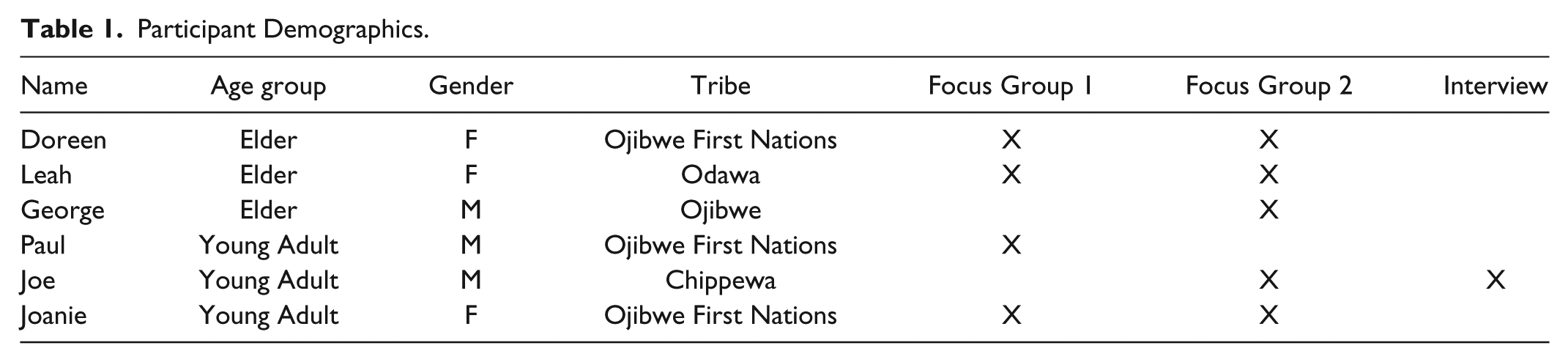
Indigenous community partners from diverse tribal nations, residing in the Chicago area participated in this study. Community partners were over the age of 18, with an explicit goal to have a representation of elders recognized as leaders within the urban Indigenous community, as well as younger participants with more recent school experiences. In this way, the range of ages and tribal affiliations of the participants provided multiple perspectives around engaging in collaborative, field-based teacher preparation. Community partners possessed expertise as community teachers (Murrell, 2000) in meeting the needs of urban Indigenous children and ideas around bridging the gap between schools and Indigenous communities. The university’s Internal Review Board approved this study and all community partners provided consent. Table 1 details the participants’ demographics, including tribal affiliation and involvement in the study. My use of Ojibwe and Chippewa were reflective of each participant’s respective tribal nation; I recognize the complexity and colonial oppression embedded in settler imposed naming and respect tribal sovereignty in choosing when or if they engage in renaming processes (Pewewardy, 2008). All participant names have been replaced with pseudonyms to protect their anonymity.
Participant Demographics.
Researcher Role
Being an insider of both institutions, I took a primarily researcher role during the Community Immersion module featured in this article. As an Odawa descendant and active member of the Kateri community, I was ever-conscious of historical wrongdoings in Indigenous research and the ongoing trauma that resulted from poorly designed studies (Deloria, 1991) and committed myself to improving Indigenous educational research. To do so, I consistently prioritized the needs of Kateri and community partners. Being a member of the Kateri community, I had previous relationships with each of the participants in this study that were both professional and personal. Within the organization, I offered service in curriculum design and grant writing; I also shared ceremonies, engaged in cultural practices, and sought spiritual guidance with the Kateri community and thus, participants of this study. Concurrently, I worked as a graduate assistant and part-time TLLSC faculty member, assisting in the design and implementation of multiple modules in the undergraduate and graduate program. As a part-time faculty member, I had collegial relationships with other TLLSC faculty members and administrators. With this study occurring in the first semester of graduate level teacher candidates’ enrollment in TLLSC, I had no existing relationships with the candidates during the research process. As a member of both organizations, I encouraged Kateri leadership to partner with TLLSC to improve urban Indigenous education, and acted as a liaison between both parties during module experiences.
Data Collection
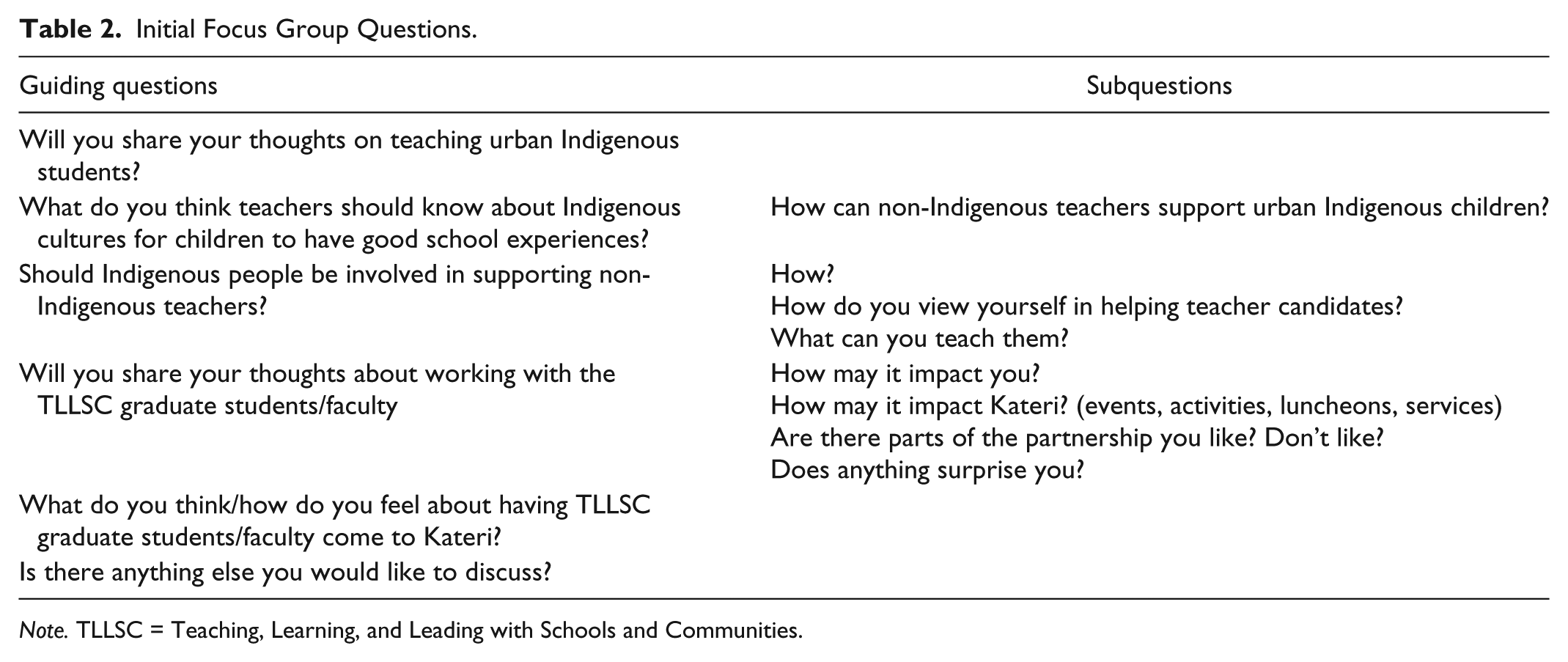
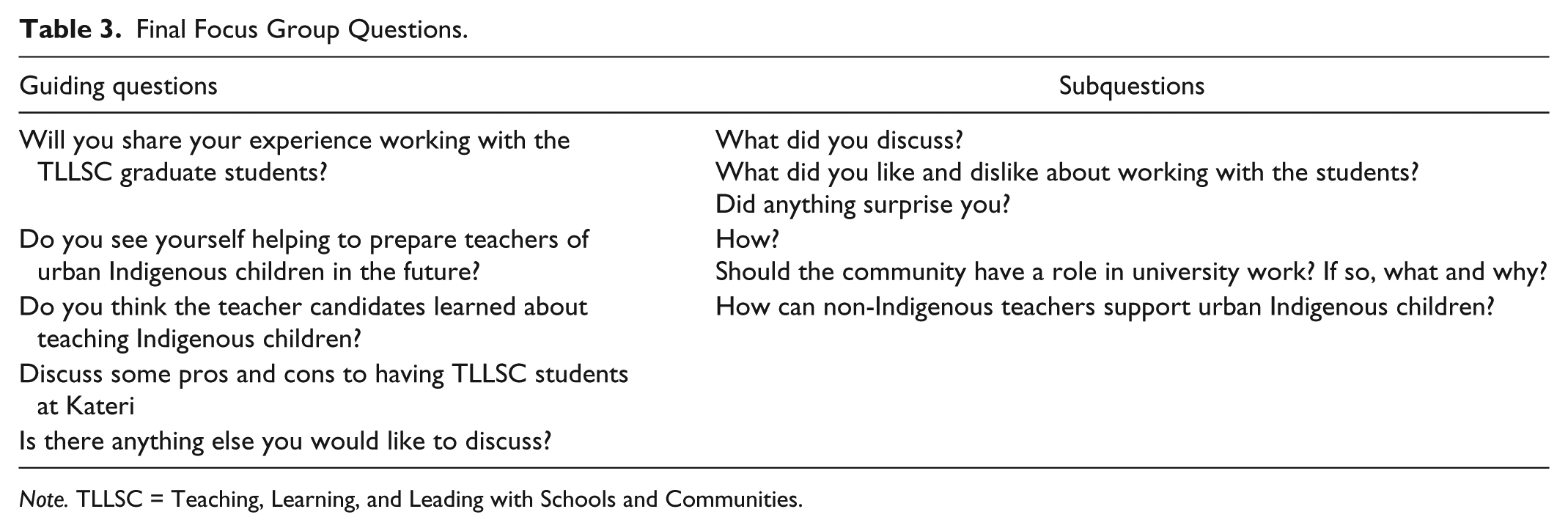
Data collection included focus groups, participant observations, and interviews, with the multiple data sources employed to triangulate findings (Merriam, 2009). The chosen methods of data collection were supported in the literature around qualitative research (Erickson, 1986; Merriam, 2009), single case design (Stake, 1995), and Indigenous studies (Deloria, 1991; Sobeck et al., 2003) to develop a framework that was both valid and culturally congruent. Focus groups, observations, and interviews were grounded in Indigenous traditions and aligned with IPT (Battiste, 2000) by recognizing Indigenous community partners as experts in the needs of Indigenous children. Focus groups with community partners prior to and immediately following the Community Immersion module served as a primary data source and aimed to create a sense of community similar to talking circles, which are traditional Indigenous ways of sharing information and discussing problems (Chilisa, 2012; Sobeck et al., 2003). As the researcher, and an involved member of the Kateri community, I facilitated the focus groups and interview by posing initial questions and allowing the discussion to be led by elder community partners whose wisdom and experiences were respected and sought out by myself and the young adult partners (Chilisa, 2012); I then posed follow up questions as needed to continue the discussion. The initial and final focus group questions that were referenced throughout the discussions are depicted in Tables 2 and 3.
Initial Focus Group Questions.
Note. TLLSC = Teaching, Learning, and Leading with Schools and Communities.
Final Focus Group Questions.
Note. TLLSC = Teaching, Learning, and Leading with Schools and Communities.
Direct observations (Merriam, 2009) acted as a secondary data source and aligned with community values and methods of acquiring information by watching and listening (Cajete, 2005), placing myself as an instrument for data collections (Chilisa, 2012). I observed all partnership activities and completed detailed notes for analysis immediately following my observations to ensure I was fully present while observing and also able to capture the essence of those observations in detail (Chilisa, 2012; Merriam, 2009). Finally, all participants had the opportunity to partake in a one-on-one interview if they were unable to attend the focus group sessions, or were more comfortable sharing their experiences apart from the group. One participant chose this option due to a scheduling conflict with the initial focus group and the same questions from the focus group discussion guided the interview.
Data Analysis
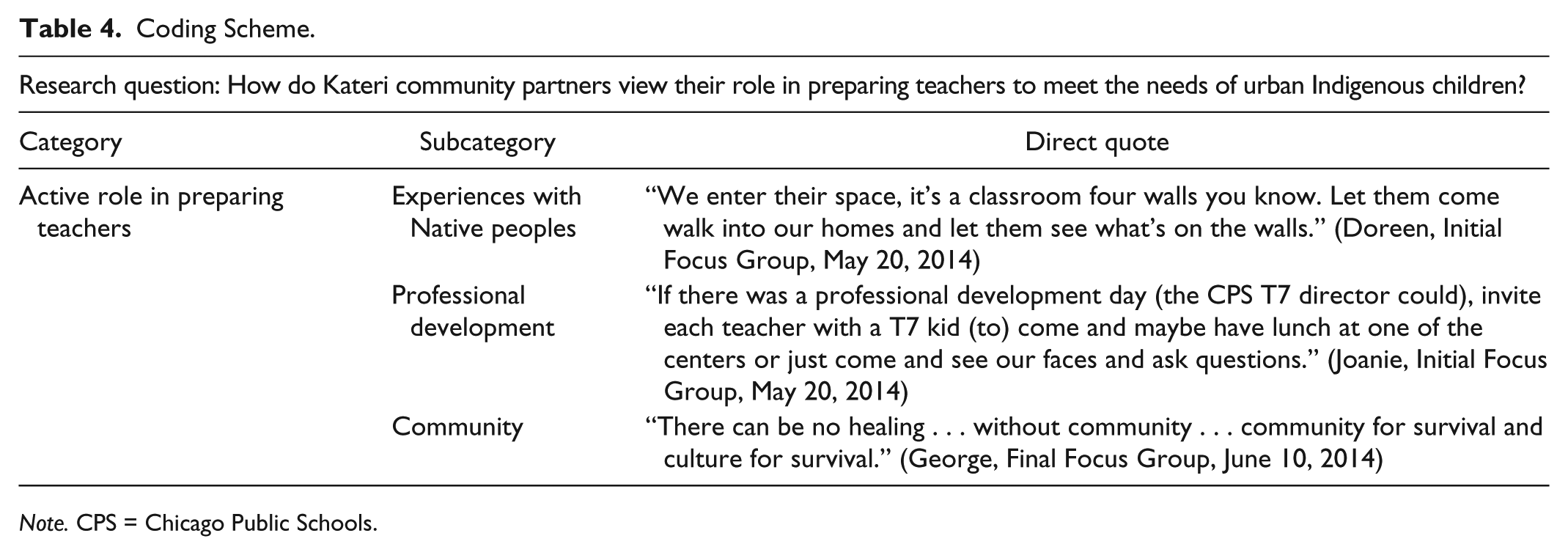
Focus groups and interviews were audio recorded with a digital voice recorder and transcribed verbatim using ExpressScribe software. I then utilized Dedoose, a web based qualitative research data analysis software, to explore the data and discern findings through an open coding method (Hartmann & Gone, 2012). Using conventional content analysis (Hsieh & Shannon, 2005), coding was an iterative process where I read and reread the transcripts to make meaning from participant ideas and began sorting information in broad categories related to the research question. I developed codes primarily using community partners’ exact words to capture their key thoughts and ideas and determined which codes represented more than one key thought, then aggregated the data in emerging categories (Hsieh & Shannon, 2005; Stake, 1995). This categorical aggregation allowed me to organize participants’ experiences as they related to my research questions (Hsieh & Shannon, 2005; Stake, 1995). I also made direct interpretations of individual instances that were important to the focus of this study (Stake, 1995, p. 74), knowing that in case study a central occurrence relative to my findings may have only happened once (Stake, 1995). Repeatedly examining the data, reading the transcripts again and again to find patterns and meanings, I used Dedoose to narrow the categories and individual instances into more specific themes using multiple descriptors to connect findings with research questions (Hsieh & Shannon, 2005; Merriam, 2009). In this, I created definitions for each category, subcategory, and code, using direct quotes to define codes. Referring to the codes and direct quotes, as they answered each research question. Table 4 offers an example of the coding scheme used for data analysis:
Coding Scheme.
Note. CPS = Chicago Public Schools.
I employed IPT to examine the Kateri–TLLSC partnership’s efforts toward postcolonialism; throughout this study, I asked if the Kateri–TLLSC partnership (a) acknowledged the historical and current oppression present in Indigenous communities, (b) recognized the need to decolonize the educational system to develop a postcolonial state, (c) endeavored to heal prior traumas, and (d) respected the assets Indigenous communities possess (Battiste, 2000). The discussion and conclusions section of this article includes considerations of each finding as related to IPT, and the framework drove the recommendations that complete this study. Using IPT provided a strong lens for how the Kateri–TLLSC partnership addressed the particular needs of an urban Indigenous community organization working to enact positive change in their children’s educational experiences.
Limitations
This study addressed the roles of Indigenous community partners as co-teacher educators in a particular context. I examined the unique experiences of six community partners in a single case, the Kateri–TLLSC partnership. Given the small sample size, uniqueness of the context, and brief nature of this study, the findings were not generalizable to all partnerships in teacher education. However, they offered significant insights into partner roles as co-teacher educators that will be discussed in detail further in this article. The process of discovery in this study shed light on other areas of investigation within the TLLSC program regarding community partnerships. The findings in no way drew explicit conclusions related to other aspects of teacher preparation, rather suggestions for systemic change and additional considerations for further development of teacher preparation for Indigenous education. Another limitation in this design was the length of the study. This study did not examine the possibility of longevity; it only examined the initial implementation of a single TLLSC module, which was a novel experience for community partners. I recommend continued investigation of the Kateri–TLLSC partnership, as well as other partnerships within TLLSC and other Indigenous communities engaged in university partnerships to ensure mutuality and sustainability in efforts of collaborative, field-based teacher preparation.
Findings: Active Role in Preparing Teachers
In this section, I answer the research question: How do Kateri community partners view their roles in preparing teachers to meet the needs of urban Indigenous children? The community partners indicated three themes in response to this question: (a) experiences with Native peoples, (b) professional development, and (c) community; through each of these themes, community partners depicted an active role for urban Indigenous community members in teacher preparation. In the ensuing subsections, I address each of these themes, followed by a discussion of the findings.
Experiences With Native Peoples
Findings from the first research question indicated that community partners recognized the importance of offering candidates direct experiences with Indigenous communities to acquire the knowledge needed to serve urban Indigenous children. During this study, I observed community partners displaying sensitivity to the needs of candidates and offering more of their personal time to provide meaningful, direct experiences in an Indigenous community setting. Community partners conversed,
Somebody recently asked me if we can take people into our homes to show them. For instance, teachers bring them to our homes. Invite them to dinner. This is our home. This is how we live.
And show them what, Indian blankets?
We could be Indians today. We could be ordering Chinese food . . . We could watch shows. It’s just like come on in and share this family. I would have loved one of [my daughter’s] teachers to come into our home and see truly how this child is in the home.
That sounds like a good idea.
It’s like entering your space you know. We enter their space, it’s a classroom four walls you know. Let them come walk into our homes and let them see what’s on the walls.
Doreen and Joe expanded on this discussion and considered why direct experiences are important and how they could be facilitated,
I think one of the things they need to see is there’s a continuing story here.
I think what needs to be done is, especially if these are students that are going into the field of education, a 2-week initial course. Like this is wonderful, but something on going . . . This needs to be something that is ongoing.
I observed community partner Joanie taking an active role in facilitating direct interactions between candidates and Indigenous peoples. Beyond meeting with the candidates to complete an interview, she provided a guided tour of Indigenous community organizations throughout the city—I observed her making phone calls to schedule meetings with educational leaders at three Indigenous community organizations. In this interaction, I observed Joanie emphasize her desire to provide candidates safe spaces to explore a community different from their own. Reflecting on her time mentoring two candidates, she stated,
I think the time needs to be spread out. It’s too much for them . . . We expect them to take everything they think and know about Indians, change that in three hours (after an initial) presentation, then meet us, then talk about having our interview questions . . . it’s almost a disservice to the (candidates) . . . It’s like Indian 101 in 2 days.
In addition to needing more time to process the bulk of information, Joanie expressed concern about the candidates’ comfort level,
I found myself wanting to create a safe place for them from the get go, so I told them you won’t insult me I’ve heard it all . . . If they can speak about diversity you have to talk about commonalities. Because I’m not going to bond with you if I don’t see you know, middle ground. So with that being said, I tried to do that at the beginning. You know feed them, bonding, that’s not just specific to the Native community it’s human. Then when it came to the Native information I think they were more willing and open because . . . they got to experience it themselves and they did good.
Committing to increase their role in teacher preparation, Joe and Joanie discuss the importance of structuring their time with candidates,
Some of them with the words during the presentation [were] afraid of not taking away from the words they were given or lessons or the information. They were afraid to interpret that for themselves because they didn’t have time to decompress it and put it back together. And the other thing is providing time where they can address us as a group one by one, why did they want to be a teacher? What influenced them? We didn’t get anything to know about them. It was one sided.
I think I engaged my students pretty well. I don’t know how you did your interviews, but I want to know a little about them for God’s sake.
Well they told me a little about them, but I didn’t know if that was common.
Joe critiqued the candidates’ take-aways after the shortness of time spent at Kateri,
I personally think on one aspect them getting outside of their comfort zone they did an ok job on, but they could have as far as . . . their awareness wasn’t as great considering they talked to all of us and we know the community, they didn’t use our knowledge.
Joanie responded and reiterated the need to form relationships, “I recommend that next time we have to eat with them . . . serve them . . . give them Indian tacos.” The community partners agreed with Joanie and brainstormed ideas for structuring time to share meals within the field-based teacher preparation model.
While discussing the need to increase candidates’ time spent with community partners, Doreen acknowledged the complexity of increasing the numbers of community partners, she stated, “I think some of the community is shy about people coming in, because a lot of our people were not taught to trust. Right away, ‘What are you here for? How much are they taking from me?’” The community partners nodded in agreement that lack of trust and previous negative experiences with non-Indigenous peoples impacted the community members who chose not to participate as mentors, and that it would take time for those community members to gain trust and begin participating as partners in teacher preparation. Acknowledging the challenges, Joe reiterated his commitment to teacher preparation,
That’s the prime time, in the first 7 years of education/the work force, that’s when you should broaden your horizons. Because when you’re tainted by the life in the work force and then you have to go through this professional development you’re going to dig your heels in because you’re going outside the norm and they’re just going through the process because they have to. They aren’t open to the process they’re just working the process. So if you get it before hand while their mind is still absorbent then go for it, so they’re not tainted.
Professional Development
While community partners demonstrated a genuine commitment to providing candidates opportunities to engage with Indigenous communities prior to entering the work force, they also recognized the importance of their role supporting inservice teachers to better serve today’s urban Indigenous students. Building from a conversation about the need to collaborate with CPS teachers to improve Indigenous children’s school experiences, Joe explained the professional development that occurred between his own tribe and teachers at a school near his reservation:
Back home on the reservation there was a lot of community meetings with our teachers. We would have talking circles and so not just the teachers on the reservation, but the teachers off the reservation . . . It took a lot of dialogue . . . And then finally the school district said, we need to fix this because most of the population attending the public school system off the reservation is Native American . . . So they reevaluated and did some exercises and . . . all of the teachers were required to in the summer take, audit this course just to get a better understanding.
I asked Joe to consider if the approach he witnessed between his tribe and teachers at the local school could transfer to Chicago’s urban Indigenous context. He stated,
We really can’t do that universally, systematically because (CPS) is so vast. But . . . if we concentrated our efforts to where the majority of our Native students are, in that one zone, and if we find out our students attend these three to four different schools, I think we could do what we did on the reservation and have this dialogue with these certain schools that our children attend . . . (but) it’s possible; I mean the old adage Rome was not built in a day. We can’t systematically go and change everything about (the) CPS system, but we can chip away at it. And if we start at this level and chip away at it hopefully it will get bigger and then it will be a universal at least in CPS it will be a universal requirement.
Joanie concurred that community-led professional development was an important facet of improving Indigenous education, she suggested,
If there was a professional development day (the CPS Indian Education director could), invite each teacher with an Indigenous kid (to) come and maybe have lunch at one of the centers or just come and see our faces and ask questions.
My observations indicated that Joanie remained hopeful that community partners could engage teachers with Indigenous communities to help them understand the importance of addressing the particular needs of Indigenous children.
Joe depicted further his responsibility to lead professional development, he stated,
We have to have an active role. As it is now we’re putting 110% trust in these non-Native instructors without really knowing anything about them. I’m sure some of them come with prejudices, and if they do that’s being, not necessarily consciously, but subconsciously it’s being taught to our students who are picking up on that.
Community partners portrayed their agreement that they must take an active role supporting inservice teachers in their work with urban Indigenous children because no other group was taking accountability for leading that effort. Their quotes made clear that greater community work was necessary to support the needs of urban Indigenous children and their teachers, which is discussed as the final theme in this section.
Community
Along with community partners having an active role supporting teachers, they believed the greater Chicago Indigenous community held responsibility for improving Indigenous education. In this study, community was defined as all Indigenous peoples and community organizations in the Chicago area. Believing that this extended network was relevant in addressing the needs of urban Indigenous children, inservice teachers, and candidates, Joe asserted,
I think even if our parents and grandparents stepped up to the plate a little bit more and helped their students in vocalizing something and getting to help the teachers get a better understanding of how we do things. You know we’ve discussed that a lot of people, we, our people complain that we were set up to fail in society and they want the dominant society to give everything to us so we can at least . . . balance things out.
This excerpt captured the complexity of Indigenous peoples’ roles in collaboration efforts with non-Indigenous schools and teachers to improve urban Indigenous education, with Indigenous peoples explaining their cultures and ways of teaching and learning to non-Indigenous teachers. Reflecting on the challenges and displaying pride in the community’s resilience Doreen stated,
I’ve been in this community oh my goodness how many years now, I think I started here in 1986 working for the Indian community . . . and there’s been struggles . . . there’s lots of diversity . . . in our community, but there’s one thing we should be proud of we’re still here. We are here. And we have some powerful people.
Community partners also illustrated the challenges of collaborating as an urban Indigenous community. Responding to why some community efforts to improve urban Indigenous education have not come to fruition, Doreen took responsibility and stated, “Because we don’t know how to work together. That’s why nothing happened.” Continuing this discussion, Doreen examined the roles of the past CPS Indigenous education directors, “What are (they) doing? Did they make a difference for our children?” Paul pondered this question and considered his own experience as a CPS student who was not made a part of the CPS Indian education program. He stated,
If you want to know when your kid was in school, who was in charge, you should be able to reflect back and it’s shame on them (for not being accessible). And it’s really upsetting because all my peers, I could have been friends with them my whole dang life; grow up with Indians since I was in kindergarten. All my peers are my age. It’s ridiculous, all my peers, its just . . . no connection. Zero connection.
Paul was explicit in describing how a lack of community support impacted his experiences as an Indigenous child without a peer group who shared his identity. We discussed his experience in taking a job with an Indigenous community organization after completing high school,
It’s amazing that I was able to coincide at 18, 19 and work at the [community organization]. And what if I didn’t? I could have gone and got some stupid, any job and decided that money was better than working at the [community organization].
And remained disconnected from the community?
Exactly.
A lot comes from strength in numbers and a voice.
Yes. And yeah, maybe this is sort of the grand scheme of things, not to have my age range . . . not to have your peers there and have a similar voice you know.
Cause you’re urban already, by the time you get your voice you’re already modern.
Responding to this discussion, Joanie reiterated her commitment of taking an active role to improve Indigenous education and asked the group, “So are you going to sit around and complain or strategize about it?”
In addition to challenges collaborating and connecting as a tribally diverse community, community partners discussed the difficulties faced with insecure funding sources:
That’s hard when we have funding and it disappears for the people and our people are left and the doors are closed. It’s terrible you know.
Especially when what is it 78% of us according to the census live in the city.
Yeah at one point it was 50% on reservation and 50% off, but it’s higher now.
You’d think that those numbers alone would (mean something).
When candidates asked Paul what additional resources could be used for educational programs Paul simply replied, “Funding. We need funding.”
During this study, I observed community partners act on the difficulties associated with insecure funding and engage as a collaborative to combine resources and address shared goals for improving urban Indigenous education. In these observations, community partners from varying Indigenous organizations met monthly to discuss the work of each organization and their roles in addressing community issues. Community partners framed this group as a starting point to making a greater impact on mutual causes, and declared that Indigenous community organizations must come together to support the needs of urban Indigenous children, families, and their non-Indigenous teachers. The topic of greater community efforts as a role in preparing teachers for the needs of urban Indigenous children was succinctly concluded with George’s reflection of a discussion he had during a weekend retreat. He stated, “There can be no healing . . . without community . . . community for survival and culture for survival.”
Discussion and Conclusions
In this study, I shared voices of Indigenous community partners regarding their experiences and perspectives around collaborative, field-based teacher preparation to improve urban Indigenous education. Community partners’ ideas around the roles of Indigenous community members in preparing teachers for the needs of urban Indigenous children moved beyond the established literature. Community partners identified three facets of active involvement to support the needs of urban Indigenous children and their teachers: (a) experiences with Native peoples, (b) professional development, and (c) community. Each of these themes advanced the conversations around the perceptions and roles of Indigenous communities as sovereign stakeholders committed to decolonization in primarily non-Indigenous teacher preparation. In this section, I discuss how these findings advanced the literature around collaborative, teacher preparation with urban Indigenous communities and the implications of IPT to realize self-determination through self-education in tribally diverse, urban contexts.
Experiences With Native Peoples
Community partners believed that they must take an active role in affording candidates direct experiences with Indigenous peoples to understand and meet the needs of urban Indigenous children. Aligned with extant literature, they believed that these experiences must be prolonged and occur in varying contexts for candidates to develop an understanding of community ways of teaching and learning (McDonald et al., 2011; Murrell, 2000; J. Oakes et al., 2002; Stachowski & Mahan, 1998). Community partners moved beyond accepted models of teacher preparation and suggested that urban Indigenous community members must actively engage with candidates, facilitate opportunities for candidates to have direct experiences with Indigenous peoples, and assist candidates in developing relationships with Indigenous families and communities to understand what it means to be Indigenous in an urban setting. This finding offered clear recommendations for the roles of community partners in teacher preparation, advancing current models focused on preparing teachers for urban schools with no clear role for community partners or acknowledgment of the uniqueness of preparing teachers for urban Indigenous communities.
Through this finding, I revealed that the Kateri–TLLSC partnership acknowledged some basic historical and current oppression present in Indigenous communities, and began to respect the assets Indigenous communities possess; but did not recognize the need to decolonize the educational system or endeavor to heal prior traumas (Battiste, 2000). This analysis makes clear that including Indigenous community partners in teacher preparation programs requires a radical reform in university structures (de Oliveira Andreotti et al., 2015). As it stands, public institutions for education are grounded in colonial assimilationist policies (Kumar, 2009) content with soft reform efforts (de Oliveira Andreotti et al., 2015). For teacher preparation programs to move beyond Eurocentric principles, and recognize and value Indigenous community knowledges as essential teacher understandings (Brayboy & Maughan, 2009), university administrators and faculty must embrace decolonization, redefine who they consider experts in preparing teachers for urban Indigenous communities, and collaborate with Indigenous peoples to design curricula inclusive of Indigenous education as a short-term goal.
Professional Development
Findings moved beyond this study’s original scope of teacher preparation, as community partners depicted their roles in supporting inservice teachers through community-led professional development. In discussions around improving Indigenous education through improved teacher preparation, community partners explained their responsibility to address the instruction and curriculum present in public schools. They described instances where they initiated trainings for teachers serving Indigenous children, and identified opportunities for expanding community-led professional development for inservice teachers in an urban district. This theme advanced the literature, which identified the importance of preparing more Indigenous teachers to serve Indigenous children (Belgarde et al., 2002; Brayboy & Castagno, 2009; Deyhle & Swisher, 1997) and instances of self-education through community-led schools (see Little Big Horn; Rough Rock Community School), but did not emphasize the role of Indigenous communities in supporting the development of inservice teachers’ knowledge.
This finding moved outside the scope of the Kateri–TLLSC partnership, but did demonstrate an alignment with each of the questions guiding the examination of efforts toward postcolonialism (Battiste, 2000). Interestingly, Indigenous community partners initiated and sustained their active efforts to engage as leaders in professional development, which revealed that community partners were committed to creating a postcolonial state. Carving out spaces to enter classrooms and schools and inviting teachers to community organizations to increase competencies in urban Indigenous education demonstrated community partners’ commitment to radical reform efforts that upturn patterns of colonial oppression on the part of public education by taking an initiative to transform school curricula with Indigenous knowledges (de Oliveira Andreotti et al., 2015). Through these efforts, urban Indigenous communities may guide the educational experiences of their children, decolonizing the existing school system by advancing mainstream curricula and methods of instruction. By recognizing and revitalizing Indigenous cultures, knowledges, and ways of teaching, and transforming contemporary systems of education inclusive of Indigenous peoples, Indigenous communities may surpass short-term goals of radical reform and realize a postcolonial state beyond reform (de Oliveira Andreotti et al., 2015).
Community
Research indicated the importance of community–school collaboration to meet the holistic needs of Indigenous children (Brayboy & Castagno, 2009; Cajete, 2005; Castagno & Brayboy, 2008; McCarty, 2012; A. Oakes & Maday, 2009; Quigley, 2006) and the value of extended community networks as resources in serving culturally and linguistically diverse children in mainstream school settings (Moll, Amanti, Neff, & Gonzalez, 2005). Community partners discussed the importance of urban Indigenous communities forming extended networks to offer support away from tribal resources, and placed increased responsibility on communities to come together to facilitate communication with non-Indigenous teachers to express their children’s needs. The literature addressed self-determination as an essential factor in sustaining quality Indigenous education, putting forth that schools supported by Indigenous leaders resulted in improved success for Indigenous students (Brayboy & Castagno, 2009; Castagno & Brayboy, 2008; McCarty, 2012). Community partners did not specifically reference self-determination, but emphasized the importance of Indigenous peoples taking leadership roles in educational programming as they held knowledges and experiences not represented in public education and were responsible for offering teachers strategies for improving urban Indigenous education (Brayboy & Castagno, 2009; Castagno & Brayboy, 2008; McCarty, 2012). To sustain these efforts and find positive results, community partners emphasized the need to work together and also the challenges in doing so. Despite these challenges, they were optimistic that with extended experiences, repeated throughout the candidates’ preparation, both the candidates and community members would benefit and ultimately improve the educational experiences of Indigenous children.
Community partners’ optimism around the potential benefits of collaborative, field-based teacher preparation aligned with the historical resilience demonstrated by Indigenous communities continuously oppressed by colonization (Grande, 2008). Indigenous communities worked to maintain their values and traditions to preserve their cultures for future generations—upholding Indigenous ways of teaching, in spite of colonial systems of education (Cajete, 2005). The roles and perceptions of community partners as co-teacher educators depicted in this study were a passive continuation of unequal partnerships between Indigenous and non-Indigenous institutions. In this sense, the Kateri–TLLSC partnership (a) acknowledged the historical and current oppression present in Indigenous communities, but failed to, (b) recognize the need to decolonize the educational system to develop a postcolonial state, (c) endeavor to heal prior traumas, and (d) respect the assets Indigenous communities possess (Battiste, 2000).
Overall, findings from this study did not depict the partnership as overtly negative, but rather community partners’ shared that their experiences were more of the same in regards to university clinical placements with Indigenous communities as brief encounters for candidates to experience otherness through soft reform efforts that risk tokenizing the knowledges and experiences of Indigenous peoples (de Oliveira Andreotti et al., 2015). To sustain mutually beneficial partnerships, working toward a long-term goal of postcolonialism, Indigenous community–university partnerships must include prolonged experiences grounded in relationships between Indigenous community partners and candidates. Next, I present recommended changes for moving forward.
Recommendations
To realize a postcolonial state, with schools serving the needs of Indigenous peoples, teacher preparation programs must reconsider how they prepare candidates to meet the needs of all children. Field-based teacher preparation, such as the model depicted in this study, holds great potential in addressing community needs and improving Indigenous education by engaging community partners as co-teacher educators. However, successful community–university partnerships require expanded space for community voice (Ristock & Pennell, 1996), with university faculty considering who are valued stakeholders in teacher preparation (Clare & Sampsel, 2013; Kruger, Davies, Eckersley, Newell, & Cherednichenko, 2009; Lees et al., 2016; Murrell, 2000). For teacher preparation programs to sanction change in Indigenous education, they must commit to decolonizing the institution and embrace community partners’ active roles in fostering candidates’ understandings around teaching Indigenous children (Clare & Sampsel, 2013) and value Indigenous knowledges and ways of being (Brayboy & Maughan, 2009).
Valuing Indigenous communities’ knowledges as important assets in teacher preparation will require universities to address underlying beliefs of faculty members as the holders of information. Indigenous community members hold knowledge candidates need to better serve urban Indigenous children; thus, university-based teacher preparation programs must create space for community partners as valued resources in preparing candidates for Indigenous education. These changes require substantial paradigm shifts and reallocation of leadership that ultimately result in loss of power for traditional university faculty members as they work to combine efforts with community partners as co-teacher educators. This reform process presents difficulties and will require deep commitments and ongoing support of all parties. Fully engaging in such efforts, in collaboration with Indigenous communities, holds the potential for universities to address historical wrongdoings and act as allies to strengthen Indigenous education and commit to aspirations of postcolonialism beyond reform.
Footnotes
Acknowledgements
Chi miigwetch (thank you) to the Kateri Center of Chicago leadership and community members for their support, love, and encouragement that made this work possible.
Declaration of Conflicting Interests
The author(s) declared no potential conflicts of interest with respect to the research, authorship, and/or publication of this article.
Funding
The author(s) received no financial support for the research, authorship, and/or publication of this article.
Notes
Author Biography
References
Supplementary Material
Please find the following supplemental material available below.
For Open Access articles published under a Creative Commons License, all supplemental material carries the same license as the article it is associated with.
For non-Open Access articles published, all supplemental material carries a non-exclusive license, and permission requests for re-use of supplemental material or any part of supplemental material shall be sent directly to the copyright owner as specified in the copyright notice associated with the article.
