



Abstract
Inservice teachers, participants in a prior study on mathematics anxiety, were revisited to determine whether their levels of mathematics anxiety still existed and/or continued to change after 5 years teaching experience. A 98-item Likert-type survey, informal discussions, informal interviews, and questionnaire-guided narrative interviews were conducted. Date revealed that all inservice teachers still experienced some degree of mathematics anxiety (p < .001). Results have implications for teacher education programs concerning the continued professional support of teachers, measurement of mathematics anxiety levels among pre- and inservice teachers, and the determination of specific contexts in which mathematics anxiety can be interpreted and reduced.
Introduction
For decades, research has documented mathematics anxiety in both pre- and inservice elementary teachers (Adeyemi, 2015; Aslan, 2013; Beilock, 2010; Boyd, Foster, Smith, & Boyd, 2014; Catlioglu, Gurbuz, & Birgin, 2014; Hadley & Dorward, 2011; Luo, Wang, & Luo, 2009) and focused on the origin of their prior negative mathematical experiences, mathematical beliefs, the effect of prior teachers, and teacher education training programs. The findings have concentrated on factors that contribute to teachers’ mathematics anxieties and ways to address those anxieties in preparation for teaching mathematics (Belbase, 2013; Gresham, 2009; Nisbet, 2015; Peker, 2009). An underlying assumption of this research is that preservice teachers with high levels of mathematics anxiety are likely to become teachers who do not enjoy teaching mathematics and may not implement effective instructional teaching practices such as those prescribed by the National Council of Teachers of Mathematics (NCTM) Principles to Action, which aims to support mathematics success for all (Beilock, Gunderson, Ramirez, & Levine, 2010; Bekdemir, 2010; Gresham, 2009; Iyer & Wang, 2013). Mathematics anxiety has an effect on learning, and may perhaps be a greater block to mathematics learning than supposed deficiencies in our school curricula and teacher preparation programs (Maloney & Beilock, 2012). This is cause for alarm, considering that teachers who possess higher levels of mathematics anxiety may unintentionally pass on these negative feelings to their students (Boyd et al., 2014; Gresham, 2010; Haciomeroglu, 2013; Peker, 2009; Vinson, 2001, Vinson, Sloan, Haynes, Brasher, & Gresham, 1998).
There has been renewed emphasis and research regarding mathematics anxiety as many elementary preservice and inservice teachers continue avoidance of the subject due to lack of confidence, ability, and mathematical content knowledge (Beilock & Maloney, 2015; Bekdemir, 2010; Degli, Lake, & Jones, 2011; Dove, 2014; Fetterly, 2010; Lake & Kelly, 2014; Nisbet, 2015). Once in the workforce, teachers might find it particularly challenging to shake any affective discomforts, particularly as it pertains to mathematical confidence or beliefs, mathematical thinking, and any negative feelings/emotions they may experience toward mathematics and teaching the subject (Aslan, 2013; Haciomeroglu, 2013). The quality of mathematics instruction at the K-6 level depends on the preparation of preservice teachers to teach mathematics (Boyd, Foster, Smith, & Boyd, 2014). This preparation inevitably carries over into inservice teaching, but to what degree do mathematical confidence or beliefs, mathematical thinking, and any negative feelings/emotions experienced toward mathematics and teaching the subject continue or change? This research study particularly addresses a gap in the extant of literature on teacher preparation by longitudinal examination. Particularly, this study is interested in understanding mathematics anxiety in relation to teaching practice for 10 teachers who not only had high anxiety postmethods scores but also had highest decreases in their mathematics anxiety during the mathematics methods course 5 years earlier. Inservice teachers’ voices must be heard and there must be a continued emphasis and illustration of its importance. This research focuses on this purpose and how it relates to the cycle of mathematics anxiety and continues to further support the push for effective methods and content courses within teacher education programs. Therefore, 10 inservice teachers (previously involved in a preservice teacher research study on mathematics anxiety) were revisited to study the primary research question:
A combined quantitative and qualitative approach was used for this study to provide a more complete and synergistic utilization of data for comparison between inservice elementary teachers’ levels of mathematics anxiety and their preservice posttest mathematics anxiety scores after 5 years teaching experience and to determine, whether any, the cause of such affected change in mathematics anxiety.
Mathematics Anxiety Defined
Mathematics anxiety knows no boundaries (Tobias, 1998) and has been defined as a feeling of uncertainty and uneasiness when asked to do mathematics. It may manifest as an inability to perform well on tests, a feeling of physical illness, helplessness and panic, faintness, and mental disorganization (Bursal & Paznokas, 2006). It may be a dread of not being able to do well in mathematics or with numbers. Tobias (1978) gave the shortest definition of mathematics anxiety, describing it as the “I can’t” syndrome. She stated, “People almost experience sudden death with mathematics anxiety, as if a curtain has been drawn, like an impenetrable wall ahead, or seemingly standing on the edge of a cliff ready to fall off” (p. 45). It is a phenomenon where individuals suffer from the irrational fear of mathematics to the extent they become paralyzed in their thinking and are unable to learn or be comfortable with mathematics.
Mathematics anxiety can be caused from a single humiliating mathematics experience or through a lack of applied understanding and application of mathematical concepts (Maloney & Beilock, 2012). It often leads to avoidance of the subject and creates a negative attitude toward mathematics (Zakaria, Zain, Ahmad, & Erlina, 2012). Specific to mathematics instruction, mathematics anxiety inhibits mathematics performance and learning (Devine, Fawcett, Szücs, & Dowker, 2012; Jansen et al., 2013). Mathematics anxiety has been identified as a characteristic in individuals who have learning problems and is considered to be both emotional and cognitive in nature (Bursal & Paznokas, 2006). Although no one cause can explain mathematics anxiety, it is widely believed that it results from parents’ and teachers’ attitudes toward mathematics, low self-concept, the inability to handle frustration, and an emphasis on mathematics drill and practice exercises about mathematics focusing on deeper understanding of mathematics facts and mathematics concepts (Kelly & Tomhave, 1985). It is a frequently encountered condition in all levels of education. Identifying and understanding mathematics anxiety as well as finding ways to avoid or reduce it are crucial for successful mathematical learning.
Mathematics Anxiety—Who Gets It and Why?
Extensive research on mathematics anxiety has been conducted throughout the United States particularly because girls/women demonstrate a fear or even antipathy toward mathematics (Beilock et al., 2010; Belbase, 2013; Catlioglu et al., 2014; Goetz, Bieg, Lüdtke, Pekrun, & Hall, 2013; Gresham, 2008a; Lake & Kelly, 2014; Lomas, Grootenboer, & Attard, 2012). Female students and students who have previously received lower than expected or below average mathematics scores have tended to have higher levels of mathematics anxiety (Hadley & Dorward, 2011). In addition, studies have consistently shown that K-6 education majors have the highest or one of the highest levels of mathematics anxiety (Gresham, 2008b; Kelly & Tomhave, 1985; Mizala, Martinez, & Martinez, 2015). However, a recent study by Aslan (2013), indicated that inservice teachers had higher levels of mathematics anxiety than preservice teachers. He argues that differences in inservice teachers’ levels of mathematics anxiety were related to their mathematics education and mathematical experiences.
As research has identified those who have mathematics anxiety, it is important to identify the causes or why these individuals experience mathematics anxiety. Lake and Kelly (2014) linked negative teacher attitudes about mathematics to mathematics anxiety. Negative attitudes toward mathematics can produce negative achievement in mathematics due to the reduction of effort expended toward the activity, the limited persistence one exerts when presented with an unsolved problem, the low independence levels one is willing to endure, and whether or not a certain kind of activity will even be attempted (Cruikshank & Sheffield, 1992; Fetterly, 2010; Vinson et al., 1998). Research has been written regarding the causes of mathematics anxiety such as assigning the same work to everyone, teaching the textbook problem by problem, and insisting on only one way to complete a problem. Effective approaches such as using problem-based learning, concrete experiences, incorporating real-life simulations, and implementing hands-on strategies have been known to reduce mathematics anxiety (Finlayson, 2014; Gresham, 2008a; Lake & Kelly, 2014; Unglaub, 1997; Vinson, 2001). The very nature of instruction itself seems to be a powerful source in shaping latter attitudes, expectations, and conceptions of learning in mathematics.
Preservice/Inservice Teachers Mathematics Anxiety and Its Relation to Instruction
Relatively little is known about mathematics anxiety as experienced by inservice teachers over time or how to reduce it. Therefore, current research conducted with inservice teachers is necessary to better understand and probe this important topic and the extent to which it exists and interacts with their teaching elementary mathematics. Even though inservice research is limited, there is extensive research involving preservice teachers (Aslan, 2013; Bekdemir, 2010; Bursal & Paznokas, 2006; Gresham, 2007; Haciomeroglu, 2013; Kelly & Tomhave, 1985; Levine, 1993; Vinson, 2001). Many preservice teachers do not feel confident in their ability to do mathematics, which carries into inservice practice. Fortunately, attention is directed toward the mathematics curriculum and in helping those who struggle learning basic mathematics skills, mastering more advance mathematics, and solving mathematics problems (Adeyemi, 2015; Aslan, 2013; Jackson, 2015). Although the NCTM (2014a) strongly encourages teaching mathematical understanding and reasoning, the making of meaningful connections, and the understanding of concepts and procedures through problem solving, the reality for teachers with mathematics anxiety is that they spend most of their mathematical time learning and practicing computation procedures and have little confidence in their ability to learn more advanced mathematical skills (Beilock et al., 2010; Iyer & Wang, 2013).
Being confident and knowledgeable in the subject matter is critical in shaping one’s attitude toward mathematics including the attitudes of teachers (Catlioglu et al., 2014; Carey, Hill, Devine, & Szücs, 2015). Studies have indicated that mathematics anxiety has implications for teacher practices in mathematics (Carey et al., 2015; Gresham, 2008b; Hadley & Dorward, 2011). Teachers with high levels of mathematics anxiety use more traditional teaching methods, such as lecture. They concentrate more on teaching basic skills rather than concepts and devote more time to seatwork and whole class instruction (Finlayson, 2014). Therefore, it is very important for teachers to have an understanding of the mathematics curriculum and knowledge of effective nontraditional approaches to teach mathematics effectively (National Governors Association Center for Best Practices & Council of Chief State School Officers, 2010). Utilizing nontraditional approaches in the mathematics classroom such as using manipulatives to bridge from concrete to abstract; implementing a variety of teaching techniques such as playing games, problem-solving strategies, small-group and individualized instruction; and addressing individuals attitudes toward mathematics can help lessen mathematics anxiety in both students and teachers (Degli et al., 2011; Lake & Kelly, 2014). One commonality found among mathematics programs reporting a reduction in mathematics anxiety for all individuals was that the material was introduced very slowly, no prior assumptions for mathematical knowledge were made, and individuals were encouraged to discuss their own thought processes in learning (Beilock & Willingham, 2014; Park, Ramirez, & Beilock, 2014). The most successful instructional mathematical programs were those featuring teachers who attempted to change the way mathematics was perceived and learned as well as through changes in instructional strategies (Bursal & Paznokas, 2006; Lake & Kelly, 2014; Park et al., 2014; Unglaub, 1997).
To ensure effective instruction, adaptations and modifications for instruction are necessary in the areas of lesson planning, teaching techniques, formatting content, adapting media for instruction, and adapting evaluation. Some teachers have limited teaching experiences and, therefore, have lessened opportunities in identifying mathematics learning concerns and mathematics anxiety in the students they directly teach. Obviously, limited teaching experiences, coupled with high levels of mathematics anxiety in preservice teachers is a concern as it may certainly carry over into the classroom once they become inservice. As a result, it is believed that teachers must be adequately prepared in mathematics (Aslan, 2013; Gresham, 2009; Lake & Kelly, 2014; Mizala et al., 2015; Peker, 2009; Wilson, 2013). The NCTM (2014b) Standards advised teachers to use a variety of instructional techniques and strategies to benefit all types of learners in the classroom. Unfortunately, many mathematics educators who teach primarily through lecture and rote memorization of algorithms often neglect to meet the needs of all students, and therefore, may unintentionally perpetuate mathematics anxiety (Hadley & Dorward, 2011; Sloan, Daane, & Geisen, 2002).
In this article, the literature review was structured to first focus on the definition of mathematics anxiety to obtain knowledge of its academic and emotional effects as it relates to mathematical learning. Research on mathematics as it relates to preservice and inservice teachers was visited as it was critical to establish a foundation of constructs in determining how mathematics anxiety affects teacher practices. Finally, focus was given to preservice and inservice teachers’ mathematics anxiety and instruction to make a compelling argument for the deficiencies of traditional approaches while offering hypotheses of how the methods used in elementary mathematics content and methods courses may affect mathematics instruction.
Method
Participants and Setting
The 10 inservice teachers in this study participated in a prior study that investigated preservice teachers’ mathematics anxiety before and after a mathematics methods course.
Even though their preservice posttest scores indicated a decrease in their mathematics anxiety levels at the end of the study, those levels still remained significantly high. Therefore, 10 preservice teachers with the highest levels of mathematics anxiety were asked to participate in the current study to determine whether their mathematics anxiety still existed and/or exhibited any change after five inservice years in an elementary education setting and to determine, whether any, the cause(s) of the affected change.
As undergraduates, all 10 teachers were required to take college algebra, principles in statistics, one K-6 mathematics content course, and one K-6 mathematics methods course. Additional mathematics courses were available as optional electives, but no teachers involved in this study chose to enroll in further undergraduate college mathematics courses beyond what was required within the elementary education program. All 10 inservice teachers were female. Seven were Caucasian, two were African American, and one was Hispanic. Each held a K-6 teacher certification endorsement. Three teachers held a master’s degree in education and one was within weeks of graduating with a master’s degree in education. All graduate studies were completed at the same undergraduate institution. For clarification and distinguishing between the two studies, the methodology from the previous study (preservice) will be discussed followed by the methodology for the current study (inservice).
Preservice Teacher Study
The previous study involved preservice teachers while enrolled in a mathematics methods course during their junior year of undergraduate studies. Two data sources were used for this study: a paper and pen questionnaire and oral interviews. The Mathematics Anxiety Rating Scale (MARS) a 98-item, self-rating Likert-type scale developed by Richardson and Suinn (1972) was used as the pre/post quantitative instrument for this study. Administered either individually or to groups, each item on the scale represents a situation that may arouse mathematics anxiety by indicating not at all = 1, a little = 2, a fair amount = 3, much = 4, or very much = 5. The MARS has been demonstrated to be a valid test (p < .001) with which it correlates at a level of .97. The test–retest reliability for the instrument has been shown to range from .78 to .85 and internal consistency has been reported as .97. Possible scores range from 98 to 490. Mathematics anxiety may be elevated by the scaling of items with possible scores ranging from 98 to 490 with high scores indicating a high level of mathematics anxiety.
The elementary mathematics methods course placed extensive emphasis upon the reform vision of the NCTM. Each preservice teacher was heavily involved in learning to provide effective instruction through the five process NCTM Standards: (a) communication, (b) problem solving, (c) connections, (d) representation, and (e) reasoning and proof. The elementary mathematics methods course encompassed an investigative approach to teaching mathematics. The investigative approach follows the major tenets of the above NCTM Standards and “involves purposeful, inquiry-based, and meaningful instruction, fostering all aspects of mathematical power, a powerful disposition, the processes of mathematical inquiry, and understanding” (Baroody & Coslick, 1998, p. 27). The course was designed to help preservice teachers develop an understanding of mathematics, mathematics pedagogy, and children’s mathematical development; and to cultivate a positive disposition toward teaching mathematics and lessen preservice teachers’ mathematics anxiety. Throughout the course, preservice teachers were involved in professional readings, group discussions, and writing about the philosophical underpinnings of different approaches to teaching and learning with a focus on the role of the teacher and student. The goal of this exploration was to help preservice teachers understand the importance and strengths of an investigative approach to teaching. Much of the mathematical content and skills were explored through hands-on approaches and strategies through the use of manipulatives in the mathematics classroom. Careful attention was given to show preservice teachers that manipulatives are for the purpose of making meaning and demonstrating concepts and not for the sole purpose of getting correct answers. Instruction was also provided on the integration of children’s literature and technology. Active participation was encouraged as they worked in cooperative and whole groups for various assignments during the semester. Investigative lessons were modeled and discussed. Preservice teachers were required to design their own investigative lessons, which were presented to the members of the class. They were also required to design and implement activities and teach a minimum of four investigative lessons using manipulatives with children during their 12-week internship experience in the schools.
The qualitative methods of the study included informal observations of preservice teachers, questionnaire-guided narrative interviews, informal discussions, and interviews that were either initiated by the preservice teacher during or after class or by the professor (the researcher in this study). The interviews were usually in response to questions by preservice teachers regarding their own personal concerns, experiences, background, assignments, and mathematical teaching practices. Field notes and audio recordings of interviews and discussions were used and analyzed and decoded for emerging themes.
Inservice Teacher Study
For the current inservice study, the MARS was used as the quantitative instrument to determine inservice teachers’ current levels of mathematics anxiety. Despite the usefulness of the original scale, researchers have sought a shorter version of the scale partly to reduce the administration time of the original 98-item scale. However, because the 98-item scale was used in the preservice teacher study, the same scale was used. Inservice teachers’ scores were compared with their preservice teacher study posttest score to determine whether any change occurred and/or continued to be affected after 5 years teaching experience.
Informal observations, interviews, discussions, and questionnaire-guided narratives occurred. Interview questions (see Table 1) from Swars, Daane, and Giesen’s (2006) interview protocol were utilized and modified for both the preservice and inservice studies. The questions were developed and adapted based on items from the MARS and the Personal Mathematics Teaching Efficacy subscale of the Mathematics Teaching Efficacy Beliefs Instrument (MTEBI). The interview questions and inservice teachers’ prior preservice comments were used to gather information regarding the perceptions of their own skills and abilities to teaching mathematics effectively as well as to how their mathematics anxiety may have affected these perceptions before and after teaching experience. Additional questions and variations were asked only as follow-up or clarification to teachers’ responses as needed. Field notes and audio recordings of interviews and discussions were used and analyzed.
Interview Questions.

Data Analysis
Descriptive and inferential statistics were used for the analysis of mathematics anxiety for both the preservice and inservice studies. Paired sample t tests were completed to consider differences between pre- and posttest anxiety levels from the preservice scores (prior study) and from the posttest–inservice test scores (current study). The posttest MARS score from the preservice study was subtracted from the inservice MARS score to reveal a difference in scores. A positive difference score meant that the inservice teacher’s mathematics anxiety actually increased after 5 years teaching experience. A negative score meant that the inservice teacher’s mathematics anxiety continued to decrease by that much.
The qualitative data were analyzed both individually and collectively using a grounded theory approach prescribed by Strauss and Corbin (1998). Microanalysis, a detailed line-by-line analysis to generate initial categories and suggested relationships among categories was also used. Selective coding processes were used to integrate categories to establish a generalized framework, with subsequent themes. Axial coding processes were then used for developed connections between a category and subcategory. Data were broken down by asking questions and then comparing similar incidents, which were grouped together and given the same conceptual label or category.
Findings
Quantitative Findings
Table 2 illustrates preservice teachers’ mathematics anxiety scores from the previous study. The MARS pretest/posttest comparison scores and gains revealed significant decreases in all 10 teachers’ mathematics anxiety from pre- to posttest after participating in a mathematics methods course. Even though their mathematics anxiety levels did decrease, their overall total MARS score remained significantly high, thus ranking them in the “high mathematics anxiety group” quartile. As a preservice teacher, Teacher 6 (−82) and 8 (−84) had significant decreases in mathematics anxiety levels during that study. Teachers 1, 2, 3, 4, 9, and 10 had a decreased range between −71 and −79. Teachers 3 and 7 had mathematics anxiety decreases of −61 and −68.
MARS Preservice Pretest/Posttest Comparison Scores.

Note. MARS = Mathematics Anxiety Rating Scale.
p < .005.
Table 3 shows the comparison of the preservice posttest–inservice test raw mean scores from the inservice teacher study. After comparing group means for the posttest and inservice scores, it was found that overall inservice teachers’ mathematics anxiety (although still highly prevalent) decreased slightly after 5 years teaching experience. Teachers 1 and 2 had the least mathematics anxiety reduction after 5 years teaching experience with a −09 and −08 decrease, respectively, thus maintaining a high anxiety grouping in both studies. Teacher 5 had the continued greatest reduction of mathematics anxiety with a −41 gain in scores. Teachers 3, 4, 9, and 10 had decreasing scores ranging between −13 and −16. Teachers 6 and 8 had a −27 decrease, and Teacher 7 had a −26 decrease in mathematics anxiety scores.
MARS Inservice Comparison Scores.
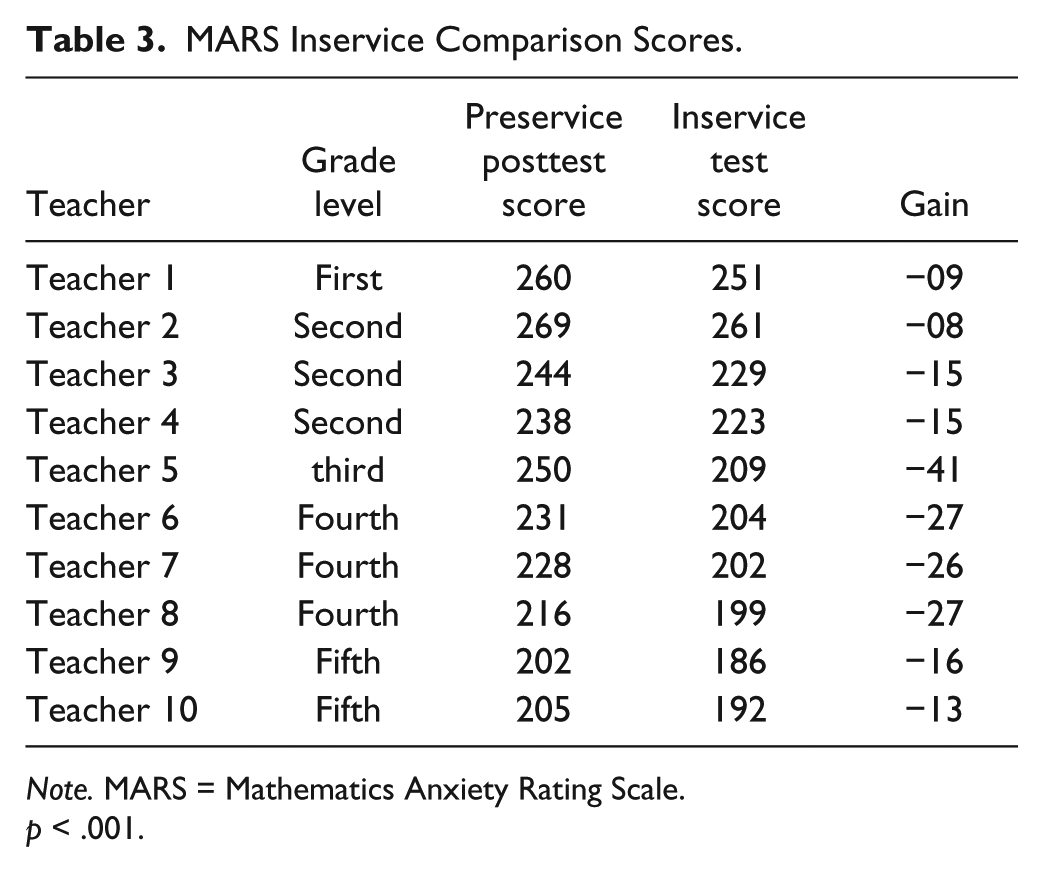
Note. MARS = Mathematics Anxiety Rating Scale.
p < .001.
Qualitative Findings
All 10 teachers commented that their mathematics anxiety was consistently evident in their mathematics classroom throughout their 5 years teaching experience. Each identified daily struggles not only within themselves but also in their students. Even though Teacher 5 had significant decreases in scores in both studies, she expressed her lack of mathematical confidence during the early years of teaching in part due to her mathematics anxiety. She taught third grade but had recently submitted a formal written letter requesting a move to sixth grade. She asserted, Seeing the material on a daily basis helped me learn the mathematics effectively and allowed me to address my mathematics anxiety and insecurities about teaching mathematics. I incorporated strategies and activities I learned in my undergraduate methods course and it helped both myself and my students immensely. I feel much more confident in the mathematics classroom now than I did when I first started teaching and I now want to move to a higher grade. (Teacher 5)
She also implied that continuing with higher education and obtaining a master’s degree in education “significantly enhanced her mathematical knowledge base and was a factor towards change in her mathematics anxiety.” She felt that the degree requirements for more mathematics classes “drove her to address her mathematics anxiety and to face what she really didn’t want to directly see with how mathematics anxiety played a negatively brutal role in her classroom.”
As evidenced by Teacher 5’s comments, her mathematics anxiety and lack of mathematical confidence and mathematics skills affected her classroom practices. Teachers 6, 7, and 8 (each earning a master’s degree in education by their fourth inservice year) also had significant decreases in scores after 5 years teaching experience. All three reiterated that additional mathematics courses (taken with the same professor as their undergraduate) and the required professional development mathematics workshops in their graduate program of study highly affected their attitudes, mathematics anxiety, and confidence within the mathematics classroom and improved their overall content knowledge. However, Teachers 5, 6, 7, and 8 (all four master’s teachers) expressed the need for “career long” mathematics professional development to continue strengthening their mathematics skills and effective mathematics teaching practices while specifically addressing and/or alleviating their mathematics anxiety in the process. The master’s teachers also posited that they were required to perform “action research” within their mathematics classrooms and reflect daily on their teaching practices. They indicated this research provided opportunities to reflect and change instructional teaching practices including addressing mathematics anxiety while empowering them to grow their professional roles and responsibilities. Each asserted that this type of research helped them define a more thorough inspection of both their effective and ineffective teaching practices. Teachers 3, 4, 9, and 10 (who did not have a graduate degree) expressed a strong need for further mathematics professional development and mentorship within their schools to help with their educational needs. They indicated this as one of the reasons their mathematics anxiety remained higher than they wanted or expected. However, each expressed they did not want to take additional mathematics courses as a way to address their mathematical deficiencies.
Interviews with Teachers 1 and 2 revealed that they felt more comfortable teaching the lower grades because they lacked confidence with the mathematical content to teach in the upper grades. Both teachers indicated such a strong “dislike and fear towards mathematics” that implementing effective lessons in the upper grades would be “intimidating and ineffective which would certainly negatively affect their students.” This disdain and fear is quite evident in Teacher 1 as she addressed her continued mathematics anxiety as “very overwhelming to the point of madness.” She asserted that teaching may not be a long-term profession for her, particularly if she is moved back to an upper grade. At her request, and because of her mathematics anxiety, she has been moved to several grade levels (fifth, fourth, and third) and finally first grade within her 5 years of teaching. Teacher 2 noted that she was hired to teach fifth grade initially, but after 3 weeks in the classroom realized her mathematics anxiety was too overpowering in this grade. Due to overcrowding, she was moved to second grade. She described this as “a blessing in disguise” because she was willing to leave the profession rather than continue teaching fifth grade. It is noted that teachers with the highest levels of mathematics anxiety taught in the lower grades and wished to remain there.
Even though all 10 teachers’ mathematics anxiety was still highly evident, all involved felt the teacher’s attitude toward the subject set the tone for students’ successful learning. Each felt their mathematics anxiety decreased as they gained more teaching experience and worked to employ a positive attitude in the classroom while hiding their negative feelings regarding mathematics. Teachers saw “themselves in their students” with relation to their own mathematics anxiety. They also emphasized how much they learned during the methods course and viewed the activities, strategies, and so forth that were incorporated within the methods course as ones currently employed within their mathematics classrooms, and which were beneficial in helping reduce their mathematics anxiety. All 10 teachers proved diligence in implementing lessons that were engaging and hands-on with real-world applications to spare their students the same angst they experienced while learning mathematics.
In the prior study, four themes emerged during preservice interviews that related to teachers’ perceptions toward the effectiveness in teaching mathematics to elementary students. These themes included attitudes toward mathematics, mathematics teaching practices, description, and understanding of mathematics. Inservice teachers were asked to read their preservice teacher comments to determine whether their prior perceptions regarding mathematics anxiety had changed. Their current comments were used to compare their thoughts after 5 years teaching experience. For interview comparisons and clarification of the two studies, all 10 teacher comments from the previous study will be restated and listed as “before” (preservice) and “after” (inservice). 1
Attitudes Toward Mathematics
In the prior study, preservice teachers’ negative attitudes toward mathematics surfaced very quickly. All 10 teachers indicated they did not like mathematics and really struggled with the subject and their negative attitudes were still evident five inservice years later. Many inservice teachers’ statements described negative emotions with words such as “stressed,” “embarrassed,” “frustrated,” “fearful,” “discouraged,” and “struggling.” They associated these words directly with their personal mathematical experiences not only as a former student themselves but also as both a preservice and inservice teacher. Their words suggest confidence inadequacies in their ability to effectively reach their students both academically and emotionally and identify their well-entrenched beliefs about mathematics teaching and learning. Below are a few of their “before and after” comments.
Teacher 1:
Before
Ever since I was in elementary school I have hated math! Literally! I remember going home crying, not wanting to go to school, screaming at my mother for making me do my homework, stressing out over not knowing how to do it, and begging her to let me quit school. And all this by 5th grade! I always got sick during math class and could feel my blood pressure rise every day. This never stopped during my years in high school either. I know I had math anxiety, I know I hated math, and I know I never wanted to see it again once I graduated from high school. Now I’m trying to be a teacher and I still hate math. How will I be able to help my students if I hate it?
After
Looking at my previous comment is certainly an eye opener, particularly my last statement. When I asked to be moved to a lower grade I felt defeated. Some days I felt like I’d been thrown off a cliff. The horrible memories of my own math experiences surfaced as a teacher, particularly when I saw my students’ struggling and crying like I used too. Students’ crying is my fault so I work extremely hard not to let them know how much I hate math! I use manipulatives, hands-on activities, etc. to teach for understanding ’cause I don’t want them to be like me. I want to think I’m reaching everyone but sometimes I do second guess myself. While I think I’m doing a good job it’s been a terrible struggle. I know that my positive attitude does make all the difference. It’s just really hard to fake it all the time when I hate math so much. Teacher 3:
Before
O.k . . . this is what I think about math . . . it’s like being on a tiny island all by myself and nowhere to run or yell for help! It stresses me out because I don’t think I will ever be rescued.
After
I actually laughed when I read my comment because I’m still on that d . . . island! My first year I thought I would die from all we had to do. Couple that with the stress of teaching math and I was blown away. I cried most days. By my second year, my negative math attitude was still there. I noticed so many students struggled that year because of me. I knew I had to change my attitude towards math because I set the tone for the day and it was negative. I constantly thought of all the ideas, strategies, and activities I implemented when I taught my preservice lessons and the class helped with my own math anxiety. However, I wasn’t doing what I knew worked! What was I thinking? That’s changed the last few years. I think implementing the strategies I learned and seeing my students be more successful has helped ease my stress in knowing that “I can do this math stuff and yes, they can do this math stuff!” Yes, I am still overwhelmed but I try not to let my students see or sense my frustration because it causes me more stress!
Inservice teacher comments below illustrate their fears for a lack of solid understanding of mathematical content and have linked this skepticism with experiences occurring within their field placement classrooms. Even though these events were not positive in their thinking, both inservice teachers expressed a much needed intentional change once they saw how their attitudes and frustrations affected their students. They reflected on the outcomes as having an effect, which required a change in their teaching practices through the implementation of the methods learned in the preservice experience. The existing classroom practices were explained as was the development of somewhat more realistic expectations for successful learning outcomes. Their comments are evident of their attempts to self-motivate and confidence build, while forging ahead with efforts to establish a more positive learning environment in spite of their mathematics anxiety, struggles, and frustration.
Teacher 4:
Before
I have dreamed about these big numbers chasing me. I know it’s funny, but I have awakened sometimes at night in a cold sweat when I knew I had to teach a lesson to my 6th graders. I have this fear that I won’t be able to answer their questions and then I’ll look really stupid in front of them. One student did ask me a question I didn’t know the answer too and I told him we would not discuss that right now. My supervising teacher freaked out. I know I missed a really teachable moment. I can’t get past this. I cried right in front of her. I hate math! I know my math anxiety is high because I answered all 5’s on the math anxiety test.
After
I still have nightmares about math! I’ve questioned whether or not I chose the right profession because I hate math. I felt like a fish out of water when it came to teaching math. I provided a workbook page or bunch of problems and said “do it.” It took a lot of reflection to figure out why that wasn’t working. I wasn’t modeling or integrating subject content effectively, using manipulatives or actively engaging my students in the learning process. I didn’t put them in small groups, use peer to peer . . . nothing! I do those things now and see a difference. I worked so hard to remember all I had learned and even contacted my former professor many times for advice and help with some of my struggles. I made it through my first and second years. By the third year, I started feeling a little better about my teaching practices and gaining a little confidence in that I was actually helping them learn rather than not. It wasn’t easier but I felt much more relaxed when I taught my math lessons. I hated math so much and still do but I don’t ignore my students when they have a question and I have to look over each day’s lesson more than once to be sure I don’t make any errors or tell them the wrong thing because I’ve done that before. I still get stressed out over the math and I teach 2nd grade! How embarrassing is that! Teacher 9:
Before
When I hear the word math, I cringe! I hate it! I hate it! I hate it! And the sad thing is I know that my students are going to pick up on that fact. How in the world will I ever be able to be a good math teacher when I dislike it so much? I can tell my coordinating teacher doesn’t like it either because she never teaches it. I think she avoids it because she hates it like I do. Talk about math anxiety? You bet I’ve got that! I think my own kids do to. They hate math just like me!
After
I’ve made a lot of progress because I’ve had too! One day I was teaching a concept and literally cried in front of my kids because I didn’t get it either. When I expressed my disdain towards mathematics and my students’ witnessed my meltdown they immediately shut down and I lost them during math lessons for weeks afterwards. I know that seeing their teacher get frustrated with the math left a long lasting if not lifelong impression on them. Talk about “not doing that”! Well I did it! I’ve had to make myself move forward because my students expected me to be confident and knowledgeable enough to help them be successful. It’s so stressful!
Mathematics Teaching Practices
Interviews from both studies showed that the use of manipulatives, using problem-solving situations, and real-world experiences in the mathematics classroom was very important for teaching and motivating students to learn mathematics. This was a requirement for their investigative teaching experience lessons in their internship as a preservice teacher. They expressed the need for including these strategies for successful learning and how they would have used them anyway even if it was not required. As an inservice teacher, each reiterated the need to engage the student in the learning process rather than lecturing and showing step-by-step procedures, which typifies a more traditional teaching approach. Using manipulatives is beneficial in helping reduce and/or alleviate mathematics anxiety. Some of the teachers who commented below also indicated their mathematics anxiety becomes heightened when trying to introduce or use manipulatives within their mathematics lessons. Teacher 6 said she “becomes overwhelmed and frustrated” when introducing manipulatives. Teachers 5 and 7 stated their students show “frustration, shut down, and become angry” with the math when trying to use manipulatives. They also said their own mathematics anxiety “gets in the way” because they did not understand how to utilize manipulatives appropriately within their lessons.
Teacher 6:
Before
One student never wanted to do his work, would misbehave, and keep others from getting their work done. One day he asked me when they would see this stuff and I told him that was a good question. I asked him what time he got up in the morning, how much money he had for his lunch that day, and how much it was going to cost him for the field trip we were going on Friday? He just looked at me kind of puzzled. Then he looked at me and smiled. I was so excited and proud of myself! He is now the first one to get going on his work and wants to be involved in everything we are doing. He was struggling with multiplication and I brought in some manipulatives to help. Instead of misbehaving like he used to do, he got busy playing and trying to work the problems. I think he sees what he needs math for now.
After
Well, I’ve seen the gamut of behavior problems during math class. I learned quickly that when students fear math, find it arduous or boring, they will act out. I teach very high at-risk students and it is sometimes very difficult to relate the mathematics to their real-world when it is so limited. But, I have discovered that learning their interests and backgrounds and developing my math lessons around such has certainly increased their attention span and lessened my behavior problems. Even though they sometimes misbehave, as they become more involved they want to do more. When I bring in the manipulatives they seem much more engaged in the learning process. I used to become so overwhelmed and frustrated when introducing manipulatives because of my math anxiety but once I got my routine down and started doing these things daily, I saw such a difference in my teaching and in students emotionally and academically. I often share my ideas with colleagues because they too experience the same things happening in their classrooms.
Similarly, Teacher 5, Teacher 7, and Teacher 10 indicated the importance of “how” to motivate students to learn mathematics. Their comments also illustrate how the methods course affected their beliefs. Their focus is placed on the understanding of students thinking and students’ mathematical needs as being critical components of the instructional decisions needing to be made by teachers. There is emphasis on their skepticism regarding the learned methods and the need to bridge from concrete to abstract, addressing students’ attitudes toward mathematics, and using a variety of techniques such as problem-solving situations, simulations, discoveries, challenges, and games. Below are their “before and after” comments regarding their teaching practices.
Teacher 5:
Before
I know it is my job to get students excited and motivated to learn. I had some kids who had never even been to the mall. How can I relate a story about traveling when they haven’t even been to the mall down the street? I’ve got to motivate them by making math meaningful and relate it to what they know and enjoy. This is very hard to do sometimes and I struggled with it in the beginning when we were asked to teach the first lesson. Now I think I am much better at it. I certainly think I give it more attention than I would have before.
After
I learned effective teaching methods during my preservice days. However, when it came to teaching I sometimes struggled. I hated the math and my math anxiety screamed at me. My students weren’t getting it and I was not a good teacher because I wasn’t putting into practice what I learned to be effective. Once I began implementing the learned methods I saw immediate results; not only in my students’ behavior but in their overall academic achievement. I also think doing this increased my confidence which was a factor in my high anxiety levels. Huge lesson learned! I now use the manipulatives to motivate and teach, I relate it to their prior knowledge, and I bring in a variety of hands-on strategies to teach them the content so they learn it and learn it well. I hate it so badly for those I didn’t or couldn’t reach because of my own inadequacies. Teacher 7:
Before
When teaching my lessons, I looked for ways to use manipulatives such as base ten blocks, colored counters, and geoboards to show students different ways to do the same thing. I actually think it enhanced my teaching and I know it helped them learn the material. I remember when I was in school the teacher never used manipulatives to teach us. She had them but never got them out of the box. I think students need to use them, they have so much fun working with manipulatives, and I really feel it gives them a better understanding of the skill I am trying to teach them. I don’t see how I can teach math without them. I think it would be so boring if we just gave out worksheet after worksheet. I have seen this done before so I know it’s boring.
After
It’s a little difficult to grasp that my 4th graders have very little to no experience with manipulatives. Their anxiousness is evident when introduced but subsides once they use them. I work extra hard to bring multiple representations, problem solving ideas, manipulatives, strategies, and activities to help ease their anxiety. I found it helps me be a better teacher as well and also lessens my own math anxiety. Students think math is much more fun and enjoyable with manipulatives. Teacher 10:
Before
My internship teacher is a master at motivating her students. They seem to love her and become so engaged when she is before the class. I observe her all over the place in the classroom. There is so much going on and yet she knows what everyone is doing. She incorporates centers, small groups, group discussions, manipulatives, and so much more. I just hope I can do all she does and with the ease in which she does it.
After
I was in awe at all my internship teacher did. She made it look so darn easy! I find it really hard to motivate all students all the time. Students’ use of technology surpasses my own knowledge and I feel like I am constantly playing catch-up. Their personal issues can be very intense when they surface in the classroom. How can I effectively teach math when they come to school hungry, sleepy, or just don’t care. It is my responsibility to get my students motivated and excited about what they are learning and I will do that although my math anxiety sometimes gets in the way of that. It takes extra effort but I refuse to give up on myself and them. I use technology, peer-to-peer, large and small groups, positive praise, differentiation, journaling, real-life lessons, and hands-on strategies and activities. This isn’t all I do but the most important thing I’ve discovered is that students must be more actively involved and engaged in the lesson.
During the preservice study, one teacher stated that even though manipulatives were required for the lessons in the internship, she never saw her teacher use them to teach mathematics. As inservice, all 10 teachers, regardless of their level of mathematics anxiety, reiterated the importance of using manipulatives, engaging, and motivating students for successful mathematical learning. They also felt that using manipulatives contributed to lessening their own mathematics anxiety to some degree. Although a few inservice teachers stated they were unsure of their use as a preservice teacher and at the very beginning of their teaching careers, they felt that as time passed they became more comfortable with teaching and with incorporating manipulatives as an essential learning tool in the classroom.
Teacher 2:
Before
I don’t ever remember using manipulatives when I was in school. I remember my teacher giving us lots of worksheets or problems. It was horrible. During the math methods class, the instructor brought in all sorts of manipulatives. I freaked out and was so terrified at first, but after learning how to use them to help us teach, I actually started enjoying the math I was learning. It definitely eased my math anxiety. I see manipulative benefits.
After
I still don’t remember ever using manipulatives when I was in elementary school. I remember seeing them on shelves collecting dust. I learned so much in my undergraduate coursework on how to effectively use them and use them in my own classroom. However, on some days I know I don’t do a very good job of introducing math concepts and showing children how to use the manipulatives to help them reason and problem solve. I know it’s my own fault and I struggle. I see them freaking out like I did and I panic. It takes so much effort to teach and I realize the difficulty our students really go through. I sometimes go through it with them! Teacher 8:
Before
I absolutely loved using manipulatives in class. I know that students will really do much better learning math if they can get hands-on instruction in class. I didn’t really need manipulatives when I grew up and didn’t use them for my first lesson. However, after using them in my other lessons I see how my students do need them to learn math. I will certainly have them in my own classroom.
After
When I started teaching I rarely used manipulatives because I didn’t need them. I thought all my students would be more like me since I was able to learn the material without them. But when I got my own classroom there was so much to cover I didn’t use them like I thought I would. When my students started struggling I realized that everyone doesn’t learn like me. Each student has a manipulative kit to use. It has made a world of difference not only in their thought process but in their attitudes and confidence with math. I am a true believer! I will say that having my own classroom has really been enlightening in that it takes a lot of work to teach but more importantly to know that each students’ needs vary greatly. I never realized how much effort it would require just to teach fractions. Teacher 9:
Before
My teacher never used manipulatives to teach her lessons. She gave them a tear-out worksheet from their book and that was it. I started using manipulatives for all of my lessons and she watched. She commented to me how much fun the kids were having during my lessons. Funny thing is that she started using manipulatives after watching me teach. I saw a big difference not only in the kids but in her teaching as well. I actually think I taught her something instead of the other way around.
After
I was shocked when I started teaching 5th grade. I witnessed students’ struggle with math. I had one student get so frustrated he threw his things across the room. I knew he was exhibiting signs of mathematics anxiety and we talked about his frustration and why he wasn’t “getting it.” When he began using the fraction circles and tiles to represent his problems he grasped the idea very quickly! His whole attitude changed and his frustration levels decreased dramatically. It was really great for me and others to see the differences in their understanding and learning while working with manipulatives. Teacher 10:
Before
Using manipulatives? Are you kidding me? I didn’t even know what those things were. The instructor showed us activities and how to teach math using them. I was completely lost at first but now love, love, love them. I just wish I had them when I was in school. I could have been so much better at math and not so afraid of it. You bet I will use them in class.
After
I have a whole new appreciation for manipulatives after being in the classroom. It didn’t take long to realize that my students respond both positively and negatively to my actions and to how the content is presented and represented. I’m finally enjoying what I do because I’m now understanding it more myself and bringing in new ways to teach it effectively. I do see that some kids don’t need manipulatives while others rely heavily. For some they know the answer but still need to confirm with manipulatives. I always tell them it’s ok and to do what works for them. It seems to ease their frustrations somewhat and really makes a huge difference.
Description and Understanding of Mathematics
As a preservice teacher, some described mathematics and their understanding of it in different ways. Although many attributed it to their ability to work hard, memorize material, and from positive experiences at home and school, others commented on the struggle to learn mathematics, lack of help from parents who had little knowledge of the mathematical content, and the challenge to meet their weaknesses in mathematics. As an inservice teacher, they not only reiterated the same thoughts but that “drill and kill” of mathematics content did not lead to mathematical understanding.
Teacher 1:
Before
I have gotten so frustrated doing math. I used to ask my parents for help and they couldn’t help me either. I felt like I had to do it all on my own. I was too embarrassed to ask questions in class and wouldn’t ask for help. Ever! That just made it much worse. I even have to count on my fingers sometimes. I understand some of it but it has taken a toll on me to say the least. Sometimes I feel like math is an uphill battle fighting in my brain.
After
If I am negative, do not understand or show confusion, my students follow me with the same reaction. I heard about this happening but to actually see it was totally different! I had to change my whole mindset when it came to math and increase my understanding of the content. Taking the methods course and learning about math anxiety and how it transfers from teacher to student made me realize it’s all up to me! Pressure? Yes! But I’m forced to reckon with my own mathematical inabilities. Teacher 2:
Before
I don’t think I’ve ever really understood math. I know that sounds bad but I have struggled to understand how it all works. I want so bad to be a good teacher and to finish and graduate with good grades. I knew that I would eventually have to take the math course and I dreaded it because I just didn’t like math. It is my biggest weakness and my supervising teacher called me out on it with my first math lesson when I taught it. I didn’t get a good score and felt horrible ’cause I think I ruined the kids! I did a little better with the second one but still need a lot of improvement.
After
I learned so much in the math methods course. Even though my anxiety was extremely high, knowing I wasn’t alone helped. Learning how to use manipulatives, implement lessons, get immediate feedback, and observe other teachers teach including my professor was a huge help. My principal asks teachers every year what they feel they need the most and I ask for professional development for math particularly with lesson planning and working with struggling learners. Even though we (nearly 3/4 of our teachers) keep asking, we aren’t getting! I just feel like it will help. I want to keep learning how to teach the math effectively and work on my math anxiety but that in itself is frustrating when we feel what we need isn’t supported. Why ask us then? Teacher 3:
Before
I used to worry about doing well in math. I never really did better than a “C” in school, but I tried hard. It just didn’t come easy to me. It was a real struggle for me because my brother and sister were so good at math. I felt like I was missing some math gene from my parents. I had to memorize everything but didn’t know what it really meant. As soon as the test was over, I forgot everything. I feel so bad for my students who are like me. It’s going to be such challenge for them if they are anything like me.
After
As time has passed and I’ve gained more teaching experience, I feel my math anxiety has lessened. I have become more confident in my abilities to deliver the material effectively without drilling them to death and I think I better understand my students’ thoughts and actions. I do witness many of them completely shut down due to their anxiety. I talk to them about my own issues with it and it does help. Although my first year was tough, I get to see the material more frequently and now know what’s coming. This not only helps me with my math anxiety but helps me predict what I perceive my students struggles may be. I know if I will have problems with the math then they certainly will. I sometimes feel it is a never ending battle.
From the inservice teacher interviews, several different themes emerged: the significance in taking the undergraduate mathematics methods course, how the methods course affected their instructional practices, how the mathematical practices learned within the course are the practices currently used in their classrooms, and the demands of teaching. Comments from all 10 teachers acknowledge and recognize teachers need deep knowledge of mathematics to be effective in their teaching and the importance of making meaningful contexts, which are constructed, connected, and applied to mathematical learning. They felt students must be actively engaged and students must be participating in the learning and understanding of mathematics.
Their comments show that such use would tend to promote problem-solving ability by providing a vehicle through which children can model real-world situations as illustrated in the methods courses. They stressed the importance of how manipulative materials can be effectively used as an intermediary between the real world and the mathematical world. In addition, their comments seem to suggest the methods course offered clarity about the precise way in which manipulative materials affect the development of mathematical concepts. Below are some of their final comments expressing the demands of teaching, their struggles with stress, and their desire to overcome it.
Teacher 1: I would not be able to teach if I had not had that particular math course. Of all the courses I took that particular one stands out the most. The professor shared her mathematics anxiety experiences with us and I felt like I could relate to her immediately. If she can overcome, I can overcome. She explained the content and represented skills liked I’ve never learned before. She was hands-on and addressed our emotions immediately which was helpful not only as a student but now as a teacher. Teacher 2: The methods course gave meaning and understanding to the math—something I never knew existed. I wasn’t sure I could be a teacher because of my math fears but hearing the professor’s personal struggles, and seeing math in action make me think I have a chance. Teacher 4: I know the methods course was effective and all that I learned I have been using. My colleagues who did not go through the same undergraduate institution see the difference in how I teach versus how they teach the math. It really does make a difference in the undergraduate training we have received. I am a testament to that! I don’t like teaching math but I do it. Teacher 6: I’m asked to do a math workshop every year on the useful mathematics activities and strategies used in my own classroom. It’s really hard to comprehend that experienced teachers haven’t seen some of the practices, ideas, and strategies we learned in the methods class. I think offering additional professional development for all of us is very beneficial.
Inservice teachers expressed wrought with the challenges of teaching as an influence on their mathematics anxiety. Their understanding of the role of the teacher was incredibly flawed at times and coincided with their thoughts of inappropriate, incessant testing of students, and how it affected their mathematical learning. They felt unprepared and unsupported with the roles and responsibilities associated with the demands of teaching. Many expressed overwhelming concerns with paperwork, lesson planning, preparing materials, the environment, and management skills. They indicated teaching required a lengthy, ongoing commitment of time and energy. Several expressed lack of leadership support and isolation in the ability to express publicly their levels of mathematics anxiety for fear of losing their jobs. Some posited their isolation and fear to discuss their mathematics anxiety as a contributing factor to its continuous cycle. However, one indicated that additional professional development opportunities may help address and/or lessen their mathematics anxiety.
Teacher 3: Teaching is 24/7. I’m here early, late, and work on weekends and support from both parents and our admin is limited, if it even exists at all. Gearing my lessons towards students’ mathematical abilities takes hard work and planning. My district focuses more on grade level teaching which is difficult for my at-risk students who often lack motivation, self-confidence, and struggle with simple tasks. I also want to express my own difficulties with the math but know that will not be well accepted. No one thinks teachers should experience issues with math content but we do. However, if you let admin know you have math anxiety or difficulties planning math lessons we are chastised. Not fun! I just want someone to listen to my frustrations because I think it would help lessen my anxiety. I know others have it too and want to ask for help but I can’t. It just keeps the math anxiety cycle rolling. Teacher 7: Teaching is hard! I had no idea it would be so mentally and physically exhausting. Couple that with the difficulties students have with the math and it’s overwhelming so I’ve learned to listen to my students. Knowing my students would have an emotional reaction to the subject was hard to conceive but I’ve seen it in older students. Both I and my colleagues have also had the same emotional reactions as my students. We only talk about it to each other because we are afraid of being fired. This only makes our math anxiety further rear its ugly head. Teacher 8: For myself, trying to gain traction and learn everything my first year only contributed to my stress and anxiety. I’m not sure how to fix this but my school did provide me with a mentor which really helped. While my district did offer some professional development it wasn’t specifically geared towards mathematics and I needed help with my math anxiety. I think having more professional development opportunities that are more subject specific would help us once we get our own classrooms. Having support is huge! Teacher 9: I began my first year as a 5th grade teacher. However, after a few weeks I realized I had made a terrible decision. Even though I was scared I would be let go if I told them I struggled with the math due to my math anxiety, I finally summoned the courage and asked for a lower grade. Fortunately, my school added a class and moved me to 2nd grade. I did that for two years and didn’t like that either. I realized my fears were a result of not wanting to teach the math and started implementing the math method ideas. For some reason I was ready for it and I started learning myself and addressed my anxiety. I actually asked to be moved back to 5th grade. Teacher 10: We have a high teacher turnover rate and profession change here. That’s sad considering the amount of money we put into college. We all have mentioned the same thing about the difficulty with teaching, particularly with having mathematics anxiety, but hesitate letting others know for fear of losing our jobs. It is so overwhelming and stressful with the numerous demands of testing and meeting specific standards quickly while speeding through the content because we have to keep moving. I can see how that could make or break you. I know I set the tone for the day with what I do, what I say, and how I react and respond. It never ends.
Discussion and Conclusion
Even though the decrease was minimal, the quantitative results from the study conclude that teachers’ math anxiety was reduced through their teaching practice. The intention of this study was to provide a more in-depth look at inservice teachers’ mathematics anxiety and the effects teaching experience may have with regard to their mathematics anxiety. There is extant evidence that both preservice and inservice teachers are prone to excessive mathematics anxiety and math avoidance (Adeyemi, 2015; Bekdemir, 2010) and that most will do little to alter these tendencies (Beilock & Maloney, 2015). Such fear and disdain toward mathematics can be detrimental to how teachers teach mathematics (Lake & Kelly, 2014), and may also increase their mathematics anxiety, which further undermines their confidence in teaching mathematics (Adeyemi, 2015).
From this study, we are reminded through the teachers’ voice of how teacher mastery of the mathematical content also has an effect on the students (Beilock & Maloney, 2015) as it goes back to teacher preparation and knowledge of subject matter. If a teacher is uncomfortable with the curriculum, it will be noticeable to the students (Hadley & Dorward, 2011). Teachers expressed the need for additional mathematics professional development as they felt it would directly affect their mathematics curriculum deficiencies as well as possibly reduce and/or alleviate their mathematics anxiety. They posited that professional development opportunities would “allow them to gain additional confidence and knowledge to help lessen and/or overcome their mathematics anxiety.” Several stated they wanted to openly express their mathematics content problem areas while also acknowledging their mathematics anxiety, the stress it has caused, and how it has affected their teaching practices. They also wanted administrative help and support if they chose to do so. However, many felt isolated and silenced for mathematics anxiety admittance for fear of losing their jobs. Acknowledging their mathematics anxiety only occurred “in silent packs while speaking with close colleagues” and with whom they too knew had the same experiences in dealing with mathematics anxiety. They situated that the lack of open administration communication contributed to more mathematics anxiety and stress as it related to the challenges and demands of teaching. They reiterated that the time, energy, changing standards, and increased standardized testing in mathematics added to their frustrations and increased their mathematics anxiety. Most important, they felt they were unprepared in mathematics content knowledge, which contributed to the continuation of their mathematics anxiety once inservice began. Elementary school teachers need professional development in mathematics because, most commonly, they have been trained as generalists. This means that elementary teachers are trained to teach all core subjects, such a reading, science, social studies, and math, but they have not developed specialized skills in the teaching of any one subject. This type of preparation leaves most elementary teachers underprepared to teach mathematics effectively (Jansen et al., 2013). The unpreparedness could be reasoning for the requests for more mathematics professional development opportunities by some inservice teachers in this study. Perhaps the lack of specialization created stress, which in turn elevated their mathematics anxiety. Being knowledgeable in mathematics content lessens mathematics anxiety (Beilock & Willingham, 2014; Carey, Hill, Devine, & Szücs, 2015). However, when teachers have not gained the mathematical content knowledge that is necessary to teach effectively, they do not gain the self-confidence that is also necessary to teach it effectively, thus the continuing cycle of mathematics anxiety (Kim, 2014). Somehow teachers are expected to overcome these obstacles and lay the mathematical groundwork for their students, whether their deficiencies in mathematics content knowledge or mathematics anxiety exists or not.
The usefulness of the mathematics methods course and experiences as reported by teachers was a salient finding. As teachers’ comments indicated, each inservice teacher longed to situate the course and his or her experiences within his or her development as an elementary educator and for direct applications to the elementary mathematics classroom. We want mathematics methods courses adequately preparing teachers for the long haul and for the demands of inservice teaching, which also includes addressing, alleviating, and/or reducing mathematics anxiety not only within themselves but also in their students as well. Even though inservice teachers’ mathematics anxiety did continue to slightly decrease after 5 years teaching experience, the greatest decrease in mathematics anxiety occurred while involved in the mathematics methods course as a preservice teacher. This research provides support to the importance of mathematics methods courses, collaborative experiences, and the use of manipulatives in shaping preservice teachers’ eventual practices as an inservice teacher, as well as a glimpse into inservice teachers’ recognition of their personal impact on their students. The results from the study provide insight into the durability and effectiveness of teacher training programs that emphasize manipulatives and other strategies to help reduce mathematics anxiety in teachers (Aslan, 2013; Bekdemir, 2010; Hart, Browning, Thanheiser, & Mosvold, 2013: Swars, Smith, Smith, & Hart, 2009). This study further supports the importance of having teacher education programs that influence the development of effective instructional practices while specifically addressing the reduction of mathematics anxiety in preservice teachers. NCTM (2014a) principles acknowledge that individuals need high-quality instruction and materials in learning environments that support them. The research that does exist indicates that elementary preservice students’ participation in methods courses that are student centered, cognitively demanding, and build conceptual understanding can help decrease mathematics anxiety (Adeyemi, 2015; Boyd et al., 2014; Dove, 2014). These instructional practices are not unfamiliar to mathematics educators, as the Principles to Action (NCTM, 2014a) support the use of such methods in all mathematics classes. The implementation of specific strategies as presented through these actions such as engaging students in mathematical thinking, reasoning, and sense making to significantly strengthen teaching and learning allows for mathematical understanding and confidence, which also directly affects mathematics anxiety in both teachers and students (Beilock & Maloney, 2015). Teachers’ comments reiterated how the implementation of these approaches not only helped their students emotionally (i.e., mathematics anxiety) and academically but also helped themselves better understand the content through the use of these actions within their lessons. The utilization of these principles in mathematics classrooms and in more mathematics courses presents an opportunity to potentially create stronger elementary teachers and students and, thus, break the cycle of mathematics anxiety (Hart, Oesterle, & Swars, 2012; Hart, Browning, Thanheiser, & Mosvold, 2013; Swars, Smith, Smith, & Hart, 2009). According to Finlayson (2014), traditional teaching methods where teachers tell the children what they need to know and provide them with answers to the problems are not effective in reducing mathematics anxiety in students, but rather the implementation of hands-on activities, and using a variety of ways math manipulatives were taught and used could positively affect mathematics anxiety. Because beliefs tend to be stable across time (Haciomeroglu, 2013) and are considered a better predictor of behavior than knowledge, they have the possibility to be harmful to teachers and their students as they can lead to incorrect ideas about mathematics and how to teach mathematics (Beilock, 2010; Park et al., 2014). This research study presents and reinforces compelling evidence as illustrated by Aslan (2013) and Haciomeroglu (2013) that teachers are less successful in conveying important mathematics concepts that are requisites for students’ academic growth as the cycle of mathematics anxiety continues with teaching experience . Also, as evidenced by several interview responses, teachers’ negative perceptions regarding mathematics elevated their mathematics anxiety. Several teachers indicated that some of their teaching practices were not effective, which not only heightened their own mathematics anxiety but also have caused or contributed to students’ mathematics anxiety. However, others commented that the use of such strategies and practices as identified heavily within the preservice methods course were effective practices implemented in their classrooms and, thus, contributed to lessening both their own and students mathematics anxiety.
Some in this study indicated their teaching practices were ineffective and possibly contributed not only to the continuation of their own mathematics anxiety but to their students’ mathematics anxiety. Some of those in this study (four of 10) chose to address their ineffective practices, mathematics anxiety, mathematical confidence, and content knowledge via higher education by completing a master’s degree in education within the first 5 years of teaching experience. Each of these teachers indicated they took graduate-level courses with the same professor who taught their undergraduate mathematics courses, and did so with the hope that it would continue to lessen their mathematics anxiety because it was addressed in those courses and would be addressed again in their graduate courses. Action research was also a requirement that enabled them to focus on their mathematics anxiety and confidence, mathematics content and deficiencies, and effective teaching practices, as well as opportunities to address their students’ mathematics anxiety. They posited that throughout the semester, the professor specifically addressed their mathematics anxiety while emphasizing additional math methods, manipulative use, and strategies not previously learned in undergraduate courses. It is interesting to note that the inservice teachers who completed their master’s degrees also had the largest decrease in mathematics anxiety levels. Kim’s (2014) study revealed that teachers who had master’s degrees had lower levels of mathematics anxiety than those who did not have master’s degrees. This study also revealed that as teachers gained knowledge for mathematics, their teaching mathematics anxiety decreased. A similar finding by Bursal and Paznokas (2006) argued that teachers’ mathematics anxiety was significantly reduced as their mathematical knowledge increased. Levine’s (1993) results concluded that insufficient knowledge of mathematics may increase elementary teachers’ mathematics anxiety, thus the need for teachers to have sufficient mathematical content knowledge to remove the cycle of mathematics anxiety. A plausible reason for why the mathematics anxiety levels of the inservice teachers in this study would decrease as they obtained higher education degrees may be due to the continued development of mathematical knowledge. Also, the gained mathematical knowledge also increased their confidence to teach mathematics, thus lessening their mathematics anxiety. Adeyemi (2015) explained that although we cannot conclude that all mathematics anxious teachers are equally determined to break the mathematics anxiety cycle and further enhance their mathematics content knowledge, it is encouraging to know that some of them are willing to do so even through continued education. This finding is also supported by Hadley and Dorward’s (2011) findings that for some teachers, the experience of mathematics anxiety “may spur them to take action to improve their mathematics instructional practices” (p. 39).
Whereas four teachers in the study did complete graduates studies as a way to address their mathematics anxiety and mathematics confidence, others neither wanted to obtain a higher degree in their chosen field nor were they willing to do so. Several expressed that their reluctance to take higher education courses was because they did have mathematics anxiety and were “terrified” that more mathematics courses were required to obtain a higher degree. Their comments also revealed that their mathematics anxiety and lack of confidence prevented them from wanting to teach in the higher grades as each expressed they would not teach higher than third grade even though they were certified to teach through sixth grade. They felt they would not be effective mathematics teachers at higher grade levels and that the material would not only be too difficult for them but would increase their mathematics anxiety levels and lessen their already low confidence, which alternatively would academically hinder the students they would be teaching. A longitudinal study by Swars et al. (2009) and other studies (Hart et al., 2013; Hart, Oesterle, & Swars, 2012) have shown that as low self-confident teachers move up in grade level, their confidence levels tend to decrease because of a perceived increase in the difficulty of the mathematics content. According to Beilock and Willingham (2014), if teachers’ negative attitudes influence the effectiveness of their teaching as well as their students’ attitude and confidence toward mathematics, this leads to a negative impact on the students’ mathematics education. These effects likely include mathematics anxiety accompanied by many more detrimental consequences (Belbase, 2013). However, inservice teachers who questioned their capabilities to teach mathematics at the higher elementary grades as some did in this study should not be forced to teach higher grades as their frustration levels may possibly increase. These teachers may not look for creative ways to promote students’ understanding of mathematics concepts and, thus, create higher levels of mathematics anxiety not only within themselves but also in their students as well (Adeyemi, 2015). The reality for teachers with mathematical learning problems including mathematics anxiety is that they spend most of their mathematical time learning and practicing computation procedures and have little confidence in their ability to learn more advanced mathematical skills (Beilock et al., 2010; Iyer & Wang, 2013). Even though four out of 10 teachers in this study did continue with higher educational mathematics courses, which all indicated were a factor toward changes in their confidence levels and possibly affected their mathematics anxiety, no assumptions can be made based on the limited sample size.
Implications and Recommendations
At this point, knowledge of these findings is not enough as we must advocate to eradicate mathematics anxiety among teachers. Tobias (1998) suggested that for individuals to overcome mathematics anxiety, they need to take some initiative in their learning process. Teachers are an important influence not only on the quality of an individuals’ mathematical learning but also with their own learning as well (Beilock et al., 2010). We know through the preservice and inservice studies that teachers with mathematics anxiety may need the same or different approaches to prevent or reduce mathematics anxiety to assist them in becoming confident mathematical thinkers. Several inservice teachers implied the need to acknowledge and openly communicate with colleagues and administration their lack of confidence and frustrations with regard to mathematics anxiety. Frequent discussions about mathematics and mathematics anxiety are recommended as helpful, specifically for girls/women, to prevail over their fear and negative feelings about mathematics and, thus, lessen mathematics anxiety (Goetz et al., 2013).
Studies have shown that teachers with positive attitude toward mathematics use teaching methods that promote students’ initiatives, mathematical reasoning, and independence. It is only when teachers recognize that they have mathematics anxiety, know its cause, and are motivated to find help to reduce it, that they can help build confidence in mathematics and promote positive attitude toward mathematics. Mathematics is a compulsory subject that is required to be taught by all K-6 educators. Therefore, implementing changes to teachers’ attitudes and practices are critical.
Past research has shown that many college and university students who are anxious about mathematics choose to become K-6 teachers to avoid further mathematics requirements at colleges and universities (Boyd et al., 2014; Jackson, 2015). However, some inservice teachers seemed to be more willing to explore various avenues to improve their knowledge of mathematics by obtaining a higher educational degree. Perhaps, because these teachers saw a mathematics anxiety reduction in the first methods course, they were more comfortable and willing to pursue additional education. According to the qualitative data, inservice teachers concluded their involvement in graduate studies, which included action research, and professional development opportunities contributed to the lessening of their mathematics anxiety. However, not all those involved in the study completed graduate studies, so no conclusion can be drawn as to the effectiveness of more striking experiences in graduate work.
Some inservice teachers’ proffered continued professional development in mathematics (workshops that specifically addressed mathematics anxiety and mathematics content) was a needed career-long designation. Inservice professional development could broaden teachers’ conceptual understanding of mathematics, which, in turn could not only lessen or reduce their mathematics anxiety but also students’ anxiety as well. This additional training may enable these teachers to acquire the necessary knowledge and skills to increase their mathematical abilities, which may affect their mathematics anxiety. More research would be needed to investigate inservice continuing education and professional development and its effectiveness in lessening or reducing mathematics anxiety.
This study also has implications for teacher education programs, particularly mathematics methods courses. According to Swars et al. (2009) and Hart et al. (2013), teacher preparation programs must be focused in providing experiences for teachers in learning mathematics and build in-depth understandings through inquiry and problem solving, grounded in theories in how mathematics is learned. Teachers who are reluctant to broaden their mathematical knowledge, perhaps due to their anxiety and fear of mathematics, may not be interested to learn about alternative teaching methods that could help students learn mathematics. These teachers tend to use traditional teaching methods and the same lessons plans that they have developed over time. Therefore, K-6 teachers must learn how to incorporate a variety of effective teaching methods and practices to meet each student’s unique needs. Previous studies (Adeyemi, 2015; Boyd et al., 2014; Peker, 2009; Vinson, 2001) have shown that mathematics anxiety levels could be reduced through accommodations and modifications of such as modeling, providing concrete representations from pictorial to abstract, using technology, providing “authentic” experiences for construction and reinforcement of concepts, developing daily routines, using cooperative learning groups, encouraging students to provide answers in written, verbal, and pictorial format, and using a variety of teaching methods and strategies will be beneficial. This study reinforces this as several teacher comments reiterated how the implementation of such practices did make a difference not only in their mathematics anxiety but also in their students’ mathematics anxiety. Effective teachers possess an amazing array of tools perfectly designed to meet the varying needs of every student. Teachers who understand the learning needs of others are more empowered to provide the kind of instruction their own students need as was evidenced in this study. There is no doubt that for some, mathematics is and will remain challenging. The qualitative findings from this study show many lacked mathematics confidence, however, teachers should discard false beliefs and resist intimidation due to lack of confidence, for the constructs of mathematics anxiety has a profound effect on learning and the potential to become effective teachers at the K-6 grade level.
Even though this study is situated in the context of a smaller sample size, the argument has demonstrated the complexity of mathematics anxiety as a universal concern for all mathematics educators. When considering the findings, a determination is not made that changes in mathematics anxiety will persist or will continue to change. However, carefully examining the process of change even with this study’s sample size may help us become better informed not only about the longitudinal effectiveness of our mathematics methods course but also about the usefulness in understanding the important outcomes of those mathematics methods courses across time. Studying the longitudinal effects of mathematics anxiety in preservice/inservice teachers may be a critical component for institutions of higher education to make informed decisions about the mathematics methods courses included in teacher education programs. However, further longitudinal studies are recommended to determine such decisions.
The study results also provide a foundation for more investigation of the need for continued mathematics professional development opportunities that specifically address mathematics anxiety and to determine how inservice teachers’ mathematics anxiety influences and affects instructional practices. Researchers and teachers must continue to work together to determine which curricula and instructional practices will bring the best results in mathematics achievement and, thus, eliminate the cycle of mathematics anxiety.
Footnotes
Declaration of Conflicting Interests
The author(s) declared no potential conflicts of interest with respect to the research, authorship, and/or publication of this article.
Funding
The author(s) received no financial support for the research, authorship, and/or publication of this article.
Notes
Author Biography
References
Supplementary Material
Please find the following supplemental material available below.
For Open Access articles published under a Creative Commons License, all supplemental material carries the same license as the article it is associated with.
For non-Open Access articles published, all supplemental material carries a non-exclusive license, and permission requests for re-use of supplemental material or any part of supplemental material shall be sent directly to the copyright owner as specified in the copyright notice associated with the article.
