




Abstract
This three phase longitudinal multiple-case study, framed by positioning theory, investigated how four novice teachers learned to use professional judgment in their literacy instruction. Data sources from coursework, student teaching, and novice teaching were included. Interviews, observations, researchers’ observational notes, and school and classroom demographics were compiled and analyzed to create case reports. Findings indicated while they differed in their use of professional judgment as novice teachers, participants learned this skill in student teaching rather than in coursework, which caused us to question whether teacher preparation programs are preparing teachers to use professional judgment or training them for technical compliance.
Rachel, a first-year teacher, was employed by a Reading First school to teach on a third-grade team. Her colleagues, veteran teachers, followed the core reading teacher’s manuals “with fidelity,” and only used required assessments. Rachel, however, instituted running records, even though the veteran teachers frowned on these “new-fangled ideas.” (Case report)
In this instance, Rachel (names are pseudonyms) was willing to use professional judgment in a situation that discouraged improvisation (Schwartz & Sharpe, 2010). Professional judgment, for our study, refers to teachers making autonomous decisions. Standard 1 from the International Reading Association’s (IRA, 2010) Standards for Reading Professionals, henceforth called Standards, states new teachers will “understand the role of professional judgment and practical knowledge for improving all students’ reading development and achievement” (p. 38). “Practical knowledge,” coined by Elbaz (1981), describes teachers’ rules of practice, practical principles, and images guiding their actions. Schön (1983) refined the concept as knowledge in action. Schwartz and Sharpe (2010) suggested that for teachers to have necessary requirements and courage to use professional judgment, they need the (a) ability to frame a problem by applying it to their beliefs, (b) necessary skills and strategies to make adaptations, and (c) appropriate experiences in decision making. They write,
Skills are learned through experience, and so is the commitment to the aims of a practice. That’s why we associate wisdom with experience. But not just any experience will do. Some experiences nurture and teach practical wisdom; others corrode it . . . Character and practical wisdom must be cultivated by the major institutions in which we practice. (p. 8)
Using professional judgment is critical for teachers because they constantly make instructional decisions (e.g., content, lesson pacing, groupings) to meet their students’ learning needs. Therefore, professional judgment should be prioritized in teacher preparation programs (programs). How candidates change and grow in their use of professional judgment to make instructional decisions as they become student teachers and then novice teachers is needed because realizing teachers reflect on and adapt instruction in the moment could enhance their instruction for students’ benefit. Specifically, we wondered how candidates came to understand how and when to use professional judgment during literacy instruction (e.g., Scales et al., 2014). We believe that professional judgment can be nurtured through program coursework and related field experiences (e.g., internships), and we envision this as an arc of development. Hence, this 3-year longitudinal study followed four participants from four programs through coursework, student teaching, and into novice teaching. We asked the following research question:
Theoretical Foundation
Positioning theory frames our inquiry because we wondered how teacher candidates (candidates) used professional judgment during literacy instruction, and we speculated this was influenced by how candidates positioned themselves and were positioned by others during coursework, as student teachers, and as novice teachers.
Positioning Theory
Positioning theory has been used by scholars to examine how people position themselves and are positioned by others in communities (Wortham, 2003). Positions are dynamic, socially constructed, and often subtle presuppositions about what individuals can say or do in particular circumstances (Harré & Moghaddam, 2003). McVee (2011) explained positions include expectations about not only “rights, duties, and obligations of an individual in any social context” (p. 5) but also ways those expectations are to be carried out. Positioning is the act “by which a person claims certain rights and opts for certain duties” (Harré, 2011, p. ix) or “has them thrust” on another within a given interaction.
Harré and van Langenhove (1999) depicted positioning theory as a triangle, with three interrelated constructs forming the triad: position, speech and other acts, and storyline. Position, as described above, is socially constructed and is assumed in relation to others. A position may include prohibitions or denials of access to some of the local repertoire of meaningful acts. Speech and other acts include every socially significant action, intended movement, or speech. Each must be interpreted as an act, a socially meaningful and significant performance. Storyline is “the episodes and patterns that are created through speech acts and positions” (McVee, 2011, p. 6). The social force of the actions in any episode and the relative position of actors mutually determine one another (Harré & van Langenhove, 1999).
People can position themselves or be directly or indirectly positioned by others. A group of students can indirectly position one member as someone who knows the answers. Teachers indirectly position students to be accepting or questioning. People can resist being positioned. Through discursive actions, individuals may adopt or deflect positions assigned to them. Sometimes people deliberately position others, but “more often [positioning] crystallizes out of the background of social practices within which people are embedded” (Harré, 2011, p. ix).
Our participants interacted in three communities: candidates in literacy coursework, student teachers as “guests” in classrooms, and as novice teachers in schools. Candidates have little room to negotiate what we teach, our assignments, or course content. Instructors position themselves and are positioned by others as “experts.” When candidates enter student teaching, cooperating teachers are positioned as authorities and may or may not position candidates as coteachers. Once candidates become novice teachers, others are positioned as authorities who make curricular decisions. Depending on context, teachers have different degrees of freedom to challenge authorities’ decisions. Candidates, therefore, must experience and navigate various positions throughout their programs to prepare for this.
Candidates Positioned by Beliefs
Candidates position themselves in relation to their beliefs and actions. Research indicates teacher beliefs are considered as windows into teachers’ rationales for instructional decisions (Skott, 2015). Although many definitions exist, this study uses Skott’s (2013) definition of teacher beliefs as “individual, subjectively true, value-laden mental constructs that are the relatively stable results of substantial social experiences and that have a significant impact on one’s interpretations of and contributions to classroom practice” (p. 19).
Candidates enter programs with beliefs about teaching and learning. Beliefs have different functions: filtering information and experiences, framing problems, and guiding action (Fives & Buehl, 2012). Hence, candidates’ preexisting pedagogical beliefs shape how they position themselves because their beliefs frame learning from coursework by filtering information to fit their beliefs, which influences how they use professional judgment during instruction.
Student Teachers Learning to Use Professional Judgment
Student teaching is a transition from being positioned as a student to being positioned as almost a teacher whose professional judgment is called upon daily. During student teaching, candidates may need to position themselves differently to satisfy their cooperating teachers. Research indicates student teachers adopt cooperating teachers’ ways of teaching (e.g., Clift & Brady, 2005; Rozelle & Wilson, 2012). Clift and Brady (2005) stated, “ . . . prospective teachers can act against their beliefs in order to avoid conflict with cooperating teachers or supervisors . . .” (p. 332). Indeed, Anderson (2009) found student teachers’ teaching perspectives changed to directly match their cooperating teachers. For half of the student teachers, changes were in actions only while they inwardly held onto their perspectives. Student teachers revealed that outward changes were because cooperating teachers, positioned as authorities, held power over them due to the evaluative nature of student teaching, and they wanted to please their cooperating teachers. Furthermore, Rozelle and Wilson (2012) discovered student teachers’ beliefs, behaviors, and instruction changed over time to replicate those of their cooperating teachers. Hence, student teachers are often unable to use professional judgment during instruction due to their position as student teachers and cooperating teachers positioned as authorities.
Other researchers (Henning & Kohler, 2007; Kohler, Henning, & Usma-Wilches, 2008) focused on preparing candidates during coursework and field experiences to use professional judgment to make instructional decisions and adapt instruction as they teach. Kohler and colleagues (2008) studied candidates’ reflections to examine instructional adaptations, specifically how they adapted in the moment or for the next lesson(s), with adaptations based on formative assessments or other student cues. By integrating this into courses and field work and promoting student teachers’ use of professional judgment, the program positioned them as teachers, with emphasis on developing thoughtful, reflective teachers.
Positioning and Novice Teachers’ Professional Judgment
Prior research describes how novice teachers adopt an identity as a school community member and as a teacher. Identity is a “dynamic, career-long process of negotiating the teacher-self in relation to personal and emotional experiences, the professional and social context, and the micro and macro political environment” (Zembylas & Chubbuck, 2015, p. 174). Thus, teachers’ developing identities are dynamic, relational, multiple, and changing over time with a range of individual and contextual factors, including macro (maintaining self-congruence) and micro (internal) aspects. Candidates’ journeys of becoming novice teachers illustrates how they position themselves while being positioned by contexts that change over time because “positions can shift within social settings and when an individual looks back on or reconstructs previous experiences and discourse” (McVee, 2011, p. 5).
Novice teachers sometimes find their initial years difficult due to challenging aspects of teaching (Clark, Jones, Reutzel, & Andreasen, 2013). For instance, using professional judgment to adapt literacy instruction can be challenging if the context enforces rigid curricular programs (Parsons, Davis, Scales, Williams, & Kear, 2010). Hence, contextual policies and authorities position teachers, influencing teachers’ use of professional judgment when planning and implementing literacy instruction.
Flexible instructional adaptations
Professional judgment appears in research literature on flexibly adapting instruction. Adaptive teaching occurs when teachers transform instruction on the spot to meet students’ learning needs (e.g., Parsons, 2012). Researchers describe adaptive teaching as “responsive elaboration” (Duffy & Roehler, 1987, p. 514), responses to “bumpy moments” (Romano, 2006, p. 973), accommodating teachable moments or opportunistic teaching (Pressley, Wharton-McDonald, & Hampston, 2006), on-the-spot instructional decision making/improvisation or interactive teaching (Henning & Kohler, 2007), on-the-spot instructional adjustments (Kohler et al., 2008), and differentiation (Parsons, Dodman, & Burrowbridge, 2013). Regardless of the term, researchers agree effective teachers seize teachable moments to address students’ learning needs (Pressley et al., 2006). For this study, we use Duffy’s (2005) definition of adaptive teachers as “teachers who are in metacognitive control of their work” (p. 306).
Researchers claim effective teachers adapt instruction while teaching to address students’ learning needs using various instructional strategies and techniques to fit the situation (e.g., Parsons et al., 2013). Thus, adaptations require teachers to be autonomous decision makers who respond to students’ learning needs.
As teacher educators, we aspire to prepare candidates to use professional judgment. Yet, we need to know how candidates and novice teachers are positioned as teachers who use professional judgment during literacy instruction, or whether they are positioned to be technicians who replicate what they are told. This study investigates how professional judgment was demonstrated during observations of and interviews about literacy instruction, from candidate through novice teaching.
Method
This qualitative, multiple-case study (Miles, Huberman, & Saldaña, 2014) included 3 years of interview and observational data per participant compiled into researchers’ case reports. As researchers are spread across the United States, we used a password-protected online site to share data, codes, reflections, and other research-related documents and met via conference calls.
We followed Miles and colleagues’ (2014) recommendations for confirmability, dependability, internal validity (credibility), and external validity (transferability) because these issues were critical with multiple sites and researchers. While planning, we established protocols for every aspect of data collection. We were explicit in procedures and created an audit trail. Case reports were shared with participants for member checking and with the larger research team. We provided additional information as needed for clarity. Researchers provided rich contextual descriptions from time in participants’ classrooms. Multiple sources allowed for triangulation. Transferability depends on comparable settings. We provided description “to permit adequate comparisons with other samples” (Miles et al., 2014, p. 314).
Participants
While the larger study included participants from nine institutions, this article focuses on novice teachers who participated for 2 years, while candidates agreed to continue through novice teaching and employed in locations accessible to researchers. Using these criteria, four novice teachers were eligible for participation. We leveraged convenience sampling while being strategic and purposive because these teachers fit aspects of participant and site selection advocated by Miles and colleagues (2014): research setting (school locations, accessibility), potential participants (met criteria, willingness to participate, accessible for interviews and observations), events (participants’ teaching, discussing teaching, and learning), and research process (participation from candidates to novice teachers).
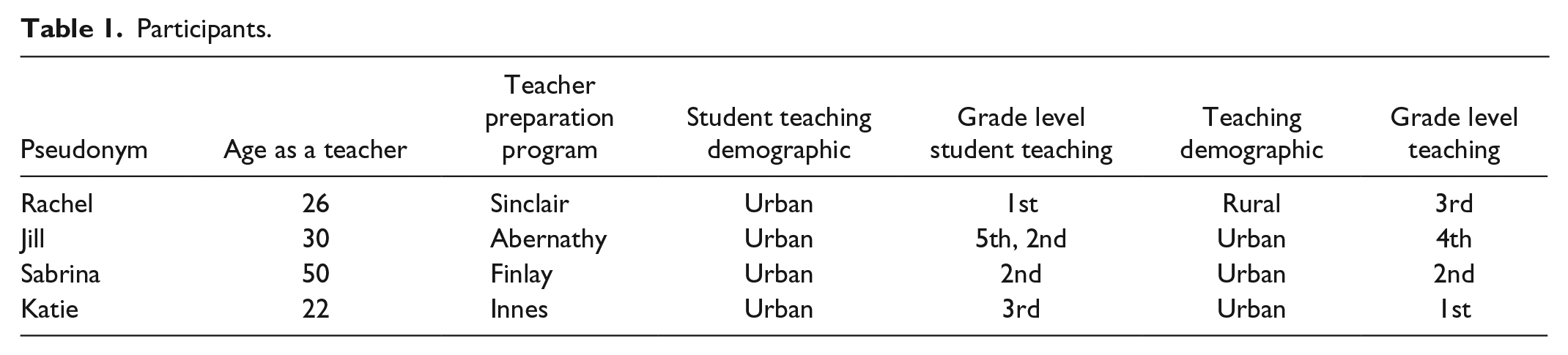
Participants were from the following locations: West Coast (Jill, Sabrina), Pacific Northwest (Rachel), and the Midwestern United States (Katie). Participants’ programs included the following: 4-year bachelor’s degree (Katie), postbaccalaureate (Jill), and graduate (Rachel, Sabrina). All participants were White women who taught Grades 1 through 4. Rachel’s school was rural and the others were urban. Katie and Rachel, traditional students, entered programs directly after high school. Jill and Sabrina, nontraditional students, had other careers prior to their programs. Table 1 provides participant information. One researcher taught Sabrina. Another taught Katie and supervised her student teaching experience. None of the researchers served as supervisors or had relationships with Jill and Rachel. The two lead authors supervised data collection and analysis, and neither worked at the institutions reported here. Finally, the researcher at each institution reread the manuscript as a member-check step.
Participants.
Data Sources
Data sources (see Table 2) ranged from coursework through novice teaching and included four audio-recorded and transcribed interviews per participant, observations from student teaching and novice teaching, and researchers’ field notes. Each researcher drew from data to compile a comprehensive case report for their participant.
Data Sources.

Participants were interviewed about literacy instruction once during coursework and once as student teachers (Appendix A). Novice teachers were interviewed once about literacy instruction (Appendix B) and once about students’ literacy learning (Appendix C).
Student teachers’ literacy lessons were observed 2 or 3 times, and novice teachers’ literacy lessons were observed 2 or 3 times. Each lesson lasted 30 to 60 min, depending on contextual expectations. Researchers aligned Henk, Moore, Marinak, and Tomasetti’s (2000) “Reading Lesson Observation Framework” with IRA’s (2010) Standards, which provided researchers with clear focus and consistency in observations across contexts. Through this tool, observations captured instructional actions while considering classroom contexts, literacy materials, tasks, lesson explicitness, and other practices (e.g., lesson pace/flow, sensitivity to needs). From the observational framework and field notes per lesson, researchers wrote reflections on how each observed lesson aligned with Standards (IRA, 2010) and their program’s literacy coursework.
A case report was prepared for each participant by the researcher who gathered data. At the conclusion of each phase (candidate, student teacher, novice teacher), researchers decided upon a case report format for consistency, which focused data analyses. Case reports synthesized findings, incorporating programs’ contextual information and interviews for candidates and the following data sources from student teaching and novice teaching: observation notes, field notes with thick description, school/classroom demographics, and notes of classroom documents used (e.g., pacing guides, textbooks, etc.). From the novice teaching, case reports included a teacher-developed table of student assessment data, two or three observations of literacy lessons, one teacher interview about instruction (audio-recorded and transcribed), and one teacher assessment interview (audio-recorded and transcribed). Table 2 contains a summary of data collected. Thus, case reports were thick, rich descriptions from multiple data sources, with each report approximately 20 pages in length. Miles and colleagues (2014) asserted multiple sources of evidence strengthen the quality of a study and allows for triangulation of data. Case reports captured 3 years of participants’ speech and other acts, which provided storylines from moving through the candidate phase through novice teaching.
Data Analysis
We used cross-case synthesis to analyze our multiple cases. Data for each case were collected by one researcher from the participant’s institution. We worked in pairs from different institutions to analyze findings per case before looking across cases. Thus, researchers did not analyze their participant’s data. We followed Saldaña’s (2013) guidelines for coding and creating researcher reflections during data analysis. Following reasoning that “coding is a cyclical act” (Saldaña, 2013, p. 8), researchers worked individually to identify codes, then verified others’ codes while considering whether additional, revised, or collapsed codes were needed. While coding, researchers wrote reflections on their thinking. The research team defined the unit of analysis for coding as a unit of text that captured meaning and could include a phrase, sentence, or larger chunk of text.
In pairs, researchers coded case reports from student teaching and novice teaching. First, Researcher 1 in the pair read the case report and coded data for experiences that allowed the participant to use professional judgment. For example, the following segment indicates while student teaching, Rachel was expected to work within a framework, but she used professional judgment to implement instruction. The researcher wrote,
Rachel had to use professional judgment in her “on the ground” teaching since the cooperating teacher did not use a core reading program. The [teacher] gave Rachel an outline of what to do when teaching, but Rachel had to make minute-by-minute decisions. (Case report)
Another example is an interview excerpt in Jill’s case report during novice teaching, where she used professional judgment to supplement the core reading program and explained her reasoning for doing so. Jill said,
I think there are some great things about [the basal]. I think there are some not so great things about [the basal]. I do a lot of supplementing . . . We use a lot of the [basal] techniques and strategies, but we talk about what we can infer . . . The most important thing to me in teaching literacy is having the kids engaged and involved in thinking it’s real . . . I don’t think [the basal] does a great job of being relevant. (Interview)
Jill acknowledged the basal contained foundational material rather than being comprehensive, and she stated she felt free to use professional judgment to alter it.
Researcher 1 reread the case report and coded for ways the participant positioned herself, through speech acts. For example, Rachel positioned herself as a teacher while student teaching. During an interview, Rachel explained how she would teach reading differently than her cooperating teacher. Rachel said she would confer with students individually more, stating she learned that in her program and in professional books. Discussing how she would teach strategy groups instead of ability groups, Rachel said,
I would also structure my groups differently. Right now, they’re just straight, leveled groups. We do testing and then they’re grouped just based on their score basically and I think sometimes kids need to be grouped differently. (Interview)
Another example is from novice teacher Sabrina, who was uninhibited by the literacy philosophy of her district or grade-level colleagues. Sabrina had strength to make a stand for her convictions about literacy instruction for her students. Sabrina shared how her instructional decisions moved away from district mandates. She said,
My view of second-grade literacy has changed over the year to be far more global and more encompassing than it was at the beginning . . . As I’ve progressed through the year, I’ve left the [core reading] teachers’ manual in the dust, and I’ve focused on what I feel is more important for second graders—to develop that sense of literacy. (Interview)
As Researcher 1 coded the case report, she wrote a reflection to share her thinking as she coded. Researcher 2 read the case report and verified Researcher 1’s codes or worked with Researcher 1 to modify or refine codes. As Researcher 2 completed this step, she wrote a reflection to share her thinking.
Next, the pairs coded the participant’s original interview data from all 3 years of the study. Researcher 2 began by coding interview data by declarations and narrations, which captured participants’ positioning speech acts. Researchers defined declarations as participants reporting from first-person points of view, and narrations were defined as communications with a storyline. Researcher 2 read interview transcripts, highlighting declarations in yellow and narrations in green. While coding interview transcripts, Researcher 2 wrote comments noting ways the participant positioned herself to build skills, question learning, and adapt ideas. These comments were compiled in a reflection to share their thinking while coding. Researcher 1 read the case report and verified Researcher 2’s codes or worked with Researcher 2 to modify or refine codes. Researcher 1 wrote a reflection to share her thinking while verifying codes.
Once case reports and interviews were coded and verified, the research team met to discuss findings. We sought commonalities across participants and discussed ways they used professional judgment and how they positioned themselves. We used participants’ speech and other acts, captured through interviews and observations, to identify how they positioned themselves because individuals position themselves and reveal how they are positioned by others through words and stories (e.g., McVee, 2011). This process revealed how participants change and adapt their use of professional judgment during literacy instruction over their trajectory from teacher candidate to student teacher to novice teacher.
Findings
In this section, we reveal how participants demonstrated the use of professional judgment during observations of and interviews about literacy instruction from candidate through novice teaching. We considered each participant’s storyline, or patterns in narratives captured in the case report through documentation of speech and other acts over time, to determine how they positioned themselves and were positioned by others. Through this storyline, we traced each participant’s demonstrated use of professional judgment in their trajectory from candidate through novice teaching.
Katie
Katie entered the university directly after high school. Her program partnered with professional development schools (PDS), and both contexts advocated balanced literacy. Katie positioned herself, and was positioned as, a team player who agreed with practices in coursework and school settings. Upon program completion, Katie was hired by the PDS where she student taught. Alignment between the PDS and coursework influenced her positioning throughout her program and as a novice teacher, which informed her use of professional judgment to make autonomous decisions.
Candidate: Positioned self as teacher
Katie’s field placement accompanied coursework. During an interview, Katie said she agreed with program content, calling it “common sense” when describing a classroom library and a “well-established reading program.” Thus, her prior views about literacy instruction matched her coursework.
Through speech and actions, Katie positioned herself as a teacher while a candidate. For instance, Katie discussed her literacy pedagogy views as they connected to coursework and how they would inform her instruction. For example, she advocated student-centered, hands-on literacy instruction. Katie said decisions about what is appropriate for a group of students should account for developmental levels. Katie emphasized student choice and responsive instruction tailored to students’ developmental levels and learning needs. Thus, Katie positioned herself as a teacher because she was planning how, as a candidate, she would use her professional judgment to make instructional decisions. While reflecting on field experiences connected to coursework, Katie said,
. . . when I was sitting in class I felt like [course content] was repetitive, but now that I’m here and I’m teaching, so many things that I think of go right back to the class that I was in, [such as] emergent literacy and just [everything]. Something will happen in our classroom and it’ll pop back into my head, “I learned that in class!” (Interview)
Student teaching: Learning to use professional judgment
Katie student taught in a PDS where teaching practices aligned with program coursework. Throughout the student teaching interview, Katie consistently used the plural “we,” positioning herself as a team member whose instructional practices mirrored her cooperating teacher. Katie said her student teaching experiences matched program content, or at least she was familiar with almost everything she was experiencing. Katie said,
I think most of the things that we do, I’ve at least heard about one or another time in all my classes. The one that specifically comes to mind . . . [is] about the different ways of having them read. [Because] we talked a lot about all the different ways and then, so, just applying it to the classroom. (Interview)
Due to alignment in pedagogical approaches between her cooperating teacher and coursework, Katie said she did not need to make decisions that differed from established routines. In one observation, Katie deviated from the prescribed core reading sequence for “Day 1” of a reading unit, where she adapted instruction to integrate math, science, and social studies activities. Another instance of adapting established practices was when Katie’s students read shared reading texts independently instead of with partners.
Katie’s pedagogical views surfaced while discussing student teaching and illustrated her positioning self as teacher through speech and other acts. This reflects how she used professional judgment to make decisions about literacy instruction. Throughout observations, Katie asked questions and checked for understanding through discussions. About vocabulary, Katie said,
We preview the chapter titles and all the pictures and all the vocabulary . . . if they understand the vocabulary, then they’re going to understand the story better. So we spend a lot of time on vocabulary and especially relating it to them and how they use it, other than in the story. (Interview)
Novice teacher: Subtle adaptor
Katie was employed by the same PDS where she student taught. As a novice teacher, she positioned herself as a grade-level team member. Due to program and PDS alignment, Katie was familiar with established practices and enacted her professional judgment about literacy instruction. Katie said, “ . . . all last year I was wondering if I was doing this right. And this year I am so much more confident and comfortable with it” (Interview).
An important aspect of Katie’s context during novice teaching was her school’s adoption of a highly structured core reading program. This limited Katie’s autonomy, as teachers were expected to follow the weekly pacing guides. Katie expressed ambivalence about the amount of structure and resulting loss of autonomy inherent in her context. She said,
It kind of bothered me that we all have to be on the same page at the same time, because I wonder if I have something come up, and I want to do this fun project, sometimes I feel like I can’t. (Interview)
Katie shared in an interview that while attempting to “squeeze in” instruction about things she found important was sometimes frustrating, she noted, “So I guess in some aspects it is good. I guess it is holding me accountable. I am going to teach this stuff anyway, so I don’t know. I kind of have mixed emotions on that one.”
As a novice teacher, Katie positioned herself as a team member, following the reading program “faithfully.” Katie’s reading lessons adhered to instructional sequences from the teacher’s manual. She used sanctioned materials, “picking and choosing” from reading program materials. For instance, Katie preferred using big books online instead of hard copies and she always assigned students workbook pages. When exercising her professional judgment in instructional decisions, she positioned herself within reading program boundaries. For example, observation notes indicated that Katie carefully monitored the match between students’ skill levels and program books they were supposed to read—moving up in level of difficulty or slipping down when necessary because she did not want students to be frustrated.
Katie revealed instances where she used professional judgment to adapt the program for her students. She said she “work(s) on other things” (e.g., sight words, word families), and supplemented the reading program with additional phonics activities. To do that, Katie sped up required instruction or used review days to “do extra things.” She used calendar time or other routinely scheduled instruction to review focus skills/concepts from shared reading lessons, even though this was not in the reading program’s manual. Thus, as a novice teacher Katie used professional judgment to make autonomous decisions about literacy instruction while being a team member.
Rachel
Rachel, a traditional student, entered her graduate program upon completion of her bachelor’s degree. She held preexisting views about literacy instruction from prior coursework and school observations. Rachel previously learned a bottom-up approach to teaching reading, but later, she stated her graduate program and field placements privileged access to books, instead of solely focusing on letters and sounds. Rachel’s pedagogical views shifted during her program, which prompted her to consider her preferred instructional methods as she positioned herself as an autonomous decision maker.
Candidate: Positioned self as teacher
The focus on reading authentic books was part of Rachel’s pedagogical approach upon program entry, which aligned with how she processed information. However, during an interview, Rachel disagreed with the lack of focus on phonics instruction. She said,
I think it is sort of a balance between the phonics and the meaning of the passage, so teaching them the sounds and the patterns and the strategies for finding out a work but then also teaching them to go back and think, “What is the purpose of this reading?” (Interview)
This excerpt illustrates how Rachel positioned herself as a teacher who could use professional judgment to plan and implement reading instruction. The case report noted Rachel was quiet and agreeable in class, but through individual interviews, Rachel revealed her position as an autonomous decision maker with strong opinions, guided by her pedagogical views. Hence, Rachel was quiet about program content she disagreed with and did not share her views with university instructors. Given researchers’ knowledge of Rachel’s program, we understand that atmosphere discouraged debate. Rachel stated her program experiences were positive because she gained practical instructional tools, such as running records, which she could use to adapt instruction to meet students’ needs. However, Rachel stood firm in her beliefs that some tools (e.g., workshop approach) were impractical. Rachel outwardly positioned herself as an agreeable student, but her preexisting pedagogical beliefs shaped her position as an autonomous decision maker who resisted positioning by the program through her use of professional judgment.
Student teacher: Mentored to use professional judgment
Rachel said through coursework, she learned specific teaching methods that aligned with her pedagogical views and while student teaching, she learned about the school-mandated Daily 5 (Boushey & Moser, 2006), which incorporated a balance of teaching phonics and providing students opportunities to read. Rachel’s cooperating teacher implemented aspects of the program but modified it to follow a rigid structure, which mirrored the previous program. Thus, she modeled for Rachel how to use professional judgment to make adaptations to work within a system. Rachel explained her disagreement with this adaptation, stating, “I think I would probably, in my own classroom, work with individuals more” (Interview). Although the classroom was congruent with Rachel’s pedagogical views and she followed her teacher’s instructional lead, Rachel explained in an interview she would do things differently. Hence, Rachel positioned herself as an autonomous decision maker in a context where she was positioned as a student learning to teach and matched her cooperating teacher’s instruction.
Novice teacher: Quiet adaptor
As a novice teacher, Rachel was faced with a reading program that did not match her pedagogical views. She quietly made adaptations without trying to convince other teachers to do the same. For instance, Rachel could have followed the other teachers and the established reading program. Instead, Rachel was quietly subversive as she used professional judgment to make autonomous instructional decisions. Indeed, Rachel described how she reconciled contextual demands with her pedagogical views, as follows:
So in reading instruction, the theories behind the instruction here and the best practices I learned at [Sinclair] are conflicting, so I have been trying to incorporate both the direct phonics instruction and some more emphasis too on reading literature and teaching reading strategies and trying to instill a love of reading. (Interview)
Furthermore, Rachel stated that she read 12 professional books the summer before her novice teaching year. She shared that this gave her confidence because she gained more instructional strategies, which reinforced her literacy pedagogical views.
Jill
Jill entered the postbaccalaureate program as a nontraditional student with children in elementary school and experience in working in their classrooms. Her preexisting pedagogical views stemmed from prior life experiences, which shaped how she positioned herself as a teacher in and beyond the program. Jill stated in an interview that she believed students could make connections to what they were reading and writing if she provided them with real experiences. From the beginning, she focused on students’ individual needs and was passionate about researching topics she taught. Jill’s pedagogical views, learning from coursework, and two contrasting student teaching placements shaped how she positioned herself as an autonomous decision maker.
Candidate/student teaching: Learning to use professional judgment
Jill’s program was structured so coursework and student teaching occurred concurrently. While reflecting on her program during interviews, Jill stated that her courses did not align with her views of literacy pedagogy, nor did they align with what she observed in student teaching placements. Indeed, Jill took early reading coursework while student teaching in fifth grade and upper elementary reading coursework while in her first-grade placement. During an interview, Jill hesitated when discussing how to support students’ reading. She stated,
I think you have to support the kids’ reading of the text. I know we talked about it, but we didn’t talk in much detail about that because we learned more about phonics and phonemic awareness and a little bit of fluency. (Interview)
In addition, the state where Jill student taught emphasized high-stakes testing of novice teachers. Thus, coursework focused on mastering content for state assessments. Jill quietly disagreed with program content and only expressed her opinions during individual interviews instead of publicly and therefore positioned herself as outwardly agreeable. She shared,
. . . at this point I’d say we have talked just about the beginning reading and standards—the things that will be on the [state assessment], which we will be taking soon. But I want kids to learn to read and to enjoy reading, so that is part of my plan. (Interview)
Jill encountered problems in her fifth-grade student teaching placement because her cooperating teacher frequently left the classroom, leaving Jill to grapple with management issues independently. Jill’s coursework at that time focused on early literacy, and she struggled to meet students’ literacy needs, who constantly tested her limits. Without guidance from her cooperating teacher, Jill adhered to the basal program’s script. Despite contextual challenges, Jill’s commitment to connect learning to real experiences shaped how she used professional judgment to plan and implement literacy instruction. However, Jill’s literacy lessons did not always go as planned. For instance, observation notes stated that Jill adapted the prescribed writing program lesson to connect it to a novel students were reading in class. She planned for students to revise their own writing, combining simple sentences with conjunctions based on this lesson. Instead, observation notes stated that the lesson was teacher-centered and described Jill asking students to chorally read sentences from charts and soliciting input for combining sentences she wrote on the board. Observation notes further stated students’ frequent disruptions were severe and the cooperating teacher was not there. Jill lacked support from her cooperating teacher to manage the classroom and develop lessons.
By contrast, in Jill’s second placement, her first-grade cooperating teacher was actively involved with helping her develop as a teacher and embraced Jill’s desire to connect students’ interests and needs with the curriculum. Jill was positioned as a student and as a teacher in this classroom and had flexibility to supplement required materials to develop connections between students and reading selections. Furthermore, observation notes stated that Jill’s cooperating teacher modeled how to use professional judgment when planning and implementing instruction in ways that were responsive to students’ learning needs. Through this mentorship, Jill learned to use professional judgment to adapt required programs, materials, and instruction in ways that supported students’ literacy learning. Thus, she began positioning herself as a teacher who could make autonomous decisions.
Novice teaching: Deliberate adaptor
As a novice teacher, Jill grew in terms of using professional judgment to make instructional decisions. Jill said,
The theme that we are on now I’m actually quite uncomfortable with and so I don’t really know how to set up the reading that we’re doing. It’s this whole unit on dollars and cents, and I’m not really sure why fourth graders are reading about money and capitalism. The last reading was about starting a business, and I feel like it’s wildly inappropriate. So I’m kind of skating over some stuff with this unit. (Interview)
Hence, Jill identified what students needed to learn and deviated purposefully from provided materials. Another example was when students finished assignments, they read independently, a strategy beyond her curriculum. Jill stated she had to navigate district policy while doing what she thought was best for students. As Jill found her footing as a novice teacher, she used professional judgment and positioned herself as a teacher with the ability to make autonomous decisions.
Sabrina
Sabrina entered her graduate teacher preparation program later in life and thus was a nontraditional student. Prior to the program, she worked as a school librarian and had adult children. Sabrina was passionate about literacy and she stood up for what she valued as effective literacy instructional practices, based on her program and life experiences. Her preexisting pedagogical views about literacy instruction, paired with coursework and student teaching, shaped how she positioned herself as a teacher who used professional judgment to make autonomous decisions.
Candidate: Positioned as teacher
During an interview, Sabrina shared that preexisting pedagogical views from working as a librarian shaped her thinking about literacy instruction. Thus, Sabrina positioned herself as a teacher and discussed how she would implement literacy instruction based on her experiences. She stated that she believed reading is for meaning, writing is for a real audience with real purpose, assessment based on students’ needs informs instruction, a literate environment involves materials and student engagement, children’s literature at varying levels and genres is important, success is based on knowing the students individually, lessons should be crafted around students’ interests, and that student talk is key to cognitive and language development. Sabrina’s views aligned with program coursework, which advocated using assessment for planning and strategies to ensure that all students learn. She said,
The thing that this program really drove home was standards-based education and setting goals for every single lesson, and conveying those goals to students, and so that’s not something that I see teachers doing out in the field, and so I think that that has been a critical element that I’ve brought to the classroom. Knowing what my standards are and explaining to the kids in their language, this is the goal, and this is what I expect you to do by the end of the lesson, and then checking for that. I’ve learned a lot of strategies, but that’s the most important thing. (Interview)
Student teaching: Learning to use professional judgment
During student teaching, Sabrina stated that her program validated her prior experiences as a librarian, and coursework gave her a deep understanding of reading and writing processes. She shared that her program and cooperating teacher helped to deepen her knowledge of literacy pedagogy, although she questioned some practices. Sabrina said,
I see that the literacy environment is not just physical, but includes time for reading and writing. All of this came from, well, partly from my background as a librarian, partly from my coursework at [Finlay], partly from my mentor teacher having much of this in place when I got here. It all fits together. (Interview)
During student teaching, Sabrina implemented her beliefs about reading and writing for authentic purposes and through the use of real objects and experiences. For example, while they raised chicks in the classroom, Sabrina borrowed stacks of fiction and nonfiction books about chicks from the public library. This supported her preexisting pedagogical view that learning needs to include real objects and experiences, student talk, and fiction and nonfiction books to meet the language needs of all learners, including English language learners.
Sabrina used professional judgment to make literacy instructional decisions as a student teacher. For instance, she included readers’ theater practice in literacy lessons, although her cooperating teacher said it was too time-intensive. She believed its value was worth the time as students’ fluency increased. Other ways Sabrina’s use of professional judgment to make decisions about literacy instruction appeared during student teaching included taking a stand for her convictions on a particular teaching strategy or stating her determination to do it differently when she was a teacher. For instance, Sabrina stood up to her cooperating teacher about independent reading. Sabrina said, “Independent reading is like it says—independent, but you know what? I have my kids talk to each other during independent reading. If there’s something funny, they have to tell their neighbor” (Interview). Whereas her cooperating teacher said students must be quiet during independent reading, Sabrina required students to share when they read so they could discuss texts meaningfully.
Sabrina said that students should read daily at their independent level and in an area of interest. During an interview, she critiqued her cooperating teacher’s practice of requiring students to read the basal text during independent reading time because it was at their frustration level. Sabrina said that when she was a teacher, she would insist on appropriate independent reading practices. She further shared how the program and her student teaching placement were different and said these differences helped her consider how she would use professional judgment to make autonomous decisions as a classroom teacher. Sabrina stated,
You know, it’s different, but you’d want to learn different strategies in different places so you learn more . . . It’s okay, but I really can’t wait until I have my own classroom and I’ll have more freedom to do what I know I need to do, more of what I learned in class. (Interview)
Novice teacher: Assertive adaptor
Sabrina shared that as a novice teacher, she examined problems she encountered to obtain results she wanted for her students. She critiqued her own teaching and her school’s requirements and planned ahead for changes and improvements to her teaching for the following year. Sabrina’s responses were infused with reflection on the year and plans for next year. For instance, she planned to increase her classroom library. Sabrina stated,
Ideally, I would have a larger library. I would have a reading workshop like it’s described in Mosaic of Thought (Keene & Zimmermann, 1997). In [my] classroom there’s not enough time to really talk with each other about their thoughts about books . . . I’m looking at my program and working on integrating more discussion about what they’ve read. (Interview)
Sabrina used the basal reading program as one resource, but described other highly effective activities she used to make literacy interactive and meaningful. Sabrina made statements about her instructional decisions that moved away from district requirements, such as abandoning the basal reader to instead focus on developing her students’ “sense of literacy” (Interview).
Sabrina noted the problem, the limited scope of the basal, and worked to solve it with additional strategies, although that was uncommon among her teaching colleagues. She shared about her grade-level colleague:
She has about 18 years under her belt, and it’s hard to change. But my kids have had a lot of success this year in reading comprehension, so she’s seeing that . . . The last few months we’ve done a lot of collaboration, and she’s seen my kids’ test scores. She has seen what I’m doing, she’s watched me, and we’ve talked about going off the pacing guide, and she’s nervous. But I really believe in developing depth in children, not breadth. So she’s seen that kind of work. (Interview)
This demonstrates how she positioned herself as a teacher to use professional judgment to make instructional decisions that aligned with her views of literacy pedagogy instead of following protocol. In addition, it shows how Sabrina advocated for practices based on students’ learning needs rather than going through the motions as a technician. Sabrina’s experiences working in schools as a librarian before entering teaching added to and magnified her work as a student teacher and as a novice teacher.
Discussion
“Pedagogy does not often survive contact with the classroom” (Lynch, 2013, p. xv). Lynch suggests learning to teach must be a combination of views about teaching that candidates bring to programs along with experience. Lynch calls this the Tuesday morning question: What will teachers do after they have had the experience of Monday? He asserts that learning from experience is possible through theories of pedagogy, but pedagogy without experience is meaningless.
Participants entered their programs as candidates with ideas about how to teach literacy. Candidates’ views can be activated or expunged, according to their learning context and how they position themselves as candidates, student teachers, and novice teachers (Levin, 2015).
Some candidates are more open to altering their pedagogies than others. According to Kuhn and Weinstock (2002), some candidates think knowledge is either right or wrong, and fixed and unchanging. These candidates do not believe they should reflect on their views or evaluate knowledge. They may enter courses wanting to know exactly how to teach and would be comfortable following a scripted program with fidelity and without question or reflection. As candidates learn about the complexity of teaching in coursework and that teaching calls for decision making, many begin to view knowledge as a personal construction. These candidates use personal experiences to modify their views, but they still believe knowledge is either right or wrong. Candidates with this view may use a core reading program, but they would not choose to use it with fidelity and would add ideas from their experiences. As candidates learn more about pedagogy, they may begin to understand knowledge is constructed, tentative, evidence-based, and evaluated in context. If these candidates were required to use a core reading program, they would adapt it.
Participants positioned themselves as teachers who used professional judgment during novice teaching. Katie’s program and PDS context were aligned and she agreed with coursework content and her school’s requirements. Rachel held literacy pedagogical views that did not completely match coursework content, but she lacked opportunities to share her opinions. Jill entered her program with ideas about literacy, but her program focused on helping candidates pass the required licensure assessment so she was unable to share her knowledge or experience during coursework. Sabrina’s ideas about literacy matched her coursework, but she lacked opportunities to learn how to adapt ideas in contexts that did not match her views. Whether or not candidates’ views about literacy were reflected in coursework, they were positioned in programs as students, and could not readily share their ideas. Through interview data, participants stated course instructors “held the knowledge,” and they were to learn course content.
Cross-case analysis suggests that teacher candidates come to their programs, in general, with only their experiences as students to draw upon as they continue their journey to become teachers. Even in preparation programs, they remain students and study abstract pedagogical concepts. What they learn in the classroom cannot adequately address all the many ways their nascent professional judgment will fit with the pedagogies they learn and the school contexts they encounter. Thus, even as novice teachers position themselves as teachers, they may not be fully aware of how their judgment affects learning outcomes. Intentional reflections during field experiences, student teaching, and novice teaching can purposefully highlight how professional judgment enriches the new teacher’s career path and their effectiveness in the classroom. In this way, preparation programs can foster a trajectory of growth from the candidate phase throughout a teacher’s career in the classroom.
Candidates learned to use professional judgments as student teachers from mentors who modeled autonomous decision making or opportunities to deviate from literacy programs, supporting Lynch’s (2013) assertion that beliefs can change through experience and reflection. Indeed, beliefs, mentorship, and contexts provided opportunities for using professional judgment to make autonomous decisions or inhibited them. Candidates said they wanted to implement their knowledge and ideas of literacy pedagogy to make instructional decisions. However, our analysis of the cases across the study shows that it was largely up to the novice teachers to figure out how they might grow as teachers by using professional judgment. In the next section, we address how professional judgment can be deliberately integrated into teacher preparation programs. We propose that professional judgment become a purposeful part of a professional development arc of growth and development throughout the teacher’s career (see Figure 1).

Trajectory of learning to use professional judgment.
Conclusions and Implications
How can programs prepare candidates for complex teaching situations that may not match coursework exactly? Learning to teach literacy is not simply learning content, skills, and strategies, but a way to think about teaching as a flexible, adaptive process that takes into account district requirements, school culture, teacher expertise, curricular demands, and students’ needs. Teachers need to make professional judgments during teaching, and perhaps even become subversive in adaptations, depending on their teaching contexts. This begins in coursework where teacher educators should help candidates understand when, where, and how to be advocates for a different stance. Indeed, we are not advocates of replicating program instructors or a “Clone Army” (McCallum & Lucas, 2002) of teachers who compliantly do as they are told. Instead, programs need to tap into unique sets of skills, experiences, and beliefs candidates bring to the program. According to Levin (2015), when candidates explicitly reflect on their belief systems, they have the potential to alter them. To do this, instructors must help candidates examine their beliefs, and compare their beliefs to those taught in the program. In the present study, some participants struggled to reflect on their teaching practices while others embraced the trajectory of their growth from candidate to novice teacher more readily. However, all candidates did show the capacity to adapt over their trajectory from candidate to teacher at varying rates.
Our data indicated the most obvious instructional adaptations occurred when student teachers’ and novice teachers’ beliefs were somehow opposed to the teaching context, so they had to exercise professional judgment to either continue following along or make modifications. As teacher educators, we should consider how to create opportunities deliberately opposed to candidates’ preexisting views, fostering dialogue to promote professional judgment to consider instructional decisions during coursework so they are more prepared to consider use of professional judgment as student teachers and novice teachers. Literacy teacher educators could use discrepant events, where the “ . . . surprising, often counterintuitive outcome creates cognitive disequilibrium that temporarily throws learners mentally off-balance” and “motivates learners to thoughtfully reconsider their prior conceptions” (O’Brien, 2010, p. xi). Such events could prompt candidates to reflect on and reconsider preexisting literacy views.
Another strategy is the use of refutational texts (Brownlee, Schraw, & Berthelsen, 2011). If an instructor encourages candidates to include independent reading in a literacy program, for example, a text refuting independent reading should be discussed so candidates can examine both perspectives and make their own decisions. When programs treat course content as the only way or the right way to teach, then they are training technicians to reproduce their learning as clones, and if candidates do not have a context amenable to this kind of teaching, they are left without understanding when, why, and how to make adaptations. In short, they do not learn to position themselves as teachers who can (and should) be thoughtfully adaptive teachers. When programs prepare candidates for various contexts and hone their professional judgment, they are indeed preparing teachers.
Because teaching contexts vary across schools and districts, it is imperative for candidates to learn to be adaptive. School contexts are not unified monoliths that look or feel the same. More explicit preparation, including numerous and varied supervised field experiences promoting reflection on how professional judgment is valued across contexts, could help novices position themselves in their new teaching environment.
Given the research on positioning paired with our findings, we present a trajectory (Figure 1) of how teachers learn to use professional judgment, moving from candidate through student teaching and into novice teaching. Beliefs are woven throughout the journey of learning to use professional judgment, where beliefs are continually influenced by experiences provided during coursework (candidates); the school context, including mentorship from the cooperating teacher (student teacher); and the school context with influence from teaching peers (novice teacher) and regulatory expectations. Furthermore, the trajectory illustrates how interactions along the journey may contribute to someone positioned as and/or the positioning of someone as a teacher. The trajectory in Figure 1 summarizes our findings holistically, as well.
Through data collection and analysis, we discovered that most of what novices need to know to position themselves is invisible and must be discerned in situ, often without guidance. Our trajectory of learning to use professional judgment (see Figure 1) makes the context for positioning visible, which could potentially benefit teacher preparation programs and perhaps novice-teacher induction programs. We posit that when candidates can see or are aware of professional judgment in their coursework and in use by mentor teachers and other colleagues in the classroom, they are more likely to position themselves as teachers who view professional judgment as an area for growth throughout their careers.
Due to the transparent nature of how teachers learn to position themselves as teachers over their preparation arc, one critical implication for preparation and induction programs is to spend more time making mechanics of positioning oneself as the classroom teacher visible. For novices like Rachel, who struggled at first to recognize how her instructional approaches would evolve as she moved along the trajectory toward her first classroom as a novice, such knowledge could break through the wall of rigid instructional approaches that knowledge and skills are somehow fixed and unchangeable over a teacher’s career.
Limitations and Future Research
First, we must acknowledge our bias that we, the research team, value use of professional judgment to adapt literacy materials and instruction to meet students’ learning needs. Second, this study focused on literacy instruction of four participants from different programs. Participants could have had other opportunities during coursework that provided them with experiences that fostered using professional judgment. Third, due to accountability pressures, required core/scripted programs tend to be more prevalent in literacy than in other subject areas. Perhaps participants have more flexibility to use professional judgment in other subject areas. Furthermore, our participants do not represent all candidates or novice teachers from our programs, and we cannot say other candidates from the same programs had similar experiences. Future research could potentially follow several candidates from the same program to investigate whether candidates had the same experience of being positioned as passive learners. Another future research endeavor could study teacher educators’ modeling professional judgment during literacy coursework. Further research could explore how teacher educators create learning experiences that are opposed to candidates’ views, perhaps with refutational texts and through discrepant events to prompt reflection on their viewpoints and how those experiences connect with teachers’ instructional adaptations.
Finally, we encourage additional research that follows candidates through student or intern teaching to the novice teaching experiences. Much of the previous research addresses teachers as candidates, student teachers, or as novice teachers as separate areas of inquiry. Although useful, these studies rarely address teacher growth over time and throughout their career trajectories as they learn to reflect on their practices as teachers and position themselves as knowledgeable professional teachers.
Footnotes
Appendix A
Appendix B
Appendix C
Acknowledgements
The authors wish to thank J. Brian Wolsey, Creative Director/Digital and Traditional Media, Western Governors University, for assistance with Figure 1.
Authors’ Note
This article is from a longitudinal study with three distinct phases (candidate/coursework, student teaching, novice teaching), and data have been investigated separately per phase, with different research questions and different lenses per phase. We have publications for each phase that we will readily share upon request.
Declaration of Conflicting Interests
The author(s) declared no potential conflicts of interest with respect to the research, authorship, and/or publication of this article.
Funding
The author(s) received no financial support for the research, authorship, and/or publication of this article.
Author Biographies
References
Supplementary Material
Please find the following supplemental material available below.
For Open Access articles published under a Creative Commons License, all supplemental material carries the same license as the article it is associated with.
For non-Open Access articles published, all supplemental material carries a non-exclusive license, and permission requests for re-use of supplemental material or any part of supplemental material shall be sent directly to the copyright owner as specified in the copyright notice associated with the article.
