




Abstract
Even though studies have shown that the impact of professional development on inquiry-based learning (IBL) tends to remain limited when it fails to consider teachers’ beliefs, there is little known about how these beliefs influence teachers’ adoption of IBL. In answer to this issue, the present study offers a framework that explains teachers’ use of IBL through three constitutive dimensions of beliefs systems, covering the constructs of education, the self, and the context. This framework is empirically investigated through a survey study with 536 secondary school history teachers. The resulting data are used to estimate a structural equation model (SEM), which indicates that the framework is able to explain a relatively large portion (38%) of the variance in teachers’ decision to implement IBL. Based on the findings, the implications for professional development and research on teachers’ use of IBL in general, and within history education in particular, are discussed.
Introduction
Research across different domains, such as mathematics, science, and history, suggests that strong factual knowledge and insight into disciplinary methods and reasoning processes are both crucial to develop a meaningful understanding of subject matter and the ability to solve problems (Donovan & Bransford, 2005). As a consequence, educational standards have increasingly emphasized the importance of inquiry-based learning (IBL), which situates the learning of facts, concepts, and theories in authentic learning activities that involve students in disciplinary thinking (Levy, Thomas, Drago, & Rex, 2013). In particular, IBL engages students in investigations that place a heavy emphasis on posing questions, gathering and analyzing data, and constructing evidence-based arguments, with the teacher facilitating the learning process, and providing help on a just-in-time basis (Hmelo-Silver, Duncan, & Chinn, 2007). Recent meta-analyses on the effects of IBL indicate that it is more effective than traditional, expository approaches of teaching, in terms of student achievement (see, for example, Furtak, Seidel, Iverson, & Briggs, 2012; Lazonder & Harmsen, 2016).
Even so, IBL is not yet a common practice in many classrooms (Lotter, Rushton, & Singer, 2013; Lotter, Yow, & Peters, 2014; Voet & De Wever, 2016). According to previous research, one of the main reasons for this finding is that a significant number of teachers lack familiarity with the key principles of disciplinary inquiry and IBL (Loucks-Horsley et al., 1998; Voet & De Wever, 2017a; Yilmaz, 2008). It thus seems unlikely that without professional development, which provides innovative education with the goal of updating teachers’ practice in light of recent advances in education (Organisation for Economic Co-operation and Development [OECD], 2009), teachers will be able to bring about a durable shift in their classroom practice. A significant body of work has therefore focused on the design of professional development initiatives to support pre- or inservice teachers’ implementation of IBL. Even though most of these studies are situated in science domains (see, for example, the review by Capps, Crawford, & Constas, 2012), there has also been some work in other domains, such as history education (e.g., Levy et al., 2013; McDiarmid, 1994).
Based on the above, it may be argued that the primary purpose of professional development with regard to IBL is to improve teachers’ understanding of disciplinary inquiry, and how to translate these practices of inquiry into classroom activities (Capps et al., 2012). When examining the available literature on the topic, five types of activities emerge that, when taken together, demonstrate how teachers can gradually be familiarized with IBL: (a) immersion, providing opportunities to participate in or observe authentic inquiries (e.g., Brand & Moore, 2011; Lotter et al., 2014; Luft, 2001); (b) explicit-reflective instruction, aimed at deepening understanding of complex subject matter, disciplinary standards, and pedagogical approaches (e.g., Cheng & So, 2012; Morrison, 2014; Nadelson et al., 2013); (c) development of lesson plans, through a transfer of newly acquired information into the adaptation of curriculum units (e.g., Akerson & Hanuscin, 2007; Lotter et al., 2014; Seraphin, Philippoff, Parisky, Degnan, & Warren, 2013); (d) reflection, allowing to discuss questions, concerns, experiences, or feedback (Brand & Moore, 2011; Lotter et al., 2014); and (e) extended support, as a way to further share ideas, lesson plans, or other professional development opportunities (e.g., Nadelson et al., 2013).
However, teachers’ implementation of IBL does not appear to be solely determined by the knowledge they hold. In fact, research has demonstrated that teachers’ actions in classroom are largely in line with their beliefs or tacit assumptions about their work in class (see, for example, the reviews by Kagan, 1992; Pajares, 1992; Woofolk Hoy et al., 2006). In essence, beliefs are personal judgments, which means that they are more affective, evaluative, and episodic than knowledge (Nespor, 1987). These beliefs act as filters that ultimately screen, define, distort, or reshape teachers’ decision-making (Pajares, 1992). As such, some have argued that, when professional development fails to consider teachers’ beliefs, or the way in which these beliefs are translated into the classroom, its impact on teachers’ practice is likely to remain limited (Lotter et al., 2013). Yet, despite these findings, a recent review of professional development initiatives on IBL shows that only “very few studies have systematically assessed teacher beliefs” (Capps et al., 2012, p. 304).
As a result, there is little information about the way in which teachers’ beliefs influence their implementation of IBL. This lack of information is especially vexing, as a framework on the relation between teachers’ beliefs and their use of IBL could be of great value to the design of professional development initiatives with regard to IBL. The present study therefore sets out to further examine this issue. However, before moving on to a framework of the way in which teachers’ beliefs determine their use of IBL, it is first necessary to address the important role of the subject domain in research on IBL.
The Case of History Education
Previous work has shown that there exist substantial differences in IBL across domains (Donovan & Bransford, 2005). Even though the core attributes of IBL, such as an engagement in disciplinary questions or the formulation of explanations based on evidence, do not vary across domains (Wiley et al., 2009), the actual inquiry practices are often different. For example, in a comparison of IBL across the domains of science, history, and language arts, Levy et al. (2013) describe how
IBL in science involves carrying out investigations and collecting data to construct evidence-based explanations of phenomena in the natural world. However, IBL in history typically involves the analysis of documents and artifacts to construct accounts of past events. IBL in English language arts (ELA) teacher education, although less clearly defined than in science and history, often requires learners to take ownership of their own learning while closely examining communicative acts such as speech or writing. (p. 388)
Apart from these conceptual differences in IBL, teachers’ beliefs about IBL are likely to vary depending on the subject, as a study by Grossman and Stodolsky (1995) points out the existence of distinct subject subcultures, which are each characterized by their own beliefs, norms, and practices. As such, it can be argued that it is imperative to take domain specificity into account when investigating teachers’ beliefs with regard to IBL.
The present study focuses on the school subject of history, and is part of a larger research project on history teachers’ implementation of IBL (see also Voet & De Wever, 2016). As noted above, most of the research on IBL is situated in science domains (see, e.g., the review by Capps et al., 2012), while there is far less research available on IBL in history (e.g., Levy et al., 2013; Voet & De Wever, 2017b). The key characteristic that sets IBL in history apart from that in other domains is the specific nature of the past, which cannot be observed directly but can still be studied through remaining artifacts (Levy et al., 2013). As the available information does not explain the past as a whole, but can offer evidence for a number of interpretations (Rouet, Marron, Perfetti, & Favart, 1998), IBL in history is based on theory–evidence coordination in which individuals apply their own theories to determine the meaning and value of evidence (Kuhn, Weinstock, & Flaton, 1994). These personal theories can then be evaluated based on the plausibility of the arguments they provide in support of their claims (Voss, Perkings, & Segal, 1991). As has been mentioned above, previous research on history education suggests that IBL is scarcely present in history lessons, with some studies indicating that lectures and textbooks often dominate the lessons (Monte-Sano, 2011; VanSledright & Limón, 2006), while others suggest that, if historical sources are studied, it is generally through brief, teacher-guided discussions, rather than through real inquiries (De Wever, Vandepitte, & Jadoulle, 2011; Wils, 2009). It is this setting of history education that forms the context against which the framework presented in the next section is operationalized.
Toward a Framework of Beliefs Related to IBL
According to Schoenfeld (1983), behavior is generally the result of beliefs about (a) the task at hand, (b) oneself, and (c) the social environment in which the task takes place. Likewise, a review study on the nature and structure of beliefs by Op ‘t Eynde, De Corte, and Verschaffel (2002) suggests that (1) the object (education), (2) self, and (3) context (class) form the constitutive dimensions of teachers’ beliefs system.
In the present study, these three constitutive dimensions of teachers’ beliefs system are further categorized into five variables: First, research on teachers’ beliefs about education generally makes a distinction between (1a) conceptions of the nature of knowledge, or epistemological beliefs, and (1b) orientation toward teaching, which represents judgments of appropriate goals and purposes of instruction (Grossman, 1990; Magnusson, Krajcik, & Borko, 2001). Second, keeping in mind the focus on teachers’ use of IBL, beliefs about the self are defined here as (2) self-efficacy. This is mainly because, contrary to other conceptions of the self, which represent general affective evaluations, self-efficacy offers an accurate judgment of one’s capabilities in light of a specific task (Tschannen-Moran, Woolfolk Hoy, & Hoy, 1998). Third, although different factors, such as the curriculum or time schedule, may influence teachers’ (3a) perceived contextual hindrances to IBL, research suggests that (3b) perceived student ability stands out as one of the most important factors that shape teachers’ ideas about the context in which they work (Woofolk Hoy et al., 2006). Finally, the present study also considers (4) teacher characteristics that appear to influence these three dimensions of beliefs systems: (4a) teaching degree (Yilmaz, 2008) and the (4b) study track in which teachers work (Voet & De Wever, 2016). An overview of this theoretical framework is presented in Figure 1. In what follows, each of these variables will be further discussed and operationalized against the domain of history education.
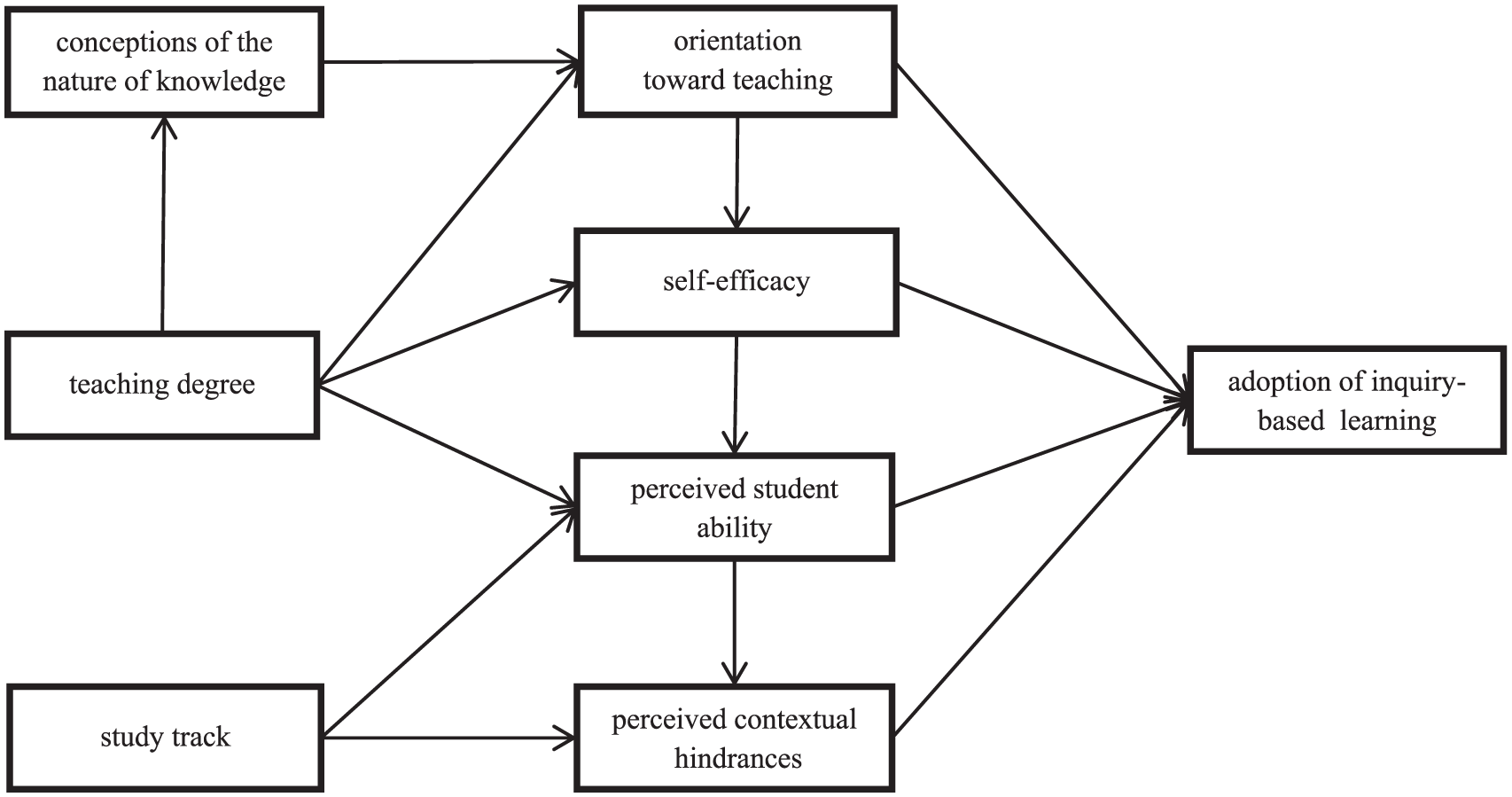
Theoretical model.
Beliefs About Education
Conceptions of the Nature of Knowledge
Beliefs about the nature of knowledge, also referred to as epistemological beliefs, are a set of conceptions about how knowledge is constructed and evaluated, including ideas about standards for inquiry, and the criteria to judge answers (Hofer, 2001). According to a review study by Muis, Bendixen, and Haerle (2006), these epistemological beliefs differ depending on the domain, even though they also appear to be influenced by more domain-general epistemological beliefs. One of the most commonly used frameworks for history, constructed by Maggioni, VanSledright, and Alexander (2009), identifies three distinct stances: (a) objectivism, which views historians as mere conduits of information, who strive for objectivity and thus carefully avoid interpretation; (b) subjectivism, which regards historical accounts as puzzled together through instinctive preference or casual selection, and reduces all of history to a matter of opinion; and (c) criterialism, which acknowledges that although historical research is guided by personal theories of historians, claims must be grounded in arguments and evidence, and can also be evaluated on these grounds. Several studies in history have found evidence for these stances, although they sometimes use a different terminology (e.g., Bouhon, 2009; McCrum, 2013; Voet & De Wever, 2016). In addition, some of these studies have suggested that teachers’ beliefs about the nature of the discipline are linked to their orientation toward teaching. Overall, previous findings indicate that teachers with objectivist views tend to put more emphasis on students’ mastery of facts and grand narratives, and seem to prefer teacher-centered instruction. Teachers with subjectivist and criterialist views, on the other hand, appear to be more concerned with critical thinking or inquiry skills, and lean toward student-centered modes of instruction (Bouhon, 2009; McCrum, 2013; Wilson & Wineburg, 1993).
Orientation Toward Teaching
Orientations toward teaching refer to the goals and purposes that direct teachers’ instructional approach (Grossman, 1990; Magnusson, Krajcik, & Borko, 2001). These orientations toward teaching are, in part, connected to more general beliefs that teachers hold about students, school, and education (Van Driel, Bulte, & Verloop, 2007). With regard to history education, researchers commonly distinguish between two overarching knowledge goals: (a) substantive knowledge encompasses the story of the past, or the “who, what, where, when and why” (Lee & Ashby, 2000); while (b) procedural knowledge is necessary to understand how history works. The latter requires insight not only into second-order or meta-concepts describing the study of the past (e.g., reliability, causation, and change) but also into the procedures for applying these ideas to authentic practices of inquiry (VanSledright & Limón, 2006). As teachers generally attribute different values to each of these two goals (Bouhon, 2009), this, in turn, results in differences in their adoption of IBL. In particular, a study by Husbands (2011) suggests that teachers who attach more value to procedural knowledge goals are more inclined to engage their students in reasoning with and about historical information and concepts. Furthermore, as a particular orientation toward teaching drives teachers to invest more time and effort in related instructional approaches (Gess-Newsome & Lederman, 1999), it can be assumed that this would ultimately lead to increased feelings of self-efficacy with regard to these approaches (Grossman, 1990).
Beliefs About the Self
Self-Efficacy
Teachers’ self-efficacy beliefs can be described as a judgment of their capabilities to reach desired goals (Tschannen-Moran & Woofolk Hoy, 2001). As self-efficacy beliefs are essentially a self-assessment based on a task analysis, Pajares (1996) argued that they should be investigated within the context of specific tasks, rather than being operationalized as a general personality trait. In the present study, teachers’ self-efficacy beliefs are thus operationalized against the backdrop of learning activities that center around an investigation of historical evidence. So far, little research has been conducted on history teachers’ self-efficacy beliefs with regard to such activities. Yet, other research has found a consistent relation between self-efficacy beliefs and teachers’ behavior in the classroom. In particular, these beliefs appear to influence teachers’ persistence and resilience when things do not work out as planned (Tschannen-Moran & Woofolk Hoy, 2001). As such, teacher self-efficacy can be assumed to positively influence their adoption of IBL. Teachers’ self-efficacy beliefs also appear to be positively related to perceived student ability, as teachers with stronger self-efficacy beliefs are more likely to expect that all students can learn and are less critical of students’ errors (Ashton & Webb, 1986).
Beliefs About the Context
Perceived Contextual Hindrances
The complexities of classroom life can have a powerful influence on teachers’ classroom practice, and have often been found to constrain their options for providing instruction in line with their ideas about teaching and learning (see, for example, the review by Fang, 1996). With regard to history teachers’ organization of IBL activities, one of the most important obstacles appears to be the history curriculum itself. The need to cover the (national) curriculum generally makes it difficult for teachers to free up time for conducting inquiries (Haydn, 2011). In addition, it appears that students often have problems to successfully engage in inquiry tasks, which can turn these activities into “time-eaters,” requiring a significant amount of extra time and effort on behalf of the teacher (Van Hover & Yeager, 2003). As such, a number of studies have documented how these contextual hindrances appeared to obstruct the adoption of IBL (Fehn & Koeppen, 1998; Van Hover & Yeager, 2003).
Perceived Student Ability
With regard to students’ ability to engage in historical reasoning, Booth (1994) concluded that limits
seem to be not set so much by cognitive factors, but by a wide range of issues such as the teaching context, the use of accessible and problematic historical materials, or the teaching styles and subject knowledge of the teacher. (p. 65)
Unfortunately, it appears that history teachers often hold different beliefs. Studies have often described these teachers’ perceptions of students’ ability as a major barrier to IBL activities, finding that they generally have doubts about students’ psychological and intellectual development, frustrations about their unwillingness to think critically, or reservations about low-achieving students’ ability to engage in higher order thinking (Moisan, 2010; Van Hover & Yeager, 2003). As such, it is likely that more optimistic beliefs about students’ ability will be positively related to the adoption of IBL and negatively to perceived contextual hindrances.
Teacher Characteristics
Teaching Degree
Teachers’ beliefs about the subject appear to be, in part, influenced by the extent to which their training has exposed them to courses about the discipline’s assumptions, values, and methods (e.g., McDiarmid, 1994). In this light, Yilmaz (2008) noted that teachers with an advanced degree in history generally hold more sophisticated conceptions of the nature of knowledge compared with those who have not taken courses on the subject. It can thus be assumed that teachers who have more knowledge about history and its methods will also have more confidence for organizing inquiry activities, resulting in a higher teacher self-efficacy. In addition, Levy et al. (2013) found that training programs confronting student teachers with historical inquiry made them more interested in teaching such activities themselves, thus affecting their orientation toward history teaching. Finally, earlier studies suggest that teachers whose training stimulated them to investigate students’ thinking or provided them with an overview of students’ capabilities might have a better understanding of students’ abilities (Monte-Sano, 2011), thus influencing perceived student ability.
Study Track
Tracking, or separating secondary school students into different study tracks based on their ability, is a common practice in the Western world (Korthals, 2013). In North American settings, the concept of tracking is commonly understood as the ability grouping of students in classes with uniform curricula, whereas in European contexts it generally refers to the grouping of students in classes with differentiated curricula, which can typically be classified as having an either academic or vocational orientation (Brunello & Checchi, 2006). As the present study is situated in the latter context, tracking should be understood here as the assignment of students to well-defined separate segments of secondary education, which offer different packages of courses. In such cases, tracking is primarily determined by student proficiency, although student and parent preferences also play a role (Pickens & Eick, 2009). As a consequence, teachers in different study tracks are generally confronted with student groups with distinct interests and abilities (Hindriks, Verschelde, Rayp, & Schoors, 2010), in addition to having different amounts of time available for teaching history each week (Voet & De Wever, 2016). It therefore seems likely that study tracks influence perceived student ability, as well as perceived contextual hindrances.
Aims
To summarize, the main aim of the present study was to empirically investigate the framework presented above, which unites three constitutive dimensions of beliefs systems to explain history teachers’ adoption of IBL. More specifically, the research questions are as follows:
Design and Method
A pen-and-paper questionnaire was designed to further investigate the theoretical model. This section provides more information on the development of the instrument, data collection, participants, validation of the measures, and data analysis.
Instrument Development
A review of the literature makes it clear that there exist only a small number of instruments for capturing history teachers’ beliefs about education, the self, and the context, in light of IBL. In addition, a closer inspection of these instruments gives rise to questions about their validity, as some include little information on the validation process (von Borries, 2000), whereas the methods reported by others are not entirely appropriate for confirming validity (e.g., the use of principal components analysis instead of factor analysis, for investigating scale dimensionality, by Maggioni et al., 2009). Therefore, several new Likert-type scales were constructed for the purpose of the present study. Some items were adapted from the instruments mentioned above, while others were developed based on the literature regarding history teachers’ beliefs. This work resulted in six 6-point scales:
(a) Beliefs about the nature of knowledge: Based on the framework of Maggioni et al. (2009), three subscales were constructed that correspond to the epistemological stances of: objectivism (NKO), subjectivism (NKS), and criterialism (NKC); (b) Orientation toward teaching: In line with the review study by VanSledright and Limón (2006), two subscales were constructed to capture orientation toward teaching substantive knowledge (OTS) and procedural knowledge (OTP); (c) Self-efficacy (SEF): Keeping in mind the context specificity of self-efficacy beliefs (Pajares, 1996), this scale was constructed to measure feelings of competence for organizing learning activities that focus on an investigation of historical evidence; (d) Perceived contextual hindrances (PCH): For this scale, a number of items were developed to capture the extent to which contextual factors called for additional efforts or caused problems when organizing IBL activities; (e) Perceived student ability (PSA): Based on teachers’ comments about student ability during a previous study (Voet & De Wever, 2016), this scale was constructed to map perceptions of students’ capability to carry out IBL activities; (f) Adoption of inquiry-based learning (AIL): This scale asked teachers about the extent to which they integrated different kinds of IBL activities into their history lessons.
The questionnaire also contained a number of categorical items developed by Bouhon (2009), which gauged history teachers’ general ideas about instructing the subject. Each of these items required teachers to review three statements, and select the one that was closest to their own ideas. Finally, there were several items on teacher characteristics, such as sex, age, teaching degree, and the study tracks in which teachers worked.
Data Collection
Data were collected within secondary education in Flanders (Belgium), which consists of six grades, starting at age 12 and ending at age 18. Throughout these grades, the attainment goals that the government sets for secondary education put an increasing emphasis on students’ ability to reason with historical information, ultimately requiring students to be able to arrive at grounded conclusions in relation to a key problem (for more information on secondary school history in Flanders, see De Wever et al., 2011). The pen-and-paper survey was distributed across three study tracks, with different amounts of time available for teaching history each week. For teachers in general education and some art education tracks, the curriculum holds two 50-min periods of history each week, whereas technical education and certain other art education tracks only receive one period of history each week. To reduce social desirability (see also Krumpal, 2013; Nederhof, 1985), the survey was designed to be filled in anonymously, through self-administration, and to be returned within a sealed envelope. Participants were asked to also fill in and sign an informed consent, which was returned within a separate sealed envelope, so as to ensure complete confidentiality.
Participants
In total, 550 history teachers from 219 secondary schools participated in the study. After examination of the data, 24 cases with a large number of missing values were removed from the sample. A model-based imputation method (EM-algorithm) was used in 13 cases with only one or two missing values (see also Kline, 2005). On average, the participating teachers had 13 years of experience in teaching history (SD = 10 years). Looking at their certification, 258 held a degree of a 3-year bachelor program at a university college, which takes mainly a practical approach to learning to teach history, in addition to one or two other subjects, and prepares teachers to work in Grades 1 to 4 of secondary education. Another 223 had obtained a master’s degree of a 4-year history course at university, centered around academic history and historical research, which was complemented by a 1-year teacher training preparing them to teach in Grades 3 to 6. The remaining 45 teachers held a degree that provided no specific preparation for teaching history (e.g., other subjects teacher, orthophonist, etc.). With regard to the time that teachers made available for teaching, 119 teachers instructed history in one-period classrooms, 205 in two-period classrooms, and 202 in both one- and two-period classrooms.
Instrument Validation
The psychometric quality of the questionnaire was examined through an investigation of factorial validity and internal consistency. First, the dataset was split into two random subsets (N = 268), which were used to respectively conduct an exploratory (EFA) and confirmatory (CFA) factor analysis. Next, the whole dataset was used to calculate Cronbach’s α for each scale. A first review of the results showed that not all subscales for conceptions of the nature of knowledge could be replicated through the factor analysis. To be more specific, it turned out that the items from the Criterialist and Subjectivist subscale failed to load onto separate factors. Therefore, only the Objectivist subscale is included in the analyses reported here.
The EFA was carried out using SPSS 18. In accordance with methodological recommendations provided by earlier work (Costello & Osborne, 2005), extraction was done through maximum-likelihood estimation, and rotation through the oblique Promax method (as factors were expected to be correlated). The results of the Kaiser–Meyer–Olkin test indicate that the sample was adequate for conducting an EFA (KMO = .82), while Bartlett’s test confirms that the items under investigation were in fact related (χ2 = 2,245.79, df = 300, p < .001).
Following the advice of Courtney (2013), the number of factors to retain was determined by comparing the number of eigenvalues greater than 1 with the output from Cattell’s scree test, and Horn’s parallel analysis (the latter was carried out using the “Paramap” package in R 3.1). The eigenvalues and Horn’s Parallel Analysis pointed to, respectively, a seven- and eight-factor structure, while the scree plot showed no clear point of inflection. As such, both the seven- and eight-factor solution were further explored. In the seven-factor structure, which is in line with the theoretical model, all items loaded moderately high to high on one factor, and cross-loadings stayed low. The results of the goodness-of-fit test further indicate that the seven-factor structure is a good fit to the data (χ2 = 159.95, df = 146, p = .203). In contrast, estimating the eight-factor structure turned out to be problematic. The occurrence of an ultra-Heywood case (i.e., a communality estimate exceeding 1, implying that a unique factor has negative variance) during the estimation process indicated that an eight-factor solution was not appropriate for the data. An overview of the EFA’s results is presented in Appendix A.
The CFA was conducted using the “Lavaan” Package in R 3.1. One within-scale correlation was allowed (BNU3 and BNU4). The results indicate a good fit (comparative fit index [CFI] = .96; Tucker–Lewis index [TLI] = .95; root mean square error of approximation [RMSEA] = .03, 90% confidence interval = [0.03, 0.04], standardized root mean square residual [SRMR] = .04) when compared with the criteria proposed by Hu and Bentler (1999): CFI and TLI ≥ .95, RMSEA ≤ .06, SRMR ≤ .08.
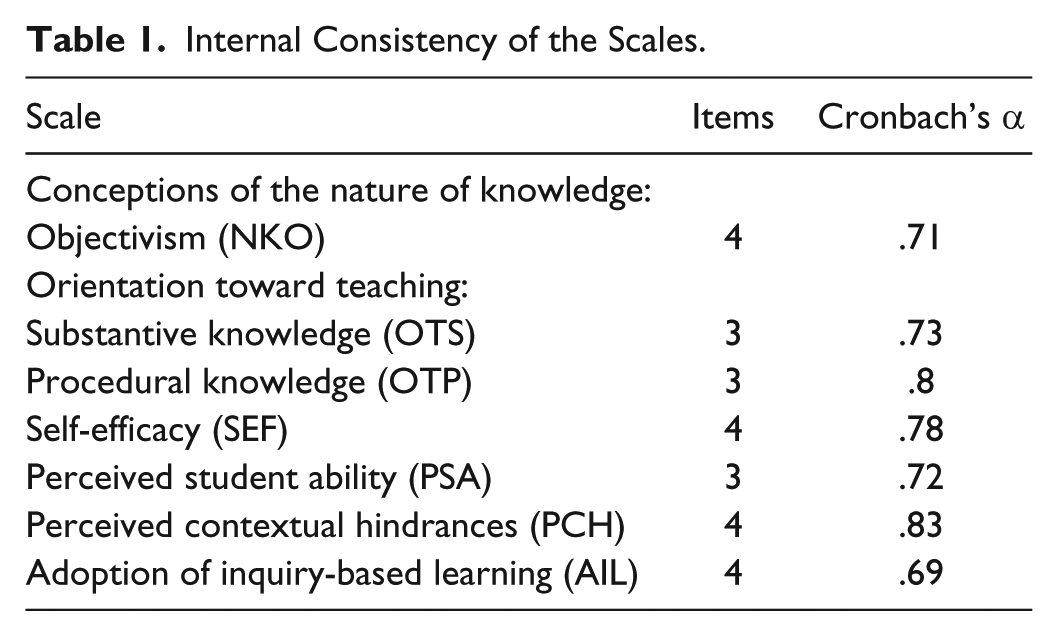
Finally, the internal consistency of each scale is presented in Table 1. The results indicate that all scales reported here have an acceptable to good internal consistency. An overview of the scales is presented in Appendix B.
Internal Consistency of the Scales.
Analysis
As a first step, teachers’ general beliefs about teaching and learning history were examined by calculating the distribution of teachers’ responses to each of the categorical items developed by Bouhon (2009). Teachers who had not completed all of these items were excluded from this part of the analysis, which slightly reduced the sample size (n = 513). In addition, the complete sample (n = 536) was used to calculate means for each of the validated Likert-type scales.
The Likert-type scales were then used to examine the beliefs framework for teachers’ adoption of IBL. Based on the complete sample (n = 536), a structural equation model (SEM) was estimated using R 3.1. The nested structure of the data (i.e., a number of teachers worked in the same schools) was taken into account using the “lavaan.survey” package. Similar to the confirmatory analysis, one within-scale correlation was allowed (BNU3 and BNU4). Compared with the cutoff criteria proposed by Hu and Bentler (1999), the results of the analysis again indicate a good fit: CFI = .96, TLI = .95, RMSEA = .03, 90% confidence interval = [0.03, 0.04], SRMR = .05.
Results
The first part of the results section presents several descriptive findings on history teachers’ beliefs about their subject, whereas the second part of this section focuses on the SEM for teachers’ adoption of IBL activities.
Descriptive Findings
Table 2 presents the findings with regard to teachers’ goals and approach to history teaching. For most teachers, the main goal is to develop students’ knowledge of the past, together with a basic ability to critically analyze information. A smaller group of about one of five teachers seems to hold higher expectations, and indicates that students should be able to conduct their own inquiries based on a problem statement presented by the teacher. Finally, approximately one of three teachers holds a narrow view of the primary goal of history as learning about what happened in the past. Moving on to teachers’ beliefs about instruction, the majority appears to favor an approach that combines student activity with teacher explanation and guidance. Approximately one of five teachers stresses a more teacher-centered approach that is dominated by lectures, while a similar number prefers largely student-centered activities that provide a significant amount of time for exploration and experimentation.
Goals and Approaches Related to History Teaching.

Note. N = 513. Teachers could select only one of the options for each question.
Table 3 further explores teachers’ beliefs about the narratives that are part of the history lesson and students’ use of information sources. As is apparent from the results, the large majority of teachers regard narratives primarily as a way to present, break down, and structure complex content into something that students can understand. About one of six teachers sees these narratives as part of an approach that also aims to develop students’ understanding of history itself, next to enabling them to actively construct their own knowledge. In contrast, only a few teachers believe that students cannot learn from narratives, and that these can only be used to organize knowledge that was first acquired through other means. Looking, then, at teachers’ ideas about working with information sources in the classroom, the results suggest that the majority prefers teacher-driven inquiries, during which students are carefully guided through each step, and teachers structure their work by asking critical questions and providing feedback on their progress. Similar to the findings presented in Table 1, one of five teachers reports that information sources should be used to let students conduct their own inquiries through an approach that provides them with room for exploring and discussing different points of view. However, a relatively large group of about one of four teachers primarily considers information sources as illustrations of the past, rather than a starting point for developing students’ ability to engage in historical reasoning.
History Teachers’ Ideas About Stories and Information Sources.

Note. N = 513. Teachers could select only one of the options for each question.
Finally, Table 4 presents the findings for the scales that are used in the SEM model. The mean for objectivist beliefs hovers near the middle of the scale, indicating neither strong agreement nor strong disagreement with conceptions of history as an objective approach to information without any room for interpretation. Looking at the means for the subscales of orientation toward history teaching, these results indicate that teachers commonly value both substantive and procedural knowledge, although substantive knowledge is rated markedly higher. Furthermore, the average teacher appears to be moderately confident in his or her own ability to organize IBL activities but seems to have neither high nor low expectations when it comes to students’ ability. Finally, the moderately high means for perceived contextual hindrances and adoption of IBL imply that, overall, teachers occasionally organize IBL activities but feel rather hindered by the teaching context when doing so.
Means and Standard Deviations of the Scales.
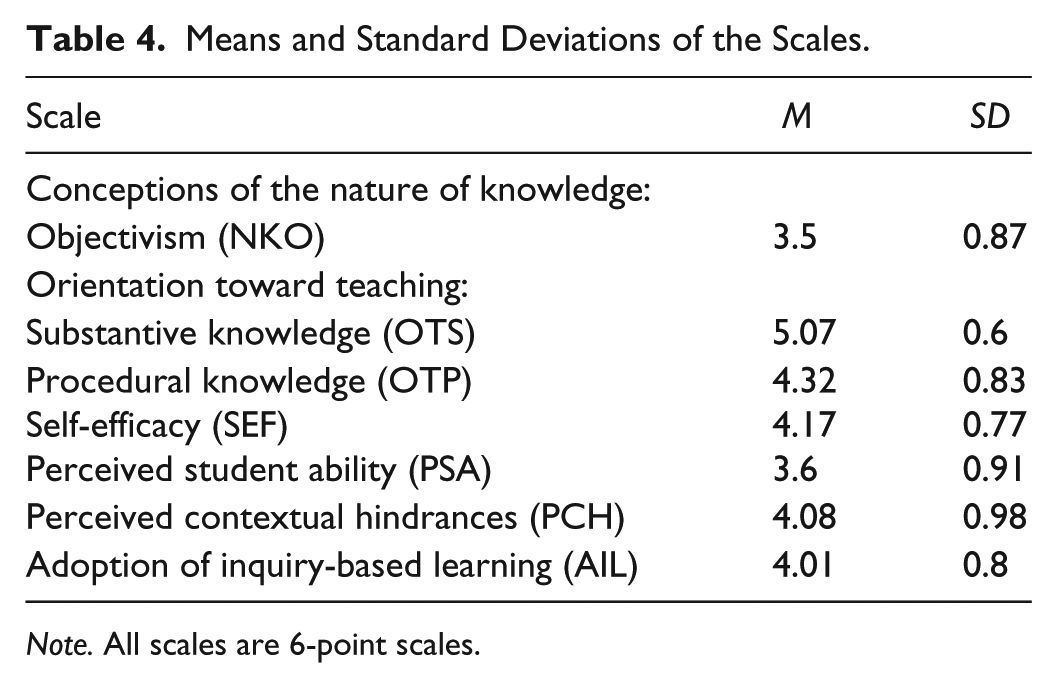
Note. All scales are 6-point scales.
The SEM Model
The SEM is presented in Figure 2. In total, 38% of the variance of teachers’ adoption of IBL is explained by the model. More information on the output of the analysis (e.g., standard errors, z-values, other R-squares) can be found in Appendix C.
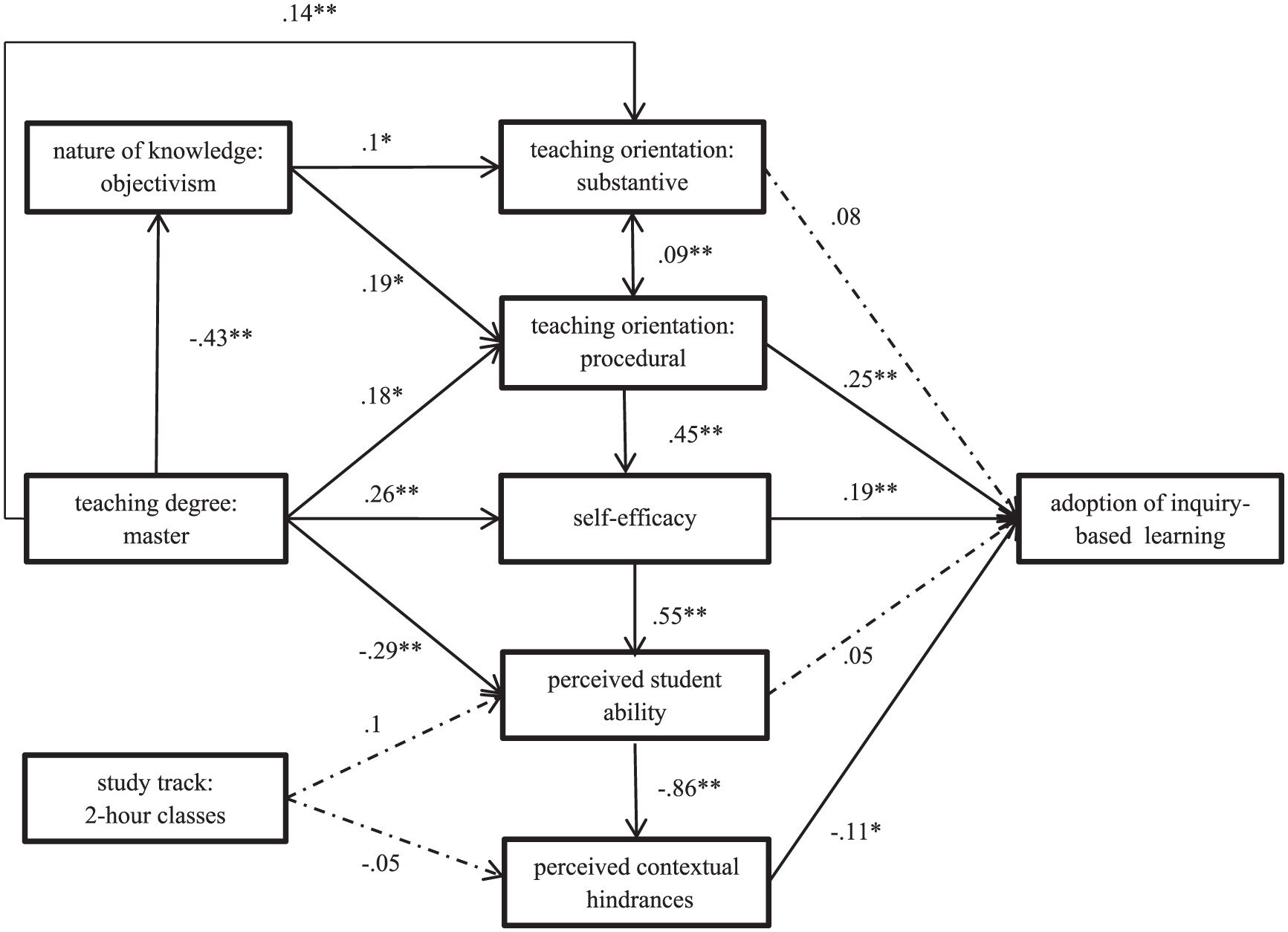
Structural equation model.
Three out of five variables have a significant impact on teachers’ adoption of IBL activities. The weight that history teachers place on procedural knowledge goals (i.e., learning about the foundations and practices of historical reasoning) appears to be most influential, and is positively related to their adoption of IBL activities (β = .25, p < .001). Teachers’ feelings of self-efficacy with regard to organizing such activities also exert a positive effect (β = .19, p = .004). In contrast, perceived contextual hindrances have a negative effect on teachers’ adoption of IBL activities (β = −.11, p = .04). Finally, teachers’ beliefs about the relative importance of substantive knowledge (i.e., acquiring a framework of the past) appear to have no significant effect (β = .08, p = .31), similar to their perceptions of students’ ability to conduct inquiries (β = .05, p = .52).
Furthermore, the SEM confirms that these five variables are connected to one another. First of all, there is a small, but significant, positive correlation between history teachers’ orientation toward teaching substantive and procedural knowledge (ρ = .09, p < .001). In addition, teachers’ commitment to procedural knowledge goals appears to positively influence their self-efficacy for organizing IBL activities (β = .45, p < .001), which in turn has a positive effect on perceptions of students’ ability to engage in such activities (β = .55, p < .001). Finally, beliefs about students’ ability appear to have a large negative effect on teachers’ report of contextual hindrances, which obstruct them from organizing inquiry activities (β = −.86, p < .001).
History teachers’ beliefs also appear to be influenced by other variables. The study tracks in which teachers work do not appear to have a significant influence, neither on their perceptions of students’ ability related to conducting inquiries (β = .1, p = .18) nor on perceived contextual hindrances (β = −.05, p = .52). There is, however, a significant influence of teachers’ objectivist ideas about history, which positively affects teachers’ ideas about the value of both substantive and procedural knowledge goals (respectively, β = .1, p = .03 and β = .19, p = .02). Teachers’ training appears to have the most powerful indirect influence on their adoption of IBL activities. At first sight, the results suggest that there are considerable differences between teachers with a master’s degree in history (i.e., obtained upon completion of a 4-year program on academic history) and teachers holding other degrees. Having a master’s degree in history seems to have a positive effect on the perceived importance of both substantive and procedural knowledge (respectively, β = .14, p = .002 and β = .18, p = .03), as well as teachers’ self-efficacy for organizing IBL activities (β = .26, p < .001). Furthermore, holding a master’s degree is negatively related to maintaining objectivist beliefs about history (β = −.43, p < .001). It also negatively affects teachers’ expectations regarding students’ ability to conduct historical inquiries (β = −.29, p = .03).
Table 5 further explores the effect of different teaching degrees. Dummy coding, with master’s degree as the reference level, was used to add the different categories into the SEM. All differences between teachers with a master’s and bachelor’s degree (i.e., obtained after a 3-year course with a practical focus on teaching history and one or two other subjects) appear to be significant. Although there are similar differences between teachers with a master’s degree and those without any formal training in history, most of these are not significant (partly due to the small size of this group, which increases the standard error).
Effect of Teaching Degrees in Relation to That of a Master’s Degree.
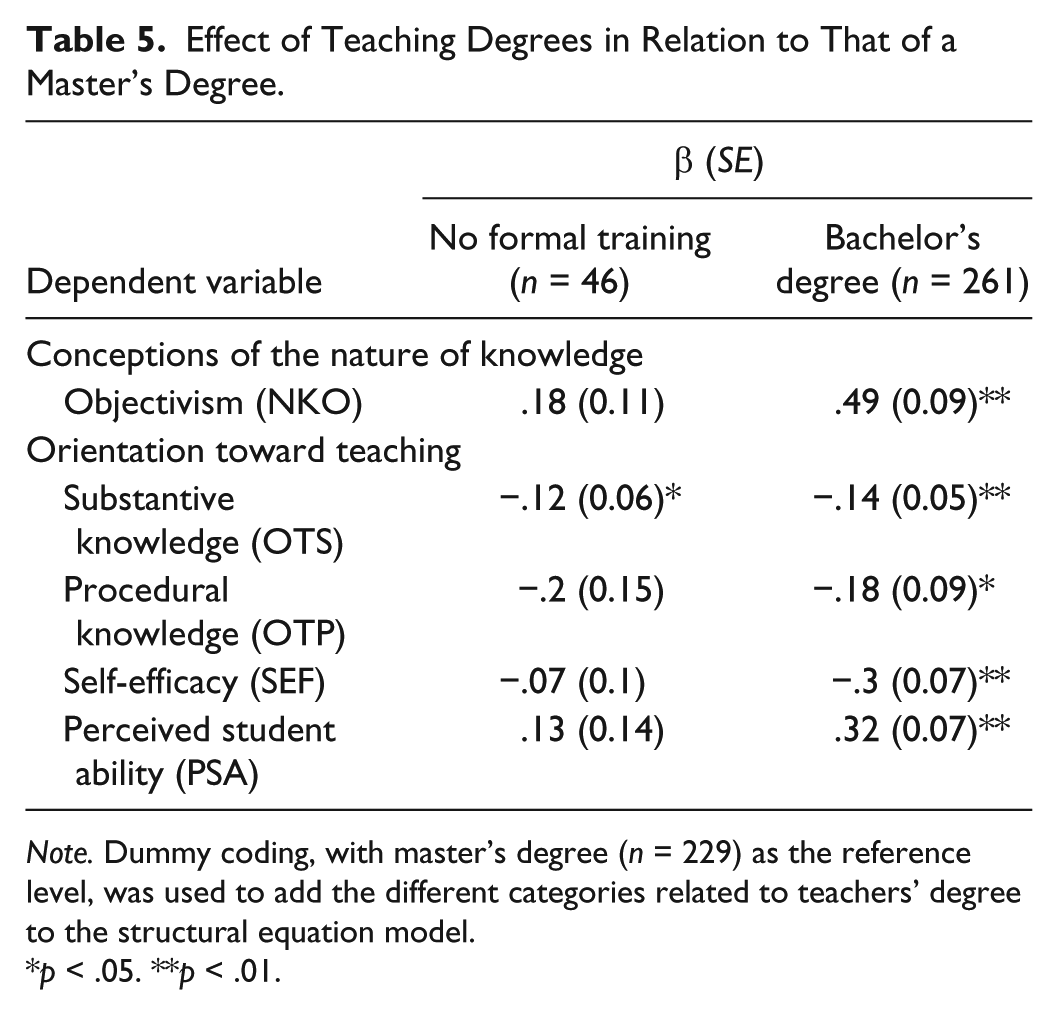
Note. Dummy coding, with master’s degree (n = 229) as the reference level, was used to add the different categories related to teachers’ degree to the structural equation model.
p < .05. **p < .01.
Discussion and Conclusion
Despite findings that professional development is likely to fail if it does not take teachers’ beliefs into account (Lotter et al., 2013), previous research on professional development with regard to IBL has generally neglected to systematically assess teachers’ beliefs (Capps et al., 2012). As such, there is little information available on how teachers’ beliefs determine their adoption of IBL. In answer to this shortcoming of the research so far, the present study offers a framework that can help inform the design of effective professional development with regard to IBL. Based on findings showing that both inquiry practices and teachers’ beliefs differ across domains (Donovan & Bransford, 2005; Grossman & Stodolsky, 1995; Levy et al., 2013), it further makes the case for operationalization of this framework against the backdrop of a specific domain. As the present study’s empirical investigation of the framework was carried out within the domain of history education, the discussion of the findings first focuses on the results within this particular domain, and afterward considers to what extent these results can be generalized.
Teachers’ Use of IBL in History Education
First of all, the descriptive findings indicate that, on average, history teachers’ beliefs related to IBL are positioned on the “moderate” levels of the Likert-type scales. The only exception to this trend are teachers’ beliefs about the value of substantive knowledge (i.e., knowledge about the story of the past), which approach the higher end of the scale. As such, it is not surprising that only a minority of teachers appear inclined to organize extensive, student-centered IBL activities. These results resemble the findings of other recent research, which concludes that teachers’ attention to historical reasoning remains relatively narrow (Van Nieuwenhuyse, Wils, Clarebout, Draye, & Verschaffel, 2015). Yet, compared with reports from a decade ago, which indicate that inquiry was seldom practiced in history education (e.g., Bain, 2006; Hartzler-Miller, 2001), they also point toward a positive evolution. As a result of the increasing emphasis on disciplinary reasoning skills across curricula, IBL appears to be gradually finding its way into the history classroom.
The results of the SEM help clarify why some history teachers are not as quick to adopt IBL activities as others. Explaining a large portion (38%) of the variance in history teachers’ use of IBL, the SEM shows that three factors play a key role in teachers’ decision-making process: (a) the value attributed to procedural knowledge (i.e., knowledge about historical reasoning and inquiry), (b) feelings of competence for organizing IBL activities, and (c) the extent to which the classroom environment is perceived as a hindrance to such activities. These three factors also appear to be connected to one another. A plausible explanation is that teachers who place more importance on the development of procedural knowledge goals will also put more effort into mastering instructional activities that allow them to teach this kind of knowledge. In turn, their increased confidence in teaching such activities likely results in a more positive view of the working context.
Furthermore, the results suggest that part of the differences in beliefs held by history teachers can be explained by the extent to which their training confronted them with academic thinking in history. In line with what previous work has generally assumed (e.g., McDiarmid, 1994), history teachers with an academic degree possess beliefs that are more favorable to the adoption of IBL. These teachers attach more weight to knowledge goals in general, including the teaching of procedural knowledge, and also feel more capable of organizing IBL activities. Similar to what Yilmaz (2008) found, they are also less likely to agree with views that run counter to current academic assumptions about the nature of the field. However, one drawback of the academic training program appears to be that its graduates generally have lower expectations of their students’ ability to conduct inquiries. A possible explanation is that, due to their academic focus, such programs might pay less attention to secondary school students’ thinking, compared with nonacademically oriented training programs. In contrast to teachers’ former training, the study track in which they teach has no significant effect on their beliefs. This finding is not in line with an earlier study, suggesting that study tracks might influence history teachers’ approach to IBL (Voet & De Wever, 2016). The present study thus seems to provide a new perspective on these previous findings, because, while there is indeed a small effect of study tracks, the analysis indicates that it is in fact not significant.
Finally, there remains one finding that is rather peculiar. History teachers’ agreement with objectivist beliefs about history is positively associated with a focus on procedural knowledge goals, whereas researchers have traditionally assumed that teachers who view history as an objective report of facts about the past are more inclined to tell its story rather than to teach students about disciplinary reasoning processes (e.g., McCrum, 2013; Wilson & Wineburg, 1993). Looking further into this matter, a plausible explanation may be found in the instrument used to measure epistemological beliefs. Previous research shows that epistemological beliefs develop over different stages (King & Kitchener, 1994; Kuhn, Cheney, & Weinstock, 2000), and this does not appear to be different for epistemological beliefs within the domain of history (Lee & Ashby, 2000; Lee & Shemilt, 2003). As such, depending on the particular stage of individuals’ epistemological development, individuals will either agree with or reject particular statements about knowledge. Even though other studies have also used Likert-type scales to measure epistemological beliefs in history (e.g., Maggioni et al., 2009), it could thus be argued that asking individuals to indicate the extent to which they agree with certain statements might not be the best approach to measuring the concept of epistemological beliefs. A more appropriate approach to pinpointing individuals’ exact stage of epistemological understanding may lie in asking individuals to choose between contrasting statements. For example, in the work of Kuhn et al. (2000), participants were presented with two different judgments, and then asked to select either: “only one can be right” or “both can have some rightness.”
Generalizing the Findings
The present study’s investigation of history teachers’ adoption of IBL draws on a framework of teacher beliefs, which is based on previous studies on the nature and structure of beliefs systems (Op ‘t Eynde et al., 2002; Schoenfeld, 1983). This framework unites three constitutive dimensions of teacher beliefs systems: beliefs about education, the self, and the context. The finding that, when operationalized against the domain of history education, the framework explains quite a large portion of the variance in teachers’ use of IBL suggests that these three constitutive dimensions of beliefs are key determinants of teachers’ organization of IBL in the classroom.
In short, the findings thus suggest that the framework of teachers’ beliefs about education, the self, and the context offers a sound theoretical basis for an investigation of differences in teachers’ use of IBL. However, even though the framework is itself domain-general, it is again important to point out that both inquiry practices and teacher beliefs have been found to vary across domains (Donovan & Bransford, 2005; Grossman & Stodolsky, 1995; Levy et al., 2013). As a consequence, it can be argued that an investigation of teachers’ use of IBL requires an operationalization of the framework within a particular domain.
Implications and Future Research
The present study improves current understanding of teachers’ adoption of IBL by offering a beliefs-based framework that explains why some teachers commonly organize IBL activities in class, whereas others do not. The findings hold a number of implications for professional development and research on teachers’ use of IBL in general. Furthermore, seeing that empirical investigation of the framework was carried out within the domain of history education, the findings point toward a number of implications specifically pertaining to this domain.
First of all, the framework of beliefs about education, the self, and the context can inform the design of professional development initiatives. By pointing out which beliefs are relevant to teachers’ use of IBL, the framework offers concrete directions for addressing teachers’ beliefs throughout such initiatives. As the literature on teacher training explains, this could be done, for example, through the use of conceptual change strategies (Korthagen, 2013), which center around making explicit often unconsciously held beliefs, pointing out their fallacies or disadvantages, and offering logical alternatives as a replacement. In the same way, the framework can also serve as a basis for the design of instruments, such as interviews or questionnaires, for keeping track of the development of teachers’ beliefs during professional development (see, for example, Voet & De Wever, in press).
The framework introduced by the present study also provides a theoretical basis for future research on teachers’ adoption of IBL. In addition, it points out that investigations of teachers’ use of IBL are best carried out through an operationalization of the framework within a particular domain. In this respect, the present study’s use of the framework within history education can act as an example for future research aiming to apply the framework to other subject domains. Furthermore, an investigation of the framework within different domains will likely contribute to a more comprehensive understanding of how beliefs about education, the self, and the context each affect teachers’ use of IBL.
With regard to teachers’ implementation of IBL within the domain of history, the results of the present study indicate that, despite a positive evolution over the past decade, there still appears to be room for improvement, as the scores for beliefs that determine history teachers’ use of IBL remain relatively moderate. In relation to this, the findings offer some suggestions to professional development initiatives within history education. As it was found that teachers with an academic training appear to hold beliefs that are more favorable to IBL, a confrontation with academic practice, thinking, and debate within history may provide a good starting point for professional development that aims to stimulate IBL in history. However, the results also indicate that academically trained teachers held significantly lower expectations with regard to students’ ability to engage in IBL. This suggests that, even though a focus on academic thinking seems to have its benefits, it is also important for professional development on IBL not to lose sight of what happens in the actual classroom, for example, by concentrating on students’ competences with regard to carrying out inquiries, or their ideas about history in general.
Finally, the results of the present study cast some doubt on the use of Likert-type scales for measuring epistemological beliefs about history. As noted above, instruments based on contrasting items appear to be more fitting for capturing this kind of beliefs. Future research could look further into this matter by comparing results of both instruments against one another, and possibly against a third measure, such as interviews, to find out whether these measures do indeed lead to different results.
Supplemental Material
751399 – Supplemental material for Teachers’ Adoption of Inquiry-Based Learning Activities: The Importance of Beliefs About Education, the Self, and the Context
Supplemental material, 751399 for Teachers’ Adoption of Inquiry-Based Learning Activities: The Importance of Beliefs About Education, the Self, and the Context by Michiel Voet and Bram De Wever in Journal of Teacher Education
Footnotes
Appendix A
Appendix B
Appendix C
Declaration of Conflicting Interests
The author(s) declared no potential conflicts of interest with respect to the research, authorship, and/or publication of this article.
Funding
The author(s) received no financial support for the research, authorship, and/or publication of this article.
Author Biographies

References
Supplementary Material
Please find the following supplemental material available below.
For Open Access articles published under a Creative Commons License, all supplemental material carries the same license as the article it is associated with.
For non-Open Access articles published, all supplemental material carries a non-exclusive license, and permission requests for re-use of supplemental material or any part of supplemental material shall be sent directly to the copyright owner as specified in the copyright notice associated with the article.
