




Abstract
edTPA is designed to strengthen teacher professionalization and provide a framework for program redesign. However, using a national assessment to shift the content of local programs is challenging because of their inherent organizational complexity. In this article, we focus on this complexity, using a systems lens to analyze edTPA implementation at a large, public university. Employing a mixed-methods case study design, we survey 250 teacher educators and candidates to understand how they interpret the demands of edTPA and how their varied perspectives impact each other. We interview a stratified, purposive subset of participants to explore mechanisms underlying quantitative findings. We find substantial internal variation in edTPA implementation that translates into differential support for candidates. This variation could not be explained by duration of implementation of edTPA. Varied perspectives may stem from distinct perceptions of teacher educators’ professional roles and the role they see edTPA playing in teacher professionalization.
Background
In recent years, teacher educators and legislators have argued for policies that better prepare teachers and strengthen teacher professionalization (Darling-Hammond, 2006; Levine, 2006; Mehta & Doctor, 2013). Many believe edTPA—a performance assessment that requires teacher candidates to videotape and reflect upon their teaching—is an important step toward fulfilling these goals. edTPA adoption has occurred nationwide; it is currently required for licensure by more than 700 institutions spanning 40 states (http://edtpa.aacte.org/state-policy).
Policymakers have framed edTPA as a rigorous performance screen, akin to a “bar exam,” designed to improve the teacher quality. Indeed, there is research suggesting that edTPA performance may predict outcomes for inservice teachers (Bastian, Henry, Pan, & Lys, 2016; Darling-Hammond, Newton, & Chung Wei, 2013; Goldhaber, Cowan, & Theobald, 2016). As such, some have suggested that edTPA pass rates should serve as a standardized assessment of program quality (http://caepnet.org/accreditation/caep-accreditation/caep-accreditation-handbook). Advocates argue that, in addition to serving an accountability function for candidates and programs, edTPA provides a framework to “guide the development of [teacher education] curriculum and practice” (http://edtpa.aacte.org/about-edtpa#Overview) and facilitate professionalization for teacher candidates and teacher educators (Darling-Hammond & Hyler, 2013).
Achieving these myriad goals simultaneously is complicated. This complexity is compounded by the fact that these varied goals involve implementation by a variety of actors including faculty, university supervisors, mentor teachers—each of whom acts as a “teacher educator” (Zeichner, 2006). These individuals likely have varied perspectives that influence their perceptions of edTPA as a tool for their own professional development, as well a helpful tool for candidates.
Prior research on edTPA implementation, however, has considered local actors in isolation, rather than in tandem. Recent studies have focused on how faculty members (Ledwell & Oyler, 2016; Ratner & Kolman, 2016) or teacher candidates (Margolis & Doring, 2013) perceive and respond to edTPA, but little research has looked at the relationship between teacher educator and teacher candidates’ perspectives. Few studies have considered how the inherent organizational complexity of teacher education programs interacts with the complexity of edTPA’s goals in ways that might affect edTPA implementation and, in turn, shape candidates’ perceptions of their training.
Rather than consider the components of edTPA implementation—goals and processes—in isolation, we analyze the relationship among these interrelated implementation efforts within a college of education at a large public university where it has been used for almost 7 years in the preparation of more than 1,000 teacher candidates. We draw on qualitative and quantitative data sources—interviews with various constituencies (teacher candidates, faculty members, university supervisors, and program administrators) and surveys of all groups (n = 272)—to better understand how stakeholders understand the purpose of edTPA and its influence on teacher preparation. In particular, we focus on the degree to which teacher candidates feel edTPA aligns with the content and goals of their teacher preparation program. We then analyze how specific programmatic factors, 1 including teacher educators’ conceptualizations of edTPA, are associated with the candidates’ perceptions of edTPA.
This study provides much needed empirical evidence about how edTPA shapes teacher preparation across the multiple organizational programs, for multiple constituencies within those programs, and in pursuit of the multiple goals of edTPA. This organizational approach is necessary to understand the way edTPA implementation occurs in practice. We answer the following research questions:
Background Literature and Conceptual Framework
It is surprising how little research has considered edTPA implementation across an entire college of education given the likelihood that teacher educators’ perceptions of edTPA will influence teacher candidates’ perceptions of the reform. The little extant research that exists relies on small samples (usually fewer than 50), limiting its explanatory power. However, these small-scale studies of performance assessment implementation—both edTPA and the Performance Assessment for California Teachers (PACT; the California-based precursor to edTPA)—indicate that attention to variation within and across contexts is important. For example, Okhremtchouk, Newell, and Rosa (2009) found that communication barriers across teacher education contexts—university to field—impeded candidates’ completion of performance assessments. Sandholtz and Shea (2012) found that university supervisors had varied perceptions of instructional quality that were differentially aligned with the paradigm suggested by PACT.
Ledwell and Oyler (2016) focused on how adoption of edTPA may vary within an institution based on methods instructors’ perspectives. They found a range of responses to edTPA from “marginalization” of the assessment to a “deep integration” in coursework. Similarly, Ratner and Kolman (2016) interview teacher education faculty in New York, where edTPA is required for licensure. They, too, found enormous variability in edTPA supports professors provided candidates. Both studies suggest that teacher educators’ attitudes result in different implementation behaviors and that the multiplicity of edTPA’s goals is implicated in producing this variation. Ratner and Kolman (2016) suggest providing instructors more time to understand that assessment will likely alleviate implementation challenges, though no work has examined this hypothesis empirically. In general, implementation studies of performance assessments point to systems for managing change (Peck, Gallucci, Sloan, & Lippincott, 2009; Peck & McDonald, 2013; Whittaker & Nelson, 2013) and for providing time for sense-making (Fayne & Qian, 2016) as of paramount importance.
Although empirical evidence about variability in edTPA responses is helpful, the range of factors that contribute to such variability is unclear. Perhaps more importantly, we need to understand how different teacher educator responses might, in turn, be associated with candidates’ perceptions of edTPA. After all, a primary goal of edTPA is to shape perspective teachers’ professional identities. Thus, to understand edTPA implementation, we need a clearer sense of the relationship between the presentation of edTPA and how candidates make sense of the assessment.
In this article, we extend prior edTPA implementation research by examining how various actors make sense of the demands of a new reform (Spillane, Reiser, & Reimer, 2002). Spillane and colleagues (2002) note that goal clarity and internal consistency are important prerequisites for the rational implementation of reforms and that to understand implementation fully, scholars must analyze how agents reconcile their existing practice with those required for reform implementation. This approach requires taking seriously the range of identities and beliefs that shape perceptions of reforms such as edTPA.
Teacher candidates and teacher educators interpret messages around teaching in ways that are situated within broader professional communities (Coburn, 2001; Spillane, 1998). In this sense-making framework, teacher educators are likely to construct understandings of edTPA, and, in turn, align their practice to edTPA’s frameworks for “good teaching” in ways that are contingent on preexisting practices and identities. Furthermore, teacher educators and teacher candidates likely make sense of edTPA in conjunction with colleagues and peers based on the culture of their professional field (e.g., clinical or research faculty). Because edTPA involves content-specific rubrics, primary implementation occurs within specific program areas. As such, we analyze how sense-making about edTPA transpires in particular licensure areas, as well as how the perceived responses of teacher educators shape candidates’ views.
An additional complication is that the groups engaged in collective sense-making are not monolithic. This raises the possibility that variegated identities will beget variegated interpretations of and responses to edTPA, even within the same group. This possibility is especially salient in teacher education, where the role of methods instructor might be complicated by an identity ranging from doctoral student to adjunct instructor to tenured faculty member. These additional roles and attendant identities may complicate any instructor’s understanding of edTPA.
Finally, implementation does not occur in a vacuum. The historical, social, political context in which a reform is implemented is consequential. In the case of edTPA, the reform is implemented in a broader accountability climate, where university-based teacher education programs are pushed to delineate their contribution to candidate development in measurable ways (Greenberg, McKee, & Walsh, 2013). This external political environment likely influences how teacher educators engage with a reform.
Data and Method
Site
All data come from a single, Research 1, state university with a long history using edTPA. A single program (Program 3) piloted edTPA in 2009-2010, and additional programs subsequently added edTPA as an “end of program assessment.” During the year of the study, all programs were required to use edTPA as a graduation requirement. Studying a site that has used edTPA for a long period was helpful in allowing us to analyze implementation that reflects multiple years of cohorts and adjustments.
The institution prepares approximately 300 teacher candidates a year. We surveyed central stakeholders in edTPA implementation—candidates, methods instructors, university administrators, field supervisors—and had high response rates: teacher candidates (n = 199, 66% of all teacher candidates), university supervisors (n = 39, 66%), and methods instructors (n = 36, 63%). Response rates did vary by programs, though all programs had at least 50% of teacher candidates respond to the survey. Only Program 10 had fewer than 50% of university supervisors respond to the survey (25%). Three programs had fewer than 50% of methods instructors respond to the survey: Programs 2 (33%), 5 (40%), and 9 (40%). Respondents were not statistically different from nonrespondents in terms of demographics. We had higher response rates among nontenure track faculty than tenure-track faculty, though at least 50% of both groups participated. Based on available demographic data on teacher candidate enrollments from federal Title II reports, the candidates at this institution are fairly comparable with those enrolled in teacher education programs at public institutions in states participating in edTPA (http://edtpa.aacte.org/state-policy), though our sample is slightly more female and less predominantly White than this broader population of teacher candidates.
To understand edTPA implementation from a wide range of stakeholders, we designed a mixed-methods case study. Surveys allowed us to gather the perspectives of more than 250 actors involved in edTPA. In total, 51 interviews helped provide nuance and depth to those quantitative measures (Marshall & Rosmman, 2014).
Surveys
Surveys were 10 min in length and focused on how teacher candidates and teacher educators made sense of edTPA in the context of their teacher education program. Topics included the following: alignment among edTPA, coursework, and fieldwork; the extent to which edTPA supported various learning goals; and the perceived strengths and weaknesses of edTPA. All survey questions were rated on 4-point Likert-type items. Participants were also asked a series of open-ended questions including, “the goals of edTPA are . . .,” “the biggest strengths/weaknesses of edTPA are . . .,” and “If I could speak to the designers of edTPA, I would tell them . . .” 2 In addition, surveys included questions about respondents’ background characteristics, including prior educational achievement (grade-point average [GPA] and standardized test scores), and prior experiences working with children (teacher candidates) or teacher candidates (teacher educators).
To establish the surveys’ content validity, we pilot tested with several members of each surveyed group from other universities using edTPA. We then engaged in cognitive interviews with pilot participants to understand how they approached particular questions and the degree to which the survey assessed relevant aspects of their edTPA perceptions. Surveys were then refined. To establish the reliability of the survey, we engaged in factor analysis, described below.
Interviews
We then conducted 51 hr-long interviews across participant groups. We interviewed eight methods instructors (23% of survey respondents) along with two university-level teacher education coordinators, 10 university supervisors (27% of survey respondents), and 31 teacher candidates (16% of survey respondents). Interview participants were selected to create a purposive sample representative of the diversity in institution’s program areas race, ethnicity, and professional identities (e.g., tenure-track/clinical faculty; Teddlie & Yu, 2007). When recruiting interview participants, we also examined participants’ survey responses to ensure participants with both positive and negative perceptions of their edTPA experience.
The semi-structured interview protocol focused on how edTPA was incorporated in coursework and field placements (e.g., “Over the course of your program, to what extent did you feel supported in completing edTPA?”), changes in university-based curriculum and supervisory activities as a result of edTPA adoption (e.g., “In what ways have you adapted or modified your teaching and feedback practices to prepare candidates for edTPA?”), and candidates’ perceptions of the assessment itself (e.g., “To what extent do you feel edTPA captures your readiness to teach?”). We member-checked our notes with each interviewee to insure our interpretation matched the interviewee’s interpretation (Creswell & Miller, 2000).
Data Analysis
Surveys
Survey data were screened for missing responses. Each item had missing data for less than 2% of the observations. Missingness was not clustered by program. We estimated all models using maximum likelihood with missing values, so that observations with missing data remained in our sample. The data were screened for both univariate and multivariate outliers and univariate points of influence, and none were identified. Data were robust to violations of univariate and multivariate normality, and no data transformations were applied.
Because we developed our survey to measure perceptions of particular constructs, we used confirmatory factor analysis (CFA) to examine the latent structure of our data. We capitalized on data from all surveys (n = 272) to analyze the perceptions of edTPA across all stakeholders at the university. Because there were only four questions in common across the three surveys, we tested a single factor model using all of these questions, designed to assess participants’ overall perception of their edTPA experience. Question text, factor loadings, and responses by role are presented in Table 1. University supervisors indicated the strongest level of agreement with three of the four statements.
Common Survey Questions Across Stakeholders.
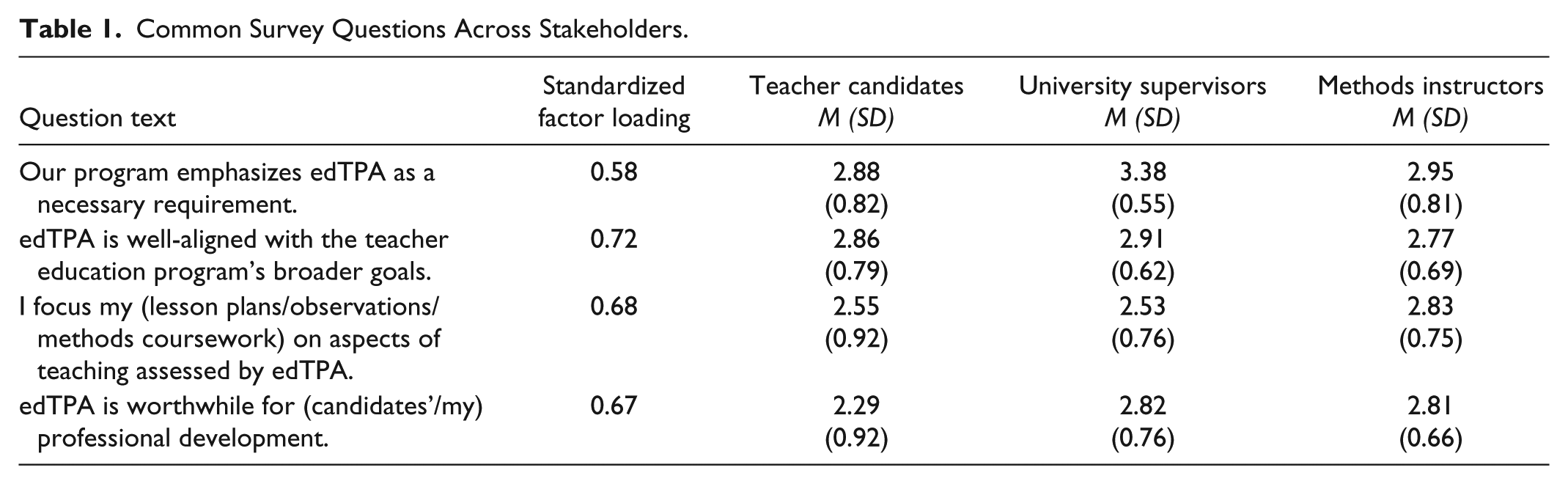
The single factor model had strong model fit in the full dataset (root mean square error approximation [RMSEA] = 0.089, comparative fit index [CFI] = .983, Tucker–Lewis index [TLI] = .948, standardized root mean square residual [SRMR] = 0.028; Hu & Bentler, 1999). Using the factor score from the CFA with data from all constituents, we ran a series of ordinary least squares (OLS) regressions to analyze whether participants’ overall perception of their edTPA experience varied by program area and duration of edTPA implementation. In each analysis, we also controlled for participant role (method instructor, university supervisor, teacher candidate) and race because of questions about racial bias in edTPA pass rates (Harris, 2015).
The second phase of our analysis involved a deeper examination of the variables contributing to candidates’ perception of their edTPA experience. Specifically, we analyzed whether candidates’ perceptions of different aspects of their preparation—university supervisor and faculty support, as well as program coherence—were associated with their overall perception of their edTPA experience. To approximate teacher candidate perceptions of support and program coherence, we created composite scores of several 4-point Likert-type response items on each topic (see Table 2 for scale items, reliability, and descriptive statistics). In the first model, we controlled for candidate program area, and in the second, length of implementation. 3 In both models, we controlled for a vector of individual-level, candidate-reported characteristics we hypothesized would be associated with perceptions edTPA: race, GPA, and whether the candidate had worked in education prior to beginning their teacher certification program. 4
Teacher Candidate Survey Responses.
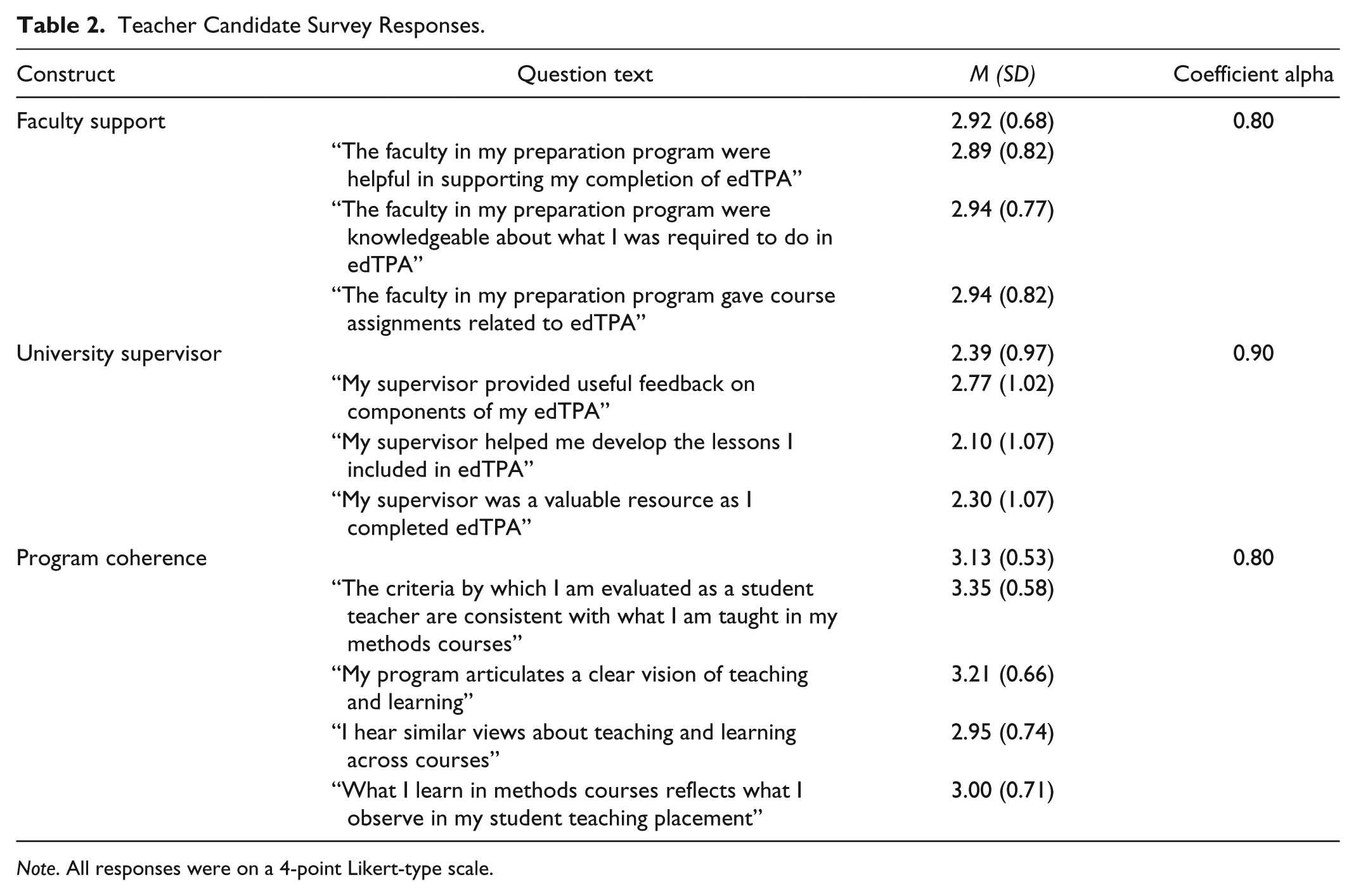
Note. All responses were on a 4-point Likert-type scale.
We then ran a series of OLS regressions to analyze whether participants’ overall perception of their edTPA experience varied by program area and the program’s duration of edTPA implementation (see Equations 1.1 and 2.2). In each analysis, we also controlled for participant role (method instructor, university supervisor, teacher candidate).


We also ran several OLS regressions using only the teacher candidate data, to better understand how candidates’ perceptions of different aspects of their preparation—university supervisor and faculty support, as well as program coherence—were associated with their perception of edTPA. Again, in the first model, we controlled for teacher candidate program area and in the second, length of implementation. 5 In both models, we controlled for the same vector of individual-level characteristics (see Equations 2.1 and 2.2).


Interviews
All interviews were analyzed over several stages. During stage one, the research team transcribed and read all the interviews and generated a list of emic (e.g., “reflection”) and etic codes stemming from our conceptual framework and factors identified in the quantitative data (e.g., “alignment”; Guba & Lincoln, 1994). We ultimately arrived at six codes that corresponded with survey data. The “affordance” code focused on the perceived strengths of edTPA as a tool for supporting teacher development or program improvement. The “constraint” code captured “costs” of edTPA at the individual or programmatic levels. “Perceived goals” captured any goals for edTPA including process goals (e.g., prompting reflection on candidates’ practices or enhancing coursework rigor) or product goals (e.g., a standardized measure of teaching professionalism or a signal of a high quality teacher education program). The “reflection” code highlighted how edTPA prompted reflection of teacher candidates or teacher educators’ practice. The “alignment” code denoted instances when edTPA was or was not aligned with the broader teacher education program. Finally, the “support” code marked the ways that teacher candidates or teacher educators were or were not supported in using edTPA. We created initial definitions and decision rules for each code and compiled them in a codebook used by the team throughout the analysis. We revised the codebook in biweekly meetings based on emerging themes and questions.
During the second stage of analysis, we coded all interviews using Dedoose software. A team member who neither conducted nor transcribed the interview coded each interview, increasing team-wide exposure to low-inference data. Interviews were coded at the stanza level, which consisted of question–answer exchanges and relevant follow-up questions. Any codes applied to the stanza captured the full exchange between the participant and interviewer (Saldaña, 2013). Overall, 15% of all interviews were double coded with more than 80% agreement across all codes (Saldaña, 2013).
We also tagged each interview with descriptors so that we could more easily disaggregate the qualitative data and integrate the quantitative survey findings. Descriptors included university role, discipline/field, duration of edTPA implementation, and role for methods instructors (clinical or tenure-track).
Finally, we engaged in an analytic memoing process. Using multiple passes through the coded data by two or more researchers, we created a memo for each code, systematically analyzing all coded instances across interviews (Dyson & Genishi, 2005). At each process stage, we paid attention to confirming and disconfirming evidence (Miles & Huberman, 1994).
Findings
Variation Across Programs
Capitalizing on survey data from methods instructors, supervisors, and candidates, we see clear differences in stakeholder’s overall perceptions of edTPA by program area (see Table 3).
Summary of Overall Perception of Experience With edTPA by Program Area.
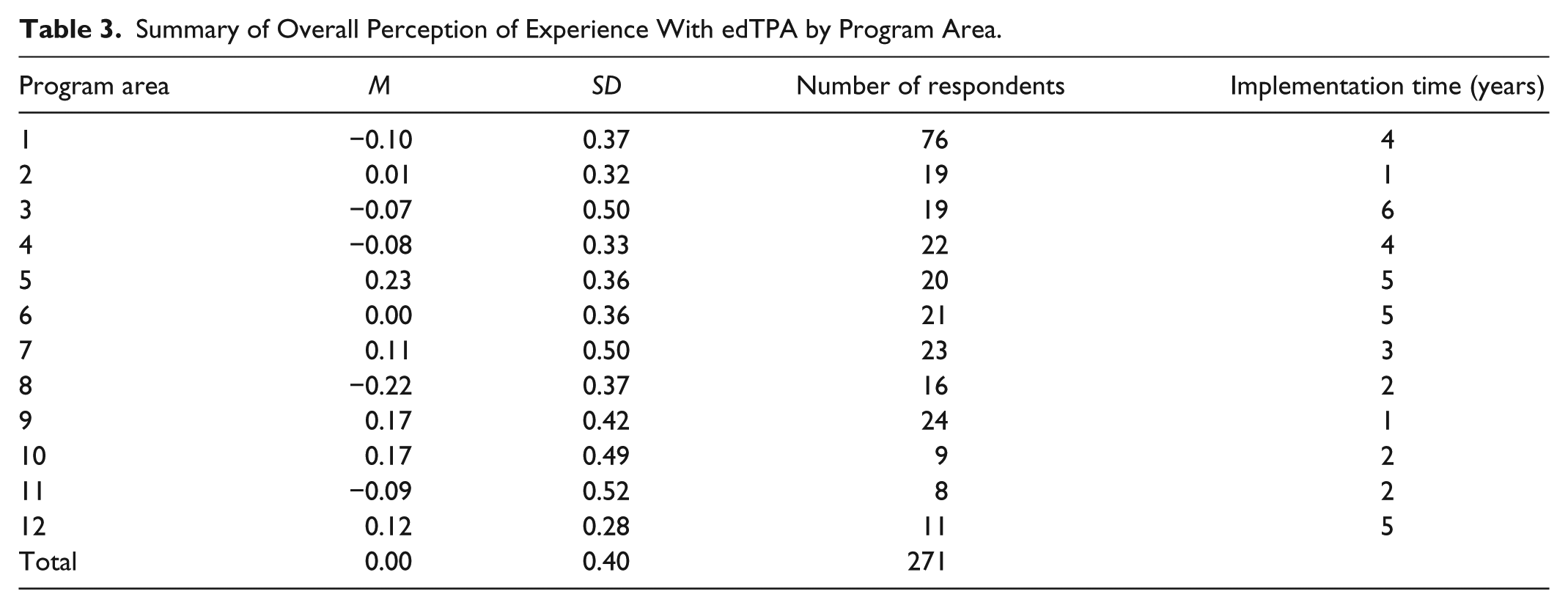
We then regressed participants’ overall perception of edTPA on variables we hypothesized might be associated with that perception, based on extant edTPA literature, including role (teaching candidate is the largest group and serves as reference category) and program (Program 8 had the lowest perception of edTPA and, as such, served as the reference program). Participants in Programs 2, 5, 7, 9, and 12 all reported significantly more positive perceptions of edTPA than those in Program 8 (Table 4). Those in other programs do not have significantly different perceptions from those in Program 8. Methods instructors’ perceptions of edTPA were not significantly different from teacher candidates’, controlling for program area, but university supervisors were, on average, significantly more positive about edTPA.
Multiple Regressions Using Full Dataset.

Note. Program 8 is omitted as reference category.
p < .05. **p < .01.
We also ran analyses to test whether participants’ perceptions of edTPA were associated with duration of implementation (1 year of implementation is the reference group for implementation time; see Table 4). Although edTPA implementation studies (e.g., Ratner & Kolman, 2016) hypothesize that duration of implementation impacts experiences with the reform, we do not find that to be the case. The duration of edTPA implementation is not, on average, a significant predictor of program respondents’ overall perception of edTPA. 6
Goals and Alignment
Although readily measurable program characteristics, including implementation duration, were not associated with perceptions of edTPA, our qualitative data suggest less readily measurable factors that might contribute to variation in overall perceptions. In open-ended survey responses and interviews, both teacher candidates and teacher educators expressed radically different understandings of edTPA’s purpose. Candidates responses ranged from a “general tool for reflection” and “a first step to becoming a National Board teacher,” to “simulating the stress that teachers feel on a daily basis,” and “testing your ability to follow directions.” Methods instructors’ responses ranged from “preparing more reflective practitioners,” to “assessing a candidate’s readiness to teach,” to “I have no idea.” University supervisors’ responses varied from, “an objective measure to hold teachers at a high standard,” to a “writing assessment,” to a “tool to focus candidates’ on reflecting on their practice.” In general, across stakeholder groups, there was a lack of basic agreement on the perceived goals of edTPA.
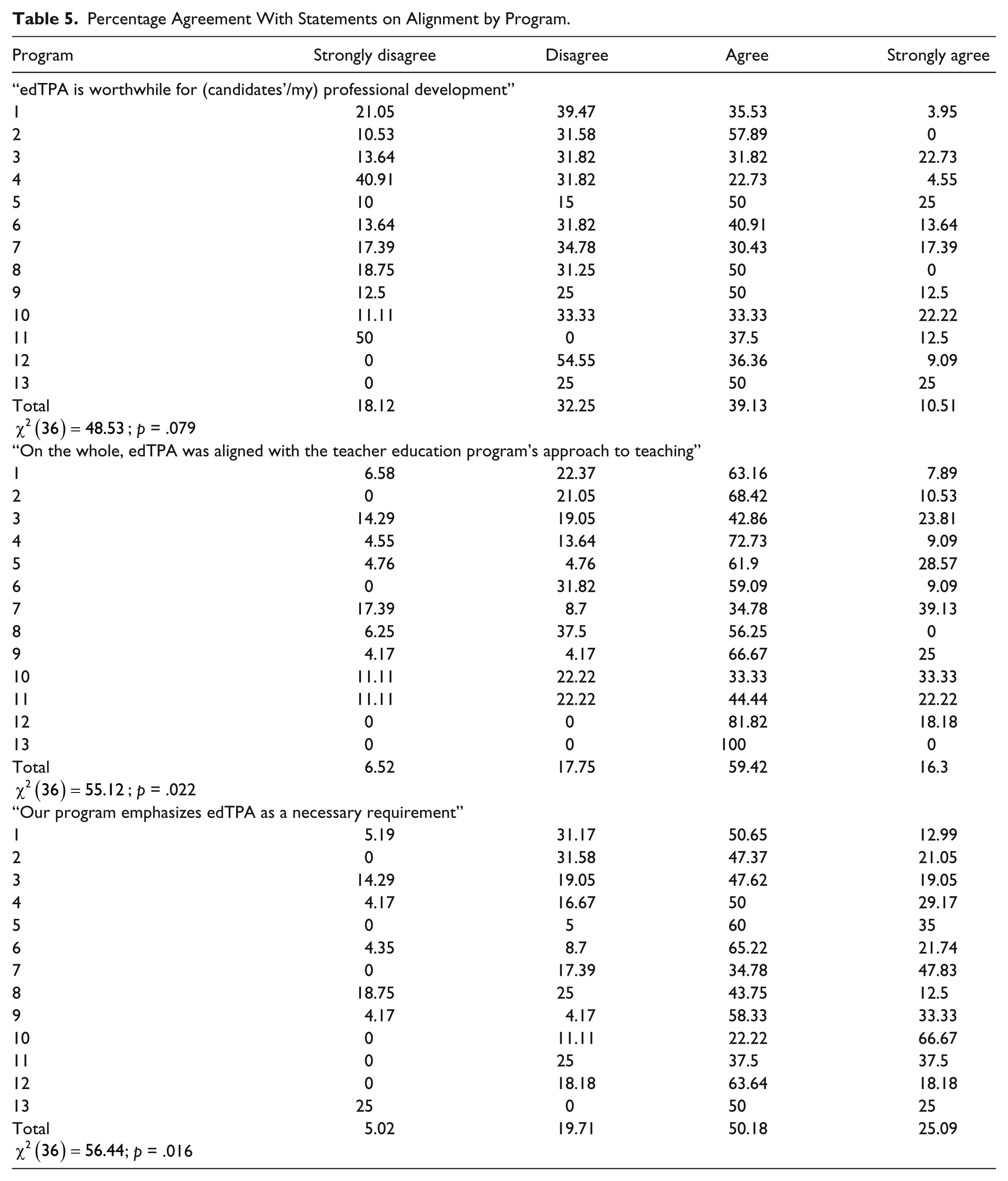
Lack of goal clarity may have translated into differences in how edTPA was framed for candidates and its alignment with broader programmatic experiences (see Table 5). A candidate in Program 1 expressed how instructor ambivalence colored teacher candidates’ perspectives:
Percentage Agreement With Statements on Alignment by Program.
My program coordinator didn’t agree with edTPA; she didn’t like it or see the point of it. So then our professors didn’t talk about it, but said, “You need to do this,” but nobody likes it and nobody really sees the value of it . . . so then I was like, “Well why am I doing it if nobody wants us to do it, nobody sees the purpose of it?”
Here, the instructors’ emphasis on edTPA’s potential stakes—“you need to do this”—rather than on its capacity for professional development, clearly influenced the candidates’ own engagement—“well why am I doing it?”
Confusion about goals may also have been driven by differences in familiarity with the reform or uncertainty about implementation responsibilities—a reflection of edTPA’s dual function as professional development framework and high-stakes graduation requirement. Indeed, there were dramatic differences across programs in terms of teacher educators’ perceived knowledge about edTPA. Some methods instructors noted they were well-trained and others said they knew next to nothing about edTPA. More than half of methods instructors said edTPA’s goals were not clearly explained by university personnel, and several wondered why edTPA data were not being used to inform instruction. Methods instructors spoke of a desire for more institutional support and more structured conversations on leveraging the value of edTPA.
Although university supervisors were generally more positive about edTPA (see Table 4), they, too, described disparate perceptions of implementation. One supervisor in Program 9 noted the value in using edTPA in formative ways to provide helpful data for programmatic improvement, suggesting, “we’ve learned so much from edTPA about where we need to work to support our candidates.” In contrast, a supervisor in Program 2 expressed little involvement in implementation: “I don’t feel I have any function in edTPA. The students . . . get enough support from the university that they don’t need to come to me for that.” A supervisor in Program 4 echoed the sentiment, “supervisors never got any kind of specific training, but I went to one that the teacher candidates received, and it was a lot to take in . . . I was a little bit overwhelmed.”
In many programs, teacher educators spoke about the need for better training and coordination among those responsible for implementing edTPA. A program coordinator and university supervisor in Program 1 noted, A huge problem with our program was a lack of training in understanding edTPA, rather than taking it on as “a task to be done.” . . . [Candidates] should see it throughout their program. It needs to be a way of thinking and demonstrating their knowledge as opposed to a task to complete, but we did not know how to make it work like that.
Other programs had more developed systems for coordinating messages. Several supervisors and methods instructors in Program 5—the program with the most positive overall perception of edTPA—noted that over the past couple of years they “got better at communicating about edTPA earlier, making reference to it early on in their methods courses, and pointing out connections between edTPA and content in coursework and field seminars.” However, several of these teacher educators noted that their program was small and had been working “as a team” for many years. One supervisor even noted the strength of the informal connections within the group that facilitated communication: “We’re friends and we play basketball together, so there doesn’t need to be any formal structure for passing on information.” In certain programs with established ties among teacher educators, edTPA was well integrated, and teacher candidates correspondingly noted high levels of support and alignment. Thus, our data indicate that while some candidates saw edTPA as well integrated into a broader set of preparation experiences with clear buy-in from their instructors and supervisors, others completed the assessment in isolation without a sense that it reflected valuable aspects of their burgeoning teaching practice.
Support for Candidates
Although there were clear differences in stakeholder’s perceptions of edTPA by program (see Table 5), the surveys also suggest variability within programs. To better understand the factors contributing to candidate’s differential perceptions of edTPA, we regressed teacher candidates’ perception of edTPA on teacher candidate perception of faculty and university supervisor support during edTPA completion, and coherence of their teacher education program (refer to Equations 2.1 and 2.2). In our first model, we included program area fixed effects, and in the second, we examined if there were differences by implementation time, controlling for a variety of individual-level characteristics (see Table 6). None of the personal characteristics reported in the surveys were associated with teacher candidates’ perception of their edTPA experience. However, a candidate’s perception of faculty support during edTPA and programmatic coherence were significantly and positively associated with candidates’ perception of edTPA in both models, though the explanatory power of both models is modest.
Teacher Candidate Perceptions of edTPA as a Function of Perceptions of Faculty Support, University Supervisor Support, and Program Coherence.

Note. GPA = grade-point average.
p < .05. **p < .01.
Candidates in different programs reported receiving vastly different levels of support for completing edTPA and beliefs about the alignment between edTPA and the rest of the program. Teacher candidates in some programs discussed activities that were added to their programs to prepare them for edTPA, including practice activities during coursework and examination of edTPA rubrics. A Program 5 candidate noted, “we dug into the rubrics a lot. We would . . . watch videos of lessons and evaluate them based on the rubric criteria. That gave us a lot perspective on how we should be looking at ourselves . . . when it comes to edTPA.” One candidate in Program 10 felt “unbelievably supported” observing that “my entire masters program was almost catered to [edTPA]. It’s just what my methods instructor believes . . . practicing, reflecting on yourself, and watching videos of yourself. And just ‘cause the edTPA had you do those things, it was a bonus.”
In contrast, a candidate in Program 1 reported, No one really talks about it, and the professors don’t care about it. The school you’re at [for student teaching], they don’t care about it. They don’t make any kind of attempt to help you . . . Obviously you’re on your own for it. It’s kind of sink or swim.
Similarly, another candidate in Program 4 noted, “It’s not something they teach you in any of the classes. So that was definitely . . . a struggle for me.”
This variation in support appears partially tied to instructors’ uncertainty about appropriate levels of support. Consistent with Ratner and Kolman’s (2016) findings, instructors differed in their understanding of the kind and extent of support they could provide. In interviews, several methods instructors thought they were not able to help students. Methods instructors from Programs 1 and 6 felt it would constitute cheating, and a methods instructor from Program 8 felt she had insufficient knowledge to support students. Methods instructors from Programs 5, 10, and 12, however, eagerly offered support—including creating “mock-TPAs,” redesigning syllabi to prepare candidates “for what was being asked by the [edTPA] prompts,” and answering specific questions about candidates’ edTPA responses.
These variations, in turn, colored teacher candidates perceptions of their instructors. Although many candidates explicitly discussed the support they received, one candidate in Program 2 suggested her instructors and supervisors indicated they were not allowed to provide any support for edTPA, which contributed to a sense that the candidate felt “almost afraid to ask questions because I didn’t want people to think I was, like, cheating.” The doubt raised about the permissibility of asking questions underscores how edTPA can recast candidates’ perceptions of their instructors. The candidate perceived the instructor’s dual role as resource and referee—a tension that resulted in her silencing her questions about edTPA.
Professionalization and Professionalism in Teacher Education
These data suggest that faculty support is a key predictor of a candidate’s perception of their edTPA experience. Given that teacher education faculty have a range of additional identities from clinical staff to tenure-track faculty, we analyzed the degree to which these professional identities were associated with responses to edTPA (Spillane et al., 2002). According to Fisher’s Exact Test, tenure-track faculty were significantly (p < .05) less likely to report that “edTPA is a valuable tool for my development as an instructor” and that “edTPA will help prepare higher quality teachers” than clinical faculty or graduate student methods instructors, though these sentiments were far from monolithic (see Table 7).
Percentage Agreement With Statements on Value of edTPA by Faculty Role.
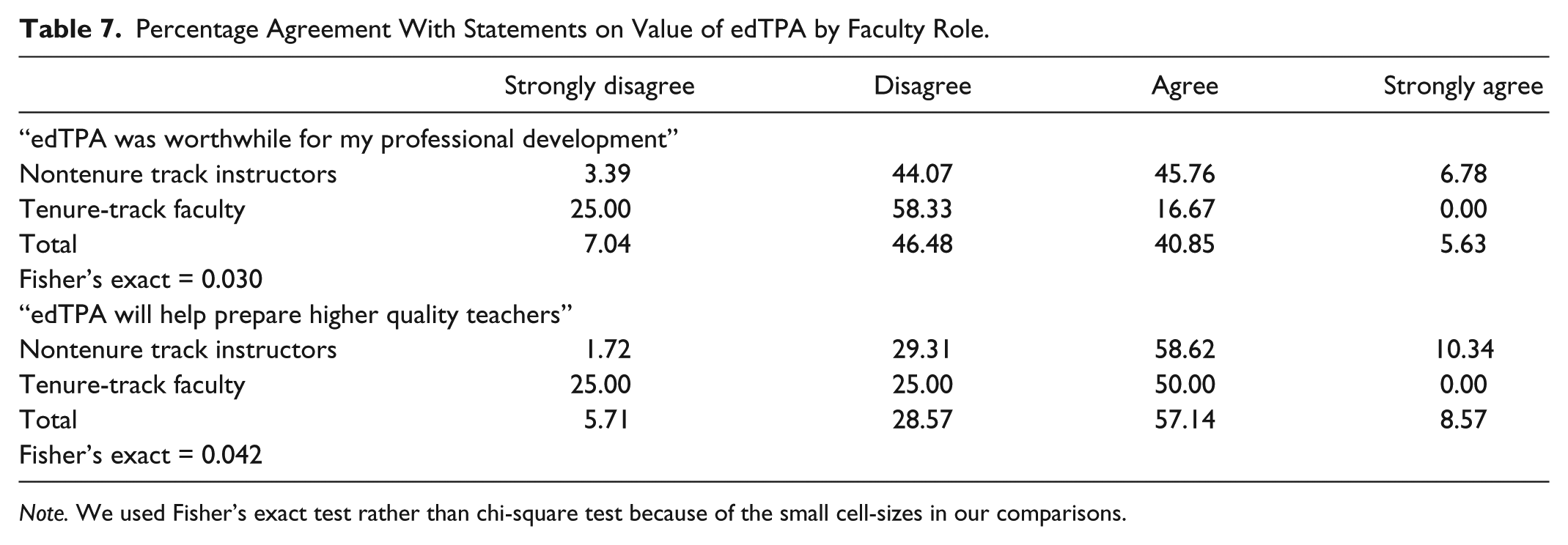
Note. We used Fisher’s exact test rather than chi-square test because of the small cell-sizes in our comparisons.
In interviews, most methods instructors noted that a primary purpose of edTPA was establishing a professional standard, likening it to the bar exam for prospective lawyers or the medical boards, assessments that lead to “professional licensure.” However, responses to edTPA as a tool for establishing professionalism were largely divided based on professional roles and identities, though there was some overlap between the two groups. Many tenure-track faculty rejected the idea that edTPA was about professionalism because of its top-down nature, its focus on procedure, and a perceived low-bar for successful completion. In contrast, clinical faculty largely perceived edTPA as a valuable tool that provided “rigor” and a “clear and standard framework” for quality practice. Some noted that it was well-aligned with extant goals for teacher development and served as a “kind of triangulation” with other observations in student teaching. One clinical faculty member in Program 11 suggested, “It’s high stakes and you have to complete it, but the three components are . . . what you should be doing already.” Another instructor in Program 12 suggested that most clinical faculty “didn’t take too much issue” with edTPA because they were familiar with portfolios of practice. The shift to edTPA felt less abrupt for them and provided more clarity in terms of expectations than homegrown tools used in the past. They appreciated being part of national conversations about the importance of clear standards and valued the structures and norms edTPA delineated. Seven different clinical faculty and university supervisors suggested value in having the “equivalent to a bar exam for teaching.” These teacher educators also highlighted the value of establishing a “common language” for describing educational practice, and many clinical faculty consciously increased their use of edTPA language in courses so candidates did not have to “code switch” terminology between what they heard in class, what they heard in schools, and what edTPA was expecting.
Many clinical educators also noted the tenor of edTPA conversations was different among tenure-track faculty. Capturing a repeatedly expressed sentiment, one university supervisor and clinical methods instructor in Program 5 suggested that discussion about edTPA “was like an academic conversation with tenure-track faculty, all about the theory and the paradigms, and not focused at all on actually supporting candidates.” Another clinical instructor in Program 8 with positive views of edTPA noted that “[as] a research institution, we have a lot of faculty who are emphasizing their research. Work in teacher preparation is sometimes an aside.” A supervisor in Program 1 observed, “when I go to the mandatory trainings, I see other supervisors, other clinical faculty, but I do not see tenure-track faculty sitting in a room with me.” The physical absence of tenured track faculty underscored for clinical faculty not only differing commitments to edTPA but also different perceptions of their professional responsibilities and roles within teacher preparation.
Although many clinical faculties noted the professional benefits of the framework and language afforded by edTPA, the majority of tenure-track faculty surveyed and interviewed noted the inherent “reductionism” of edTPA, highlighting how “programs were teaching to the test” or “boiling complex content down too much to be meaningful.” Several tenured methods instructors refused to accept edTPA terminology as legitimate, noting “nobody on our faculty has heard of these terms [used in the rubrics]. I don’t know what body of research these terms are coming from.” Others noted that the skills assessed by edTPA were “arbitrary” and disconnected from “what we know about high quality teaching in the literature.”
Beyond the top-down initiation of edTPA, many also noted that the emphasis on edTPA constrained the range of “acceptable” conversations about teacher education in a way that chaffed their identities as academics and professional teacher educators. One tenure-track methods instructor in Program 2 recalled a colleague taking her aside to say, “Stop talking about edTPA! We are either going to get run over by the train or get on it.” And I am like, “What the hell? Why can’t we slow the train and think about the train?” Why are [there] only two choices? We’re intellectual. We’re supposed to be the thinkers. That’s why we get tenure, right?
Along the same lines, another tenure-track faculty member in Program 4 suggested that policy mandates were less well-received by tenured colleagues in her program: “In other programs, it may be less of a problem because they have graduate students doing all the work, or clinical faculty, who don’t think broadly about teacher education.” Here, too, the faculty member suggests perceived divisions in terms of professional roles and identities among teacher educators. In contrast to clinical faculty who appreciated the structure and coherence afforded by a common assessment, tenure-track faculty suggest that adopting a standardized assessment undermines intellectual and professional autonomy—hallmarks of their identity as research-focused faculty members.
Other tenure-track faculty members voiced discomfort that edTPA seemed to require they blur the distinction between a professional preparation program and a professional licensing board. Referencing the “bar exam” and “medical boards”—frequent cross-professional analogies made in the edTPA literature—one faculty member in Program 1 asserted, “those are tests for certification, and while the certification relies on it, it has nothing to do with . . . what you did in your schooling. I can’t think of any profession that has this kind of test for graduation.” Another in Program 4 noted, Professors in medical school don’t teach to the medical board. Law professors don’t focus on the bar exam. If they’re going to require nationally normed tests, and were all going to be pushing the same kind of philosophies, that’s clearly a problem.
The idea of national standards and rigorous common assessments were perceived quite differently depending on a teacher educator’s existing professional identities.
edTPA Roll Out at the University
The director of teacher education and the director of edTPA evaluation at the university provided insight into edTPA’s roll out across programs. The director of edTPA evaluation spoke at length about opportunities for candidates to learn about edTPA but focused less on opportunities for faculty to learn about edTPA. When asked about resources for university supervisors, he noted, “we made a video about edTPA and put it up on the teacher ed website, but I’m not sure if [supervisors] watched it.” To support implementation in coursework, the teacher education office hosted “edTPA trainings and institutes,” featuring what the director termed “deep dives into what edTPA is,” “how edTPA is scored,” and “how [to] engage and do curriculum and inquiry around edTPA.” Both program administrators suggested they were available resources for faculty or university supervisors (e.g., “if they are confused, they can come to us”), but as the director of edTPA evaluation acknowledged, the strategy had been “awareness” and “making knowledge available” about edTPA, rather than outreach around integration into coursework.
The director of teacher education acknowledged that though they provided optional supports around implementation, the approach was “top-down” in that edTPA was mandated by the dean of the college who wanted to be a leader on matters of teacher professionalization. Although the state does not require edTPA for licensure, there is a widespread belief that such a mandate would be “coming soon.” The university mandate therefore served a desire to “get ahead” of state policy. Both teacher education office officials recognized that many faculty did “not understand edTPA” or “did not like edTPA,” but the director suggested that with a new mandate “you will automatically encounter some resistance” regardless of its substance, especially from tenured faculty. She underscored that at a recent edTPA meeting “nearly 75 teacher educators 7 attended and not one of our tenure-track faculty, even though everyone was invited.” The director of edTPA evaluation lamented the “same people always come [to edTPA sessions]—the clinical faculty.”
From a leadership perspective, the director of teacher education recognized structural challenges inherent in teacher educators’ roles and priorities: Promotion and tenure dictates what our faculty will be doing. It is a matter of survival. They already have busy schedules, which are filled with teaching and research . . . That’s a reality of a research institution that you don’t have with a teaching institution.
Given the extensive “time, attention, and work involved with edTPA implementation and evaluation,” she is not certain what it would take to involve tenure-track faculty in implementation processes given the perceived misalignment with the incentive system for faculty work. Repeatedly, she suggested that “over time,” faculty will come to understand and appreciate edTPA.
The director of edTPA evaluation suggested it was not so much a matter of time or understanding as of control. He expressed a desire for more “authority over faculty doing edTPA implementation,” and systems of “accountability for faculty.” Similarly, the director of teacher education wanted “required edTPA training to get everybody on the same page.” She noted the “multiple purposes of edTPA” and hoped that by having edTPA dovetail with CAEP accreditation requirements, the long-term goal of the teacher education office, the pragmatic value would convert even disillusioned tenure-track faculty.
Limitations
This was a case study of edTPA implementation at a single university. The sample is not designed to be representative of teachers and teacher educators generally. That said, dozens of Research 1, public universities are currently using edTPA as a consequential performance assessment. Given that most of these universities have a range of programs in teacher preparation, staffed by teacher educators with a range of professional identities, we think these findings likely have relevance across numerous contexts, with some important caveats. This university was selected in part because programs had different amounts of experience implementing edTPA. It is unclear the degree to which these findings would generalize to universities that are in earlier stages of implementation. Moreover, whereas the university required edTPA for graduation, it is not currently required for state licensure. Faculty and candidates might implement edTPA differently in states where passing is mandatory (Ratner & Kolman, 2016). That said, there are important benefits of working with a single case. We were able to collect data from a variety of stakeholders, providing a more comprehensive sense of implementation across the teacher education system than currently exists in the edTPA literature, and we are able to analyze implementation processes with multiple data sources.
An additional caveat is that we were unable to collect data about support candidates received from mentor teachers. Given that others have found enormous variability in the edTPA support mentor teachers provide (Margolis & Doring, 2013), this is an important limitation of our study. We also did not focus our data collection around the content of specific edTPA rubrics, which may have contributed to the ways that teacher educators from different disciplines responded to the assessment. Understanding more about the interplay between the structure and substance of different edTPA rubrics and the degree to which they reflect disciplinary norms is an important area for future research. The modest explanatory power of our model indicates that these and other factors are also likely drivers of stakeholder perceptions of edTPA that went unmeasured in our survey.
Our data also rely entirely on self-reports. We were not able to observe how edTPA was introduced to participants or how teacher educators were actually supported in using edTPA. Triangulating self-reported data from surveys and interviews with actual observations of practice would enhance the scope of our understanding about edTPA. These data also do not include information on how candidates actually performed on edTPA or their performance in classrooms as teachers of record. Tracking the performance of candidates from implementation into the field is an important next step for research on edTPA but is outside the scope of the current study.
Discussion and Implications
A sense-making framework suggests that implementation analyses should focus less on “fidelity” to a particular reform and more on the environmental and personal contexts in which implementation occurs because contextual factors shape actors’ responses to reforms in fundamental ways (Spillane et al., 2002). We hypothesized that these contextual factors would be especially salient in a reform such as edTPA that involves multiple goals and crosscuts a variety of programmatic, disciplinary, and professional perspectives. Our findings confirm this hypothesis and underscore the importance of studying how contextual factors influence sense-making about reforms. It was variation in the proximate contexts (notably programs) and identities that were associated with variation in perception of edTPA implementation, not duration of implementation.
In raising the salience of contextualized sense-making, our results highlight three notable implementation challenges: (a) the potential of top-down mandates leading to a lack of clarity about goals and variable implementation across programs, (b) the salience of program context for influencing implementation—highlighted by candidates’ divergent views of support available while completing edTPA, and (c) the multiple professional identities of teacher educators that color perceptions of and engagement with edTPA’s professionalization goals. Given that edTPA implementation is ongoing at some 700 universities, it is important that we understand the factors that affect implementation so that best practices can be identified and potential pitfalls can be avoided. This has several important implications for how we think and talk about edTPA implementation.
First, it requires we disaggregate discussions of edTPA implementation. Although the literature often speaks about specific universities “doing edTPA,” these data suggest such framing is misleading: edTPA is implemented in markedly different ways within particular programs within the same university, and those differences contribute to significantly different perceptions for all involved. While some viewed edTPA as central to a preparation program and valuable for candidates’ long-term professional development, others viewed it as an irrelevant, if consequential, “add-on.” Although university administrators believed more time and familiarity would reduce these differences—a common assumption—our data suggest this is unlikely, as implementation duration was not associated with these variations in perception of edTPA. Likewise, developing structures and routines aimed at increasing centralized oversight or procedural compliance—organizing meetings or disseminating information—are likely to leave core implementation issues untouched.
While it would be helpful if we could point to definitive quantitative variables that explain programmatic differences, these data do not allow us to draw these kinds of conclusions. Although our data can only suggest potential explanations—rooted in salient identities and organizational contexts—for variations in implementation, it seems clear that there is a complex interplay among the multiple actors, identities, and goals of edTPA. Our data suggest that a constellation of less readily quantifiable factors and group dynamics contributed to differences in programmatic implementation of edTPA. Based on our interviews with different stakeholders, network structures and internal hierarchies may have played a role in what actors had “voice” or “sway” in particular program contexts. Understanding the particulars of these network structures is beyond the scope of this study, but our findings indicate these issues are important topics for future research on edTPA.
More so than many reforms, edTPA implementation involves particular challenges in that it incorporates goals ranging from developing individual teacher practices to reorganizing teacher education curricula to shifting the societal status of teachers—while intertwining the potentially conflicting ideologies of professionalization and accountability (Cochran-Smith, Piazza, & Power, 2013; cf. Darling-Hammond & Hyler, 2013). The theoretical balance edTPA maintains between these goals was disrupted in practice by respondents, particularly tenure-track faculty members, who openly questioned the implications of edTPA for teacher preparation. While clinical faculty viewed edTPA as conferring additional professional status through its association with rigorous standards and standardized evaluation, tenure-track faculty viewed edTPA’s standards as a mark of diminished professional status—requiring the ceding of judgment, discretion, and autonomy in the name of reform. If these divergent views were confined to feelings of internal conflict or water-cooler debates, the matter would be interesting but incidental to the core work of implementation. However, teacher candidates were clearly aware of these disagreements. The mixed, or openly conflicting, messages colored candidates’ understandings of edTPA and, in turn, their experience with edTPA as a summative, capstone assessment.
Beyond understandings of program area or professional identity, edTPA raised deep and challenging questions for participants about professional schools and external accountability. Although Spillane and colleagues (2002) acknowledge the importance of the broader political context of reform, writing at the start of the high-stakes accountability era, they could not imagine the extent to which the external policy environment could permeate schools and universities. Far from a backdrop, we find that views of the policy environment were foregrounded in respondents’ sense-making about edTPA: teacher educators’ views of implementation were framed by whether they saw edTPA as an assessment or a professional framework. Tenure-track faculty who viewed it primarily as an assessment bridled at the idea that edTPA implementation required embodying an additional identity: gatekeeper. Although professors always serve as gatekeepers of sorts, in this case, many expressed frustration that their responsibilities as teacher educators and gatekeepers to the profession were being merged in uncomfortable ways. Multiple tenure-track faculty members noted that in other professions, licensure examinations exist at a distance from training programs and preparation for them is not considered part of the core mission of professional schools in either law or medicine. As with other tensions surfaced by edTPA implementation, these disagreements among teacher educators translated into very different perceptions for teacher candidates both in the messages communicated about the purpose of edTPA and the support candidates received in completing the assessment. Although state edTPA requirements can place these tensions in sharper relief (Ratner & Kolman, 2016), our data—collected in a state where edTPA is not required—suggests these issues are likely inherent to edTPA implementation, regardless of the consequences attached to passing.
The suggestion, raised by some in our sample, that faculty resist edTPA because they “resist all reforms” or because they are too busy, may contain grains of truth but will never suffice to guide future edTPA implementation or research. Our findings suggest that these implementation issues must be addressed head-on, given the centrality of the questions raised about the role of consequential performance assessments in teacher education. Existing literature on the importance of “opportunities to learn” about a policy (Cohen & Hill, 2001) remains valuable, but providing meaningful opportunities requires a nuanced understanding of issues posed by the reform—information we have tried to begin identifying through these data. Even if consensus about goals and integration in coursework and fieldwork is likely to prove elusive for many programs, reaching an understanding about how best to balance the competing demands of edTPA within a program is likely within reach. The configuration of that balance is likely to differ from program to program, even within the same university. However, teacher educators should recognize that, according to our findings, their responses to edTPA and its myriad goals will likely color teacher candidates’ perspectives on an assessment that is a consequential component of their teacher education experience.
University-based teacher education is an incredibly complex endeavor involving a variety of institutions, goals, and professional identities. It is hardly surprising, then, that an effort to create a common framework to unify this disparate endeavor would, as our data indicate, result in the persistence of variation. Still, only by describing this variation within and across teacher education programs, can we begin to determine how to address these implementation challenges. In particular, we need a clearer understanding of what variation is desirable and worth preserving, and what is inimical to the goals of programs, edTPA, or the teacher profession more generally. Although state and university edTPA mandates create a top-down dynamic, implementation must proceed in ways that acknowledge the complexity of the institutional mission of colleges of education and that honors and engages the multitude of professional identities involved in the training of future educators. Even as policymakers and teacher educators strive to standardize the work of teacher training through reforms such as edTPA, we must accept that our approaches to improve a system must be at least as nuanced and complex as the system itself.
Supplemental Material
JTE783183 – Supplemental material for Sense Making and Professional Identity in the Implementation of edTPA
Supplemental material, JTE783183 for Sense Making and Professional Identity in the Implementation of edTPA by Julie Cohen, Ethan Hutt, Rebekah L. Berlin, Hannah M. Mathews, Jillian P. McGraw and Jessica Gottlieb in Journal of Teacher Education
Supplemental Material
JTE783183m – Supplemental material for Sense Making and Professional Identity in the Implementation of edTPA
Supplemental material, JTE783183m for Sense Making and Professional Identity in the Implementation of edTPA by Julie Cohen, Ethan Hutt, Rebekah L. Berlin, Hannah M. Mathews, Jillian P. McGraw and Jessica Gottlieb in Journal of Teacher Education
Footnotes
Declaration of Conflicting Interests
The author(s) declared no potential conflicts of interest with respect to the research, authorship, and/or publication of this article.
Funding
The author(s) disclosed receipt of the following financial support for the research, authorship, and/or publication of this article: This work was generously supported by a seed grant from the Dean’s Office at the College of Education, University of Maryland, College Park. The views expressed in the article are solely attributable to the authors.

Notes
Author Biographies
References
Supplementary Material
Please find the following supplemental material available below.
For Open Access articles published under a Creative Commons License, all supplemental material carries the same license as the article it is associated with.
For non-Open Access articles published, all supplemental material carries a non-exclusive license, and permission requests for re-use of supplemental material or any part of supplemental material shall be sent directly to the copyright owner as specified in the copyright notice associated with the article.
