




Abstract
While there has been an increased focus on inquiry-based learning in teacher preparation programs, little is known about the influences of these programs on teacher development over time. Using activity theory as its theoretical framework, the researcher employed a longitudinal interpretative case study design to examine the development of three history teachers’ conceptual and practical tools from their methods course through their fifth year or exit from the classroom. The findings revealed that, while the teachers had inquiry-aligned beliefs and developed inquiry-related conceptual tools, a lack of practical tools and support during teacher preparation and within their eventual communities of practice had a major impact on their ability to frequently implement inquiry in their classrooms. Recommendations are offered for teacher preparation and inservice professional development programs.
For the past two decades, there has been a movement across the content areas toward inquiry-based learning, which, in turn, has influenced the design of national learning standards (i.e., C3 Framework for Social Studies State Standards, Next Generation Science Standards, Common Core State Standards; Levy, Thomas, Drago, & Rex, 2013). As a result of this pedagogical shift, some teacher preparation programs have undergone changes to better prepare teachers for different instructional expectations; methods courses have been redesigned to help novice teachers learn to teach through inquiry.
This shift toward inquiry-based instruction has also been present in history education (Barton & Levstik, 2004; Grant, Swan, & Lee, 2017; Levy et al., 2013), and consequently, many social studies teacher preparation programs have reoriented their methods courses to focus on the development of disciplinary thinking in history and the social sciences (Adler, 2008). Moreover, there is growing evidence from researchers that inquiry-based learning helps students develop not only historical thinking (Barton & Avery, 2016; Lévesque, 2008; Wineburg, 2001) but also the type of thinking skills needed for democratic citizenship (Barton & Avery, 2016; Barton & Levstik, 2004; Hess, 2009; Journell, 2016; Lévesque, 2008). Yet, many teachers struggle to implement inquiry-based methods, which contributes to an enduring classroom culture dominated by didactic instruction (Windschitl, 2002). Moreover, despite a shift toward inquiry in social studies teacher preparation courses, inquiry-based instruction has not been widely incorporated in history classrooms (Barton & Levstik, 2004; Levy et al., 2013).
While there is a growing body of work that examines how preservice teachers learn to use inquiry (Grant et al., 2017; Levy et al., 2013), few studies follow these teachers beyond their teacher preparation programs and into the early years of their professional careers (Adler, 2008; Clift & Brady, 2005; Cochran-Smith & Zeichner, 2005). Without this longitudinal work, we cannot fully understand why teachers’ instructional techniques have remained relatively unchanged despite shifts in learning standards and teacher preparation programs. Building on previous reports that examined the development of history teachers during their preservice preparation and first year (Martell, 2013, 2014), this study followed the same group of teachers through their fifth year in the classroom or exit from teaching. The research questions that guide this study are the following: Do beginning history teachers’ conceptual and practice tools related to inquiry-based instruction change over time? If so, how, why, and under what conditions? What influences the teachers’ successes or struggles in implementing inquiry-based practices?
Theoretical Framework
This study used Grossman, Smagorinsky, and Valencia’s (1999) application of activity theory to teacher learning as its theoretical framework. As they argued, Activity theory (Cole, 1996; Leont’ev, 1981; Tulviste, 1991; Wertsch, 1981) is predicated on the assumption that a person’s frameworks for thinking are developed through problem-solving action carried out in specific settings whose social structures have been developed through historical, culturally grounded actions. (p. 4)
In addition, a tenet of activity theory is that the goals of development and the ways that environments are structured are infused with promoted ideal personal and societal features. Community members’ relationships are mediated by the tools and artifacts that they use and based on their general agreements over purposes and meaning. As such, it is necessary to examine not only the tools and artifacts that the participants use, but also how the community of a target activity influences the ways in which participants understand and use those tools and artifacts.
Based on activity theory, Grossman, Smagorinsky, and Valencia (1999) contended that there are certain conceptual and practical pedagogical tools that teachers use in their instructional choices and classroom decision-making. Conceptual tools are defined as the applicable theories or ideas teachers have about teaching, learning, and disciplinary acquisition that guide their instructional practices, while practical tools have a more local and immediate utility, and include the instructional practices and curriculum resources that they use in their classrooms. Using the lens of activity theory, researchers are able to examine both the practical decisions that teachers make in the classroom, as well as the underlying conceptions that guide their beliefs about practice.
In examining the teachers’ conceptual and practical tools, I used inquiry-based instruction as the lens. In this study, I worked from Barton and Levstik’s (2004) definition of historical inquiry as a process involving “asking questions, gathering and evaluating relevant evidence, and reaching conclusions based on that evidence” (p. 188). This definition of inquiry is predicated on students using evidence to support their claims regardless of the type of classroom activities that the teacher employs. Whether a teacher uses mock trials, debates, or more traditional source work, the students will be asked to use historical evidence and consider alterative interpretations or explanations in forming their arguments. I have intentionally chosen this broader definition of inquiry, because it serves as a utility for both developing students’ historical thinking (Wineburg, 2001) and the tools they need to fully participate in democratic citizenship (Barton & Levstik, 2004; Levstik & Barton, 2011) with the ultimate goal of making sense of conflicting views of history (Lévesque, 2008) and the present day (Hess, 2009; Journell, 2016). Wineburg (1991) has argued that students should learn to think about history like historians do, through three main processes: (a) corroboration, the act of comparing documents with one another; (b) sourcing, the act of looking first to the source of the document before reading the body of the text; and (c) contextualization, the act of situating a document in a concrete temporal and spatial context. (p. 77)
Yet, Levstik and Barton (2011) reminded us that there is also a sociocultural context and related purpose for the study of history. History teachers must help their students think about who we are and picture possible futures. History is the study of human interpretation of the past, explained through narratives, that is controversial and requires a study of present politics.
Relevant Literature
Over the past 20 years, there has been an increasing amount of research on inquiry-based instruction across the content areas. In their examination of inquiry-based instruction in history, science, and mathematics, Bransford, Brown, and Cocking (2000) emphasized that inquiries look differently based on subject matter and disciplinary ways of thinking. They argued that expert teachers must have a knowledge of their discipline’s structure for helping them design classroom inquiry-based activities, assignments, and assessments. In their literature review of inquiry-based approaches to learning, Barron and Darling-Hammond (2008) found that teachers may misunderstand inquiry as simply unstructured learning and students need sufficient support and modeling to successfully learn through inquiry. As a result, one of the main challenges for teachers implementing inquiry-based instruction is learning how to balance the design of lessons, the classroom management of students, and support students in their content learning.
Within the field of history education, there are numerous studies that focused on the development of inquiry-based instruction during preservice teacher preparation (Baron, Woyshner, & Haberkern, 2014; Barton, McCully, & Marks, 2004; Hawkman, Castro, Bennett, & Barrow, 2015; Levy et al., 2013; Martin & Monte-Sano, 2008; Mayer, 2006; Seixas, 1998; van Hover & Yeager, 2004; Yeager & Wilson, 1997) or the use of inquiry-based instruction by experienced or exemplary teachers (Grant, 2001; Monte-Sano, 2008; Reisman, 2012; Voet & Wever, 2016). Across these studies, there were two main findings. First, preservice teacher preparation focused on inquiry-based instruction had a positive impact on how beginning teachers conceptualized classroom instruction. Second, teachers struggled to use inquiry-based practices when they faced classroom management issues and the expansive content demands found in the curriculum.
There are several longitudinal studies on the development of teachers’ beliefs and practices that inform this research. Across these studies, there are three key findings. First, beginning teachers struggled to adopt the practices espoused in their teacher preparation programs due to the turbulence of their first years; however, they were more likely to adopt these practices after gaining experience and classroom stability (Grossman et al., 2000; Valencia, Martin, Place, & Grossman, 2009; Valencia, Place, Martin, & Grossman, 2006). Beginning teachers, through their on-the-job learning from interactions with colleagues, students, or professional development leaders, were able to enact practices advocated for in their teacher preparation. Second, beginning teachers with strong initial transmission-oriented beliefs were unlikely to move away from didactic instruction (Alger, 2009; Cook, Smagorinsky, Fry, Konopak, & Moore, 2002; Donnell, 2007; Seung, Park, & Jung, 2014). Third, beginning teachers were more likely to use inquiry-based practices, if their cooperating teachers and colleagues also had inquiry-oriented beliefs about practice (Agee, 2004; Bickmore, Smagorinsky, & O’Donnell-Allen, 2005; Martell, 2013, 2014; Newell, Tallman, & Letcher, 2009).
A small number of studies in history education have examined how teachers develop inquiry-based practices over time. Of these studies, one focused on beginning teachers’ use of inquiry-based instruction as part of writing instruction (Monte-Sano & Harris, 2012), another focused on the development of pedagogical content knowledge (Monte-Sano & Budano, 2013), a third on teaching history as interpretation (Martell, 2013), and a fourth on the teachers’ evolving constructivist beliefs (Martell, 2014). These researchers were able to only follow teachers into their first or second years of teaching. Yet, Liston, Whitcomb, and Borko (2006) have argued that there is evidence that teachers’ intense focus on survival generally lasts beyond the first year and teachers do not typically move toward a “focus on curriculum, teaching practices, and eventually student learning” (p. 352) until after that period. This research attempts to fill that gap by examining teachers’ development of inquiry-based practices over longer periods of time and past the often turbulent first year of teaching.
Method
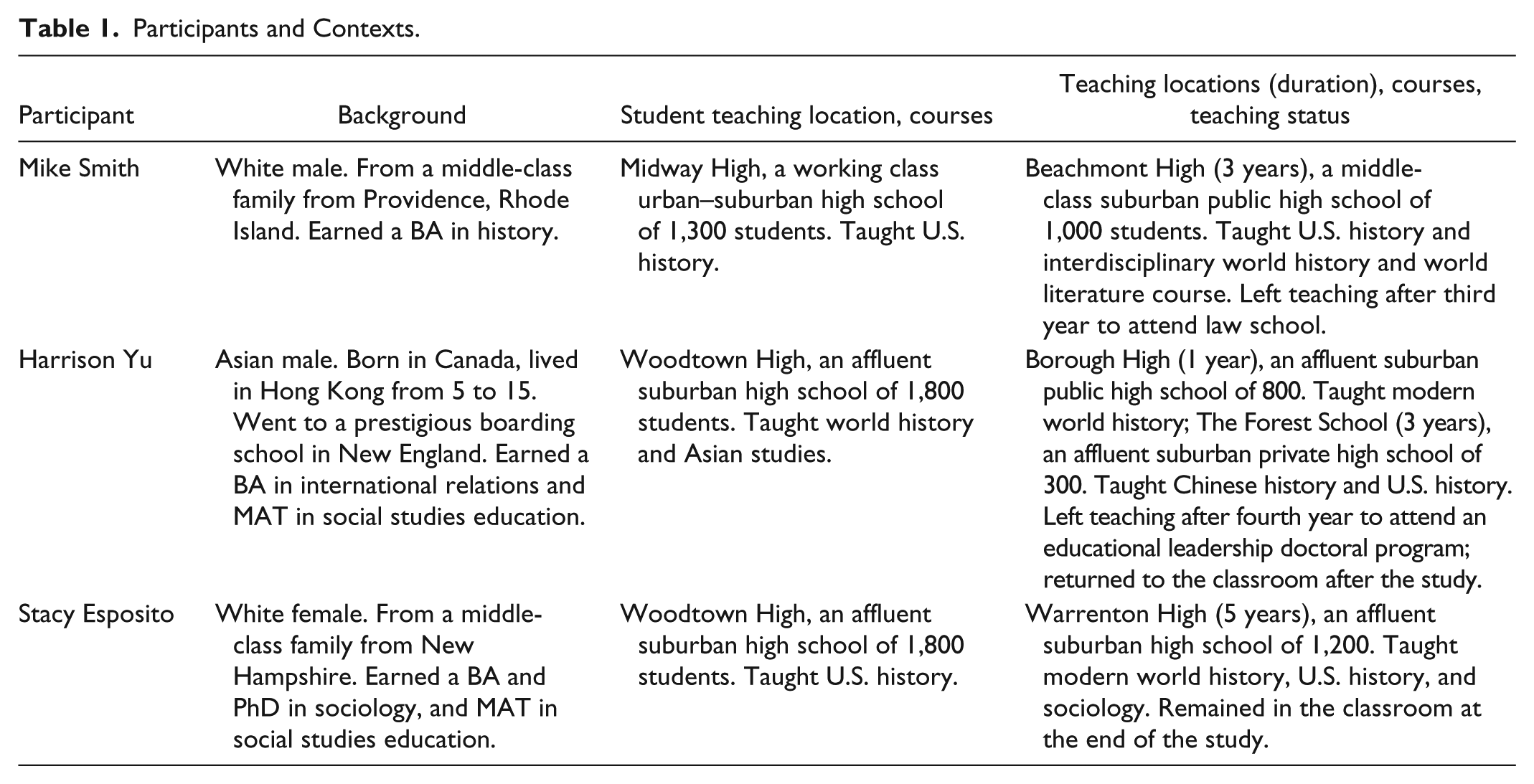
This longitudinal interpretative case study employed a multiple-case design (Stake, 2006). The participants for this study were purposely selected from the 30 preservice teachers enrolled in a colleagues’ secondary social studies methods course at City University 1 (CU), a large urban university in the northeast United States. Of the 20 participants from the methods course, 12 volunteered for the study. After an initial interview and observation, I identified two participants as teachers with a preference for lecture or didactic instruction and they were dropped from the study. Of the 10 remaining participants, five found employment as social studies teachers the following autumn. At the beginning of their first year, one participant chose to leave the study. At the end of their first year, one teacher left the profession (this participant was included in previous reports from this study). This study relies on the data from the remaining three participants. The participants had undergraduate degrees in three different subject areas (history, international relations, and sociology). They all completed a social studies education program that led to a teaching license in high school history. A detailed description of the participants and their school placements are listed in Table 1.
Participants and Contexts.
Data Collection
I collected data from the three participants over a 6-year period, which included the participants’ social studies methods course and student teaching practicum (2008-2009), first (2009-2010), second (2010-2011), third (2011-2012), fourth (2012-2013), and fifth (2013-2014) years in the classroom or their exit from teaching. The data came from 14 interviews and 12 observations with Stacy, 12 interviews and 10 observations with Harrison, and 10 interviews and eight observations with Mike. I also collected data from three observations of the participants’ methods course, including the course syllabus and class handouts, and discussions with the instructor about the course. Throughout the study, the teachers occasionally supplied written reflections when I prompted them with a question related to a recent interview or observation.
Each face-to-face interview lasted approximately 60 min. For each interview, I used a uniform interview protocol and the entire interview was transcribed. The interviews included a series of questions about the participants’ beliefs and the development of their conceptual and practical tools. Each observation ranged from 50 to 90 min in duration. I used a uniform observation field note protocol to take extensive field notes. My observation field notes tracked classroom activities, interactions between the teachers and students, and important classroom dialogue. In addition, I collected all classroom artifacts (e.g., classroom handouts, primary sources, PowerPoint presentations, homework assignments) used during observed classes. The teachers also submitted their resources for several different units over the course of the study. Throughout data collection and analysis, I used memoing to keep track of any early patterns or themes that began to appear in the data.
Data Analysis
My data analysis was comprised of three stages. In the first stage, I took three passes through the raw data, which included a careful reading of the interview and observation transcripts, classroom artifacts, and field notes. First, I focused on the data case by case, reading the data in silos by participant. Second, I moved to reading the data chronologically, allowing me to begin thinking about possible themes cross-cutting the participants. Third, after a rough coding, I read the data by broad themes organized around my research questions, including teachers’ conceptual tools, practical tools, and their communities of practice.
In the second stage, I moved to coding. Using the work of Erickson (1986) for guidance, I formed assertions within each case and then tested those assertions against the data corpus. I began to code each data source, creating labels for assigning meanings to the data compiled during the study. During coding, I used what Miles and Huberman (1994) called an iterative process, where I worked through multiple cycles, clarifying the main patterns, seeing contrasts, identifying exceptions or discrepant instances, and uncovering negative instances. I developed a preliminary coding scheme based on my theoretical framework and research questions. As I coded my first case, and then subsequent cases, I continued to reevaluate and revise my codes. After an initial coding, I worked through the data corpus reexamining my codes and determining if certain codes could be eliminated, combined, or modified. I then revised and dropped assertions that lacked an evidentiary warrant.
In the third stage of analysis, I engaged in a case analysis using Stake (2006) for guidance. This involved an individual case reading followed by a cross-case analysis. During the individual case analysis, I organized the data within individual case folders and then chronologically by data source. For each individual case, I carefully reviewed the coded data including interview and observation transcripts, classroom artifacts, and field notes. Using a thematic analysis, I searched for major themes across the data within each single case. However, this process was also recursive; as I develop themes, I reexamined and revised my codes. Next, I engaged in a careful rereading of the data, which lead to the development of cross-case themes that connected directly to my research questions and theoretical framework. I sorted the evidence based on my assessment of their importance. I determined the extent to which findings fed into themes and located any case findings that were atypical to the cases as a whole. In the final step, I reviewed the assertions in an attempt to ensure they could not be misinterpreted or interpreted differently.
Results From Previous Reports
While this article presents the findings from the full 6-year longitudinal study, two previously published reports described initial findings from the participants’ preservice teacher program and first year of teaching (Martell, 2013, 2014). While the two initial reports laid the groundwork for this longer longitudinal study, this article reports a continuation of the study through the teachers’ fifth year in the classroom or their exit from teaching. It was an attempt to avoid what Grossman et al. (2000) described as “the danger of making claims about what teachers did and did not learn in teacher education based on data from their first year of teaching” (p. 659). By examining the teachers’ conceptual and practical tools as they transition from novice to experienced teachers, we can better understand the longer term impacts of teacher education.
Results
The following vignettes describe each teacher’s development over the duration of the study. The individual case descriptions include a summary of the teachers’ communities of practice and the development of their conceptual and practical tools over time. In the cross-case analysis, I discuss the influence of the teachers’ K-12 schooling, preservice teacher preparation, and inservice teacher experiences on the development of their conceptual and practical tools.
Mike Smith
Mike Smith is a White male, who grew up in Providence, Rhode Island. As an undergraduate at City University, he majored in history and went through its teacher preparation program. During his student teaching, Mike taught U.S. history at Midway High, an economically and racially diverse urban–suburban school. His cooperating teacher primarily used lecture as her main instructional technique and this forced Mike to find strategic ways to use other types of instruction. Mike then accepted a position teaching U.S. and world history at Beachmont High, a predominately White and middle-class suburban school. He described his experiences at both schools as positive. Although Mike mentioned teaching history as a possible long-range career, he would eventually decide to leave teaching after his third year to attend law school.
Throughout the study, Mike consistently described himself as having beliefs and conceptual tools aligned with inquiry-based instruction. During student teaching, he said, “I wouldn’t have a prepared lecture and come in and just give the lecture and take questions at the end. The kids only get my knowledge that way. They don’t construct it” (Interview, March 12, 2009). In his third year, Mike said, “I’d like to try to be constructivist and use inquiry-based learning. . . . It can be group work, independent working, and problem solving, but somehow, they have to be making meaning by looking at documents and answering questions” (Interview, November 1, 2011).
During my observations, Mike taught three inquiry-based lessons. In his third year, he taught a lesson on the Renaissance using a document-based question in his world history course. In small groups, the students answered the following question using primary sources: “Was the change in beliefs of European society during the Renaissance positive?” Mike walked over to one group and said, So how is this group doing?
We’re looking at this one. Galileo.
Yeah, he says that people care more about the Church being right than knowing the truth.
What do you think about that?
Well, it seems like a good idea to know the truth.
But why do you think they were having a hard time with this new information?
The Church told them everything. It was everything they believed.
It was God.
Yeah, God can’t be wrong.
Good. So, could you see this being a bad change at all?
Probably not.
Well, it is hard to think your religion is wrong. We talked about him making people mad.
So, talk about this. Was it a good change that Galileo says here (pointing to the document), that they need to use their own senses rather than only listening to the Church? (Observation, May 24, 2012)
As Mike walked away, the students continued their conversation, arriving relatively quickly to an agreement that the change was positive. At the same time, they agreed that it made sense that so many people, especially in the Catholic Church, were upset with Galileo’s writings. In two other lessons, Mike had students propose Depression-era economic policies based on primary sources and statistics (Observation, March 12, 2009) and he had students debate the role of the Progressives in influencing changes in early 1900s work conditions through their analysis of primary sources and “The Jungle” (Observation, October 15, 2009).
On the few occasions that I observed Mike use inquiry in his classroom, he was successful at implementing lessons that developed students’ historical thinking (Wineburg, 2001) and tools for democratic citizenship (Barton & Levstik, 2004; Levstik & Barton, 2011). In all three lessons, Mike had students interpret evidence in response to inquiry questions. He had students engaged in contextualization, corroboration, and sourcing (Wineburg, 2001). Students were asked to think like historians to compare conflicting documents of the Renaissance, the Progressive Era, and the Depression; examine the different perspectives of the documents’ creators; and place those documents in the correct historical context. At the same time, Mike’s inquires modeled the way citizens must make civic decisions based on evidence connected to the present (Barton & Levstik, 2004). For instance, during his lesson on the Depression, students needed to use historical data to inform proposed policy decisions, but he was also asking them to consider the present-day role of New Deal ideas. In another lesson, students were asked to decide whether the Progressive Era reforms led to adequate work conditions today.
Stacy Esposito
Stacy Esposito is a White female, who grew up in New Hampshire. Before completing a teacher preparation program at City University, she earned a bachelor’s degree and doctorate in sociology at another university. During her student teaching, Stacy taught U.S. history at Woodtown High, a predominately White and affluent suburban school. Stacy described her student teaching experience as difficult. She did not feel supported by her cooperating teacher and she struggled with classroom management. She then accepted a position teaching modern world history, U.S. history, and sociology at Warrenton High, a predominately White and affluent suburban school. Some teachers at her school did share similar views of teaching and the teachers routinely shared their lesson plans with each other. However, she described most of her borrowed lessons as not being inquiry-based. Stacy consistently described each year as better than the previous. By year two, she described an improving history content knowledge and ability to manage the classroom. By year five, she had gained more confidence in her teaching.
Throughout the study, Stacy consistently described herself as having beliefs and conceptual tools aligned with inquiry-based instruction. During student teaching, she said, I hate just presenting them with information. When I teach, I want to use activities where they are stopping, asking lots of questions about why this would happen. Looking at a document that explains what happened, using those documents to get information to answer questions. And using that to springboard to answer that important question that I pose to them. (Interview, March 3, 2009)
In her fifth year, Stacy said, The best type of teaching, I think, asks an interesting question, like, “Was the Boston Massacre really a massacre?” And then let’s look at some documents, like in general gather evidence. If students are being asked to make up their own mind, then they aren’t constructing their own knowledge.” (Interview, January 7, 2014)
Stacy provided an example to show how inquiry-based instruction should work and why she thought it was the best teaching method to use.
During my observations, Stacy taught only one inquiry-based lesson, which was a lesson plan provided by her teacher preparation program. In this lesson, she had students engage in a mock trial during her U.S. history course. Students used primary sources to construct cases for or against Eugene Debs, answering the question: Did Debs violate the Sherman Antitrust Act by interfering with the U.S. Mail during the 1894 Pullman Strike? During the trial, students had the following dialogue: Student 1: Now, Mr. Debs, the Sherman Antitrust Act states that one may not have a conspiracy to restrain trade. Was that your intentions in striking? Student 2: Being a worker since I was 14, my intentions were to improve our work conditions. My intentions were to raise wages. Student 1: But did the strikers interfere with the U.S. Mail, will you tell us what actually happened? Student 2: Well, our goal was to not use the home cars and we were trying to keep the mail cars going. But they chained the mail cars to the home cars, therefore the mail could not be moved. The company is to blame. (Observation, March 9, 2009)
Students were able to argue a case for or against Debs using evidence from the period with the jury ultimately deciding in favor of Debs (which conflicted with the actual court decision).
In the one observed inquiry, Stacy was successful at implementing a lesson that developed students’ historical thinking (Wineburg, 2001) and tools for democratic citizenship (Barton & Levstik, 2004; Levstik & Barton, 2011). Stacy had students interpret evidence in response to an inquiry question. She had students engaged in contextualization, corroboration, and sourcing (Wineburg, 2001). Students were asked to think like historians to compare conflicting documents of the Pullman Strike in their preparation for the mock trial, examine the different perspectives of the documents’ creators, and place those documents in the correct historical context. At the same time, Stacy’s inquiry modeled the way citizens must make civic decisions (Barton & Levstik, 2004). Students were asked to reflect on the Pullman Strike in relation to current day workers’ rights movements, such as raising the minimum wage and the work conditions of undocumented immigrants. Stacy described her view of inquiry as helping “the students be prepared with specific evidence to support their point of view, just like citizens have to” (Interview, May 31, 2013).
Harrison Yu
Harrison Yu is an Asian male, who grew up in Canada and Hong Kong. Before completing a teacher preparation program at City University, he majored in international relations at another university. During his student teaching, Harrison taught world history and Asian studies at Warrenton High, a predominately White and affluent suburban school. Harrison cited his cooperating teacher as an important mentor, as she sometimes had the students engage in inquiry. He then accepted a position teaching modern world history at Borough High, a predominately White and affluent suburban school. During his first year in the classroom, Harrison struggled with classroom management, which, in turn, led to the increased use of teacher-centered methods. Harrison rarely had students use primary sources in his classroom, because he described having limited experiences learning with them and that his colleagues rarely used them in their teaching. At the end of his first year of teaching, Harrison accepted a different position teaching Chinese and U.S. history at the Forest School, an affluent suburban private high school. He described his experiences at both schools as generally positive. Harrison became more comfortable using primary sources in his classroom. Although he still did not use historical inquiry frequently, out of the three teachers, Harrison showed the most change in his instructional techniques toward inquiry. Harrison decided to leave teaching after his fourth year to enroll in a school leadership doctoral program. Since this study, he has returned to the classroom.
During student teaching, Harrison initially described himself as having beliefs and conceptual tools aligned with inquiry-based instruction. Due to first-year classroom struggles, he began to doubt his views about inquiry-based instruction. However, a change in school context during his second year would renew and strengthened his support for inquiry. During student teaching, he said, “I think it is best to give the students open ended questions on like major themes. Have them look at the documents and getting them to give their opinions and thoughts about it” (Interview, March 19, 2009). In his fourth year, Harrison said, For me, teaching, the whole point is to try to get students to ask questions and inquire. . . . They should try to figure out the why and the how, and use evidence to answer important questions about the past. (Interview, June 26, 2013)
During my observations, Harrison taught two inquiry-based lessons. In his third year, he had students analyze news clips that described Whites’ reaction to the first Black family who moved into Levittown, Pennsylvania: Harrison: Okay, let’s try to dig deeper into these kind of feelings of the White families in those suburbs. Why might they be feeling threatened? Or uncomfortable? Student 1: They personally didn’t feel threatened, but they felt threatened for their kids. They don’t want them inter-marrying. Harrison: Why did they think intermarriage was so bad? Student 1: Because it has never really happened before. Student 2: It looks bad to them. Harrison: Okay, it is not their norm. It doesn’t fit into their . . . Student 4: It would like change their family dynamic to have another type of race in their family that they never had before. I guess that shows how ignorant they were. Not comfortable being around a person of another race. Harrison: What about this impact of television. On the one hand, you can see, riots now, race riots. . . . And, who is not being interviewed? Student 5: The Meyers (the Black family) were not interviewed themselves. Harrison: The Meyers were not interviewed themselves. So, television is supposed to be showing everything, but even in this news segment, there is no interview of what Black families feel themselves. (Observation, May 7, 2012)
Harrison continued to lead the discussion around the impact of Blacks not being included in the media, except in negative ways, such as being involved in riots. The students thought the lack of a Black perspective in the media would have contributed to Whites’ negative perceptions of integration. In another lesson, Harrison had students participate in a mock panel featuring Confucian, Buddhist, and Taoist thinkers, which was based on historical sources (Observation, September 30, 2011).
On the two occasions that I observed Harrison use inquiries in his classroom, he was successful at implementing lessons that developed students’ historical thinking (Wineburg, 2001) and tools for democratic citizenship (Barton & Levstik, 2004; Levstik & Barton, 2011). Harrison had students interpret evidence in response to inquiry questions. He had students engaged in contextualization, corroboration, and sourcing (Wineburg, 2001). Students were asked to think like historians to compare conflicting documents and videos related to world religions and Levittown, examine the different perspectives of the documents’ and videos’ creators, and place those documents and videos in the correct historical contexts. At the same time, Harrison’s inquiries modeled the way citizens must make civic decisions (Barton & Levstik, 2004). Students were asked to compare their own religious or philosophical beliefs to those of Confucian, Buddhist, and Taoist thinkers or connect the development of 1950s American suburbs to their own communities’ racial segregation.
Cross-Case Analysis
K-12 schooling
The teachers described a relationship between their own K-12 schooling and the development of their conceptual tools. Across the three cases, there was evidence that the teachers’ own experiences as students in lecture-dominated or teacher-centered classrooms impacted their development of inquiry-based practices. For instance, Stacy said, I would say my experience as a student completely influences me. I had very “stand and deliver” teachers. . . . I don’t ever really remember being asked to give thoughts and opinions on things. I try to do more with how students interpret, make sense of moments, what their meaning-making is. (Interview, May 27, 2014)
This disconnect between their experience as K-12 students and beginning teachers became clearer to them as they took over their own classrooms. For instance, Mike said, In high school, I seem to remember having a lot more kind of teacher-centered lecture. . . . I struggle to do anything really analytical with them, that method of inquiry, because it is something that I just did not do much as a kid. (Interview, May 20, 2010)
The teachers’ lack of experience as students learning through inquiry had an impact on their abilities to create inquiry-based lessons themselves. They had witnessed their own teachers use few practical tools related to inquiry, which was problematic. For example, Harrison said, “I try to think of [student-centered activities] actually, and sometimes it’s difficult, because the way I was taught was actually almost, from what I remember, almost exclusively [through] discussion” (Interview, August 26, 2009). Harrison’s limited experiences as a learner using inquiry influenced his struggles using inquiry in his own teaching.
Preservice teacher preparation program
The teachers described characteristics of their teacher preparation program as influencing the development of their conceptual tools related to inquiry-based instruction. In their methods course, they read articles about historical thinking and historical inquiry. The methods professor used two textbooks to specifically develop the teachers’ pedagogical content knowledge (Shulman, 1986) related to inquiry: Sam Wineburg’s (2001) Historical Thinking and Other Unnatural Acts, and Yell, Scheurman, and Reynolds’ (2004) A Link to the Past. They also critiqued several inquiry-based prepackaged lesson plans from the latter text. They were required to create lesson plans for the final course unit project that included inquiry questions and the use of historical documents.
While the teachers found their methods course helpful in developing conceptual tools, they described a need for an increased focus on developing their practical tools. For instance, Stacy had described in her first year that she wished the methods course gave her a “tool kit” of lesson plans and activities that she could use in her own classroom. In her fifth year, she continued to see that as a major weakness, saying, I could imagine a whole methods course being designed this way. . . . [Where] we share all of those resources [that we create]. I don’t feel like I went into my first year ready, because I had to make everything from scratch or borrow, and almost nothing was inquiry. Now in year five, I still don’t have very many of those lesson plans. (Interview, May 27, 2014)
In his fourth year, Harrison said, I wish in teacher prep. that we had a chance to share lessons more. . . . We had a critical friends group this year [at my school]. That was very helpful. We just had teachers bring in an artifact, like student work, or a lesson plan and we shared it. I wish we did that in methods. (Interview, June 26, 2013)
Adding to their lack of practical tools, Stacy and Harrison also faced issues with their history content knowledge (neither were history majors) and Stacy described issues with her classroom control (something Harrison would also face in his first year). Stacy’s and Harrison’s struggles to regularly implement inquiry-based instruction may have been exacerbated by these factors, as they feared that they would lose control of their classroom or be unable to answer students’ questions. As Grossman et al. (1999) argued, without exposure to practical tools and the opportunity to use them during preparation programs, beginning teachers may become frustrated with, or lack trust in, those teaching methods that are most aligned with their conceptual tools. For Stacy and Harrison, their lack of practical tools compounded the typical factors that make it difficult for beginning teachers to use inquiry-based instruction. In addition, only Harrison seemed to start developing any of those practical tools in his fourth year after collaborating with colleagues.
Mike had more success implementing inquiry-based instruction during student teaching. However, his cooperating teacher did not share his views of teaching, which created a situation where Mike had to balance how he wanted to teach with how his cooperating teacher wanted him to teach. Throughout this experience, Mike would find ways to teach according to his beliefs about teaching by occasionally creating a few of his own student-centered activities or more often adding lessons from prepackaged curriculum available to teachers at the school. Unlike his methods course, the prepackage curriculum offered Mike some practical tools, through tangible classroom activities, that he could implement in support of his inquiry-based conceptual tools.
Inservice teacher classrooms and school contexts
The teachers’ communities of practice in their beginning years, and specifically the role of their students and colleagues, influenced the intensity of the teachers’ beliefs and conceptual tools over time. Grossman et al. (1999) highlighted that activity theory emphasizes the importance of settings in learning to teach and that the community of a target activity influences the ways in which teachers understand and use tools and artifacts. For Mike and Stacy, their beliefs and conceptual tools consistently became more inquiry-oriented over time. They described their interactions with students as affirming their beliefs about the necessity of using inquiry-based teaching. Both teachers were in schools where their colleagues generally agreed with their views of teaching. In his second year, Mike connected the support he received from his colleagues to his beliefs. He said, “It’s definitely something encouraged by everyone around here. Talking to other teachers. My current school kind of has more of a constructivist bend to it” (Interview, March 1, 2011).
In her fourth year, when I asked Stacy if she thought that inquiry-based instruction aligned with her beliefs, she said, I am and I think I’m moving more toward that [in my teaching] more than I have before. I’ve done more student-centered learning. . . . [where] students come to their own sense of the meaning and significance of an event. (Interview, October 24, 2012)
She described these beliefs being supported by like-minded colleagues and fewer classroom management problems compared with her student teaching experience.
Harrison experienced the most variation in his beliefs underlying his conceptual tools. While he initially expressed strong alignment between his beliefs and inquiry-based instruction, after struggling with issues of classroom control in his first year, he began to doubt his beliefs. At that time, he said, I think I’m a little bit more of the transmitter. . . . Part of the reason is with the kids I teach, when I get them to do a reading . . . a lot of them will just not understand it well enough. (Interview, May 17, 2010)
As a result of this view, he began relying heavily on lecture and discussion. Yet, with a change in schools during his second year, Harrison experienced more success using debates and inquiry-based projects in his classroom. He described this as affirming his beliefs. In his fourth year, he began using homework assignments where students had to read competing primary sources or historians’ analyses of an event with questions that asked the students to take a stance on the event. Harrison also described like-minded colleagues as helping support his renewed confidence to teach in student-centered ways.
Despite a belief that inquiry is how students learn history best, the teachers had difficulty using it in practice as often as they considered necessary. Across 30 observations of the three teachers, I observed only six lessons that involved historical inquiry. After their first year, all three teachers described using inquiry-based lessons a few times a month or less, with most of their instruction being in the form of lectures or discussions. Stacy said, “I feel like I rarely [have students] question, evaluate different historical perspectives or look at different primary sources to answer [questions]” (Interview, January 7, 2014). She proceeded to explain that, although she would like to use inquiry more, she was more comfortable asking broader questions and leading students in class discussions. While the discussion-based lessons that Stacy used may have had students thinking historically in some ways (considering different perspectives, contextualizing events), it did not involve an interpretation of evidence when answering questions (Barton & Levstik, 2004) and was unlikely to engage students in corroboration and sourcing of historical documents (Wineburg, 2001) found in inquiry-based lessons. This type of instruction may be better than a purely teacher-led lecture on the subject, but it does not allow for the students to interact with evidence when reaching conclusions about a topic.
All three teachers expressed a desire to use inquiry-based practices, but expressed several barriers to using it more frequently. This was problematic as they described inquiry as the teaching method most aligned with their beliefs. Initially, all three teachers described a lack of “tools” or a limited teaching repertoire as a major barrier in implementing inquiry-based lessons. However, as the teachers became more experienced, they described the students’ struggles using inquiry as a major barrier. They attributed this to their students’ general inexperience with using inquiry and a relative comfort with history being the memorization of facts, as well as students having an overall difficulty accessing the primary sources that they used. Mike said, I try to [use inquiry], but I think the problem is that some students just can’t read the primary sources that I think that inquiry requires. And not just some, I think a lot of students from what I’ve seen are just not able to. (Interview, June 5, 2012)
Unlike Mike and Harrison, Stacy expressed being uncomfortable and lacking the knowledge to design inquiry activities herself. When she did use inquiry, she said it was usually activities created by others, lessons she borrowed either from a colleague or from online sources.
All three teachers expressed a need for professional development (PD), either in their schools working with colleagues or from outside organizations, that would focus on historical inquiry. They were not given enough time to work with likeminded colleagues in their communities of practice. When it came to enacting their practices in the classroom, a lack of support within their school communities and time to work with their peers on lesson plans may have been one of the strongest factors in their lack of success implementing inquiry-based instruction. As such, they were not able to use tools that they should have developed during teacher preparation in their later years in the classroom. For instance, Stacy described that the PD that she received from her district was not related to history or using inquiry-based instruction. Stacy said, So, we always have these district-wide professional development days, . . . but they never focus on teaching history. They definitely never talk about inquiry. The last one that we had was on formative assessments. . . . I wasn’t really getting a chance to actually improve my history teaching. (Interview, January 7, 2014)
Similarly, Harrison discussed some positive PD experiences related to generic teaching techniques, but no time spent on learning about teaching history. He said, “I’ve been to a few conferences, and they are great, . . . [but] now that I think about it, none of these conferences really discussed inquiry. That would have been helpful” (Interview, June 26, 2013).
Discussion
Across the research, there is strong evidence that teachers face numerous barriers in implementing inquiry-based instruction in their classrooms. These barriers have included teachers’ pedagogical orientations not being aligned with inquiry (Schoenfeld, 2010), a lack of preparation in inquiry-based methods (Barton & Levstik, 2004; Levy et al., 2013), difficulties overcoming a classroom culture dominated by didactic instruction (Windschitl, 2002), and the general problems of apprenticeship of observation (Lortie, 2002). However, there is also evidence that teacher preparation programs that build on teachers’ preexisting beliefs are more likely to influence those teachers’ practices (Wideen, Mayer-Smith, & Moon, 1998). While the teachers in this study received a significant amount of instruction in inquiry-based methods, and eventually found positions in schools aligned with their beliefs and supporting the development of their conceptual tools, the teachers were still unable to develop the necessary practical tools to make inquiry-based methods a frequent part of their classrooms. In the following section, I discuss three specific components of the participants’ teacher education experiences that related to their struggles to enact inquiry-based instruction.
Experiences as K-12 Students
The teachers’ experiences as K-12 students did have an influence on their practice. Lortie (2002) described the concept of apprentice of observation as rooted in the fact that “the average student has spent 13,000 hr in direct contact with classroom teachers by the time he graduates from high school” (p. 61). As such, he argued that teachers model their practices, in part, from those of their former teachers. However, while the teachers did experience an apprenticeship of observation, their experiences were different from those described by Lortie. Instead of modeling the instruction of their former teachers, they saw many of their teachers as examples of how not to teach. All three teachers described their K-12 experiences as dominated by lecturing teachers and discussed experiencing the downside of overusing that type of instruction. The teachers intentionally used these personal experiences as students (and later teachers) as evidence of why inquiry-based instruction was important to help students understand the material. At the same time, the teachers expressed relying on their own K-12 teachers’ instruction as a fallback. Despite their beliefs, the teachers defaulted to teacher-centered strategies of their own teachers when they were unsure how to teach a particular topic using inquiry.
This makes the problems of apprenticeship of observation more complex. Lortie (2002) speculated that as groups of teachers openly resist the conservatism of teaching and a lack of change, “the expectations around [teachers will] gradually shift to new techniques and more frequent innovation. There will be a generalized pressure toward adaptability” (p. 219). However, while there has been pressure, some of it through mandated curriculum or changing cultures in schools, this shift toward inquiry-based instruction has been incredibly gradual, lasting decades. As such, there are beginning teachers attempting to implement these techniques with few experiences learning in these ways.
Experiences as Preservice Teachers
Building on their experiences as students, the teachers described their methods course as helping them understand their beliefs and develop certain conceptual tools related to historical inquiry in practice. These findings were aligned with those of Clift and Brady (2005), whose review of research on methods courses found prospective teachers’ thoughts about practice were generally influenced by their methods courses, albeit in complex and nonlinear ways. Throughout the study, the three teachers routinely cited their methods professor and his course. The teachers credited this class with influencing them see learning as helping students to think about history as interpretation and to use an inquiry question to guide student learning, rather than having students simply memorize discrete facts.
At the same time, the way that inquiry was taught in their methods course may have contributed to the teachers’ difficulty in implementing it in their classrooms. The course did not have students develop many practical tools and share those tools (i.e., lesson plans, document sets) with their classmates. There was no opportunity to start building a repertoire of inquiry-based lessons. The methods course did not have teachers participate in inquiry or other types of activities that would have allowed them to experience inquiry as learners. The course did have students watch and analyze video of teachers teaching, but the videos were not usually of inquiry-based lessons.
Experiences as Inservice Teachers
In a study discussed earlier, Grossman et al. (2000) found that beginning teachers struggled to develop practical tools in their first and second years, but ultimately used the conceptual tools that they gained in teacher preparation to develop practical tools in their third and fourth years. The findings of this study appear to show the opposite; the teachers were unable to reincorporate conceptual tools from teacher preparation, as they became more experienced teachers. At a time in their professional careers when they should have been moving toward becoming master teachers, they were still not using inquiry at the frequency that they desired or was advocated for in their teacher preparation program.
There appears to be two major differences between the teachers in Grossman et al. (2000) and this study. First, the teachers in Grossman et al.’s study had developed some practical tools in their teacher preparation programs, which they could then carry with them into their own classrooms. This allowed the teachers to reinvent their practices as they encountered different curricula and classroom situations. In this study, coming out of their teacher preparation program, the teachers expressed a need for a teaching “tool kit” related to historical inquiry. While the teachers did have a firm vision of what historical inquiry looked like and could implement it successfully in practice, without many practical tools in the form of tangible lesson plans in their repertoire, it proved difficult to become a regular part of their practice. This problem may have further stemmed from missing components in their methods course. As previously described, the methods course was focused heavily on exposing students to inquiry-based practices, but not having them create, adapt, or share inquiry-based lessons as teachers or learners. As such, the methods course provided many conceptual tools related to inquiry-based instruction for the teachers to consider, but not many practical tools for the teachers to create or use in their future teaching.
Second, most of the teachers in the Grossman et al. (2000) study attended workshops and other forms of PD on the teaching of writing, which served as a place for them to reflect on their conceptual tools and further develop their practical tools. The history teachers in this study received no subject-specific PD that would have allowed them to reflect on their practice in relation to their beliefs. Instead, most PD focused on generic topics, such as formative assessment, differentiated instruction, or interdisciplinary learning. Furthermore, the teachers in this study had few opportunities to discuss or share lesson plans with their likeminded peers. The only places where the teachers could gain inquiry-based lesson plans were the shared computer drives at their schools (all three had this) or websites designed for teachers to share lesson plans, but inquiry-based lessons were difficult to locate in those two places. Without developing practical tools during teacher preparation and continuing to not develop them during their PD, the teachers were essentially on a pedagogical desert island, left to figure out inquiry-based teaching alone.
Conclusion
While beginning teachers may have strong inquiry-aligned beliefs, developed conceptual tools, and desire the ability to use inquiry with their students, a lack of practical tools and support during teacher preparation and afterward may have a major impact on their ability to implement it as often as they consider necessary. At the beginning of this study, the teachers had a strong desire to use the inquiry-based techniques that they learned about in their methods course and they had some success using it in practice. However, they were never able to make it a frequently used instructional technique and did not move beyond a primarily lecture and discussion-based pedagogy.
The results of this study offer recommendations for teacher preparation and inservice PD programs. To support teachers’ use of inquiry in their classrooms, preservice programs must focus on the development of both the conceptual and practical tools that are needed to implement inquiry-based practices. It is not enough to expose preservice teachers to inquiry; methods courses must give students opportunities to create, share, and “try out” inquiry. As the teachers in this study continually expressed, beginning teachers would benefit from tangible resources that can be brought into the classroom, such as inquiry-based lesson and unit plans. However, this cannot end with teacher preparation. There is some evidence that the impact of teacher preparation programs diminishes over time, at least as measured by the standardized test scores of their program graduates’ students (Boyd, Grossman, Lankford, Loeb, & Wyckoff, 2009; Goldhaber, Liddle, & Theobald, 2013). Similarly, this study shows that teacher preparation programs do influence teachers’ practices, but that their impact may also weaken over time. As such, it is essential that we not rely on teacher preparation programs as the sole location for the development of teachers’ conceptual and practical tools related to inquiry.
Finally, teachers who developed strong conceptual tools in their teacher preparation programs will continue to struggle using inquiry in their classrooms and teachers who do develop practical tools as preservice teachers may have difficulty sustaining these practices over time. Teachers may have strong inquiry-aligned beliefs and conceptual tools and want to use inquiry-based lessons with their students, but without continual professional support, they may struggle to implement inquiry in their practice.
Footnotes
Declaration of Conflicting Interests
The author(s) declared no potential conflicts of interest with respect to the research, authorship, and/or publication of this article.
Funding
The author(s) received no financial support for the research, authorship, and/or publication of this article.
