



Abstract
Even as momentum builds for critical, culturally sustaining, and decolonial approaches to pedagogy, curriculum, and teacher education, efforts in practice-based teacher education remain epistemically linked to Eurocentric, colonial objects of schooling, and shallow notions of justice. Yet attention to the what the day-to-day work of teaching is critical to novices’ development, especially when the challenges we hope they will embrace—disrupting oppression and advancing liberation—are so complicated. Clear, concrete models of decolonial repertoires of practice are needed to ensure our teacher education efforts produce skilled practitioners prepared to advance the decolonial project in education. In this article, through a decolonial reading of the practice-based literature, and an examination of rehearsal deployed with decolonial intent, I argue for a decolonial practice-based teacher education that will cultivate educators to engage in epistemic disobedience, learning how to teach while resisting the coloniality that permeates schools.
Keywords
In recent years, education has seen a significant turn toward liberatory, decolonial, and culturally sustaining pedagogies (Paris & Alim, 2014; Alim & Paris, 2017), and frameworks of teacher education that challenge us to radically reconsider the ontological and epistemic foundations of our praxis and practice (Andrews et al., 2019; Domínguez, 2019; Lyiscott et al., 2018; Rector-Aranda, 2019). Yet presently, discussions of developing practice, the day-to-day skills, relational work, and minutiae of teaching, have been dominated by—and largely left to—a practice-based teacher education (PBTE) paradigm (Ball & Forzani, 2009; Forzani, 2013; Teaching Works, 2018) concerned with a type of teaching and learning that reflects a very different ontological and epistemic ideal, one whose notion of justice is wanting (Philip et al., 2018) and rarely translates into novice’s praxis (Kavanagh & Danielson, 2020).
Given this tension, and the limited attention paid to what the cultivation of decolonial pedagogical practice might involve, we face a critical question: what might it look like to pursue a teacher education that links decolonial epistemic growth with the development of concrete classroom practices and skillsets?
In what follows, I argue for the urgency of focusing on practice within a decolonizing teacher education and ground this by discussing what the practice-based pedagogy of rehearsal might look like if restructured to cultivate, as Mignolo (2009) says, epistemic disobedience—an active resistance to oppressive, colonial logics.
PBTE: A Decolonial Reading
Broadly, PBTEs have been built around the premise that teaching is a complex, intricate, and unnatural work (Ball & Cohen, 1999; Ball & Forzani, 2009; Lampert, 2010). Following this, the logic goes, effective preparation requires that novice educators appreciate how the complexity of teaching lives in discrete practices, which can be deployed as “knowledge in action,” (Ball & Forzani, 2009; Grossman et al., 2009; Lampert, 2010). Ultimately, through strategies that can involve “deliberate and unabashed prescriptiveness” (Ball & Forzani, 2009, p. 506), the goal is “building novices’ commitment to teach ambitiously” (Lampert et al., 2013), such that they have rehearsed and fine-tuned the deployment of “core,” “high-leverage” practices in dynamic and flexible ways (Grossman, 2018; Windschitl et al., 2012). These high-leverage practices are meant to be culturally relevant, available to “all sorts of students” (Lampert & Graziani, 2009), justice-oriented (Ball, 2018; Forzani, 2013), and attentive to, “students’ personal development and . . . participation in a diverse democratic society,” (Ball & Forzani, 2009, p. 503).
There is good-intention to these pragmatic efforts, but their core assumptions, and what those engender, warrant review. Across the literature, the epistemic construction of “ambitious” teaching practice PBTE advances has largely involved a narrow, particular, vision of high-level academic instruction, and an ideal practitioner who, “would maintain high expectations of all students and enact practices that accomplish high-level academic learning goals as ‘normalized’” (Lampert et al., 2013, p. 240). As McDonald et al. (2013) explain: By raising the quality of disciplinary teaching, a central goal of this work is to improve the learning opportunities available to students of color, low-income students, and English language learners. The aim is to address the persistent inequities that overwhelmingly limit those students’ opportunities to learn. (p. 378)
While some (Barton et al., 2020; Matsko & Hammerness, 2013) have sought to add complexity to this picture, warning of the need to avoid reductive, generic, “pedagogies of poverty” for marginalized youth, and advocating richer ways to consider and develop core practices, PBTE still remains bound to the epistemic idea that a “core” set of “ambitious” “high-leverage” practices—teaching the same things, in the same system, better—is sufficient to address generations of educational dispossession. As Philip (2019) notes, there is something insidious and deficit oriented about this understanding of the relational aspects of teaching; a settled belief that, in the face of a persistent education debt, justice is simply a matter of setting “ambitious” standards (reflecting a particular, western, notion of high academic achievement and disciplinary rigor) for youth of color.
There is something troubling, something colonial, in this vision of teaching practice, practitioner identities, and outcomes for historically marginalized youth.
Framework: Decolonial Moves in Teacher Education
What I mean to call attention to is the importance of the epistemic and ontological assumptions that we operate from when thinking about practice, and the ways that in education, even our best intentions can, unwittingly, be obedient to a logic of coloniality.
As a Chicano teacher-educator, I am acutely aware of the ways educational institutions insist on our adherence to a Eurocentric, White gaze. Thus, I approach this work from a decolonial perspective, centering coloniality as the defining factor in the continued inequity of our institutions and sociocultural interactions (Maldonado-Torres, 2010). As Quijano (2007) notes, coloniality involves the way that the power dynamics, oppressive logics, and affective relations between the “West” and the Global South have persisted beyond de jure systems of colonization, evolving across generations to maintain the dominance of whiteness. While coloniality’s tangible impacts appear in inequitable discipline rates, Eurocentric curricula, racism, misogyny, homophobia, and other social malignancies, its epistemic pervasiveness is its most insidious feature. In schools, and elsewhere, colonial affective geographies—landscapes of socio-emotional intensity and constraint—take shape, conditioning and confining us, as the epistemology of coloniality stretches out, invisible, but omnipresent. Eurocentric ideals, expectations, definitions of success and belonging, and values—all these things, along with inequitable power relations and marginalization—begin to feel both normal, and inevitable (Castro-Gómez, 2005). Immersed in all this, convinced of its normalcy, we become obedient to what Mignolo (2009) calls a colonial episteme—a framework for seeing the world, shaped by colonial logic, that makes it difficult to consider any other way of thinking or being as possible. Nondominant ways of being and thinking are left to feel alien; positioning the marginalized as Other, subaltern (Spivak, 1988). And so, obediently, perhaps even when we intend to be advancing equity, we replicate existing systems, we keep to the epistemic norm, we replicate coloniality (Castro-Gómez, 2005).
This is colonial obedience, and it is endemic in the discourse of education, and in PBTE specifically. By foregrounding “intellectually ambitious instruction,” “high-leverage practices,” and other, similar discursive stand-ins for western-epistemology, PBTE roots itself to that colonial episteme, and an understanding of education—what counts as good learning, matters in youth development, is valued in schooling, and counts as a voice worth being heard—that reflects Eurocentric values, affluent-white standards of excellence, and reifies a system that dismisses the affective realities experienced by marginalized youth. A teacher education with this epistemological anchor builds a self-defeating, ontological distance (Domínguez, 2017) into novices’ praxis; misunderstanding the divergent ways teachers and their marginalized students understand and experience the world, and allowing novices to distance themselves from the affective and embodied realities marginalized youth experience (Ohito, 2019). As Forzani (2013) herself notes, the object of teaching and learning that guides novices’ development matters quite a bit to the outcome. And that is the point here: the dominant object—the episteme—behind normative notions of “ambitious” teaching reflects, and reinforces, the disembodied White Gaze of coloniality; it necessarily precludes humanizing engagement in the classroom, perpetuating “colonial otherness” (Bhabha, 1994). As long as this remains the case, however unintentionally, the pedagogies, and practitioner identities, that are possible to cultivate, become limited, bound to colonial ways of being that, as Okihiro (2016) explains, “were conceived in power and dedicated to the proposition of inequality; they require not reform but revolution,” (p. 171).
Alternatively, a decolonial pedagogical framework actively, intentionally, seeks to un-do the power relations of the colonial episteme, not find parity within them. It rejects the epistemology of the White Gaze and its disembodied focus on academic standards. Instead, decolonizing pedagogy seeks to center and honor the practices, languages, discourses, and affective realities of marginalized students (Paris & Alim, 2017; McCarty & Lee, 2014). A corresponding teacher education must challenge us to invite novices (and ourselves) to not only be efficient and “intellectually ambitious,” it must allow us to be epistemically disobedient (Mignolo, 2009), refusing to assent to the logic of coloniality, and fundamentally changing the way we think the world, position ourselves in schools, and in relation to marginalized youth and communities.
Imagining a Decolonial Practice-Based Approach
With this said, teaching is, without question, a complex, intricate work deserving of focused attention. While present constructions of PBTE may be caught in a colonial episteme, the concern they raise for the importance of the work of teaching—pragmatic, relational—is incredibly valuable.
The urgency of this task is heightened when we consider that translating critical commitments into enacted critical pedagogies has long proven elusive (Cochran-Smith, 2004; Jones, 2012; Kohli & Pizarro, 2016; Zeichner, 2019). Too often, eager young teachers, thrust into constraining school settings without clear models of decolonizing practice, and what it looks like to act and be humanizing and epistemically disobedient, will unwarily be drawn into colonial obedience. In schools, disciplinary pressures to ignore the affective and embodied experiences of youth, and teach in “high-leverage,” obedient ways abound; coercing novices into damage-centered frameworks and colonizing pedagogies. This is not to disparage novices, or their potential for growth, but to stress that even in striving for epistemic disobedience, we must attend to practice.
A decolonial pedagogy is incredibly more complex, more intricate, and more ambitious than any pedagogical models of “high-leverage” practices present in schools today. It requires skillsets that disrupt what counts as knowledge and meaning-making, how we account for intellectual growth, attend to the affective and embodied dimensions of youth experience, and distribute power in the classroom. Achieving such an epistemically disobedient skillset as a classroom educator, requires, frankly, practice.
I am by no means advocating for any sort of “deliberate prescriptiveness,” around what decolonial practice must look like, but I do not want the rising decolonial voice in teacher education to relinquish conversations about the development of concrete practices to a colonial ideology, nor those in the present PBTE paradigm to feel the emerging decolonial conversation is not relevant to their work. There are pragmatic and relational skillsets essential to decolonial, culturally sustaining work that we should seek to name, rehearse, cultivate, and attend to as decolonial repertoires of practice, so that these humanizing skills are not opaque. Reading comprehension, for instance, matters regardless of our ontological commitments; but an earnest commitment to the decolonial certainly shapes how we should approach the work of developing comprehension, what we concern ourselves with as we do so, and demands that we find ways to show novices the skillsets they might use to guide reading development in ways that disrupt coloniality, and give them opportunities to practice this mundane work of teaching,
The challenge is in figuring out how to do so in ways that embrace the decolonial imagination (Pérez, 1999) to assemble skillsets that have not necessarily been articulated, or even considered. To this end, I pivot to discuss a moment of teacher education practice, situated within a larger decolonial ecology, focusing particularly on how pedagogical rehearsal—a common PBTE approach—of a common teaching task might be reimagined to engage with the affective geography of classrooms and rehearse epistemic disobedience.
Contextual Considerations and Research Methods
The following episode of pedagogical rehearsal takes place in a 16-week spring semester humanities methods course at a western U.S. university that served as the pedagogical preparation for a diverse group of preservice teachers participating as instructors in an ethnic studies summer program for high school youth.
Context and Participants
An element of this project involved including both preservice teachers majoring in education, and in ethnic studies, as part of our cohort of summer instructors, to blend expertise, experience, and perspectives. As a result, this cohort of 23 preservice educators was more than 50% students of color; atypical for most teacher education contexts. Rather than a caveat to the veracity of these data, recomposing our cohorts, and finding pathways to invite global-south knowledge into teacher praxis (regardless of cohort demographics), is a goal we must strive for to disrupt the epistemic obedience of our spaces. That being said, the participating novices had actively sought to be there; some, as student leaders/co-founders of the summer program, while others joined our cohort out of interest and a desire to learn more about critical approaches to education. From the outset, all were eager collaborators in the research, excited to attempt new approaches to pedagogical learning. This self-selection and initial epistemic desire to see the world differently obviously colors any reading of the data that follow, but while these participants were uniquely diverse, committed, and self-selected, our cohort still had much to unpack in our relationships to pedagogy and instruction.
Theater of the Oppressed
Prior to the episode detailed here, students had read extensively around decolonial theory and culturally sustaining pedagogy, thoroughly discussed the socio-political circumstances and affective geographies of schooling facing the youth they were due to work with (in the summer, and the future), and participated in other activities that involved examining and decomposing effective and ineffective critical pedagogical practices. They had additionally participated in several other rehearsal activities, all of which followed a Boalian teatro del oprimido approach, which has a history of use in teacher education (Souto-Manning, 2011; Stillman & Beltramo, 2019). Teatro was chosen for our rehearsal practice with great intention, for it is expressly decolonial in its roots; a product of Latinx thought, teatro is ontologically conscious of ways in which colonization divorces the mind from sensation, how power and privilege circulate and oppress different bodies, and how a colonial episteme shapes the affective geographies in which we operate (Boal, 1979). Richly intersubjective, individual development in teatro emerges from a focus on collectively navigating and negotiating multiple perspectives and disagreements (Matusov, 1996). Indeed, as all participants are spect-actors (active participants, regardless of whether they are central, or peripheral figures in an activity), teatro becomes a “collective mind” (Vossoughi & Espinoza, 2014), focused on imagining humanizing, decolonizing practices that have yet to be created.
The episode detailed here involves Forum Theater—a teatro strategy similar to an interactive play, wherein a particular dilemma is re-enacted. Here, a protagonist is invited to enter the forum, navigate the moment, and, with community input, “break” the oppression characters are experiencing (Boal, 1995), recognizing that the tools to do so do not yet exist. Had extant tools—like “core practices”—been successful, the oppression, the affective conditions, would not exist; thus, the moves that an educator might enact to resolve a moment of tension productively must be collaboratively imagined and lived by examining the world as it is, and looking to the world as it could be (Boal, 1979), concerned both with pragmatic outcomes, and humanizing all participants through the action taken (Boal, 1995). In this way, a teatro—encompassing both the iterative performance, and the discussion it provokes—is a perfect technology of decolonization, a tool for practicing epistemic disobedience as it might be lived in common classroom moments and tasks, without falling prey to prescriptive solutions, or losing sight of our decolonial commitments.
It is important to note that the moment described here involved a teacher-educator trained as a teatro practitioner, and a cohort who had worked for months to build trust and empathy. The dilemmas guiding these rehearsals were generated collaboratively, by drawing real and hypothetical scenarios from our discussions of readings, viewing of classroom video, and reflections on our own schooling experiences. Our mutual trust, positionalities, and reflection allowed us to embody the affect of these imagined classroom moments with something approaching realistic intensity, while ensuring that our performances, and subsequent discussion, did not veer toward the reductive, the damage centered, or harmful. Humor, affirmation, and respect punctuated our portrayals of sometimes problematic characters and ideas, which were embodied by volunteers who felt capable, and comfortable, doing so.
It is a fine line between exploring the pedagogical implications of coloniality in classrooms, and role-playing those same dynamics in ways that reinforce command-and-control management, or notions of cultural damage and pathology. Rehearsal, whether through teatro, or more generalized role-playing, should be undertaken with considerable caution, in spaces of confianza, and as but one of many decolonial practice-based pedagogies that help novices cultivate epistemically disobedient skillsets.
Research Methods and Data Analysis
During our methods course, we participated in more than 15 of these enactments, organized around moments of blatant oppression, but also subtler instantiations of coloniality (for instance, a 35-minute discussion of what role the word “No” had in a decolonial classroom, and how negative responses to student sharing positioned knowledge and shaped classroom affect). The data collected included video of teatro sessions, and recordings of interviews with focal participants in the year following the course, and myriad artifacts, including individual reflections, collaboratively produced documents, and cognitive maps of praxis, values, and goals. In addition, because transcriptions and data analysis of teatro sessions occurred several months after their completion (an effort to mitigate issues of power dynamics, given my role as instructor), I often completed reflective memos that helped me categorize sessions thematically for future coding.
After the summer program was complete, recordings of teatro sessions and interviews were transcribed, and an open-coding approach (Erickson, 2004) was used to identify themes that emerged in and across the full range of data. In keeping with decolonial approaches to qualitative research (Patel, 2015), these themes were member checked with participants for further refinement and to ensure they felt humanizing; resulting in a codebook of final themes—including disruptions of praxis, affective intensity, intersubjectivity, colonial dilemmas/tensions, and epistemic contradictions. Given teatro’s unique, episodic structure, I then re-analyzed the teatro data as singular, cohesive discourse-episodes, tracing how group discussion reflected, and moved among, these themes. Finally, thematic and substantive connections were drawn from these episodic analyses to other data points—particularly interviews and participant artifacts—which added longitudinal depth to themes that emerged in teatro sessions.
The particular moment I discuss here was chosen in part for the richness of its collaborative sense making but also because of its clarity of data—many of our teatros, while equally rich, took tangential turns, exploring multiple, generative dimensions of praxis but not always in linear ways, making them difficult to represent concisely on the page. Moreover, because of her centrality to this enactment as our “protagonist,” my discussion pays some particular attention to Kirsten, though this should not suggest this moment involved her growth and learning alone.
Researcher Positionality
Finally, important to this study is my own role and positionally in the space. My own history of difficult experiences in schools as a Chicano student and classroom educator shaped the commitments I brought to this research, the class, and teatro facilitation. Moreover, I had several roles in this space; teacher-educator, program co-director, mentor, and researcher, as well as having been a collaborator and co-conspirator in the development of the summer program itself. As such, I was keenly aware of issues of power and trust present in the space, and ways I might myself be reinscribing coloniality. On a macro-level, this meant putting novices’ learning, and the success of the program they had envisioned, ahead of any research goals, with analyses only occurring after the program concluded. On a micro-level, I worked constantly to maintain the trust of our cohort, especially when involved in teatro, and ensuring my pedagogy was as problem-posing and disruptive to colonial power relations and ideas of knowledge production as the pedagogy I was guiding them to consider. Leading novices through the vulnerability of decolonial growth requires our own ontological self-reflection and constant interrogation of how we working to close gaps that might exist between ourselves and others.
Decolonial Rehearsal as Epistemic Disobedience
Rehearsing a Decolonial Classroom Revolution
The moment of forum theater rehearsal into which we will dive deeply was built around the teaching challenge of reading “Red Clowns” a chapter from Sandra Cisneros’ The House on Mango Street involving sexual assault. In this, and several previous sessions, we had discussed at length that the reading of texts is not just about the transmission of information but also the shaping of included and excluded identities, and thus any academic engagement with reading was understood—from the start—as a potential point of colonial affect and tension.
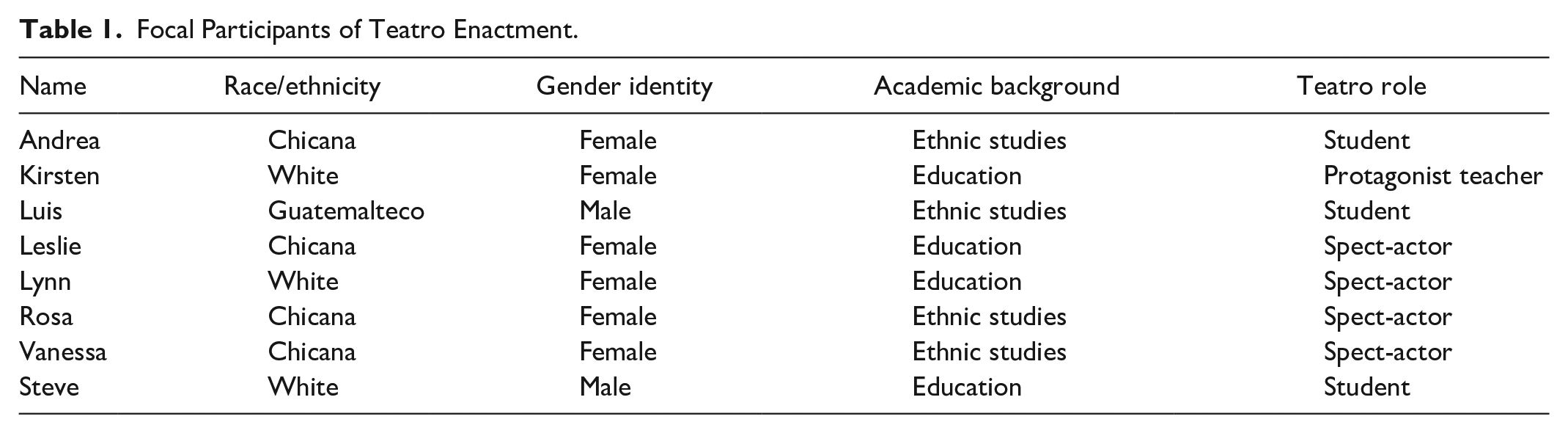
In this data excerpt, a novice teacher served as protagonist, while four other participants acted as students, with academic and affective profiles to embody (collaboratively discussed to ensure they avoided caricature and imbued the imagined youth with agency), while I took on the role of moderator, called the “Joker” in teatro, who supervises the scene to mediate the discussion and ensure safety. Our remaining 18 participants, as spect-actors, remained active participants in the collaborative problem solving and decolonial imagining. The eight individuals most engaged in this particular teatro sequence are detailed in Table 1 and represent our cohort’s demographics well.
Focal Participants of Teatro Enactment.
As noted, our goal was not to hone the implementation of extant academic practices that had not worked for youth in the past, but to devise new, culturally sustaining and liberatory ones. Equipped with conceptual knowledge, an array of strategies, and clarity of commitments, our community sought to enter a pedagogical imaginary and, as Boal (1979) says, “rehears[e] the revolution.”
Confronting the reality of affective challenges
We pick up the scene already underway. Kirsten is attempting to engage her students with the particular comprehension task of characterization. Having done a critically imbued think aloud with a short segment of text, trying to draw out elements that might help with characterization, she solicited student voices. Luis, a “student,” expressed (in character) a common, but problematic, opinion: that because the character in the story had never actively said “no,” she was in some way culpable for her actions, a weak character. This was designed as the heart of the scenario; the way that, in overt and covert ways, problematic, colonial frames—like misogyny—inevitably flow into our students’ readings of texts, and the world. Will we respond with neutrality? By silencing dissident voices? Or will we contest it? And, what does that look and feel like as an educator?
In our scene, Luis’ comment produced a sharp response from “student” Andrea, leading to a heated exchange between the characters the two were embodying, which Kirsten attempted to mediate:
Like, I just want to say that I’m like, really uncomfortable with what you just said, because you’re basically saying that she chose this, and that like, she had the entire role in like what happened to her, and I just want you to know that that’s like really wrong, and that you should be really ashamed of yourself for thinking that because . . .
Hey, hey I’m not a sexist!
You’re being really hateful towards her right now, and her experience is not your own, and you can never understand that, So I just want you to know . . .
Hey I’m not being sexist I’m just pointing out what’s going on here and she confused . . . and I don’t understand how she can respect herself . . .
Can we pause real quick, not the teatro, I’m pausing this conversation because I know Steve might still be kind of confused as to what’s going on [with the text] and I think other people may be as well, but what are you guys kind of going back and forth about, can you name what it is in the story?
Important to notice here is that the pedagogical challenge that Andrea and Luis produced was not strictly academic. Although centered on engagement with text, this dilemma produces a complicated affective geography that echoes the complexity of the classroom; Luis has voiced a misogynistic, patriarchal perspective, and Andrea has responded with agency and fervor, contesting this colonially rooted oppression. Yet, Andrea is engaged in a dehumanizing, personal attack. Disrupting the tense debate in humanizing ways is not so simple as challenging sexist discourse; there are implications for who controls knowledge, and determines which voices “count” in the classroom. Kirsten’s attempt to intervene shows yet another layer, that in the midst of this, there is still the text, which another “student” (Steve), who has yet to speak, remains confused by. With this in mind, Kirsten attempts to defuse the affective tension by returning to the text, to content. However, doing so is a move toward colonial obedience, avoiding the significance of this affect, and allowing misogyny to escape uninterrogated. In our imagined classroom, Andrea and Luis, refused to let her evade, purposefully “naming” the moment in conflicting ways to raise the intensity of the situation further. Kirsten, actively pushing back in her chair, leaning away from the table at which she and her “students” were seated, feels that tension, pausing the enactment:
Ok, I’m pausing from teatro . . . This is really hard for me . . . ‘cause this is something that’s really personal . . . and so this is like, really good that I’m doing this right now, but, [to Luis] I want to strangle you.
[Group laughter]
[leans back a bit, drops head] I know, I’m sorry.
Um, No, this is very, like, valid.
‘Cause I know like a lot of like, younger people they don’t . . . I’m not saying that they do or not but they, they say she should have just expressed herself, she should have just duked it out, I’ve seen people have that conversation.
Oh no, I know! I’m not saying, I’m not saying, please understand, I know the role you are playing right now, I’m not saying . . . your type of person, not you, but the type of person who does that, I’m like [Kirsten makes a tense expression and shakes her fists in simulated rage].
This is an important moment. Not just because it is an opportunity for imaginative sense-making around a very real pedagogical dilemma but because it demonstrates ways in which this generative rehearsal invites affect itself. Kirsten is challenged to attend to the multiple layers of affect at work among her students, while engaging the text, and considering the anxiety that this scenario produces for her. Rarely visible in teacher education, this is an inflection point of colonial obedience, or decolonial action. Indeed, this rehearsal allows Kirsten, who had volunteered for this scene aware of the content and her own relationship to it, to have an approximate experience of what a classroom space would look like were this conversation to occur. It is worth noting that real-Luis is supportive, apologetic; feeling the affective-impact of his character, and how that acted on Kirsten, his friend and colleague. This was a community operating with confianza (Razfar, 2010), collectively engaged in disruption—not avoiding anxiety, but creating a space that rehearses the jarring moment when the work of decolonization becomes possible in as supportive a manner as possible, providing tools so that Kirsten, now and in the future, need not retreat into “safer,” ontologically distant, colonially obedient practices. Andrea and Luis are able to force the issue in a way that youth might not, making it at once artificial but also crystalizing its existence and urgency. Their disobedience to the colonial pressures of the classroom (to simply behave and stop arguing) insists that Kirsten be disobedient as well and consider what it means to serve as witness to her students, while simultaneously allowing her own affective truth to be witnessed in a supportive, if intense, context. She explained her thinking:
So I had to pause it, because I don’t know . . . I’m trying to make it so everyone feels comfortable but, in reality I want to be like, “Yeah Andrea, like freaking go!” [ group laughter] And then I want to say “I worked on a rape crisis hotline, my sister was raped,” like, I know many people who were, I want to, like, say all that, but I don’t want to make your person, not you, but like who you’re enacting . . .
Yeah, yeah, just to be like . . .
. . . uncomfortable. Y’know, ummmm. I’m vocalizing what I’m thinking right now.
Kirsten here is raising a pedagogical dilemma that is real in its complexity, not rendered inert by an obedient focus only on the academic core practices around textual engagement. Teaching this text (or any) is not, nor ever could be, simply an act of pedagogical “automaticity.” Whether vocalized or not, content and interaction in the classroom draws out affective experience—we either obey coloniality, and silence it, or disrupt those relations of power, and humanize ourselves. Kirsten has begun to grapple with multiple layers that are at work here, seeking to reconcile what it means for a harmful ideological stance to be positioned as victim in a conversation, while herself feeling an affective intensity toward that individual, just as she might in a classroom of her own. There is no illusion in the rehearsal that ontological and emotional distance could be maintained—to engage in the practice demands that the affective dimensions of the moment be confronted as well as the intellectual ones.
Imagining decolonial solutions
This is where teatro as collaborative, decolonial rehearsal, becomes powerful. As Joker, I stepped in, inviting imaginative solutions from the community. Not all agree, or see the breaking of the oppression occur in the same way, but this mapping of the many paths epistemic disobedience might take produced generative possibility, building from, and with, one another. At this point, Leslie built from a suggestion by Luis to “get a little personal, and express that, y’know, there are different places that we’re all coming from here,” reflecting: And people are ALL coming from different places, I think that’s what’s important to remember when these kinds of things happen too, and just like, take a breath, and this is another human being, that has had an experience, that has been informed, you know what I mean? The way that they exist in the world has been informed by their experience, just like the way that I exist has been informed by MY experience and like, I’m not in a position to judge, you know, the extent of their experience thus far, and I think it’s important to keep it open, so that those people don’t shut down, and feel like they are being attacked, because sometimes it is, like, when you know better, you do better. You know what I mean? And a lot of times . . . they don’t realize, the full weight of what they’re saying sometimes . . .
Leslie, though she does not engage the word in her discourse, is capturing a rich understanding of the affective geography of classrooms here, drawing this out as a critical pedagogical, and human, consideration. Her insistence on attending to “ALL” the different experiences in the classroom ensures that the complexity of the situation—that Luis’ character is shaped by and experiencing colonial affect too—is not lost in the pressing task of combating misogyny. This critical comment left the group momentarily silent, pondering the complexity of what it meant to be with youth, before the teacher-educator turned the discussion to consider how one might rise to concrete in this moment. Lynn, offered up a pragmatic solution, a way to build a “pause” into a real classroom scenario: You could have like, have an activity that can maybe be individual for a second, like a quickwrite, that they can release those strong feelings and opinions for a second before coming back together.
This suggestion, though, was not just taken and reintroduced as a quick solution, a “core practice” to circumvent discomfort. The point here is that accepted practices, particularly when uninterrogated, are insufficient, obedient to coloniality. We must transform pedagogy to move beyond strategies—even if “high-leverage”—that have not, historically, worked for marginalized youth. The participants here were well aware of this, and so Lynn’s suggestion is not just enacted reflexively. Rather, we wrote the practice on chart-paper to archive it and then proceeded to discuss the implications of the strategy, considering all aspects of the affective geography they were working in. Rosa mentioned that for the teacher, Lynn’s suggestion: . . . gives us like, the opportunity to um, kinda connect with what we’re feeling as well, but then also, ah, having a moment to rethink how we’re gonna go back to it. And I think part of it is remembering that whenever there’s conversations that are really going to create change, they’re gonna be . . . hard. And there’s gonna be feelings that are gonna be mixed up, and nothing’s ever gonna be clean, because there’s nothing that’s completely clean, but trying your best to come from it, like to it from a standpoint of wanting to move forward, as a group and so, I mean, I think not beating oneself, because I think that many times teachers or educators they beat themselves down for not having things not coming out like how they expected or wanted it to come, and that it should be like a clean way of doing it, a, b, c, but knowing that that’s not the way it’s going to come out.
Significant in Rosa’s comments is the ontological relation they are advocating for. The context of this activity allows her to make transparent an essential reality of the inherent messiness that comes with transformative work. She speaks into existence the consideration of anxiety and discomfort in the practice that is being rehearsed, preparing the community to not expect clear-cut academic solutions and clean outcomes. Rosa continued, building from Luis’ earlier comment to “get a little personal”: The way I see it, is that it’s ok for you to get your emotions involved as well, because that’s part of learning. And I think that’s why this is so valuable is because it’s not ignoring the feelings that we’re all bringing in, rather cherishing them, and using it as a tool for us to move forward. And I think that also comes back into this idea of us becoming vulnerable ourselves.
This is a passionate and reasoned argument for epistemic disobedience; connecting practice, with affect, with a pedagogical identity set on closing ontological distance.
Confronting tension and contradiction
Yet as with all spaces of intersubjectivity, there was both consensus, and disagreement (Matusov, 1996). Vanessa, another Chicana spect-actor, raised the difficulty of enacting and envisioning the sort of embodied, vulnerable, and humanizing pedagogy Rosa was advocating. Referencing her own, and others, experiences in reductive, neocolonial schools, Vanessa raised this tension with the group:
That’s [being vulnerable as instructor] kind of hard though, no? ‘Cause growing up we never saw that . . .
No, but I mean like . . .
. . . so I feel like what you’re saying is easier said than done, ‘cause I feel like in her position she’s like, “wait, hold up,” cause y’know we’re not used to this kind of thing, so how would we go about it? I guess it would just be in the moment you’d find out, huh?
Asked to elaborate, Vanessa expanded on the tension she was observing:
Yeah, like from teachers, you know, rare teachers would give you emotion, [but most] they’d just like teach you, teach you, teach you, that’s it—go home. That’s it. That’s what I’m saying; it’s kind of new to see that, you know? Like, barely in college I’ve had like, awesome teachers but, like K[indergarten] through what, all those years . . .
There are two significant things to note in Vanessa’s reflection. First, Vanessa ensures that this discussion is not mistaken as easy, “we’re not used to this kind of thing, so how would we go about it?” In schooling experiences marked by (for them) pedagogies borne of a colonial episteme and teachers who would rarely “give you emotion,” and just “teach you, teach you, teach you,” there are no referents to which they can turn to easily envision humanizing, disobedient pedagogy. It is process-oriented, reflective of the immanence involved in becoming a decolonial teacher, and necessarily vague in its demands. Second, while Vanessa complicates the efficacy of proleptic practice, she simultaneous demonstrates its need. Her repetition of “teach you, teach you, teach you,” emphasized with a fist into her hand, brings to life the ontological distance, the colonial affect, of classrooms that the enactment is necessarily taking as its object. Vanessa raises complexity, but also urgency, making clear that this epistemically disobedient approach, one that acknowledges affect and emotion, rather than merely honing the implementation of old, failed practices, is necessary. Seeking to clarify her earlier point, Rosa offered the following consideration on decolonial vulnerability: I just think, what I want, what I want to make sure to work on was, um, not getting scared and allowing myself to go back to this, uh, I dunno, like classroom whole thing where I have the power over the rest of the students, but remembering that I have the right just as they do to learn, and express myself and learn with them, because by doing that they’re learning from me and I’m learning from them as well. And so, just not trying to disconnect myself. Cause I’ve seen that, where teachers start to become vulnerable, but then the next second they disconnect and they’re inaccessible to the student, and so as a student, you get mixed signals from the teacher, “well I did become vulnerable but that was wrong, so I won’t allow myself to do it ever again,” and the student, you’re being told that you shouldn’t do that either. And I think that’s why we don’t come to real conversations about what we feel, what we’re feeling, what we really want to tell each other.
Just as Vanessa named the tension of operating in ways that create ontological distance between student and teacher, Rosa carries on that thread, naming the danger of falling back into colonial obedience, “allowing myself to go back to this . . . classroom . . . where I have the power,” while recognizing the tension that comes from wading into the affective geography, and seeking to close ontological distance, her vision of “just not trying to disconnect.” This proleptic hope is linked to concrete outcomes, sense-making about practice—that avoiding affect, maintaining ontological distance, and refusing to be vulnerable is not just an affective concern, but one that relates directly to learning, to the richness of conversations that are possible in the classroom space. Building from this, Andrea, adds the complication of considering how this work operates in relation to the construction of professional identities: I think sometimes in the role of educator, or like of teacher, you’re expected to be like super strong, and like, never really show how you truly feel, because that could like, make your students feel some type of way, um, like, kind of perpetuate that you’re not . . . capable . . . of being in that position, or like discussing these things, but like, I personally think that showing emotion, like crying is so healing, and in certain spaces like as an educator you can like, demonstrate that to your students, and like kind of destigmatize, like being emotional . . . sometimes [students] do need, almost a little validation for their feelings, and sometimes we as educators can provide that.
While the rich theorization of practice that these novices were engaging in was important, this discussion did take place in a pedagogical rehearsal, a space intended to develop and hone practice. In this regard, Andrea’s comments bridged the broader discussion of affect, ontological distance, and pedagogical identity, back to pragmatics, and what actionable things decolonial teachers might do.
Returning to practice
Rising to the concrete from this discussion, Luis built on Lynn’s earlier solution, trying to synthesize what a disobedient, decolonial practice might involve in the space, to which Andrea offered a complicating pragmatic wrinkle, linked to the potential affective experiences and engagements of youth:
Yeah I was just thinking about the whole process of having them pausing and uh, and having them writing, y’know their feelings and frustrations down, does anyone think that would be a smart idea to present that with their peers, without interruption? Kind of see where everyone’s coming from, y’know this is how I generally feel, like just simply how they generally feel, just simply what they wrote down, verbat-, verbatim, and just have them just sit down and then start together again?
Would you like tell them that initially? ‘Cause I think that that would definitely affect the things they’d write.
These are generative, pragmatic solutions, proposed to operationalize the humanizing vision of praxis that the spect-actors theorized earlier, expressing the desire to recognize the complexity of affect in the space, and witness the voices of all students, even if they evince oppressive, colonial logics. This comment then led to a further discussion around feasibility—could we expediently and efficiently let every student share the fullness of their work, within the confines of a 60- to 90-minute class period and still address goals and needs relating to comprehending and analyzing this text in its academic context? This led Leslie to offer a solution, a concrete practice that grew from the decolonial vision the group held: Sometimes y’know you do a writing and then like come back and just like, everyone could share like a word, or a segment, and that would give you, kind of a little bit of a gauge, without them feeling like they can’t write what they want to write, or like, y’know. ‘Cause I feel like it’s important for you to be able to write and it actually be like, how you feel like it’d actually be what you feel, and then you could pick, just like a little part.
These additional concrete-practice solutions were added to our written archive, and the teacher-educator closed this particular vein of sense-making, and returned the group to the forum enactment to test these solutions, Kirsten now prepared with alternative tools to both attend to youth on academic and affective levels and to conceptualize how the affective intensity she was experiencing fit into the space and her pedagogical identity. Kirsten began, testing out the practice that had been devised: Ok so I’m going to have everyone take out a sheet of paper real quick. And, so we’ve got a lot of different ideas going on about, um, the sexual assault going on in, um, this story, and so I wanted you guys to write, for about 5 minutes, any feelings you’re having or what you think went on in this story, um, how you might think that’s getting played out, um, in social situations that you’ve been in, um, yeah.
In what followed, Kirsten, and several other participants who subsequently stepped into the protagonist/teacher role, grappled with this, as well as the other layers of coloniality that were embedded in this enactment, testing out solutions, generating alternative practices based on the results and archiving these for reflection. This is not to say that the practices they came up with were somehow wildly unique. Having students do a quick-write, or share a reaction-word, is not some drastically novel strategy only found in culturally sustaining or decolonial pedagogy; rather, what is key in this segment, and throughout our deployment of pedagogical rehearsal, was the intentionality which guided us to those practices, and the epistemic origin of the pedagogy that would surround them. The quick-write could easily be a decontextualized, reflexive, “core-practice” of accountability, deployed to ensure students are conforming to the colonial script of the classroom and allow the teacher to escape its affect. Yet here, it becomes a practice of decolonial witnessing (Zembylas, 2006) because of the way it is leveraged, and its epistemic intent; transformed into a means of actively inviting affect into the space to humanize participants as it encourages academic engagement.
Here and elsewhere, we identified particular classroom challenges and tasks that novices needed to be prepared for, and tried to honor them for their affective reality, disrupting the colonial relations they reflected. The imaginative task of exploring what it would mean to be a culturally sustaining practitioner in those moments allowed solutions to rise from their humanizing vision, to the concrete of decolonizing practices and strategies that had been practiced, rehearsed, and played with. This was, as Anzaldúa (1989/1999) says, rehearsal as nepantla, inviting creativity by embracing a decolonial vision of the world full of contradiction: “nothing is thrust out, the good, the bad, the ugly . . . not only does she sustain contradictions, she turns ambivalence into something else” (p. 101).
As they move forward, these practitioners may generate wholly new practices and strategies, or engage common ones; but they will do so, hopefully, as disobedient, decolonizing actors; challenging widely accepted, “high-leverage” or “intellectually ambitious” practices, and considering the affective terrain and ontological origin from which their pedagogical choices should grow.
Epilogue: Disobedience beyond the rehearsal
Six months later, many of our cohort were leading their own classrooms, seeking to live out their decolonial commitments. Steve had revamped the literacy curriculum in his role teaching at a youth detention facility, introducing poetry writing and novels in lieu of static worksheets. Leslie, a special educator, challenged her administration, eventually resigning in protest from a school she felt was doing harm to her community. Daniel, a Chicano participant, found himself constantly involved in curricular subversion, trying to stay dynamic and disobedient in a school he described as “colonial as fuck.” There were as many frustrations as triumphs, but participants all reported feelings of efficacy in maintaining their decolonial commitments, if not complete success in enacting them.
Kirsten, particularly, was teaching middle school language arts, and as she reported in an interview, believed herself to be employing the strategies and decolonial practices that emerged in our course. Prompted to share an example of how our work informed her praxis and practices, she recounted an incident that occurred while visiting a museum exhibit on the social and cultural construction of race with her students and another teacher. During this visit, Kirsten took the opportunity to exercise epistemic disobedience, inviting a local activist to attend, and engage with her students, almost all of whom identified as Latinx, in a discussion of their experiences of race. This, she noted, ensured the activity would be grounded in students’ lived experiences rather than academic, and emotionally distant. While generative for the students, Kirsten found her white colleague immediately resistant to the conversation, “visibly uncomfortable while we were having those conversations . . . continually shifting, looking around.” Kirsten still pursued the conversation, leaning, disobediently, into the tension of this moment when ontological distance narrowed through a recognition of the differently racialized experiences that they as affluent, white teachers, had from their Latinx students: She [another teacher] seemed really irritated that we were getting into this conversation [on race], and not taking the kids to do the virtual ski jump . . . but I was thinking, here’s a chance for them to engage with something important to them and someone who’s an activist in this, and that’s an important opportunity . . . it was messy, it’s just really messy work, and I made people get their hands dirty, and I’m glad I did.
Interesting here is that the language she uses—“messy work”—is the inverse of the language used by Rosa in the teatro rehearsal, a fact of appropriation not lost on Kirsten, as she noted: I feel like, teatro was a dress rehearsal for the real thing. And I think one of the biggest things that teatros helped me with is the way that I’ve been communicating things when I find things to be unjust or not okay in some sort of way.
The opportunity to practice concrete, epistemically disobedient skills encouraged Kirsten to do decolonial work in the same vein as what she had rehearsed, aware of its urgency, and conscious of the need to ask colleagues, as well as herself, to face the colonial episteme, and the anxiety that comes from considering their own subjectivities in relation to the affective lives of their students. Kirsten concluded this thread of our interview reflecting that she felt she was now living differently, eager to be epistemically disobedient, asserting that she “didn’t want” and “didn’t know if [she] could,” temper her desire for critically engaging with her students and colleagues.
Discussion
Toward a Different Kind of Ambition
I certainly do not seek to make causal claims that this particular moment of teatro conclusively transformed Kirsten’s—or any of the participants’—future pedagogical actions, or that it alone was responsible for her subsequent advocacy. There are grounds to argue, however, that creating spaces to practice rich, collaborative, epistemic disobedience—decolonial skills—had utility for participants’ self-efficacy and emerging professional identities. These individuals had earnest, critical commitments to begin with, but commitments require cultivation; they need to be practiced, encouraged, and given room to grow. By her own assertion, the practices, as well as the analytical lenses honed during our teatro-as-rehearsal activities, generatively impacted Kirsten’s praxis, allowing her to feel prepared to actualize critical commitments, both in terms of what she did, and who she was. To what extent she, and the other educators, will continue to do so, and translate these “dress rehearsals” into actualized decolonial praxis in the constraints of classrooms remains to be seen; but after 9 months teaching, Kirsten continued to feel efficacious and able to point to concrete ways she was enacting decolonial disruptions. This outcome bucks the trend of PBTE approaches failing to produce meaningful, actionable justice-oriented commitments among novices (Kavanaugh & Danielson, 2020).
The data here present a single example of what it might look like to craft rich, decolonial, practice-based moments of teacher education that advance a teaching practice that is epistemically disobedient. That this was the goal is important to emphasize, because it makes this moment substantively different than typical PBTE practices. Throughout this rehearsal of reading praxis, the goal was never just academic; because the affective elements that arose—how the text interacted with the positionalities of those reading it, and what that meant for human relationships—are equally important. In “intellectually ambitious” PBTE, coloniality positions those affective, relational elements of praxis as peripheral to rigor and ambitious outcomes, and conditions us to minimize them as we prepare novices. This strips the work of teaching of its true depth and complexity, rendering the possibility of liberatory outcomes (and pedagogies) impossible (Mignolo, 2003). Alternatively, centering disruptive elements, and affective aspects of praxis that humanize and resist a colonial episteme in novices’ vision of instruction, and how they deploy teaching skills, is ambitious, but in a fundamentally different way.
The instruction we rehearsed here was still concerned with robust questions about content, but it was more ambitious than that; raising compelling questions about our shared humanity, and disobedient to the sterile, colonial idea of what “counts” as comprehension, and matters in the relational process of teaching. Its rigor arose from challenging novices to interrogate and reflect on the ontological relationships they had with knowledge, their students, and themselves, and what those looked like in instruction. To that end, our vision of instruction was affectively ambitious—eager to produce liberation, rather than equity; epistemic revolution, not reform.
Operationalizing decolonial practices in teacher education pedagogy is neither straightforward, nor a panacea, and this argument—on the importance of exploring the concrete practices of decolonial pedagogy—is an addition, not alternative, to continued efforts to shift the epistemic commitments of institutions at large. Yet evidence shows that when intentional, focused, and guided by ontological clarity beyond the colonial episteme, cultivating critical and decolonial repertoires of practice are possible (Dutro & Cartun, 2016; Philip, 2019). In short, we would do well to ground our cultivation of decolonial educators in practice-based moments where the embodied and affective task of humanizing pedagogy can be foregrounded, experienced, and lived in situ.
Conclusion
As progress toward decolonial pedagogies in education continues, it is essential that we not surrender or neglect discussions of practice, or the epistemologies that shape our construction of practice. “Practice-based” need not be an approach dominated by notions of teaching which, intentional or not, remain stuck in the thrall of colonial obedience, detached from the affective and embodied experiences of marginalized youth, and reliant on ontologically distant practices we have employed for too long. Imagining other ways a PBTE—guided by a decolonial epistemology—might be structured to provide novices some feeling of familiarity, and preparation, for how they might live epistemic disobedience, is a pressing task for the field: What might a decolonizing case-study, curriculum design activity look like? How might we use video to decompose the presence of coloniality in classroom practices? Can we re-structure and re-arrange practicum experiences and interactions with youth to disrupt novices’ perceptions of expertise?
Even if the complete realization of the radical practices we rehearse might be unlikely, we can still work—through moments like this teatro—to ensure our novices encounter the skills needed to challenge the colonial episteme (Mignolo, 2009), and live the minutiae of decolonial praxis in their actions and choices. Epistemic convictions matter (Andrews et al., 2019), and a commitment to liberation, to a decolonial future, driven by the pressing urgency of the education debt (e.g., Ladson-Billings, 2006), suggests we ensure our efforts to cultivate pragmatic skills and practices, are grounded in, and guided by, epistemological commitments that are liberatory, and humanizing. It will be exciting to see teacher education researchers build on emerging decolonial frameworks (e.g., Lyiscott et al., 2018), and translate these into practice-based models that aid novices in operationalizing the decolonial.
By articulating what decolonial repertoires of practice and pedagogies might look like—pragmatically, relationally, and affectively—and how we can cultivate them in rich, compelling ways, a decolonial practice-based pedagogy might work, as Bhabha (1994) says, as an insurgent process of relinking; a decolonial space to foster culturally sustaining skillsets, and to cultivate educators committed to subverting coloniality by bringing new, epistemically disobedient pedagogies, and affectively ambitious instruction, into existence as concrete, sustainable practices of liberation.
Footnotes
Acknowledgements
I am grateful to the amazing group of educators whose voices are present in this article, and to Kris Gutiérrez and Susi Long, for their invaluable mentorship and editorial guidance.
Declaration of Conflicting Interests
The author(s) declared no potential conflicts of interest with respect to the research, authorship, and/or publication of this article.
Funding
The author(s) received no financial support for the research, authorship, and/or publication of this article.
