



Abstract
The study explores the rights consciousness of senior teachers who participated in a student rights professional development (PD) course and designed educational projects during the course. It analyzes teachers’ perceptions of students’ rights and the influence of the PD and other factors on these perceptions. The data included interviews with 17 teachers and an analysis of their projects. One cluster of teachers held a top-down perception of students’ rights, conveying a contrastive approach to rights reflecting students’ autonomy. The second cluster of teachers held a broader perception, which included bottom-up mobilization of students’ free speech and participation rights, conveying a supportive approach to these rights. The teachers’ projects did not reflect these patterns, limiting their focus to rights already embedded in school. Furthermore, the teachers did not report their learning experience as transformative. Rather, they applied their newly acquired knowledge and thinking frameworks to support their existing moral perceptions and practices.
Introduction
International human rights law determines that human rights education (HRE) should be one of the right to education’s main goals (Convention on the Rights of the Child, 1989, Article 29(b); International Covenant on Economic, Social and Cultural Rights, 1966, Article 13(1)). HRE comprises three dimensions: (a) knowledge and skills; (b) values, attitudes, and behavior; and (c) taking action to defend and promote human rights (United Nations [UN] High Commissioner for Human Rights, 2005).
In 2011, the UN adopted the Declaration on Human Rights Education and Training, which determines that HRE “should be based on the principles of the Universal Declaration of Human Rights and relevant treaties and instruments” (Article 4). One component of HRE is children’s rights education, which refers both to rights that ensure children’s protection and provision and to rights that provide children with autonomy, such as participation, freedom of expression, and freedom of thought, conscience, and religion (Convention on the Rights of the Child, 1989). Both kinds of children’s rights are relevant to the school setting. Children’s rights education in school may include education about rights, and also education through rights and for rights (Declaration on Human Rights Education and Training, 2011, Article 2) by various practices, such as students’ participation in school governance, disciplinary proceedings, and assessment (see Perry-Hazan, in press; Struthers, 2015).
The first phase of the World Program for HRE determines that HRE should include teacher professional development (PD; UN High Commissioner for Human Rights, 2005). Despite being bound by international obligations, many countries, including European countries, the United States, and Australia, do not ensure that all students obtain HRE (Jerome et al., 2015; Tibbitts, 2015) and do not incorporate HRE in their teacher training programs (Jerome et al., 2015; Struthers, 2015). Therefore, it is not surprising that the empirical study of HRE teacher training is scant (Bajaj, 2011b; Lyle, 2014). Understanding how teachers learn HRE is critical for any democratic country. It is of particular concern in Israel as a country facing national, religious, and ethnic tensions with implications regarding access to human rights. Although Israel’s State Education Law (1953) sets HRE as one of the goals of education (Article 2(2)), HRE enjoys only a marginal presence in school curricula (State Comptroller, 2016) and is not addressed in teacher training programs (Jerome et al., 2015).
This study explored the rights consciousness of senior teachers in Israel who participated in a PD student rights course and designed educational projects during the course. We examined how these teachers perceived students’ rights and whether and how the PD and other factors influenced these perceptions. The literature review comprises four axes. The first axis describes barriers to the implementation of HRE programs in schools. The second axis reviews the scholarly literature on teachers and HRE and highlights the current study’s contribution to this literature. Only two empirical studies have reported on teachers learning HRE (Bajaj, 2011b; Lyle, 2014), but these did not examine the teachers’ diverse experiences, nor did they consider the interface of teachers’ learning and their identity. The literature review’s third axis discusses the role of teachers’ identity during professional learning processes. Its fourth axis focuses on the research addressing rights consciousness, which examines how rights are perceived and what processes spur people to name problems and obstacles as rights violations. HRE is a crucial facilitator of these processes (Almog & Perry-Hazan, 2011). The next sections elaborate on the research design, present the findings, and discuss them. The findings characterized two conflicting patterns of teachers’ rights consciousness and indicated that most teachers applied their newly acquired knowledge and thinking frameworks to support their existing moral perceptions and confirm their practices. To explain these findings, the study relied on theories that address the development of rights consciousness and the role of teachers’ anchoring beliefs about teaching and learning in teachers’ PD. The study concludes with practical recommendations for the design and instruction of HRE programs for teachers.
Literature Review
Barriers to the Implementation of HRE in Schools
Comprehensive HRE teacher training is essential in light of the various barriers to effective implementation of HRE in schools. Some of these barriers relate to the ideological approach and the priorities of the State (Bajaj, 2011a; Coysh, 2014). Political barriers to HRE may be stronger when cultural or religious communities’ traditional values clash with human rights (Coysh, 2014; Howe & Covell, 2005). Conflicting definitions, models, and perceptions of HRE may dilute its core content and strengthen State power to shape the teaching of HRE in light of political interests (see Bajaj, 2011a; Struthers, 2015; Tibbitts, 2017).
HRE also faces various barriers at the school level. Among these barriers are organizational impediments relating to the gaps between HRE’s content and most schools’ organizational structure, particularly concerning zero-tolerance policies, punitive disciplinary practices, surveillance, and the lack of student participation (Osler & Starkey, 2010; Perry-Hazan & Birnhack, 2018; Perry-Hazan & Lambrozo, 2018). In homogeneous schools, such as religious or selective schools, additional challenges relate to the lack of ethnic, racial, and religious diversity (Osler & Starkey, 2010; Perry-Hazan, in press).
Other barriers hindering HRE at the school level can be traced to teachers’ perceptions. Teachers may perceive children’s rights as an impingement on their authority and thus resist rights-based pedagogies (Bajaj, 2011b; Howe & Covell, 2005; Lyle, 2014; Trivers & Starkey, 2012). In certain countries, such as Israel and the United States, such resistance may also relate to the fact that teachers comprise a disempowered group subject to constant supervision (Perry-Hazan & Birnhack, 2019; Santoro, 2018). Teacher resistance to students’ rights and HRE may also stem from perceptions of adultism (see Perry-Hazan, 2016), namely, the view that as children are immature and incompetent, expanding their rights may harm their best interests (see Leung et al., 2011; Lyle, 2014). A further barrier relates to teachers’ limited knowledge of legal concepts and their willingness to seek legal information (e.g., Martínez-Sainz, 2018; Perry-Hazan & Tal-Weibel, 2020; Schimmel & Militello, 2007). Teachers may also be hesitant to teach politically controversial issues relating to human rights (Struthers, 2016).
Studies Concerning Teachers and HRE
The various noted barriers hindering HRE emphasize the importance of understanding how teachers perceive it and teach it. Several empirical studies inquired into teachers’ perceptions of HRE, unrelated to specific programs (Cassidy et al., 2014; Struthers, 2016). Other empirical studies explored teachers’ role in implementing HRE programs (Covell et al., 2010; Leung et al., 2011; Martínez-Sainz, 2018). These studies mainly focused on school-level barriers to HRE, which were discussed in the previous section. Beyond this context, Covell et al. (2010), exploring the implementation of children’s rights education programs in U.K. schools, differentiated between schools that successfully incorporated students’ rights across the curriculum and throughout their policies and practices and schools that were less successful. The findings revealed that teachers from both groups of schools did not revise their core attitudes during the programs’ implementation. Another important study on teachers’ role in HRE is Brantefors and Quennerstedt’s (2016) meta-analysis of studies that explored the teaching and learning of children’s rights. A recurring theme in their study was one’s relationship to the other, indicating that children learn about rights primarily by experiencing interactions informed by and infused with human rights. The crucial role of teachers in implementing HRE was also discussed by Osler and Starkey (2010), who emphasized the need to contextualize HRE and draw on the learners’ experiences and stories. Osler and Starkey examined how HRE could be developed as an agenda for action in working for justice and peace. Their comprehensive analysis addressed HRE’s history, politics, and pedagogies but did not include interviews with teachers.
In light of these insights, several studies have highlighted the importance of HRE teacher training programs and presented models for such programs (e.g., Jerome et al., 2015; Nazzari et al., 2005; Osler & Starkey, 1996). However, only few empirical studies investigated teachers participating in HRE training (Bajaj, 2011a, 2011b; Lyle, 2014). The study having the greatest significance for the current research was that of Bajaj (2011a, 2011b), who explored the work of an Indian nongovernmental organization’s (NGO) educational wing. Her research concerning the impact of HRE training on teachers working in marginalized communities showed that many teachers perceived the training as a “transformative experience” that modified their attitudes, behavior, and actions (Bajaj, 2011b, p. 219). In addition, she showed that the social distance between teachers and students was reduced through HRE, resulting in increased democratization of the classroom and school.
Lyle (2014) examined the perceptions of educators who participated in 1-day HRE training programs. The analysis included categorizing post-it notes into themes relating to children’s immaturity, their need for adult protection, and concerns of altering teacher–student power relations. The study concluded that the program changed the teachers’ attitudes regarding these themes. Apart from these studies, our knowledge concerning teachers’ experiences of HRE training is scant. Moreover, the reviewed studies neglected to examine teachers’ diverse HRE experiences. More data are needed to understand how different teachers experience HRE training and how HRE affects their perceptions. In the current study, we use the frameworks of teacher identity and rights consciousness to facilitate our understanding of these processes.
Teacher Identity and Professional Learning Processes
Various studies have shown that teachers’ professional learning experiences are intertwined with their identity as teachers (e.g., Garner & Kaplan, 2019; Luehmann, 2007; Mockler, 2011; Noonan, 2019; Webster-Wright, 2009), namely, who are teachers, who do they believe they are, and who do they want to be as teachers (Garner & Kaplan, 2019). Thus, teachers’ perceptions of and responses to professional learning are a consequence of the interaction and intersection of their own beliefs, knowledge, experiences, and practices (Noonan, 2019; Opfer & Pedder, 2011). These personal factors, in turn, are embedded in teachers’ professional context and their sociopolitical environment (Mockler, 2011; Opfer & Pedder, 2011).
The aforementioned insights imply that teachers’ learning outcomes may be unpredictable (Garner & Kaplan, 2019; Opfer & Pedder, 2011) and that there is no one best way to design effective PDs (Noonan, 2019). As Noonan maintained, “one teacher’s transformative experience may be just another Tuesday for her colleague sitting a few feet away” (p. 1). Noonan’s conceptualization of anchoring beliefs describes teachers’ closely held principles about teaching and learning. He argued that such beliefs are “a durable but permeable filter through which people see and make sense of the world,” and they reflect and refract teachers’ identities (p. 2). Noonan found that teachers’ retrospective accounts of powerful professional learning generally aligned with their current beliefs. Similarly, Garner and Kaplan (2019) asserted that when teachers study newly constructed beliefs that are congruent with their existing beliefs, they “will experience increased commitment towards changes in the role identity, and will be more likely to implement the new practices” (p. 14).
Specific challenges transpire when the PD aims to produce a reform-minded teacher whose professional identity is incompatible with the current norm (Luehmann, 2007). To be successful, such a PD may necessitate a change in a myriad of components that constitute the teacher’s identity system, such as the teacher’s purpose and goals in teaching, self-perceived attributes regarding teaching, worldview as a teacher, and perceived possibilities for action as a teacher (Garner & Kaplan, 2019). Teachers’ anchoring beliefs about students’ rights may be interrelated to all of these components as they concern not only pedagogical content but also school practices and power relations. Studies on rights consciousness assist in a better understanding of such beliefs.
Rights Consciousness
Rights consciousness is the capacity to name injuries as a violation of rights, which is a precondition to claiming rights and fulfilling them (see Almog & Perry-Hazan, 2011; Merry, 2003; Morrill et al., 2010). In these aspects, rights consciousness is proximate to sociopolitical consciousness, a term widely used in educational research to describe the ability to take learning beyond the confines of the classroom and act against societal inequities (e.g., Jackson & Knight-Manuel, 2019; Ladson-Billings, 2014; Young, 2010). Factors that facilitate the development of rights consciousness include conveying knowledge pertaining to human rights and their realization as well as implementing practices that reinforce the experience of rights (Almog & Perry-Hazan, 2011; Hirsh & Lyons, 2010; Merry, 2003). Another factor affecting the development of rights consciousness relates to emotions such as anger, indignation, hope, and courage, as well as self-respect (Abrams, 2011). Thus, rights consciousness is intertwined with the normative, social, and institutional environment (Hirsh & Lyons, 2010; Merry, 2003) and with the individual’s professional, social, and cultural identity (Zembylas et al., 2015).
Most studies on rights consciousness have focused on disempowered groups (e.g., Calavita & Jenness, 2013; Merry, 2003), including children (e.g., Birnhack et al., 2018; Morrill et al., 2010; Velez, 2017). Other studies have explored the legal consciousness of human rights activists and their efforts to mobilize rights by developing human rights consciousness (e.g., Newman, 2013; Perry-Hazan & Perelstain, 2018). Only a few studies focused on individuals responsible for implementing the rights of others (Edelman et al., 1993; Munkres, 2008; Perry-Hazan & Birnhack, 2016). One of these studies focused on educators. It explored how Israeli school principals who installed CCTV systems in schools merged their managerial considerations with personal conceptions of human rights and education in their decisions (Perry-Hazan & Birnhack, 2016). Some of them relied on imagined law to justify their decisions. They erroneously assumed the existence of a law that guided them in the matter and inventively imbued its content with personal intuitions and perceptions.
Apart from these studies, we know relatively little about the rights consciousness of those responsible for implementing the others’ rights and whose behavior often determines the effectiveness of rights much more than the ability and willingness of the disenfranchised to claim them (Munkres, 2008). These contentions are especially pertinent for teachers. The mobilization of students’ rights relies on teachers who define problems and practices in terms of rights and educate students to protect, respect, and fulfill their own rights and the rights of others.
Research Design
Objectives
This study explored the rights consciousness of senior teachers who participated in a PD student rights course and were tasked with designing educational projects during the PD. Specifically, the study examined how these teachers perceived students’ rights and whether and how the PD and other professional, cultural, and personal factors affected these perceptions. The study also analyzed the implications of the findings for the design and instruction of HRE courses for teachers, particularly courses that focus on students’ rights. The study supplements the empirical literature on HRE teacher training and on the rights consciousness of teachers as agents responsible for overseeing students’ rights. Figure 1 situates our study in the reviewed literature and highlights the connections between the various theoretical frameworks.
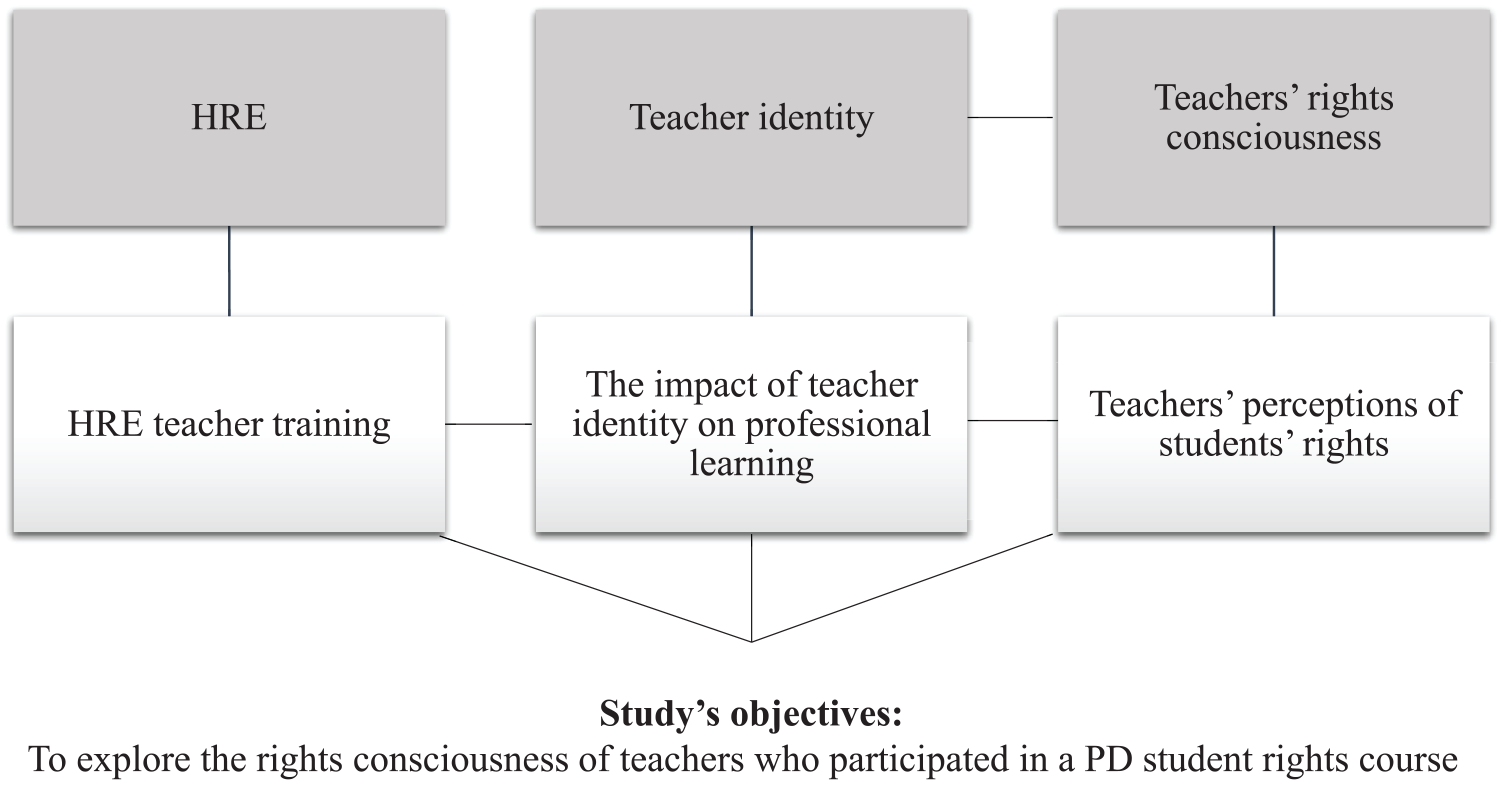
The study’s framework.
Context
The Israeli Ministry of Education (MoE) determines all aspects of initial teacher education and PD and requires teachers to participate in PDs to receive advancement in rank and wages. Teachers choose their PDs from the Ministry’s PD websites or receive explicit recommendations from their superiors and colleagues. Several MoE units offer sporadic activities and PD tracks relating to HRE. One of them, the Student’s Rights Unit, conducted the PD that we explored in the current study. The PD we explored was an MoE-recognized inservice training requirement for senior teachers’ promotion. As HRE is typically absent in Israeli teacher education programs (Jerome et al., 2015), this is virgin territory for the vast majority of teachers attending PD programs on student rights.
Methodology
The study relied on semi-structured interviews with 17 teachers who participated in an MoE’s PD on student rights. To triangulate the data, we analyzed the educational projects that the teachers prepared during the PD. We also gathered factual information from the two PD instructors.
The PD’s requirements were to attend all meetings and design and implement a final project as an initiative that would focus on children’s rights and address a specific school or community need. The teachers were required to choose a right that they learned about in the PD, prepare a literature review, and elaborate on their project’s rationale, target population, goal, implementation plan, and evaluation.
The first year of the 2-year course comprised mostly lectures presented by experienced PD instructors and other experts as well as readings of various materials, including international human rights instruments. Some of the lectures concerned specific student rights, such as participation, equality, education, and privacy, and others presented general topics, such as the Convention on the Rights of the Child and rights awareness. Additional lectures focused on visual media presenting violations of children’s rights or on teachers fulfilling their students’ rights. Other lectures addressed methodological issues relating to the project’s design. Each of the first year’s 14 sessions lasted about 2 hr. The second year’s 15 sessions were mostly focused on implementing the designed projects and included workshops and teacher presentations.
We called the 43 teachers who participated in two parallel PD classes and requested their consent to participate in the research. Among the 40 responding teachers, 17 agreed to participate, with the others declining due to time constraints. All the interviewees were Jewish and worked in Jewish schools; Arab teachers did not participate in the PD. The participating teachers’ seniority in the school system ranged from 17 to 34 years, with their ages ranging from 44 to 62 years. They came from various schools, all from northern Israel, and most did not know each other. When asked why they chose this PD, only six interviewees indicated an interest in student rights. Eleven interviewees reported being motivated by prospects of promotion, nine noted the instructor’s good reputation, six were attracted to the use of visual media (appearing in the PD’s title and description), and three chose the PD because they knew a colleague who had applied. Most of the interviewees (N = 15) were female, a distribution consistent with the composition of the teaching profession in Israel. The teachers had diverse professional and communal backgrounds. Table 1 presents the demographics of the interviewee sample. We removed the participants’ identifying information in view of ethical considerations.
The Interviewees’ Sample (N = 17) and Categorization of Teachers’ Perceptions.

The procedures and research tools were approved by our university’s institutional review board (IRB; Approval No. 144–16). The teachers were interviewed in 2016, immediately following the PDs’ conclusion or during their projects’ implementation. All the interviews were held in the teachers’ homes or schools at their convenience. We presented the teachers with general, open questions about their definitions and perceptions of students’ rights, about the accommodation of students’ rights in their school, about the PD, and about their projects (Appendix A presents the interview guidelines). The interviews lasted approximately 1 hr, and they were recorded and transcribed. As noted, we also analyzed the projects that the teachers prepared and gathered factual information from the two PD instructors relating to the PD’s goals, syllabus, and instructions.
We used thematic analysis to analyze the data. The data analysis included several rounds of categorization (Merriam, 2009). To ensure reliability, each of the authors reviewed the transcriptions and projects independently and recorded their ideas for a coding scheme. Disagreements were resolved by discussion to reach a consensus.
Appendix B presents the coding scheme. The first round of analysis focused on each teacher’s interview and project, with the second round seeking patterns among the entire sample. Our initial set of categories reflected the various themes identified in the interviews and the projects. We identified three themes that were dominant in both sets of coding: (a) teachers’ perceptions regarding the significance of various students’ rights; (b) teachers’ level of support of students’ rights; and (c) the range of influences on the teachers’ perceptions. At this stage of analysis, our independent coding resembled the general codes that emerged from the research questions and the interview guidelines. Upon analyzing the data according to these themes and delineating subcategories, the data revealed conflicting perceptions and approaches among the teachers.
Consequently, we conducted a further round of categorization to identify and classify the teachers’ various perceptions and approaches. This stage of analysis required considerable discussion and revision of the codes. The final coding scheme identified two conflicting patterns of teachers’ rights consciousness: (a) top-down perceptions of students’ rights, reflecting a contrastive approach, and (b) bottom-up perceptions of students’ rights, reflecting a supportive approach. Table 1 presents the two categories of the interviewed teachers’ perceptions. The distinction between the two categories, while not dichotomic, portrays different patterns of teachers’ rights consciousness and contributes to our understanding of how teachers made sense of the PD. The final coding scheme also differentiated between factors that influenced teachers’ rights consciousness. It included the following subthemes: (a) the PD’s impact and (b) the impact of other factors: cultural elements, personal school-related experiences, professional experiences, and personality traits.
Findings
Conflicting Patterns of Teachers’ Rights Consciousness
Top-down perceptions of students’ rights and a contrastive approach
One cluster of nine teachers held a top-down perception of students’ rights, describing the school as a space where the students come to learn while the teachers teach and protect them. Most of the teachers in this top-down cluster emphasized time and again the importance of the right to education in its basic sense of acquiring knowledge when they discussed the importance of different students’ rights. For example, Anna noted that “anyone [working] in the education system knows that he is there to teach the students. That’s the first right.” She lamented the fact that students “think that they come to school to learn how to socialize rather than to learn and acquire knowledge.” Similarly, Rachel said that every student “has a basic right, which is first and foremost to learn,” and “the teacher has a responsibility to teach him.”
As to the integration of rights in school, this cluster of teachers focused on practices that facilitate student learning. Shira referred to a learning center for low achievers, Natalie described learning adaptations for special education students, and Rachel said that she promotes students’ rights by devoting her personal time to prepare them for exams. The teachers raised the same allusions to the right to education when asked to describe barriers to the implementation of students’ rights. For instance, Shira described cases in which students received exemptions from certain requirements because of parental pressure. She also referred to schedule conflicts between her classes and the schools’ social activities: “[The school’s management] put the social [relationships] above all, so social activities are on top, and learning is at the bottom. . . I see here that they derogate the child’s rights to be prepared for the exams.”
Other aspects of the right to education emphasized by this cluster of teachers referred to the school’s physical conditions and accessibility. For example, in response to a question about the importance of students’ rights in school, Anna noted the importance of providing clean and functioning toilets as well as lockers to store heavy books, and Leah, Rachel, and Shira lamented the lack of infrastructure that would enable students with physical disabilities to access all the school’s facilities. This cluster of teachers also emphasized students’ right to physical protection at school. For instance, Dana noted that: The most important student right is to be [physically] protected . . . Parents who send their child to school want him to learn and progress, but even more so, want him to feel protected at school. That’s the basic obligation.
Furthermore, some teachers in this cluster, such as Karin, Benjamin, and Sarah, stressed the importance of inclusion and integration of diverse students. These teachers similarly described hierarchical relationships in school and focused on adults’ responsibility to implement students’ rights.
When teachers who held top-down perceptions of students’ rights discussed students’ rights to autonomy, their views reflected a contrastive approach. This approach was characterized by a perception of an unchecked “inflation” of students’ rights and of their inappropriate implementation. As Karin summarized: “We often provide [students] with too many privileges . . . which aren’t always used for worthy purposes.” Similarly, Anna associated students’ rights with their exaggerated sense of entitlement and contended that the students “perceive that everything is permitted.” Benjamin also noted that students have “too many rights,” a condition that may create “dis-rights.” Several teachers said that students use their rights to derogate the rights of others, especially teachers. For example:
They receive excessive rights and freedoms, and they don’t acknowledge boundaries. [They need] to respect the teacher, the principal, the person who cleans the school’s floors . . . I think that the children are too aware of their rights, and they forget to be human beings.
What about the teacher? Doesn’t she have rights? Isn’t she a human being? . . . Can you just trample me and receive everything?
Leah also expressed her anger toward the legal and educational systems that require teachers to respect students’ rights but do not understand the difficulties incurred. She was amazed to find out during the PD that a student is legally allowed to record a teacher during the lesson; she then described her anger: Children are entitled to receive knowledge from you, and at the same time, you should protect their rights . . . [You are required] to coddle them all day, and you can’t talk, and you can’t make remarks, and you should be careful. That’s not real.
Leah even said that after the PD, she is happy that she will soon retire. “It was hard for me to hear ‘children’s rights, children’s rights, children’s rights’ all the time,” she noted, “And what about us?” Other teachers also linked overly accommodating students’ rights to lack of teachers’ rights, despite not being asked directly about teachers’ rights. For example:
Is there any law that protects teachers’ rights? Too bad. There won’t be such a law. . . We only protect students’ rights and not teachers’ rights.
The teachers are those who were set aside . . . Look at the students’ rights and see where the student is and where the teacher is.
We forget that [teachers] have a few rights, too, but teachers’ rights are never on the table [for discussion] unless something extreme happens.
A further characteristic of the contrastive approach was an intuitive linkage between students’ rights and obligations. For instance, Benjamin said that “rights and obligations are matched. It’s like in the army,” and Sarah noted: “There are rights as well as rules. You perform [your duties], you receive [rights]. You don’t perform, so you don’t receive.” Leah incorporated the interconnection of rights and duties in the project she designed. She requested the students to list their rights and think of what obligation would correspond to each right.
Bottom-up perceptions of students’ rights and a supportive approach
Another cluster of eight teachers emphasized students’ rights to autonomy and highlighted the importance of student agency. Five of these were among the six teachers who expressed their initial interest in students’ rights. The teachers who held bottom-up perceptions highlighted the importance of broadening the students’ choice of course subjects and learning activities. For example:
I want to provide them with the right to choose between art, technology, and agriculture . . . children have a right to choose . . . and they can’t be forced to learn a subject that isn’t mandatory . . . In my class, there are often choices. If someone doesn’t want to do [learning activities] because he doesn’t feel like it on a certain day, he can sit and read a book.
The right to choose [is very important] . . . The issue of learning tracks is “hot” in our school. [Some teachers] try to push students [to certain tracks] because if there aren’t enough participants, the track will be closed. Not me! I sit with the students for private conversations [and say]: “No! you’ll do what’s good for you.”
Danielle made similar references to the students’ right to choose their volunteering assignment, an activity integrated into the school’s curriculum, noting that “it’s the [students’] right to choose what’s right for them and what’s not.” David claimed to have offered students the right to choose between two different exam administration dates: He’s going to be in the army soon and will be driving, so he should be given the responsibility to decide when he isn’t ready for the exam . . . It’s an example of how we can tell the students: “We trust you . . . Take responsibility for what you’re doing and use it wisely.”
When David discussed integrating students’ rights in the school, he also noted the importance of an active student council, which provides “the freedom to act” and “the feeling that things can change.” Then, he proceeded to criticize the barriers that hinder the student council’s decision-making role in his own school.
Another prominent right that this cluster of teachers discussed is students’ free speech. Ella noted the importance of providing children with opportunities to exercise their freedom of expression, especially those with learning or social difficulties who have been mainstreamed. Ruth discussed the importance of allowing children to express their dissatisfaction, “to share things that disturb them,” and to “refuse.” David described other aspects of free expression relating to unique clothing and haircuts. He criticized his colleagues for insisting on a school uniform and “not giving a place” for free speech. He also noted, “Children feel the school is a . . . factory. [Teachers] don’t know the children, not their names, not their history, and not who they are because they don’t give this [opportunity] for a dialogue.”
The bottom-up perceptions of students’ rights were intertwined with a supportive approach toward students’ autonomy. The supportive approach was characterized by positive perceptions of students’ rights and understating of their justifications. For example, David noted that students’ rights are “invaluable,” not only for the students but also for the organization, which needs guidelines for directing the teachers’ behavior. He also noted that enhancing students’ awareness of their rights will promote a “wise usage” of these rights, as this implies that the students will also become familiar with the limits of their rights. Sharon said that “when the teacher respects children’s rights, it bonds the teacher and the student” and transmits messages of caring, which make the student “a partner” and “decrease resistance [to schooling].” Emma stressed that the students’ rights discourse is “important” and “educative.” In this context, she recalled how her students demanded their right to participate in a drama program and appealed to the principal to present their claims regarding the fairness of one-time auditions.
Teachers holding a supportive approach toward students’ rights rejected the common perceptions that characterized the contrastive approach. For example, Ella said that she does not agree with the common “contention” that students “are granted too many rights” and lamented her colleagues’ opposition to students’ rights because of their “ego.” Sharon and David referred to common teachers’ perceptions as well:
Teachers think that we compromise too much . . . However, just like you’re fighting for your rights, [students] have rights, too. We should view them as human beings who have a list of rights and help them fulfill them and not [say]: “We give them too much, look how rude they are.”
When you say children’s rights, the average teacher will say: “Wait a minute, but what about the teacher’s rights?” . . . [I think] that children’s rights are children’s rights, and teachers have rights, and they don’t contradict each other.
The supportive approach was also characterized by suggestions to raise students’ and teachers’ rights consciousness. For example, Maya noted: I think that [students’ rights] should be discussed during the teacher orientation days before the start of the school year . . . to distribute to every class a children’s rights poster and hang it near the students’ birthdays chart . . . [The list] should be in teachers’ organizers . . . There should be a students’ rights day . . . The parents should receive [information about rights] in the school bulletin . . . When you speak and say the word, it anchors it deep in your consciousness.
Some teachers said in this regard that students’ rights should be integrated across the curriculum. For instance:
It’s something that has to be built-in within the school. . . There should be a discourse [on students’ rights] at every opportunity. . . it should be a daily moral-cultural discourse. . . in each and every lesson.
There are many daily life events that I can connect to rights. . . It’s an issue that should be lived.
In addition, the supportive approach was characterized by emphasizing the importance of adopting a lexicon of rights. Danielle explained that students should change their semantics, and instead of saying, “I want to,” they should say, “I have a right.” Emma noted that the lexicon of rights and its association with law and values provide students with self-confidence.
The intersection of teachers’ rights consciousness and their projects
The teacher’s patterns of rights consciousness were not reflected in their PD projects. The right to education, especially aspects relating to improving pedagogies, was dominant in most projects. Even some of the teachers who emphasized the importance of children’s free speech and participation, such as Ella and Ruth, designed projects that highlighted the right to education. Ella’s and Ruth’s projects addressed language abilities. Natalie, whose project focused on language abilities as well, noted in her project’s objectives that language is essential to establish self-confidence. In her interview, Natalie said that language enables the fulfillment of students’ rights, including the right to “make mistakes and correct them” and the right to dignity, which is fulfilled when students hear a fellow student reading aloud and “respect him when he reads and make mistakes.”
Similarly, Anna’s project’s goal was to use active learning pedagogies to help students perform mathematical calculations. Also, Rachel and Dana focused on mathematics abilities, tying them to daily life activities, such as managing money and bank accounts. Rachel explained that “using money is extremely important. It’s a basic right of every child and every human being.”
Another type of rights dominant in the projects was equality and respect for diversity and difference, mostly concerning students with disabilities. Teachers in both of the two main clusters designed projects that focused on these rights. Shira’s and Karin’s joint project focused on the social integration of special education students currently enrolled in a separate class in the school year that they teach. The projects submitted by Sharon, Rebeca, Leah, and Maya similarly addressed the inclusion of disabled or socially rejected students.
Only few teachers, all in the bottom-up cluster, designed projects reflecting the rights to participation and free speech. For example, Ella planned to let her students decide on the project’s topics and then “design something that has relevance for them.” Rebeca initially thought to ask the students to create posters, but, following the students’ requests, she let them determine the final assignment’s medium. David’s and Emma’s projects focused on different aspects of free speech. Whereas David’s project emphasized the importance of free speech, Emma’s project focused on its limits.
Most teachers articulated their choice of the project by noting a specific “problem” or “difficulty” in the school, and few indicated a personal connection to the topic. Perhaps the project’s instructions, which required the teachers to focus on rights that addressed a specific school or community “need,” led them to focus on rights already embedded in the school’s culture and curriculum.
Factors That Influenced Teachers’ Rights Consciousness
The impact of the PD
Some teachers indicated that the issue of student rights was new to them. Other teachers said that they had been previously exposed to the issue, but the PD offered new knowledge and raised their awareness of the importance of students’ rights. Most said the PD was interesting; it opened up new horizons and had relevance to their everyday experiences. We found several references relating to the PD’s influence on the teachers’ ability to identify incidents as a violation of rights:
[The course] often touched on some points . . . that evoked incidents in your memory . . . And you suddenly say, “Oops, this child doesn’t have this, or doesn’t receive support.”
I understood many things . . . that I felt over the years that don’t go well in the education system.
We had a student with a disability, and there was a need for a special elevator. [After the PD] we approached the principal and explained that it’s not a favor to the student and that she should fight for it, that it’s part of the [student’s] rights. [The PD] sharpened it for us; we can’t say that it didn’t exist [before the PD], but it strengthened our desire to fight and be granted what the student should have received.
I don’t permit [the students] to laugh at [other] children . . . but I’ve never connected it with children’s rights. I followed my instincts and did what I felt was right . . . so this year, I’ll associate it [with children’s rights].
The interview data showed that most teachers used their newly acquired knowledge and thinking frameworks to establish a foundation for supporting their existing moral perceptions and confirming their practices. These insights held true for teachers holding a contrastive approach as well as those holding a supportive approach. Some examples follow:
I think that [after the PD] I can define for myself, or anchor [my thoughts], in terms of rights. . . [the PD] assisted me to [explain] why I’m doing it. . . To ideologically frame things that I already did.
[The PD] provided me with an ideological base. . . and strengthened what I [already] think.
It’s something that you think, and then suddenly, you’re saying it aloud. . . It’s obvious that children have rights, but I never thought that it should be defined and that [the children] need to know what it means. . . It’s there in your subconscious, and it’s not something that is on the table.
Ruth and Benjamin said in this regard that the PD provided a moral endorsement for their worldview:
We received some kind of confirmation of what we’re doing.
I always knew that children have rights, and even 30 years ago, when I pushed a child to class in a wheelchair . . . I understood then that he has a right to learn. That didn’t change. . . My worldview simply received a stamp of approval.
The impact of other factors
The excerpts in the previous subsection showed that the PD did not substantially change the teachers’ rights consciousness. Indeed, the interviews revealed several sets of factors that influenced the teachers’ rights consciousness. The first and most prominent set of factors reflected cultural elements. Several teachers who were orthodox Jews and held a contrastive approach sought to connect the rights to their own worldviews. For example, Benjamin said that “the most important right is what is written in the Torah—[respecting] the human being.” Leah emphasized how she incorporated the knowledge she gained in the PD into her religious worldview and “took” the issue of children’s rights into “her space,” such as becoming more active in her community. Leah also noted that although the PD highlighted the rights of students of different sexual orientations, she is not planning to raise this issue in her school because “it isn’t relevant” for most of the students, and she does not want to “get [the students] in a place where they shouldn’t be.” Another kind of cultural influence was noted by Anna, an immigrant from Russia who maintained a contrastive approach. Anna referred to students’ rights as a privilege that she had not experienced and lamented the insufficient “distance” between students and teachers. “I believe that children should learn to do things because they were told to,” Anna noted, emphasizing that these views were influenced by her “communist upbringing.” An “open” and pluralistic culture was also mentioned as an influential factor that shaped teachers’ rights consciousness. For example, Emma, holding a supportive approach, explained the impact of a rights-based educational background: I come from a tradition . . . that is open to rights . . . When I was in the youth group and in the [pre-army volunteer year], we always kept notebooks of workers’ rights [of working youth] and tried to help them.
A second set of factors influencing teachers’ rights consciousness was their own school-related experience, whether as students or parents. Teachers recalling such experiences adopted a supportive approach. Danielle, for example, said that as her own children have special needs, she often felt that the PD’s instructor was speaking for her and describing her difficulties. “I felt at home in the course,” Danielle explained. Similarly, Natalie said: Two of my three children have ADHD, so it “burns in my bones” . . . My own children’s needs made me more aware of [rights] and more protective and assertive. As a homeroom teacher, I demanded time extensions [for special education students] and adapted exams and activities. I applied [experiences with my own children] in my class.
Ella said that she experienced difficulties as a student “who was lost in school,” and these difficulties made her understand that “every child has a right to be seen” and become a teacher who can adapt her teaching methods to different students.
The third set of factors influencing teachers’ rights consciousness related to their professional experiences. Teachers employed in special education schools were influenced by the unique context of special education. Rachel and Dana emphasized the various “lackings” that characterize special education students: lack of knowledge, lack of ability to cope with difficulties, and lack of self-confidence to assert rights. Ruth noted that the context of special education instills in teachers the need to be more sensitive and supportive. Teachers’ rights consciousness was also influenced by the subject matter they teach. For example, Maya, whose approach was supportive, said that she teaches a subject matter that encourages students to think “out of the box,” and thus, she is used to nurturing students’ creativity and imagination. Seniority in school also influenced teachers’ rights consciousness. Emma, who maintained a supportive approach, noted that due to low confidence during her first years as a teacher, she used to “keep the students on a tight rein” to show them that “she doesn’t even know how to be nice.” In this context, David, who also held a supportive approach, described how his perceptions changed over time: I used to be like an army officer: “Get up! Get out! Sit Down! Go home, and come tomorrow with your parents!” I learned that a child is much more than “I don’t want to” . . . [so I made] a million mutual agreements [with the students] instead of: “Do what I say because these are the school’s rules.”
The fourth set of influencing factors concerned specific teachers’ personality traits. The interviewees typically noted the personalities of other teachers—those who are “insulting” or “strict”—as a barrier to the development of rights consciousness.
Discussion and Conclusion
This study explored the rights consciousness of senior teachers who participated in a PD focusing on student rights and designed educational projects during the PD. The findings revealed two conflicting categories of teachers’ rights consciousness. One cluster of teachers held a top-down perception of students’ rights, which was intertwined with the power relationships in school. When this cluster of teachers discussed students’ rights to autonomy, their views reflected a contrastive approach. They argued that there is an unchecked “inflation” and inappropriate use of students’ rights, constantly compared students’ excessive rights with teachers’ lack of rights and emphasized a linkage between rights and duties. Teachers’ perceptions of students’ rights as a threat to their authority have been presented in earlier studies (Bajaj, 2011b; Howe & Covell, 2005; Lyle, 2014; Trivers & Starkey, 2012). Such concerns are prominent in Israel, where teachers’ social status has been reported as substantially lower than that characterizing other countries (Dolton et al., 2018).
A second cluster of teachers took a broader view of rights that included bottom-up mobilization by students as active agents who exercise their participation and free speech rights and whose opinions should be considered in decisions affecting them. These teachers tended to reflect a supportive approach toward students’ rights to autonomy. They discussed the justifications for students’ rights, offered various paths to raise students’ and teachers’ rights consciousness, and emphasized the importance of students’ use of a rights discourse.
The two patterns that we identified regarding teacher rights consciousness were not manifested in the projects they designed. The teachers tended to focus on rights that were already embedded in the school’s culture and curriculum, and only two teachers designed projects that focused on free speech and participation rights. This is not surprising, as the project’s instructions required the teachers to focus on rights that address a specific school or community “need,” whereas free speech and participation rights demand a new frame of thinking about students as subjects who share decision-making power with adults (Nir & Perry-Hazan, 2016; Perry-Hazan, 2015). These findings indicate that HRE encounters barriers relating to schools’ traditional and hierarchical structures (see also Osler & Starkey, 2010), even among teachers supportive of students’ rights.
Empirical studies of teachers who had participated in HRE training described the training as a transformative experience, which modified attitude, behavior, and action (Bajaj, 2011b; Lyle, 2014). Our interviewees noted that the PD provided them with new knowledge and frameworks of thinking, and some mentioned that it assisted them in “naming” specific practices as violations of students’ rights. However, none of our interviewees described their experience as transformative. Contrarily, the interviews indicated that most teachers used their newly acquired knowledge and thinking frameworks to support their existing moral perceptions and confirm their practices. The interviews also portrayed the various factors that influenced teachers’ rights consciousness. Some of these factors related to the teachers’ cultural or religious background. Other factors related to the teachers’ personal experiences as students or parents, to their professional background, and to personality traits.
As the PD that we explored was relatively lengthy and rich in content—it included active learning, required the creation of knowledge, and was designed and taught by experienced instructors—we do not believe that unique contextual factors undermined its potentially transformative experience. Our findings can be explained by scrutinizing the impact of teachers’ identity—particularly, teachers’ anchoring beliefs—on teachers’ professional learning processes. The study showed that the issue of student rights was intertwined with the teachers’ professional worldview and particularly with their perceptions of power relations between students and educators. Thus, the PD’s learning outcomes were embedded in the teachers’ closely held beliefs about teaching and learning (Noonan, 2019) and their professional context (Mockler, 2011; Opfer & Pedder, 2011). As an interviewee noted, “Every group situates the issue of rights in its own familiar domain.”
These conclusions imply that the teachers’ professional learning outcomes were rooted in their anchoring beliefs, even when instructed in a subject matter introducing unfamiliar frameworks and basic concepts. Whereas Noonan’s (2019) study on teachers’ anchoring beliefs explored teachers’ experiences of powerful PDs in subject areas within their teaching specialties, such as math, English, and social studies, our study reveals a broad interplay between teachers’ professional identities and their leaning processes. It implies that teachers’ anchoring beliefs may shape how they learn new subjects. This is especially the case when the content of such subjects and the modes of thinking they require pertain to teachers’ perceptions of their purpose and goals in teaching and their possibilities for action as teachers (see Garner & Kaplan, 2019). The vocabulary of student rights was new to teachers; however, this new vocabulary’s moral and organizational implications constitute part of how teachers make sense of their work. The linkage of teachers’ anchoring beliefs and their learning of new subjects that are intertwined with their professional identity may be particularly evident among teachers with extensive professional experience. Experienced teachers such as our study’s interviewees are likely to have already crystallized their anchoring professional beliefs, which constitute a filter for the assimilation of PD content.
The findings also correspond to studies on the development of rights consciousness that have underscored that human rights knowledge is interwoven with previous experiences of rights (Hirsh & Lyons, 2010; Merry, 2003) and emotions (Abrams, 2011). Indeed, as McCann (2006) argued, human rights knowledge provides a new lens for seeing, thinking, constructing, and imagining (p. xiv). However, our findings showed that this new lens is deeply embedded in teachers’ existing cultural and moral frameworks as well as in teachers’ sensations, such as empathizing with students whose rights were derogated, or feeling that their own self-confidence may be undermined by expanding students’ rights.
Implications for the Design and Instruction of Student Rights Courses for Teachers
Our findings implicate that designers and instructors of HRE, who are, in many cases, human rights activists and lawyers, should relinquish the conventional view of HRE as transformative and adopt a more nuanced understanding of learning. HRE must be linked to the teachers’ multiple identities and contexts (see Garner & Kaplan, 2019) as it is a domain that is deeply intertwined with the individual’s worldview. Learning that is adapted to the learners may not only assist in promoting identification with the issue and developing positive perceptions toward students’ rights; it may also assist teachers in mediating the discourse of rights in different contexts and for diverse classrooms (Martínez-Sainz, 2018). A related implication is that teachers should learn about the interconnections of HRE, rights consciousness, and identity and be cognizant of their bringing their own identity to their study of human rights (Mockler, 2011; Noonan, 2019; Webster-Wright, 2009). Teachers should also understand that the interface of the human rights discourse and their professional identity might produce misconceptions of rights (Perry-Hazan & Birnhack, 2016). Regarding these implications, it is important to note that adapted learning can transpire in multicultural PD classes that expose teachers to different worldviews and enable a safe space for encounters and discussions (see Luehmann, 2007).
Teachers should also learn about other barriers that hinder HRE and think of ways to overcome such barriers. A discussion concerning potential conflicts between teacher rights and students’ rights is especially important to diminish teacher resistance (Perry-Hazan, in press). Discussing teachers’ honest concerns may provide an opportunity to learn about the legal and moral limits of students’ rights and the effort to balance these rights with those of others.
It is also important to teach student rights in teacher preparation programs, in which teachers construct the building blocks of their professional identity (Schultz & Ravitch, 2013), cemented over time as anchoring beliefs (Noonan, 2019). Teachers in many countries, including Israel, do not receive any training in student rights (Jerome et al., 2015). Moreover, our interviewees reported having a negative view of students’ rights when they were low self-confident novice teachers. Thus, a student rights course may provide students in teacher preparation programs an opportunity to discuss the challenges facing novice teachers.
Moreover, HRE program designers should invest considerable thought regarding how to raise teachers’ rights consciousness concerning rights that highlight children’s agency. Our study showed that teachers may have profound anchoring beliefs regarding these rights (see Noonan, 2019) but only few examples of successful practices. Therefore, teachers need strong moral and practical frameworks to help them understand the justifications for these rights and possible ways to implement them in school.
Finally, teachers should develop their rights consciousness concerning their own rights. This is particularly crucial in the Israeli context, given teachers’ low social status (Dolton et al., 2018). Disempowered teachers cannot empower their students.
Study Limitations and Future Research
Participant observations during the PD and the implementation of the teachers’ projects in the schools could add valuable data for this research. As the current study focused on teachers’ learning, we believe that the in-depth interviews and the teachers’ projects enabled us to achieve saturation concerning the research questions. Future research may include observations of teachers who implemented their HRE projects in their classrooms. A further limitation of this study derives from our not incorporating interviews with the two instructors due to ethical considerations; we decided not to interview the instructors out of concern for keeping their identity confidential. Future research that includes HRE instructors’ views of learners’ experiences could enrich our understanding of HRE. An additional limitation concerns the qualitative study design, which limits generalizability. This design was appropriate for the open research questions we asked, which did not derive from prior assumptions. Our findings regarding the impact of the PD and other factors on teachers’ perceptions can be tested in a quantitative study. Future research may also examine teachers’ perceptions of students’ rights before and after the PD. However, such research should consider that teachers may have very limited knowledge of students’ rights, and thus, their perceptions of rights before the PD might be based on inaccurate information and myths (see Perry-Hazan & Birnhack, 2016; Perry-Hazan & Tal-Weibel, 2020; Schimmel & Militello, 2007). Another path for future research may compare the HRE learning experiences of novice and senior teachers.
Footnotes
Appendix A
Appendix B
Declaration of Conflicting Interests
The author(s) declared no potential conflicts of interest with respect to the research, authorship, and/or publication of this article.
Funding
The author(s) received no financial support for the research, authorship, and/or publication of this article.
