




Abstract
Preservice teachers’ schooling during their “apprenticeship of observation” has long been a focus of attention in teacher education as it is seen as influential in the development of teacher beliefs and in limiting preservice teachers’ openness to alternative conceptions of teaching. Looking through the lens of autobiographical memory, the research engaged 42 preservice teachers in semi-structured interviews exploring their talk about secondary schooling experiences. This research found that the participating preservice teachers agentically constructed nuanced schooling memories. Rather than their experiences of schooling practices imposing conceptions of teaching on them, participants were selective in encoding and recalling practices congruent with their goal of becoming a teacher. While acknowledging the important contribution of the apprenticeship of observation construct, these research findings suggest that when viewed through the lens of autobiographical memory, the construct is more nuanced than commonly presented, and, thus necessitates further consideration by teacher educators.
Keywords
Aligning with Darling-Hammond (2000), we believe that it behooves teacher educators to pursue “knowledge building and truth finding” (p. 171) to support preservice teachers to look beyond their own experiences, viewpoint, and boundaries to teach others different from themselves. From this perspective a key question then emerges: how best can teacher educators create “a genuine praxis between ideas and experiences . . . helping [pre-service] teachers reach beyond their personal boundaries to appreciate the perspectives of those whom they would teach” (Darling-Hammond, 2000, p. 171)? Part of the answer to this question, we contend, is that preservice teachers must be supported by initial teacher education (ITE) to be agentic in the things they do in their practice (Biesta et al., 2015). By enacting their agency, preservice teachers can play their part in their self-development to adapt and determine their responses to diverse classroom settings (Bandura, 2001; Biesta & Tedder, 2007).
This research focussed on an examination of a key factor that might impact the creation of “a genuine praxis between ideas and experiences” in teacher education (Darling-Hammond, 2000, p. 171) and ultimately teacher agency, the “apprenticeship of observation” (Lortie, 1975). The apprenticeship of observation is a construct that has been associated with predominantly negative effects on preservice teachers’ engagement with ITE, including capacity to develop sophisticated conceptions of teaching; capacity to look beyond themselves when teaching others different than themselves; agency; professional identity; and professional development. In this article, we argue that a deeper understanding of the apprenticeship of the observation period, particularly as it affects the construction/evolution of teaching conceptions, may support teacher educators to scaffold ITE more effectively and, thereby, enable preservice teachers to agentically reflect on their schooling.
The research evolved consequently to problematizing an aspect of our work with preservice teachers that hinged on their talk/discourse about their teaching conceptions. Research identifies that teaching conceptions are formed early in preservice teachers’ lives and that they are heavily influenced by their apprenticeship of observation (Borg, 2005; Fajet et al., 2005; Lortie, 1975; Sugrue, 1997). Being resistant to change, these conceptions have proven “troublesome” for teacher educators (Darling-Hammond, 2006a).
In line with the literature, we noticed that preservice teachers’ talk about their teaching conceptions showed the effect of an apprenticeship of observation. Rooted in their thousands of hours of exposure to teaching during their schooling experiences, preservice teachers’ articulated conceptions of teaching were generally simplistic and naive—they were not talking about “reach[ing] beyond their personal boundaries to appreciate the perspectives of those whom they would teach” (Darling-Hammond, 2000, p. 171). Preservice teachers’ conceptions and beliefs about teaching concerned us as teacher educators because of the established connection between what preservice teachers believe about teaching, their preconceptions of teaching, and how those preconceptions can influence what they will go on to try to enact in their practice (Buehl & Beck, 2015; Calderhead, 1996; Pajares, 1992). Furthermore, through 4 years of an ITE undergraduate program, we noted that despite carefully constructed ITE pedagogic input, this talk evidencing their conceptions of teaching remained largely consistent with their incoming simplistic conceptions.
Research Aim
Within this context, this research was designed to gain an insight into the apprenticeship of observation of a cohort of secondary school preservice teachers’ (teaching 12- to 18-year olds) during their own secondary schooling and the consequent evolution of their teaching conceptions. To do this, the research primarily used a psychologically-oriented autobiographical memory theory, the Self-Memory System (SMS; Conway & Pleydell-Pearce, 2000) within a discourse analysis (DA) research superstructure to analyze participants’ recollections of their secondary schooling period.
Literature Review
Apprenticeship of Observation
Lortie (1975) states that the extended formal schooling period, over thousands of hours where students have face-to-face contact and interaction with teachers, is very like an apprenticeship for teaching, hence the term apprenticeship of observation. During this apprenticeship, preservice teachers develop “lay theories” about teaching and learning which Holt-Reynolds (1992) claims represent tacit knowledge lying unexamined by a student. These lay theories evolve and are judged to shape beginning teachers in terms of their engagement with ITE, their socialization to teaching, their teaching identities, and their teaching practices in schools (Darling-Hammond, 2006b).
The Impact of the Apprenticeship of Observation
The apprenticeship of observation is deemed to come with limitations in terms of understanding the complexity of teaching. Essentially, a student has only witnessed teaching activity from the perspective of the target audience. Consequently, students assess teacher outcomes from their own subjective position as the target audience (Borg, 2005; Lortie, 1975). Borg (2005) states that during the apprenticeship of observation, students are not a party to the intentions of the teacher and the complex planning tasks undertaken to prepare lessons, in other words, the difficulty and very particular demands of teaching tasks. Moreover, Lortie (1975) contends that during the apprenticeship of observation what students learn about teaching lacks analysis, it is “intuitive and imitative” particularly in relation to pedagogical principles (p. 62).
Another research thread suggests that, consequent to an apprenticeship of observation, preservice teachers have an underdeveloped concept of the complexity of teaching as well as an orientation toward a transmissive, conservative approach to teaching (Fajet et al., 2005). Evidence has shown across preservice teachers of all school levels that, consequent to an apprenticeship of observation, preservice teachers perceive interpersonal, affective teaching characteristics as most significant when describing good teaching (Entwistle et al., 2000; Fajet et al., 2005; Murphy et al., 2004). Literature on the subject proposes that an emphasis on affective characteristics instead of cognitive ones may inhibit preservice teachers’ openness to and assimilation of crucial pedagogical and subject knowledge input in ITE (Fajet et al., 2005; Murphy et al., 2004). They do not identify their new vantage point as preservice teachers as one that contrasts with their experiences as students in schools (Flores & Day, 2006; Holt-Reynolds, 1992; Lortie, 1975; Pajares, 1992).
Some researchers have concluded that what preservice teachers learn in ITE is “filtered” (Merk et al., 2017) through firmly held beliefs about teaching and simplistic conceptions of teaching that manifest as a consequence of lay theories developed in large part during the apprenticeship of observation in school (Buehl & Beck, 2015; Darling-Hammond et al., 2005; see Figure 1). They argue that the filtering mechanism developed through this apprenticeship has a significant negative impact on ITE (Darling-Hammond, 2006c).

A graphical representation of Lortie’s conceptualization of the filtering effect of the apprenticeship of observation.
A small body of research argues against a wholly pejorative perception of the influence of the apprenticeship of observation on ITE and practice. For example, Smagorinsky and Barnes (2014), researching secondary school preservice teachers, contend that perceiving the apprenticeship of observation as being responsible for persistent conservative teaching—a reinforcement of the idea that incoming teachers’ conceptions of teaching are impervious to change—is overly deterministic and static. Mewborn and Tyminski (2006), researching primary/elementary school preservice teachers, also offer a rebuttal of the pejorative perception of the apprenticeship of observation. They contend that the frequently reported negative consequences associated with the apprenticeship of observation and teaching represent a myth whereby an idea has become established through repetition rather than empirical evidence. They argue that people experience both positive and negative teaching models as students. Lortie’s own position supports this view. Writing more recently about preservice teachers mimicking past teachers consequent to an apprenticeship of observation, he wrote, “I do not wish to imply that emulation—even extensive emulation—is, per se, undesirable; in my opinion, it becomes so only when it has not been examined carefully and subjected to reconsideration” (Lortie, 2005, p. 151).
Autobiographical Memory and the Apprenticeship of Observation
In relation to ameliorating the negative effects of conceptions of teaching entrenched in the apprenticeship of observation, research has tended to be undertaken mostly from sociological and pedagogical perspectives. For example, research by Westrick and Morris (2016) highlights characteristics of effective pedagogy that can disrupt the negative impact of the apprenticeship of observation on ITE. Our review of the literature did not reveal research pertaining to unpacking the apprenticeship of observation from a more psychological perspective. We suggest that this gap in research is indicative of an underestimation of important psychological influences in relation to the apprenticeship of observation construct.
Consequent to the origins of this research project, an interest in preservice teachers’ talk/discourse about their teaching conceptions, we came to realize that an examination of the highly individualized narratives or stories they tell about their apprenticeship of observation—their autobiographies of schooling—was required. Therefore, autobiographical memory became a key theoretical construct in the examination of the participant preservice teachers’ discourse about their apprenticeship of observation. The following section outlines this theoretical framework.
Theoretical Framework
Autobiographical Memory
Pillemer (2001) states that memory is more about the future than the past, as vivid memories direct and sustain peoples’ behavior, attitudes, beliefs, and self-concept long after events take place and act as “the data base of the self’” (Conway, 2005, p. 594). Autobiographical memory is a long-term memory system concerned with the recall of detailed personal events comprised of semantic memory—which refers to memory that is encoded with explicit meaning such as knowledge of facts and events—and episodic memory—which refers to information that is encoded with specifics of time, location and associated emotions (Schacter & Madore, 2016; Tulving, 2002). It has been defined as a complex, higher order mental construction that is “effortfully” maintained and which must be controlled as it influences all other forms of cognition (Tulving, 2002; Wheeler et al., 1997). It is constructive in nature and made up of influential episodes that actively link between the present and the past (Conway & Pleydell-Pearce, 2000; Nelson, 2003; Pillemer, 2001).
Despite including both episodic and semantic memory (Tulving, 2002), autobiographical memory is often referred to as a type of episodic memory that acts as a historical context for who we are now (Conway, 2005; Conway & Holmes, 2004; Nelson, 2003; Williams et al., 2008). It is also crucial to the formation of the “self”—“where the self is conceived as a complex set of active goals and associated self-images, collectively referred to as the working self” (Conway, 2005, p. 594).
Pillemer (2003) frames three core functions of autobiographical memory in a way that is conceptually useful in the present context. First, he describes a self function—a multidimensional set of active goals and connected self-images (Conway, 2005); second, Pillemer identifies a social and communicative function—facilitating social interaction through providing memories for conversations; and, third, he frames a directive function that is largely concerned with problem-solving—using past experiences to solve current problems.
The Organization of Autobiographical Memory: The SMS
In relation to research addressing the organization of autobiographical memory, Conway and Pleydell-Pearce (2000) developed the SMS, a widely accepted and much used conceptual model of memory encoding and retrieval to help understand the construction of autobiographical memory. The key tenet of this conceptual model is that autobiographical memory is driven and/or motivated by goals (Conway, 2005). Autobiographical memory is presented as a construction within a SMS which connects the self (working-self) and memory (Conway, 2005; Conway et al., 2004; Conway & Pleydell-Pearce, 2000). Primarily, the SMS ensures “coherence” of memories with an individual’s self-concept so that dissonant memories can be managed through a range of strategies such as justification, closure, rumination, or preoccupation. Second, the SMS ensures “correspondence” in a person’s memories—memories correspond to experience—protecting the self from change, thus maintaining coherence (Conway et al., 2004).
Conway and Pleydell-Pearce (2000) present the SMS as a conceptual framework comprising two parts, a complex autobiographical knowledge base representing the personal history of a person and a dynamic/executive working-self (Conway & Pleydell-Pearce, 2000; Conway & Williams, 2017; Haque et al., 2014). Conway (2005) identifies the working-self as a useful construct within the SMS as it offers an expedient collective term for the goals and self-images which make up the self. The concept of working-self is understood in terms of an interconnected goals’ hierarchy; some goal-related knowledge, life schema; and active self-concept models (Conway & Pleydell-Pearce, 2000). The working-self is oriented around self-defining memories—personal memories that are significant to an individual; they are integral to how individuals describe themselves and how they present themselves to others (Singer & Blagov, 2004)—which connect to an individual’s goal hierarchies and self-conceptions. As stated by Conway and Pleydell-Pearce (2000), “. . .the working-self routinely gates access to knowledge and thus can be inhibiting or faciliatory” (p. 272). It is connected to self-schemas—themes that give meaning to life—and possible selves, which also act as a constraint on behavior (Markus & Ruvolo, 1989). Hence, who we believe we are strongly influences the memories we encode, store, and recall.
Manifestly, the retrieval of memories is a key aspect of autobiographical memory. Psychological research identifies that numerous factors such as emotionality, age of memory encoding, cultural factors, gender, trauma, and personality affect memory recall (Williams et al., 2008). Of particular significance to this study, age of memory encoding, as a crucial factor affecting memory retrieval, has been intensely researched, most notably resulting in the Memory Retrieval Curve (Conway & Haque, 1999). This is most denoted in a graph representing an estimate of the probability distribution of autobiographical memories encoded at various ages during the lifespan (see Figure 2). Of all the stages on this curve, the “reminiscence bump”—from 10 to 30 years old—has been the subject of most research due to the disproportionate number of memories that can be accessed/retrieved from this time period. Research on motivation for memory recall suggests that the prominent bias in memory availability at this time is related to the goals of the self, making those parts of the SMS knowledge base that relate to currently active goals highly available (Conway & Pleydell-Pearce, 2000). Memories that are most vividly remembered are supported by the goal hierarchy of the self/working-self (McAdams, 2011), a central tenet of this study.
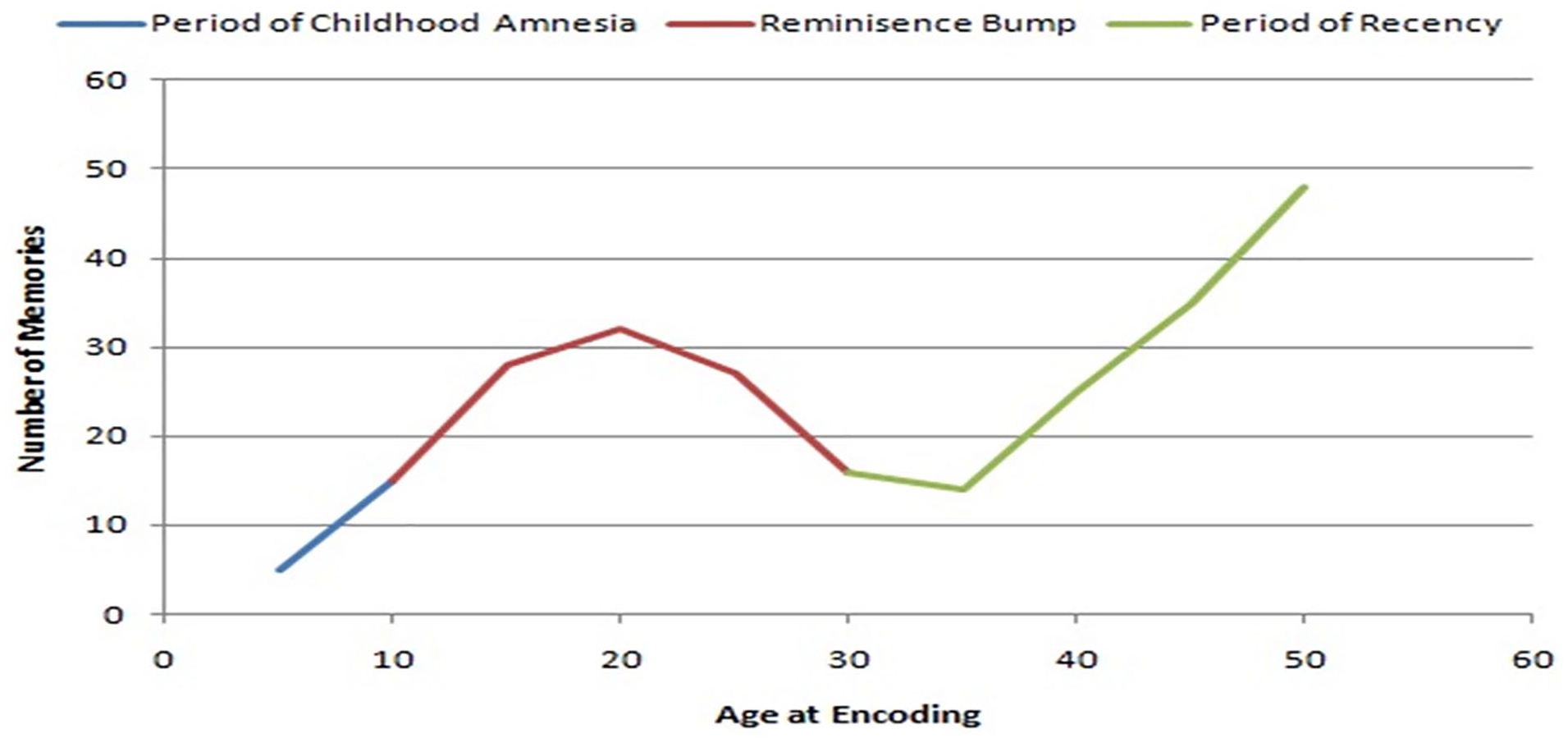
The lifespan retrieval curve.
Life-Story Model of Identity Constructs in Parallel With the SMS
Consequent to participants’ autobiographical stories/narratives being of particular interest to this research, we incorporated an aspect of a parallel and complementary body of research that explores the narrative or storied nature of identity integrating autobiographical memory. McAdams (1988), as a key contributor to this body of research, developed the Life-story Model of Identity which contends that narrative (story) coheres autobiographical memory and is commonly employed to connect the self and autobiographical memories (McAdams, 1996, 2006). McAdams (1996, 2001, 2011) argues that during the late adolescent ego identity phase, individuals begin to make meaning of their lives by reconstructing their past and foreshadowing their future. They do this by filtering their autobiographical memories to craft coherent personal histories; their life-stories.
McAdams’ work overlaps with Conway and Pleydell-Pearce’s (2000) work on the SMS in relation to both the construction of the self through autobiographical memory and how autobiographical memories are organized and retrieved to make a self out of experience, to construct a life-story. In both models, an autobiographical knowledge base must be generated from autobiographical knowledge and episodic memories.
Personal Event Memories
As episodic memories are important in exploring the autobiographical knowledge base in both the SMS and the Life-story Model of Identity, for the purposes of this study, we primarily concentrated on episodic memories, specifically those recalled with what is referred to as “event-specific knowledge” (Williams et al., 2008) during the secondary school period. From a life-story or narrative perspective, Pillemer (2001) is among those who have focused attention on a type of episodic memory, labeled “personal event memories” that we deemed useful to this research. With strong relevance to the schooling period, these are vivid memories of specific events that are identified as having occurred at a specific time and place and as having elements of autonoesis, that is, re-experiencing sensory attributes of memories, such as olfactory, auditory, and tactile elements, supporting the rememberer’s belief in the events (Nelson, 2003; Pillemer, 2001). In relation to this research focused on the apprenticeship of observation, this is significant as these memories remain vivid because they are inextricably linked to corner stones of the adult self and are connected to goals (Pillemer, 2001).
Personal event memories are resistant to decay over time because of the presence of originating, anchoring, analogous, and self-defining events (McAdams, 2001; Pillemer, 2001; Singer & Salovey, 2010). Originating events are specific memories of the origins of significant interests such as an occupational choice (McAdams, 2001). Anchoring events are linked to transitional events and provide an episodic foundation of belief systems (Pillemer, 2001). Analogous events can be understood as exemplars for present behavior by using analogies as lessons for present actions (McAdams, 2001; Pillemer, 2001). Self-defining events describe memories of vivid, emotionally intense events concerned with life themes—critical knowledge of success and failure of life goals—leading to the adoption of a superordinate life goal (Pillemer, 2001; Singer & Salovey, 2010). These self-defining events overlap with the self-defining memories critical to the SMS which connect an individual’s goal hierarchies and self-conceptions (Singer & Blagov, 2004).
This exposition of autobiographical memory highlighted that memory is an individual construction used to support the self by making coherent life-story narratives. This would suggest that when exploring preservice teachers’ schooling experiences, and by the association of their apprenticeship of observation, what they recall is not simply what occurred during their schooling but instead, what they consider important in cohering their life-story, and, perhaps their justifications for their career decisions.
Method
Research Setting and Context
In the Republic of Ireland (Ireland), there are two main pathways to qualify as a secondary school teacher; the first is a 2-year post-graduate ITE qualification, the “Professional Masters in Education.” This pathway is open to graduates who wish to teach curricular subjects germane to their undergraduate qualification. The second pathway is a 4-year Bachelor of Education degree program. These ITE programs are predominantly targeted at secondary school-leavers, mostly aged 18 years. In such programs, teacher education is offered concurrently with selected subject-specific academic content, for example, English. Throughout these undergraduate pathway programs, there are extended blocks of school-based placement. This research was undertaken in two higher education institutions in Ireland offering 4-year undergraduate ITE programs for teaching in secondary school.
Research Participants and Selection
All third-year preservice teachers from the second-level ITE programs in the two institutions, circa 275, were invited to participate through a written communication outlining the study details. This cohort was selected as they had completed at least 2 years of their ITE program and had undertaken at least one practicum school-based placement. Preservice teachers volunteered to participate by responding to the emailed invitation. Forty-two participants, 21 from each institution, with an average age of approximately 20 years responded to the invitation. This represented approximately 15% of the total third-year target cohort at the time the research was undertaken.
Research Approach
As the participants were assured that data analysis would be undertaken on anonymous transcripts—and, owing to the homogeneous nature of Irish ITE students (white and predominantly female; Heinz, 2013), neither the race nor the gender of the participants was identified in the research. Before beginning the data collection phase of this research, we acquired ethical approval from the relevant ethics committees of the Universities. Mindful of power dynamics (Mann, 2008) that occur between students and university lecturers, the research employed two experienced interviewers who were both teacher educators and site-external, to reduce the potential for bias and potentially to increase participants’ engagement with the interviews. To ensure that the interviews were conducted in line with best practice, both interviewers were thoroughly briefed in relation to the methodology and specific design of the research.
Interview Instrument
Research data used for this study were garnered from a specific set of questions designed to explore participating preservice teachers’ experiences of schooling using cued recall conditions (Conway & Holmes, 2004). A semi-structured interview schedule was constructed to tap into participants’ experience of secondary schooling with a view to eliciting their beliefs about teaching and learning (see Table 1). General event and repeated event memories were explored initially to establish the mini-histories connected to goal-related memories (Conway & Holmes, 2004; Wheeler et al., 1997). While a wide variety of goals feature in the goal hierarchy of the working-self, this research limited its focus to the career goal to be a teacher.
Excerpt of Interview Question Stems Aligned to the Analytic Concepts of the Research.
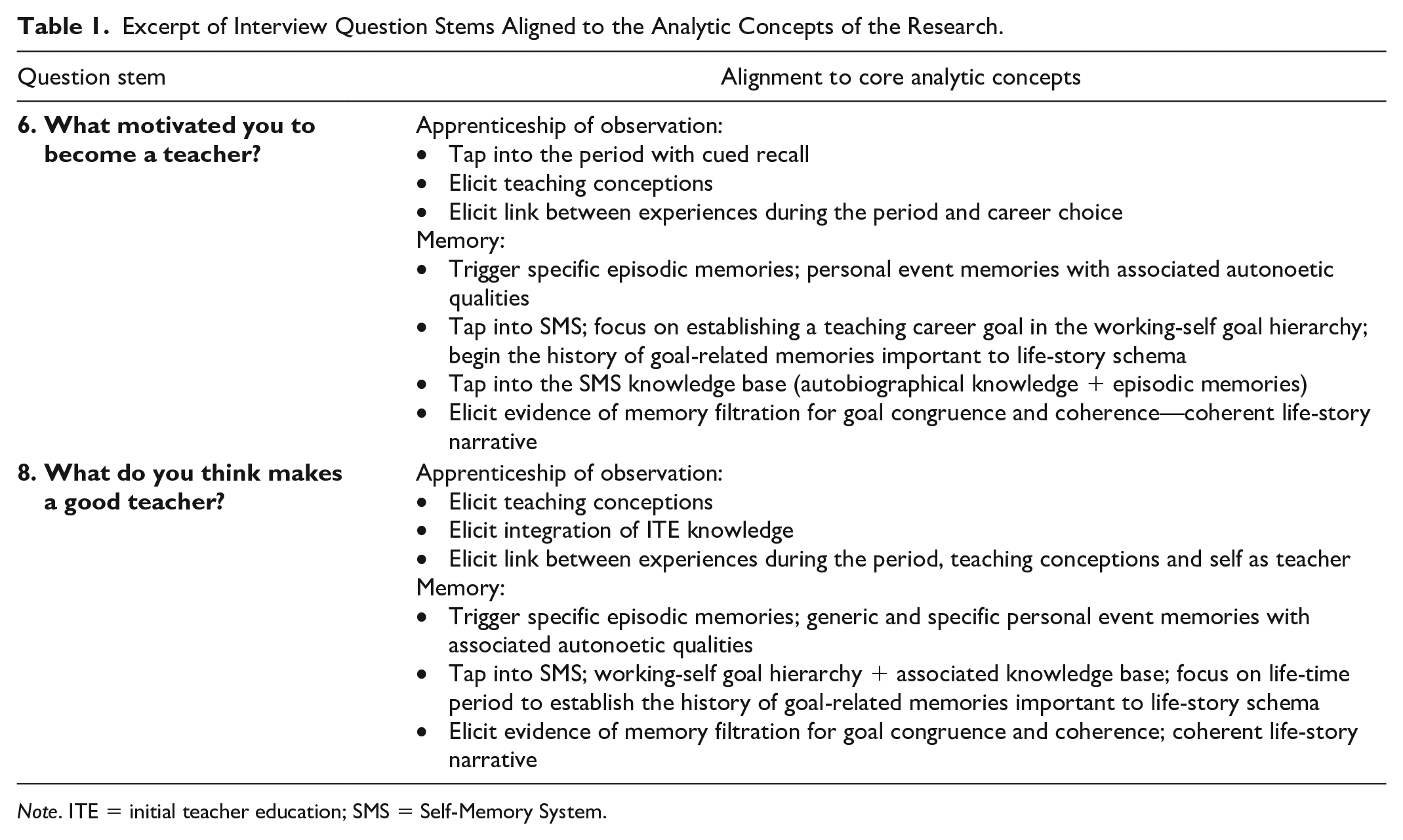
Note. ITE = initial teacher education; SMS = Self-Memory System.
Questions were constructed to progress from very general schooling memory probes to more specific ones: For example, participants were asked to describe the type of secondary school they attended as a student and to describe what a typical school day was like. General questions were followed by more focused trigger questions in relation to outstanding schooling memories and effective/ineffective learning and teaching moments as an access point to sensory/perceptive memories important to the participant’s life-story schema (see Table 1). The participants were also asked to recall memories of how and why they chose a teaching career, in other words, their memories in relation to the goal of becoming a teacher.
The Interviews
Two pilot interviews were conducted to establish quality assurance in relation to the research design and the interview instrument. Subsequently, a small number of alterations were made to the interview schedule. Interviews with the full cohort were then carried out. Each interview was approximately 1-hr long. The interviews were audio-recorded and transcribed by a professional transcription service. To safeguard the anonymity of transcripts and reduce gendered assumptions by readers, participants were assigned with a number (P1–P42) rather than a name.
Data analysis: DA
As preservice teachers’ talk/discourse was central to this study, we elected to use DA, from the discursive psychology tradition, as an interpretive research methodology. At its core, DA methodology is language and discourse-oriented. It derives from an understanding that language is socially and culturally constructed and has a key performative function; that is, it frames the concepts and classifications of an individual (Wetherell et al., 2001). The approach favored in this research is the DA research approach framed by Potter and Wetherell (1987; Wetherell & Potter, 1988).
Three analytic concepts underpin DA, namely, “interpretative repertoires,” “subject positions,” and “ideological dilemmas.” Interpretative repertoires have been characterized as the “common sense,” but often inconsistent, ways a person talks when evaluating experiences and narrating events from a personal perspective to construct their social world (Gilbert & Mulkay, 1984, as cited in Potter & Wetherell, 1987). The key components of these repertoires are the “discursive resources,” which denote the content of peoples’ talk/discourse, and “discursive processes,” which denotes the functions of discourse while also identifying how individuals use discourse to position themselves. These repertoires evidence a specific grammatical and stylistic approach often communicated by metaphors, clichés, and figures of speech.
Davies and Harré (1990) identify that subject positions are rooted in interpretative repertoires and are used to contribute to a dynamic and adaptable representation of multiple selves. They relay how a person positions themselves in relation to ideas, groups, and individuals. Finally, ideological dilemmas denote the contradictions, inconsistencies, and fragmentations manifest in a person’s discourse.
Interviews were coded using the DA analytic devices outlined earlier, namely, interpretive repertoires, subject positions, and ideological dilemmas. Each transcript was read, and the three analytic devices were identified in the text. The researchers engaged in interrater reliability to quality assure this coding. Once these different devices were identified within the text, they were subsequently used to build a broader picture of each of the participant’s narratives. When these were established at an individual level, commonalities and differences between the participants were then explored.
Findings
Career Choice Decisions During Secondary Schooling (Apprenticeship of Observation)
As previously stated, the SMS is based on the central premise that memory is driven by goals created to ensure that an individual’s autobiographical memories have coherence and correspondence to self-concept (Conway, 2005; Conway & Pleydell-Pearce, 2000; Conway & Williams, 2017; Haque et al., 2014). For this reason, it was essential to establish if participants had the goal to become a teacher both during the apprenticeship of observation and at the time of interview as this would justify the use of the SMS analytical lens, an analytic tool that focuses directly on the functionality of the executive goal hierarchy of the working-self.
An initial analysis of the 42 participant transcripts identified that, as expected, a strong majority (37 participants, approximately 88%) identified teaching as their foremost career choice during their schooling; their apprenticeship of observation. Five (12%) participants did not have a goal to be a teacher during schooling but acquired it afterward, for example, randomly selecting the ITE program when filling out college applications or as a second qualification.
Further analysis of the transcripts established that from the full cohort of 42 participants, 32 (76%) had a clear goal of becoming a teacher at the time of interview. Analysis of the cohort of 10 (24%) participants who were either unsure about their career goal (14%, n = 6) or did not have the career goal of teaching at the time of interview (10%, n = 4) garnered interesting information (see Figure 3).

More about the participants who did not have the goal of teaching at the time of interview.
Simplistic Conceptions of Teaching?
The assumption that the apprenticeship of observation pejoratively results in preservice teachers undertaking ITE with incoming and ongoing simplistic conceptions of teaching which are unhelpful and hard to change (Darling-Hammond, 2006b; Lortie, 1975) is at the heart of this study. Analysis of transcripts evidenced abundant simplistic teaching conceptions in the memory discourse of all participants. This aligns with international research on the impact of the apprenticeship of observation on preservice teachers’ teaching conceptions and lay theories (Darling-Hammond, 2006b; Holt-Reynolds, 1992; Sugrue, 1997).
In many instances, the preservice teachers’ discourse presented distilled, reductionist, narrow, and often singular descriptions of “good” and “bad” teachers based on participants’ experiences of the apprenticeship of observation. Such comments included “good teaching is being in control”; “bad teaching is poor discipline and punishment”; “bad teachers use text-based teaching”; “teaching is an altruistic profession”; “teaching is a certain personality”; “ICT makes teaching better”; “good teaching is peer teaching”; “bad teaching is a simple lack of planning”; and “subject teaching is matched to a personality.”
In line with international research into the apprenticeship of observation, one particular simplistic conception of teaching was evident in all of the 88% (n = 37) of participants who had the goal of teaching during schooling, that was, participants chose teaching based on an unsophisticated understanding of the complexity of teaching. They chose it because of what they saw and experienced without examining it from the perspective of the teacher (Borg, 2005; Darling-Hammond, 2006b; Lortie, 1975). P33’s comments are a good example of this simplistic conception: P33: it’s the one career where you know you have so much experience of it before you even step foot in it . . . part of me probably chose it because it was something that I knew . . . I knew what it was about. Whereas the idea of working in industry just seemed so abstract to me . . . I couldn’t figure what doing a course in applied physics was. What, what do these people do? . . . Whereas I could, kind of, just look at a teacher and say “that’s what they do.” The get up to go to school at 9 o’clock, they finish school at 4, they stand in front of class all day. And I thought, with a bit of training, I could learn how to be this.
Furthermore, within the same cohort and in relation to motivations for teaching, there was significant evidence of career decisions being based on simplistic conceptions of teachers and teaching focused on imitative practice and personal attributes, particularly affective characteristics (Borg, 2005; Fajet et al., 2005; Lortie, 1975; Murphy et al., 2004). For example, P10 identifies that they
1
chose teaching because they wanted to ensure that nobody felt left out in the classroom and wanted to model themselves on an enthusiastic teacher: P10: I always remember that feeling of being left out at the back of the classroom going “I am screwed here because the teacher doesn’t want to help me.” . . .that was a terrible feeling to have . . . I wouldn’t like someone else to have that feeling as well. So, if I could be a teacher, I would hope that I could help all my students and they would go home having that feeling everyday like. So that really motivated me to be a teacher.
Autobiographical Memory Constructs in Participants’ Memories of Secondary Schooling
Analysis of the transcripts garnered findings that were consistent with the research on autobiographical memory. When asked to recall their schooling experiences, the memory-talk of all of the participants clearly evidenced the functions of autobiographical memory, that is, a self function, a social and communicative function, and a directive function in efforts to ensure that memory effectively acted as the conduit between the present and the past (Conway & Pleydell-Pearce, 2000; Nelson, 2003; Pillemer, 2001). Furthermore, in most cases, these functions could be explicitly linked to the goal of becoming a teacher.
All 37 participants (88%, n = 37) who had the goal of a teaching career during schooling evidenced vivid episodic personal event memories linking to this goal. These important corner-stone memories of their young adult selves (Pillemer, 2001) were key to analyzing the SMS in relation to the apprenticeship of observation. Consistently, the strong personal event memories integrating all functions of memory were imbued with autonoesis to help the rememberer believe in the veracity of the memory, and thus, making them very resistant to decay over time (McAdams, 2001; Pillemer, 2001; Singer & Salovey, 2010). For example, when asked to recall a stand-out event from secondary school, one participant recalled a very specific set of memories with exact quotes, actions, voice tone, names and animated imitation of the teacher demonstrating the autonoetic qualities of personal event memories:
Interviewer: Did anyone inspire you to be a teacher?
One of my English teachers, he was very enthusiastic in class. There was never a day he wasn’t going “right lads, open up your books” [said in dull tone]. He was [participant claps hands and shouts] “OKAY LADS! This is what we are going to do today. We are going to do this! Let’s do this weld now! We are going to weld these together and then evaluate. . .” Then he’s, “Sean! What’s this tool? Jack! What’s that process called?” [very enthusiastic tone]. You know, very up-tempo, I loved that, I suppose I wanted to be that.
Among this same cohort of participants (88%, n = 37) who had the goal to be a teacher during their apprenticeship of observation, all types of personal event memories—origination, self-defining, anchoring, and analogous (Pillemer, 2001)—were present in the transcripts. Origination memories were sought specifically when participants were asked to recall what motivated them to become a teacher. Unsurprisingly, these participants recalled very early memories of their awareness that they wanted to become teachers. Self-defining memories, that is, vivid life event memories linked to the success and failure of goals leading to the adoption of a superordinate life goal (Pillemer, 2001; Singer & Salovey, 1996), featured to varying degrees in the recollections of all participants who had adopted the goal of teaching during the apprenticeship of observation. In the recollections of the 12% (n = 5) of participants who did not have the goal of teaching during their secondary schooling, self-defining memories were not clearly linked to teaching as one could expect. While memories of effective and ineffective learning experiences were offered with vivid detail, these memories were not clearly linked to decisions to become a teacher nor were they used as a template for the type of teacher they wanted to be. The self-defining memories of this 12% (n = 5) of the cohort were less distinct and were indicative of a lack of clarity in relation to superordinate life goals. None of these participants identified a definite career goal adopted during their secondary schooling in their interviews.
Anchoring memories, the episodic foundations of belief systems, and analogous memories, which offer exemplars for present behaviors (Pillemer, 2001; Singer & Salovey, 1996), proliferated in the discourse of the participants’ transcripts. All participants shared both of these kinds of memories regardless of whether they had the goal of teaching during their apprenticeship of observation or not. Given that the entire cohort was engaged in ITE at the time, the context of the interviews and the nature of the questions asked, it is not surprising that all participants recounted some anchoring and analogous memories.
Agentic Filtration Through the SMS
The SMS model of memory encoding and retrieval proffers that autobiographical memory is constructed within an SMS that connects the self (working-self) and memory and is underpinned by the core principle that memory is motivated by goals (Conway, 2005; Conway et al., 2004; Conway & Pleydell-Pearce, 2000). Consequently, central to looking at filtration through the SMS is an appreciation of the current goal hierarchy of the working-self, as SMS filtration happens at the time of both memory encoding and memory retrieval (Conway, 2005; Conway & Pleydell-Pearce, 2000). This highlights an important distinction between those 37 (88%) participants who had the goal of teaching during their schooling and the 32 (76%) participants who had the active or current goal to become a teacher at the time of interview. The subsections focus on the cohort of 32 preservice teachers who had the goal of teaching at the time of interview, offering an examination of their agentic construction of secondary schooling memories through the SMS that emerged in analysis.
Filtering for goal congruence
All 32 (76%) participants who were committed to the goal of becoming a teacher at the time of the interview recounted schooling memories that were congruent with their goal of becoming a teacher. Their memories served a purpose, a key component of SMS theory. Even when memories of negative learning experiences were recounted, they were purposefully included in discourses to support conceptions of good teaching or the motivation to become a teacher—they had a directive function. For example, in the extract below P34 identifies things they hated about a particular teacher to position themselves away from this teaching approach, using it as an anchoring and analogous memory to define who they want to be/become as a teacher: P34: . . .some teachers that you look back now, when you are teaching and you’re like oh they were terrible. . .we had one teacher. . .if you got a question wrong, you’d write it out 50 times . . . you’d leave the class just feeling so deflated and you’d never get like encouragement or praise [you] left the class feeling depressed and that like your work kind of wasn’t good enough, well, she scared you so much then that you felt, oh well like, I can’t go in and not have the question right, so you still did the work so she was still getting the good results but wasn’t getting them in a positive way. . .that’s someone I do not want to be in a classroom.
Filtration for coherence and correspondence to self-concept
In line with SMS theory, strategies to ensure coherence and correspondence of memories to self-concept, such as rumination or preoccupation, justification, and closure, were clearly present in the memories recounted by all 76% (n = 32) of participants who had the goal of teaching at the time of interview. For example, in relation to preoccupation or rumination, P21 recounted an incident with a teacher who belittled them in front of peers. In subsequent questions relating to effective and ineffective learning memories, they consistently returned to memories related to this particular story and, equally, highlighted attributes of good teachers using repertoires of “respect” and “rapport” to position themselves clearly away from the “belittling” teacher—key features of the same story shaped the majority of schooling memories recounted in P21’s interview.
In relation to justification, when P12 was asked about outstanding memories of secondary school, they said they could recall no negatives about this time despite alluding to negatives in repertoires such as “rote learning is bad teaching” in previous discourse. Comments such as “I loved school” and “school was good/easy for me” justified their superordinate goal of becoming a teacher by filtering out and disregarding the disconfirming experiences.
Regarding closure, in recounting the memory of “free physics Friday,” the participant below closed out any further evaluation of a favored teacher who was largely absent from class, an attribute normally considered negative in the context of good teaching. By both justifying the teacher’s actions and evaluating the teacher as a very good principal and excellent physics teacher, the participant positioned themselves toward this teacher as an exemplar of who they wanted to be by closing out further evaluation and finding a way of turning a potential negative memory about teaching into a positive one: P13: . . .[one memory] stuck out as exemplary of what I want to be. My physics teacher was largely absent for the majority of sixth year. We had something called “free physics Friday.” Where he wouldn’t show up for the double period on Fridays and we would have a lovely free class to do our homework in or just relax. Because you know, you need a little relaxation when you’re doing the Leaving Cert[ificate examinations]. It was very considerate of him to allow us to have that. He went on to become the principal. He is a very good principal too. He was an excellent physics teacher when he came in.
Another example of selective filtration for coherence and correspondence was evident in the detail omitted from the participants’ recollections of schooling. When asked in the context of what they would recount about school to friends, over a drink, no participant (n = 42) referenced a personal relationship, and only three (8%) participants identified a close friend in any memory story from their general schooling. While acknowledging participants responses may have been limited to what they felt was appropriate to share, the absence of these types of memories is noteworthy.
In summary, this research found that participants had significant simplistic conceptions of teaching as third-year preservice teachers. It also found that their memories of schooling were consistent with autobiographical memory constructs. In line with SMS Theory and, specifically, the goal hierarchy of the working-self, memories recalled by the participant preservice teachers tended to be quite selective and they appeared to use them to ensure congruence, coherence, and correspondence with their goal to be a teacher.
Discussion
Looking at the recollections reported by the preservice teachers through the lens of autobiographical memory, it was clear that a selective filtration of past schooling experiences was at play. This filtration consistently revealed a bias toward memories of schooling that were significant to the goal hierarchy of the working self at the time of both encoding and retrieval (Conway & Pleydell-Pearce, 2000). For example, as identified, all 32 (76%) of the participants who were committed to the goal of becoming a teacher at the time of interview recounted schooling memories that were congruent with their goal of becoming a teacher thus ensuring the maintenance of a coherent life-story narrative in keeping with their goal-hierarchy.
In relation to selective filtration for coherence with one’s working-self goal hierarchy, it is theorized that memory prioritizes goal-related experience at the time of encoding (Conway & Pleydell-Pearce, 2000). Furthermore, evidence shows that memories are often inaccurate and that they are susceptible to editing leading to the distillation of desirable memories where individuals leave out what they consider inconsequential details (Schacter & Addis, 2007). Aligning with Barclay (1996) and McAdams (2001) regarding the veridicality of memory, we agree that autobiographical memory is not an accurate account of events but a construction that offers coherence and continuance to the self. This raises an interesting question about which memories were omitted from the participants’ recall of schooling. It is not unreasonable to expect that participants would incorporate memories about relationships with peers, friendships, and romantic liaisons into lifetime periods such as schooldays when very general, non-leading questions about the school, its environment, and their enjoyment of it were asked. However, as previously stated, no participant referenced a personal relationship, and only three participants mentioned a close friend during the interviews. It might be surmised that these memories, while important to the self, were not as significant to the goal hierarchy of becoming a teacher at the time of encoding.
Considering this evidence of filtration for coherence and congruence with one’s working-self goal hierarchy, we suggest, therefore, that this study provides evidence to support the view that the preservice teachers’ autobiographical memories of schooling are not necessarily a biography of events experienced during their schooling as would be the case in a traditional presentation of the apprenticeship of observation. Rather, their autobiographical memories are a purposeful selection of memories consistent with their goal hierarchy at the time of memory encoding, demonstrating that they clearly had agency in the construction of their autobiographical memories of schooling and therefore their apprenticeship of observation.
While there is no doubt that past schooling practices influence how future teachers teach and the apprenticeship of observation is an important concept for teacher educators, looking through the psychological lens of autobiographical memory, its effect is more nuanced and less deterministic than commonly perceived. A preservice teacher’s apprenticeship of observation is not simply the sum of what they experienced in school but rather a selective account of what caught their attention at the time of memory encoding based on their working-self goal hierarchy at that time. Rather than past teaching experiences determining preservice teachers’ conceptions of teaching, it would appear that personally held conceptions of what constituted “good” teaching during schooling led the preservice teachers to remember certain experiences. Hence, preservice teachers are not automatically influenced by all of their past teachers, they are influenced by teachers they believed to be significant in their past (based on their working-self goal hierarchy at the time of experience).
The findings of this research would seem to support the conclusion that each preservice teacher had agency in the construction of their own apprenticeship of observation, making it a memory construct. This means that the apprenticeship of observation is a construct unique to each individual predicated on their agentic use of the SMS. For example, two students experiencing the same teachers through their schooling are likely to encode different memories based on their own working-self goals. Premised on this understanding of the apprenticeship of observation, then is it reasonable to suggest that, instead of preservice teachers’ conceptions of teaching being influenced by the apprenticeship of observation, it is instead first filtered through the SMS? This view of the development of teaching conceptions is contrasted with the traditional view in the following revised model (see Figure 4).
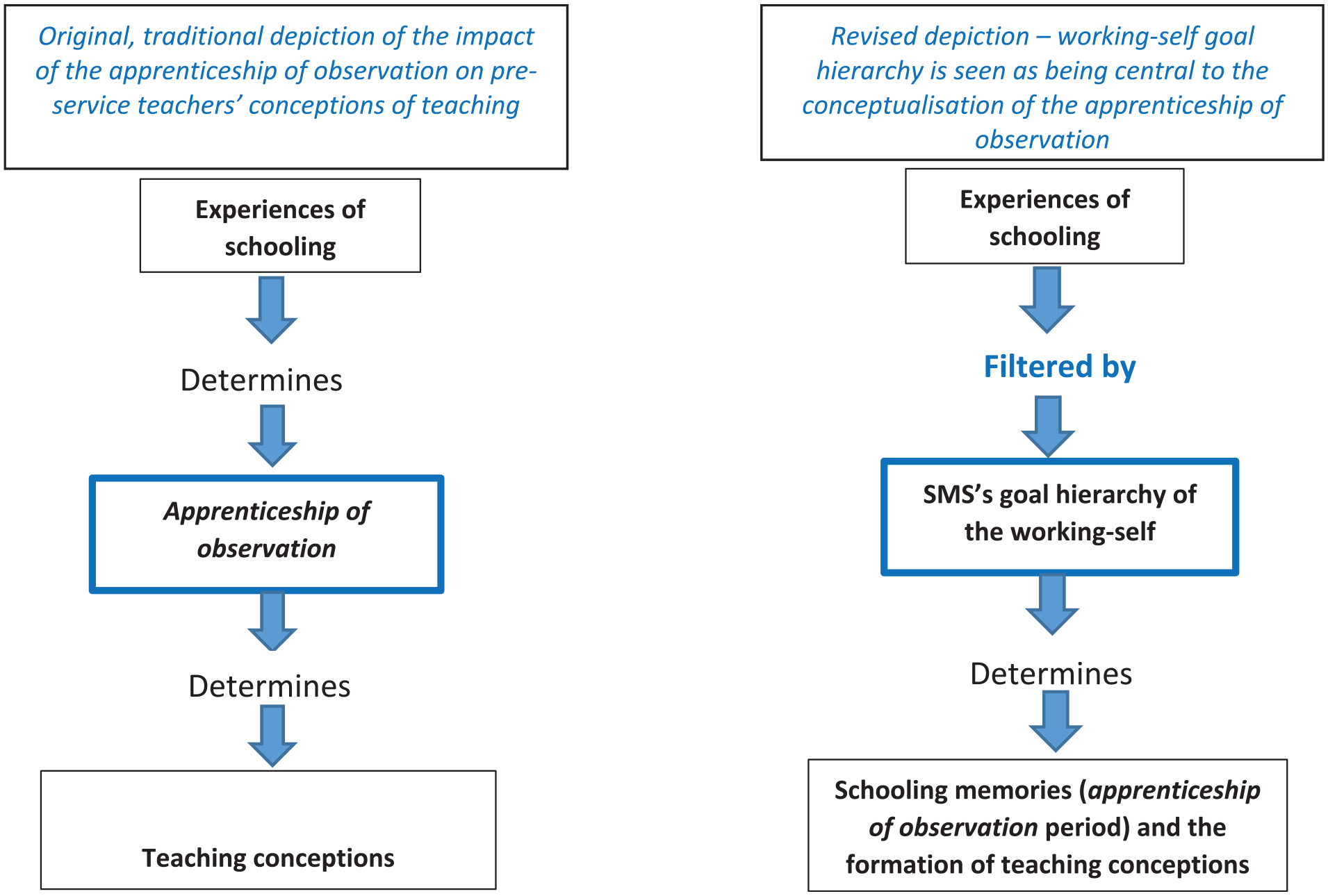
Revised depiction of the impact of the apprenticeship of observation.
Implications for Teacher Education and Future Research
This finding in relation to the development of teaching conceptions, we argue, has implications for how the apprenticeship of observation should be viewed by ITE. The traditional presentation of the apprenticeship of observation suggests a linear causation of future practice and beliefs, that is, what “happens” to preservice teachers as school-goers shapes who they become as teachers and how they see teaching. For example, the dominant wisdom regarding the impact of the apprenticeship of observation on ITE is that preservice teachers who experienced “bad” teaching would replicate it: as the apprenticeship of observation acts as an agent of continuity rather than change (Lortie, 1975). Instead, when the participants who were committed to teaching at the time of interview experienced what they perceived as “bad” teaching, they appeared to have had some criteria by which they judged it—evidence, perhaps, of the agentic filter of the working self. This view, questioning a linear causation consequent to the apprenticeship of observation, aligns with Smagorinsky and Barnes’ (2014) concerns about the overly deterministic and static interpretation of the apprenticeship of observation construct. It also supports Mewborn and Tyminski’s (2006) contention that people experience both positive and negative teaching models as students.
The apprenticeship of observation construct, as it is understood since Lortie (1975) coined the term, is based on the idea that individuals have very little agency during the apprenticeship of observation and, therefore, that their apprenticeship of observation—and the role it plays in shaping student teachers’ conceptions of teaching—is determined by the structures, processes, and personnel of the schools they attended. However, this premise requires adjustment if the apprenticeship period is understood as an individual autobiographical memory construct where preservice teachers have a large degree of agency in the construction of the lens through which they subsequently view their ITE, and which, in turn, results in the cultivation of ongoing resistant simplistic conceptions of teaching.
In this scenario, ITE planning must consider preservice teachers’ agency in both the construction and the deconstruction of their autobiographical memory filtration process. By doing this, ITE can support preservice teachers to reflect on their own unique and self-constructed apprenticeship of observation, thereby helping them to consider the experiences that have helped shape their conceptions of teaching (Bandura, 2001; Biesta & Tedder, 2007). This aligns with Lortie’s (2005) later reflections on Schoolteacher, where he stressed the importance for preservice teachers to reflect on their past teachers and for teacher educators to assist this reflective process: Much remains to be learned about the carry-over of student experience into the work lives of classroom teachers. More research on this problem would inform such efforts to make teaching a more reflective undertaking . . . Greater knowledge of differences in the ways and extent to which teachers are influenced by former teachers could inform the work of teacher educators as they help teachers to become more selective in deciding what to retain and what to alter from the past. (Lortie, 2005, p. 151)
Reflective work during ITE therefore needs to help preservice teachers not just to reflect on past schooling experiences and past teachers that the preservice teachers can recall, but also encourage them to agentically reflect on why such memories, above other experiences, are important and remain salient. Moreover, reflecting on the memories absent from this recall is equally important. While it may be difficult (if not impossible) for preservice teachers to recall teachers they had not deemed important at the time of memory encoding, challenging them to consider why they overlooked other teachers and practices could facilitate conversations about what they believe to be “good” teaching. Furthermore, unpacking these priorities and getting them to consider other teacher/teaching experiences that they failed to distinguish and encode to memory may help preservice teachers to recognize the other important teacher qualities and skills that may not be overtly evident in the classroom.
Another possible course of action for ITE could involve engaging preservice teachers who have consciously committed to a future career in teaching, to compare their memories of schooling with those that have not chosen to enter the profession. This could help them see the alternative ways schooling experience could have been conceptualized, thus helping them to recognize the subjectivity of their own recollections.
Turning to the implications for future research, Lortie (2005) notes that, “. . . much remains to be learned about the carry-over of student experience into the work lives of classroom teachers” (p. 151) and while acknowledging the small-scale exploratory nature of this study, the findings presented here suggest that taking a psychologically oriented approach, autobiographical memory is a good lens through which to undertake this work. In particular, future research could explore preservice teachers’ recollection of teachers from their schooling and examine the extent to which the recalled practices influence their conceptions of teaching and learning and the extent to which they emulate past teachers’ practices. In addition, future research could also investigate the process through which preservice teachers reflect on their schooling memories. Deeper knowledge of this process could support preservice teachers’ efforts to look beyond the dominant memories they hold to memories that disrupt and challenge the coherent life-story narrative that aligns with their goal-hierarchy of becoming a teacher. The disequilibrium caused by such reflection could help highlight the current assumptions they hold about “good” teaching.
Conclusion
Lortie’s (1975) influential work set the apprenticeship of observation within a sociological arena. The term he coined captured his observations about how past schooling experiences appear to influence current practices. Although Lortie’s term was not a fully developed theoretical construct, it has had a significant influence on the teacher education community, because it underpins widely held beliefs about the influence of past schooling practice on preservice teachers. While acknowledging the important contribution of Lortie’s work and the value of the “apprenticeship of observation” concept for teacher educators, in adopting a psychological approach this study has highlighted the complexities related to preservice teachers’ encoding and recollection of past schooling experiences. Preservice teachers’ schooling experiences can help to explain their resistant, conservative practices and their unsophisticated views of teaching, but as this study has highlighted, preservice teachers have agency in determining the memories they encode from their schooling. This would indicate that the influence of their apprenticeship of observation is more nuanced and complex than traditionally presented. While advocating for the continued importance of this concept in teacher education, we contend that its complexity needs to be further understood by teacher educators and that there should be a greater recognition of the nuances of how memory and teaching conceptions are formed in line with an individual’s working-self goal hierarchy. We advocate that teacher education should move toward recognizing autobiographical memory as a robust and helpful additional theoretical lens through which preservice teachers’ past schooling experiences can be viewed and understood.
Footnotes
Declaration of Conflicting Interests
The author(s) declared no potential conflicts of interest with respect to the research, authorship, and/or publication of this article.
Funding
The author(s) received no financial support for the research, authorship, and/or publication of this article.
