



Abstract
Since the early 2000s, accountability and evaluation have been regarded by policymakers as key mechanisms for “fixing” teacher education and by many teacher education leaders as vehicles for elevating the status of the profession and uniting a fragmented field. Although educational inequity has been an enduring and endemic problem during the same time period, most major policy proposals regarding teacher education evaluation and accountability have said very little about equity. This article makes an argument for equity-centered teacher education evaluation and accountability by highlighting nine innovative examples that collectively illustrate what it means and what it looks like to position equity at the center of teacher education evaluation/accountability. Together, these examples are intended to be generative, providing a lens into how the interrelated dimensions of strong equity-centered evaluation play out at different sites of practice and how equity initiatives emerge and operate at different levels of policy.
For more than three decades, it has been asserted that improving teacher preparation quality will produce better teachers, which will boost students’ achievement and enhance competition in the global economy (Akiba & LeTendre, 2017; Furlong et al., 2008). Although these assumptions have been roundly contested on empirical, philosophical, and political grounds, in the United States, they have been the basis for numerous policies and initiatives that expanded and intensified accountability systems and evaluation schemes (Cochran-Smith et al., 2018; Taubman, 2009). By the early 2000s, accountability and evaluation were regarded by top policymakers as key mechanisms for “fixing” the “broken” system of teacher education (A. Duncan, 2009; U.S. Department of Education, 2002) and by many teacher education leaders as vehicles for elevating the status of the profession and uniting a fragmented field (Brabeck & Koch, 2013; Darling-Hammond, 2004).
It is critical to note that during teacher education’s “accountability era” (Cochran-Smith et al., 2018), there was also overwhelming evidence of enduring and endemic inequity in society and education, based on race and other intersecting sociocultural, socioeconomic, historical, and political factors (Carter & Welner, 2013; G. J. Duncan & Murnane, 2011). During this time period, there were also excoriating critiques of injustice and inequity within teacher education itself, particularly its failure to acknowledge the deficit perspectives underlying “neutral” practices (Milner, 2012; Philip et al., 2019; Picower, 2009) and its foundation in whiteness (e.g., Brown, 2013; Daniels & Varghese, 2020; Sleeter, 2001, 2017). And there were multiple efforts by local teacher preparation programs to recognize community or minoritized cultural values and/or to make equity a central program goal (e.g., Kretchmar & Zeichner, 2016; Lees, 2016; Murrell, 2000; Salazar, 2018; Zygmunt & Clark, 2015) as well as attempts to address diversity and culture in accreditation and licensing standards (e.g., Gallavan et al., 2001). Despite these efforts, however, the accountability and evaluation initiatives that were dominant did not position equity as a central outcome, and, in fact, these initiatives often undermined, peripheralized, or co-opted equity (e.g., Cochran-Smith et al., 2018; Philip et al., 2019; Taubman, 2009).
This article, which addresses these issues head on, is a companion piece to an earlier analysis (Cochran-Smith & Reagan, 2021) of widely-disseminated policy proposals regarding “best practices” for teacher education evaluation/accountability, commissioned by the National Academy of Education. As we elaborate below, our analysis found that most major policy proposals regarding teacher education evaluation and accountability said very little about equity. We concluded our policy analysis with a clarion call for teacher education evaluation/accountability centered in “strong equity” (Cochran-Smith et al., 2018; Cochran-Smith & Keefe, 2022), and we posed 11 guiding principles toward this end. We stand firmly by those principles. However, our policy analysis did not include concrete examples of initiatives intended to transform evaluation, and we received many questions from interested practitioners and researchers about what strong equity-centered evaluation in teacher education actually looks like in practice. This article is intended to answer those questions. We begin with a short recap of our policy analysis. Then, we focus on nine innovative examples of evaluation and accountability initiatives in teacher education that are consistent with principles of strong equity.
As co-authors of the report and of this article, we identify as white European American women who are university-based teacher education scholars and practitioners. Cochran-Smith has written about teacher education for justice and equity for more than 30 years and has studied accountability in teacher education over the last 20. Reagan has worked on social justice–oriented policy and practice in teacher education for the past decade. Like many of the scholars and practitioners whose work we cite in the report and throughout this article, we work from the assumption that no approach to teacher preparation evaluation is objective, apolitical, or innocent of questions about whose interests are served, whose perspectives are represented, and whose voices are included. Rather, we recognize that values are inherent in any approach to teacher preparation evaluation. In our policy analysis of “best practices” and in our discussion of the examples for this article, we follow evaluation scholars who have argued both that the most defensible values in evaluation are justice, equity, and empowerment (e.g., Greene, 2006; Hood et al., 2005, 2015) and that it is critical to understand how power is taken up in the practice of evaluation (Haugen & Chouinard, 2019; Schwandt & Gates, 2016, 2021).
“Best Practices” in Teacher Education Evaluation: A Policy Analysis
In 2020, the National Academy of Education launched a 3-year project, Evaluating and Improving Teacher Preparation Programs, whose aim was to identify the most promising practices and models of evaluation that support high-quality teacher preparation and ongoing program improvement. 1 As the authors of one of eight papers commissioned by the academy, we were charged with analyzing “best practices for evaluating teacher preparation programs” by synthesizing recent policy reports and proposals.
To fulfill our charge, we began with the National Research Council (NRC, 2010) report, Preparing Teachers: Building Evidence for Sound Policy, which was mandated by Congress to determine the extent to which the characteristics, practices, and policies that typified teacher preparation were consistent with scientific evidence. We identified 19 additional reports, 2 issued between 2010 and 2020 by a variety of professional organizations, think tanks, consultants, advocacy organizations, and academic groups. Because the reports worked from considerably different assumptions, we organized and analyzed them according to their underlying theories of evaluation (Alkin & Christie, 2004; Mertens & Wilson, 2012:): postpositivist, methods-focused approaches; pragmatic, use-oriented approaches; and transformative, equity-centered approaches.
Many of the reports we identified took a postpositivist, methods-focused approach to evaluation (e.g., Worrell et al., 2014), assuming an objective relationship between researchers and those being researched. These reports advocated externally driven evaluation systems featuring rigorous and validated assessments of impact, employer/student satisfaction, and new teacher employment information. They defined “best practice” as statewide use of rigorous measures of new teachers’ impact on achievement linked back to their preparation programs. The reports that took a pragmatic, use-oriented approach focused on impact and use rather than particular evaluation methods (e.g., Feuer et al., 2013). Like the postpositivist reports, the pragmatic reports emphasized validity, but conceptualized “best practice” in terms of alignment across evaluation measures, uses, and purposes defined in terms of accountability, consumer protection, or programmatic improvement. The smallest group of reports took a transformative, equity-centered approach to evaluation (e.g., Education Deans for Justice and Equity [EDJE], 2019). Conceptualizing teacher quality systemically rather than as an independent factor in educational success, these reports rejected the concept of “best practice,” instead proposing evaluation frameworks that recognize power inequities, balance external/internal accountability, and provide feedback supporting democratic and equity aims.
Overall, we found that “equity” and “justice” appeared very few times in the postpositivist and pragmatic reports, while the terms “effectiveness,” “data systems,” and “validity” appeared repeatedly. However, our analysis also revealed that the concept of equity was not completely absent from these reports. Rather, lack of access to teacher quality was regarded as a primary cause of inequity and thus redistribution of access to teacher quality was seen as the cure. That is, most of the reports in the first two categories assumed that equity was a by-product of an accountability system wherein all students had access to teachers whose preparation programs (and their students) were evaluated using validated metrics. In contrast, the reports in the transformative category aimed to center justice and equity in all aspects of teacher education evaluation/accountability and understood issues of equity at a systems level. We concluded our analysis of the policy proposals by rejecting its original premise regarding the identification of “best practices” for teacher education evaluation. Instead, we called for equity-centered evaluation and accountability, offering key guiding principles along these lines, organized according to the four dimensions of strong equity (see Figure 1).
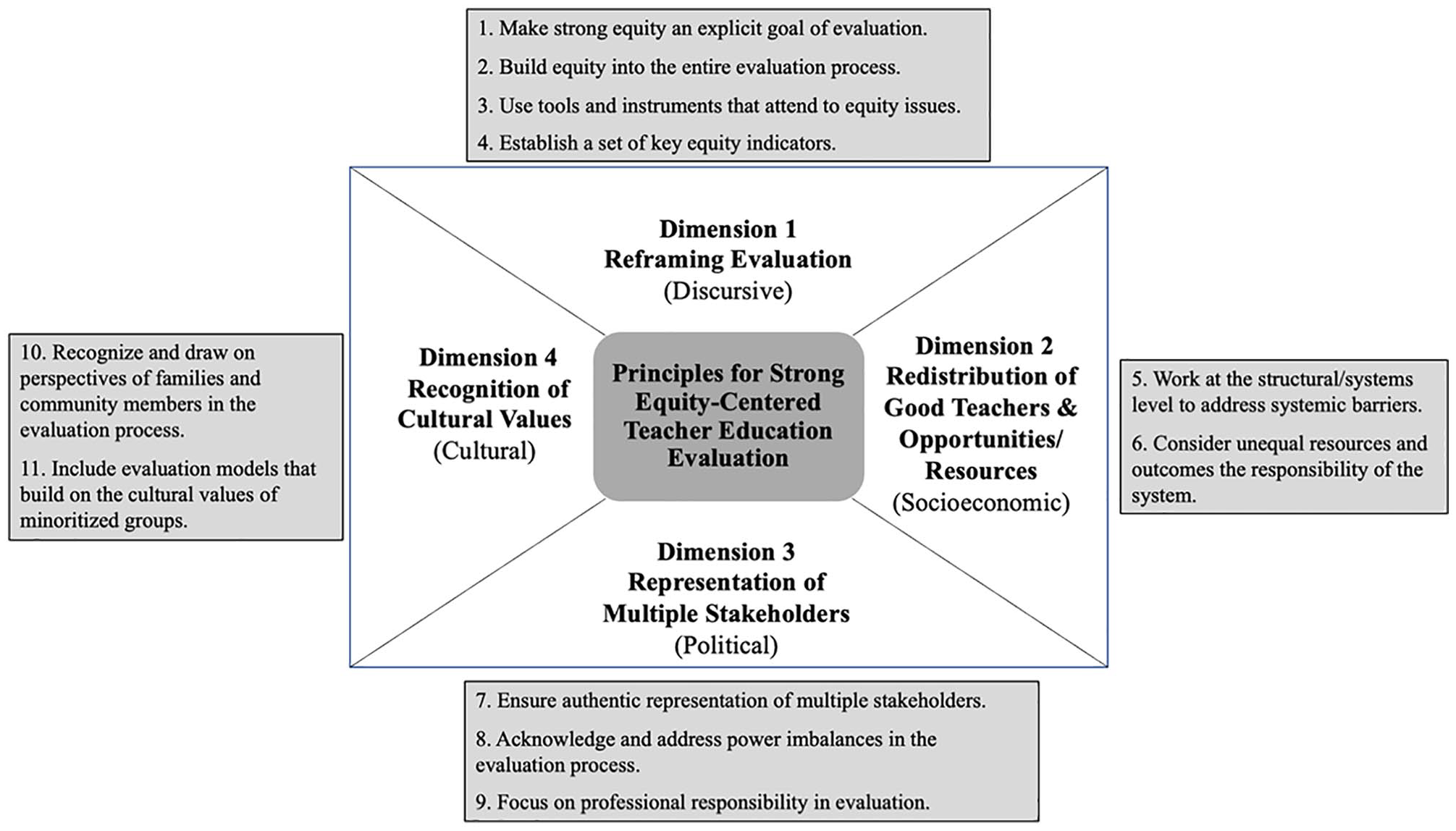
Principles for strong equity-centered teacher education evaluation.
Examining Examples of Equity-Centered Teacher Education Evaluation
In the remainder of this article, we describe and analyze nine initiatives in teacher education evaluation and accountability that are consistent with principles of strong equity. Here, we define “teacher education evaluation and accountability” broadly, including initiatives and policies at many levels intended to assess the content, credentials, practices, or impact of teacher candidates; teacher preparation programs; or the organizations in which they are housed.
Criteria for Selection of Examples
The examples of teacher education evaluation highlighted in this article differ in size, scale, breadth, and depth; they also represent different aspects and actors involved in the multi-layered field of teacher education. The examples are drawn from four core sites of policy and practice in teacher education evaluation: (a) initiatives by individual teacher preparation programs to center equity across aspects of program design and evaluation; (b) efforts by teacher education leaders to enact equity-oriented evaluation frameworks in practice at the program, school of education, or university level; (c) cross-institutional networks or professional organizations that address the impact of evaluation policies on equity issues in teacher education or assess whether, how, and to what extent equity is integrated in programs seeking professional accreditation; and (d) state-level initiatives intended to transform teacher preparation program approval and/or teacher licensing policies and procedures around equity-centered goals.
Across these four categories, we selected examples consistent with one or more of the principles of strong equity. To describe the evaluation initiative in each example, all of which are ongoing, we drew on multiple sources of information, including organizational documents, website materials, position statements, and studies/scholarly analyses written by the architects of this work. In addition, for every example, we had conversations with one or more program or organizational leaders about the initiatives, and we checked back with them concerning initial drafts to ensure that our understandings of their purposes, aims, and contexts were accurate. The nine examples are listed in Figure 2, arranged according to the four sites of practice and policy in teacher education evaluation/accountability. We selected these examples because together, they provide a lens into how equity principles play out in practice and because we found them provocative, promising, and potentially generative for the work of others.

Equity-centered teacher education evaluation: Sites of policy and practice.
Analytic Framework
The guiding principles of a strong equity-centered approach to teacher preparation evaluation/accountability, summarized in Figure 1, serve as the interpretive framework for our discussion across the nine examples. As elaborated in our policy analysis (Cochran-Smith & Reagan, 2021), we define strong equity in teacher education accountability and evaluation in terms of four dimensions, which draw extensively from the work of critical philosopher, Nancy Fraser (2003, 2009) 3 and others (e.g., Gewirtz & Cribb, 2002; Honneth, 2003; King, 2008; Young, 1990, 2000). The four dimensions include (a) reframing, a discursive dimension, which has to do with wholesale rethinking of the dominant frames of teacher education evaluation and accountability in terms of equity and justice issues; (b) redistribution, a socioeconomic dimension, which means teacher education evaluation should attend both to providing well-prepared and effective teachers to all schools and students and to acknowledging the need for systemic redistribution of resources well beyond schooling, such as early childhood services, health care, housing, and jobs; (c) representation, a political dimension, which means ensuring broad and authentic inclusion of all stakeholders within a community with all of them entitled to make claims about the outcomes and values for which teacher education should be held accountable; and (d) recognition, a cultural dimension, which means acknowledging and regarding as assets in evaluation/accountability approaches—not deficits—the cultural values, experiences, and knowledge traditions of minoritized students, families, and communities.
Equity-Centered Teacher Education Evaluation: Promising Policies and Practices
Below we illustrate the concept of equity-centered teacher education evaluation/accountability with examples drawn from the four core sites of policy and practice in teacher education evaluation. Taken together, these examples provide a rich picture of variation in efforts to center equity in teacher education evaluation/accountability in local and larger contexts as well as some of the commonalities that cut across these efforts.
Local Programs With Equity Goals “Baked In” Across Components
Across the United States, many teacher education programs have equity-related goals, and/or they include the language of equity in mission statements or lists of program highlights. However, programs do not necessarily mean the same thing by the word, “equity,” and programs that publicly advertise their commitment to equity do not necessarily carry it out in program design or ways of evaluating teacher candidates or program impact (Cochran-Smith & Keefe, 2022). In contrast, the programs we highlight in this section are noteworthy in that they have reframed teacher education evaluation by “baking” equity into multiple program components, including curriculum, coursework and fieldwork, and assessment/evaluation practices. In other words, with these programs, equity and justice are the raison d’être rather than one among a list of commitments and goals. To illustrate, we focus on Clark Atlanta University’s teacher education programs, Western Washington University’s Early Childhood Education program, and Ball State University’s Schools within the Context of Community program.
As one of the oldest consolidated Historically Black Colleges and Universities (HBCU) in the South, Clark Atlanta University (CAU) has a proud history of providing higher education for students of color, including preparing teachers of color for schools across Georgia and the United States. The CAU School of Education’s commitment to equity is integrated into every aspect of teacher education programming, including school and community partnerships, curriculum, and modes of assessment (J. Fidel Turner Jr., personal communication, July 7, 2022). For example, building on long-standing partnerships with surrounding communities, more than 90% of CAU’s field placements for teacher candidates occur in local Title I schools, where assessments are built into the field placements (D. Teodorescu, personal communication, July 7, 2022). In addition, as part of a university-wide collaboration, the School of Education serves as the site of the Horizons Clark Atlanta program, a 6-week summer program designed to prevent summer learning loss for K–12 students living in poverty conditions in Atlanta; this program features CAU teacher candidates working with K–12 students on the CAU campus (Clark Atlanta University, 2022). Furthermore, in partnership with Spelman and Morehouse Colleges, CAU teacher candidates complete ethics trainings and assessments, wherein they grapple with professional and ethical responsibilities around controversial topics, such as Critical Race Theory and the role of standardized assessments in schools (J. Fidel Turner Jr., personal communication, July 7, 2022).
A second example of teacher education programs with equity goals “baked in” is Western Washington University’s Early Childhood Education program (ECE). Consistent with a recent state curricular mandate on Native American education, Western Washington University’s ECE program takes up land education approaches, along with critical and decolonizing theories, to disrupt settler colonial curriculum and carry out its social justice mission (A. Lees, personal communication, July 5, 2022; Lees et al., 2021). The ECE faculty have integrated the social justice mission into program syllabi, teacher candidate learning opportunities, and assessments. For example, as described by Lees et al. (2021), teacher candidates “complete a field-based critical literacy course situated in a tribal nation early learning center where they work with Indigenous teachers to develop and implement tribally specific literacy engagements” (p. 7). This course sets the foundation for land education through collaboration with Indigenous educators and efforts to build relationships with the natural world. In addition, ECE faculty have transformed the program’s culminating preschool internship by making the centerpiece an inquiry project with children, which focuses on just futures (A. Lees, personal communication, July 5, 2022). In this culminating assessment, teacher candidates engage children in critical thinking about the complexity of socio-political-ecological systems to foster children’s socially conscious development. Integrating land education approaches into the ECE program is an effort toward decolonization where Black, Brown, and Indigenous communities may thrive.
A third example is Ball State University’s Schools within the Context of Community program, an 18-credit community-embedded program located in the historically Black neighborhood of Whitely in Muncie, Indiana (Zygmunt & Clark, 2015). As an immersive experience for elementary and early childhood teacher candidates, the semester-long program integrates coursework, school-based field experiences, community-based mentorship, and critical service learning with the aim of preparing culturally responsive and community sustaining educators (Cipollone et al., 2022; Zygmunt & Clark, 2015; Zygmunt et al., 2018). Central to program design and implementation is authentic partnership, or what Cipollone et al. (2022) call “radical reciprocity” between university-based faculty and community mentors/mentor families, all of whom serve as teacher educators. What makes this reciprocity “radical” is that within the program, community mentors collaborate with university faculty to co-teach courses, vet new faculty, interview prospective teacher candidates, facilitate community events, assess teacher candidates, participate in accreditation visits, and serve on university committees (K. Cipollone & E. Zygmunt, personal communication, November 19, 2021).
These three examples demonstrate how some teacher education programs have deeply embedded or “baked equity into” coursework, field placements, assessment, and evaluation. These programs differ in size, institutional structure—public, private, HBCU, and predominantly white institutions—and geographic location—South, Midwest, and Pacific Northwest. Despite these differences, however, each program rejects notions of standardized “best practices” and instead defines its equity mission in response to context-specific, local community strengths and needs. In particular, each program has sustained authentic, reciprocal relationships with schools, organizations, and community members historically minoritized in teacher education, schooling, and society. Furthermore, in each program, community members are positioned as valuable sources of knowledge (Guillen & Zeichner, 2018) and work alongside K–12 educators in teacher candidate assessment and programmatic decision-making.
It is important to note that although these programs provide compelling examples of what it looks like to move equity from the margins to the center of teacher education evaluation, the programs continue to operate within the constraints of state standards and national accreditation requirements. That is, all three programs adhere to the requirements of state professional standards boards or departments of education, and all three are approved by national professional accrediting bodies. It is worth noting that even while meeting these standards, which are sometimes perceived as obstacles to the democratization of knowledge and responsibility for teacher education and evaluation, these programs have redefined how local community members and school-partners are authentically represented in decisions about program design and evaluation. Together, these examples shed light on what it means to acknowledge and address conventional power imbalances between university-based programs, on one hand, and the schools and the communities they serve, on the other.
Equity-Centered Frameworks in Action
During teacher education’s accountability era (Cochran-Smith et al., 2018), many states and professional accreditors required “valid and reliable” evidence to prove that programs were meeting standards (Bartell et al., 2018; Murray, 2012; Wineburg, 2006). This was concurrent with nationwide efforts to develop psychometrically-sound tools to assess effective teaching (Cantrell & Kane, 2013), which were also used in teacher education. However, research also suggested that policies requiring standardized evaluation tools often fostered superficial compliance rather than genuine change or attention to local/community issues (Bell & Youngs, 2011; De Voto et al., 2021; Kornfeld et al., 2007; Valli & Rennert-Ariev, 2002). For this reason, in this section, we do not focus on separate equity-related assessment tools used by programs, but on what we call “equity-centered frameworks in action,” which refers to the implementation over time of broad equity agendas that treat assessment in terms of its entanglement with all other aspects of the work of teacher education programs and/or whole schools of education.
Here, we briefly describe two examples of equity-centered frameworks in action—the Education Deans for Justice and Equity Framework for Assessment and Transformation (EDJE, 2019) and the Framework for Equitable and Excellent Teaching (Salazar, 2018). Education Deans for Justice and Equity is a nationwide alliance of education deans to advance equity and justice in education through collective action and public discourse (Education Deans for Justice and Equity [EDJE], n.d.). The EDJE (2019) Framework takes a systems approach to transforming assessment, considering all the tasks of schools of education—governance/finance, teaching/learning, faculty/staff, and partnerships/public impact—rather than narrowly focusing only on assessment. With the task of teaching/learning, for example, the EDJE framework raises questions about whether/how current teacher education accreditation and assessment practices hinder or support justice and equity goals; in addition, however, with the task of finance, the framework poses penetrating questions about how neoliberal trends shape budgeting and funding rationales. A founding member of EDJE, Kathy Schultz is Dean of the School of Education at University of Colorado, Boulder, where the EDJE framework is applied to all aspects of the work of the school and where all faculty and staff are on board with its justice and equity orientation (K. Schultz, personal communication, May 19, 2022). Commenting on what it means to enact the EDJE framework, Schultz suggested that the framework brings complex issues to the surface, including, for example, current tensions—partly generational—that stem from distrust (Schultz, 2019) based on different understandings of race and racism among faculty, all of whom are committed to justice and equity (K. Schultz, personal communication, May 19, 2022).
Based on a theory of culturally responsive teacher evaluation that connects culture, pedagogy, assessment, and evaluation, the Framework for Equitable and Excellent Teaching (FEET) was developed by Maria del Carmen Salazar at the University of Denver (DU). Unlike widely-used models of teacher evaluation, which are centered in whiteness and dominant culture, FEET deliberately integrates equity language and concepts into all levels of teaching, including engaging students, planning, teaching equitably, and exemplifying leadership (Salazar, 2018; Salazar & Lerner, 2019). In speaking to us about the FEET at DU, Salazar emphasized that the framework is not only research- and standards-based (Govindasamy et al., 2019; Salazar, 2018) but also draws on a long history of the work of scholars of color and the values of minoritized communities, including her own experiences as a Latinx schoolchild whose culture and knowledge were excluded from the curriculum (M. Salazar, personal communication, December 1, 2021). The development of the FEET involved a 10-year pilot period at DU, which showed that teacher candidates prepared according to the guidelines of the framework were effective in the classroom. Salazar pointed out that the most important thing about the FEET at DU is that it is not a separate tool for the observation of teachers or teacher candidates, but rather that the concepts and commitments underlying the framework drive curriculum, admissions policies, placements of teacher candidates, work with school-based mentors, and partnerships (M. Salazar, personal communication, December 1, 2021).
These examples illustrate how two organizations enacted strong equity-centered frameworks for assessment and evaluation, one at the whole-school level and one at the program level. As these examples show, unlike separate assessment tools, which are often “add-ons” to programs, equity-centered frameworks in action are more encompassing and potentially powerful in that they reflect, but also challenge, decisions and actions across many levels. Perhaps what is most striking about these two examples is their systems-level approach to making equity central to assessment. With both frameworks, the explicit assumption is that inequities in school students’ achievement and other outcomes are reproduced by multiple structural and systemic barriers, not simply by gaps in students’ access to teacher quality. Thus, these frameworks in action focus on the multiple structural/systems-level barriers that reproduce inequity, such as organizational funding, admissions policies, and local partnerships. Along similar lines, both frameworks provide usable information that informs local organizational change as well as continuous revision of the frameworks themselves. For example, Salazar indicated that she is working on a revision of the FEET with more attention to racial justice, and Schultz indicated there are ongoing discussions about how the EDJE framework can account for both the internal and external pressures on a school of education.
Another striking feature of these two frameworks is their explicit grounding in the assumption of the non-neutrality and non-innocence of both educational organizations and evaluation models. The EDJE framework explicitly asserts that no educational institution is neutral politically or ideologically and emphasizes that injustices and inequities play out (and thus must be addressed) at individual, institutional, and ideological levels (EDJE, 2019). The FEET framework adamantly rejects the notion that current teacher evaluation models are objective and neutral, instead persuasively demonstrating that they center and reinforce whiteness and the values of the dominant culture while simultaneously marginalizing the resources of culturally and linguistically diverse learners (Salazar, 2018; Salazar & Lerner, 2019). Along these lines, the FEET framework is explicitly grounded in the purpose of dismantling the “whitestreaming” of norms, values, and history in widely-used evaluation tools (Salazar & Lerner, 2019).
Cross-Institutional Organizations and Professional Networks
A third core site in teacher education evaluation includes cross-institutional organizations and professional networks focused on the impact of state and national evaluation/accreditation policies and practices on equity. Here, we include two very different examples wherein participants are working to move equity to the center of teacher education accreditation/program approval standards and requirements—the Association for Advancing Quality in Educator Preparation, the smaller of two national teacher education professional accreditors in the United States, and the Consortium for Research-Based and Equitable Assessments, a network of 14 state teams of teacher preparation programs and local/state education agencies endeavoring to influence state policies regarding entrance requirements for teacher education programs.
Founded in 2017, the Association for Advancing Quality in Educator Preparation (AAQEP) now has working arrangements with 31 state/territory departments of education, and more than 180 teacher education programs/institutions have earned or are seeking AAQEP accreditation (M. LaCelle-Peterson, personal communication, May 16, 2022). To a great extent, AAQEP’s emergence and its early success as a new national professional accreditor were the result of mounting demand for an alternative to the single existing educator preparation accreditor at the time, the Council for the Accreditation of Educator Preparation (CAEP). 4 CAEP required programs to use contentious admissions criteria for teacher candidates and to demonstrate test-based impact consistent with proposed stringent federal guidelines (Cochran-Smith et al., 2018). AAQEP supporters were particularly opposed to CAEP’s test score and GPA admissions requirements partly because they believed these would increase bias and decrease diversity among teacher candidates, and partly because they feared these requirements would hamstring teacher preparation programs and limit their autonomy to work with school and community partners (M. LaCelle-Peterson, personal communication, May 16, 2022). AAQEP’s accreditation approach was explicitly grounded in trust of the profession; it highlighted local program innovation (LaCelle-Peterson, 2018) and required programs to monitor and support the teacher candidates they chose to admit using multiple sources of information (Association for Advancing Quality in Educator Preparation [AAQEP], 2022). In addition, for the last 18 months, AAQEP staff members have been involved in an ongoing effort to interrogate their own assumptions, policies, and procedures in terms of questions consistent with the four dimensions of strong equity (LaCelle-Peterson, 2022).
In 2021 with funding from the Gates Foundation, the American Association of Colleges for Teacher Education (AACTE) established the Consortium for Research-Based and Equitable Assessments (CREA). Informed by research documenting the history of the discriminatory use of teacher licensure exams in the United States (Fenwick, 2021), CREA was designed to shine a spotlight on systemic barriers to entry into the profession (L. Fenwick, personal communication, November 15, 2021). CREA worked with an array of program partners, including Minority Serving Institutions and both teaching and research universities; each partner had working relationships with local and state education agencies (W. James, personal communication, June 18, 2022). 5 CREA’s charge was to analyze entrance exam policies across the states, explore the experiences of teacher education faculty members, experienced teachers, and teacher candidates with entrance exams, and make recommendations to increase the diversity of the teacher workforce (AACTE, 2022). Based on their shared motivation to increase the diversity of teacher candidates and, eventually, the teacher workforce, the 14 institutions and CREA leaders meet regularly to examine state practices and policies and to exchange innovative ideas and strategies for reducing barriers to program entry. CREA’s first report, authored by Leslie Fenwick (2021), AACTE Dean in Residence, focuses on the history of entrance/exit exams in teacher education from the perspective of structural racism. In collaboration with state agencies, P–12 schools, and teacher education programs, CREA is currently developing guidelines for equitable entrance exam policies and practices at the state-level, based on increasingly diverse stakeholder representation in decisions about entrance exam policies.
These two examples illustrate the efforts of professional accreditation organizations and cross-institutional networks to make teacher education evaluation/assessment more equity-centered. These two organizations are very different from one another—one is a professional accreditor and the other a small purpose-driven consortium of universities housed within a much larger professional alliance. Despite their differences, one of the most interesting similarities here is that both organizations were founded in part to contest the dominant accountability and evaluation paradigm in teacher education. Like other critics both within and outside of the field of teacher education during the first two decades of the 21st century, the founders of these networks perceived the dominant accountability paradigm as a top-down drive to “fix” teacher education by controlling it through standards and other requirements intended to produce uniformity and compliance (Cochran-Smith et al., 2018; Kumashiro, 2015). Of particular concern to the members of these networks was the imposition of requirements that did not derive from transparent decisional processes, did not involve authentic stakeholder participation, and did not account for the strengths, commitments, and needs of local teacher education programs working collaboratively with school and community partners. As the descriptions above suggest, both of these networks were concerned about systemic barriers to the diversification of the teacher work force, including state policies and accreditation requirements themselves. In particular, these networks were engaged in efforts to remake state and accreditation policy to enhance the diversity of the teacher education pipeline, particularly the numbers of Black and Brown teacher candidates who enter and graduate from preparation programs and then join the teaching profession.
It is important to note that neither of the networks we highlight in this section is trying to do away with state or professional standards and other requirements. Rather, both are working for equity in evaluation and accreditation within the complex constraints of a nation where there is not a coherent national evaluation system, but rather where there is a collection of uneven, often opaque, and shifting state systems criss-crossed by multiple strands of national-level accountability requirements, expectations, and demands. Within this context, some networks and cross-institutional organizations, like the two we describe here, are working toward standards and requirements that increase transparency, enhance the authentic participation of stakeholders and communities, and decrease bias against minoritized candidates attempting to gain entry to the profession.
State-Level Initiatives to Move Equity to the Center of Program Approval/Licensing Policies
In our review of teacher education policy recommendations (Cochran-Smith & Reagan, 2021), we found many demands for statewide evaluation systems based on rigorous, evidence-based, and validated metrics regarding teacher performance, impact, and career trajectories. In most of the reports, it was assumed that this would improve teacher education, which in turn would improve teacher quality, which in turn would improve K–12 students’ achievement. However, as noted above, we found very few explicit references to equity or justice.
Our fourth core site of policy and practice in teacher education evaluation involves state-level policies or initiatives intended to increase the number of teachers of Color, reduce barriers to entry into teaching, and/or recognize teachers’ and communities’ cultural and linguistic resources in the evaluation process. The first example is Massachusetts Department of Elementary and Secondary Education current revisions to state-level educator preparation program approval guidelines. The second is the Oregon Teacher Practices and Standards Commission’s policy allowing multiple measures of teachers’ content knowledge and skills.
A decade after what the Massachusetts Department of Elementary and Secondary Education (MA DESE) called a “transformative and effective” overhaul of guidelines (MA DESE, 2022), the department is now engaged in a multi-year effort to revise and update the Massachusetts Educator Preparation Program Approval Guidelines to reflect current priorities (MA DESE, 2022). As part of this work, MA DESE aims to build a foundation for “anti-racist” and “day-one ready” practices that “enable teachers and administrators to nurture and cultivate the academic excellence, cultural and linguistic competence, sociopolitical consciousness, and emotional intelligence of all students” (MA DESE, 2021a). In addition, the proposed guidelines explicitly include “equity in outcomes” as one of four key outcomes preparation programs must demonstrate to earn program approval (MA DESE, 2021a). According to MA DESE Director of Educator Effectiveness, Claire Abbott, these priorities reflect a state-level effort to build a “strong and explicit foundation of racial equity” in the Massachusetts program approval process (C. Abbott, personal communication, December 8, 2021). One of the questions driving the MA DESE effort is, “How are educator preparation efforts designed to break historical patterns of racial inequity—not by accident, but by design?” (MA DESE, 2021b). As Abbott elaborated in conversation with us, “We pose this question to ourselves [as a state agency] and to prep providers, as it’s going to be incumbent upon both systems and processes to make decisions and design systems that meet its goal” (C. Abbott, personal communication, December 8, 2021). Based on these priorities, the process for revising program approval guidelines involves collaboration with key stakeholders, including diverse educator preparation programs and P–12 schools through a statewide listening tour, focus groups, advisory groups, and surveys (C. Abbott, personal communication, December 8, 2021).
The Oregon Teacher Standards and Practices Commission (TSPC), which oversees educator licensing and approval of educator preparation programs in the state, has recently adopted and implemented multiple measures options to assess teacher candidates’ content knowledge (TSPC, 2021). This effort is consistent with the recent Oregon TSPC “statewide equity lens,” aimed at the adoption of “equitable standards and assessments in the state’s educator preparation and retention strategies” (A. Rosilez, personal communication, November 17, 2021). As part of these efforts, the TSPC collaborated with the Oregon Department of Education and the Oregon Educator Advancement Council to design the Multiple Measures Assessment Model to reduce barriers to entry into the teaching profession, particularly for teachers of Color and teachers from minoritized communities (A. Rosilez, personal communication, November 17, 2021). In line with state legislation (HB 3427, ORS 342.457), the Multiple Measures Assessment Model policy allows teacher licensure candidates to demonstrate content knowledge through one of five options: subject matter standardized assessments; program completion; approved undergraduate or graduate degree in licensure area; subject matter standardized assessment with supplemental data; or holistic assessment. Following a 2-year pilot, in 2021, the Oregon TSPC commissioned an evaluation of the model as part of a “more extensive and ongoing process to reduce barriers to educator licensure and ensure that educators are well prepared for teaching and learning in Oregon classrooms” (Oregon TSPC, 2021, p. 6). These options aim to provide multiple pathways for teacher candidates to demonstrate content knowledge by reducing barriers to entry and by reducing the cost burden on teacher candidates, while simultaneously ensuring that candidates adequately demonstrate content knowledge in the licensure area. The holistic option allows evidence in multiple forms, including coursework, professional experience, and “cultural experience” (Oregon TSPC, 2021, p. 23).
Both examples in this section highlight how state agencies are working at the systems level to address inequities in education. This work is grounded in the assumption that problems, such as the lack of diversity in the teacher workforce, are problems of the system—not problems of particular preparation programs or particular candidates. This means that problem solutions must also be designed at the systems level. One of the striking features of these examples, which have been developed, piloted, and evaluated over time, is that they represent collaborative efforts among state agencies of education, K–12 districts/schools, and teacher preparation programs to create pathways and options for establishing equity-based processes and outcomes for teacher licensure or program approval.
As we have argued, many recommendations regarding state-level evaluation policies have assumed that equity is more or less a by-product of a system wherein all school students have access to teachers whose programs have been evaluated with rigorous metrics regarding teacher quality. From this perspective, it is assumed that school students’ equal access to teacher quality can fix inequity without addressing the systems and structures of power and privilege that produce inequity in the first place. In contrast, these two state-level examples demonstrate an explicit focus on equity in teacher licensure and program approval processes. In both the Massachusetts and Oregon examples, there is an explicit racial justice agenda— enhancing teachers’ anti-racist practices and/or reducing systemic barriers to diversifying the teacher workforce. Here, state-level policymakers are taking a bold approach, even in the face of a divisive national political climate.
Strong Equity-Centered Teacher Education Evaluation: Dimensions and Directions
As noted, the examples above vary in size, location, scale, breadth, depth, and the mixture of actors, agents, and agencies involved. These variations emphasize that equity-centered evaluation initiatives in teacher education are occurring around the country at multiple levels and in multiple sites of policy and practice, which have differing constraints and affordances. Shaped by both constraints and affordances, each initiative or policy confronts and attempts to rectify one or more of the significant problems of inequity embedded in teacher education evaluation practice and policy, such as lack of diversity in the teacher work force or dissemination of teaching practices assumed to be culturally-neutral and appropriate for all students, but actually grounded in whiteness and deficit perspectives.
Dimensions of Strong Equity-Centered Evaluation Across Sites
The nine examples in this article collectively illustrate what it means and what it looks like to position equity at the center of teacher education evaluation/accountability. Together, they provide a lens into how the four dimensions of strong equity-centered evaluation—reframing, redistribution, representation, and recognition—play out in practice (see Figure 1).
Consistent with the first overarching dimension, every example in this article reflects a reframing of evaluation/accountability in teacher education in that each intentionally disrupts dominant evaluation norms, assumptions, policies, procedures, and/or practices, which contribute to the production and reproduction of inequity. Along these lines, each of the initiatives we highlight makes equity an explicit part of multiple phases and aspects of evaluation, which are integrated across program design elements. Reframing involves challenging programmatic, institutional, professional, and/or governmental evaluation practices and procedures that have historically served as barriers to equity and, at the same time, unequivocally naming equity as a desired/required outcome of evaluation, rather than simply presuming that equity will come along as a by-product of evaluation. When evaluation is reframed and centered in strong equity, it can be reclaimed by the profession as a process that supports rather than stymies broader missions, goals, and visions related to racial justice, inclusivity, and democratic education.
Underlying equity-centered evaluation initiatives is the assumption that inequity is the product of historical, institutionalized, and sometimes difficult-to-discern systems and structures that distribute educational and many other resources and opportunities unequally and unfairly along broad racial, cultural, and socioeconomic lines. Strong equity-centered teacher education evaluation, then, is conceptualized not as a singular solution to inequity, but as part of larger efforts aimed at the redistribution of access to educational resources and opportunities at the same time as, and within the larger context of, the redistribution of access to resources and opportunities in other socioeconomically-structured aspects of daily life including housing, health and child care, employment, safety, jobs, and freedom from poverty conditions. That is, strong equity-centered teacher education evaluation and accountability initiatives and policies work from a structural/systems-level perspective, recognizing the multiple systemic and structural barriers that perpetuate inequity in education and elsewhere. For example, the EDJE framework explicitly asserts that no educational institution (or its policies and practices) is neutral and poses guidelines that get at the structural aspects of schools of education that perpetuate inequity. This includes not only program content but also admissions policies, hiring/promotion practices, and funding decisions. In addition, Oregon’s TSPC and the CREA network both aim to mitigate the inequities caused by teacher entrance exam requirements that have historically been barriers to recruiting and supporting a diverse teacher workforce through research, advocacy, and state-level policies. Along somewhat different lines, the Massachusetts DESE is moving to require all approved teacher education programs to prepare prospective teachers to engage in anti-racist teaching practices and to demonstrate that they are intentionally designed to disrupt historical patterns of racial inequity in teaching and learning. As these examples make clear, strong equity-centered evaluation/accountability involves redistribution of outcomes and opportunities based on the assumption that this is the responsibility of systems, not of individual actors, such as minoritized students and their communities, teacher educators and preparation programs, and school-based teachers and leaders.
In addition to aiming at redistribution of opportunities and outcomes, equity-centered evaluation policies and initiatives also involve the authentic representation of the actors and organizations with a stake in evaluation decisions. This assumes that those who are most affected by evaluation policies, including both the teacher educators who prepare teachers in local programs and the communities they serve, especially historically minoritized communities, should have a genuine voice in decisions about evaluation and accountability. For example, part of CREA’s efforts to diminish the negative impact of entrance exams on teachers of color is ensuring that teacher educators in local programs have a voice in state-level decisions regarding teacher entrance exam cut scores are how these are implemented. Along different but related lines, Ball State University’s Schools within the Context of Community program deliberately collaborates with community mentors of color to plan and teach courses, select program faculty, admit and assess candidates, and prepare accreditation materials. Finally, as a national educator preparation program accreditor, AAQEP is explicitly grounded in respect for the autonomy of local teacher educators to select and monitor teacher candidates. It is important to note that representation, as we conceptualize it here, goes far beyond “having a seat at the table,” which can be a symbolic gesture that means little in terms of real decision-making power. In contrast, as a dimension of strong equity-centered teacher education evaluation, representation means creating the conditions for the substantive and authentic participation of formerly unrepresented, underrepresented, or minoritized stakeholders with attention to and advocacy for agendas that reflect their needs and ideas.
Finally, strong equity-centered teacher education evaluation features recognition of the worth and importance of the knowledge traditions, values, experiences, and priorities of the students, families, and communities served by the schools, in particular those communities that have been minoritized and marginalized. For example, the FEET framework in action at the University of Denver deliberately assesses the extent to which teachers and teacher candidates recognize, build on, and value the knowledge and resources of culturally and linguistically diverse communities, simultaneously rejecting so-called “neutral” models of teacher evaluation, which actually reinforce dominant white values and knowledge (Salazar, 2018). Along somewhat different lines, as noted above, the vast majority of Clark Atlanta University’s teacher candidates are intentionally placed in Title I schools, which contrasts with the common practice of constructing “high quality” teacher placements as those serving mostly White students in well-resourced communities (Souto-Manning, 2019). Clark Atlanta’s approach clearly conveys the message that prospective teachers can learn from the values and approaches of teachers and schools serving minoritized students. Finally, building on state requirements that the curriculum include Native American education, Western Washington University’s Early Childhood Education program incorporates land education approaches and requires teacher candidates to work with Indigenous educators in their field placements (Lees, 2016). This program and the collaborations that make it possible acknowledge and build upon Indigenous knowledge and values. As a key dimension of equity-centered teacher education evaluation, recognition often requires that teacher candidates and teacher educators unlearn entrenched ideas about legitimate sources of knowledge and help to construct the contexts wherein local cultural knowledge is an explicit part of the knowledge foundation for teaching and teacher education.
Directions for Strong Equity-Centered Evaluation
We have shown that the four dimensions of strong equity-centered teacher education evaluation are interrelated and mutually reinforcing. We also want to note that none of the examples featured here perfectly reflects all four dimensions. This means no example should be taken as an “exemplar” to be copied or borrowed—full blown—by others. This would be conceptually inconsistent with our rejection of the concept of “best practice,” a notion that implies that teacher preparation evaluation can and should be uniform, objective, and decontextualized. In contrast, as our examples suggest, efforts to make teacher education evaluation more equity-centered are diverse, normative, intentionally value-laden, and deeply embedded in complex local (and larger) historical, political, social, and cultural contexts.
We have argued here that strong equity-centered teacher education evaluation is grounded in systemic and structural perspectives regarding the production and reproduction of inequity. However, this does not mean that any particular policy initiative or practice itself, including those we feature as examples in this article, operates at a whole-systems level. Along these lines, in our analysis of “best practices” in teacher education evaluation (Cochran-Smith & Reagan, 2021), we concluded that equity-centered whole evaluation systems did not exist in the United States in teacher education, especially given the complex and sometimes conflicting roles in teacher education evaluation of state and federal agencies, philanthropies, independent advocacy organizations, and professional accreditors and organizations. Although each initiative highlighted in this article works from a systemic perspective to address one or more aspects of inequity, there is always a tension between an underlying systemic viewpoint and what any one initiative itself can take on and how far it can reach. Relatedly, as we had conversations with people involved in the initiatives highlighted here, we learned that the leaders of some initiatives that were similar in the kinds of inequities they sought to challenge or the levels of policy at which they operated, were unaware of the work of others. Although some of the projects described here have been ground-breaking in terms of creating cross-organizational networks, there remains a need to create more conditions and contexts wherein various actors, agents, and agencies can talk to each other across sites of practice and policy.
In addition to systems and organizational tensions, there are also tensions between the roles of individuals and their larger entities in crafting strong equity-driven evaluation initiatives. Along these lines, for example, several of the examples we highlight here have visionary leaders who have worked over relatively long periods of time to overcome resistance, build reciprocal collaborations with minoritized communities, transform teacher preparation practices, inform and implement policy, and/or study and disseminate their own work. Again, however, there are often tensions between individual initiatives and their larger parent organizations as well as tensions among leadership, membership, and partnership. For example, although many of the projects included here deliberately include previously underrepresented actors, none of the initiatives we examined include the voices of K–12 students, and few include the voices of teacher candidates in their design of assessment and evaluation efforts. Along similar lines, although state-level teacher education agencies that are taking the lead in equity initiatives are remarkable, their work reveals that it is very difficult actually to alter power relationships and to establish genuine reciprocity between state agencies and teacher educators working at the institutional or program level, given their different priorities and responsibilities.
We want to note that all efforts to move equity to the center of teacher education evaluation, including those described here, depend to a great extent on material goods and available resources, which vary significantly across programs, institutions, and states, and they sometimes also depend on highly unpredictable circumstances. Along these lines, all of the initiatives we include in this article have been shaped in certain ways by the global pandemic with some projects put on hold in the face of other institutional or programmatic priorities, some initiatives affected by reduced funds, some school-university partnerships interrupted by completely online instruction at the K–12 and higher education levels, and some university-community partnerships delayed or circumscribed by social distancing and other changing requirements.
In conclusion, we hope that the examples and analyses in this article fulfill its dual purposes: to provide a lens into some of the ways strong equity principles play out in the practice of teacher education evaluation and to offer provocative, promising, and potentially generative examples that may support, challenge, or inspire the work of the other educators who are committed to centering equity in all aspects of teacher education. As we have shown, differently-positioned individuals and groups are working at different levels and in different sites of teacher education evaluation policy and practice to address inequities. We see this as a very positive trend, given that simultaneous efforts in many different sites and at all levels of teacher education evaluation practice and policy are needed to challenge enduring inequities in teacher education.
Footnotes
Acknowledgements
The authors would like to thank Claire Abbott, Kristin Cipollone, Leslie Fenwick, Weadé James, Mark LaCelle-Peterson, Anna Lees, Anthony Rosilez, Daniel Teodorescu, Maria del Carmen Salazar, J. Fidel Turner, Jr., and Eva Zygmunt who generously shared their time, expertise, and work with us as examples of equity-centered teacher education evaluation.
Declaration of Conflicting Interests
The author(s) declared no potential conflicts of interest with respect to the research, authorship, and/or publication of this article.
Funding
The author(s) received no financial support for the research, authorship, and/or publication of this article.