



Abstract
In the context of the challenges posed by the end of the Second World War and the early post-war period, the Argentinian governments foresaw aviation as a pillar of its national and international presence. Argentina created the Air Force, nationalised ground aerial infrastructures, placed domestic flights under state control and in 1950, all Argentinian airlines were nationalised and merged into a single state-owned enterprise: Aerolíneas Argentinas. Meanwhile, Argentinian leadership aggressively negotiated bilateral agreements. This paper analyses aviation policy (both domestic and international) of the first Peronista decade from 1945 to 1955, framing it as a response to limit USA expansion into South America, building Argentinian hegemony in the region and consolidating the ongoing process of industrialisation and economic autonomy.
Introduction
In the first half of twentieth century, the rapid progress and relevance of aviation gave the national governments a series of challenges and opportunities in terms of sovereignty, regional and national integration, and impact to economic growth. Additionally, Second World War changed the panorama establishing the United States as the dominant world power and consolidated its (previously disputed) hegemony over the western hemisphere. In this context, facing overwhelming USA competition, the survival of commercial national airlines depended fundamentally on state protection, and this was naturally also the case for Latin America. Against these relevant elements, commercial aviation history in Latin America has not received much attention, with a few exceptions in recent years, especially in the case of Argentina. 1
This paper seeks to contribute to building a history of Latin American aviation through the analysis of the Argentinian example, focusing on the pivotal moment of the Peronista years (1945–55). It will frame the history of commercial aviation in the wider political and geostrategic landscape to better understand the central role of the national governments in the modernisation of Latin American countries and their economic nationalism in the 1940s and in the 1950s. The paper also provides knowledge on how “small” countries resisted – as Jenifer Van Vlek has put it – “the ascendant American Century”. 2 In doing so, this work seeks to provide a more complete understanding of the global processes of transformation of the sky into a territory, a process in which peripheral countries came to play minor, but still significant roles. I argue that Argentinian air policy was defined in a systematic way – for the first time – in the final years of the de facto regime and the first ones of the constitutional government headed by Perón. The main lines established in those years would define the direction of air policy until the 1990s.
This work is based mainly on primary sources from Argentinian archives; based on those documents, I will seek to reconstruct the prism through which Argentinian governments perceived the national, regional and global challenges of the post-war period and elaborated their policies and strategies.
The national scenario: Economic nationalism and regional ambitions
Argentina’s discomfort with USA hegemony had a long history. In the first half of the twentieth century, the country had been the most dynamic, most industrialised and most modern economy in the Latin American region. 3 During those decades Argentina presented social and economic data (urbanisation, birthrate, etc.) that were similar to those of Europe and had a highly dynamic economy before the 1929 crisis. This was linked with an open society, characterised by upward social mobility. Speaking about transport, the country developed – at a particularly early stage – national commercial aviation and private vehicles (with a motorisation rate higher than many industrialised European countries). While having close ties to Great Britain, it had aspired to a role of leadership in the Southern American Cone, a goal that had been reflected, for example, in its defiant diplomatic participation in the Panamerican Union during the 1930s. The nationalist military government of 1943, and within it the increasingly powerful Colonel Juan D. Perón, accentuated these autonomous expectations and tendencies.
The ties with the UK were not just political, but also commercial. Argentinian meat and agricultural production was indeed relevant and found particular attention in there; for example, until Second World War, the greater part of Argentinian agricultural exports went to Great Britain (e.g. 40 per cent of the British market for meat was supplied by Argentinian exports) and Argentina was also one of the countries which received the highest levels of British direct investment. 4 Thus, not surprising, UK leadership had a strong interest in limiting, as much as possible, the increasing influence of the USA in the Austral America region, thus preserving the “special relationship” which it had enjoyed with Argentina since the 1880s. However, with the entry of the USA into Second World War, pressure increased on those Latin American countries which had hesitated to declare war on the Axis powers. Among other reprisals and pressures, the USA boycott of Argentina involved banning it from Pan American and other international meetings, including the 1944 Chicago Conference. 5
The impact of the war on global trade stimulated Argentinian industrial development. This favourable constellation would eventually come to an end, however, as feared by many policy-makers and a large part of the army leadership. Argentinian elites forecasted that the ending of the war would bring further disturbances in international trade, triggering unemployment and economic crisis in the exporting countries. As a possible way to avoid such a negative situation, Argentina witnessed growing public opinion favourable to policies of economic autarchy. 6 At the same time, the national political situation in Argentina also had become more complex. In 1943, a military coup led by an ideologically heterogeneous group of nationalist officers overthrew a conservatively inclined pro-British civilian government. The coup was a response not only to the political deterioration of the conservative government, which had lost consent due to its systematic practice of electoral fraud, but also to the above-mentioned concerns about the nation’s economic and political future.
The ambiguous international position of Argentina against the Axis powers is a third element to be considered. The country maintained neutrality until April 1945, resisting USA reprisals. However, this led naturally to a deterioration of the relationship and changed the regional status quo. Existing agreements and contracts for Argentina’s purchase of armaments were cancelled by the USA, while contracts for the modernisation of the armed forces were offered instead to neighbouring countries, such as Brazil, which had agreed to follow USA war efforts. 7 Meanwhile, in a way that not all the actors perceived clearly, the war had confirmed the final decline of British hegemony and the fall of its currency, the English pound. In the long run, for Argentina, this implied seeking a new place in an international market that was now structured around the USA; and, in the short run, it generated an acute currency problem, since the USA was not a client for Argentinian products. 8
The Argentinian military government (1943–46), and even more so, the civil government (headed by Perón after February 1946), was thus committed to taking action, aiming to preserve exports, targeting economic autonomy and South American leadership. On the one hand, this set of goals was mainly conceived in military terms as an aspect of national sovereignty and defence. Independence in terms of industrial production and military supplies were considered of prime importance to national security, given a context in which, from the point of view of the government, a new world war was highly probable. On the other hand, “internal” development was seen as a way of protecting the level of employment and economic activity in the face of the vicissitudes of world trade and the concomitant social and political unrest. In this way, public policy was oriented towards privileging industrial development by transferring resources from the agro-export sectors to the urban and industrial sectors. This objective had a national and a geostrategic dimension. Argentina aimed to become a regional leader, and a way to achieve a greater connection was strengthening commercial links with South American markets (also considering how those had purchased Argentinian industrial exports during the war). On a national level, this strategy asked to resolve domestic imbalances, with the objective of promoting national integration. Argentina’s vast territorial extension, its low population density and its unbalanced regional distribution (more than 70 per cent of the population was concentrated in the Pampas region) had been considered, since the end of the nineteenth century, to be the key factors in explaining the country’s economic problems.
Transport occupied a central place in both of these perspectives. The railways were nationalised in 1947 9 and the management of the lines was centralised, while at the same time a merchant navy fleet was created and commercial river navigation was nationalised. These national enterprises received hefty subsidies, whose aim was to stimulate regional economies and activities such as tourism. The construction of paved roads was also given a strong boost, with the goal of promoting regional economic development and improving connections with neighbouring countries (especially Brazil). These transport policies were coupled with projects for the development of the local production of planes, locomotives and cars, for the most part by state enterprises. 10
It was in this context that Argentina defined its first systematic air policy. This responded simultaneously to the desires to halt USA expansion in South America, to affirm Argentinian hegemony in the region and to consolidate the ongoing process of industrialisation and economic autonomy, while integrating the nation into the world economy, in a post-war scenario which was expected to be turbulent.
The international scenario: Between “freedom” and “order” in the air
During the final years of Second World War, the US government began to prepare post-war plans for the world economy under what they expected to be their single leadership. International civil aviation was on the list of the major topics addressed. 11
According to Alan Dobson, the challenge was to create a commercial international regime “that would allow airlines of the world to flourish whilst being compatible with different and conflicting national interests”. 12 The standardisation of technical and safety matters was relatively easy to achieve: at the 1944 Chicago Conference a large number of the countries signed the International Air Traffic Agreement and this granted the first two primary “freedoms of the air”. 13 Commercial matters were far more difficult to solve and 1944 Agreement did not achieve a satisfactory outcome. The USA dominated civil aviation, and consequently sought to open up the markets in order to expand their operations worldwide. 14 This policy was opposed by Britain, which was inclined to regulate the market tightly. 15
The global situation changed rapidly between 1944 and 1946, while the start of the Cold War altered plans, the Anglo-American Loan negotiations made Britain increasingly vulnerable to USA pressure. 16 In early 1946, the Anglo-American bilateral agreement on air rights signed in Bermuda granted all five freedoms, and during the following decades, the Bermuda agreement would serve as a “prototype for other air rights agreements”. 17 The USA applied it in many of the bilateral agreements signed with other countries, but also interpreting its terms differently when needed, to offer greater protection to USA interests. 18
For the smaller countries, the agreement seemed to be a direct threat to their rights over international air traffic emanating from their sovereignty. Interpreted widely, the fifth freedom could allow USA and British carriers, which had routes all over the world, to pick up traffic almost everywhere, thus reducing these “small” countries’ current (or potential) chances to be part of the commercial aviation industry. 19
The “Argentina doctrine”. Argentina in the international debate over international commercial aviation
At the end of 1946, the new head of the Aeronautics Ministry, Brigadier Bartolomé de la Colina, designed what would become the Argentinian policy in the field of international aviation. Argentina’s position was based on the principle of the country’s exclusive and complete sovereignty over its airspace. This was an idea over which there was a very wide political consensus, and it was embodied in the law passed in 1935 by which Argentina adhered to the 1919 Paris Treaty. 20 Such a claim on total control of the airspace, informed Argentina’s participation in international forums and its handling of bilateral negotiations. The “Argentinian doctrine” rested on the British idea of “order in the air” and on what the Chicago Conference had affirmed with respect to the juridical equality of the countries and their sovereignty. However, Argentinian policy went further: it presented the air traffic between two nations as an immaterial asset that belonged to both nations independently of the nationality of the travellers, arguing that the profits created by this traffic ought therefore to be shared fairly between them. For this reason, it was not possible to dispose of the air traffic of other countries without consultation, contrary to what had been permitted by 1946 Bermuda Agreement. 21
This doctrine was deployed at the start of negotiations around the bilateral agreements that opposed the Bermuda model. In May 1946, the first of these deals was done with the UK (i.e. contradicting the agreement the British had signed at the Bermuda just in February with USA). The USA reaction was swift: the government called the Argentinian delegates to Washington to negotiate a treaty, but shortly after the negotiations started, they were suspended with the claim that some members of the USA delegation had to leave for London for “Aviation Week”. In reality, they had gone to negotiate a new agreement with Great Britain, the USA achieving the “London Pact”, an attempt to discipline the fractious British by neutralising the effects of the Anglo-Argentinian treaty. The London Pact stated that until a multilateral agreement was reached, neither country would enter into agreements with other nations whose rules differed from those reached in Bermuda. It also stated that those pacts already signed had to be amended. After this achievement, USA negotiators resumed talks, but Argentina had lost the leverage of the British treaty and no agreement was reached. Shortly afterwards, worsening the Argentinian position, the USA signed an agreement with Brazil which conformed to the Bermuda model. 22
As a countermove, Argentina then began to attempt to find new allies. It initiated dialogues with Spain and Portugal, both dictatorship with nationalist governments, also considering the very good terms Argentina had with Spain. Those talks were positive and led to treaties signed in March 1947. Argentina hoped to regain some of the ground lost through the London Pact the year before, even more so considering the preparation for the first “International Civil Aviation Organization” (hereafter ICAO) assembly in May 1947 in Montreal. This ICAO meeting was an important one, not just to better establish the association as such, but it was also foreseen as a new arena for discussing multilateral and multinational commercial aviation rules. Indeed, following the failure of 1944 Chicago agreement, it was hoped that Montreal would become a second chance. This revamped the fear that the Bermuda Agreement would make it possible for USA airlines to fully conquer the air, leading many countries – such as Argentina – to negotiate much more restrictive bilateral agreements.
While ICAO (following the recommendations of the United Nations) did admit Spain among its ranks, USA delegates touched down in Buenos Aires shortly before the Argentinian delegation was ready to travel to Montreal. On the eve of the first ICAO meeting, an USA–Argentina agreement was signed and presented as an Argentinian capitulation. This generated discouragement among the Latin American delegates in Montreal but, in fact, the treaty’s slightly ambiguous text left it open to different interpretations. Although the effective sharing in equal parts of the traffic between both nations had not been established, the treaty assumed a condition of parity, offering “fair and equal opportunity for the airlines of the contracting parties to operate on each of the routes to be established between their respective territories”, a formula present in the treaty with Great Britain. 23 According to the treaty, the traffic capacity had to be in relation “with the requirements of the area through which the airline, duly taking into account the services regional and local; and, likewise, it will be in relation with the requirements of the operation between the terminal points”. 24 The treaty stated as well that the fifth freedom traffic was to be considered “complementary” of the traffic between the USA and Argentina, and “subsidiary” to the needs of that main traffic. In the case of objections raised by third parties “they will initiate consultations in order to concretely and practically apply these rules to any particular case”. 25
Indeed, at the ICAO meeting, one of the major points under discussion was the application of the fifth freedom. Some countries (China, UK and USA) preferred a system based on free contracts between states, based on the “capacity” of the route, which was calculated via general traffic demand. However, this formula, other countries replied, completely ignored the rights of any third countries involved. 26
In the midst of this discussion, making reference to the Argentinian-USA treaty, the French representatives in ICAO criticised the USA for using “their great power to bend the will of small countries”. Ferreyra, an Argentinian delegate, then intervened to point out an “error” in the interpretation of the text of the treaty; he maintained that it considered “fifth freedom” traffic as subsidiary and complementary, and made it obligatory to take into account the objections of the third (intermediary) countries. USA delegates did not contradict this interpretation during the meeting but, afterwards they abandoned negotiations for the plan on complementary routes that were only outlined in the agreement and were a requisite to put the treaty into force. 27 Argentina, however, continued to grant precarious permits to Panagra and later to Pan American to exploit routes to Buenos Aires; the need to maintain these connections clearly overcame the high-sounding Argentinian claims to sovereignty and reciprocity.
The Montreal deliberations on the Multilateral Pact were expected to continue in Geneva in November 1947. There, surprisingly, the French delegates, who had agreed in principle with “almost all” of Argentina’s position, withdrew their proposal and signed one with Canada, the USA and the UK. They were not, however, strong enough to control the commission, in which 29 countries participated, and the Argentine position on the “fifth freedom” was incorporated into the final report before a silent US delegation. But, we should also notice how the USA position had shifted between 1944 and the beginnings of the Cold War. By 1947, the USA was less keen to achieve a multilateral agreement that would imply the automatic exchange of the five freedoms, 28 giving the USA room to structure international air travel along bilateral agreements. 29 This was better suited to evolving USA interests, which continued to use Bermuda as a model for its relations with key aviation states, 30 even paying the price of heterogeneity and more restrictions than the United States had wanted.
Although the position of Argentina’s delegates in the international arena had been quite intransigent (and relatively successful), in the national political debate, the leaders of the political opposition thought that the principle of complete and exclusive sovereignty had not been defended sufficiently. Frondizi, for example, was doubtful about the agreement with the USA and he was even sceptical about the advisability of adhering to the Chicago Convention. 31
Designing an Argentinian air policy
For the military officers participating in the 1943 coup, the strengthening of “national air power” was a central aspect of national sovereignty defence in the new global context. 32 Originally developed by the US Air Force, the concept was defined as a nation’s complete capacity for flying, something which included the totality of civil, military, commercial and private aerial activity, both existing and potential. This civil–military air power had to be planned and regulated in a centralised manner by the state, and among the state’s agencies, by the armed forces. Commercial aviation was one of its most important aspects, because this would make it possible to maintain a large body of pilots and personnel in continuous training, while its aircraft and infrastructure would provide logistical support and could be reconverted to military use, should the need arise. 33 The perspective of the Argentinian armed forces’ defensive nationalism, which rejected ideas of conquest, gave this theme strategic importance. It made it possible to base national defence on “a small air force, a school of commandos and an intense development of commercial airlines”. 34
At the same time, in the context of expectations about the future post-war domestic economy and Argentinian aspirations to economic sovereignty, public investment in transport was seen as one of the central forms whereby the state could promote private enterprise and create space for economic growth, triggering the development of backward zones in particular. About the latter issue, Argentina had to contend with a radial network of railways, centred on Buenos Aires (the country’s capital), which had led to an excessive concentration of wealth in the region of the Pampas. As Eulogio Gómez, acting director general of commercial aviation, stated in 1948, aviation could help solve such a situation and thus stimulate more balanced national development. Well-developed national commercial aviation would make it possible not only to connect each province with Buenos Aires, but also to connect the provinces to each other. This would promote “direct exchange between productive zones” and help to improve population distribution. 35 Even more, Gómez cautiously considered Argentina having an “unbeatable geographic position”, which he believed, meant it was “destined to be an obligatory point of contact for all the international [air] routes”. 36
In 1945, it was in this mind-set that the military government of General Edelmiro Farrell approved a series of decrees seeking a unified Argentinian aerial navigation policy. In January 1945, the Air Force was created as an autonomous armed force. In April, a new decree established complete and exclusive national sovereignty over the national airspace, and placed in the hands of the Aeronautics Ministry the promotion of commercial and sports aviation. 37 Ground infrastructure, aerodromes and airports, communications and meteorology were also nationalised, while the construction of a major international airport in Buenos Aires (in the Ezeiza district) advanced. 38
According to this set of rules, international airlines should abstain from undertaking domestic flights, and their home countries had to reciprocate by authorising Argentinian international flights in their airspace. The decree reserved internal air routes for state or private–public enterprises, in which private shareholders had to be Argentinian citizens resident in the country. Absorbing the existing two private Argentinian airlines (“Aeroposta” and “Corporación Sudamericana de Transportes”), and the routes of LADE (Líneas Aéreas del Estado) in the north east and the Andean Patagonia, three companies were created to handle domestic flights, organised in accordance with zones of influence: “ALFA” (Sociedad Mixta de Aviación del Litoral Fluvial Argentino), which run the routes in the north east, “ZONDA” (Zonas Oeste y Norte de Aerolíneas Argentinas) in the northwest and central west regions, and Sociedad Mixta Aeroposta in Patagonia and the Atlantic coast. 39 The state participated with 20 per cent of the capital, but took responsibility for covering the operating deficit and of guaranteeing private capital a minimum dividend of 5 per cent. 40
A fourth, international airline, “Flota Aérea Mercante Argentina” (hereafter FAMA), was also created, taking the form of a private–public entity, beginning its operation in June 1946. It had a different statute from the rest of the mixed enterprises, more capital (ten times that of ZONDA, for example), and a state participation totalling a third of the capital.
The masterplan of these initiatives was to exploit public capital invested, modernising the industry and purchase brand-new aeroplanes. Technical innovation was seen as the key to overcoming the company’s deficits; it was thought that it would make it possible to reduce or eliminate the operating deficit and attract passengers. But the strategic and political role of commercial aviation was not forgotten, even over profitability. Flight operations were extended, and new routes opened: Aeroposta, for example, quadrupled its mileage between 1945 and 1948, introducing flights to Esquel, Bariloche and Mar del Plata (see Figure 1(a) and (b)). The plan proved to be more difficult – and the pace slower – than expected. State contribution was delayed, leading the enterprises to accumulate operational debts; also, domestic flights were underperforming, carrying fewer than 30 passengers. Modern planes were not easy to purchase; setting aside the USA’s lack of trust on Argentina, we should consider Argentina’s lack of hard currency (in US dollars). Furthermore, aviation equipment industry was not flexible: Argentina placed an order for three USA Douglas DC-6s for FAMA, but they arrived only after 1948. FAMA flew to Madrid, Santiago de Chile and Río de Janeiro, but, as we shall see, did not originally obtain permission to overfly the United States (and in the meanwhile Panagra, Panair do Brasil – both Pan American owned or controlled – and Pan American continued to fly to Argentina).
Evolution of domestic routes in Argentina. From left to right: (a) 1945 (Aeroposta, Panagra and Corporación Sudamericana de Transporte), (b) 1950 (mixed enterprises), (c) 1961 (only Aerolíneas Argentinas). Note that routes belonging to the private domestic companies which operated from 1957 and which made the network even more dense have not been included.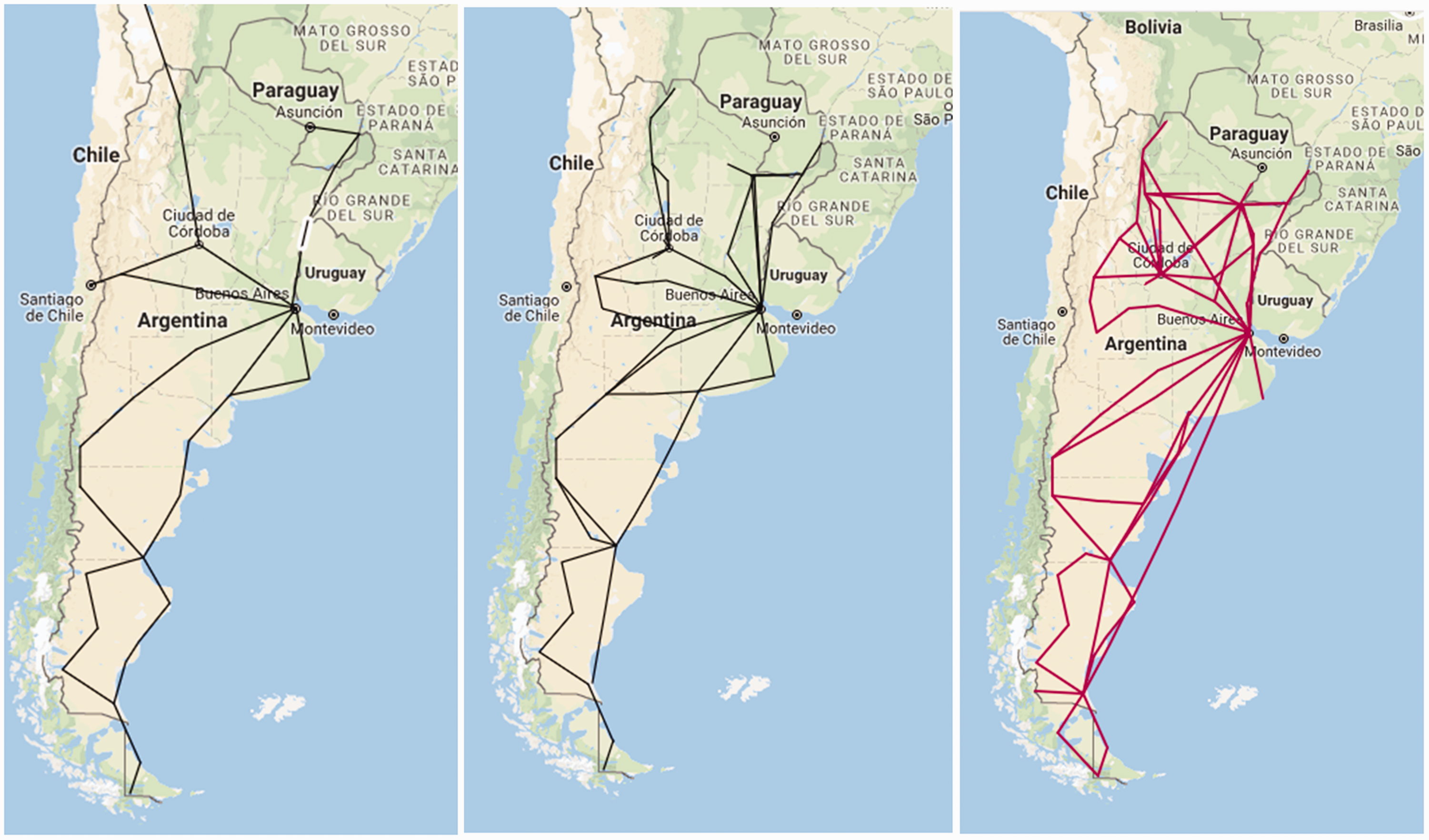
The immediate economic results were deceptive: operating inefficiencies and the obsolescence of the fleet led to an increasing deficit. 41 In little more than two years, even the most efficient of the new airlines, Aeroposta, had accumulated a deficit superior to the value of its total capital. If some delays in implementing the original plans could have caused such a bad situation, there is no need to remark how this was mainly generated by the incompatibility of two logics: acting on a political scale (which led companies to extend their services over routes with little traffic) against business and market cost.
The decision to opt for a mixed enterprise scheme had been criticised by the political opposition. Arturo Frondizi, for example, a Congressman and one of the leaders of the Radical Party, 42 pointed out in 1949, the ever increasing need for capital in commercial aviation and, consequently, the global tendency towards concentration, and even monopoly in that field, “as happens in all the great public services”. 43 For the Radical party, mixed enterprise had “all the inconveniences of state intervention with none of its advantages and without having, either, any of the advantages of private initiative”. Frondizi claimed it was necessary to choose between unadorned nationalisation and a fully private initiative. 44
By 1949, however, Perón, as president of the republic, had arrived at a similar conclusion. The push for a new policy was surely defined in the context of the deterioration of Argentina’s balance of trade and in spite of the already announced plans to re-capitalise the enterprises with new contributions by the state. He decided on the nationalisation of the mixed enterprises and their fusion (the pilots called it “confusion”) 45 into a single state airline. Moreover, the new international political landscape, marked by the Cold War, was part of this decision, as well as, naturally, the aviation international agreements signed after 1944. This led to a main outcome for the country: in 1950 Aerolíneas Argentinas was born.
Finale: Aerolíneas Argentinas and the affirmation of sovereignty
Until 1946 Argentina did not have its own international airline and the making of FAMA filled this gap. First, it was a political decision: FAMA functioned more to affirm sovereignty (“Carrying our colours and defending our interests under the skies of other Continents”), 46 than to generate concrete commercial benefits for the state. After 1950, Aerolíneas Argentinas, a state enterprise and Argentina's flag carrier, would be an even more suitable instrument for the realisation of this end.
With the creation of Aerolíneas and the gradual improvement of its fleet through the inclusion of modern planes (two more Douglas DC-6s and four Convair 240s 47 were purchased), the routes inherited from FAMA multiplied. More destinations in Latin America were added; in 1950, Aerolíneas flew to New York. 48 According to the Aerolíneas Investigatory Commission, which conducted an inquiry into the company after the 1955 coup, the majority of these routes were “anti-economic”, because the difference in quality between the service offered by Aerolíneas and those of the other companies limited any commercial opportunities. Even more, in a new political context, now anti-peronista, according to the 1955 commission, the decision to operate some routes, such as the Buenos Aires–Lima route, was simply considered a “whim” of the president. 49 More likely, these routes, although not producing direct economic benefits, were seen as an investment in geopolitical and symbolic prestige for the nation and as a mean of creating conditions for the expansion of industrial exports.
As we have also seen above, the development of domestic commercial aviation was a way of affirming sovereignty. In this case the policy privileged regional and national integration, as means of making certain areas (such as Patagonia, or the “northeast”) more secure in terms of sovereignty as well as promoting the development of regional economies. As already noted, the mixed enterprises had begun to expand domestic air routes, and this expansion grew further with the creation of Aerolíneas Argentinas. The latter had more planes with higher capacity; new aircraft for the international fleet made it possible to divert the older planes (the flying boats and the DC-4s) to the domestic service. By 1960, Aerolíneas Argentinas served 49 national stopovers; for example, connecting the cities of Comodoro Rivadavia and Río Gallegos to a series of smaller localities on the Patagonian coast (Río Grande, Ushuaia, San Julián, Puerto Deseado, Santa Cruz) and the Andes (Gobernador Gregores, Lago Argentino, Sarmiento, Esquel, Perito Moreno and Río Turbio) (see Figure 1(b) and (c)).
Between 1950 and 1962, domestic flights were served primarily by relatively small planes (the biggest was the Convair, which could carry 40 passengers, while the DC-3 carried 28); the majority of the fleet consisted of piston-driven DC3s, DC-4s and flying boats, which consumed a high amount of fuel in relation to the payload they could transport and needed a lot of maintenance. 50 At the same time, the advantage of these planes was that they were able to make difficult landings at certain airports, which was a common challenge in Argentina. This constellation of circumstances combined with a state perspective which highlighted the political value and the special role of the state airline in affirming sovereignty, and in the promotion of development, undervalued its commercial (in)efficiency and economic yield.
The result was a scheme of networked routes, with flights with multiple stopovers and hubs in different cities of the Centre, West, Northwest, the Patagonia and the Northeast, which made it possible to increase intra-regional and inter-regional connectivity (see Figure 1). 51 This benefited in particular the connections to frontier regions such as the Patagonia or the Northwest, which were traditionally isolated and had a low population density, something which generated anxieties with respect to sovereignty among the armed forces (but not only among them). It also implied, of course, a boost to economic activities and the reinforcement of the regional leadership of cities like Mendoza, Córdoba, Tucumán, Comodoro Rivadavia or Corrientes, which became air hubs.
As a consequence, the number of available seats also increased (179 per cent between 1950 and 1959) as well as the number of passengers transported. In 1943, 67,197 passengers were transported in Argentina by all the airlines operating in the country (on domestic and international flights). 52 Almost double that number (108,991) flew in 1947 in the mixed enterprises alone, a figure which the passengers of Aerolíneas Argentinas tripled by 1950 and quintupled by 1958. 53
Conclusion
For Argentina, as for several Latin American countries in the period after Second World War, the development of the nation’s own commercial aviation capacity was a national government affair. The increasing costs and complexities of commercial aviation, an activity which was in those days extremely loss-making, made essential the collaboration of state resources for the construction of airports with concrete runways and radio towers. Modernising the fleets – the only way to improve economic yields – also required huge resources. The geographic and demographic characteristics of Argentina, moreover, made many air routes economically feasible only with heavy state subsidies. The Argentinian state, under the control of nationalist factions, took action decisively from 1945 onwards.
For Perón and his cadre, developing Argentinian international aviation was an unavoidable destiny, having an international airline was indispensable for a country which still aspired to leadership in the Southern Cone. The symbolic deployment of “our colours” via an international Argentinian airline present in many world’s airports was, for Peronismo, crucial to the affirmation of the place of Argentina in the new world order. It also formed a part of Argentinian economic sovereignty (one of the pillars of Peronista “doctrine”), because it vindicated the right to exploit part of the traffic produced by the country.
The development of an international airline, however, required more than just state investment: international diplomacy was crucial. The existence of organisations such as ICAO gave Argentina and other peripheral countries the possibility of opening a breach in the growing USA hegemony in the field of commercial aviation. Although conceived with the aim of constructing hegemony, and pierced by the existing inequality between central and peripheral countries, ICAO was based, at the same time, on egalitarian principles. This left an opening in which the action of peripheral states (above all when associated together) could achieve influence. This breach was one of the conditions that made it possible for peripheral countries, among them Argentina, to develop their own airlines in those years, filing niches opened by their bilateral agreements. These were in various cases negotiated with relative autonomy, resulting in conditions of reciprocity.
Within the country, as we have seen, the development of commercial aviation also played a strategic role. One the one hand, from the military’s perspective, commercial aviation was a fundamental aspect of air power. On the other hand, commercial aviation appeared as the key to solving various national political and economic problems, which for many decades had been interpreted in terms of territory. The “vastness”, the “desert” and the “isolation” had all been invoked as the cause of the unequal development which opposed a prosperous and modern Pampean region to a backward and impoverished interior, and faraway limits vulnerable from the point of view of sovereignty. As we have seen, Aerolíneas aspired to overcome this situation. It connected the regions, brought the national capital closer and gave a boost to business. It also had an extra symbolic achievement: it affirmed the presence of the state with the arrival of the plane to these previously isolated population centres. Analysing Peronista air policy brings together evidence which qualifies the statism of the Peronista government. Clearly, for the military officers who took power in 1943, and for Perón himself, there was no question as to whether the state should control the strategic sectors, among which transport was included. It was also clear that during this period that transport policy led to the creation of large centralised public enterprises. However, there is a growing consensus among scholars that in many cases the Peronista government came to constitute public enterprises by making a virtue out of a necessity. 54 Whereas the impossibility of collecting embargoed debt in the Bank of England with something other than British assets in Argentina led the government to acquire obsolete railways, the evidence suggests that it was the losses generated for the state by the mixed enterprises, which led to the Peronista government’s creation of Aerolíneas.
Finally, the characterisation of Peronista air policy as being linked above all to geopolitical concerns offers insight to understanding the company’s subsequent trajectory. From its origins, Aerolíneas was conceived of as the embodiment of the Argentinian national state in multiple corners of the country, as well as around the world. This association between the company and the nation was a mark of its origins and its endurance, explaining the special place which Aerolíneas Argentinas has had in the national imaginary. In turn, the country was responsible, in great part, for helping the airline to survive multiple threats to its existence, which had arisen since its creation. 55
Footnotes
Declaration of conflicting interests
The author(s) declared no potential conflicts of interest with respect to the research, authorship, and/or publication of this article.
Funding
The author(s) received no financial support for the research, authorship, and/or publication of this article.