




Abstract
This article analyses the conflicts between Catholic churches and Interstate Highway routing during the civil rights era, looking at three Catholic institutions in Birmingham, Alabama, that were adjacent to planned Interstate Highways. The article concludes that Alabama Highway officials did not significantly change Interstate Highway plans because of concerns about the impacts on Catholic institutions, which many Catholics viewed as religiously and racially biased. Catholic institutions that served African American or White children were unable to affect significant changes to politically and racially motivated Interstate Highway routing because those changes would have been to the detriment of middle-class White neighbourhoods.
Introduction
This article analyzes Catholic institutions that faced off against Interstate Highway routing in Birmingham, Alabama, during the civil rights era. The article argues that Alabama Highway officials prioritised the needs of White neighbourhoods over the concerns of Catholic churches and schools, regardless of the race of the church congregants or parochial school students. The article also argues that Highway officials prioritised the use of Highways as buffers between segregated neighbourhoods over the concerns of Catholic institutions. The article also points out that some activists viewed decisions by Highway officials to not move Highways away from Catholic institutions as motivated by religious and racial bias. The article begins with a background of Birmingham and Catholic institutions during the civil rights era, and a background of Urban Renewal and the Interstate Highway System, followed by an analysis of the three Catholic institutions that were in the path of Interstate Highways in Birmingham, Alabama – Holy Family School and Hospital, St. Joseph School, and St. Barnabas School.
Birmingham, Alabama during the civil rights era
During the Jim Crow era, segregation was assured in Birmingham through laws, including zoning. After technically ending racial zoning in 1951, Birmingham public officials turned to neighbourhood zoning and planning to maintain segregation. 1 By keeping neighbourhoods segregated and assigning small schools to each neighbourhood, the Birmingham Planning Commission sought to keep schools segregated after the 1954 Brown v. Board of Education decision prohibiting segregated public schools. 2
Some of the most violent civil rights confrontations in Birmingham occurred over school segregation. In 1957, Birmingham civil rights activist Reverend Fred Shuttlesworth tried to enrol 13 African American children in White schools. After the school board rejected the appeal, Shuttlesworth filed a lawsuit, Shuttlesworth v. Birmingham Board of Education, and the case was eventually decided by the U.S. Supreme Court, upholding the school segregation law. 3
In 1959, Shuttlesworth organised another group of students to seek enrolment at White public schools, resulting in another lawsuit, Armstrong v. Birmingham Board of Education. 4 Confirming the important link between neighbourhood segregation and school segregation, the Birmingham Board of Education argued that while schools were designated as African American or White, those designations were due to their location in African American or White neighbourhoods. The case was decided in 1963 when an appeals court ordered the Birmingham school system to submit a plan for school desegregation. The result was the enrolment of the first African American students to a formerly White public school in Alabama.
Into the 1960s, Birmingham was a well-known as a centre of civil rights activity, with the Freedom Rides in 1961, the bombing of the 16th Street Baptist Church in 1963, the Birmingham Campaign in 1963, and the Children’s Crusade in 1963. 5 At the same time, Urban Renewal and Interstate Highway construction were used to transform the racial composition of neighbourhoods and school districts and maintain segregation. White urban residents also moved to suburbs to avoid integration, and Birmingham’s suburbs became almost exclusively White.
By the end of the 1960s, as school integration accelerated, many White families enrolled their children in newly established White private schools, termed “segregation academies”. The number of private schools in Alabama rose from 34 in 1965 to 109 in 1970, and the number of children enrolled in private schools rose from 39,524 in 1969 to 68,123 in 1970. 6 In some counties the number of students withdrawing from public schools and enrolling in White private schools was over 90 per cent. 7 Catholics contributed to school segregation by operating segregated parochial schools and hospitals, but were also among the first to desegregate their institutions.
Catholic institutions in the civil rights era
The Catholic church had a complex relationship with civil rights. Members of the Ku Klux Klan (KKK) burned down a Catholic church near Birmingham (in Pratt City), in 1916. 8 In the 1920s, an anti-Catholic movement surfaced in the U.S., and the KKK’s attacks on Catholics gave rise to attempts by non-Catholics to regulate or eliminate parochial schools, which were often viewed as separatist. At the same time, discrimination and violence towards Catholics gave rise to an increasing number of parochial schools. 9
In 1932, underscoring the complicated relationship between Catholics and civil rights, the Federated Colored Catholics decided to allow White clergy to control the organisation instead of African American congregants. In 1934, Catholic Jesuit priest John LaFarge formed the Catholic Interracial Council of New York, dedicated to promoting racial justice, and convinced other Catholic leaders to take a more liberal position on race issues.
White religious minorities in the South experienced different, far less severe, discrimination than African Americans, because their Whiteness gave them legal and political privileges that African Americans did not have. Nonetheless, White religious minorities, including Catholics, were the targets of some forms of discrimination. 10 It is with this backdrop of religious discrimination, combined with the Catholic church’s poor record on issues of slavery and race, that many Catholic clergy and some White Catholics promoted racial justice and desegregation at the beginning with the civil rights movement in the 1950s, while others promoted the doctrine of separate but equal. At the same time, African American members of the Catholic faith were growing in number, pressuring Church leaders to do more to foster desegregation in Catholic churches and schools.
An important factor that supported biracial Catholic churches was the fact that priests and bishops did not serve at the pleasure of their congregations, unlike many other religious denominations. However, the Vatican also gave bishops and archbishops considerable autonomy, resulting in uneven desegregation outcomes. 11 Therefore, a divide often existed between Catholic clergy, who embraced racial justice, and White congregants, who were opposed to integration. This dynamic led to an uneven record on civil rights among Catholic institutions, such as in Atlanta, where the Catholic church built segregated institutions, while Bishop Francis Hyland supported a biracial Catholic church and civil rights activism. 12 In the late 1950s, however, the civil rights movement led to more acceptance of Catholics in the South because it provided White Catholic and Protestant Southerners with common ground to try to preserve the racial status quo. 13 In 1958, the U.S. Catholic Bishops issued a statement condemning segregation as a moral wrong. 14 By early 1960, however, some of the same churches that began integrating in the 1940s and 1950s reversed course, fearing the violence from non-Catholic Whites. 15
Parochial schools had the same uneven pattern of desegregation as Catholic churches. Some Catholic schools voluntarily desegregated before court-ordered desegregation of local public schools. In 1954, ten days before the Brown v. Board of Education decision, Bishop Ireton announced that Catholic schools in Richmond, Virginia would desegregate.Archbishop Rummel in New Orleans began desegregating Catholic schools in 1954. 16
The first Parochial school in Alabama to desegregate was St. Joseph’s in Huntsville, an African American school that admitted 12 White students in 1963, and by 1964 there were about 50 White children in the school. 17 Also in 1964, the Archbishop of Mobile announced that all of the parochial schools in the Archdiocese of Mobile, of which Birmingham was a part, would desegregate when school started that Fall. 18 However, mirroring student placement laws that were enacted throughout the South which made it difficult for African American students to attend White public schools even after desegregation orders, admission to the parochial schools would be determined by individual pastors and the Archdiocese superintendent, which largely based admissions on school record, placement tests, and recommendations from past teachers and pastors. Although race was not part of the admissions criteria, there was wide latitude given to individual school administrators and pastors as to which students would be admitted, and the procedures only resulted in token desegregation. 19 It was not until the late 1960s that parochial schools in the Archdioceses of Mobile achieved “a modicum of integration”. 20
Against this backdrop of the complex roles of Catholics in the civil rights movement, three Catholic churches in Birmingham found themselves in the centre of the racially motivated routing of Interstate Highways.
Interstate Highways and Urban Renewal in Birmingham
In 1956, Congress passed the Interstate Defense Highway Act, which marked the start of major Interstate Highway construction in the U.S. The Act designated 90 per cent of the construction costs for the system to the federal government. The U.S. Housing Act of 1949 created the Urban Renewal Program, which allowed cities to acquire properties that were deemed blighted and demolish buildings to prepare them for redevelopment. 21 The federal government would pay 75 per cent of the cost of the land clearance, but left redevelopment mainly to private developers.
Both programmes have been widely criticised for targeting African American neighbourhoods and for demolishing the cultural fabric of many minority communities. 22 Interstate Highways were used to buffer White neighbourhoods from African American neighbourhoods and reinforced patterns of segregation to keep neighbourhood schools segregated. 23 As early as 1950, urban residents began to fight Interstate Highways and Urban Renewal. Citizen activism against urban Interstates, termed freeway revolts, occurred in cities such as San Francisco, Montgomery, Alabama, New Orleans, and Washington, D.C. 24 Likewise, citizen activists rallied around the publication of Jane Jacob’s 1961 book, The Death and Life of Great American Cities, to oppose Urban Renewal. 25
In Birmingham, anti-freeway activists were faced with White supremacist government officials and violent reactions to citizen protest from public officials. Government officials preferred a top-down government structure and resisted public participation. 26 Alabama Highway officials, who were often linked to hate groups such as the Citizen’s Councils and the KKK, also preferred to use Highway routing as a weapon against integration. 27 Therefore, Birmingham did not have the large sustained freeway revolts that other cities in the U.S. experienced. However, there were many individual efforts to affect the locations of Interstate Highways and Urban Renewal areas, and a few citizen groups formed, but the success and longevity of their activism falls short of what is typically considered a major freeway revolt. 28 Some of the vocal activism in Birmingham came from White Catholic clergy, who were concerned about their institutions that would be impacted by the Interstate Highways. Some Catholics believed that their institutions were targeted because of their focus on African American health and education, or because of religious discrimination.
Catholic institutions v. Interstate Highways
After the announcement of the routes of the Interstate Highways through Birmingham, local Catholic leaders found that three Catholic institutions – Holy Family School and Hospital, St. Joseph School, and St. Barnabas School – would be significantly affected by the Interstates. Each of those three Catholic institutions is discussed below, focusing on how they would be impacted by the Interstate Highways, the reaction from clergy and congregation members, and the eventual result (see Figure 1).
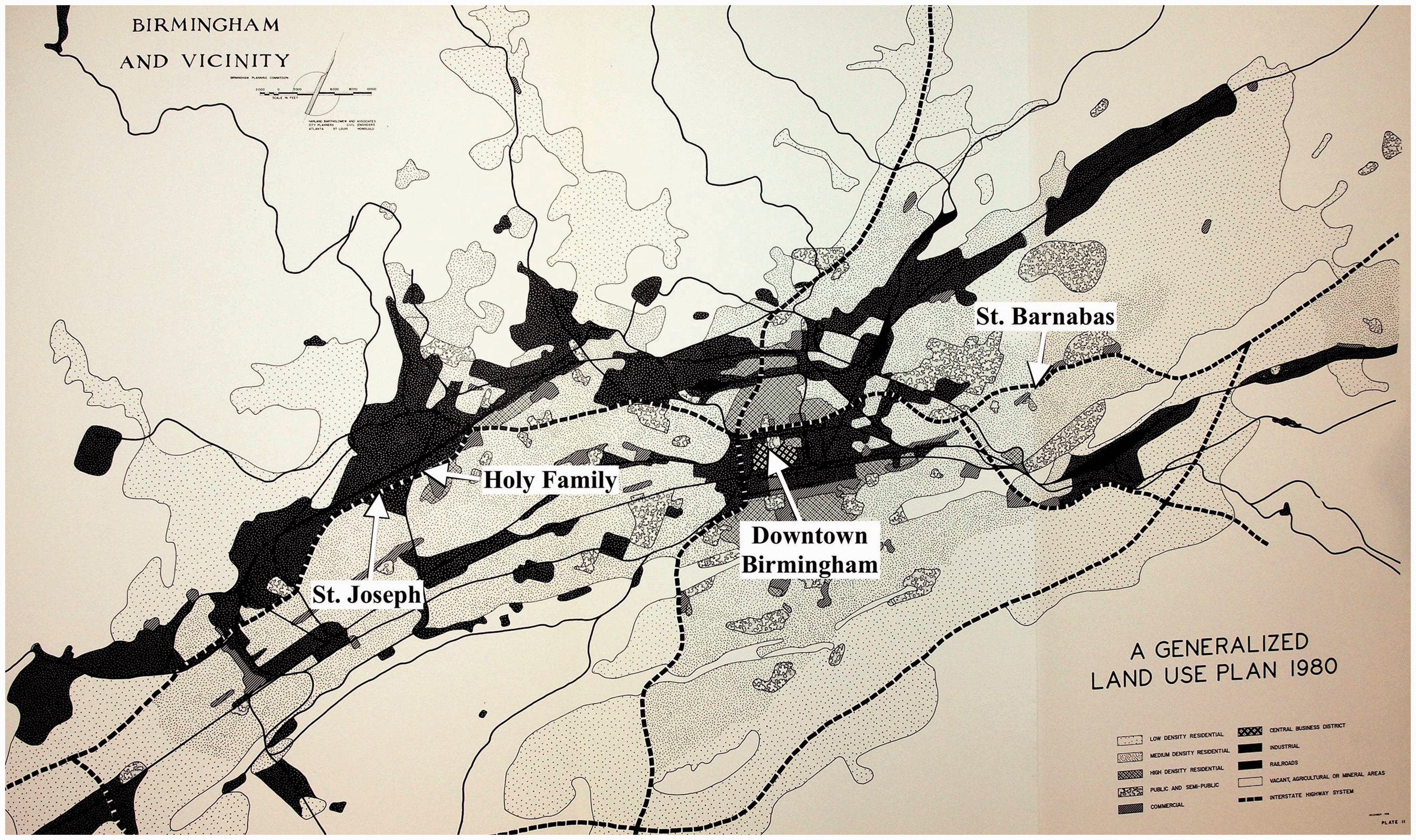
Future land use map of Birmingham, Alabama from the 1961 Land Use Plan, showing the proposed Interstate Highway locations. The author edited the map to show the location of the three Catholic churches discussed in this article: Holy Family, St. Joseph, and St Barnabas. Downtown Birmingham is also indicated. Source: Harland Bartholomew and Associates, The Comprehensive Plan, Birmingham, Alabama (Birmingham AL: Birmingham City Planning Commission, 1961), 41.
Holy Family Mission
Holy Family Mission, which included a hospital and school, on Birmingham’s west side, was adjacent to the Tuxedo neighbourhood, an Urban Renewal area that was part of a larger Urban Renewal plan for the Ensley area. 29 The Ensley Urban Renewal plan contained several areas that were proposed for clearance and redevelopment, and the Tuxedo neighbourhood was chosen as the first project. The neighbourhood contained a mix of industrial and African American residential land uses. Many residents of the neighbourhood were low-income African American people, with an average annual income of $1,951 in 1950, and almost all of the dwelling units were classified as substandard under the Urban Renewal plan. Just south of the Tuxedo neighbourhood was Ensley Highlands, a primarily White, middle-class neighbourhood. 30 The reason for choosing the Tuxedo neighbourhood as an Urban Renewal area was racially motivated – to eliminate vaguely-defined blight and “prevent the spread of blight southward into presently sound neighborhoods”. 31 I-59 was located at the edge of the Tuxedo Urban Renewal area to provide a buffer between the White neighbourhood to the south and the African American neighbourhood in Ensley.
Holy Family School and Hospital was run by the Passionist Fathers Mission, a Catholic organization with White clergy that constructed the hospital with local and national donations when a group of White Catholics became concerned about the lack of medical care for African American people in Birmingham. The group worked with the Sisters of Charity of Nazareth (in Kentucky), which ran a small clinic for African American obstetrical patients in Ensley. 32 The clinic agreed to operate the hospital if the Catholic charity could find the funds to build it. Local White business leaders took over the fundraising campaign in hopes that the hospital would reinforce segregation. 33
White city leaders viewed the new hospital as a way to quell civil rights protests and urged congressional representatives to give federal grants to the hospital, to “remedy uneven medical care for blacks; and by providing better facilities it could ‘answer to those clamoring for civil rights legislation’”. 34 The hospital eventually received a $600,000 federal grant. The new hospital would also give African American doctors in Birmingham a place to practice because they were excluded from practicing at White hospitals. 35
By the early 1960s, the hospital had grown to a 60-bed capacity with an outpatient clinic, and often operated over capacity by 25 per cent. The hospital had 30 African American doctors and several White doctors on staff. The hospital was exploring ways to expand, when an amendment to the Federal Housing Act was announced in 1962 which gave priority to hospitals that wanted to expand within 1.4 miles of a planned Urban Renewal area. The hospital was planning a three-story expansion into the Ensley Urban Renewal zone when the Bureau of Public Roads (BPR, now the Department of Transportation) announced that the route of I-59 would run through the property that it planned to purchase.
In addition to the hospital, the Mission had already constructed a high school for African American boys, when the Ensley Urban Renewal area was established. 36 The school was originally constructed in 1943 and was the only accredited private school for African American children in Alabama. The Mission was one of three Catholic institutions that would be affected by the Interstate Highway, a point that was viewed as suspicious by supporters of the Mission, who suspected religious and racial discrimination. 37
The Interstate would curtail the expansion plans, and a collector road parallel to the Highway would come within 5 ft of the property line of the hospital, causing noise and traffic. The collector road would also would take part of the school’s property, including the football field. 38 While the Mission agreed with the Urban Renewal plan, noting in its literature, “houses are coming down by the scores – which of course will be a real blessing, for most of them are miserable hovels”, 39 it was concerned about the traffic in front of the hospital and school and the taking of the football field. The church noted its scepticism about being targeted because of religious and racial bias, “three Catholic institutions … are thus affected by this Road, and no others at all – isn’t this rather ironic! Could it be just a coincidence?” 40 In another letter, Father Martin, the head of the Passionist Fathers, wrote, “living by faith, and in the knowledge that God hears our prayers, we know we shall succeed in the face of these obvious facts, – and shall I add, prejudices?” 41
The Mission newsletter sent out a call to supporters throughout the country to help protest the Highway plans. It had an important national audience through its connection to the charity in Kentucky that had helped fund the hospital. Many individuals, including Father Ronald Norris, who represented the Mission, contacted BPR, the Alabama Highway Department (AHD, now the Alabama Department of Transportation), and White House officials, including President Kennedy, to protest the Highway routing. In addition to people who were directly connected with the Mission, people from outside the South contacted President Kennedy, their representatives, and BPR officials, asking them to reconsider the Interstate location. Letters came from Connecticut, Chicago, New Jersey, California, Ohio, New York, and Pennsylvania. 42
In a letter to BPR Director Rex Whitton, Father Martin suggested several proposals that would lessen the impact of the Interstate Highway on the Mission. 43 The first suggestion was to move the Interstate about 70 feet south towards Pike Road, which was still within the Urban Renewal area and, according to Martin, “the degree of angle over this stretch of several blocks would be almost imperceptible, and cause no inconvenience to traffic”. 44 The second proposal was to construct a bridge for the Interstate over the Mission. The Mission also asked that a planned underpass along 20th Street be relocated. While moving the Interstate a few blocks to the south would avoid the impacts to the school and hospital, it would also encroach on the middle-class White neighbourhood south of the Interstate. After meeting with Father Martin, BPR asked AHD to reconsider route alternatives that would avoid the Interstate near the Mission, and explore moving it south towards the White neighbourhood of Ensley Highlands. 45 AHD, however, was not interested in moving the Expressway or modifying the proposal, preferring the politically and racially motivated route choice at the edge of the Ensley neighbourhood (see Figure 2).

Route of I-59 though Ensley and West Birmingham. To the north of I-59 (the solid thick black line) is the African American Ensley neighbourhood, and to the south is a White neighbourhood. The Expressway was the buffer between the two neighbourhoods. Source: RG 30, NRC 69B0176, Box 2, Folder IH-15-route 20, National Archives Atlanta Branch.
Although AHD refused to move the Interstate towards the White neighbourhood, it did redesign the 20th Street underpass because of concerns from the Mission, it noted, “all factors have been considered including the effect on the Passionist Fathers’ facilities with the objective of developing a Highway …” 46 However, the primary concern of the Mission was the effect of the entire Interstate on the Mission – not just the 20th Street underpass. Those concerns went unaddressed. 47
Many of the individuals who wrote letters received the same response, referencing the relocation of the 20th Street underpass, but not mentioning the effect of the Interstate Highway on the Mission. Many of the concerned citizens received letters in response that were nearly identical, noting, we [BPR] have been working with the Alabama State Highway Department to develop a design which will minimize the adverse effect on the hospital. The design now adopted removes the heavy traffic from 20th Street which is located immediately adjacent to the hospital.
48
Although the change to the 20th Street underpass was minor, the City Commission of Birmingham was firmly against the modification, and adopted a resolution opposing it, “we find the said changes highly objectionable and request all authorities connected with the Interstate Highway Program to use their utmost efforts to prevent the proposed change…”
50
The Birmingham City Engineer sent a copy of the resolution, along with a letter, to AHD Director Ed Rodgers, and copied the entire Alabama congressional delegation, AHD engineers, Birmingham City officials, and other public officials. The letter listed the owners of the property involved, all affiliated with the Mission, and indicated that it was the Mission which demanded the change, “it is my understanding that it is these groups who have requested this change, which in my opinion is highly objectionable”.
51
The letter also claimed that the change was unfair because it prioritized the interests of an African American school, One of the tracts that is needed for right-of-way is to be used as a future football stadium for a colored school located in the area, which appears to me to be a definite example of favoritism and should not be permitted.
52
In a rare instance of the federal Highway authorities recommending a Highway design that was contrary to a state Highway department’s recommendation, BPR responded to AHD and the City of Birmingham’s criticism by defending the new design. The historical pattern of Interstate Highway routing indicates a shift to local and state decision-making over decision-making by BPR, because local and state Highway officials had more knowledge of land use, traffic, and social issues. 54 The City Resolution mentioned concerns about increased traffic along Pike Road, which was on the White middle-class side of the Expressway. However, BPR defended the decision, noting that increased traffic is a concern for all collector roads along the Interstate, “we are fully cognizant that the development of Interstate routes will increase traffic on roads and streets connecting to the Interstate Highway at interchange points”. 55 BPR recommended that the City of Birmingham should develop a comprehensive arterial Highway plan for the increased traffic volume. The route was approved by BPR, and this research uncovered no evidence about whether or not AHD eventually agreed with the decision.
St. Joseph Church
St. Joseph Church, also located in the Ensley neighbourhood, opened a school in 1956. 56 The school initially served White students in two rooms of the Mission building. The school originally had just 18 students in 1956, but expanded quickly. A new eight-room school for children in first through fifth grades was constructed in 1958. 57 By 1960 the school had 125 students.
A new school was constructed in 1960 next to the Mission building. When St. Joseph Church applied for a permit from the City of Birmingham to construct the new school and a new church building, they were informed that the new buildings would be potentially impacted by the proposed Interstate. Two routes through the area were being considered – one on the north side of the neighbourhood that would eliminate taking the school, church, convent, and part of Ensley Park; and one to the south side of the neighbourhood that would provide a buffer between the White neighbourhood to the south and Ensley to the north (see Figure 3). The church, however, went ahead and constructed the buildings, hoping that the AHD would choose the north route. When the Highway route was finalized along the south route adjacent to the school, the church objected to the route. AHD refused to change the routing, noting that the school had warning about the potential conflict with the Highway before it was constructed. 58
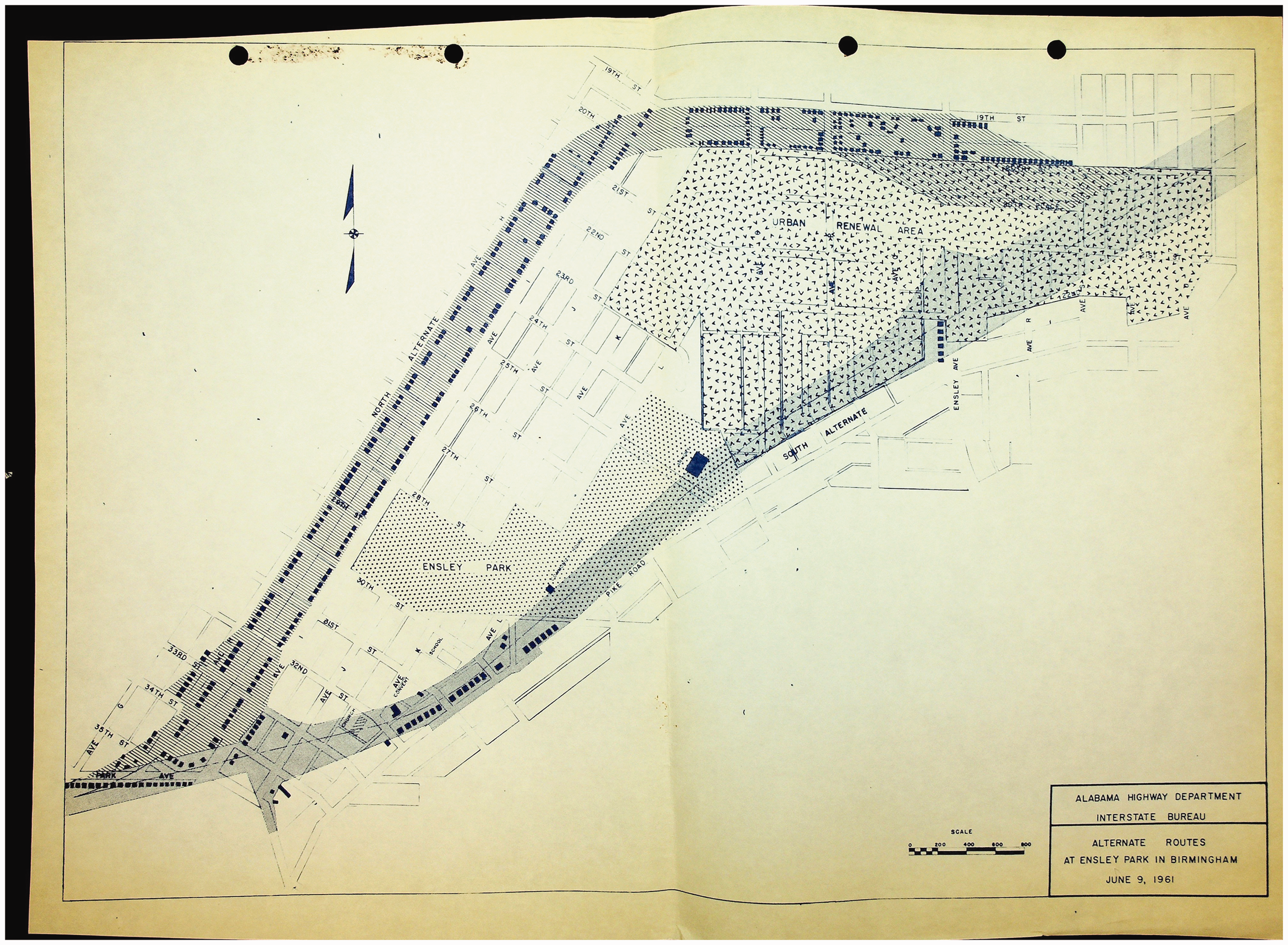
Map showing the north and south routes through Ensley near St. Joseph School. The school is located at Avenue K and 30th Street, in the bottom left corner. The Interstate Highway eventually took the south route, creating a buffer between the African American neighbourhood to the north and the White neighbourhood to the south. Source: Alabama Highway Department Interstate Bureau, Alternate Routes at Ensley Park in Birmingham, June 9, 1961, James Morgan Papers, Highways – East-West Thru Ensley, Proposed, 13.39, Birmingham Public Library.
Construction of the Interstate Highway cut off much of the access to the school and other church properties, as St. Joseph’s Buildings and Grounds Committee noted, the problems … are being caused by the failure to provide us with adequate and reasonable means of access, ingress, and egress, to and from our properties when the city streets presently serving our properties are closed because of the construction of the Interstate Highway.
59
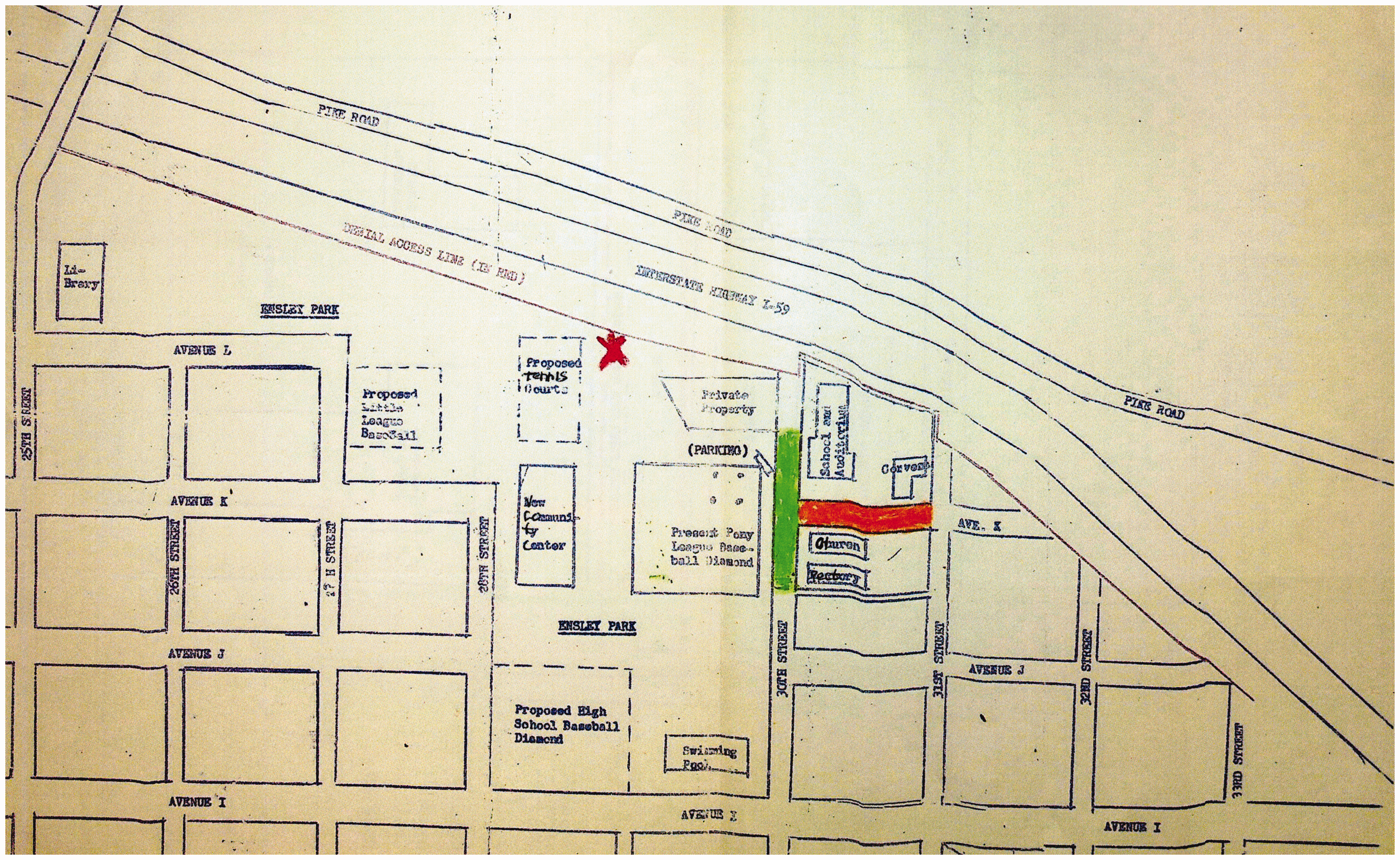
Hand-drawn map showing the location of St. Joseph church, rectory, school, and convent, which were difficult to access after construction of the Interstate Highway. The highlighted streets (in green and orange) show where the church partnered with the City of Birmingham to improve street access to the property. Source: Boutwell Files – St. Joseph School, File 20.28, Birmingham Public Library.
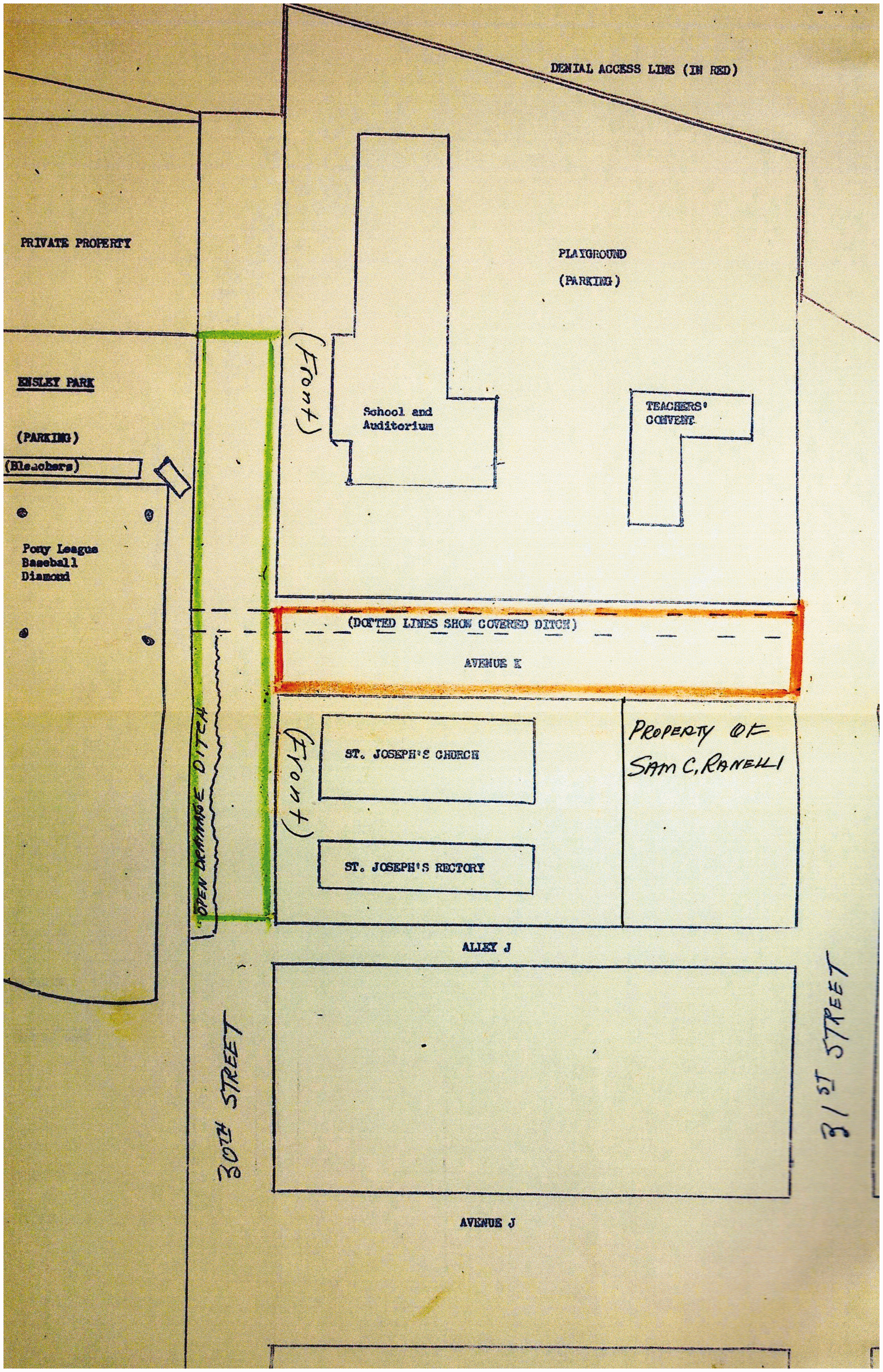
Hand-draw map showing the detail of St. Joseph’s property. The two highlighted areas on 30th Street and Avenue K (in green and orange) are the locations where drainage ditches were filled and covered by new roads to access the property. Source: Boutwell Files – St. Joseph School, File 20.28, Birmingham Public Library.
St. Joseph Church also lobbied AHD to provide access from Ensley Park, which was adjacent to the Interstate Highway and the school, to Pike Road, on the opposite side of the Interstate. This request would allow the people on the south side of the Interstate to have access to Ensley Park on the north side of the Interstate, “This walkway will make it possible for many persons to walk to the park and to the Pony League [baseball] diamond from Pike Road who otherwise would have to walk huge distances or have to secure vehicular transportation”. 61 AHD agreed to the request and constructed a large pedestrian bridge over the Expressway.
St. Joseph Church was not as successful as Holy Family Church at getting widespread support and public attention for their challenge to the Interstate Highway. This research uncovered no evidence of a major campaign to move the Expressway or to mitigate the damage to the Catholic institution, and no correspondence with Congressional representatives. The only evidence of the effort to get the Expressway moved away from the church are letters between church officials, AHD, and BPR. Importantly, St. Joseph Church did not have a large network of national donors like Holy Family Church, and instead relied on local donations, so there was not the same kind of national attention to the issue. Therefore, it provides an interesting comparison with Holy Family because the two were located near each other, in the same Urban Renewal area, with similar impacts from the Highway. However, only Holy Family, which had a significant amount of attention from Catholics throughout the country and many elected officials, was able to pressure for a change to an interchange. Neither institution, however, was able to get the Highway moved to the south, as both of them had requested, which would have been to the detriment of the middle-class White neighbourhood south of the Interstate, and the buffering role of the Interstate. 62
St. Barnabas Church
St. Barnabas church and school, located in the East Lake neighbourhood on the east side of Birmingham, had a White congregation and clergy, and the school was for White children. 63 Four route choices were proposed for I-59 near the neighbourhood (A, B, C, D). Routes B, C, and D would have gone through the nearby middle-class White Woodlawn community, including a business district, but those routes were more direct and avoided sharp curves in the Interstate. Historical research suggests, however, that traffic and engineering issues such as avoiding sharp curves in Expressways were less of a priority for decision-making by Highway engineers than political issues such as race. 64 Route A would require a sharp turn in the Highway in order to bypass Woodlawn, and it would go through the edge of an African American neighbourhood and adjacent to St. Barnabas Catholic church and school. Residents were concerned about the impact of the Expressway on the school, noting, “I protest with citizens of East Lake and with the parents of children attending St. Barnabas School against the routing of this free-way within a short distance of our school”. 65 Father Dan O’Rielly, representing the church and school, discussed the route choice with BPR administrators, and asked BPR to choose Route C, which would avoid the church and school, instead of Route A. 66
Opponents of the Expressway, who were concerned about the impacts of the Expressway on the entire neighbourhood – not just the school, formed a Citizens’ Freeway Committee to oppose Route A through the neighbourhood. At a public hearing to discuss the route, city and state officials dismissed the concerns of the residents, “Virtually all of the opposition to the route recommended by the Highway department stems from an organization called ‘citizens freeway committee,’ who contend that the route selected by the State is not the most desirable nor the most economical”. 67 The committee argued their preference for Route C and brought their own civil engineer to the public hearing to present cost figures and route lengths that conflicted with AHD data. However, AHD disagreed with the engineer’s assessment and defended its own data and decision-making. Although the Citizens’ Freeway Committee was active in opposing the Expressway, it did not have many of the characteristics of freeway revolts of the era that had more success, and it was relatively short-lived. 68
The Woodlawn Chamber of Commerce wrote to BPR in 1960 to oppose Routes B, C, and D, in favour of Route A. 69 The letter from the Chamber of Commerce sought to delegitimise the Citizens Freeway Committee, which it referred to as “disgruntled homeowners”, 70 and claimed that the 5,000 signatures on a petition to relocate the route “are persons who live in sections far removed from any area which would be affected by any one of the proposed routes”. 71
AHD concluded, Line A is the shortest and provides the greatest traffic service. It is the lowest in cost except for line D … . Line A has the support of the City of Birmingham, the City Planning Commission, and the Woodlawn Chamber of Commerce.
72
Conclusions
The three churches analyzed in this article add nuisances to the literature about the racial and religious politics of Highway routing in the South in the 1960s. The case studies challenge researchers to reconsider how the multiple interlocking hierarchies of race, religion, class, and economics shaped Southern Highway development in the 1960s, and how Highway engineers used Interstate routing choices as a form of political expression in support of the interests of White residents and neighbourhoods.
None of the churches in this analysis were able to affect significant change in the location of the Interstate Highways, but there were some differences between them. In all three cases, moving the Interstate Highway to one of the alternative locations would have been to the detriment of a middle-class White community. Historical research has noted that Interstate Highways were placed between White and African American neighbourhoods to create a buffer between them. 74 All three churches were requesting that the Highways be moved towards the White neighbourhoods, which would negate the role of the Interstate as a buffer, leaving a small part of the White neighbourhoods on the opposite side of the Highway. These cases suggest that government officials in Birmingham prioritized the buffering capabilities of Interstate Highways over the interests of Catholic institutions, even when the Catholic schools were for White children and the congregants and clergy were White.
The only school in this analysis that was able to affect a change in Interstate design was Holy Family. However, Holy Family requested a major change – moving the Interstate south towards the White neighbourhood – and received a minor change – the redesign of an underpass. Holy Family also had a much more significant outpouring of support, with many letters coming from congressional representatives from other states, including to President Kennedy. This case also suggests that it was only with support from outside Alabama that a Catholic church was able to affect Highway design, albeit a very small accommodation. However, while letters to President Kennedy may have been instrumental in generating this minor change, Alabama had split its electoral College votes between Kennedy (a Catholic) and Southern Democratic candidates Harry Byrd and Strom Thurmond, reinforcing the idea that anti-Catholic bias may have played a role in AHD’s resistance to more serious accommodations to minimise the effects of Highways on Catholic institutions.
Although the focus of Holy Family Mission was on African American health and education, Holy Family had a lot of advantages that gave it some leverage in discussions with BPR and AHD. The Mission was run by White clergy, had White donors, and had wide support from White people across the country, including representatives from outside Alabama and the South. Also, it was affiliated with an African American hospital, and White politicians in Birmingham initially supported the hospital to avoid integration of White hospital facilities. The other churches were not affiliated with hospitals and were not as well-connected.
Supporters of Holy Family Church were also careful to note that they were White, as one supporter from Chicago wrote, “I am not colored, but have deep sympathy for all god’s underprivileged children”. 75 This fact potentially drew the attention of Highway officials more than if the supporters were African American people. Nonetheless, supporters of the Mission believed that the decision to locate the road near the mission had religious and racial bias, as one writer from New Jersey wrote to his Senator, “Won’t you look further into this expending of federal funds in a way deliberately prejudicial to Catholics and Negroes…” 76 Another letter to President John F. Kennedy asked for a decision that was “right and just … one that is made free of prejudice and race or creed”. 77
It is important to remember, however, that while the Mission was the only one that was able to affect a change in Highway interchange design, it was unable to get the Interstate moved to a location away from the school. Moving the Highway away from the school would have impacted the middle-class White neighbourhood to the south of the school. It also would have lessened the impact of the Highway as a buffer between the African American Tuxedo neighbourhood and the White neighbourhood to the south. In the hierarchy of concerns about Interstate Highway location, middle-class White neighbourhoods rose well above the concerns of Catholic churches and schools, especially when those churches were located in African American neighbourhoods.
Another important finding from this research is the dynamic of BPR’s redesign of the underpass near Holy Family church with initial resistance from the City of Birmingham and AHD. The research on Highway routing decisions indicates that it is relatively rare that BPR would not go along with a state Highway department’s recommendation in the Highway building era. State departments of transportation held most of the power in Highway routing decisions, and BPR typically approved their preferences. 78 Although AHD may have eventually gone along with BPR’s proposal for the redesign, it initially objected to it. Potential reasons for this outlier could be that the change was minor, the issue received national attention, and it was possibly given as an accommodation that could potentially distract from the fact that the church had requested a much larger move of the Expressway towards the White middle-class neighbourhood.
The White schools in the analysis did not receive any accommodation in Highway location. However, the alternative to building the Interstate adjacent to those schools was to route them through White neighbourhoods instead of African American neighbourhoods. Also, moving them towards White neighbourhoods would have negated the purpose of the Interstate as a buffer between African American and White neighbourhoods. BPR and AHD were unwilling to accommodate even White schools at the expense of a middle-class White neighbourhood.
The leaders of the three Catholic institutions that were affected by the Interstate Highways in Birmingham viewed the fact that their concerns were unaddressed with suspicions of discrimination. This fact, combined with the reluctance of public officials to consider any adjustment to the Interstate that would negatively affect White middle-class neighbourhoods, leads to the conclusion that there was an element of both racial and religious discrimination in routing the Highways in Birmingham, and Highway officials gave more priority to the needs of White neighbourhoods and the buffering capability of Interstate Highways.
Footnotes
Acknowledgements
The author thanks Stuart Meck, FAICP, for his guidance, inspiration, and friendship. She also thanks Auburn University Master of Community Planning student Wilson Bowling, who helped format and proofread the article, and two anonymous reviewers.
Declaration of conflicting interests
The author(s) declared no potential conflicts of interest with respect to the research, authorship, and/or publication of this article.
Funding
The author(s) received no financial support for the research, authorship, and/or publication of this article.
1
Abbreviations used in citations are as follows: Alabama Department of Archives and History in Montgomery, Alabama: ADAH, Birmingham Public Library in Birmingham, Alabama: BPL, National Archives Atlanta Regional Branch: NAA, and National Archives II in College Park, Maryland: NA2. Brown v. Board of Education, 347 U.S. 483 (1954); Charles Connerly, The Most Segregated City in America: City Planning and Civil Rights in Birmingham, 1920–1980 (Charlottesville VA: University of Virginia Press, 2005); Mark Benton, “Just the Way Things Are Around Here: Racial Segregation, Critical Junctures, and Path Dependence in Saint Louis”, Journal of Urban History 44:6 (2018), 1113–30; Zebulon Vance Miletsky, “Before Bussing: Boston’s Long Movement for Civil Rights and the Legacy of Jim Crow in the ‘Cradle of Liberty’”, Journal of Urban History 43:2 (2017), 204–17; Genevieve Siegel-Hawley, “City Lines, County Lines, Color Lines: The Relationship Between School and Housing Segregation in Four Southern Metro Areas”, Teachers College Record 115:060307 (2013), 1–45.
2
Harland Bartholomew and Associates, Land Use: A Part of the Comprehensive Plan of Birmingham, Alabama (Birmingham AL: Birmingham Planning Commission, 1959); Davison M. Douglas, Reading, Writing, and Race (Chapel Hill NC: The University of North Carolina Press, 1995); Gregory S. Jacobs, Getting Around Brown (Columbus OH: Ohio State University Press, 1998).
3
Shuttlesworth v. Birmingham Board of Education, 162 F. Supp. 372 (N.D. Alabama, 1958); Shuttlesworth v. Board of Education, 358 U.S. 101 (1958).
4
Armstrong v. Board of Education of City of Birmingham, 220 F. Supp 217 (N.D. Alabama, 1963); Armstrong v. Board of Education of City of Birmingham, 333 F. 2d 47 (U.S. Ct. of Appeals, 5th Dist, 1964); Joseph Bagley, The Politics of White Rights (Athens GA: The University of Georgia Press, 2018); Harland Bartholomew and Associates, A Report on Schools and Parks: A Part of the Comprehensive Plan, Birmingham, Alabama (Birmingham AL: Birmingham Planning Board, 1961).
5
In his Letter from Birmingham Jail, Martin Luther King, Jr referred to Birmingham as “probably the most thoroughly segregated city in the United States.” Martin Luther King, Jr. “Letter from Birmingham Jail”, Open letter to Fellow Clergymen 16 April 1963, 1.
6
Bagley, The Politics of White Rights.
7
Ibid.
8
Glenn Feldman, Politics, Society, and the Klan in Alabama, 1915–1949 (Tuscaloosa AL: University of Alabama Press, 1999).
9
Lynn Dumenil, “The Tribal Twenties: ‘Assimilated’ Catholics’ Response to Anti-Catholicism in the 1920s”, Journal of Ethnic History 11:1 (1991), 21–50; Mark Paul Richard, “‘This is Not a Catholic Nation’: The Ku Klux Klan Confronts Franco-Americans in Maine”, The New England Quarterly 82:2 (2009), 285–303.
10
Cory Callahan and Janie Hubbard, “Protest and Prayer: The Jewish and Catholic Presence at Selma”, Social Studies Research and Practice 14:2 (2019), 238–54.
11
Mark Newman, Desegregating Dixie: The Catholic Church in the South and Integration, 1945–1992 (Jackson MS: University Press of Mississippi, 2018).
12
Andrew Moore, “Practicing What We Preach: White Catholics and the Civil Rights Movement in Atlanta”, Georgia Historical Quarterly 89:3 (2005), 334--67; Mark Newman, “Desegregation in the Catholic Diocese of Richmond, 1945–1973”, Virginia Magazine of History and Biography 117:4 (2009), 356–71; John McGreevy, Catholicism and American Freedom: A History (New York NY: W. W. Norton and Company, 2004); Newman, Desegregating Dixie: The Catholic Church in the South and Integration.
13
Andrew S. Moore, The South’s Tolerable Alien: Roman Catholics in Alabama and Georgia, 1945–1970 (Baton Rouge LA: Louisiana State University Press, 2007). Moore notes that “any Protestant attack of a Catholic was more likely to come in protest of support for integration than for Catholicism’s sake”, p. 64.
14
National Conference of Catholic Bishops and United States Catholic Conference, Pastoral Letters of the United States Catholic Bishops (Washington D.C.: United States Conference of Bishops, 1958); James Findlay, “Religion and Politics in the Sixties: The Churches and the Civil Rights Act of 1964”, Journal of American History 77:1 (1990), 66–92; Christopher Paul Lehman, “Civil Rights in Twilight: The End of the Civil Rights Era in 1973”, Journal of Black Studies 36:3 (2006), 415–28; Karen Johnson, “Beyond Parish Boundaries: Black Catholics and the Quest for Racial Justice”, Religion and American Culture 25:2 (2015), 264–300; David Southern, John LaFarge and the Limits of Catholic Interracialism, 1911–1963 (Baton Rouge LO: Louisiana State University Press, 1996).
15
Some Catholic churches in the South had a small degree of integration as early as the 1940s. In Birmingham, for example, African American people sat on the left side and White people sat on the right side in Our Lady of Fatima Catholic church. See Moore, The South’s Tolerable Alien: Roman Catholics in Alabama and Georgia.
16
Sharlene Sinegal Deuir, “Nothing Is to be Feared: Norman C. Francis, Civil rights Activism, and the Black Catholic Movement”, The Journal of African American History 101:2 (2016), 312–34.
17
Moore, The South’s Tolerable Alien; Newman, Desegregating Dixie.
18
Archdiocese of Mobile Archives, Letter from Rev. T.J. Toolen to Priests, 22 April 1964. The letter notes, After much prayer, consultation, and advice, we have decided to integrate all schools of our diocese in September. I know this will not meet with the approval of many of our people but in justice and in charity this must be done … . The procedure for admission will be determined by the pastors and Rt. Rev. J. Edwin Stuardi, superintendent of schools. (p. 1)
19
Newman, Desegregating Dixie; Moore, The South’s Tolerable Alien.
20
Moore, The South’s Tolerable Alien, 122.
21
The term blighted was and remains a politically contrived and controversial term because it is infused with racism and ethnic prejudice.
22
David Karas, “Highway to Inequity: The Disparate Impact of the Interstate Highway System on Poor and Minority Communities in American Cities”, New Visions for Public Affairs 7 (2015), 9–21.
23
Christopher MacGregor Scribner, Renewing Birmingham (Athens GA: The University of Georgia Press, 2002); Charles Connerly, The Most Segregated City in America: City Planning and Civil Rights in Birmingham, 1920–1980 (Charlottesville VA: University of Virginia Press, 2005); Charles Connerly, “From Racial Zoning to Community Empowerment: The Interstate Highway System and the African American Community in Birmingham, Alabama”, Journal of Planning Education and Research 22:2 (2002), 99–114; Bobby Wilson, America’s Johannesburg: Industrialization and Racial Transformation in Birmingham (New York NY: Rowman and Littlefield Publishers, Inc., 2000); Bobby Wilson, Race and Place in Birmingham: The Civil Rights and Neighborhood Movements (New York NY: Rowman and Littlefield Publishers, Inc., 2000); Christopher Silver, Twentieth-Century Richmond: Planning, Politics, and Race (Knoxville TN: University of Tennessee Press, 1984); Ronald Bayor, Race and the Shaping of Twentieth-Century Atlanta (Chapel Hill NC: The University of North Carolina Press, 1996); Richard Baumbach and William Borah, The Second Battle of New Orleans: A History of the Vieux Carre Riverfront Expressway Controversy (Tuscaloosa AL: University of Alabama Press, 1981).
24
Zachary Schrag, “The Freeway Fight in Washington D.C.: The Three Sisters Bridge in Three Administrations”, Journal of Urban History 30:5 (2004), 648–73; Matthew Roth, “Whittier Boulevard, Sixth Street Bridge, and the Origins of Transportation Exploitation in East Los Angeles”, Journal of Urban History 30:5 (2004), 729–48; Raymond Mohl, “Citizen Activism and Freeway Revolts in Memphis and Nashville: The Road to Litigation”, Journal of Urban History 40:5 (2014), 870–93; Raymond Mohl, “Stop the Road: Freeway Revolts in American Cities”, Journal of Urban History 30:5 (2004), 674–706; Raymond Mohl, “Making the Second Ghetto in Metropolitan Miami, 1940–1960”, Journal of Urban History 21:3 (1995), 395–427; Leland White, “Dividing Highway: Citizen Activism and Interstate 66 in Arlington, Virginia”, Washington History 13:1 (2001), 52–67; Joshua Cannon, “Huntsville, the Highway, and Urban Redevelopment: The Long Road to Connect Downtown Huntsville, Alabama to the Interstate Highway System”, Journal of Planning History 11:1 (2012), 27–46; Rebecca Retzlaff, “Interstate Highways and the Civil Rights Movement: The Case of I-85 and the Oak Park Neighborhood in Montgomery, Alabama”, Journal of Urban Affairs 41:7 (2019), 930–59.
25
Jane Jacobs, The Death and Life of Great American Cities (New York NY: Random House, 1961).
26
NA2, 7/1968-1/1968, RG 406, A1-33, 530, 33, 41, Box 12, Letter from Harry Stark to E.H. Swick, DOT FWA Motor Carrier Files of Admin Francis C. Turner, 23 January 2963, p. 4.
27

28
29
The church was just along the edge, but outside the Urban Renewal area. See NA2, Model Cities Reports, RG 207, Au/c.97, 130, 3, 14, 3, Box 2–4, City of Birmingham, Alabama, Model Cities Application for Planning Grant, 12 April 1968; Christopher MacGregor Scribner, Renewing Birmingham (Athens GA: The University of Georgia Press, 2002). Holy Family was initially established in a storefront in 1938, after an advisory letter from the Vatican was issued by Pope Pius XI to “reach out to the Black Community in the United States.” See Father Joseph Lody (ed.), History of the Diocese of Birmingham (Strasbourg: Editions du Signe, 2009), 83. A new church was built in 1941, a high school built in 1943, and a new elementary school to replace an older one in 1945. In 1956, the high school moved to a larger building, and an auditorium and gymnasium were added to the high school in 1975. See Lody, ed., History of the Diocese of Birmingham.
30
By the time the Urban Renewal area was announced, a large housing project, Tuxedo Gardens, was already underway, demolishing 20 blocks of mostly African American Housing. See ADAH, Public Information Subject Files – Ensley, Container SG6868, Container 81, “Portion of Project Area to be named ‘Tuxedo Gardens’”, The Birmingham News 4 October 1956. Other Urban Renewal areas in Birmingham that were affected by an Interstate Highway include the Southside Medical Center and Civic Center. The history of Urban Renewal and Interstate Highways in Birmingham, and their use in racial segregation, are chronicled in two excellent books: Connerly, The Most Segregated City in America; and Scribner, Renewing Birmingham.
31
Connerly, The Most Segregated City in America, 145.
32
The sisters of Charity of Nazareth had a long history of working in African American health and education in Alabama. They arrived in 1941 to Birmingham to run a health clinic. The Sisters of Charity of Nazareth also ran hospitals in Mobile, AL, Selma, AL, Pensacola, FL, and Marbury, AL. An associated organization, The Vincentian Sisters of Charity, arrived in 1940 in Montgomery to help run the first hospital in for African Americans in Alabama, at Montgomery’s City of St Jude, which also served an important role in the Civil Rights movement. See ADAH, Public Information Subject Files – Holy Family SG6869, Container 30, Lorine Alexander, “Sisters of Charity Will soon See their Prayers Answered”, Birmingham News, n.d.; Sister Nary Ruth Coffman, Build Me A City (Montgomery AL: Pioneer Press, 1984); ADAH, Public Information Subject Files – Holy Family SG6869 “Catholic Hospital for Negroes to be Dedicated Sunday; Non-Catholics Help Raise Funds”, The Catholic Week 9 January 1954.
33
NA2, RG 406, A 1-3, 530, 33, 19, 5, Box 2, Letter from Helen Sullivan to Rex Whitton, February 1, 1963, FWA Correspondence Relating to Federal Aid Primary and Secondary System Projects, 1961–1978, p. 1. Committee members were John Newsome (a former congressperson), Donald Comer (owner of industrial businesses), Louis Pizitz (owner of a department store), Walter Henley (a business owner), Mervin Sterne (a business owner), and William Pritchard (a lawyer). Newspaper articles praised the committee for their diversity, because it included people who were Jewish, Protestant, and Catholic, but the members were all White men. The committee raised $250,000 and planned to also use funds from a $600,000 federal Hill-Burton Grant for the project. The Sisters of Charity of Nazareth contributed $101,000. See ADAH, Public Information Subject Files – Ensley, Container SG6868, Container 81, “Work on New Hospital May Begin Soon”, Birmingham News 29 February 1952; ADAH, Public Information Subject Files – Ensley, Container SG6868, Container 81, Lane Carter, “Faiths, Races Meet, Dedicate New Holy Family Hospital”, Birmingham News, 11 January 1954; ADAH, Public Information Subject Files Holy Family, Container SG 6869, File 30, “First Negro Hospital”, Birmingham News 23 September 1952; ADAH, Public Information Subject Files – Holy Family, Container SG 6869, File 30, “Catholic Negro Hospital Nears Realization”, Jefferson County Catholic 1 March 1952.
34
Christopher MacGregor Scribner, Renewing Birmingham, 44; See also BPL, J. W. Morgan Papers, Slum Clearance, Medical Center, 25.20, Electa D. Green, DDS, “Medical Center – Separate But Equal”, Birmingham Post-Herald 1 December 1953.
35
As one article noted, the lack of a place for African American doctors to practice affected African American health because African American people were not allowed at most White hospitals, In Birmingham, where about 40 per cent of the population is Negro, we now have only 16 active doctors. You need only to divide the 130,000 Negroes in Birmingham by this number and you see that the task is insurmountable.
ADAH, Public Information Subject Files – Holy Family, Container SG 6869, File 30, “Ground Broken for Hospital that will mend”, Birmingham News 24 September 1952, para. 11; NA2, FWA Correspondence Relating to Federal Aid Primary and Secondary System Projects, 1961–1978, RG 406, A 1-3, 530, 33, 19, 5, Box 2, Letter from Helen Sullivan to Rex Whitton, 1 February 1963; BPL, J.W Morgan Papers, Slum Clearance – Medical Center, 25.20, Letter from Clarence Hanson, Jr to Oveta Culp Hobby, 22 September 1953; ADAH, Public Information Subject Files – Ensley, Container SG6868, Container 81 “Work on New Hospital May Begin Soon”, Birmingham News 29 February 1952; ADAH, Public Information Subject Files – Ensley, Container SG6868, Container 81, “First P-TA at St. Joseph’s Works Hard for Their Brand New School”, The Catholic Week 2 January 1959.
36
Planning for the Ensley Urban Renewal project began passed in 1949, funding for the preliminary study for the project was approved in 1958, demolition of homes for the Tuxedo Court housing development began in 1959, and the U.S. Housing and Home Finance Agency approved the Ensley Urban Renewal project in January 1961. See Connerly, The Most Segregated City in America; NA2, FWA Correspondence Relating to Federal Aid Primary and Secondary System Projects, 1961–1978, RG 406, A 1-3, 530, 33, 19, 5, Box 2, “Passionist Fathers Missions: Urban Renewal, Road, and the Hospital”, Newsletter from Passionist Fathers Missions, September 1962; ADAH, Public Information Subject Files – Jefferson County – Holy Family, Container SG 6869, Folder 30 “Ground Broken in Ensley for Negro School”, Birmingham News 21 October 1955.
37
NA2, FWA Correspondence Relating to Federal Aid Primary and Secondary System Projects, 1961–1978, RG 406, A 1-3, 530, 33, 19, 5, Box 3, Letter from Richard Eichner to Senator Clifford Case, 17 September 1962; ADAH, Public Information Subject Files – Holy Family SG6869, Container 30, “Holy Family School will be Dedicated”, Birmingham News 12 December 1956.
38
NA2, FWA Correspondence Relating to Federal Aid Primary and Secondary System Projects, 1961–1978, RG 406, A 1-3, 530, 33, 19, 5, Box 3, Letter from Father Luger Martin to Rex Whitton, 12 October 1961.
39
NA2, FWA Correspondence Relating to Federal Aid Primary and Secondary System Projects, 1961–1978, RG 406, A 1-3, 530, 33, 19, 5, Box 2, “Passionist Fathers Missions: Urban Renewal, Road, and the Hospital”, Newsletter from Passionist Fathers Missions, September 1962, p. 1.
40
NA2, FWA Correspondence Relating to Federal Aid Primary and Secondary System Projects, 1961–1978, RG 406, A 1-3, 530, 33, 19, 5, Box 2, “Passionist Fathers Missions: Urban Renewal, Road, and the Hospital”, Newsletter from Passionist Fathers Missions, September 1962, p. 1.
41
NA2, FWA Correspondence Relating to Federal Aid Primary and Secondary System Projects, 1961–1978, RG 406, A 1-3, 530, 33, 19, 5, Box 2, Letter from Father Ludger Martin to Carl Hooffstetter, 19 October 1962, p. 2; NA2, FWA Correspondence Relating to Federal Aid Primary and Secondary System Projects, 1961–1978, RG 406, A 1-3, 530, 33, 19, 5, Box 3, Letter from Rex Whitton to Carl Hoopffstetter, 2 September 1962.
42
NA2, FWA Correspondence Relating to Federal Aid Primary and Secondary System Projects, 1961–1978, RG 206, A 1-3, 530, 33, 19, 5, Box 3, Letter from Josiah Henry Rank to Senator Keating, 1 September 1962; NA2, FWA Correspondence Relating to Federal Aid Primary and Secondary System Projects, 1961–1978, RG 206, A 1-3, 530, 33, 19, 5, Box 3, Letter from Rex Whitton to Senator Keating, 1 October 1962; NA2, FWA Correspondence Relating to Federal Aid Primary and Secondary System Projects, 1961–1978, RG 406, A 1-3, 530, 33, 19, 5, Box 2, Letter from Father Ludger Martin to Carl Hooffstetter, 19 October 1962; NA2, FWA Correspondence Relating to Federal Aid Primary and Secondary System Projects, 1961–1978, RG 406, A 1-3, 530, 33, 19, 5, Box 2, Letter from Rex Whitton to Carl Hooffstetter, 23 November 1962; NA2, FWA Correspondence Relating to Federal Aid Primary and Secondary System Projects, 1961–1978, RG 406, A 1-3, 530, 33, 19, 5, Box 2, Letter from Carl Hooffstetter to President John F. Kennedy, 26 October 1962; NA2, FWA Correspondence Relating to Federal Aid Primary and Secondary System Projects, 1961–1978, RG 406, A 1-3, 530, 33, 19, 5, Box 2, Letter from Byron Heitzman to President John F. Kennedy, 13 November 1962; NA2, FWA Correspondence Relating to Federal Aid Primary and Secondary System Projects, 1961–1978, RG 406, A 1-3, 530, 33, 19, 5, Box 2, Letter from Rex Whitten to Byron Heitzman, 23 November, 1962; NA2, FWA Correspondence Relating to Federal Aid Primary and Secondary System Projects, 1961–1978, RG 406, A 1-3, 530, 33, 19, 5, Box 3, Letter from Rose M Sailers to President John F. Kennedy, 23 September 1962; NA2, FWA Correspondence Relating to Federal Aid Primary and Secondary System Projects, 1961–1978, RG 406, A 1-3, 530, 33, 19, 5, Box 3, Letter from Rex Whitton to Rose Sailers, 5 October 1962; NA2, FWA Correspondence Relating to Federal Aid Primary and Secondary System Projects, 1961–1978, RG 406, A-1-3, 530, 33, 19, 5, Box 3, Letter from Rex Whitton to Mary Slimak, 5 October 1962; NA2, FWA Correspondence Relating to Federal Aid Primary and Secondary System Projects, 1961–1978, RG 406, A-1-3, 530, 33, 19, 5, Box 3, Letter from Mary Slimak to unknown recipient (Dear Sir), 26 September 1962; NA2, RG 206, A 1-3, 530, 33, 19, 5, Box 3, Letter from Mrs George W. Evans to Mr Flood, 3 October 1960, FWA Correspondence Relating to Federal Aid Primary and Secondary System Projects, 1961–1978; NA2, FWA Correspondence Relating to Federal Aid Primary and Secondary System Projects, 1961–1978, RG 406, A 1-3, 530, 33, 19, 5, Box 3, Letter from Lawrence E. Strangier to President John F. Kennedy, 26 September 1962.
43
NA2, FWA Correspondence Relating to Federal Aid Primary and Secondary System Projects, 1961–1978, RG 406, A-1-3, 530, 33, 19, 5, Box 2, Letter from G.M. Williams to R.S. Anderson, 30 November 1962; NA2, FWA Correspondence Relating to Federal Aid Primary and Secondary System Projects, 1961–1978, RG 406, A-1-3, 530, 33, 19, 5, Box 3, Letter from D. Grant Michle to Reverend Ludger Martin, 8 November 1962.
44
NA2, FWA Correspondence Relating to Federal Aid Primary and Secondary System Projects, 1961–1978, RG 406, A 1-3, 530, 33, 19, 5, Box 3, Letter from Father Luger Martin to Rex Whitton, 12 October 1961, p. 2.
45
NA2, FWA Correspondence Relating to Federal Aid Primary and Secondary System Projects, 1961–1978, RG 206, A 1-3, 530, 33, 19, 5, Box 3, Letter from G.N. Williams to R.S. Anderson, 19 July 1962.
46
NA2, FWA Correspondence Relating to Federal Aid Primary and Secondary System Projects, 1961–1978, RG 406, A-1-3, 530, 33, 19, 5, Box 3, Letter from D. Grant Michle to Reverend Ludger Martin, 8 November 1962, p. 1.
47
NA2, FWA Correspondence Relating to Federal Aid Primary and Secondary System Projects, 1961–1978, RG 406, A 1-3, 530, 33, 19, 5, Box 3, Letter from D. Grant Michle to Representative Daniel J. Flood, 26 October 1962.
48
NA2, FWA Correspondence Relating to Federal Aid Primary and Secondary System Projects, 1961–1978, RG 206, A 1-3, Stack 530, Row 33, Compartment 19, Shelf 5, Box 3, Rex Whitton to Senator Keating, 1 October 1962, p. 1; BPL, J.W Morgan Papers, Overpass and Underpass, Concerning the Construction of Viaducts in the Birmingham Area, 30.23, “Bureau Approves Ensley Overpass”, Birmingham News 27 June 1951; BPL, J.W Morgan Papers, Overpass and Underpass, Concerning the Construction of Viaducts in the Birmingham Area, 30.23, “Project to be Studied for N. Birmingham”, Birmingham News 13 February 1954; BPL, J. W Morgan Papers, Overpass and Underpass, Concerning the Construction of Viaducts in the Birmingham Area, 30.23, “Bureau of Roads Engineers Scan N. Birmingham Sites”, Birmingham News 19 February 1954; BPL, J.W Morgan Papers, Overpass and Underpass, Concerning the Construction of Viaducts in the Birmingham Area, 30.23, Letter from J.W. Morgan to U.S. Housing and Home Finance Agency, 17 March 1955; BPL, J.W Morgan Papers, Overpass and Underpass, Concerning the Construction of Viaducts in the Birmingham Area, 30.24, Letter from Alton McWhorter to Edward Baxter, 30 May 1958.
49
NA2, FWA Correspondence Relating to Federal Aid Primary and Secondary System Projects, 1961–1978, RG 206, A 1-3, 530, 33, 19, 5, Box 3, Letter from Rex Whitton to Reverend Ronald Norris, 28 September 1962, p. 1.
50
NA2, FWA Correspondence Relating to Federal Aid Primary and Secondary System Projects, 1961–1978, RG 206, A 1-3, 530, 33, 19, 5, Box 2, Commission of the City of Birmingham Resolution, 29 January 1963.
51
NA2, FWA Correspondence Relating to Federal Aid Primary and Secondary System Projects, 1961–1978, RG 206, A 1-3, 530, 33, 19, 5, Box 2, Letter from Alton McWhorter to Ed Rodgers, 29 January 1963, p. 4.
52
NA2, FWA Correspondence Relating to Federal Aid Primary and Secondary System Projects, 1961–1978, RG 206, A 1-3, 530, 33, 19, 5, Box 2, Letter from Alton McWhorter to Ed Rodgers, 29 January 1963, p. 4; NA2, DOT FWA Central Correspondence, 1968–1969, RG 406, A1-1-A, 530, 33, 4, 5–6, Box 134, Letter from R.B. Gillette to Harry E. Stark, 30 August 1968, p. 1.
53
NA2, FWA Correspondence Relating to Federal Aid Primary and Secondary System Projects, 1961–1978, RG 206, A 1-3, 530, 33, 19, 5, Box 2, Lou Isaacson, “Commission Protests Relocating Thruway”, Birmingham News 29 January 1963, para. 5; NA2, FWA Correspondence Relating to Federal Aid Primary and Secondary System Projects, 1961–1978, RG 206, A 1-3, 530, 33, 19, 5, Box 2, Letter from E.D. Jordan to George Huddleton, 24 October 1962.
54
Richard Rothstein, The Color of Law: A Forgotten History of How Our Government Segregated America (New York NY: Liveright Publishing Company, 2017); Mark Rose and Raymond Mohl, Interstate: Highway Politics and Policy Since 1939, 3rd ed (Knoxville TN: University of Tennessee Press, 2012).
55
NA2, FWA Correspondence Relating to Federal Aid Primary and Secondary System Projects, 1961–1978, RG 206, A 1-3, 530, 33, 19, 5, Box 2, Letter from D. Grant Michle to John Sparkman, 8 February 1963, p. 1.
56
The church was initially established in 1930 and was a Mission from St. Marks Parish until 1921. In 1934, the church and kindergarten were renovated and more than three hundred children enrolled in kindergarten that year. The church and school were White before desegregation.
57
ADAH, Public Information Subject Files – Jefferson County – Ensley, Container SG6868, Folder 82, “Ensley Schools to Open $1 Million Job”, Birmingham News 29 August 1958; ADAH, Public Information Subject Files – Jefferson County – Catholic – St. Joseph’s, Container SG 6872, Folder 46, “Archbishop Breaks Ground for St. Joseph School, Ensley”, Catholic Week 7 February 1958. A convent to house the nuns who taught at the school was built in 1957. See ADAH, Public Information Subject Files – Jefferson County – Catholic – St. Joseph’s, Container SG 6872, Folder 46, “Archbishop Dedicates St. Joseph’s School, Convent, Sunday at 3”, The Catholic Week 2 January 1959.
58
NAA, RG 30, NRC 69B0176, Box 2, 3 IH-15-Route 59, April 6, 1958, Letter from Paul Royster to Lister Hill, 23 January 1959.
59
BPL, Albert Boutwell files, 20.28, Letter from Tony P. Cantavespre to Mayor Boutwell, 19 February 1964, p. 1.
60
BPL, Albert Boutwell files, 20.28, Letter from Frank Wagner to Parks and Recreation Board Members, 6 May 1965.
61
BPL, Albert Boutwell files, 20.28, Letter from John Tortorici to Mayor Albert Boutwell, 13 May 1965, p. 2; BPL, Albert Boutwell files, 20.28, Letter from Tony Cantavespre to Mayor Albert Boutwell, 31 August 1964.
62
By 1964 the church invested $50,000 to move the convent from the path of the Highway, and built a new school auditorium-cafeteria and a new church. See ADAH, Public Information Subject Files – Ensley, Container SG6868, Folder 30, “Catholics to Break Ground for Church”, Birmingham News 11 July 1964; Lody (ed.), History of the Diocese of Birmingham.
63
The church was first established in 1908 and moved to a larger church in 1938. A new church was built in 1954. See ADAH, Public Information Subject Files – Holy Family SG6869, Folder 30, “Dedication of St. Barnabas Church, Sunday”, The Catholic Week 9 January 1954; ADAH, Public Information Subject Files – Catholic – Barnabas, Container SG 6872, Folder 37, “Pews Built by workers in Parish”, The Catholic Week 10 January 1953; ADAH, Public Information Subject Files – Catholic – Barnabas, Container SG 6872, Folder 37, “Ground Breaking for New St. Barnabas Church”, Catholic Week 5 January 1952; ADAH, Public Information Subject Files – Catholic – Barnabas, Container SG 6872, Folder 37, “St. Barnabas Church to Open Christmas”, The Catholic Week 20 December 1952; Lody (ed.), History of the Diocese of Birmingham.
64
Gary Schwartz, “Urban Freeways and the Interstate System”, Transportation Law Journal 8 (1976), 167–264; Roger Biles, “Expressways Before the Interstates: The Case of Detroit, 1945–1956”, Journal of Urban History 40:5 (2014), 843–54; Eric Avila, The Folklore of the Freeway: Race and Revolt in the Modernist City (Minneapolis MN: University of Minnesota Press, 2014); Rose and Mohl, Interstate: Highway Politics and Policy Since 1939.
65
“Many Dissatisfied with Recommended Freeway Routing”, Birmingham News, no date, para. 10. The article was attached to a letter from NA2, Classified Central File, 1960–65 Segment, RG 30, PI 134/E.6F, 530, 29, 8, 1-, Box 1664–1665, F.C. Turner to Lister Hill, 15 April 1960.
66
NAA, RG 30, NRC 69B0176, 3 IH-15-Route 59, 6 April 1958, Letter from Paul F. Royster to John McCormack, 1 March 1961.
67
NAA, RG 30, NRC 69B0176, IH-15-Route 20, Letter from B.A. Scott to Rex Anderson, 15 November 1960, p. 1.
68
Mohl, “Stop the Road”, 674–706.
69
The Woodlawn Commercial district was a neighbourhood commercial district. NA2, Classified Central File, 1960–65 Segment, RG 30, PI 134/E.6F, 530, 29, Box 1665, Letter from C.B. Hudson to Director of the Bureau of Public Roads, 4 April 1960, p. 1; NA2, Classified Central File, 1960–65 Segment, RG 30, PI 134/E.6F, 530, 29, Box 1665, Letter from Lister Hill to Bertram Tallamy, 7 April 1960.
70
NA2, Classified Central File, 1960–65 Segment, RG 30, PI 134/E.6F, 530, 29, Box 1665, Letter from C.B. Hudson to Director of the Bureau of Public Roads, 4 April 1960, p. 1.
71
NA2, Classified Central File, 1960–65 Segment, RG 30, PI 134/E.6F, 530, 29, Box 1665, Letter from C.B. Hudson to Director of the Bureau of Public Roads, 4 April 1960, p. 2.
72
NAA, RG 30, NRC 69B0176, Box 2, IH-15-Route 20, Letter from B.A. Scott to Sam Engelhardt, 28 March 1961, p. 1.
73
NAA, RG 30, NRC 69B0176, Box 2, IH-15-Route 20, Letter from B.A. Scott to Sam Engelhardt, 28 March 1961, p. 1.
74
Connerly, The Most Segregated City in America; Wilson, America’s Johannesburg; Wilson, Race and Place in Birmingham; Scribner, Renewing Birmingham; Tracy Neumann, Remaking the Rust Belt: The Postindustrial Transformation of North America (Philadelphia PA: University of Pennsylvania Press, 2016); Avila, The Folklore of the Freeway; Mohl, “The Interstates and the Cities”; Schrag, “The Freeway Fight in Washington D.C.”; Roth, “Whittier Boulevard, Sixth Street Bridge, and the Origins of Transportation Exploitation in East Los Angeles”, 729–48; Mohl, “Whitening Miami”, 319–45; Mohl, “Citizen Activism and Freeway Revolts in Memphis and Nashville”, 870–93; Mohl, “Stop the Road”; Mohl, “Making the Second Ghetto in Metropolitan Miami, 1940–1960”, 395–427; Leland White, “Dividing Highway: Citizen Activism and Interstate 66 in Arlington, Virginia”, Washington History 13:1 (2001), 52–67; William Borah, The Second Battle of New Orleans: A History of the Vieux Carre Riverfront Expressway Controversy (Tuscaloosa AL: University of Alabama Press, 1981); Eric Avila, “L.A.’s Invisible Freeway Revolt: The Cultural Politics of Fighting Freeways”, Journal of Urban History 40:5 (2014), 831–42.
75
NA2, FWA Correspondence Relating to Federal Aid Primary and Secondary System Projects, 1961–1978, RG 406, A 1-3, 530, 33, 19, 5, Box 3, Letter from Rose M Sailers to President John F. Kennedy, 23 September 1962, p. 1.
76
NA2, FWA Correspondence Relating to Federal Aid Primary and Secondary System Projects, 1961–1978, RG 406, A 1-3, 530, 33, 19, 5, Box 3, Letter from Richard Eichner to Senator Clifford Case, 17 September 1962.
77
NA2, FWA Correspondence Relating to Federal Aid Primary and Secondary System Projects, 1961–1978, RG 406, A 1-3, 530, 33, 19, 5, Box 3, Letter from Lawrence E. Strangier to President John F. Kennedy, 26 September 1962, p. 1.
78
Rose and Mohl, Interstate: Highway Politics and Policy Since 1939.