



Abstract
This special issue brings together articles on the history of walking in European cities and urban hinterlands since the late nineteenth century. Taken together, they reveal how the conditions to walk changed as cities and streets were rethought and rebuilt for motorised mobility, and they highlight the role of labelling and defining pedestrians in order to legitimise change. The anticipation and making of car cities entailed locally specific yet similar versions of marginalisation of walking. Discursive othering (vocabularies, rules, etc.) and material ordering (through designs, etc.) of pedestrians combined to make walking the “second” mobility and produced street modernities. Using the articles as interpretative inspiration, we claim that in the twentieth century, what we refer to as mechanical equality grew in importance at the expense of embodied equality. We propose that un-marginalising walking requires the revaluation of – and hence a more thorough understanding of – the bodily qualities and mundane practices of walking.
laura [laúra] substantiv ∼n lauror
• ⟨vard., åld.⟩ vimsig kvinnlig trafikant
Since 1950, the Swedish Academy's dictionary (SAOL) includes the female European name “Laura” as a noun (“laura”) and eponym for a “whimsical female road user”. Even though the use of the term has today faded in everyday language, the transformation of a seemingly neutral name into a derogatory term may serve as an entry point to the inequalities of the street that this special issue addresses. The eponym originated from a traffic safety campaign of the Swedish National Traffic Safety Association (NTF). Founded in 1934, two years later the organisation published a pamphlet and distributed it extensively (500,000 to schools and 800,000 to the public). The pamphlet featured a story about a whimsical hen named Laura that ran around in the street causing havoc and danger (Figure 1). She was “an excellent example”, the pamphlet explained, “of how not to behave in traffic.” 1 The term “laura” was quickly popularised as a derogatory term. In April 1937, for example, NTF invited, as part of a national drawing competition in Swedish schools, children to depict the traffic behaviour of either “the ideal road user” or one “of the ‘Laura-type’”. A few months later, a reader of Svenska Dagbladet filed as his entry to the newspaper's stamp competition one with a portrait of “the traffic hen Laura”, adding, “The denomination is low [ett öre; one penny], but then Laura isn’t too highly valued either.” 2 The same year, the weekly newsreel Veckorevyn, produced for the movie audience, featured a segment on Laura the traffic-hen. The fourth Nordic marketing congress held in 1937 celebrated NTF's campaign as exemplary in how it had problematised irresponsible pedestrians and influenced public opinion. 3
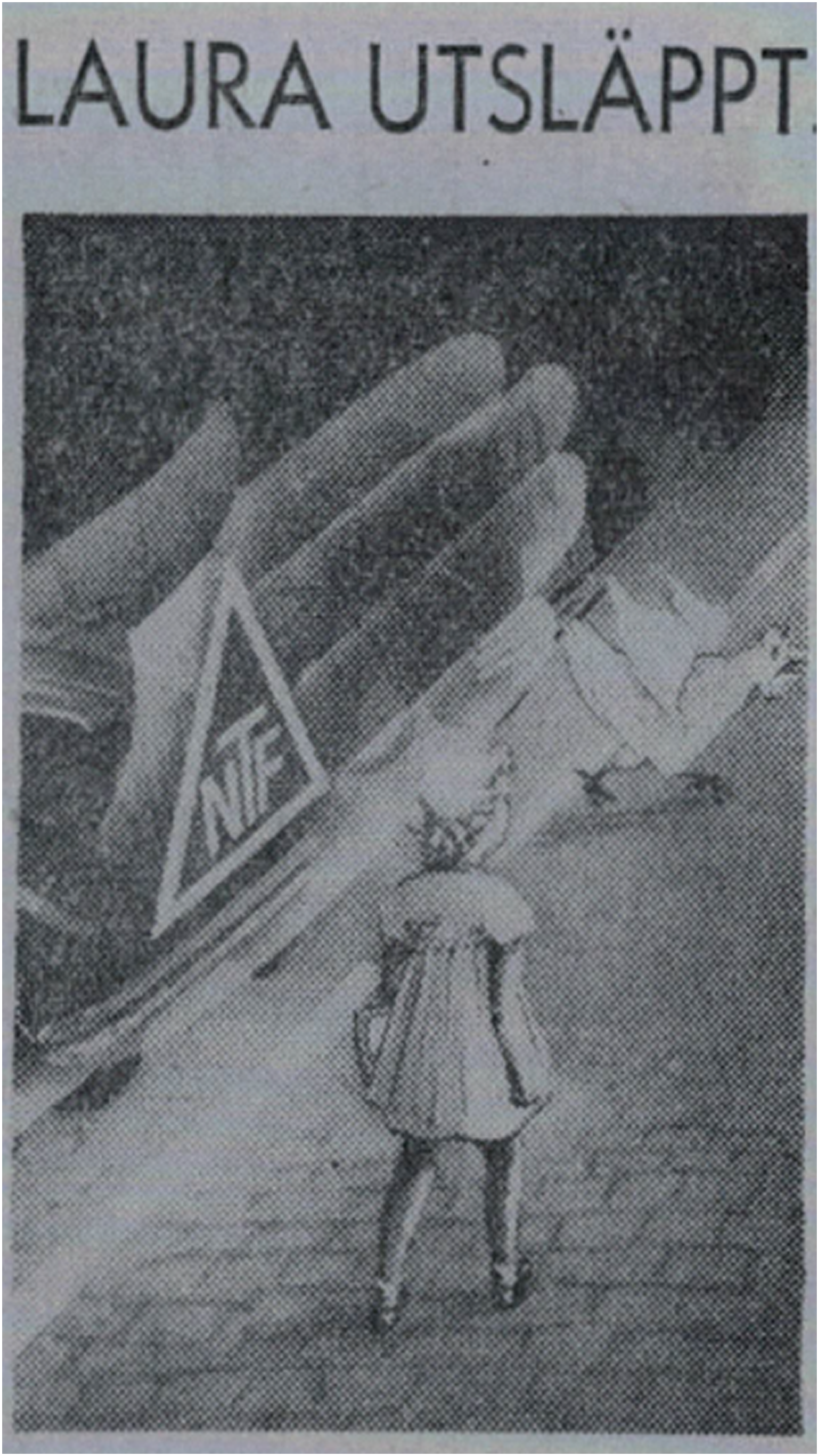
“Laura released.” In their mid-1930s campaigns, the Swedish National Traffic Safety Association (NTF) used a hen, named Laura, to allude to the allegedly irrational behaviour of pedestrians. Image reproduced from Aftonbladet, 9 April 1936.
Fast-forward some 30 years and Laura reappeared, now as a 1.5-meter high and equally wide welded copper plate sculpture at Norrmalmstorg, a square in central Stockholm and an interchange in the city's bus network (Figure 2). This Laura, whom we will call Laura no. 2, was created in 1970 by the Swedish sculptor Ebba Hedqvist. Apparently chosen due to her previous work with metal bird sculptures, the city had commissioned Hedqvist to make another to adorn the upcoming refurbishment of Norrmalmstorg. With many people still having Laura no. 1 (the whimsical, irresponsible hen pedestrian) in fresh memory, yet being created in a new context of nascent criticism of urban automobility, Laura no. 2 became the subject of mixed feelings. Hedqvist argued that Norrmalmstorg was the perfect place for the sculpture, since “Laura needs to have life and movement around her… She will sort of run with everyone else, afraid of the cars. And at the same time perhaps be a little reminder about whimsiness.” 4 The press picked up on how Laura would be “a personification of all whimsical pedestrians”; she would “remind” or “warn” them about the dangers of crossing the street blindly. 5 Politicians of different stripes seemed to agree. Situated in “one of our worst traffic spots”, one city councillor argued, Laura could serve as a “warning signal” to pedestrians, while another referred to the sculpture as “a little ironic illustration of how many people behave in traffic in our city.” 6
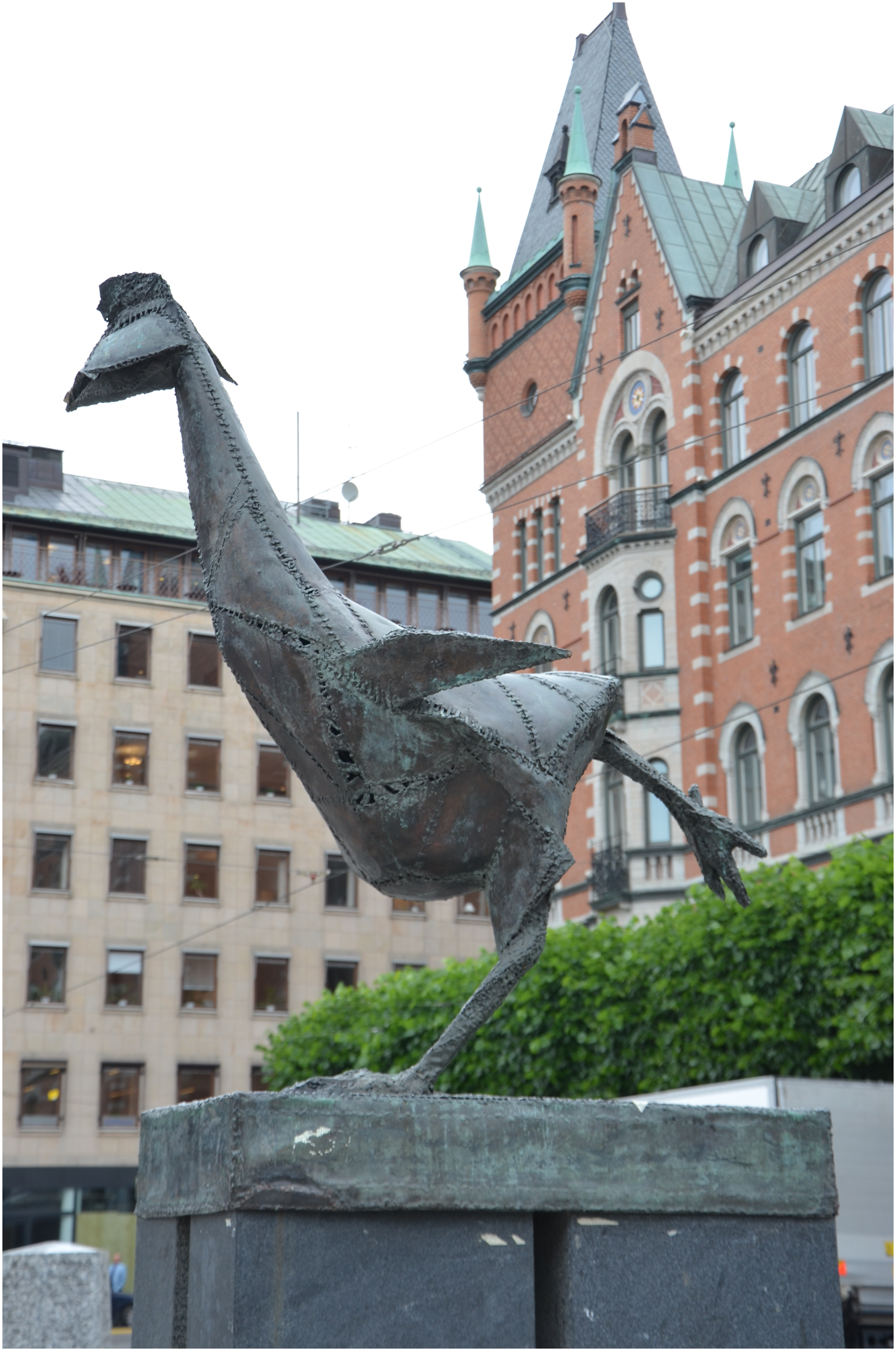
Ebba Hedqvist's sculpture “Laura”, Norrmalmstorg, Stockholm. Installed in 1971, contemporary observers variously saw it as portraying pedestrians as irrational, scared by, or angry about the surrounding traffic. Photo: Bengt Oberger, 2013, CC BY-SA 3.0, via Wikimedia Commons.
While these commentators confirmed and appeared to appreciate the connection to Laura no. 1, others interpreted the sculpture in light of pedestrians’ precarious situation in increasingly car-oriented cities. To them, Laura was “confusedly and angrily trying to escape from the cars” and displayed “the fear of cars that many pedestrians feel.” 7 Jan Olof Mallander, a critic on Dagens Nyheter's culture pages, was highly critical towards the “cynical” message from the past that he saw in the sculpture. In a situation when pedestrians already risked their lives on the streets of Stockholm, now they were also mocked and humiliated by Laura. 8 According to the secretary of the municipal board in charge of public arts in Stockholm, however, critics such as Mallander had confused Laura no. 2 with Laura no. 1. “The symbolism”, he argued, is precisely that the sculpture mirrors the difficult situation of the pedestrian. Laura is a monument of how pedestrians are made to react in this kind of city!” 9
Laura exemplifies several themes addressed in this special issue. 10 Taken together, Laura no. 1 (the whimsical) and Laura no. 2 (the victim) reveal – and the contributions here will further qualify this – the changing conditions of pedestrians during the twentieth century as well as the relationship between these conditions and how pedestrians were labelled and defined. On the one hand, the labelling of pedestrians was key to their marginalisation, in particular as they were backed up by material innovations, which is another topic of the contributions. On the other hand, as pedestrians were marginalised, new definitions emerged and layered with previous ones. The example of Laura also points to the importance of institutions and stakeholders – in this case, NTF – in orchestrating shifts in responsibility and access. Finally, although we have not made it explicit above, events in Stockholm and Sweden were influenced by developments elsewhere, while they were in turn inspirational to social actors in other places. Hence, in August 1937, the director of NTF reported to the press that Oslo would follow the Stockholm example with a behavioural campaign aimed at pedestrians – most likely a result of the positive mention at the Nordic marketing congress during the spring. Whether Oslo would also “‘import’ Laura the hen”, however, remained to be seen. 11
Below, we will first position the contributions of this special issue in the small yet growing scholarship on the history of urban walking. With this short historiography as a basis, we then outline what we hope is a useful conceptualisation of “street-level modernity” and the production of orders and (in)equalities in urban mobility. We end by proposing some venues for further research, not least how historical mobility scholarship might benefit from tracing not only the many attempts to govern urban walking but focus more on the mundane practices by foot.
Histories of walking in European cities
Scholarship on the history of urban walking forms a master narrative of control and marginalisation. During the twentieth century, in increasingly car-oriented cities, pedestrians were pushed aside by means of traffic rules and police control, planning and designs. The articles of this special issue – spanning some 150 years from the late nineteenth century into our present days – in many ways confirm this narrative. They shed light on a wide range of gradual changes whereby informal rules, norms, discourses, laws, enforcements, material scripts, designs and technological functionality cornered pedestrians and imposed certain walking practices in urban settings and beyond. They were largely the results of various stakeholders trying to manage pedestrians’ coexistence with cars on city streets. Indeed, we posit that the changing conditions to walk in cities are hard to appreciate without considering the coming of car cities. That is not to suggest that the outcome was predetermined. The contributions here also show that things could have been otherwise. They reveal the work needed to control and marginalise, while they also testify to the existence of pedestrian subversion and opposition as well as alternative discourses that at times changed or temporarily changed the dos and don’ts by foot.
Broadly conceived we suggest a periodisation of the coming of car cities in anticipation and breakthrough. In a European context, we position such a breakthrough to the post-World War 2 period. Historical scholarship on urban walking has prioritised the first half of the twentieth century (i.e. the period of anticipation), when the future of urban mobility was still very much up for grabs. Focusing on various social actors and ways to govern pedestrians as well as motorists, scholars largely agree that, although policymakers and experts often tried to balance the perceived needs of different road user groups, ultimately, they prioritised car traffic flow over pedestrian safety and accessibility. 12 Peter Norton's pioneering work highlighted the importance of labels, discourse, and imaginaries in the process. In launching the derogatory term “jaywalker” to signify a pedestrian in lack of appropriate manners, for example, motoring interests were able to reinterpret streets as places where cars belonged. It made it legitimate to control and adjust pedestrians, facilitate urban automobility and press for the realisation of car cities. 13
In her analysis of liberal governance of mobility, Hagar Kotef differentiated between “(I) the citizen…as a figure of ‘good’, ‘purposive’, even ‘rational’, and often ‘progressive,’ mobility that should be maximized; and (II) other(ed) groups, whose patterns of movement are both marked and produced as a disruption, a danger, a delinquency.” 14 Using Kotef's analytical lens, “jaywalkers” were embodied others. The cultural politics involved also comes across in our opening example of Laura, the whimsical hen. As a female, the pedestrian became gendered and differentiated against modern, male (auto)mobilities. As a whimsical hen, the notion of the pedestrian became primitive – animalistic even. Like “jaywalker”, Laura the hen alluded to the rural backwaters that had been outrun by the modernity of urbanisation. The metaphor of Laura smeared rooted injustices (gendered and urban/rural) in interwar Sweden to the pedestrian. The examples of pedestrians being given belittling or derogatory names to imply their irrational or clumsy behaviour can be manifold, and, as Tiina Männistö-Funk (this issue) shows, did not stop in the interwar period.
While traffic safety campaigns and motoring interests framed pedestrians as irrational, other efforts discursively narrowed down the meaning of walking even when they were considered good and purposive citizens. For example, in Estonia in the interwar period, as Tauri Tuikene (this issue) shows, the word liikleja was invented to define a pedestrian as someone who participated in traffic as a rational and purposeful road user. Meanwhile, the English word pedestrian, like the French piéton, links walking to the sphere of banal, mundane and ordinary activity. Taken together, in the first half of the twentieth century, pedestrians were discursively reduced to road users on foot. If they failed or refused to play their role, they were framed as unruly or irrational, which helped render cars in city streets legitimate. However, words and definitions, and how they were performed, are only part of the story. We will return to this.
In the post-World War 2 period, European car cities were increasingly realised through urban planning. Traffic experts and urban planners, looking at developments in the United States, understood the coming of car cities as inevitable and part and parcel of societal progress. Anticipating mass automobility, they planned and realised a refurbishment of cities to accommodate cars with road infrastructures and parking facilities, while suburban areas were organised with separate networks to parcel out motorised from other traffic. 15 As the builders of emerging car traffic systems shaped dominant problem definitions, they often reduced pedestrians to the groups that featured particularly often in traffic accidents: children and the elderly. As Tiina Männistö-Funk (this issue) shows, the Finnish traffic safety association Talja continued to highlight pedestrians' responsibility as a traffic mode among others, while also framing them as reckless, invisible and, not least, weak. Hence, if pedestrians had, in the anticipatory period before World War 2, been framed as problematic road users in need of discipline, now pedestrians were increasingly interpreted as weak road users in need of special care and attention – a transformation mirrored in the two Lauras (nos. 1 and 2) in the vignette. The measures taken to safeguard them, however – traffic signals, pedestrian tunnels, etc. – often came with longer waiting times and detours that made walking a less appealing practice. 16 Meanwhile, as Cedric Feriel (this issue) shows, even pedestrian streets and precincts – commonly understood as pedestrian-friendly policy appearing already in the 1950s – were integral to the creation of the modernist car-centred city. These pedestrian reserves, small islands in a sea of car infrastructures, only pinpoint the overall car-oriented context in which they were (and are) implemented.
A couple of qualifications are in place. One regards the common understanding (shared in this introduction) of the marginalisation of walking as the downside of car-centric cities. However, as Martin Emanuel (this issue) highlights, the process of redefining streets, creating hierarchies, and labelling pedestrians started in pre-car times. The creation of pavements, for example, was initially as much about providing comfortable surfaces for respectable walking as it was about providing pedestrians with a space safe from traffic, and the usage of pavements was the subject of struggles of its own, where pedestrian flow got the upper hand versus more subsistence-driven usages. 17
What is more, despite the seemingly unstoppable rise of automobility in the twentieth century, people continued to walk. Although often neglected, pedestrians remained an important part of urban mobility. 18 Neither were (nor are) pedestrians easily controlled and fitted into urban traffic systems in the way experts imagined. In fact, the various attempts to govern pedestrians often failed, or succeeded only partially, as pedestrians defied the intentions of the designers. 19 As we have shown elsewhere, what motoring interests understood as rebellion or bad manners, many pedestrians simply found to be the safest way to cross the street. 20
The various attempts to control walking were not only resisted in everyday practice. Urban automobility was also vocally resented and practically challenged by individuals and various social groups, such as mothers who cried out against children being killed in traffic or who feared that the sociality of their streets was at risk as they were taken over by cars. 21 Less commonly, as in the case of the UK, pedestrians had institutional backing from a Pedestrian Association, which, however, struggled to make their claims heard in increasingly car-oriented societies. 22 If critiques of urban automobility were always present, in the late 1960s and the 1970s, in a context of counter-cultural movements and urban environmental activism, for a moment, they gained in strength. In this context, pedestrians were called upon in the critiques of the car city. In Finland, the traffic policy association Enemmistö made use of pedestrians to display what they understood as an unjust traffic system and urban environment, yet they ultimately failed to translate their concerns into the sort of policymaking that would have challenged the car as a norm. “Pedestrians were everyone and no-one”, Männistö-Funk (this issue) writes, and the difficulty to define them brought difficulties not only in enforcing rules but also in terms of advocacy.
Since the 1970s, proponents of walking have exclaimed, with some regularity, a pedestrian renaissance. Yet, as Barbara Schmucki argues regarding the UK, despite new voices and new research that made pedestrians heard and seen in the 1980s and 1990s, “actual policy totally ignored the needs of walkers” – one exception being pedestrian shopping precincts. 23 Nevertheless, the contributions of this special issue show that the increasing interest in policy and planning for walking has come with, or at least been paralleled by, a gradual opening up of the definition of the pedestrian. Cedric Feriel (this issue) points to how early pedestrianisation policies framed, in a context of revitalising city cores, pedestrians as consumers – a feature that is strong to this day. Despite present-day pedestrianisation advocates claiming the contrary, there is a clear link between their own programmes and those of the early post-war period. 24 Meanwhile, Breen et al. (this issue), in their treatment of the long process in the UK to make the countryside accessible to people with a range of physical or other disabilities, add another category to those of children and the elderly as pedestrians in need of particular consideration. Importantly, however, as Tauri Tuvikene (this issue) shows, notwithstanding this opening up of understanding of what it can entail to be a pedestrian, past perceptions of pedestrians as walking road users, and their shortcomings in this regard, remain strong among traffic experts. More holistic views of what it entails to walk have yet to break through in traffic policy circles.
This special issue engages with European histories of urban walking. This is not to imply that there is necessarily something particularly “European” about them; it is rather a geographically grounded delimitation. The cases brought together here centre on capital and large cities in the north-western and eastern parts of Europe, leaving out southern Europe. That being said, the findings here and in previous scholarship allow for cross-case comparisons and seeing wider trends, as indicated above. Some similarities are probably due to the transnational circulation and local appropriations of governance strategies and various scripts to control pedestrians. Such circulation did not stop at the European continent, of course. Using North America as inspiration for building car cities in Europe has already been noticed. Cedric Feriel's article (this issue) on pedestrianisation moreover shows how ideas moved not one-way but circulated back and forth across the European continent, as generations of pedestrianisation policies succeeded one another. Many innovations in traffic control, urban designs, as well as traffic safety campaigns and problem definitions around pedestrians travelled across Europe and beyond. Yet their diffusion (or, better, as we will argue below, their translation) appears to have followed a similar pattern: with some simplification, they tended to appear first in the United States, then in the United Kingdom, to later spread among cities in north-western Europe, reaching the eastern parts at a later stage. To some degree, this reflects different patterns of modernisation: levels of urbanisation, economic growth and related car ownership levels as well as available resources to realise car cities. Hence, it is no coincidence that the tradition of rural walking, as highlighted by Breen et al. (this issue), is particularly strong in the UK, which urbanised very early, giving rise to a strong wish to seek refuge from supposedly crowded modernity in the British countryside.
Thinking in terms of diffusion, however, comes with a risk of reproducing post-war traffic planners’ views about car cities as an unavoidable result of modernisation. The contributions in this special issue, and the workshop in which the manuscripts were originally discussed, have inspired us to challenge, in the following text, mobility-related “modernity-explanations” by instead addressing how “modernity” is locally situated and made in the streets. Bruno Latour preferred translation to diffusion. While diffusion suggests that change is driven by some diffuse progress, he argued, translation shifts the explanatory power to the efforts of those societal actors who refer to progress to legitimise change. 25 In attending to local and situated change, the contributions of this issue point to how the “diffusion” of modernity was in fact a question of how ideas, labels, visions, local governance, agendas and materialities were locally introduced and adapted. For example, how pedestrians had to be “caged” – to think again of Laura the hen – before cars could be welcomed in Swedish cities.
Street modernities
“Modernity” at times takes a position as the mother of all explanation. Exhibited variously in labels such as urbanisation, industrialisation, standardisation, rationalisation, globalisation, and Americanisation, modernity tends to be understood as entwined with notions of mobility that have side-tracked the ephemeral, the disruptive, the slow and the disorganised. 26 Yet while modernity is a persuasive concept for capturing large realms over longer periods of time, it becomes more elusive when studying street-level processes of the everyday. Hence, many scholars within the new mobilities paradigm (and the social sciences in general) perceive modernity less as an explanation than as something that needs to be explained. In this spirit, the contributions in this special issue provide insights into the makings of modernity by focusing on street-level orders and (in)equalities. Taking a street view is thus methodological. It allows us to perceive things from the perspective of Laura, either by sympathetically interpreting how pedestrians are restricted by spokespersons and actors who govern the streets (and the countryside) or, as in the case of Emanuel's article (this issue), by explicitly trying to capture the “view from the street”.
Urban streets have a long history of being institutionally organised by society (or the commons) as a place to meet, disagree, dispose of waste, etc. Streets were communal and as such a place for all. On the micro-scale one could even argue that the streets are the seminal stage upon which larger social orders – or societies – are constructed and played out: by the pedestrians, the beggars and thieves, the bailiffs and everyone else, with or without authority. As such, the street, the pavement or the path are arenas where democratic ideals are put to the test and orders revealed. 27
By looking at those that move by foot, the contributions in this special issue reveal various ways in which such orders – discursive and material, interactional and institutional – are produced and negotiated. They provide examples of how both citizens of mobility as well as the other(ed) disobedient bodies are discursively defined: articulated and defined, supported and suppressed. The articles also follow the discussions, debates, negotiations and agreements around pedestrians and different forms of mobility taking place in rooms of power. From the political platform of the British Labour Party in England (Breen et al., this issue) through the design ideals of a modern urban core (Feriel, this issue) to the conflicts between the Finnish traffic safety association Talja and the activists within Enemmistö (Männistö-Funk, this issue). In these negotiations, institutional orderings evolved at the cross-section between the use of place and the institutional mundane governing of that place. 28 The street view also provides insights into interactional orderings, the way the streets are organised in situ by those that collectively use the street simultaneously and thereby together create a workable order (Emanuel, this issue). 29
The street level in this perspective includes the material powers of infrastructures and other artefacts: kerbstones and street surfaces, benches and lampposts. 30 They are what Bruno Latour calls “the missing masses” that guide us in the way we understand and engage with others on the street. 31 While they assist us by reducing the complexity of interacting on the street, however, the contributions here also point to the programming that materiality entails – that is, its contribution to the (un)equal ordering of streets.
As stated previously, streets are a challenge in that they become places where democratic ideals, such as equality, are put to the test. They become the breeding ground for equalities as much as inequalities – inclusions as much as exclusions – as illustrated in the creation of “the laura” as a whimsical female/hen that could subsequently be excluded from street access. As such, the street is a stage where (un)equal orderings are enacted. 32 However, the history of European walking practices and their governance also reveal, we propose, a change in the forms of equality. As with many other concepts of grandiloquence (such as objectivity, ethics or power), what we understand as equality changes in time; it is contextual and relational. We suggest that within the period in question here, mechanical equality grew in importance at the expense of embodied equality. 33
Equality has been defined as “an ideal of uniformity in treatment or status by those in a position to affect either.” 34 Hence, on the street, the co-equal treatment of each other requires an organisation of mutual respect and reciprocity – what Richard Sennett referred to as “civility”. 35 Such mutual organisation has to be achieved by those who are co-present in the street. As pointed out by Emanuel (this issue), the inequalities and status that were staged and maintained on the pavements in late-nineteenth-century Stockholm required considerable work by the co-present cohort. We suggest calling this embodied equality, as the person, in relation to other persons, establishes the presence or absence of equality. Embodied orders (e.g. those organised small societies of baboons studied by Shirley Strum) are difficult and tedious to maintain and the bodies themselves – height, sex, age, weight, agility, strength and so forth – provide a variation that can quickly become organising principles for differentiation in treatment. 36 Add wealth in attributes and clothing and we have materialities that provide further ordering principles for (in)equalities. Bodies afford variations that are incorporated in the making, or failing to make, equality.
With mechanical equality, we refer to the reduction of the importance of the abilities and expressions of the body by the introduction of tools, techniques and technologies. For example, there are obvious discriminations and inequalities between a person impeded in movement (e.g. limping or being old) and the fit jogger on a street, the jogger being able to do things that the person with limited movement cannot. However, as both are moved into the driver's seat of a car, for example, their positions in relation to each other become more alike, equal. Locating both in similar forms of cocoons enables them to rely on their ability to manoeuvre the car rather than the strength of their muscles. Hence, equality is mechanically achieved rather than weighted on their physical abilities. Materialities, together with labels, we argue, are key in understanding how (in)equalities are made.
Drawing on Latour's emphasis on the role of materiality in making societies, we can see that the materialities of the street extend and enhance embodied (in)equality. The able body can avoid traffic regulations by crossing the street in inconvenient places, or roaming and running across farmers’ fields, whereas the limited (victimised) body is confined to traffic signal-regulated crossings (that can give you too little time) or pedestrian tunnels (inaccessible for those in wheelchairs). Similar technologies such as traffic lights are equally ignorant to the jogger and the person in the wheelchair (treating them equally), even though the experiences of the time allotted to them may be radically different. As this example illustrates, materialities can shift the condition from an embodied (in)equality into a mechanical equality. In cars they are equal, however, only as long as they stay in the car, which also implies that they are (un)equally chained to this materiality and the equality it affords.
Considering street modernities, we see that the anticipation of the car city and the expansion of (auto)mobility provided an expansion of mechanical equality, but as pointed out by Mimi Sheller and others, only to a limited degree. To people of colour, for example, driving can still be a dangerous undertaking in the USA. 37 Between these dystopian (in)equalities of materiality, the pedestrian remains remarkably immune to modernity. In a sense, and to paraphrase Latour, the pedestrian never became really modern. The pedestrian as a street participant has been subdued and othered by mechanical (in)equality of automobility, yet it is still embodied, as emphasised in the growing corpus of pedestrian studies within the social sciences. 38
These contemporary studies of walking practices, inspired variously by Michel de Certeau and phenomenological or post-phenomenological thought, have highlighted the importance of the body and its ability to sense the surroundings. 39 Walking has even become its own legitimate method in walkalongs. 40 Although perhaps in a less explicit fashion, the sensuousness and the experiences of walking, hiking and running are apparent in the contributions of this special issue. Breen et al. (this issue) highlight how the practice of moving is dependent on infrastructure, where the feeling of inclusion or exclusion is related not only to property but also to the obstacles of the surroundings. Feriel (this issue) details the aesthetic appeal of the pedestrian street for the pedestrian, and how designers tried to adhere to these qualities. Meanwhile, Emanuel (this issue) shows how the ability to see others on the street depended on the capacity to look up from the (un)reliable surface of the street. As such, the contributions are a small but important expansion of the history of the senses in mobility history studies. 41
Taken together, these studies root the practice of walking in its embodied state, a feature that makes walking a fascinating phenomenon to study. (Auto)mobility and urbanisation have brought friction in the use of streets, where the utterly embodied practice of walking requires attention to a surrounding managed through the logic of mechanical equality. Looking at the street level provides a tale of materiality and embodiedness that did not disappear, however, with the mechanical equality of the car. Yet pedestrians were made second-rate inhabitants of streets that were increasingly defined through, and in relation to, the dominance of automobility. The contributions of this issue – or at least our interpretations of them as guest editors – provide an alternative explanation of the persuasiveness of modernity by highlighting the (un)equal footing between mechanical equality and embodied equality.
Beyond the transport system
The contributions in this special issue provide insights into different stages where pedestrian (in)equalities were enacted. As such, they provide clues on how mobility justice might be achieved. 42 Breen et al.'s article (this issue) on the right to roam in the UK provides an overview of the political process in which access and the right to mobility are provided but also transformed. Similarly, Männistö-Funk (this issue) provides insights into the political stage of pedestrian (in)equality in Finland. Her article, like Emanuel's (this issue), also mirrors the enactments of pedestrians in the public realm, through their everyday practice as well as by making claims in public press. Finally, the grey suits of modernity – the bureaucrats, designers, planners and regulators – are also important cohorts that shape the street, its use and limitations. Through the contributions, we see by and for whom and where the construction of (in)equality was made. The articles also provide an understanding of how: the language and practices in the politics of making public streets. Unequal footings were produced not only in the streets, but also in newspapers and committee rooms, as well as in the planning and design departments. As such, some tentative proposals can be made for equal footing. Walking entails bodily movement and as such, under the dominance of automobility, it has been rendered second-rate mobility. Similar to how Simone de Beauvoir's seminal reflection on the “second sex” sparked a reaction against gender inequalities, we propose that the inequalities of walking could be a starting point for questioning the hegemony of mechanical (in)equality. 43
Je suis Laura! The eponym “laura” became part of Swedish everyday vocabulary. In 1954, the students at a girls' school in the Swedish city of Linköping named their school magazine Lauran (the laura), while the building was described as “the henhouse”. 44 A traditional institution, the girls’ school in Linköping opened in 1949, in the midst of a transition towards a more modern society with new gendered relations geared, at least in theory, towards equality. In 1963, it was incorporated into a school for both boys and girls. Making Laura the hen a symbol of the identity of being a student at the school, the girls made use of the dual meaning of the hen: as unreliable and disoriented on the one hand, and as protective and loyal on the other hand. Hence, their description of Laura can be seen as having both acknowledged gendered notions of inequality and subverted the othering that the girls were facing. We interpret their use of Laura as a tactic of empowerment: as a symbol of the outdated, rural and traditional, supposedly standing in the way of progress and modernity, the use of the word became in itself modern. The duality between traditional and modern could thus be played out. Hence, the transformation of the Swedish school system in the 1950s was enacted also on the micro-scale of the schools, in reinterpreting the gendered norms of the laura.
The subordination of pedestrians to the system of automobility is not unavoidable. The whimsical hen could become a symbol of liberation of pedestrians – we could call it Laura no. 3 – in the same spirit as how it helped the students in the girls’ school in Linköping to subvert the gendered roles they had been prescribed. As we saw in the opening vignette, some commentators indeed interpreted Ebba Hedqvist's sculpture in 1971 (Figure 2) in this way, not as a mere victim but as symbolising pedestrians’ indignation over their situation in city traffic. As many of the contributions in this special issue testify, the persuasive control surrounding pedestrians enables us to question the orders and organisations that inhibit them. In light of “smart” or “liveable” cities, we argue, this is not accomplished by extending mechanised equality into recreated, artificial islands of idealised pedestrianisation as exemplified in the designs of pedestrian streets (Feriel, this issue). Instead, we suggest bringing the pedestrian – whether a Laura or a piéton – to the forefront and to revalue the status of pedestrians, with their embodied (in)equalities, rather than creating reserves for containment. The articles in this special issue highlight the importance of the mundane and taken for granted that upholds and maintains the systems of mobility. More research is needed and we believe that studies into the histories of mundane walking practices would be particularly prolific.
Furthermore, there is a co-production between interaction, language and regulation – a mundane governance – that is enacted on the street level. 45 As such, these histories connect to the experiences of everyday life and the ontologies that the members of a society revolve around. It connects to the democratisation of societies by returning to the arena of the commons. This, we hope, will lead to a multiplicity of understanding pedestrians – including but not limited to Laura nos. 1, 2, and 3; the disordered, the victim and the empowered) – instead of remaining in the hegemony of automobility that for so long has overshadowed the history of transportation. The reflection by Tuvikene (this issue) is one example; Massimo Moraglio's call for new ontologies in mobility history is another avenue. 46 This proposition will include the challenge of identifying pedestrians and their rights. This, as shown in the articles of this special issue, includes further studies of the norms that they act upon and their embodied (dis)abilities. As such, we propose a mobility (history) beyond the transport system – an understanding of the logics of Laura instead of the rationality of logistics.
Footnotes
Declaration of conflicting interests
The authors declared no potential conflicts of interest with respect to the research, authorship, and/or publication of this article.
Funding
The authors disclosed receipt of the following financial support for the research, authorship, and/or publication of this article: This work was supported by the Svenska Forskningsrådet Formas (grant number Dnr. 2019-01941).
