



Abstract
The amphibian Xenopus laevis is an alternative animal model for developmental biology and toxicology. The Frog Embryo Teratogenesis Assay-Xenopus (FETAX) stands as a validated test for ecotoxicology and chemical hazard characterization. Conventionally, fertilized eggs are obtained through adult hormonal injection. In adherence to the 3R principles, our proposed method offers the opportunity to obtain embryos through natural amplexus, rearing adults in controlled conditions that replicate the most favourable environmental parameters.
Introduction
The amphibian Xenopus laevis serves as an alternative animal model for developmental biology and toxicology. Besides the Xenopus Eleutheroembryonic Thyroid Assay and the amphibian metamorphosis assay for detecting chemicals acting on the thyroid axis,1,2 the Frog Embryo Teratogenesis Assay-Xenopus (FETAX), developed by Dumont and colleagues in 1983, 3 was later validated by the American Society of Testing and Materials in 1998 4 as an alternative screening test for hazard characterization of chemicals and mixtures. FETAX is conducted on X. laevis mid-blastula stage embryos during the organogenesis period, considering that early embryonic development in amphibians mirrors many of the major processes of mammalian embryogenesis. To obtain fertilized eggs, FETAX involves adult hormonal stimulation, specifically intra-lymphatic injection of human chorionic gonadotropin (hCG).4,5
Before the introduction of hormonal stimulation, X. laevis bred in captivity were tentatively induced to reproduce by mimicking seasonal water temperature variations, as described by Bles in 1906. 6 This involved daily changes of aquarium water, allowing it to cool and then slowly return to 22°C, simulating seasonal rains. The main limit of this method was its applicability only during spring. Hormonal injection was later introduced by Nieuwkoop and Faber (1956), 7 considering that hCG stimulates X. laevis egg deposition throughout the whole year, but a two/three-month resting period is needed.8,9
We tested a new protocol simulating optimal environmental breeding conditions supporting natural mating without exogenous hormonal exposure. In nature, X. laevis mating occurs at night during spring. Mating-prone females exhibit cloacal flaps, while males develop darkened nuptial pads (melanin accumulation on the underside of their forearms). 9 Amplexus, a dorsal pelvic mating embrace, takes place. Females typically lay hundreds of eggs during the 3–4-h event, deposited in a jelly matrix. Males release sperm into the water, and fertilization is external.
Based on the belief that X. laevis frogs are hardy and robust, capable of tolerating a range of environmental conditions and experimental procedures, conventional husbandry parameters suggested by the literature include 12–14 h of light and 10–12 h of darkness; water depth of 10–15 cm; water temperature ranging from 16–18°C up to a maximum of 24°C; water pH between 6.5 and 8.5; water conductivity of 50–2000 μS/cm; and a recycling flow rate of 10–50 ml/min.10–12 However, these parameters seem inconsistent or incomplete for mimicking the environmental conditions necessary for natural mating. Therefore, we established additional breeding conditions to facilitate successful natural mating. These parameters aimed to reduce potential animal distress and the number of bred animals, in compliance with the 3R principles proposed by Russell and Burch. 13
Methods
Our X. laevis facility comprised 12 never hCG-injected adults (NASCO wild type strain: five males and one female; NASCO albino strain: one male and five females) purchased as sexually mature in 2017 (Xenopus1, Michigan, USA) and 2018 (Nasco, Wisconsin, USA). Our stock comprises the majority of albino females and the majority of wild-type males in compliance with our scientific purposes: albino embryos are preferred (bleaching is in this case not needed in the case of immunostaining of NF 13–26 embryos) while, considering that pigmentation in melanocytes is a good parameter to detect neural crest cell migration defects, embryos obtained from wild-type males allow to evaluate pigmentation defects. Breeding conditions were arranged to simulate ‘spring conditions’, including air temperature (20 ± 2°C) and relative humidity (40–60%) as sensitive parameters. Parameters and animals were monitored daily by qualified technicians, and adults were fed twice a week (using XE40 by Mucedola, Settimo Milanese, Italy). The presence of pathogens was checked twice a year or, if requested, after weekly veterinary inspection.
The animals were maintained in reconstituted water (osmosis water with added salts) in a water recirculating housing system (XenopLus, Techniplast, Italy), following the guidance on the housing and care of the African clawed frog X. laevis. 12 Water parameters were set at temperature of 20.5 ± 1°C, pH of 7.5 ± 1, conductivity of 1150 ± 250 µS, with a water flow rate of 30 ml/min. All water quality parameters were continuously monitored 24 h per day and displayed on the touchscreen system controller of the XenopLus systems. The husbandry system featured brownish tanks (27l, water depth 13 cm) enriched with hiding refuges and plastic water lilies (Figure 1(a) and (b)). Animals were housed in groups (3–6 animals per tank) to ensure social behaviour, free swimming, and hiding for each animal. Males and females were housed separately, while maintaining the same social groups. The ‘spring conditions’ set-up allowed 100% of adults to display a phenotype indicating readiness to mate: males, including albino males, exhibited the typical dark nuptial pads, and females were recognizable by swollen cloacal lips and sometimes a type of nuptial pad (Figure 2). Natural breeding was partially stimulated according to Bles, 6 who reported cycles of water changes aimed at cooling water temperature to mimic the effects of rain on ponds. Our protocol considers changes in both temperature and humidity parameters (rain conditions). In the morning preceding mating, 100% relative air humidity was generated at the top of the tanks using ultrasonic foggers (we utilized terrarium amphibian/reptile foggers with a tube, adapted by converging the tube on the tank top. Fogger specifications: power 25 V, maximum humidification 300 ml/h, actual humidification 200 ml/h, tank capacity 3l). The 100% relative air humidity was maintained until the end of the mating period. In the late afternoon, selected couples were simultaneously paired in mating tanks (one tank/couple) with water at 18°C, which were placed inside thermostatically controlled aquaria set at 22°C to allow the water temperature in the mating tanks to gradually rise to 22°C (Figure 1(c)). Since amplexus in nature occurs at night, overnight pairing was planned. The following morning, the adults were relocated to the rearing system, and mating success was verified by evaluating laid egg fertilization and embryonic stage under a dissecting microscope. Animals that were not mated were subjected to ‘rain’ stimulation twice a week until mating or for a maximum of seven cycles.
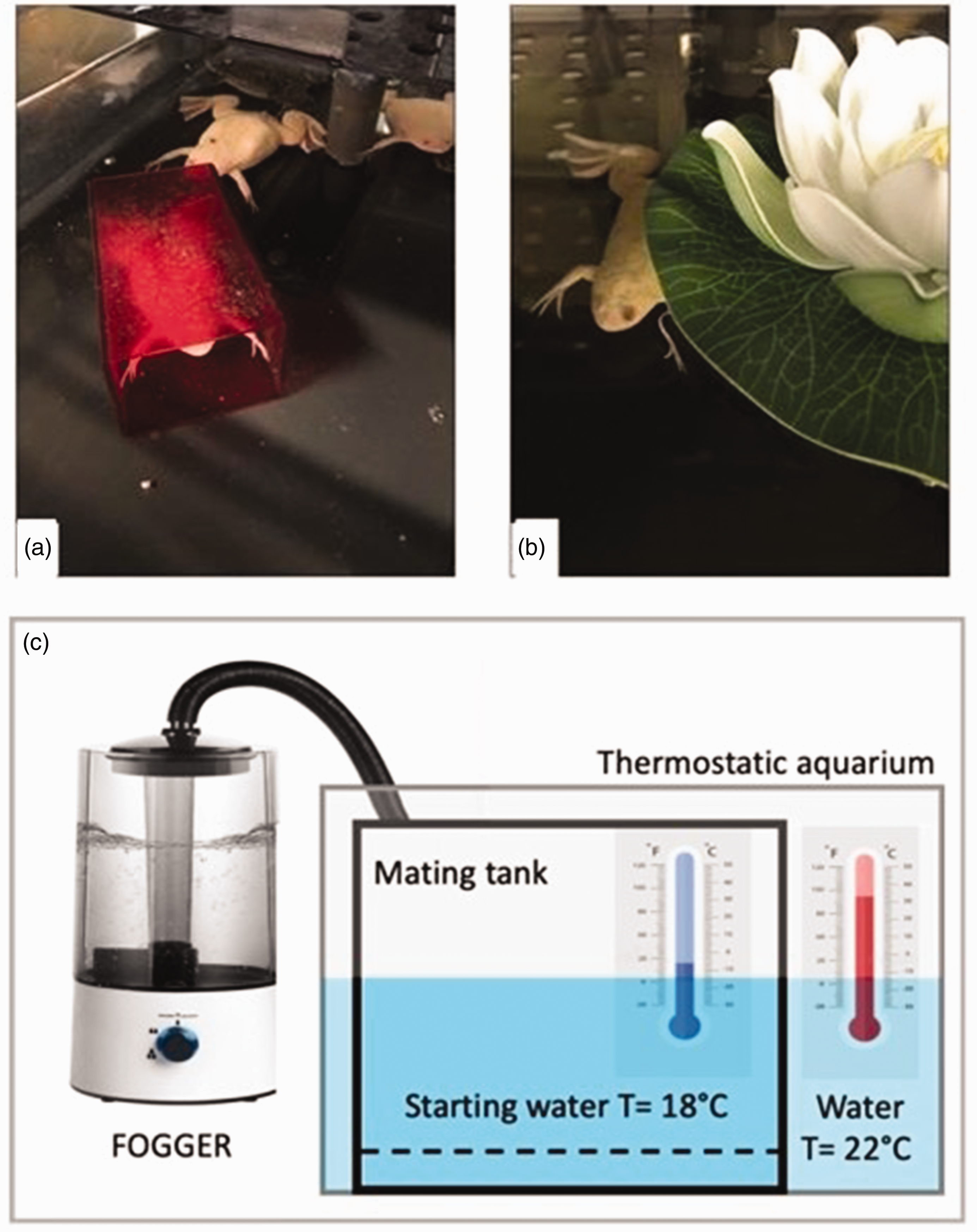
Enrichments (a, refuge; b, water lily) in the breeding tanks. (c) Mating housing system. T: temperature

Characteristics indicating that adults are ready for stimulation to mate. (a), (b) Nuptial pads formed by melanin accumulation on forelimbs of wild-type (a) and albino (b) males. (c), (d) Swollen red cloaca lips (c) and sort of nuptial pads (d) in an albino female ready to lay eggs.
Results and conclusions
Among the 12 stimulated adults, only two males (one wild type and one albino) were insensitive to the set ‘rain conditions’. The other adults paired successfully and produced a large number of live embryos (about 1500 laid eggs/deposition, with almost 80% vital embryos reaching blastula stages) capable of developing into healthy tadpoles. Staging in albino embryos was performed under a stereomicroscope with light-incidence set in order to visualize the morphological details as also described by Shan et al. 14 One to five ‘rain’ cycles were required to stimulate the first deposition and fertilization. A rest period of about three weeks was set and resulted sufficient to ensure another successful mating; by consequence, this method could be theoretically applied on each couple up to 17 times/year; in our experience we paired some couples a maximum of 10 times/year.
In conclusion, the protocol used in this study, in accordance with the 3R principle of refinement, minimized distress since hCG intralymphatic injection involves distress due to immobilization and pricking. Moreover, the hormonal peak quickly produced by hCG injection is far from the naturally environmentally-induced pituitary secretion. Finally, owing to the shorter rest period, fewer bred animals are required (3R principle of reduction).
We recommend the proposed method as the gold standard for animal welfare in facilities housing X. laevis for scientific purposes.
Footnotes
Acknowledgment
The authors thank the staff of Xenopus facility at the Università degli Studi di Milano.
Data availability
Data will be shared on demand.
Ethics statement
The study was conducted according to the relevant European (EU Directive 2010/63/EU for animal experiments) and Italian (Legislative Decree No. 26/2014) laws, rules and regulations. All procedures were examined and approved by the Animal Welfare Organization of the Università degli Studi di Milano. Facility authorization number: 198283; date: 19/12/2019.
Declaration of conflicting interests
The authors have no conflicts of interest to declare.
Funding
The authors received no financial support for the research, authorship, and/or publication of this article.
