




Abstract
Breast cancer is the most common cancer in women worldwide, underscoring the need for ethical and effective preclinical models to advance disease management. This study aimed to highlight the importance of humane endpoints in a rat model of mammary carcinogenesis undergoing ladder resistance training to evaluate and ensure the absence of animal suffering. Twenty-eight female Wistar rats were assigned randomly to four groups of seven animals per group: sedentary, sedentary induced (with N-methyl-N-nitrosourea (MNU)), exercised and exercised MNU-induced. At 7 weeks of age, the animals in the induced groups were injected intraperitoneally (i.p.) with the carcinogenic agent (N-methyl-N-nitrosourea; i.p; 50 mg/kg). The animals’ welfare was monitored using a set of biological characteristics. The resistance exercise training, started at 9 weeks old and comprised climbing a ladder three times per week for 18 weeks, gradually increasing the load throughout the protocol. Of 14 MNU-induced rats, 9 (64%) developed mammary cancer. Exercised rats tended to show delayed tumor ulceration despite larger tumor volumes. No significant differences in bodyweight were observed, although weight loss appeared earlier in sedentary-induced animals. Exercised rats exhibited more stress signs, including reduced grooming and one case of chromodachryorrhea, yet had lower tumor-related humane endpoint scores. Three rats were euthanised early due to tumor-related endpoints. Minor tail wounds occurred but did not affect exercise or welfare. These results indicate that, with careful endpoint monitoring, the exercise protocol is well tolerated and may improve performance in tumour-bearing rats, supporting ethical standards while allowing accurate investigation of resistance training effects.
Introduction
Breast cancer (BCa) is the most commonly diagnosed type of cancer in women worldwide. 1 The causes behind this complex disease remains incompletely understood and represent an extensive field of study. 2 Animal models have become an indispensable tool for conducting preclinical studies, investigating cancer biopathology and for assessing novel therapeutic interventions. Chemically induced BCa models are used widely used for in vivo studies of the disease, because these animals do not spontaneously develop BCa. 3 Nevertheless, although rodent models are undoubtedly valuable, they face limitations under the 3Rs principle, which emphasises the importance of continuously improving animal welfare standards.4,5 Humane endpoints are defined as one or more predetermined factors, either physiological or behavioural, that define a point at which an animal is experiencing distress, discomfort or pain. The concept of humane endpoint may involve a degree of subjectivity, as its application depends on the experimental context, disease model and the species studied.6,7 However, humane endpoints should always help to determine when intervention is necessary to improve an animal’s wellbeing and to prevent or alleviate suffering. In some cases, when an animal reach an established humane endpoints and its health is compromised, euthanasia may be required. In such cases, the study may be terminated early. It is imperative that humane endpoints are tailored to each specific research protocol, ensuring animal welfare and safety.
The endpoints regarding a rat model of mammary tumorigenesis have already been reported. 8 It has been shown that simple tumour alterations do not directly correlate with the degree of animal suffering, and all endpoints should be evaluated in combination. However, these endpoints require revision whenever a therapeutic intervention is investigated. Exercise is becoming increasingly recognised in the prevention and treatment of BCa, offering well-documented benefits, including improvements in patients’ quality of life.9–14 The use of animal models offer advantages to study exercise-related outcomes, as they enable the observation of systemic and local adaptations, as well as inter-organ communication, which are often unattainable in clinical trials due to ethical constraints on sample collection. 15 Although there is less preclinical research on resistance exercise than on aerobic exercise, there is evidence that it provides significant health benefits in BCa management, 12 including improvements in muscle strength and physical function, which are of paramount importance for patients undergoing treatment. 16 In animal models, resistance exercise protocols typically involve ladder resistance training (LTR),17–20 where rats climb a ladder with progressively heavier weights attached to their tails. By gradually increasing exercise intensity over time, it is possible to evaluate the impact of resistance training on the progression of BCa and the overall health in animal models. However, the implementation of LRT in a rat model of BCa faces significant technical and physiological challenges that must be addressed to ensure the animals’ welfare. LTR alone can induce physical and psychological stress in animals, which may have a detrimental effect on their welfare even in the absence of tumour induction.8,18,21,22 In this context, implementing humane endpoints is essential to carefully balance the exercise-induced stress and tumour-related effects, ensuring animal welfare. This study aimed to highlight the importance of implementing the optimal humane endpoints for a rat model of mammary tumourigenesis subjected to a LRT protocol.
Materials and methods
Animals
A total of 28 female Wistar rats (Rattus norvegicus), aged 4 weeks were acquired from Envigo RMS (Spain). The animals were housed in the animal facilities of the University of Trás-os-Montes and Alto Douro under controlled conditions of temperature (23 ± 2°C), humidity (50 ± 10%) and a 12-h light/dark cycle. Tap water and food (2014 Teklad Global Rodent diet, Envigo, Spain) were provided ad libitum throughout the study. Animals were housed in polycarbonate cages (Eurostandard Type IV, 598 × 380 × 200 mm) with fresh corncob for changing bedding weekly.
To minimise stress, acclimatisation sessions were conducted before the start of experimental procedures to habituate the animals to human contact and experimental handling. Gentle handling was defined as approaching the cage calmly, speaking softly, lifting the animals with both hands (avoiding tail lifting) and avoiding sudden movements or restraint during handling. Rats were allowed to explore the experimenter’s hands and forearms for 2–3 mins with the body loosely enclosed, and were returned to the cage immediately upon signs of stress or vocalisation. Rats were handled individually five times per week until the start of the experimental protocol (always at the same time of day) by researchers who later performed tumour palpation, injections and exercise sessions. During the protocol, animals continued to be handled similarly four times per week for the procedures, such as exercise, tumour palpation and routine cage changing. Environmental enrichment was provided, including two hard plastic tubes and paper strips in each cage. The health and hygiene status of the animals were monitored by our research team. All rats were certified as specific pathogen-free and showed no signs of infectious disease throughout the study.
The sample size was determined a priori using power analysis (α = 0.05; power = 0.80), for the primary outcome, mammary tumour incidence, based on differences reported in chemically induced breast cancer models in Wistar rats. A minimum of seven animals per group was required and were included, in accordance with the 3Rs principles. 23 All experiments were conducted in accordance with the European (Directive 2010/60/EU) and National (Decree-Law 113/2013) legislation on the protection of animals used for scientific purposes and approved by the Portuguese Ethics Committee for Animal Experimentation (Direção Geral de Alimentação e Veterinária; approval no. 04583) and the Ethics Review Body (Órgão Responsável pelo Bem-Estar dos Animais, ref.834-e-CITAB-2020).
Experimental protocol
After 1 week of quarantine and 2 weeks of acclimatisation to the laboratory conditions, animals were assigned randomly to four experimental groups of seven animals per group using a computer-generated random sequence (Microsoft Excel RAND function): sedentary (SD), sedentary induced (SD+N-methyl-N-nitrosourea (MNU)) (SD+MNU), exercised (EX) and exercised MNU-induced (EX+MNU). Each group included seven animals per cage. To reduce bias, blinding was used at several stages during the study. The researcher assigned to randomising animals was not involved in the experimental design or analysis of results. During the experimental procedures, the staff performing the interventions were aware of the group assignments, but the researchers assessing the primary and secondary outcomes and performing data analysis were unaware of the group allocation. Data coding was used to keep the statisticians blinded until all analyses were completed. At 7 weeks of age, the animals in SD+MNU and EX+MNU groups were injected i.p. with the carcinogenic agent MNU (50 mg/kg; Fluorochem, UK) and the animals in SD and EX groups received the same volume of physiological saline solution (0.9% NaCl; B. Braun, Germany). Following the MNU injection, the animals were evaluated on a weekly basis for health status, as described in the following section, and for the presence of mammary tumours, with palpation conducted twice a week by two independent and experienced investigators.
The animals that survived (25 animals) the 20-week protocol were weighed 24 h after the last exercise session and euthanised with ketamine (75 mg/kg, Rompun 2%, Bayer Healthcare SA, Kiel, Germany) and xylazine (10 mg/kg, Clorketam 1000, Vetoquinol, Barcarena, Oeiras, Portugal), administered as a single i.p. injection, followed by exsanguination via cardiac puncture. Ketamine/xylazine were administered using 1-ml insulin syringes with a microlitre scale and 26-gauge needles (B. Braun, Germany), to minimise the risk of visceral perforation. The plastic needle cap was cut so that only the bevel was exposed, shortening the needle. The total volume of the anaesthetic solution was on average 0.33 ml per animal, and the solution was prepared immediately before injection. Reflex responses were assessed before cardiac puncture by gently applying pressure to the paws to confirm the absence of nociceptive reflexes, and only animals exhibiting complete loss of reflex responses were subjected to cardiac puncture. Animals euthanised earlier in the protocol underwent the same euthanasia procedure.
Training protocol and animal performance
The LRT protocol, adapted from Padilha et al., 24 was performed for 18 weeks, and started at 9 weeks of age (2 weeks after tumour induction; Supplemental Material Figure S1). Weights were attached to the base of the tail using soft Velcro straps to ensure secure fixation without causing discomfort. Rats underwent a 5-day habituation period before formal training, beginning with unweighted climbs and progressively adding weight starting at 75% bodyweight (BW) with 30 g incremental additions. Maximum carrying load (MCL) was reassessed every 3 weeks (Supplemental Material). During each session, the animals completed four to eight climbs, each comprising 8–12 dynamic movements, while carrying 80% of their MCL. Training sessions were conducted three times a week (Monday, Wednesday and Friday), over the course of 18 weeks. The animals were engaged in physical activity in the dark cycle (from 8.00 a.m. to 8.00 p.m.) to minimise stress and because rats are more active at night. The lights were turned off and animal handlers placed a low-intensity lamp in a corner of the room to handle the animals. Positive reinforcement training was used during habituation and training sessions. Rats were rewarded with standardised small portions of whole grain cereal (Estrelitas, Nestlé, Portugal) to encourage voluntary participation. All experimental groups received identical rewards with standardised quantity and type of cereal to minimise potential effects on tumour growth and feeding behaviour.
MCL was calculated every 3 weeks, always in the same way. The animals began by climbing with 75% of their BW attached to the tails. An additional 30 g load was added incrementally. This procedure was repeated until the animal was unable to complete a full climb after three consecutive attempts. The weight used in the last successful climb was recorded as the animal’s MCL.
Animal welfare
The animals’ welfare was monitored using the list of biological variables (including BW), presented in Table S1 (Supplemental Material) and adapted from Faustino-Rocha et al. 8 Variables were measured weekly after quarantine (since tumour-induction at 7 weeks of age) until euthanised at week 20. The primary outcome measure was the presence and severity of humane endpoint signs. Secondary outcome measures included BW, food/water consumption, body temperature and tumour characteristics. BW and food/water consumption were measured using a digital scale (KERN PLT 6200-2A, Dias de Sousa S.A., Alcochete, Portugal), whereas body temperature was measured using non-contact infrared thermometer in the animals’ back (Andon iHealth PT2L, Paris, France). Daily food/water consumption were measured at the cage level and was calculated as the difference between container weights at start/end of week, divided by number of days and number of rats in the cage, as described previously. 25
The following formula was used to calculate the mean daily food consumption for each rat (g):

The following formula was used to calculate the mean daily water consumption for each rat (g):

The animals’ general condition was evaluated through visual inspection, considering factors such as posture, coat quality and grooming, as well as the condition of mucous membranes.
Behavioural responses, such as the reactions to external stimuli, were assessed by evaluating the response of animals to hand clapping above the cage. To ascertain the animals’ hydration status, a skin pinch test was used. 21 Posture was observed within the cage, with any signs of discomfort identified by an altered posture (orthopneic posture). A lack of grooming in rats is a typical sign of poor health or distress, and can be associated directly with anxiety. 26
Tumour burden was calculated using the formula:
A score from 0 to 3 was attributed for each parameter. An increase to a score of 3 in any of these parameters was considered an indicator for humane sacrifice, as described previously in the rat model of BCa (Table S1). 8
Statistical analysis
Normality of the fitted models was assessed using Q–Q plots, with the Shapiro–Wilk and Kolmogorov–Smirnov tests used to confirm the results. A Kruskal–Wallis test, followed by Dunns’s post hoc test was employed to analyse the differences in initial and final BW. Food and water consumption were measured at cage level, and were analysed using linear mixed-effects models, with experimental group as fixed factor and week as repeated measure. The experimental unit was the cage. Body temperature was analysed using linear mixed-effects models with a Tukey’s post hoc. Association between the variables was analysed using Spearman correlation, followed by linear regression. Results were considered significantly different when p < 0.05. Data are presented as mean ± standard deviation for each experimental group. For all the analysis, the number of subjects was seven, since 12th week SD+MNU group had six rats until week 17, and five rats thereafter and the EXE+MNU group had six rats after week 17. All statistical analyses were performed using GraphPad 9.0.2 (GraphPad Software, San Diego, CA, USA) and SPSS 30.0.0.0 (IBM, Chicago, IL, USA).
Results
General findings
Three animals were euthanised earlier, in week 12; from the SD+MNU group, one rat was euthanised due to tumour ulceration, continuing the following weeks with six rats in the cage. In week 17, another rat from SD+MNU was euthanised due to tumour ulceration, continuing with five rats thereafter. In the same week, one rat from the EX+MNU group was also euthanised earlier for the same reason, continuing the rest of the protocol with six rats in the cage. At the end of the 20 weeks, and 24 h after the last exercise session, the animals that survived (25 animals) were euthanised. No animal died spontaneously.
BW and food and water consumption
The final BW of each group was compared with its corresponding initial BW. The final BW was higher than the initial BW in the EX group (EX initial BW: 157.80 ± 18.75 g versus EX final BW: 299.00 ± 21.04 g, (p = 0.0013)). No changes were observed in the difference in final BW in SD, and SD+MNU groups when compared with their initial BW (SD initial BW: 159.90 ± 13.11 g versus SD final BW 280.20 ± 10.26 g, (p = 0.1186); SD+MNU initial BW: 150.00 ± 12.87 g versus SD+MNU final BW: 279.40 ± 28.07, (p = 0.1256) (Figure 1(a)).
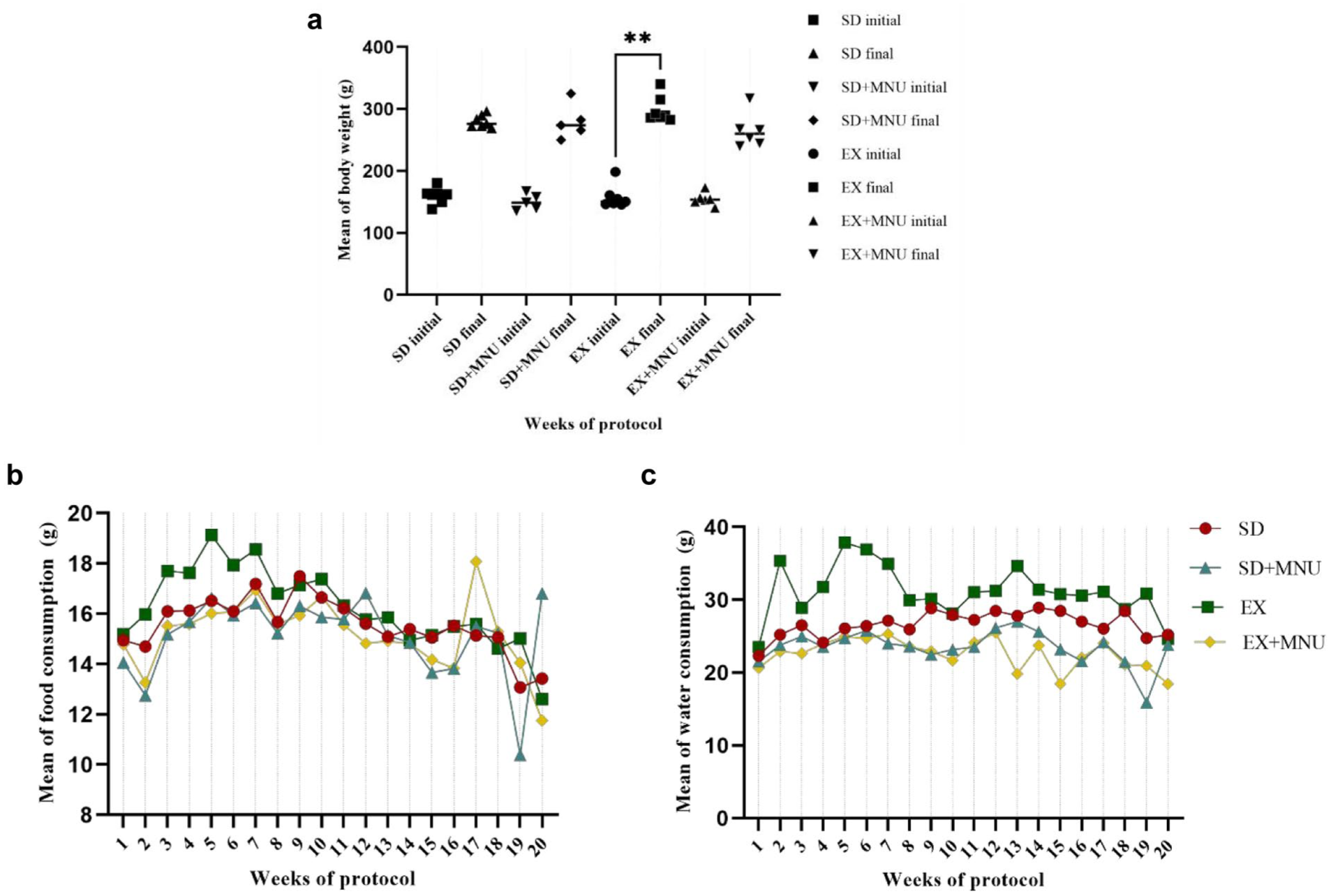
(a) Influence of resistance training interplay with mammary carcinogenesis on rat BW. SD and EX groups: n = 7 rats; SD+MNU: n = 5 rats; EX+MNU: n = 6 rats; rats euthanised before 20 weeks were not used to measure BW variation. Influence of resistance training interplay with mammary carcinogenesis on groups’ daily mean consumption of (b) food and (c) water. For SD and EX groups there was one cage (n = 7 rats). For group SD+MNU in week 12, the cage had six rats and in week 17 the same cage (SD+MNU) had five rats, and group EX+MNU continued with six rats. All values are expressed as mean ± standard deviation. Significantly different results are represented as **p < 0.01. BW: bodyweight; EX: exercised group; EX+MNU: exercised and induced group; MNU: N-methyl-N-nitrosourea; SD: sedentary group; SD+MNU: sedentary induced group.
No significant effect of group on food intake was observed (p = 0.318) (SD: 15.55 ± 1.10 g, SD+MNU: 15.10 ± 1.56 g, EX: 16.24 ± 1.55 g and EX+MNU: 15.18 ± 1.38 g; Figure 1(b)). A tendency for variation over time was detected (p = 0.063), as expected, but the interaction between group and time was not significant (p = 0.549), indicating a similar temporal pattern across groups.
A significant effect of group on water intake was observed (p = 0.024) (SD: 26.65 ± 1.74 g, SD+MNU: 23.51 ± 2.34 g, EX: 31.13 ± 3.60 g and EX+MNU: 22.58 ± 2.13 g; Figure 1(c)). But no variation over time was detected (p = 0.411), and no interaction between group and time (p = 0.528), indicating a similar temporal pattern across groups.
Mammary tumour development
In total, from the total of 14 MNU-exposed rats, 9 developed mammary tumours, indicating a mammary cancer incidence of 64%. Animals not exposed to the carcinogenic agent did not develop any mammary tumour during the experiment.
In the SD+MNU group, over the 20-week protocol, four rats developed mammary tumours, with an incidence of mammary cancer of 57%. The first tumour was detected in Rat 2 by week 10, with a tumour burden of 5.17% and tumour volume of 11,350.22 mm3, which progressed to 10.83% and 24,238.40 mm3 by week 12—the highest tumour burden observed. Due to ulceration and reaching 10% tumour burden, this rat was euthanised in the same week (mean tumour burden: 6.60 ± 3.72%; Figure 2(a); mean tumour volume: 14,751.00 ± 8325.00 mm3; Figure 2(c)). By week 13, Rat 6 developed a tumour burden of 0.48% and volume of 928.67 mm3 that eventually increased to 5.7% and 11,248.02 mm3 by week 17 but, due to tumour ulceration, this rat was also euthanised in the 17th week (mean tumour burden: 3.75 ± 2.63%; Figure 2(a); mean volume: 8206 ± 5464 mm3; Figure 2(c)). In week 19, Rat 5 and Rat 7 both developed measurable tumours (1572.86 mm3 and 1033.75 mm3), progressing until week 20 (2976.36 mm3 and 2384.73 mm3) (mean tumour volumes: Rat 5: 2275.00 ± 992.40 mm3 and Rat 7: 1709.00 ± 955.30 mm3; Figure 2(c)).
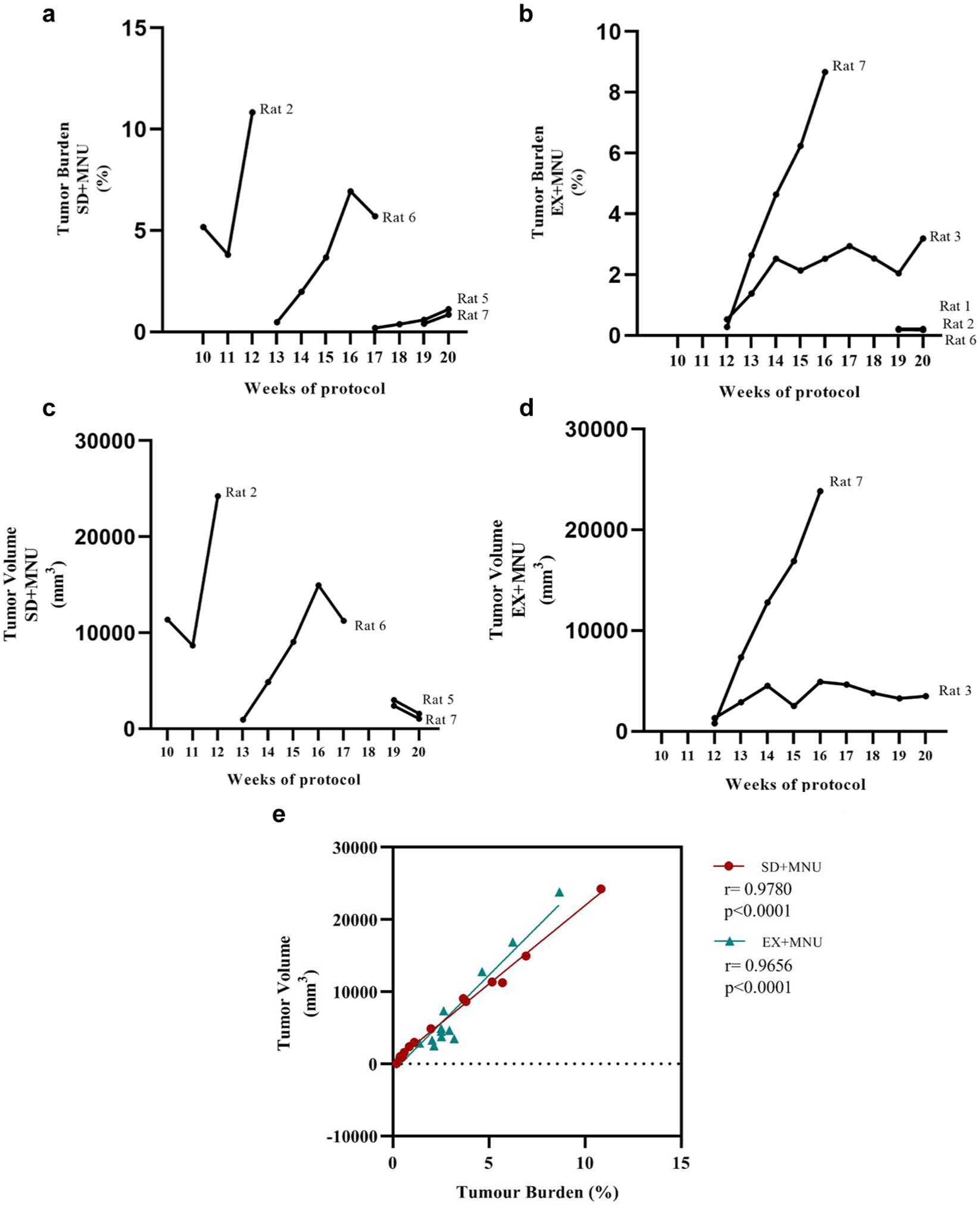
Variation in mammary tumour burden per rat in the (a) SD+MNU and (b) EX+MNU groups over the 20-week protocol. Tumour burden and volume are shown from week 10 onwards, when the first measurable tumours appeared. No measurable tumours were detected in weeks 1–9. Variation in mammary tumour volume per rat in the (c) SD+MNU and (d) EX+MNU groups over the 20-week protocol. In (a)–(d), Tumour burden and volume values were obtained as described in Materials and Methods. Each line represents an experimental unit (a,b) or one animal (c,d). (e) Correlation between tumour volume and tumour burden. Each dot represents one animal over the weeks; p < 0.05 was considered significantly different. EX+MNU: exercised and induced group; MNU: N-methyl-N-nitrosourea; SD+MNU: sedentary induced group.
In the EX+MNU group, over the 20-week protocol, five rats developed mammary tumours, indicating an incidence of 71%. The first tumour was detected in Rat 3 by week 12, with a tumour burden of 0.53% and volume of 1323.21 mm3, which progressed to 3.19% and 3494.58 mm3 by week 20 (mean tumour burden: 2.20 ± 0.81%; Figure 2(b), and mean tumour volume: 3480.00 ± 1149.00 mm3; Figure 2(d)). Rat 7 tumour volume increased from 777.73 mm3 in week 12 to 23826.37 mm3 in week 16 and was euthanised in that week, due to tumour ulceration, with a tumour burden of 8.67% (mean tumour burden: 4.50 ± 3.23%; mean tumour volume: 12,324 ± 8823 mm3; Figure 2(b) and (d)).
Overall mean tumour burden of earlier euthanised rats was 4.69 ± 2.36% (SD+MNU: 4.82 ± 2.34% and EX+MNU: 4.49 ± 2.43%) and mean volume was 11,300.31 ± 5573.26 mm3 (SD+MNU: 10,660.64 ± 6966.56 mm3 and EX+MNU: 12,323.77 ± 6610.32 mm3). While the mean tumour burden of the rats euthanised just at the end of protocol was 1.21 ± 0.96% (SD+MNU: 0.59 ± 0.26% and EX+MNU: 1.48 ± 1.07%) and mean tumour volume was 2877.95 ± 1063.40 mm3 (SD+MNU: 1795.14 ± 708.32 mm3 and EX+MNU: 3479.51 ± 876.38 mm3).
To explore potential associations between tumour volume and burden, a Spearman correlation was conducted. Positive correlations were observed in SD+MNU group (r = −0.9780, p = 3.8748 × 10⁻⁸; Figure 2(e)), and in group EX+MNU (r = 0.9656, p = 9.6574 × 10⁻¹⁰; Figure 2(e)).
Humane endpoints
Figure 3 highlights the biological parameters evaluated in experimental groups throughout the 20-week experimental protocol.
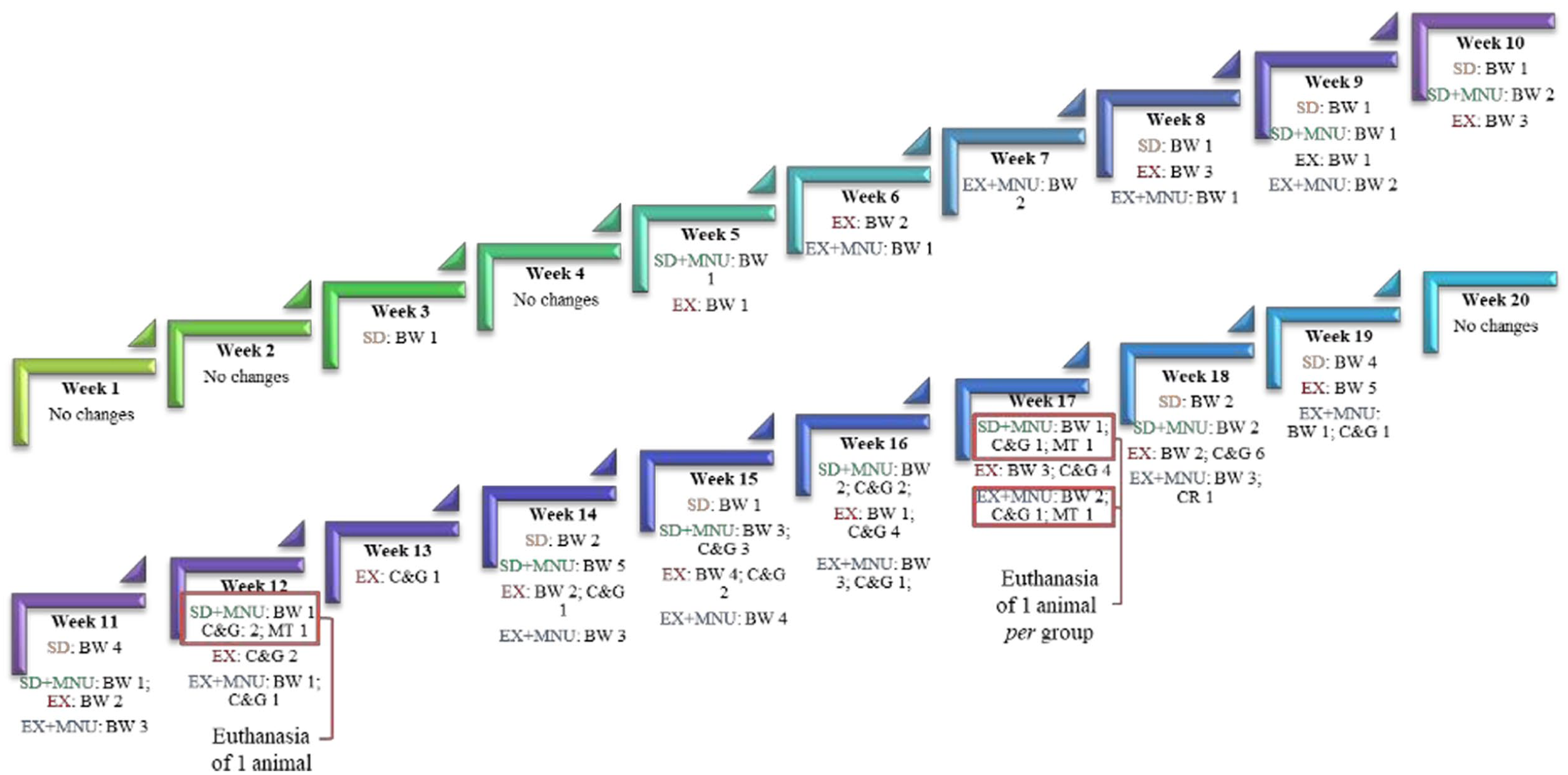
Schedule showing changes in humane endpoints in groups over the 20-week period. The number after each parameter refers to the score. BW: bodyweight; C&G: coat and grooming; CR: chromodachryorrhea; EX: exercised group; EX+MNU: exercised and induced group; MNU: N-methyl-N-nitrosourea; MT: mammary tumour evaluation; SD: sedentary group; SD+MNU: sedentary induced group; TP: temperature.
Until week 3, no changes were detected in any of the biological parameters. However, a change in BW was observed, with an endpoint score of 1 in the SD group. In week 5, one animal from SD+MNU showed a score of 2 for BW alterations, while one animal from EX showed score of 1. At week 6, two animals from EX and one from EX+MNU each presented a score of 1 for BW alterations, and in week 7 two animals from EX+MNU exhibited the same changes. By week 8, one animal from SD, one from EX+MNU and three animals from the EX group all showed a score of 1 for BW alterations. At week 9, all groups presented BW alterations in at least one animal. At week 10, one animal from SD, two from SD+MNU and three from the EX group exhibited BW alterations, all with a score of 1. Until week 11, only changes in BW were observed, in four animals from SD, two from EX, and three from EX+MNU, all with score of 1.
In SD+MNU group (week 12), one animal showed worsening BW alterations (score of 2), lack of grooming (score of 2) and tumour-related factors, such as location (score of 2), macroscopic evaluation (score of 3) and tumour burden (score of 1). This animal exceeded the humane endpoint score limit and was euthanised due to tumour ulceration.
From week 12 onward, a lack of grooming became observed more frequently across all groups. In this week, two animals from SD+MNU, two from EX and one from EX+MNU exhibited this alteration, all with a score of 1. BW alterations were also noted in SD+MNU and EX+MNU groups (one animal per group, each with a score 1). At week 13, only one animal from EX exhibited a lack of grooming (score of 1).
Figure 4(c) shows an animal with normal coat and Figure 4(b) and (f), two animals with lack of grooming. At weeks 14, 15, 17, 18 and 19, BW alterations and lack of grooming were observed in almost all groups. The highest endpoint score of BW alterations (score of 2) occurred at weeks 12 and 15 in one animal from the SD+MNU and EX group, respectively. In week 16, one animal from EX+MNU group obtained an endpoint score of 1 for body temperature, probably associated with hypothermia (35.3°C; EX+MNU; Figure 3).
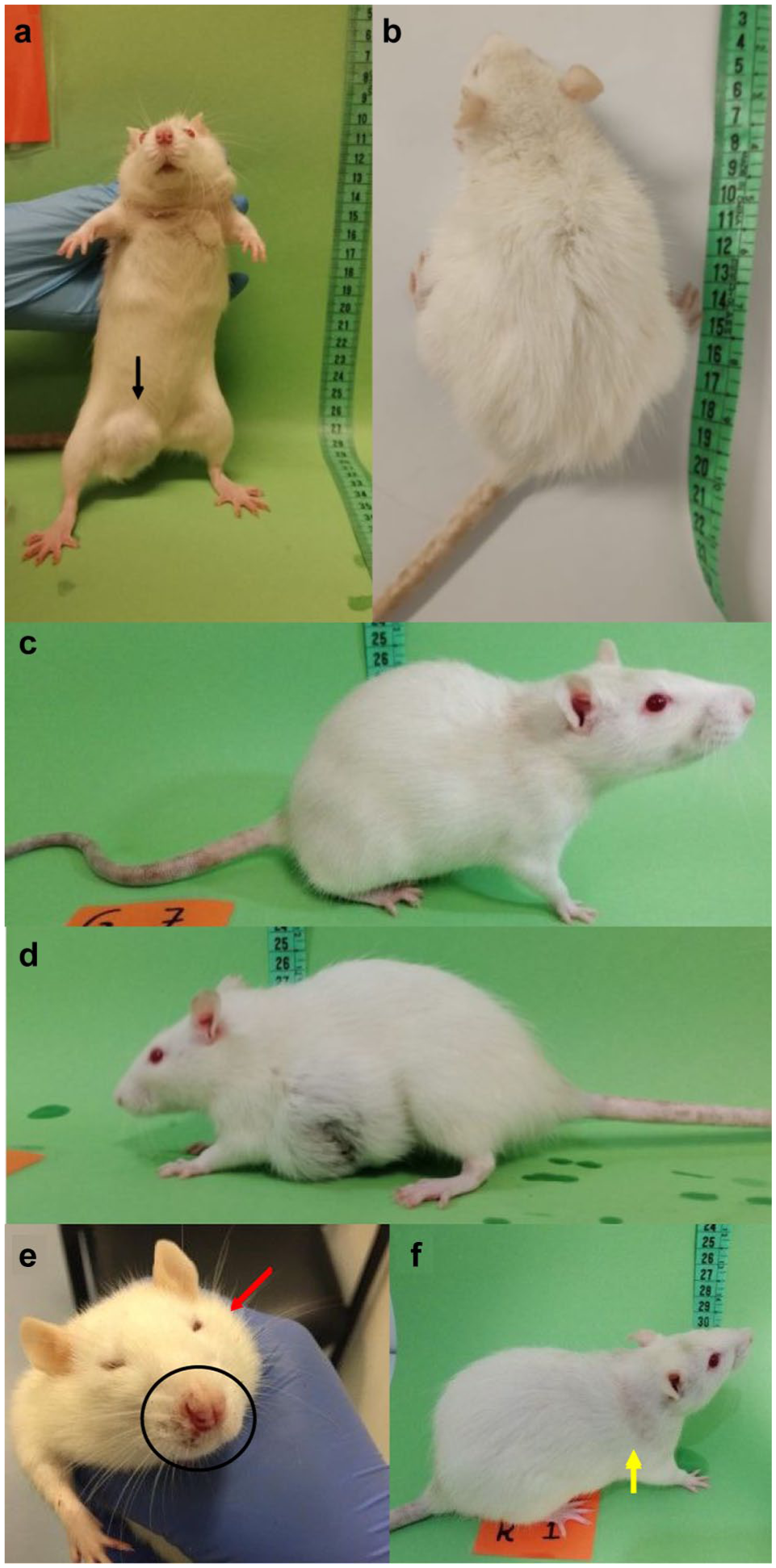
(a) Rat with a mammary tumour that is likely to impair exercise training performance. (b) Rat with lack of grooming and piloerection. (c) Healthy exercised rat. (d) Rat with an ulceration on a mammary tumour. (e) Rat displaying chromodachryorrhea (black circle) and partial closed eyes (red arrow). (f) Rat with lack of grooming, indicated by uncleanliness around the neck, forming a darker orange halo (yellow arrow).
At week 17, changes in parameters related to tumour burden were observed in one animal from SD+MNU and one from EX+MNU. These animals had the highest mammary tumour score of 3, due to tumour ulceration, leading to their euthanasia (Figures 3 and 4(d)). This was the higher endpoint score observed in the exercised animals and only regarding tumour-related humane endpoints.
Additionally, chromodachryorrhea was observed in one animal from the EX+MNU group at week 18 (Figures 3 and 4(e)). At the last week of the experiment, no changes were found.
During the protocol, signs of hair loss were observed in four animals in the EX group at weeks 12, 14, 15 and 18, although this was not reported as an animal welfare endpoint. Furthermore, one animal in the EX+MNU group appeared to have a neck wound by week 2, which seemed to disappear in the next weeks (EX+MNU). A wound in the left ear was observed in one animal from EX group, at week 14, which also disappeared (EX). Additionally, one animal in EX+MNU group presented a wound in the tail at week 14, which could have been caused by the exercise training (EX+MNU).
To explore potential associations between MCL and BW, a Spearman correlation was conducted. A positive correlation was observed between the BW of the animals in both groups and the training loads (r = 0.6337, p < 0.0001 for EX group; r = 0.5979, (p = 7.400 × 10⁻¹⁴) for EX+MNU group; Figure 5). The first MCL measurement (at week 2) was 212.86 ± 28.64 g for the EX group and 185.71 ± 28.82 g for EX+MNU. By week 20, the final MCL measurement was 697.14 ± 30.57 g for the EX group and 598.33 ± 92.53 g EX+MNU group.
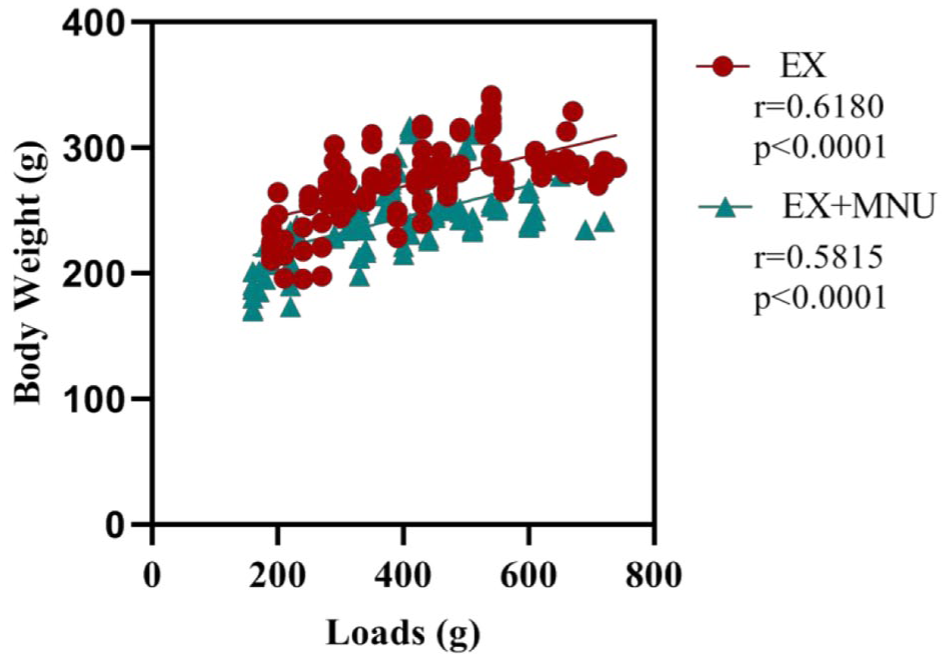
Correlation between rat MCL and BW. MCL was measured every 3 weeks, as described in Materials and methods. In the weeks in which MCL was measured, the BW in that week was used for the graph. Rats in the EX group (n = 7) are represented in red and those in the EX+MNU group (n = 7; n = 6 after week 17) are in blue. Each dot represents one animal over the weeks. Results were considered significantly different at p < 0.05. BW, bodyweight; EX: exercised group; EX+MNU: exercised and induced group; MCL: maximum carrying load; MNU: N-methyl-N-nitrosourea.
Discussion
Data from the present study highlights the humane endpoints implementation for a rat model of chemically induced mammary cancer undergoing a resistance training protocol using a climbing ladder, ensuring animal welfare throughout the protocol duration. The minimisation of animal suffering in research is a fundamental ethical priority. 28 In this context, the concept of humane endpoints is of paramount importance. The early and clear identification of these signs facilitates the timely implementation of appropriate interventions, either by providing relief or by humanely euthanizing the animal, if necessary. 29
The MNU model of mammary cancer was selected based on previous experience of our research group, and due to its effective application for the study of exercise in mammary tumourigenesis.30,31 MNU administration must be administrated i.p. to rats at 50 days of age resulting in a high incidence of mammary cancer with a short latent period and minimal toxicity, by interfering with a crucial phase of a mammary gland development.32–34 We used female Wistar rats, as they tend to be more active—an essential feature for LRT—and they exhibit greater heterogeneity, making them more representative of the human population.35,36 In the present study, from 14 rats induced with mammary cancer, nine developed BCa, giving a total incidence rate of 64%. SD+MNU had four rats developing BCa (57%) and EX+MNU had five rats with mammary cancer (71%). Although the incidence was high, it did not reach the typical 100% incidence rate reported previously by our group, likely due to the use of a different rat strain (Wistar rats instead of Sprague–Dawley), its different susceptibility to the carcinogenic agent MNU and the short-term protocol duration.8,30,37 The Wistar rat strain appears to exhibit reduced susceptibility to this carcinogenic agent, as evidenced by the longer latency periods observed—a finding also reported by other authors.38–40 Interestingly, rats from SD+MNU group euthanised in the end of protocol had lower mean tumour burden (0.59 ± 0.26%) compared with the ones from EX+MNU group (1.48 ± 1.07%). And the same happened for tumour volume, where rats from EX+MNU group had slightly bigger tumour volumes (3479.51 ± 876.38 mm3), compared with those in SD+MNU rats (1795.14 ± 708.32 mm3). In fact, a positive correlation was observed between tumour volume and tumour burden in both groups. These results are in line with expectations, as an increase in tumour volume is associated naturally with an increase in tumour burden. However, it appears that exercised rats are generally able to tolerate tumours for a longer period without developing ulcerations, suggesting that exercise may, in some way, have contributed to the prevention of tumour ulceration. Hence, when exercise protocol is performed, the humane endpoints regarding tumour macroscopic alterations may take longer to be reached or not reached at all, depending on the protocol duration. Furthermore, it is important to note that only tumours measurable with the caliper were included in the tumour volume analysis. This should always be the case, as only measurable tumours have the potential to ulcerate. Smaller tumours that are merely palpable pose health concern for rats only in longer protocols, by which time other tumours would have already ulcerated. Humane endpoints should be applied only to measurable tumours, as small nodules can sometimes be mistaken for enlarged lymph nodes. There is just the exception, in the case of tumour burden, defined as the number of tumours per rat (or the number of neoplastic cells), the volume of these small nodules should be considered once they become measurable. 27 It is noteworthy that the mean tumour burden and volume was not associated with the time of diagnosis, which underscores both the biological variability in tumour growth and the importance of early monitoring for accurate humane endpoint evaluation. 5 Performing tumour palpations twice a week was essential to minimise pain and distress, especially in animals with higher humane endpoints score due to tumour progression. This observation not only enabled prompt interventions to alleviate suffering but also helped the management of tumour growth in way that allowed the maintenance of the exercise training protocol without compromising animal welfare. Furthermore, if mammary tumours develop in the abdominal-inguinal region, it may be necessary to suspend the LRT, depending on the tumour volume and macroscopic evaluation, as tumours may come in contact with the ladder during climbing, potentially causing discomfort or injury. 5 In terms of tumour assessment, it is crucial to monitor for ulceration in these areas.
Rats were acclimatised to the ladder apparatus for a period of 5 days before the beginning to training, aligning with best practices for reducing stress and promote voluntary engagement in exercise, as evidenced by previous studies.24,41,42 Minor injuries, such as transient wounds, particularly on the animal’s tails, were observed in both groups, highlighting the importance of gradual adaptation to the ladder. Although not recorded as humane endpoints, these minor injuries are related to the LRT protocol, as loads were attached to the animal’s tail. Such injuries could hinder the animal’s ability to perform the exercise correctly and limit its capacity to carry additional weight. In our protocol the tail wounds observed did not compromise exercise capacity or welfare. However, tail wounds should be included among the humane endpoints criteria, with a view to reducing such incidents and mitigating stress. If such injuries persist, it may be necessary to adjust the protocol, such as reducing the carrying loads or allowing the animals to rest for longer periods, to ensure animal welfare and their ability to finish the protocol. Furthermore, conducting the sessions during the dark phase of the circadian cycle allows the optimisation of the animals’ natural activity patterns, which may reduce stress levels, as rats are typically nocturnal animals. 43
The exercise protocol was designed to maximise muscle activation without heightening the risk of injury. 44 While protocols, such as that of Hornberger and Farrar, use higher MCL percentage, achieving significant muscle hypertrophy in only 8 weeks.18,45 Notably, even load-free LRT can enhance rodent’s load-carrying capacity, with improvements linked to increased training loads, this is likely due to the sedentary lifestyle observed during the period of accommodation.18,46 This LRT protocol was essential for evaluating BCa prevention without causing early fatigue or stress.18,47 Indeed, no significant differences were observed in endpoint mean scores between groups, suggesting that moderate-intensity LRT is well-tolerated by tumour-bearing animals.
BW loss was the first humane endpoint alteration reported, which was first reported in animals from SD group (Figure 3). Resistance exercise protocols have been shown to prevent or delay BW loss and mitigate body wasting associated to BCa.20,24,44 In fact, a correlation between BW and load capacity suggests that LRT may counteract muscle loss induced by mammary carcinogenesis. 48 Scaling carry loads to BW, minimises risk of injury and aligns with the physiological abilities of each animal.20,44,45 However, towards the end of the protocol, we began to observe greater BW loss in exercised compared with sedentary animals. Although BW loss is used commonly as a humane endpoint, its interpretation requires caution when exercise is involved. Resistance training is known to reduce adipose tissue while potentially increasing muscle mass, which can result in overall BW loss without indicating a negative health outcome. Therefore, the BW reduction observed in exercised animals should not be automatically considered a sign of distress or used as humane endpoint. Instead, it may reflect a positive physiological adaptation to training. We recommend that in protocols involving resistance exercise, BW loss should be assessed alongside additional indicators of muscle mass, such as the diameter of the biceps brachii or gastrocnemius muscle. 49 These additional indicators should be incorporated into the list of humane endpoints to provide a more comprehensive assessment of animal welfare in exercise-based protocols.
Lack of grooming was the second most observed humane endpoint change, which was more frequent in exercised groups (Figure 3). Grooming is a complex, conserved behaviour in rodents, performed in a structured and organised pattern, and highly sensitive to various factors. 50 Interestingly, in contrast to a previous MNU-induced BCa protocol, 8 where a lack of grooming was not observed, rats in our protocol exhibited a reduced capacity for grooming, predominantly in exercised groups. Although the relationship between self-grooming and stress is complex, other studies demonstrate that the quality or pattern of grooming, rather than its quantity alone, may be a more accurate reflection of stress levels.50–52 Future protocols would benefit from examining grooming patterns, in addition to the quantity, to accurately evaluate the stress induction. Even though we used stress-reducing strategies, such gradual habituation to the ladder and daily animal handling, this suggest that LRT may induce additional stress comparing with MNU administration alone. 8 To counteract these effects, animals were rewarded with food (cereal) and handled carefully (speaking quietly to the animal, moving hands slowly and closing hands loosely around the rat), following each successful climb. Additionally, classical music can be played during the exercise session. 53
Furthermore, chromodachryorrhea was observed in one animal. This condition occurs when porphyrin, a substance produced by the Harderian gland, located behind the eyes, accumulates around the eyes and nose of rats. Excessive chromodachryorrhea is usually typically indicative of stress, pain or injury. 54 Furthermore, in comparison to another chemically induced rat model, without any form of exercise, no significant changes in humane endpoints were observed. 8 We can propose that the LRT may introduce an additional form of stress, which should be considered carefully in the experimental design.
Overall, exercised animals showed more stress signs, such as BW loss, lack of grooming and chromodachryorrhea. However, they had lower scores, particularly in tumour-related humane endpoints compared with sedentary animals. This suggests that although exercise itself is a stress inducer factor, its long-term beneficial effects may help prevent higher scores, particularly related with tumour endpoints. However, the impact will vary with exercise type and duration, which should be considered carefully.
Food and water intake is linked closely with various environment and physiological factors, including housing conditions (high number of animals, or animals of different sexes), stress levels experienced by the animals and frequency of handling.55,56 Contrary to expectation, we did not observe any significant difference in food intake in groups, as both the LRT protocol and the mammary carcinogenesis are known to increase metabolic demands.57,58 It seems that, overall, animals did not develop cancer-associated body wasting, as final BW did not differ between groups.8,58 Water intake showed a significant group interaction. Water intake usually is less responsive to house/experimental conditions than food consumption; rather, it is linked closely to feeding behaviours.55,56,59,60 These findings underscore the necessity for further investigation into the impact of environmental factors and stressful situations, such as LRT, on eating and drinking habits. Additionally, food and water intake may also be influenced by room temperature, although it seems to be also related to age, due to fur thickness. 61 Furthermore, a key challenge in measurement group’s food and water consumption is that one sick animal can decrease overall measurements, and accurately tracking one animal’s intake among six more can be challenging. While individual housing could theoretically allow for more precise measurements, we do not recommend this approach due to welfare concerns, as rats are social animals and isolation can induce additional stress. 62 Given this, we recommend using changes in BW for more accurate results. Furthermore, while n = 7 per group provided >80% power for primary tumour incidence outcomes, secondary endpoints, such as food/water consumption may be underpowered due to greater variability.
We propose an update to the table previously proposed by Faustino-Rocha et al. 8 Although BW loss is one of the humane endpoints used most commonly, its interpretation in exercise protocols requires caution, as it may reflect beneficial adaptations to training rather than a welfare concern. To improve the accuracy of welfare assessment, we recommend including muscle-related indicators, such as the diameter of the biceps brachii or gastrocnemius muscles. However, it is important to note that such adaptations are highly dependent on the type and intensity of exercise performed. Additionally, when an animal reaches a humane endpoint requiring euthanasia, such as tumour ulceration, it should be scored as 3 rather than 2. Tumour macroscopic evaluation should consider ulceration as a criterion on its own, rather than only when combined with a size >35 mm in a 250 g rat. Additionally, tumour location, such as interference with exercise or contact with the climbing ladder, should not be direct criteria for euthanasia. Instead, adjustments like removing the animal from the exercise protocol or reducing exercise intensity should be considered. The primary goal was to establish the humane endpoint implementation for the protocol combining MNU-induced mammary tumourigenesis with LRT in Wistar rats, which required careful balance between exercise stress and tumour progression. The chosen sample size (n = 7 rats per group initially, reduced later by early euthanasia) was appropriate for this objective and aligned with the 3Rs principles, allowing us to validate the feasibility and welfare impact of this combined protocol. While it may limit statistical power for secondary outcomes and may increase the risk of Type S and Type M errors in significant findings, the study successfully enabled the creation of a framework that can guide and inform future research on how to implement this protocol.
Conclusions
Overall, the findings of our study highlight the importance of establishing humane endpoints in a rat model of BCa subjected to a LRT protocol. This type of exercise was shown to be feasible for prolonged use, without exacerbating tumour-related comorbidities, enabling a thorough evaluation of exercise effects on tumour progression. Further research may be needed to assess the feasibility of other resistance exercise protocols. Overall, the study demonstrates the potential of exercise protocols in cancer research while maintaining ethical standards and minimizing animal suffering.
Supplemental Material
sj-docx-1-lan-10.1177_00236772261444916 – Supplemental material for Strengthening animal welfare: monitoring humane endpoints in a rat model of mammary tumorigenesis undergoing a ladder resistance training protocol
Supplemental material, sj-docx-1-lan-10.1177_00236772261444916 for Strengthening animal welfare: monitoring humane endpoints in a rat model of mammary tumorigenesis undergoing a ladder resistance training protocol by Inês Aires, Jessica Silva, Tiago Azevedo, Rita Ferreira, Ana I. Faustino-Rocha, José Alberto Duarte and Paula A. Oliveira in Laboratory Animals
Footnotes
Acknowledgements
The authors thank Lio Gonçalves for revising the statistical analysis.
Author contributions
I.A., J.S.: conceptualization and writing (original and draft preparation); I.A., J.S., T.A.: methodology. R.F., A.I.F.-R., J.A.D. and P.A.O.: supervision, validation, and writing (reviewing and editing). All authors have read and agreed to the published version of the manuscript.
Declaration of conflicting interests
The authors declared no potential conflicts of interest with respect to the research, authorship and/or publication of this article.
Funding
The authors disclosed receipt of the following financial support for the research, authorship, and/or publication of this article: This work was supported by national funds from the FCT–Portuguese Foundation for Science and Technology, under the projects UIDB/04033/2020 (CITAB, DOI: 10.54499/UIDB/04033/2020), LA/P/0126/2020 (INOV4AGRO, https://doi.org/10.54499/LA/P/0126/2020), UIDB/00772/2020 (CECAV, https://doi.org/10.54499/UIDB/00772/2020), LA/P/0059/2020 (AL4AnimalS, https://doi.org/10.54499/LA/P/0059/2020), UIDB/00690/2020 (CIMO; https://doi.org/10.54499/UIDB/00690/2020), and UIDP/00690/2020 (CIMO; https://doi.org/10.54499/UIDP/00690/2020), and UID/50006/2025-Laboratório Associado para a Química Verde - Tecnologias e Processos Limpos, and the doctoral grants awarded to J.S. (2020.07999.BD; https://doi.org/10.54499/2020.07999.BD),T.A. (2023.01329.BD;  ) and I.A. (2024.18509.PRT) under the scope of FCT-ECIU (PRT/20/2021).
Data Availability
The data that support the findings of this study are available from the corresponding author upon reasonable request.
Supplemental material
Supplemental material for this article is available online.
References
Supplementary Material
Please find the following supplemental material available below.
For Open Access articles published under a Creative Commons License, all supplemental material carries the same license as the article it is associated with.
For non-Open Access articles published, all supplemental material carries a non-exclusive license, and permission requests for re-use of supplemental material or any part of supplemental material shall be sent directly to the copyright owner as specified in the copyright notice associated with the article.
