



Abstract
This study examines the contribution of constituent order, prosody, and information structure to the perception of word-level prominence in Russian, a free word order language. Prominence perception is investigated through the analysis of prominence ratings of nominal words in two published narrative texts. Word-level perceived prominence ratings were obtained from linguistically naïve native speakers of Russian in two tasks: a silent prominence rating task of the read text passages, and an auditory prominence rating task of the same texts as read aloud by a native Russian speaker. Analyses of the prominence ratings reveal a greater likelihood of perceived prominence for words introducing discourse-new referents, as well as words occurring in a non-canonical sentence position, and featuring acoustic-prosodic enhancement. The results show that prosody and word order vary probabilistically in relation to information structure in read-aloud narrative, suggesting a complex interaction of prosody, word order, and information structure underlying the perception of prominence.
1 Introduction
Cross-linguistically, prosody and the linear position of a word in a sentence are used to convey information structure, in other words, distinctions in focus or discourse-givenness that relate the meaning of a word to its discourse context. Properties related to prosody, constituent order, and information structure, in turn, contribute to the perception of a word as prominent relative to other words in the same phrase or sentence. There is considerable variation among languages in the use of prosody and constituent order, alone or in combination, to encode information structure, which has the potential to yield differences in how prominence is perceived in relation to these factors across languages (Donati & Nespor, 2003; Swerts, Krahmer, & Avesani, 2002). For example, Xu and Xu’s (2005) study of English shows that focus is marked through acoustic-prosodic parameters associated with the focused word, independently of the word’s position in the sentence. The prosodic marking of focus independent of sentence position in English 1 is no doubt related to the fact that reorganization of constituent order in English is very limited (Arnold, Losongco, Wasow, & Ginstrom, 2000). Unlike in English, in French, the location of the main phrasal prominence is invariably at the rightmost boundary of a phonological phrase (Féry, 2013) and acoustic-prosodic cues appear to function primarily as cues to prosodic phrasing. As a result, information structure distinctions in French are typically expressed through structural reorganization of an utterance, for example, through the use of cleft constructions. Skopeteas and Fanselow (2010) observed a high proportion (33%) of clefts used to mark a focused subject in a corpus of 297 semi-elicited utterances in Québec French. In the same study, the rate of cleft constructions observed in a corpus of 118 semi-elicited utterances in English was as low as 5%.
While English and French are examples of languages that differ in the preferred strategy—prosody or word order—for encoding information structure meaning, other languages, including Georgian, Finnish, Romani, and Russian, have been reported to deploy both means, interchangeably or in combination (Genzel, Ishihara, & Surányi, 2015; Sekerina & Trueswell, 2012; Skopeteas & Fanselow, 2010; Vainio & Järvikivi, 2006). One fundamental difference between these languages and a language like English is that they more freely allow reordering of sentence constituents through means other than clefts or overtly marked syntactic structures. In these so-called free word order languages, constituent order may be discourse motivated and used as a means of optimizing the distribution of information in an utterance. Such optimization typically calls for information already known to the speaker and the listener to precede the information that is new and may benefit the human parser: Arnold et al. (2000) and Clifton and Frazier (2004) argue that the “given-before-new” template allows the speaker to retrieve highly accessible, already active referents before the novel, less accessible ones, which, due to considerations of cognitive economy, improves efficiency of production and comprehension processes. Non-canonically ordered utterances, from this standpoint, are formed whenever adherence to the canonical constituent order is suboptimal for production and comprehension purposes. Driven by these considerations, optional movement of a focused constituent to a position where it will receive prosodic marking, such as the sentence-final position for nuclear accent, secures its enhanced prominence in right-branching languages with flexible constituent order, such as Italian and Russian (Slioussar, 2010, 2011b; Swerts et al., 2002).
While the evidence that languages may combine constituent reordering and prosodic accenting to signal information structure continues to accrue, less is known about the relative impact of these mechanisms on how prominence is perceived in a language that exhibits both strategies, that is, in free word order discourse. In this study, we focus on the effects of acoustic-prosodic expression and constituent reordering on perceived prominence in Russian, a case-marking free word order language. Russian is chosen as the test case because it allows but does not require reordering of sentence constituents for information structure purposes, and it exhibits distinctions in prosodic expression among sentence constituents (Sekerina, 1999, 2003; Slioussar, 2011b).
In what follows, we explore how prosody and constituent order function separately and in combination as cues to the information status of words in Russian, and we further ask how these two cues relate to the perception of word-level prominence during discourse comprehension. We report results of two prominence rating tasks with linguistically naïve native Russian speakers, where we examine word-level prominence ratings in relation to the information status of nominal words, their acoustic-prosodic characteristics, and their position in a sentence or phrase. We demonstrate that in Russian, perceived prominence is closely related to the information status of a word. Our experimental investigation reveals that raters reliably discriminate between words of different information status and are more likely to rate words introducing discourse-new referents as prominent. In the study materials, such words occurred ex-situ more often than words that are not discourse-new, with the result that ex-situ position is an important, albeit probabilistic, contributor to the likelihood that a word is perceived as prominent. Prominence perception also varies in relation to the acoustic-prosodic properties of a word. Our findings indicate that the acoustic-prosodic expression and linear order of sentence constituents reinforce each other as cues to perceived prominence in Russian, and that both these properties of a word are also related to its information status. We conclude that the cross-linguistically well-attested effect of information status on perceived prominence holds for Russian, and furthermore, Russian listeners demonstrate sensitivity to acoustic-prosodic cues and word order in rating word prominence in sentence context.
The following section reviews prior work on information status, constituent linearization, and acoustic-prosodic features as they relate to prominence. To aid the reader, we first define the term prominence, as used here. Our primary concern is with prominence from the perspective of the listener, and specifically in the factors that influence how listeners perceive the prominence of words in spoken discourse. Our over-arching hypothesis, detailed below, is that listeners perceive word prominence as a joint function of its acoustic, lexical, syntactic, semantic, and pragmatic properties. Prominence deriving from these linguistic factors has a direct influence on the comprehension of words, sentences and discourse (e.g., Bornkessel-Schlesewsky & Schlesewsky, 2009; Fowler & Housum, 1997), and on the memory encoding of sentence information (e.g., Fraundorf, Watson & Benjamin, 2010, 2015), which suggests that listeners’ experience of word prominence plays a central role in the processing of linguistic information. Linguistic factors that contribute to listeners’ perception of word prominence may themselves be described as prominence-lending: for example, a pitch-accent may be a prominence-lending feature of intonational phonology in some languages; a focus-marking particle may be a prominence-lending morphological feature; a cleft construction may be a syntactic device that lends prominence to the clefted word, etc. These are examples of prominence-lending devices a speaker chooses when formulating an utterance. There are also factors known to influence listeners’ perception of word prominence that are not controlled by the speaker, such as word frequency, focus-as-alternatives, or the information status of a word as it relates to the discourse context (e.g., Cole, Mo, & Hasegawa-Johnson, 2010; Cole et al., 2019). We interpret terms such as “acoustic prominence,” “syntactic prominence,” and discourse prominence,” encountered in the literature, as referring to specific factors hypothesized (or shown) to be prominence-lending (for the listener), in the sense defined here.
2 Information status and the linguistic expression of prominence
2.1 Information status
The information status of a word presented in a discourse context has been offered a variety of interpretations in the linguistic and psychological literature (e.g., Arnold et al., 2000; Watson, 2010). In cognitive accounts (Chafe, 1976, 1994; Gundel, Hedberg, & Zacharsky, 1993; Lambrecht, 1994; Prince, 1981), information status refers to the accessibility or givenness of discourse entities and is described in terms of the activation costs associated with bringing these entities into the focus of speaker’s/hearer’s attention. Information status has an effect on the choice of referring expressions, as well as sentence intonation and constituent order (Chafe, 1994; Fisher & Tokura, 1995; MacWhinney & Bates, 1978; Marslen-Wilson, Levy, & Tyler, 1982). Although distinctions in accessibility or givenness may be gradient, information status is categorically discretized in speech production through lexical choices, sentence position (given before new), morphological devices, and/or prosodic accenting 2 (Clark & Haviland, 1977; Féry, 2013; Fowler & Housum, 1987; McKoon, Ratcliff, & Ward, 1993; Morgan, Meier, & Newport, 1987; Watson, 2010). These various linguistic devices may be used individually or in combination to encode distinctions between words that are lexically or referentially given in the prior discourse, and those that introduce novel information and call for an update in the mental state of the hearer to reflect the new knowledge communicated by the speaker (e.g., Krifka, 2007).
2.2 Constituent linearization
The position of a word in linear sentence structure is one factor in determining word prominence. Most languages have a number of constituent linearization possibilities at their disposal, constrained by their syntactic and phonological properties (Destruel & Féry, this issue; Féry, 2013). Particularly compelling evidence for the importance of the linear order of sentence constituents in discourse comes from relatively “free” word order languages, where the grammatical function of syntactic constituents is transparently expressed by means of word morphology irrespective of where in the sentence the constituents occur. In most free word order languages, there exists a canonical ordering of sentence constituents which is strongly preferred across discourse contexts and thereby is particularly common. Non-canonical orders, as argued by Titov (2017), require an interpretative license: for example, by placing a word ex-situ, outside of its default projection, the speaker brings the critical information to the focus of the reader’s or listener’s attention. According to the Functional Sentence Perspective framework (Daneš, 2015; Firbas, 1992), modifications of constituent order play a central role in helping the speaker achieve his/her communicative goal by controlling the distribution of information in an utterance. For Firbas (1992), each element in a sentence, such as a clause or a word, contributes towards fulfilling its communicative intent, in other words, carries a different degree of communicative dynamism. The linear order of sentence constituents in a highly free word order language may be subject to modification to allow the least dynamic, previously introduced elements to precede the most dynamic, new elements which tend to occur towards the end of the phrase.
Russian is a morphologically rich language with overt morphological case marking. The semantically neutral, default constituent order in Russian is SVO. As in other free word order languages, the subject and the direct object in a sentence can appear in- or ex-situ. Russian allows pre-verbal (fronted) object placement as well as post-verbal (post-posed) subject placement. The linear sequencing of sentence constituents marks information status or communicative intent and not grammatical function (Bryzgunova, 1980; Luchkina & Cole, 2016; Neelman & Titov, 2009; Sekerina, 2003; Slioussar, 2011b; Švedova, 1982; Yokoyama, 1986). Jasinskaja (2013) argued that in Russian, via the mechanism of word order optimization, the preferred location of discourse-given information is at the left edge of a sentence or phrase, and the preferred location of discourse-new information is sentence-final. Under this configuration, words bearing new information optionally undergo movement to the sentence-final position, where they align with the nuclear pitch accent. Contrastively focused words as well as sentence topics may undergo optional fronting and tend to occur pre-verbally (Neeleman & Titov, 2009), although post-verbal placement of these elements is also possible but uncommon (Svetozarova, 1998).
Despite the fact that Russian is often characterized as a highly free word order language, the canonical SVO order accounts for approximately 80% of the utterances in the Russian language corpora (Bivon, 1971). Consequently, at least 80% of the time, Russian is necessarily “reduced” to a fixed word order system. OVS presents the second most common constituent order (Sirotinina, 1965), meaning that SVO and OVS orders in Russian are compatible with more than one information structural configuration. Acoustic-prosodic marking of information structure provides a means to further distinguish among information structure configurations in the two most frequent constituent orders.
2.3 Acoustic-prosodic expression
The use of prosody to express prominence is well documented for English (Bishop, 2012; Bolinger, 1986; Breen, Fedorenko, Wagner, & Gibson, 2010; Cruttenden, 2006, Pierrehumbert & Hirschberg, 1990, Watson, 2010; Watson, Arnold, & Tanenhouse, 2008). It involves perceptually salient changes in one or more measures of pitch, voice quality, local tempo, and loudness, which may signal categorical differences in prominence.
In fixed word order languages like English and Dutch, it is generally the case that a word can be assigned prosodic prominence as an expression of its information status and focus. To illustrate, Breen et al. (2010) report that in English, the location, size, and type of a focused constituent is determined based on the magnitude of its acoustic-prosodic features, including intensity, duration, and F0, relative to other words in the sentence. In their analysis of prosodic prominence in a corpus of English spontaneous speech, Aylett and Turk (2004) proposed the Smooth Signal Redundancy hypothesis, according to which gradient variation in prosodic prominence serves as means of ensuring that all elements in an utterance produced by the speaker have an equal probability of being recognized by the listener, such that the utterance achieves “a smooth signal redundancy profile” (p. 33). According to Aylett and Turk, one way in which speakers control for signal redundancy is by continuously varying segmental duration as a function of the information status of a word, which is operationalized through measures of word predictability in that study. Aylett and Turk demonstrated that words that are easily predictable from context do not require careful articulation and have reduced duration. In related findings, Givón (1983) and Gundel, Hedberg, and Zacharski (1993) report that readily accessible words, such as pro-forms, are normally unstressed and have the most reduced phonetic content.
2.4 The interaction of acoustic-prosodic prominence and constituent linearization
The systematic variation in acoustic prosodic parameters of F0, intensity and duration (as a measure of local tempo), serves as a cue to the information status and focus status of words in Russian (Jasinskaja, 2013; Svetozavora, 1998). Sekerina and Trueswell (2012) argue that prosody in Russian acts independently of constituent linearization (for example, under canonical SVO configuration), or “in consort with word order variation,” in spoken discourse. When the canonical SVO order is preserved, the location of the nuclear pitch accent in the sentence may vary if a non-sentence-final constituent is focused, similarly as in English. Jasinskaja (2013) concurs that in Russian, monitoring the location of the nuclear pitch accent is important for determining the location and size of a focused constituent. Under a non-canonical constituent order, acoustic-prosodic expression helps disambiguate the information status of the ex-situ constituent, as illustrated in the following example: (1) Na kozla vskochila lisa . . . onto goat-ACC jumped fox-NOM The fox jumped onto the goat
In 1, the object “goat” is pre-verbal and can be construed as a sentence topic, in which case it is likely to be prosodically reduced, or as contrastively focused, in which case its acoustic-prosodic expression is expected to be augmented. Not surprisingly, in previous research on Russian, the information status of discourse entities has been linked to distinctive prosodic characteristics: for example, a falling pitch contour and greater pitch peak height signal discourse-new information (Bryzgunova, 1980; Krylova & Khavronina, 1988; Luchkina & Cole, 2016; Meyer & Mleinek, 2006; Neeleman & Titov, 2009; Yokoyama 1986).
While some researchers view constituent order and acoustic-prosodic expression as functionally complementary mechanisms, such that natural language may deploy or prioritize one over the other (Calhoun, Wollum, & Va’ai, this issue; Donati & Nespor, 2003; Swerts et al., 2002), our understanding of these prominence-marking devices is such that they may operate in tandem. For instance, Féry (2013) argues that word order variability serves as a mechanism permitting speakers to mark prominence on the edges of prosodic domains, by aligning the prominent (focused) element with a phrasal boundary. Such a mechanism operates under the assumption that alignment with a boundary of the largest available prosodic domain (such as a prosodic phrase or an intonation phrase) serves as a universal focus cue. For example, in Russian, a word that is positioned ex-situ at a prosodic boundary or in the location of the nuclear pitch accent assignment may be viewed as relatively high in information prominence, and, as such, is more likely to be prosodically prominent—in other words, have perceptibly augmented acoustic-prosodic expression. In line with Féry’s proposal, for Russian, we entertain the possibility that when simultaneously available, constituent linearization and acoustic-prosodic expression jointly act as markers of information prominence and, along with the word’s information status, may contribute to the likelihood that a word is perceived as prominent by the listener. In what follows, we put this proposal to an empirical test.
3 The present study
Although the use of acoustic-prosodic expression and constituent linearization have been previously investigated in relation to information status (and focus), the effects of joint application of these mechanisms have only recently been the subject of linguistic research (see, e.g., Calhoun, 2015; Luchkina & Cole, 2016; Patil et al., 2008; Vainio & Järvikivi, 2006). The present study aims to contribute to this growing body of research by examining how constituent linearization (i.e., word order) and acoustic-prosodic expression work separately or together as perceptual cues to prominence in Russian. Specifically, we seek to determine the role of constituent order and word-level acoustic-prosodic expression in the perception of prominence in Russian. We investigate this question while also considering the relationship between constituent order, prosody, and information structure in the speech materials we use to test prominence perception. The over-arching goal of this work is to understand the role of information structure, constituent order, and prosody in mediating the perception of prominence in spoken discourse in Russian.
In what follows, we examine constituent linearization (see section 3.2) and acoustic-prosodic variability (see section 3.3) in relation to the information status of nominal words in two read narratives in Russian. Following Baumann and Riester (2012), we consider information status at two distinct levels: lexical, pertaining to the previous mention of lexical words; and referential, pertaining to the referents themselves. To operationalize constituent order, we focus on two kinds of ex-situ positions previously studied for Russian (Slioussar, 2011a; Titov, 2012, 2017). We refer to these positions as ex-situ pre-verbal and ex-situ post-verbal. Pre-verbal ex-situ elements in Russian are reflective of constituent fronting and are compatible with two distinct information structural configurations: topicalization, whereby the fronted element is a highly accessible discourse topic, and contrastive focus fronting (Titov, 2012). Post-verbal ex-situ elements are associated with new information focus. In the experimental part of our study, we report results of two unguided prominence rating tasks (henceforth, PRTs) in which linguistically naïve native Russian speakers provided ratings of perceived word-level prominence in the narratives under analysis (see sections 5.1–5.5). In the silent reading PRT, we evaluate the relative contribution of constituent order and information status to the probability that a word is perceived as prominent. In the auditory PRT, we ask if acoustic-prosodic expression of a word further contributes to the likelihood that it is perceived as prominent. In section 6, we discuss results of these investigations and what they mean for our understanding of perceived prominence in free word order language discourse. Section 7 presents our conclusion.
3.1 Russian text materials
Materials selected for this study include two published narratives which were initially analyzed in Luchkina and Cole (2016). Our analysis of these materials, summarized below, confirms that the narratives exhibit expected relationships between information status (IS), non-canonical constituent orders, and patterns of acoustic-prosodic variation. The first narrative (Text 1) is an excerpt from a biography; the second narrative (Text 2) is an unabridged folk tale. Two stylistically different texts were chosen to reflect more standard (Text 1) and more colloquial (Text 2) language use. Cumulatively, these materials contain 344 content words and 69 function words. With an average sentence length of 5.2 content words (SD = 1.77), approximately 18% of all nominal words occur in non-SVO constituent orders. Text 1 contains 29 SVO clauses, 3 OVS clauses, and 1 SOV clause. Text 2 contains 25 SVO, 3 OSV, 2 VSO, 2 SOV, 4 OVS, 2 OV, and 3 VS clauses. Such uneven distribution of constituent orders is not unexpected, because SVO (see example (2) taken from Text 2) is the pragmatically neutral constituent order which is compatible with all information structure configurations.
(2) Svekrov’ nevzlyubila nevestku. mother-in-law-NOM disliked daughter-in-law-ACC Mother-in-law disliked daughter-in-law.
(O)VS, the second most common constituent order in Russian, is compatible with topic fronting, as shown in example (3) taken from Text 2, contrastive focus fronting (not shown), and movement of the new information focus to the clause peripheral position as illustrated in example (4) taken from Text 2.
(3) K tomu zhe, also Also, he preferred to send his earnings to his mother and not to his wife. (4) V moskve sluzhil in Moscow was appointed Sergey’s father, Alexander, was appointed in Moscow.
Each nominal word in the narratives was coded as in-situ (e.g., “svekrov’ and “nevestku” in example 2) ex-situ pre-verbal (e.g., “zhalovanie” in example 3) or ex-situ post-verbal (“Aleksandr” in example 4), for a total of 28 ex-situ pre-verbal and 33 ex-situ post-verbal nominal words.
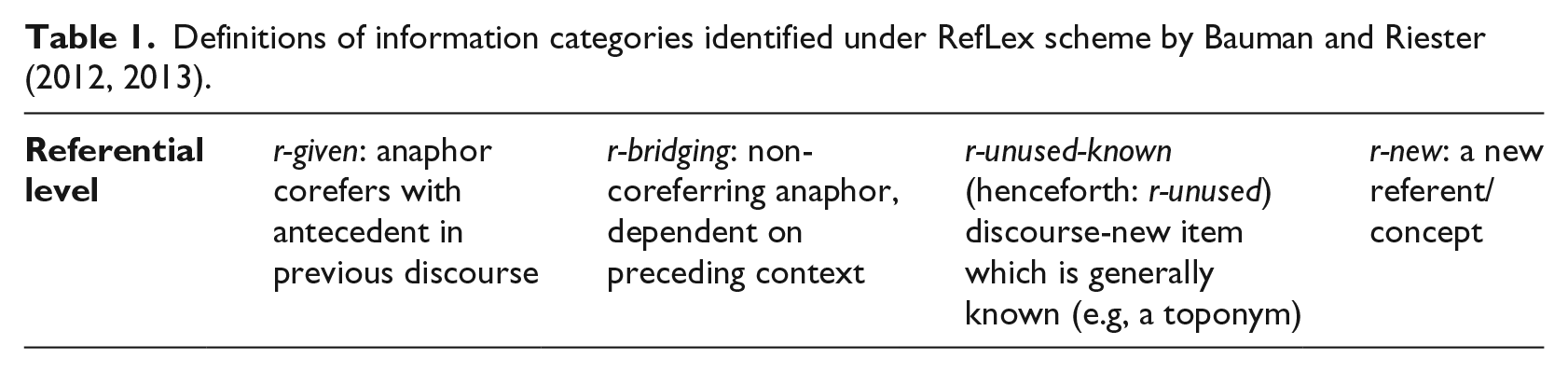
The information status of each nominal expression was manually coded using the RefLex annotation scheme for information structure (Baumann & Riester, 2012, 2013). Rooted in Chafe’s cognitive approach to information structure (1976, 1994), RefLex discriminates between information categories at two distinct levels: referential, pertaining to the properties of the word referent; and lexical, pertaining to the lexical choices a speaker makes to identify a referent. While we expect there to be a relationship between referential givenness and word order, we do not expect a similar relationship for lexical givenness, and for that reason we do not consider lexical givenness in the analysis presented below. Our decision to focus on referential givenness, and not lexical givenness, is informed by research on the effect of word order on sentence processing. In the so-called free word order languages, including Russian, deviation from the canonical constituent order is computationally costly (see Sekerina, 1999, for an overview), and as such must be justified. Titov (2018) demonstrated that non-canonical constituent orders in Russian require an interpretative license—in other words, must be contextually accommodated and interpretable under a given information structure configuration. Titov’s proposal suggests that the referential level of information structure takes precedence over the lexical level, in that it can serve as the basis for an interpretative license of a non-canonical constituent order. Returning to the topicalization example given in (3), this means that the topical status of the lexically new noun “wages” is due to its referent being accessible from the preceding context. Driven by this line of thought, we only examine the distribution of the referential categories specified under RefLex across the clausal positions of interest in the narratives selected for this study. 3 Following Baumann and Riester (2012), at the referential level of annotation (r-), referents in the narratives were classified as r-given, r-bridging, r-unused-known, and r-new. The referential information categories examined in this study are summarized in Table 1.
Definitions of information categories identified under RefLex scheme by Bauman and Riester (2012, 2013).
The annotation was performed by one of the authors (TL) and another native Russian speaker. Inter-rater agreement (linearly weighted Kappa) between the annotators and across Text 1 and Text 2 was satisfactory: ϰ = .89, SE = .03, α = .05.
To confirm that the materials used in the prominence rating tasks display the expected relationship between information structure and constituent order, we examined the narrative texts for the distribution of nominal words across sentence positions. To confirm the expected relationship between information structure and acoustic-prosodic expression, we measured acoustic correlates of prominence of nominal words in the read production of the texts by a linguistically naïve native speaker of Russian. These analyses are presented in the following two subsections.
3.2 Information status and constituent order in Russian text materials
In examining the study materials for effects of information status, we sought to obtain confirmatory evidence that in Russian, non-canonical constituent orders result from certain information structural considerations, such as optimization of information layout. Consistent with this view, we looked to see if relatively accessible information in the narratives has a tendency to occur early in the utterance, in other words, pre-verbally, and if discourse-new information has a tendency to occur post-verbally. Such distribution would conform with the “given-before-new” sequencing of information deemed optimal in Russian (e.g., Jasinskaya 2013; Sekerina & Trueswell 2012).
The distribution of referents of different information status across the three types of clausal positions, in-situ, ex-situ pre-verbal, and ex-situ post-verbal, in the two Russian texts used in this study is presented in Figure 1.
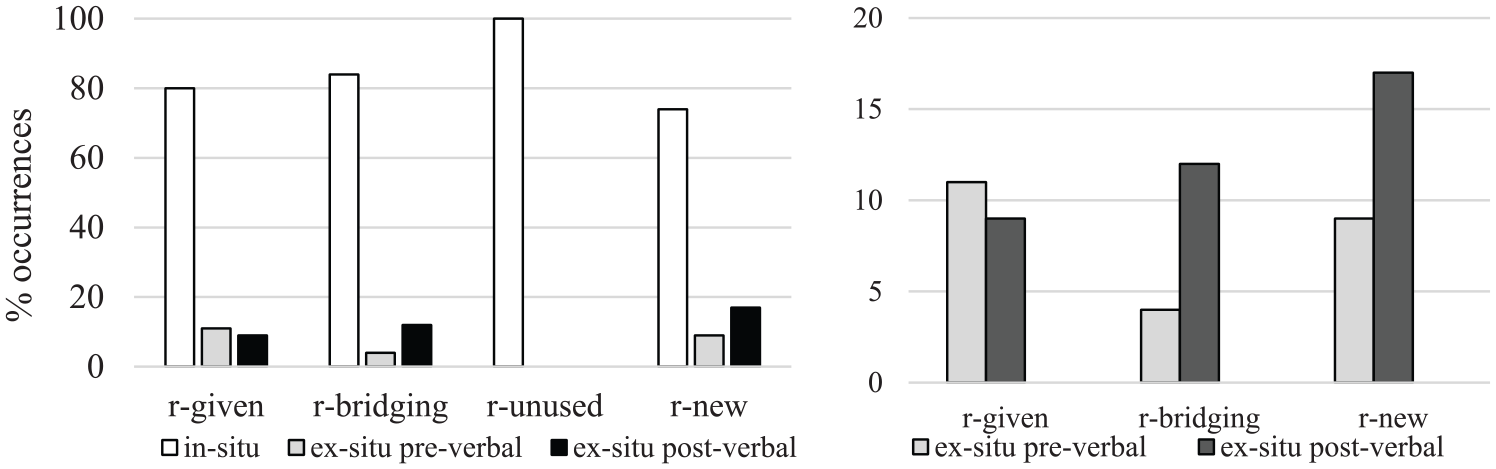
Distribution of referent types across clausal positions in the PRT materials. The frequency of occurrence (%) in the narratives (y-axis) is shown for words grouped by referent type (x-axis) and clausal position (bar shading). Left panel: in- and ex-situ occurrences; Right panel: ex-situ occurrence only.
As discussed in section 2.2, in Russian, the canonical SVO order accounts for approximately 80% of the utterances in the studied corpora (Bivon, 1971). Not surprisingly, the left panel of Figure 1 demonstrates that most nominal expressions in the narratives occur in-situ. Zooming in on the distribution of the ex-situ occurrences among the different referent types, the right panel of Figure 1 demonstrates that discourse-new referents have the largest proportion of ex-situ occurrences in the narratives (approximately 25% occurrences) and account for most instances of ex-situ post-verbal words (approximately 20% occurrences). While the proportion of the in-situ occurrences is greatest for intermediate information categories r-bridging and r-unused (approximately 85%–100% occurrences), their distribution across clausal positions is overall similar to that of words with discourse-new referents, with more ex-situ r-bridging words occurring post-verbally (approximately 10% occurrences) than pre-verbally (approximately 5%). Approximately 80% of discourse-given referents in the narratives occur in-situ. As Figure 1 demonstrates that more ex-situ discourse-given words occur in the ex-situ pre-verbal position (approximately 12% occurrences) than in the ex-situ post-verbal position (approximately 9% occurrences).
Summing up our observations of the distributional properties of different referent classes across the clausal positions of interest, we reported an overall high proportion of in-situ occurrences of nominal expressions, which is expected for Russian. Furthermore, the observed distribution of referential information categories across the ex-situ positions is only partially consistent with the “given-before-new” information structural template. The observed distribution of referent classes corroborates that the pre-verbal position in Russian is often topical and, as such, bears an association with more accessible (given) information (Ionin & Luchkina, 2018; Neeleman & Titov, 2009; Slioussar, 2011a). When the post-verbal position is adjacent to a clausal boundary, which is the default location for nuclear pitch accent, it provides an optimal landing site for words introducing discourse-new referents. Consistent with this observation, referentially new words had the most ex-situ occurrences in the post-verbal position. For both discourse-given and discourse-new referents, we also observed placement patterns that do not conform to the preferred information structure template, and which must therefore be driven by factors not investigated in the present study.
3.3 Information status and acoustic-prosodic expression
Turning now to the effects of information status on the acoustic-prosodic expression of a word, under the assumption that information accessibility (discourse-givenness) is inversely related to prominence, such that the information which is discourse-new, and thereby less accessible to the reader/listener, is more likely to be signaled as prominent than the more accessible, previously established information, we anticipated the least accessible discourse-new information to be cued via acoustic-prosodic augmentation, partial or comprehensive. By the same token, we anticipated words which are lexically or referentially accessible based on prior discourse to lack acoustic-prosodic augmentation, or to be prosodically reduced.
The Russian materials used in the present study consist of read productions obtained from a single native speaker of Russian, which were taken from a larger corpus of recorded speech from 15 native speakers of Russian whose reading performance was examined in Luchkina and Cole (2016). The model speaker, age 27, was chosen based on her fluent and expressive reading ability; she was not a linguist, and was not informed about the goals of the study. The model speaker read the narratives in a lively naturalistic manner, as if addressing an audience. All recordings were made in a soundproof recording booth using a Marantz PDM 750 solid state recorder and a head-mounted microphone. Recorded data were digitized at the sampling rate of 44 kHz and submitted to acoustic analyses. Figures 2–4 provide illustrative examples of the model speaker’s annotated read speech data.
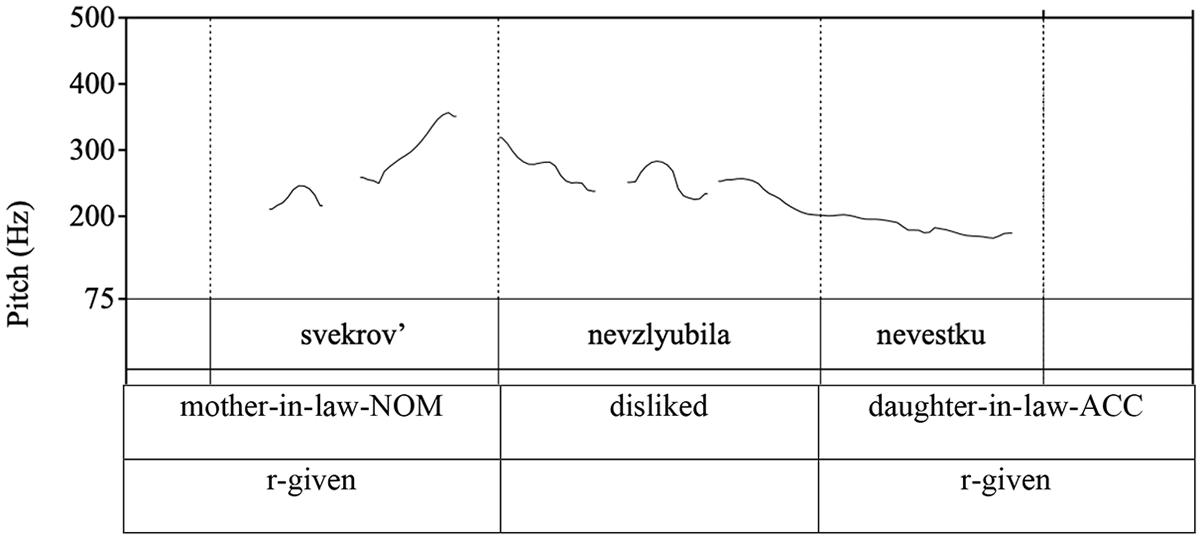
F0 contour of a canonically ordered SVO sentence.
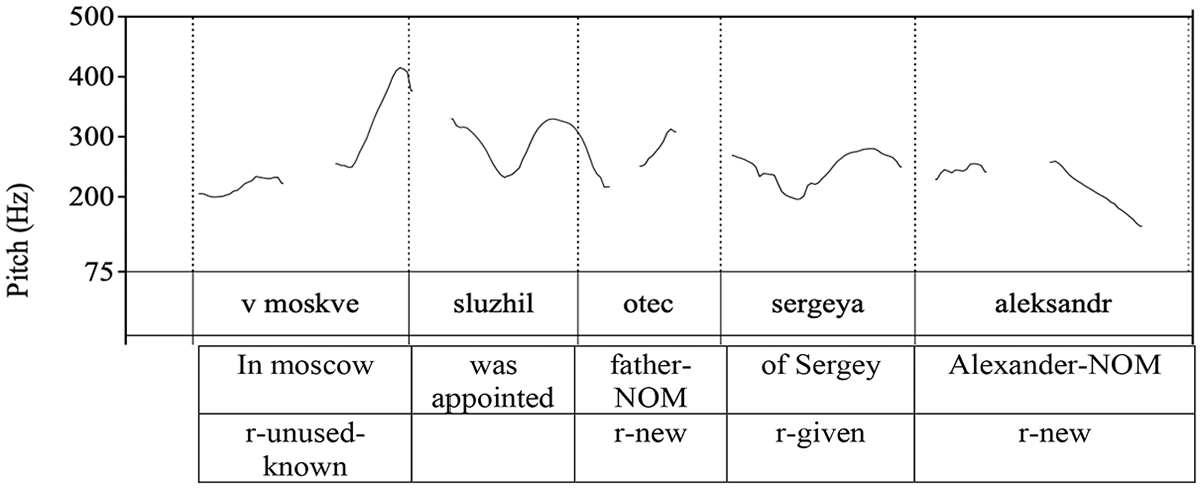
F0 contour of a sentence demonstrating sentence-final subject placement.
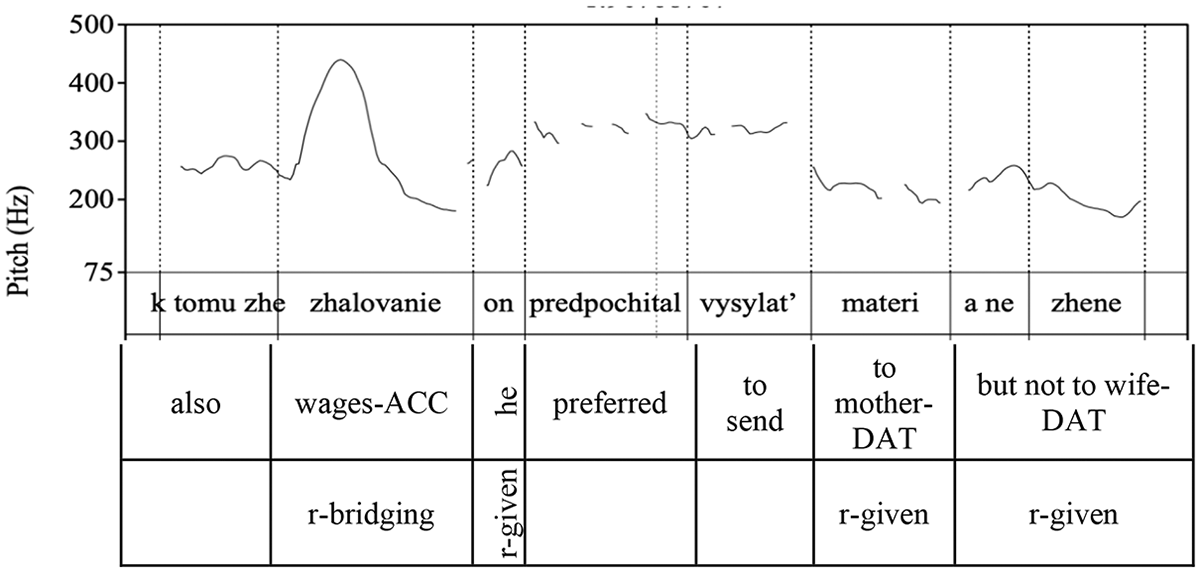
F0 contour of a sentence demonstrating sentence-initial object placement and sentence-final placement of contrastive focus.
Figure 2 shows the F0 contour of a canonically ordered utterance in which both nominal expressions have previous mentions and are r-given. The downstepped F0 contour over the direct object “nevestku,” corresponding to the label IK-1 in Bryzgunova (1980) and HL* in Jasinskaja (2013), is indicative of the nuclear pitch accent placement in accordance with the Nuclear Stress Rule.
The spectrogram shown in Figure 3 demonstrates an utterance-final placement of a grammatical subject which is referentially new. A more pronounced or, in Jasinskaja’s terms, convex-shaped fall in F0 is observed over the discourse-new subject, corresponding to the label IK-2 in Bryzgunova (1980) and H*L in Jasinskaja (2013).
Figure 4 presents an example of fronting, due to topicalization, of the r-bridging direct object “wages,” which allows for sentence-final placement of the contrastively focused indirect object “to the mother but not to the wife.” Following Svetozarova’s (1998) description of the melodic properties of new and topical information in Russian, a raising tone over the pre-verbal object “wages” is due to its sentence-initial position where it linearly precedes the pro form “he.” The latter evokes a highly accessible, discourse-given referent established in the preceding context.
The model speaker’s read production data were examined for acoustic-prosodic variation indicative of the information status of a word and its referent. We focused our analyses on the acoustic-prosodic parameters of F0, intensity and duration. To account for prosodic events occurring in the post-stressed vowel region (also known as post-tonic pitch movements in Russian (Makarova, 2007; Svetozarova, 1998), the acoustic measures of F0 maxima and F0 range 4 were taken from each vowel in nominal words in the recorded narratives. For consistency, we used the same domain of measurement when sampling the acoustic-prosodic measures of mean intensity and duration.
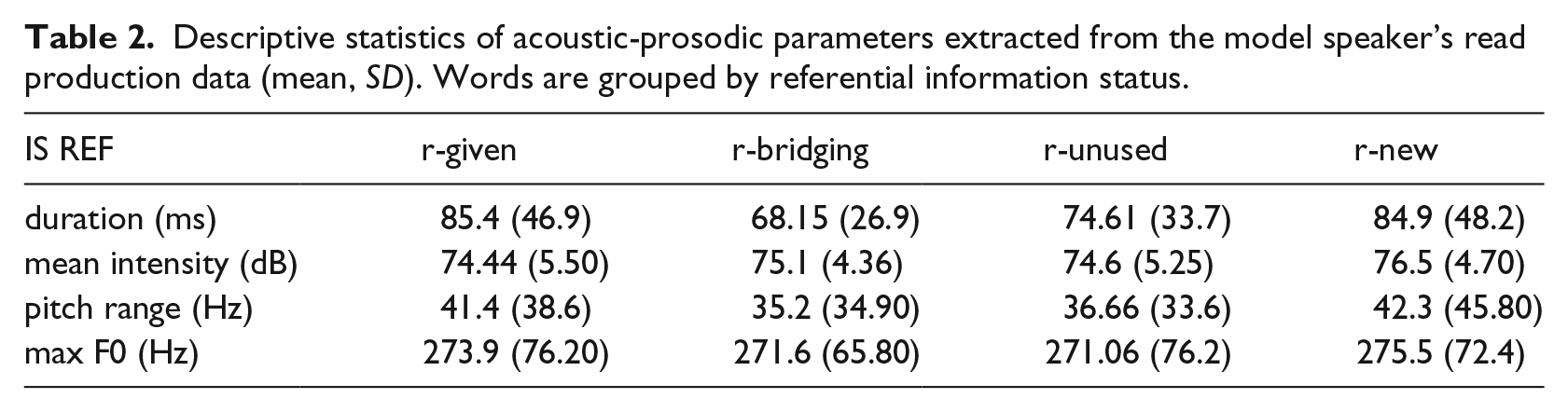
All measurements were extracted automatically using Praat (Boersma & Weenink, 2016). Fundamental frequency and intensity were measured from the center region of the vowel, excluding the 10-ms sub-regions from the vowel edges, to mitigate the influence of adjacent consonant sounds at vowel onset and during inter-segmental transitions. Each F0 output was transformed to semitone values relative to a fixed value of 100 Hz. For the purposes of statistical analyses, log transformation and mean-centered coding of acoustic-prosodic measures was implemented (Bush, Hess, & Wolford 1993; Mitchell 2012). The read production data were analyzed for covariance between the extracted acoustic-prosodic measures, summarized in Table 2 for nominal words in the narratives selected for this study, grouped by information status.
Descriptive statistics of acoustic-prosodic parameters extracted from the model speaker’s read production data (mean, SD). Words are grouped by referential information status.
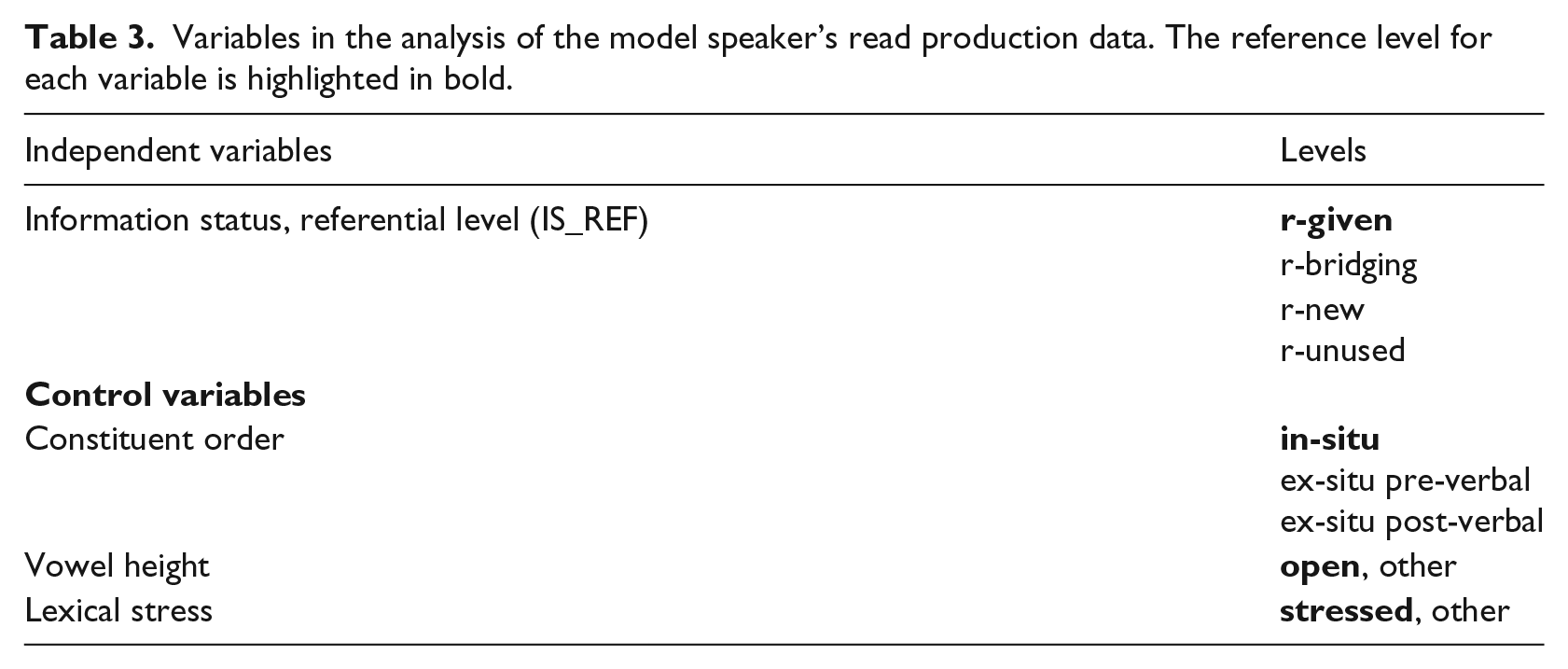
The read production data were analyzed using a system of simultaneous multivariate linear regressions, in which acoustic-prosodic parameters mean intensity, duration, F0 range, and max F0 were introduced as dependent variables (one per regression equation), referent information status (IS_REF) was introduced as predictor variables, and constituent order, vowel height and lexical stress were introduced as control variables. All variables and their levels are listed in Table 3 and the output of this analysis is summarized below. 5
Variables in the analysis of the model speaker’s read production data. The reference level for each variable is highlighted in bold.
Keeping constituent order constant and relative to the IS_REF category r-given, words that introduce discourse-new referents (r-new) demonstrate evidence of comprehensively augmented acoustic-prosodic expression, with greater mean intensity (t = 5.75, p < .001), duration (t = 2.36, p < .05), F0 range (t = 3.58, p < .001), and max F0 (t = 2.74, t < .01). Words with r-unused and r-bridging referents have systematically greater F0 maxima and mean intensity (max F0: t = 5.15, p < .001 for r-unused and t = 7.25, p < .01 for r-bridging; mean intensity: t = 3.71, p < .001 for r-unused and t = 2.65, p < .01 for r-bridging) but smaller duration than words with r-given referents (t = -3.91, p < .001 for r-unused and t = -7.11, p < .001 for r-bridging). These results are overall consistent with analyses of read production data in German by Baumann (2006), who reported that prosodic marking of intermediate information categories is rather subtle, indicative of their semi-active status in discourse.
The prosodic expression of information status shown in the model speaker’s production data should be characterized as rather subtle. Consider, for example, the probability distribution of duration measures across the three referential statuses that are best represented in the production data: r-given, r-bridging, and r-new, as plotted in Figure 5. Apart from systematically reduced duration in r-bridging words, the speaker produces highly overlapping duration measures for r-given and r-new words. Summary statistics presented in Table 2 provide additional evidence of considerable overlap in the distributions of acoustic-prosodic measures intensity and F0 range across words of different information status, further supporting the subtle nature of (de)accenting coincidental with the information status of a word in the model speaker’s read production.
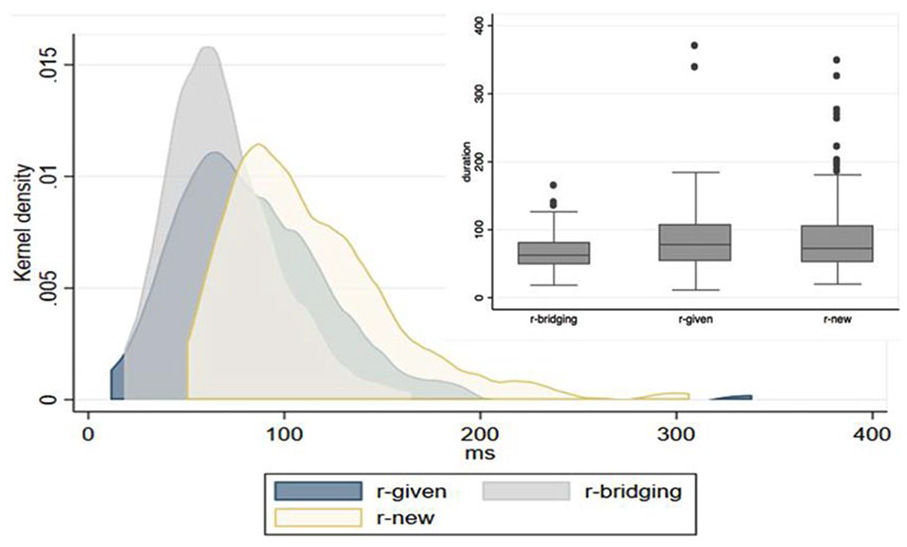
Left: Probability distribution of duration (ms) in words with referential statuses r-given, r-bridging, and r-new; upper right: box-plot diagram of duration (ms) in words with referential statuses r-given, r-bridging, and r-new. Error bars show the standard deviation.
Analyses of the model speaker’s read production data allow us to compare the observed patterns of covariation between the acoustic-prosodic parameters and referent information status in the model speaker’s data with those reported for a larger pool of participants who read the same narratives, examined in Luchkina and Cole (2016). Luchkina and Cole (2016) reported that across speakers, the effects of information structure on acoustic-prosodic expression were by no means uniform. In fact, for each acoustic-prosodic parameter examined in their study, they singled out a speaker who actively deployed that parameter (a high-profile speaker) and a speaker who deployed that parameter to a considerably lesser extent (a low-profile speaker), thus demonstrating considerable variation in the speakers’ use of prosodic cues in the expression of referent information status. While care was taken to exclude the “high” and the “low” profile speakers’ data when selecting the model speaker for the present study, our model speaker’s productions exhibit both differences and similarities with the reading performance of the 14 other speakers analyzed in Luchkina and Cole’s earlier study. To illustrate, our present analyses reveal that the model speaker showed evidence of comprehensive acoustic-prosodic augmentation of discourse-new referents. Luchkina and Cole (2016) reported, however, that in the production data of 15 native speakers of Russian, discourse-new referents had systematically augmented intensity, whereas F0 range and segment duration were in fact greatest for referentially given words. Furthermore, in Luchkina and Cole (2016), the acoustic-prosodic profile of words with bridging referents rendered them prosodically reduced when compared to r-given words, due to systematically smaller F0 range and duration. In the production data of our model speaker, however, the r-bridging category is second to r-given words only in terms of segment duration, but features significantly greater intensity and F0 maxima and in terms of the acoustic-prosodic expression patterns more like words with discourse-new referents. We will further address the acoustic-prosodic expression of r-given words when discussing the results of the auditory prominence rating task in section 6.
Concluding our exploratory analysis of the model speaker’s read production data, for the referential information categories specified under RefLex, we observed that discourse-new information is cued via acoustic-prosodic augmentation of every examined acoustic parameter, whereas discourse-given information undergoes partial prosodic reduction. We also demonstrated that the acoustic-prosodic characteristics of the intermediate information statuses r-bridging and r-unused pattern, although imperfectly, with those of discourse-new referents.
4 Interim summary: Information status and prominence
Using two published narratives in Russian, we (1) examined the linearization of sentence constituents and (2) explored patterns of acoustic-prosodic variation in the model speaker’s read production in relation to the information status of nominal words and their referents. While maintaining an overarching preference for the canonical constituent order, Russian allows for virtually any permutation of sentence constituents, as long as such permutation is interpretatively licensed (Titov 2018). Following Jasinskaja (2013) and Titov (2017), we presented evidence that the linear order of sentence constituents, particularly in the non-SVO orders, is reflective of their information status.
More specifically, we determined that discourse-new referents in the analyzed narratives are more likely to occur in the ex-situ post-verbal position. Discourse-given referents, on the other hand, have fewer ex-situ occurrences and when occurring ex-situ, gravitate towards the pre-verbal position, in line with the “given-before-new” information structure template. We also presented evidence of qualitatively different distributional patterns which appear to contradict the “given-before-new” principle. We reported, for example, that r-new words may surface phrase-initially, and r-given words may occur phrase-finally. In the present study, we make no further inquiries as to what factors (other than information structure) drive these apparent violations of the preferred information structure template in Russian. Our exploratory analyses of word order and information structure call for systematic inquiry into a broader set of semantic, syntactic, and discourse-pragmatic factors which act as joint determinants of constituent linearization in discourse (Branigan, Pickering, & Tanaka, 2008). We conclude that the distribution of ex-situ nominal words is only partially consistent with the “given-before-new” principle and is by no means driven solely by information structural considerations in Russian (see Luchkina & Cole, 2016, for further discussion).
Because the two most frequent constituent orders in Russian (SVO and OVS) are compatible with more than one information structural configuration, disambiguation of the information status by means of acoustic-prosodic expression is deemed important for Russian (Svetozarova, 1998). This led us to examine the acoustic-prosodic expression of nominal words in relation to their information status in the read production of the narratives by a linguistically naïve native Russian speaker. Analyses of her read production data presented evidence of comprehensive acoustic-prosodic augmentation of words introducing discourse-new referents in comparison with partial prosodic reduction of words with relatively more accessible, inferable referents. We also reported that nominal words introducing discourse-given referents have systematically greater duration than the discourse-inferable words. These results corroborate our earlier findings that the acoustic-prosodic parameters intensity, duration, and fundamental frequency exhibit systematic variation in relation to the information status of a discourse referent in Russian (Luchkina & Cole, 2016) and are, at least in some instances, inversely related to referent accessibility. The observed partial overlap in the acoustic-prosodic expression of the two diametrically different categories of words, r-new and r-given, points to the probabilistic nature of prosodic encoding of information status distinctions in read discourse.
Concluding our exploratory examination of the study materials, our results are generally in agreement with the view that information structure licenses non-canonical constituent order and influences, albeit probabilistically, the acoustic-prosodic expression of words in the narratives selected for the perception experiments, to which we turn next.
5 Unguided prominence rating tasks
To date, it remains largely unclear if in Russian, listeners attend to constituent order, acoustic-prosodic expression or the information status of its discourse referent to compute the perceived prominence of a word during discourse comprehension. In what follows, we analyze the effects of these factors on perceived prominence ratings obtained from linguistically naïve listeners performing two unguided prominence rating tasks (PRTs) with a read production of the narratives analyzed in section 3 above.
5.1 Method
During the PRT experiments, participants were presented with orthographic excerpts from Text 1 and Text 2 on a computer screen and rated each nominal word in these narratives as + or – prominent. Two PRT experiments were administered: the silent reading PRT, during which raters read the narratives silently to themselves; and the auditory PRT, during which raters listened to the narratives recorded by the model speaker whose reading performance was analyzed in section 3.3. The silent reading PRT allows us to gauge the contribution of referent information status and constituent order to the perception of a word as prominent, in the absence of acoustic information. The focus of the auditory PRT is the combined effects of information status, constituent order, and acoustic-prosodic expression of a word on the probability that it is perceived as prominent.
Each PRT version included the total of 39 clause-size excerpts from Text 1 and Text 2. Depending on the task modality, each excerpt was presented as written text or an audio recording of the model speaker’s reading performance. A clause was chosen as a unit of presentation because it expresses one relatively complete thought and can be perceived as a whole. Each discourse segment was presented along with the preceding context from the narrative. Context was provided in the written form in each PRT version. Participants read the entire portion of the text preceding the target segment, read (in the silent reading PRT) or listened to (in the auditory PRT) the target segment and identified the prominent word(s) in each segment by associating them with one level of the binary variable “+/– prominent.” In the silent reading modality, participants placed a check mark next to each word that they perceived as prominent. During the auditory PRT, we asked participants to listen to the target segment and type the words perceived as prominent in a text box. Following Cole, Mo, and Hasegawa-Johnson (2011), no formal definition of prominence was given. Participants were instructed to identify only those words as prominent that “were the focus of their attention.” Participants accessed the task online and received monetary compensation for their participation.
5.2 Participants
Forty-nine native speakers of Russian (ages 18–42) completed the silent reading PRT and 32 speakers (ages 19–38) completed the auditory PRT. At the time of participation, all participants resided in Russia and reported Russian as their native language as well as the only language spoken in their household.
5.3 Hypotheses and predictions
In this study, we propose that the information status of a word, its clausal position relative to the underlying (canonical) constituent order, and its acoustic-prosodic expression mediate the perception of the word as prominent. As we seek to validate this proposal using the PRT data, we test the following hypotheses and predictions. First, on the strength of prior work showing that prominence is inversely related to the accessibility of a discourse referent (Baumann & Riester, 2012, 2013; Breen et al., 2010; Jasinskaja, 2013), we hypothesize an effect of information status on prominence rating.
In a framework that posits levels of referent accessibility that are intermediate to discourse-new and discourse-given, as proposed by Baumann and Riester (2012, 2013), Hypothesis 1 would further predict the intermediate likelihood of prominence rating for words with intermediary levels of referential givenness.
In section 2.2 we discussed sentence position as a factor related to word prominence, reflecting the “given-before-new” principle of word order and the reported tendency for speakers to use non-canonical order to locate words in linear sentence positions according to their information status. These observations are the basis for Hypothesis 2. Considering that non-canonical word order, though licensed in Russian, is still relatively infrequent in narrative and discourse uses of language, we predict that any deviation from the canonical word order may be salient in highlighting discourse relations among referring expressions.
A narrower prediction is available when we consider the use of non-canonical word order to achieve the “given-before-new” distribution of information in a sentence or phrase. Post-posing a word locates it in a position preferentially associated with discourse-new information, while a pre-positioned word is in a position associated with discourse-given information. This probabilistic association between clausal position and information structure allows a more specific set of predictions for Hypothesis 2:
Finally, following Svetozarova (1998) for Russian, as for many other languages, Hypothesis 3 expresses the basis of prominence perception in acoustic-prosodic properties. We follow Svetozarova (1998) in claiming that acoustic-prosodic expression is the default marker of prominence when the canonical constituent order is observed in Russian.
Hypotheses 1–3 and their corresponding predictions express the main effects on prominence perception, but we also expect some interactions among them. For instance, the prosodic expression of a word is affected not only by information status, but also by the position of the word in its prosodic phrase (Cole, 2015; Féry, 2013). An ex-situ word that is post-posed may realize prosodic boundary features that would not be present on that word under a canonical word order. Accordingly, we hypothesize the following interaction:
5.4 Statistical modeling of the PRT responses
Following Mo, Cole, and Lee, (2008) and Cole, Mo, and Hasegawa-Johnson (2010), for each nominal word in the narratives, we computed its prominence score, operationalized as the percentage of participants who marked it as prominent, in each PRT modality. These measures, averaged over the words in each category of referential information status, are presented in Figure 6.
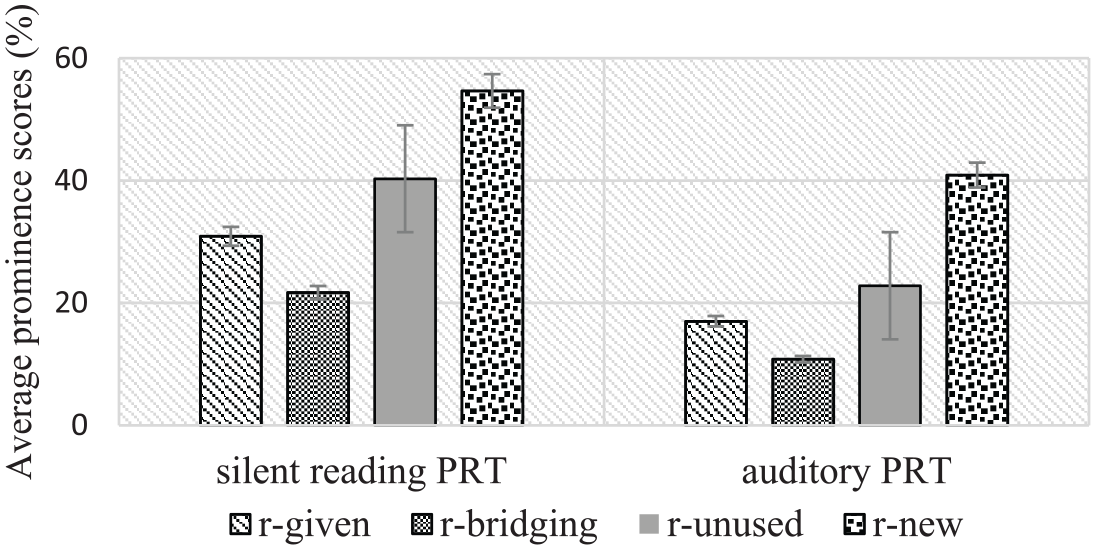
Average prominence scores for nominal words grouped by the information status of the word’s referent. Error bars show the standard deviation.
In Figure 7, we present the average percentage of respondents who rated in- versus ex-situ words as prominent, in each PRT modality.
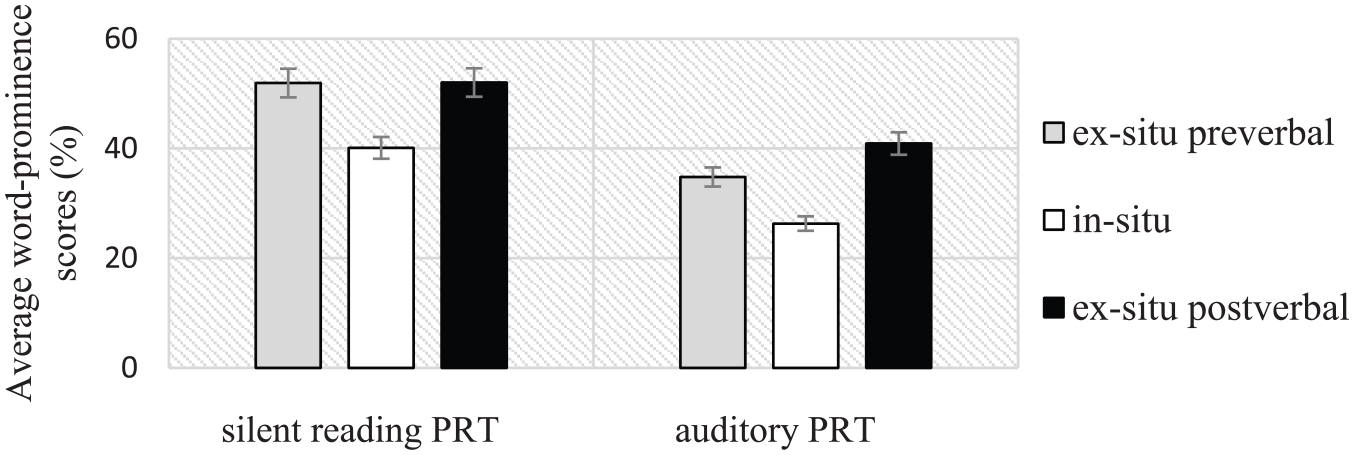
Average percentage prominence scores for nominal words grouped by the clausal position of the word’s referent.
Descriptive statistics presented in Figure 6 and Figure 7 warrant the following observations. First, across the PRT modalities and among the referential information categories, (a) more respondents rated words introducing new referents as prominent compared to words introducing referents of other information status; (b) more respondents rated words introducing discourse-given referents as prominent compared to words introducing discourse-bridging referents; and (c) more respondents rated words introducing unused but generally known referents as prominent compared to words introducing referents of discourse-given status. Second, more respondents rated ex-situ words as prominent, compared to in-situ words, across the PRT modalities. In the auditory PRT, the rate at which ex-situ post-verbal words were identified as prominent was higher than that for ex-situ pre-verbal words.
Average percentage prominence ratings were assessed for inter-rater agreement. Obtained Fleiss’ kappa statistics translate into fair but highly significant agreement levels: silent reading PRT κ = .26, p < .001 and auditory PRT κ = .36, p < .001. PRT responses from each rater were coded as a binary variable, prominence ratings, which equaled 1 if a rater selected a word as prominent, and 0 otherwise. Prominence ratings were modeled using mixed-effects logistic regressions, one per task version. Each model assessed the log likelihood of a nominal word being rated as prominent. Regression modeling was implemented in Stata 13.
In the silent reading PRT model, summarized in Table 4, we gauge the effects of clausal position of a word relative to the canonical constituent order and referent information status on the probability that a word is rated as prominent. In addition to these predictor variables, the auditory PRT model, summarized in Table 5, also accounts for the effect of acoustic-prosodic expression of a word on the likelihood that it is rated as prominent by estimating the effects of a word’s mean intensity, F0 range and duration on the probability that the word is identified as prominent. Each logistic model featured prominence ratings at the word level as the binary dependent variable. Due to collinearity, referent categories r-unused known and r-new were merged.
Results of the mixed effects logistic regression model of perceived prominence ratings obtained from the silent reading PRT. For each predictor variable tested in this model, average marginal effects, while holding other variables of interest constant, were computed post-hoc and are shown in parentheses following each fixed effect coefficient.
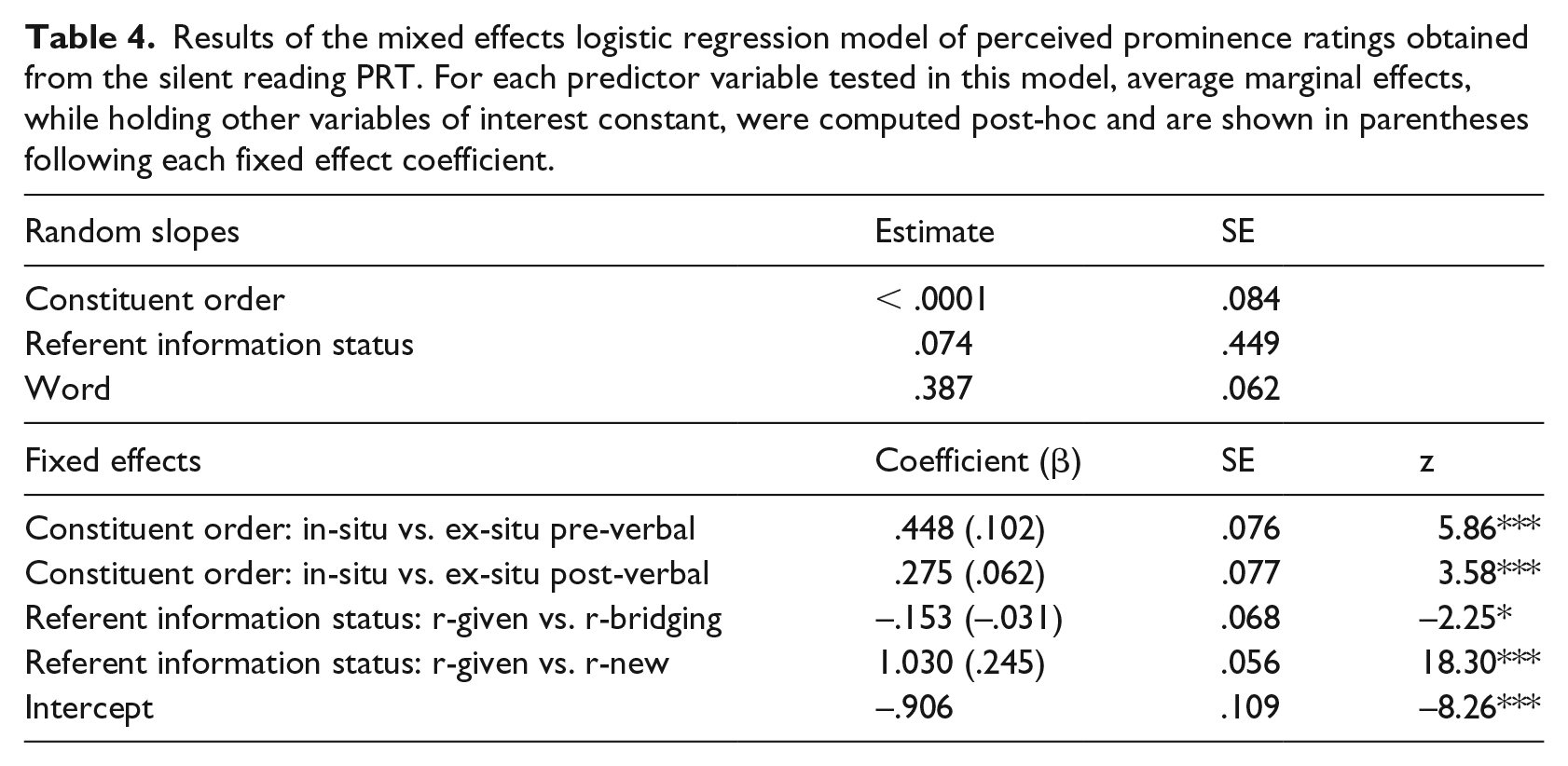
Results of the mixed effects logistic regression model of perceived prominence ratings obtained from the Auditory PRT. Inclusion of interaction terms crossing Constituent order and acoustic-prosodic measures (per Hypothesis 4 and Prediction 4) was not implemented due to model non-convergence. For acoustic-prosodic measures tested in this model, average marginal effects, while holding variables of interest at their means, were computed post-hoc and are shown in parentheses following each fixed effect coefficient.
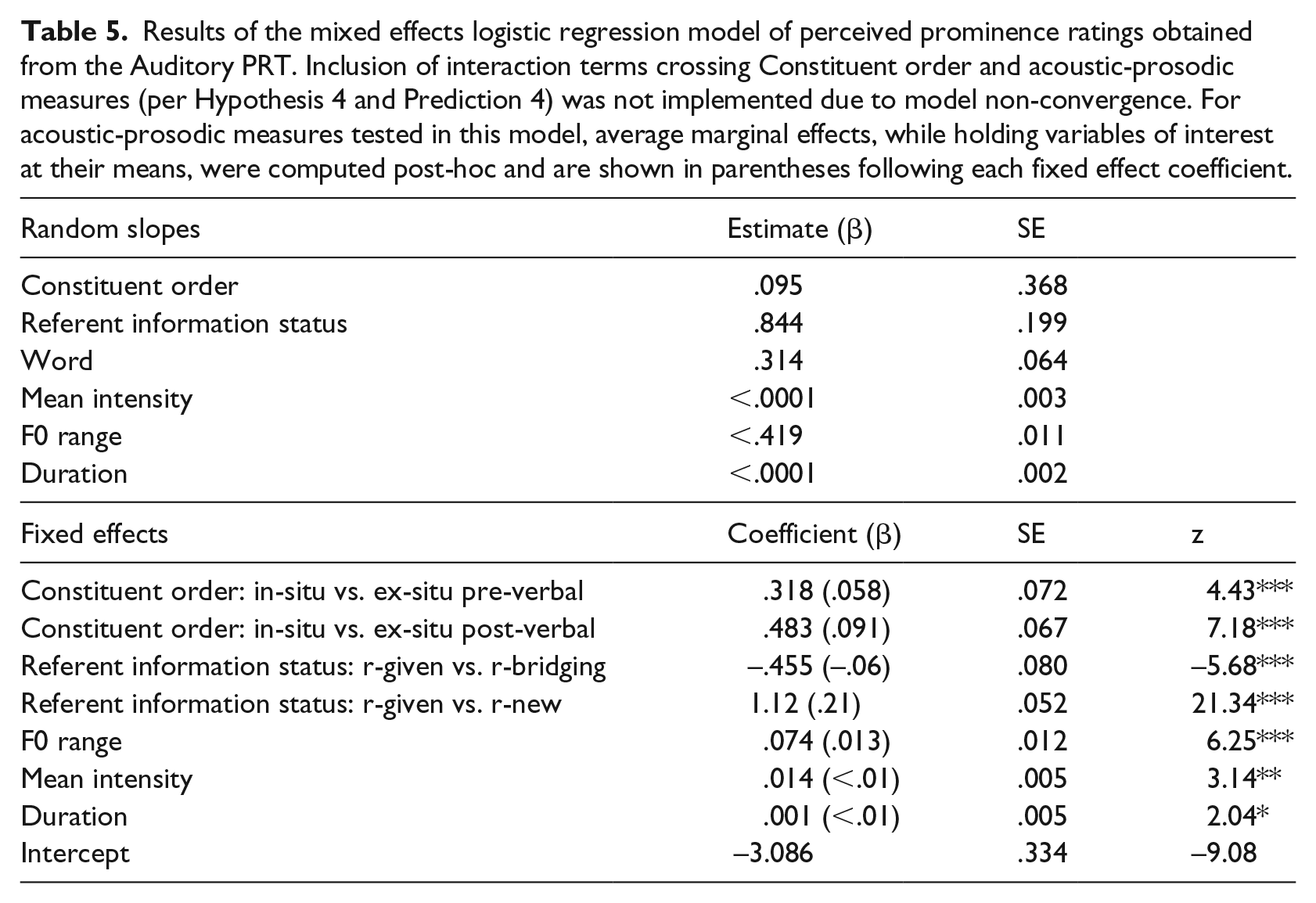
Following Barr, Levy, Scheepers, and Tily (2013), for each PRT data set, our regression approach was to fit a model containing all factors of interest as both fixed effects and random slopes over participant. A post-hoc estimation of the average marginal effects associated with each fixed effect in the silent reading PRT model provides an estimate of the average of predicted change in the probability that a word is identified as prominent for different levels of the predictor variables. A post-hoc estimation of the average marginal effects in the auditory PRT model, additionally, provides an estimate of the average of predicted change in the probability that a word is identified as prominent for a fixed amount of change in the acoustic-prosodic measures tested in the present study.
5.5 Results
To further examine the relationship between perceived information prominence, constituent order and acoustic-prosodic expression, per Hypotheses 3 and 4, for the acoustic-prosodic measures mean intensity, F0 range and duration and each level of predictor variable constituent order, we generated univariate linear regression plots visualizing the relationship between the magnitude of the acoustic parameters estimated in the auditory PRT model and the average prominence score for each word, across raters. We then repeated these analyses for each level of the predictor variable referent information status, to elucidate the relationship between the acoustic-prosodic measures and prominence ratings obtained in the auditory PRT, as outlined in Predictions 3 and 4. Univariate regression plots are presented in Figures 8–10 below.
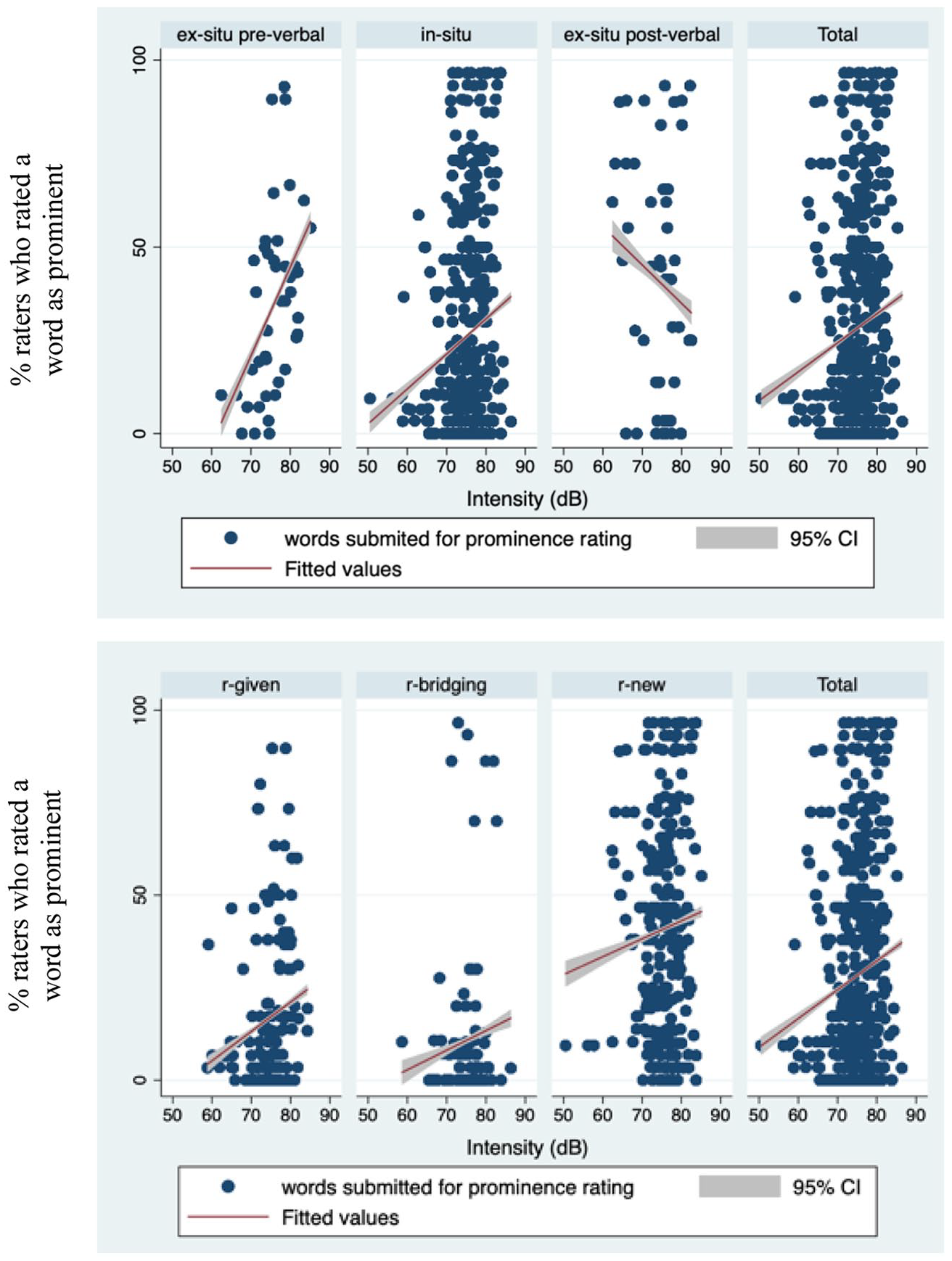
Mean intensity (dB) in the model speaker’s reading performance and word prominence scores in the auditory PRT. Top panel: words grouped by clausal position; bottom panel: words grouped by referent information status.
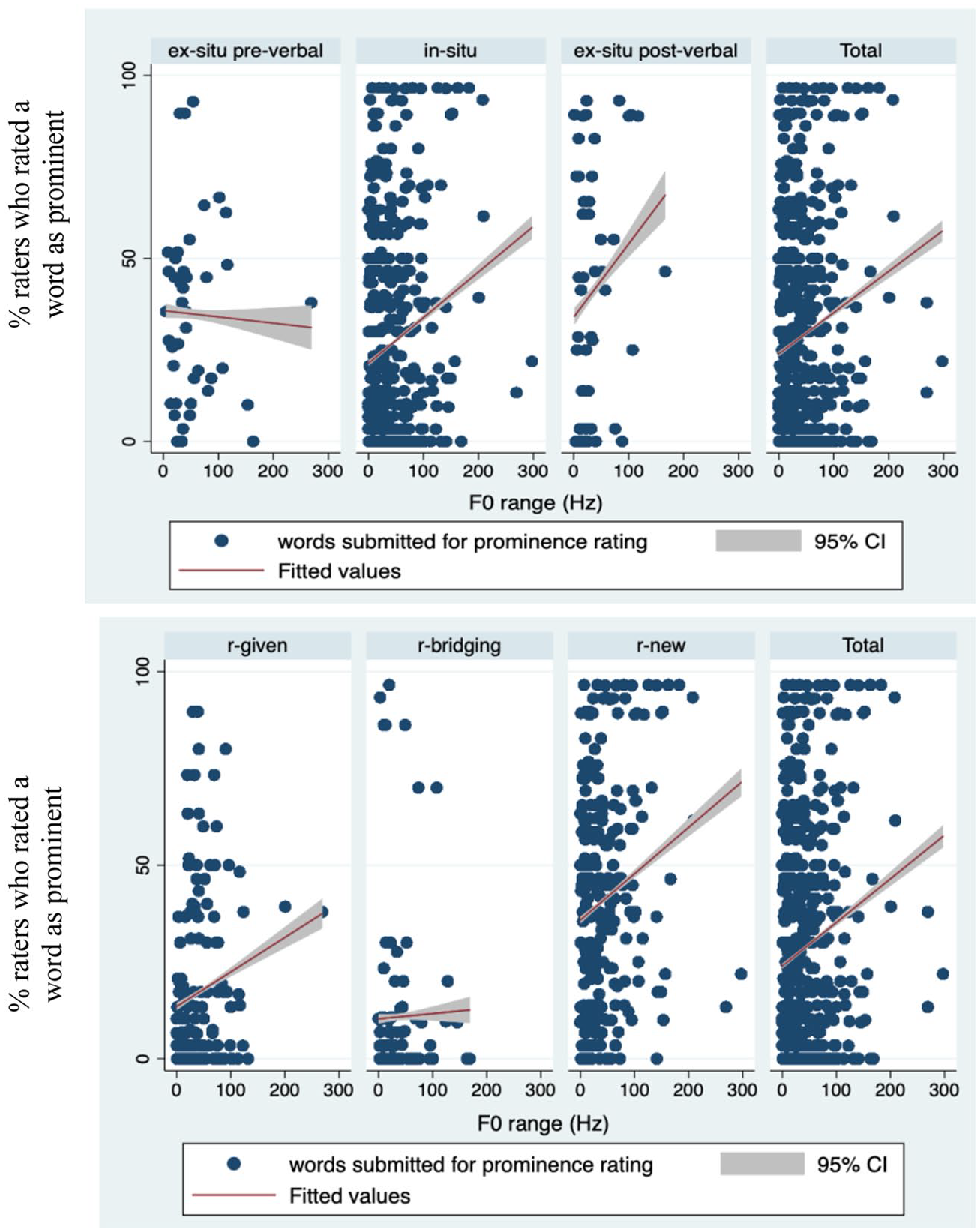
F0 range (Hz) in the model speaker’s reading performance and word prominence scores in the auditory PRT. Top panel: words grouped by clausal position; bottom panel: words grouped by referent information status.
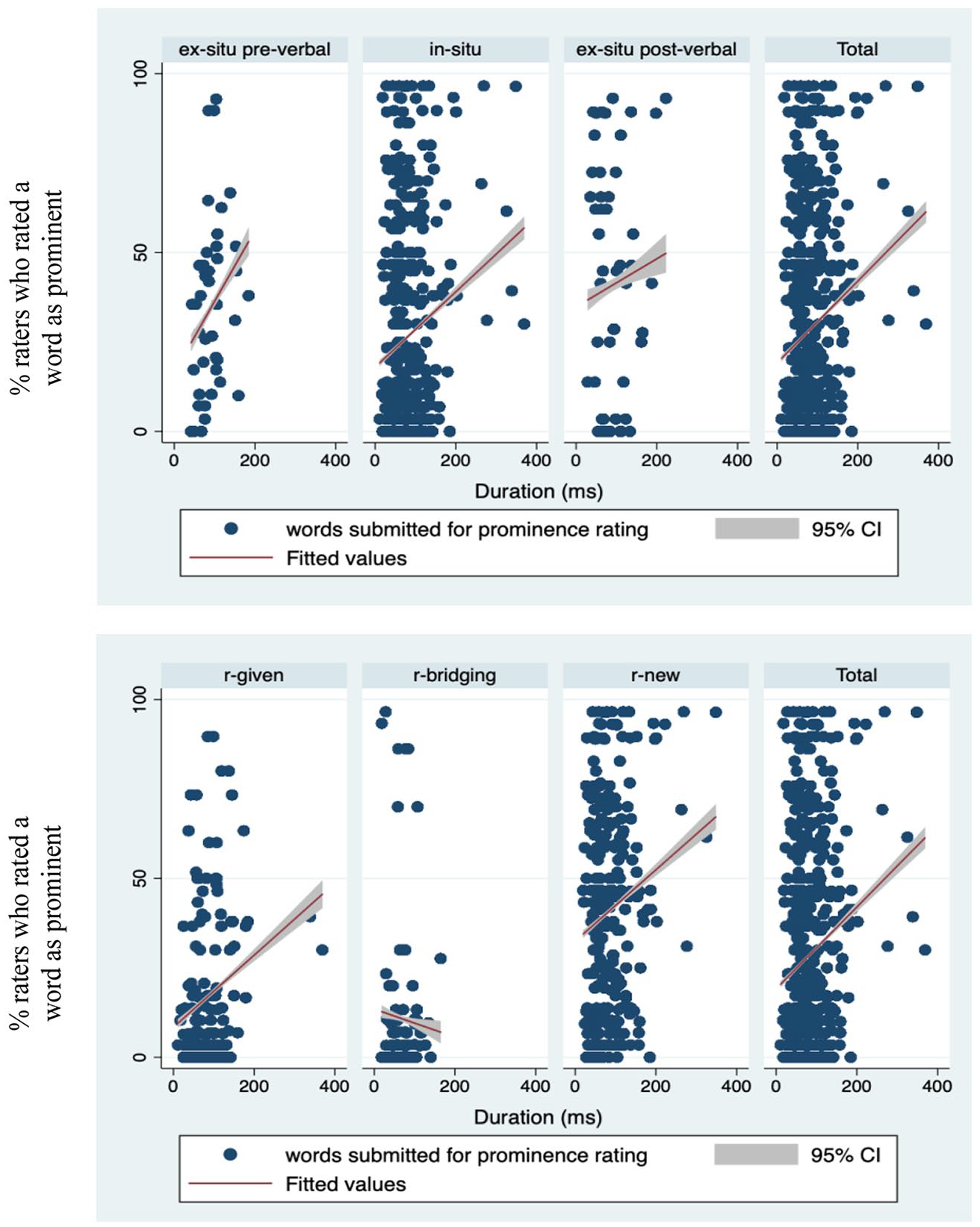
Vowel duration (ms) in the model speaker’s reading performance and word prominence scores in the auditory PRT. Top panel: words grouped by clausal position; bottom panel: words grouped by referent information status.
Figure 8 demonstrates that
Figure 9 demonstrates that
Figure 10 demonstrates that
Results of the univariate analyses presented in Figures 8–10 corroborate the results of the multivariate logit model of the prominence ratings obtained in the auditory PRT. These analyses support the conclusion that prominence ratings are based jointly, though probabilistically, on the information status of a word, its clausal position and its acoustic-prosodic expression. To illustrate, r-bridging referents, due to being relatively more accessible to the reader/listener, are associated with prosodic reduction in the model speaker’s read production data and a significantly smaller likelihood of being identified as prominent in the PRT data. Acoustic-prosodic expression of words introducing discourse-new referents, on the contrary, is systematically augmented in the model speaker’s read production and is associated with a greater probability of being rated as prominent. Not surprisingly, of the two referent types, the latter have more ex-situ occurrences in the PRT materials.
Furthermore, results of the univariate analyses provide some preliminary support for Prediction 4, which calls for a test of the interaction between constituent order and acoustic-prosodic measures, as, arguably, the latter can be further mediated by where in a phrase a word is located. Figures 8 and 10, specifically, demonstrate that the nature of the effects of mean intensity and duration is very different depending on where in the utterance these measures are taken. To illustrate, the ex-situ post-posed position is where we observe a lack of evidence of a positive relationship between the magnitude of these parameters and the probability of a prominence rating, which were established in the multivariate logistic analysis (see Table 5). This may further explain the relatively small impact of these acoustic measures on the probability that a word is identified as prominent during the auditory PRT.
6 Discussion
The goal of this study is to parameterize perceived prominence in Russian, a free word order language, and determine the factors that guide naïve readers’ or listeners’ perception of a word as prominent, rated in relation to its discourse context. To this end, we tested whether variation in constituent order, acoustic-prosodic properties of nominal words and their information status mediate their perceived prominence during silent reading and listening of narrative texts by linguistically naïve native speakers of Russian. We began by analyzing patterns of constituent order and acoustic-prosodic variability related to the information status of nominal expressions in read productions of two published narratives in Russian. We then examined the relative contribution of these factors to the likelihood that a nominal word is perceived as prominent during the silent reading or listening of the narrative texts selected for this study. We conducted two unguided prominence rating tasks during which linguistically naïve native speakers of Russian evaluated relative information prominence of the nominal words during silent reading, or while listening to the study materials.
In line with earlier work on information structure and its relation to prominence (Breen et al., 2010; Watson, 2010), we tested whether the relative accessibility of a word’s referent is predictive of the likelihood that any given word is perceived as prominent. The nature of this effect was laid out in Hypothesis 1, which predicted an inverse relationship between discourse accessibility (givenness) and perceived prominence. This prediction was borne out: words introducing discourse-new referents were more likely to be rated as prominent and accounted for 41–51% of words rated as prominent across the PRT modalities. In fact, the r-new status alone increased the probability that a word is identified as prominent by 21–24% across the PRT modalities. Further corroborating this result, contextually accessible r-bridging words were much less likely to be rated as prominent, summing to only 11–21% of the words selected as prominent across the PRT modalities. Unexpectedly, we also found that r-bridging words, whose referents are predictable based on the discourse context, were 3–5% less likely to be rated prominent than r-given words, across the PRT modalities. Words with discourse-given referents comprised 17–31% of all words rated as prominent, across the PRT modalities. Below, we discuss the prominence status of r-given words in conjunction with their acoustic-prosodic profile in the model speaker’s read production data.
Another goal of the PRT experiments was to validate that in Russian, the linear order of sentence constituents interacts systematically with information status at the word level, in their influence on prominence perception. Approximately 20% of the utterances in the narratives used in the PRT experiments feature non-canonical constituent orders. Per Hypothesis 2, constituent order, licensed by information structural considerations in Russian, has an effect on perceived prominence, such that positioning a nominal word ex-situ signals its information status as different from what would be expected in the default word order. In this way, the ex-situ positioning of a word directly contributes to its perceived prominence. We focused on two distinct patterns of non-canonical constituent order, whereby a nominal constituent appears ex-situ in pre-verbal, or post-verbal position.
Results of the PRT experiments revealed a reliable association between an ex-situ position and the likelihood that an ex-situ word is rated as prominent, confirming that an ex-situ position acts as an independent cue to prominence in Russian (Botinis et al., 2005; Luchkina & Cole, 2016). The effect of non-canonical constituent order was of a more moderate magnitude than the effect of referent information status and increased the probability that a word is perceived as prominent by 6–10% across the PRT modalities. Remarkably, both pre- and post-verbal ex-situ positions had a positive impact on the likelihood of perceived prominence, consistent with the constituent order-information structure configurations established for Russian, as well as with the fact that some ex-situ occurrences are motivated by focus. Specifically, Russian is known to favor the “given-before-new” template, which makes the phrase-final position, aligned with the nuclear pitch accent, the preferred location for new information (Luchkina & Cole, 2016).
In the silent reading PRT, the ex-situ pre-verbal position was in fact associated with greater perceived prominence, increased the probability that a word is identified as prominent by 10%. This result may be attributed to the fact that in non-canonically ordered sentences, the pre-verbal position is known to be reserved for highly salient sentence topics and contrastive foci (Neeleman & Titov, 2009). More generally, it reveals that most ex-situ occurrences, regardless of the linearization scenario, pre- or post-verbal, do not go unnoticed during discourse comprehension. When we examine the auditory PRT on its own, however, it is post-verbal ex-situ words that are more likely to be rated as prominent than pre-verbal ex-situ constituents. This result is not unexpected, given that in the Russian materials tested here, the position of ex-situ words is partly predicted by the information status of their discourse referents. As Figure 1 demonstrates, words whose referents are discourse-given have a tendency to occur in-situ or pre-verbally, that is, relatively early in a sentence or phrase. Words introducing discourse-new referents, on the other hand, have the most post-verbal ex-situ occurrences. Because the sentence-final position in Russian is the position of nuclear pitch accent, this position benefits from both structural and acoustic-prosodic prominence. Positioning discourse-new words towards the end of an utterance may be seen as an effective strategy to facilitate discourse comprehension and subsequent information recall, as has been previously demonstrated for English by Cutler, Dahan, and Van Donselaar (1997), Fraundorf, Watson, and Benjamin (2010), and Kember, Choi, Yu, and Cutler (this issue).
Confirming Prediction 2a, in Russian, the effect of constituent linearization increasing the likelihood of prominence rating is further reinforced in the presence of acoustic-prosodic features specific to the ex-situ position and consonant with the word’s information status. Because non-canonical constituent linear order occurred in approximately 20% of the utterances in the analyzed narratives, following Svetozarova (1998), we anticipated acoustic-prosodic expression in the model speaker’s read production to present a more systematically available cue to prominence in clauses conforming to the basic constituent order. Analyses of the read production data confirmed predicted patterns of co-variation in the magnitude of the acoustic-prosodic measures extracted from nominal words and the likelihood that any such word is rated as prominent, as per Prediction 3.
In order to parameterize acoustic-prosodic expression, using the read production data from our model speaker, we evaluated dynamic changes in the range of the fundamental frequency, mean intensity and duration in relation to information status and perceived prominence at the word level. Our findings reveal that all of the acoustic parameters selected for analysis vary in relation to the word’s information status and have an effect on the likelihood that a listener perceives a word as prominent. In the auditory PRT data, vowel
In the model speaker’s read production data, greater
In summary, results of the auditory PRT reveal that raters were attuned to the patterns of prosodic augmentation in the model speaker’s reading performance and used the acoustic-prosodic features of the nominal words as cues to their relative prominence. While the maximum values recorded for the tested acoustic-prosodic parameters were reserved for the discourse-new referents in the model speaker’s read production data, we presented novel evidence supporting a special discourse status of discourse-given referents. Recall that in the model speaker’s read production data, words with r-given referents had unreduced segment duration which was greater than that of intermediate referent categories such as r-bridging. Furthermore, however conservative the effect of duration obtained in the auditory PRT, the magnitude of the duration measure, both for r-given and r-new words, was positively related to the probability that any such word was identified as prominent. In the analyses of read productions of the PRT materials by 15 Russian speakers (including the model speaker for this study) reported in Luchkina and Cole (2016), not only duration, but also the F0 range of r-given words was systematically greater than that of words with referents of different information status. Cumulatively, these results lead us to seek out alternative explanation of patterns of accentedness observed in conjunction with the discourse-given status in the model speaker’s production. In this study, we entertain two possibilities, prompted by earlier research on Russian phonology by Svetozarova (1998), as well as by recent work on accentedness in discourse in English by Chodroff and Cole (2018, 2019).
Chodroff and Cole (2018, 2019), in their analysis of phonetic and phonological IS correlates in American English, find that the relationship between pitch accenting, at both nuclear and pre-nuclear levels, and information structure (including givenness and contrastive focus) is probabilistic, as evident from the lack of systematic deaccenting of discourse-given information and the imperfect correlation between the pitch accent type and the information status of the accented word. In a similar vein, exploring patterns of pitch accenting in relation to noun information status in Russian discourse, Svetozarova (1998) reported theme (given) and rheme (new) to be systematically accented information categories in Russian and further proposed that discourse-given status may be inherently (prosodically) prominent. This proposal is in line with an observation by Gundel et al. (1993) that in Russian, “bare nouns”—in other words, nouns not preceded by a determiner or bearing a morphological marker—are attested for all information statuses and in all clausal positions, making it plausible that dissimilar accenting patterns may be assigned to words of different information status, such as r-new and r-given. Preliminary empirical evidence supportive of Svetozarova’s view is presented in Sityaev (2000), who used a corpus of read Russian speech and compared accenting patterns of discourse-new and discourse-given referents. Sityaev found that 79–97% of discourse-given referents in his data were accented but made no further claims regarding the accent types associated with given or new information. Our production data lend further support to Svetozarova’s view in that discourse-given nominal words in the model speaker’s read production had systematically augmented duration and were more likely to be rated as prominent than words of intermediate information status. More broadly, our findings point to the probabilistic nature of the relationship between the acoustic-prosodic expression of a noun and the information status of its referent, given or new.
Jointly, our results highlight similarities between Russian and other languages in which acoustic-prosodic expression presents an important means of communicating pragmatic meaning and cuing perceived prominence in discourse. For Russian, this means that the magnitude of acoustic-prosodic parameters at the word level is related to the information status of a discourse referent and is also predictive, albeit to a various extent, of the likelihood that a word is perceived as prominent.
7 Conclusion
This study contributes to the understanding of the linguistic mechanisms that render a word perceptibly prominent in read discourse. We report that in Russian, a language known for its high degree of word order flexibility, perceived prominence varies in relation to the information status of a discourse referent and may be signaled by acoustic-prosodic means, constituent linearization (word order), and their interaction. Analyses of word-level prominence ratings provided by linguistically naïve native speakers of Russian reveal that the level of discourse-givenness of a word’s referent is inversely related to the likelihood that it is perceived as prominent. Furthermore, Russian offers two distinctive mechanisms for signaling prominent information in discourse. One of these mechanisms is non-canonical constituent order which serves as an independent, albeit a highly probabilistic cue to prominence, whereby a non-canonical placement of a sentence constituent is associated with a greater probability of its being perceived as prominent. Because canonically ordered utterances by far outnumber alternative constituent orders in Russian, acoustic-prosodic expression of a word is instrumental in expressing its prominence in the auditory modality. Russian behaves similarly to intonational languages with more rigid constituent order, like English, in that it deploys acoustic-prosodic cues to signal the information status of a word and its relative prominence in discourse. This explains a positive relationship between the magnitude of acoustic-prosodic parameters tested in this study, and the likelihood that a word is perceived as prominent.
