



Abstract
To ascertain the characteristics of accidental deaths of elderly people in urban and rural areas, we analyzed the deaths of elderly people over the 10-year period from 2000 to 2009, in three geographic areas: nationwide, in the 23 wards of the metropolis of Tokyo, and in Saga prefecture. In addition, to assess the regional variation in accidental deaths of the elderly, we aggregated the numbers of accidental deaths of elderly people for each of Japan’s prefectures in the year 2009 and categorized the deaths by accident type. The results showed that nationwide, deaths due to threats to breathing, falls, and drowning and submersion are increasing, while deaths due to transport accidents are decreasing, indicating a need for measures to prevent deaths from accidents other than transport accidents. In the urban areas of Tokyo’s 23 wards, there is an increasing incidence of deaths due to falls, which is likely due to the high number of structures such as buildings and railway stations that elderly people need to negotiate. In urban areas, measures to reduce the incidence of accidental deaths need to focus on improving the physical environment to help prevent falls. In the rural locality of Saga prefecture, increasing numbers of elderly people are dying by drowning and submersion. The results of analysis of accidents in all prefectures of Japan by accident type show that the causes of accidental deaths of elderly people vary regionally, suggesting that accident prevention measures for elderly people need to consider the characteristics of the locality.
Keywords
Introduction
Due to the decline in their physical and cognitive functions, elderly people are more likely to experience an accident than youths or adults (up to middle age), so efforts to prevent accidents are needed to ensure the safety of elderly people. Fatal accidents are considered most important and efforts to address accidental deaths of elderly people are currently focused on transport accidents. However, elderly people commonly die as a result of other kinds of accidents, such as falls, threats to breathing due to accidental ingestion, drowning and submersion in a watercourse, freezing or heat stroke due to extreme ambient temperatures, and poisoning due to toxicity of medication. To prevent the accidental deaths of elderly people, it is necessary to provide physical environments that minimize the likelihood of accidents by determining the characteristics of fatal accidents and assessing the conditions of places where accidents tend to occur.
In this study, we analyzed the accidental deaths of elderly people in Japan over the 10-year period from 2000 to 2009, nationwide, in the 23 wards of the metropolis of Tokyo, and in Saga prefecture (where the authors previously worked), to ascertain the characteristics of accidental deaths of elderly people in urban and rural areas and to obtain fundamental knowledge and data for developing measures to prevent fatal outdoor accidents among elderly people. In addition, to examine regional variations in accidental deaths, we aggregated the number of elderly accident fatalities for all prefectures by accident type. Japan is now facing the challenge of having the world’s oldest population. The structure of Japan’s population is gradually aging. In 2009, people 65 years of age and over made up 22.7% of the total population, with the life expectancy for men reaching 79.59 years and that for women reaching 86.44 years. By the year 2067, people 65 years of age and over are expected to make up 40.5% of the total population.1,2 In due course, other countries too will need to address the challenges of an aging population; Japan is simply the first. By studying the problems faced by an aging population and developing solutions, Japan can establish itself as a model for other countries.
Materials and methods
Statistical analysis of accidental deaths of elderly people
Using vital statistics, 3 we compiled data on the accidental deaths of people 65 years of age and over for the period from 2000 to 2009, in three geographic areas: nationwide, in the 23 wards of the metropolis of Tokyo, and in Saga prefecture. In addition, we used vital statistics to aggregate the number of accidental deaths of elderly people for all prefectures for 2009 by accident type. The accidental deaths were divided into seven categories according to the ICD-10: transport accident (V01‐V99), falls (W00‐W19; fall from a height and fall from a standing height), drowning and submersion (W65-W74), threats to breathing (W75-W84), exposure to smoke, fire, and flames (X00-X09), poisoning and exposure to noxious substances (X40-X49) and others (X50-X59).
Results
We analyzed the trend in accidental deaths of elderly people for the period from 2000 to 2009 in three geographic areas: nationwide, in the 23 wards of the metropolis of Tokyo, and in Saga prefecture. Nationwide, there was an increase in deaths due to threats to breathing, fall, and drowning and submersion, while deaths due to transport accidents decreased. In the 23 wards of the metropolis of Tokyo, there was an increase in deaths due to threats to breathing and falls, but a decrease in deaths due to transport accidents. In Saga prefecture, there was an increase in deaths due to threats to breathing and drowning and submersion, but deaths due to falls remained largely unchanged, while deaths due to transport accidents decreased (Figures 1–3).
Trend in accidental deaths (nationwide, elderly people, 2000–2009). Trend in accidental deaths (23 Tokyo wards, elderly people, 2000–2009). Trend in accidental deaths (Saga prefecture, elderly people, 2000–2009).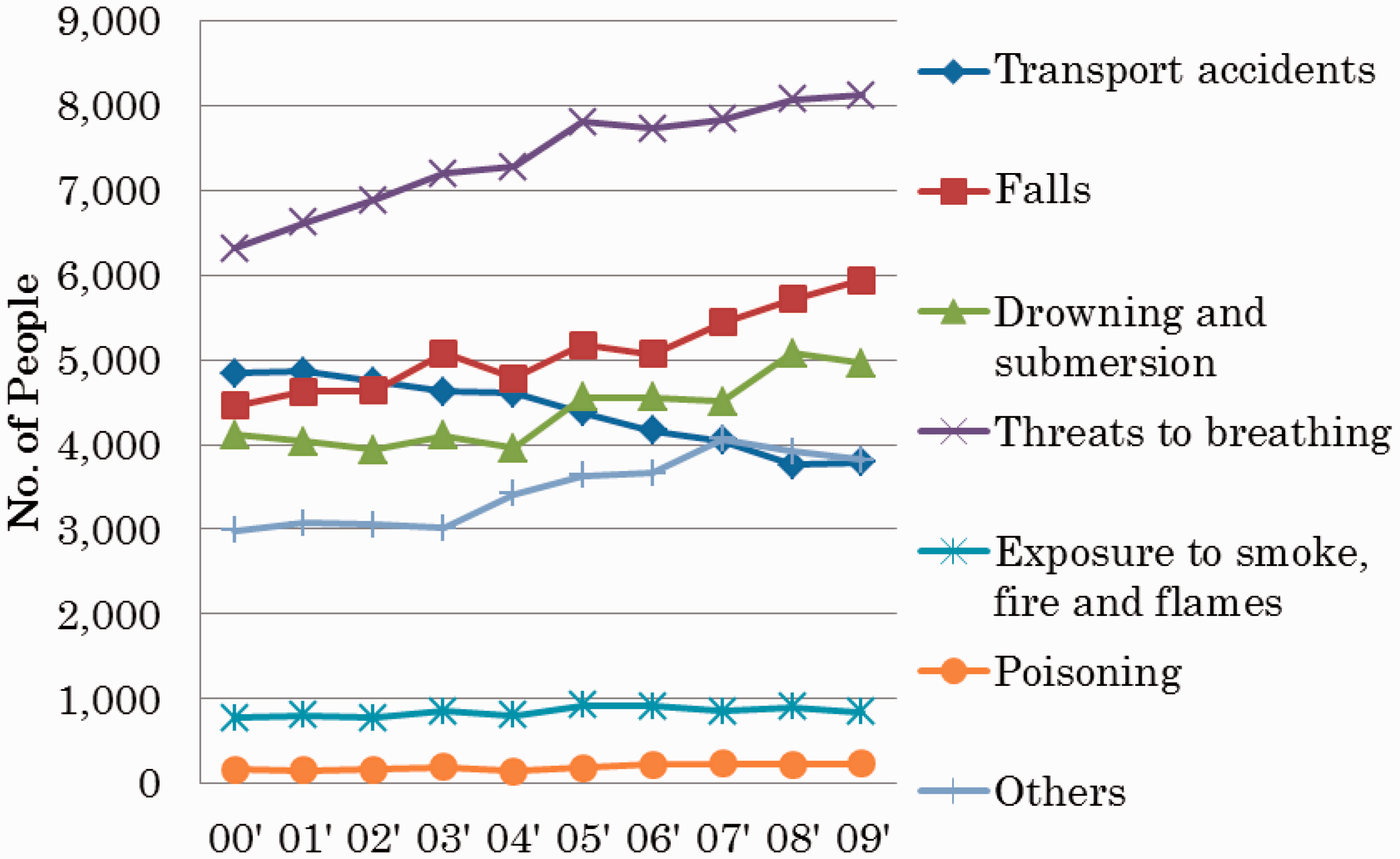


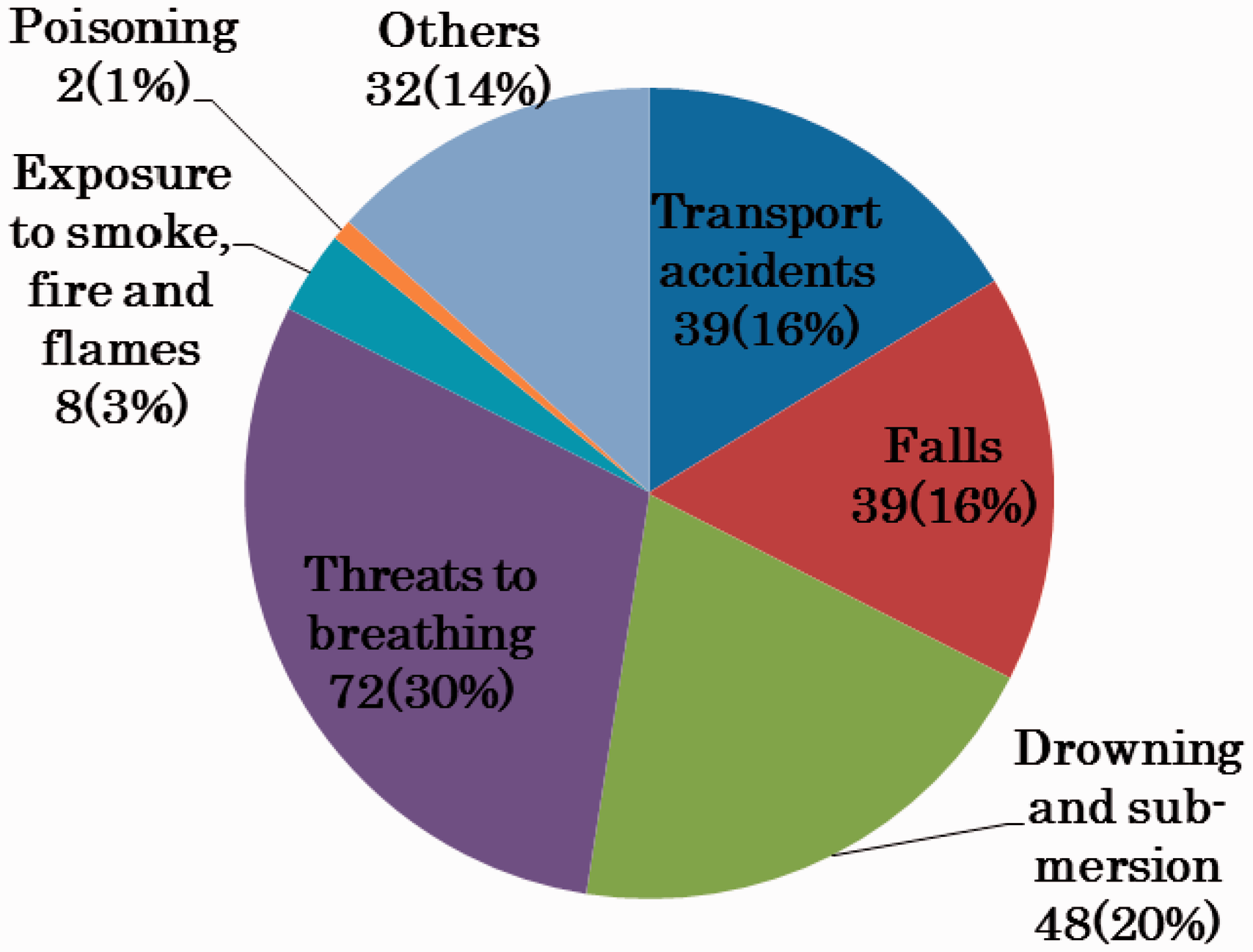
The most common cause of accidental deaths of elderly people in 2009 nationwide was threats to breathing (29.3%), followed by falls (21.5%), drowning and submersion (17.9%), and transport accidents (13.7%). In the 23 wards of Tokyo, the top cause of accidental death was threats to breathing (27.3%), although falls (27.2%) was a very close second, followed by drowning and submersion (19.8%), and transport accidents (6.7%). In Saga prefecture, the leading cause of accidental death was threats to breathing (30.0%), followed by drowning and submersion (20.0%), and then falls (16.3%) and transport accidents (16.3%) (Figures 4–6).
Accidental deaths (nationwide; year 2009; 27,710 elderly people). Accidental deaths (Tokyo wards; year 2009; 1263 elderly people). Accidental deaths (Saga prefecture; year 2009; 240 elderly people).

Our compilation of accidental deaths of the elderly for all prefectures for 2009 by accident type showed that in Tochigi, Yamanashi, and Nara prefectures, deaths due to falls were more frequent than deaths due to threats to breathing, whereas in Fukuoka, near drowning and submersion was a more common cause of accidental death than threats to breathing. In addition, we found that in Tochigi, Saitama, Chiba, Nara, Kyoto, Shimane, Yamaguchi, Kochi, Kumamoto, and Okinawa prefectures, deaths due to falls were at least twice as frequent as deaths due to drowning and submersion, whereas in Niigata and Kanagawa prefectures, deaths due to drowning and submersion were at least twice as frequent as deaths due to falls.
Discussion
Nationwide, accidental deaths of elderly people due to transport accidents decreased, but deaths due to threats to breathing, falls, and drowning and submersion increased. The incidence of deaths due to transport accidents has been on the decline both for all age groups and for elderly people. However, the proportion of elderly people dying in transport accidents to the total number of deaths is increasing, reflecting the fact that the rate of decline in deaths of the elderly is lower. 4 The decline in traffic accident deaths is the result of various factors: legal and regulatory measures, such as the introduction of more severe penalties for drunk driving and making the wearing of seat belts compulsory; comprehensive measures to prevent accidents, such as safer road environments, stronger vehicle structures, and increased public transport; and improved emergency treatment for people injured in accidents. 5 Traffic safety education for elderly pedestrians and cognitive function testing of elderly drivers have been particularly significant in the decline in accidents among the elderly. Also, in June 2009, it became obligatory for drivers 75 years of age or over on the expiry date of their driver license renewal period to undergo a cognitive function test as well as to attend a training class for elderly drivers. 6 Looking ahead, further measures to prevent transport accidents involving elderly pedestrians are considered necessary. 7
The highest rate of private car ownership per household in Japan is in rural areas, with Fukui prefecture (1.75) at the top of the list, followed by Toyama (1.72), while the lowest rate is in urban areas, with Osaka prefecture (0.68) and the metropolis of Tokyo (0.49) at the bottom. 8 Obviously, measures aimed at reducing the incidence of transport accidents in rural areas that rely heavily on private cars as a means of transport will be different from those in prefectures with very large cities that are well served by public transport networks. In rural areas, prevention of accidents involving elderly drivers is of primary importance, whereas in big cities, prevention of deaths due to public transport accidents, such as those involving trains and railway station platforms, is of primary importance. Installation of platform screen doors in train and subway stations that shield the platform from the train has been progressing in cities to reduce the risk of accidents, especially from trains passing through the station at high speeds.
The increasing incidence of deaths among elderly people in recent years due to threats to breathing, falls, and drowning and submersion suggests a need for measures to prevent these kinds of accidents. Although a variety of measures have been taken to address the deaths of elderly people in transport accidents as a key issue, much less attention has been paid to other kinds of fatal accidents involving elderly people. Measures aimed at preventing falls and drowning and submersion accidents among elderly people have been implemented within medical facilities and indoor environments, but hardly any measures have been taken to prevent such accidents in outdoor environments.9,10 Now that the rate of fatal transport accidents among elderly people has fallen, it is necessary to further reduce the incidence of deaths of elderly people by means of educational activities relating to other kinds of fatal accidents and through improvements to outdoor physical environments, such as road surfaces, stairs, and watercourses.
A comparison of accidental deaths of elderly people nationwide, in the 23 wards of the metropolis of Tokyo, and in Saga prefecture shows that the most common cause of death in the urban areas of Tokyo’s 23 wards is falls, whereas the most common cause in rural Saga prefecture is drowning and submersion. The reason that falls is the most common cause of accidental death among the elderly in the 23 wards of Tokyo is likely the large number of structures such as buildings and railway stations. Measures to address the issue of accidental deaths of elderly people in urban areas must aim at preventing falls. Persons 70 years of age and older made up 46% of patients who fell and were injured while getting on escalators in buildings and railway stations in the metropolis of Tokyo. To prevent falls on an escalator, it is necessary for elderly persons to hold the handrail and not to walk while getting on the escalator. 11 In rural Saga prefecture, the reason for the relatively high number of deaths due to drowning and submersion is likely the large number of irrigation canals for agricultural use. Results of the analysis of accidental deaths in all the prefectures of Japan clearly indicate regional variations in the causes of fatal accidents involving elderly people. In view of this, an effective approach to reducing the rate of accidental deaths of elderly people should take into account the particular characteristics of each locality when developing measures to prevent accidents.
There is general agreement among studies that the rate of fall-related injuries increased in elderly people in developed countries. 12 An analysis of mortality data in USA shows mortality rates from falls increased by 38% for white elderly men during 1999 to 2005. 13 An epidemiological study of injury-related deaths in South Korea shows the greatest increase (24%) for fall injuries among elderly people during 1996 to 2006. 14 In most Western countries, the incidence of traumatic brain injury, a major cause of death in accident victims, is falling among young people due to successful road traffic accident preventions. However, the aging of the population has shifted the epidemiology of traumatic brain injury toward more frequent falls at home, mainly involving the elderly. 15 The variation over time of accidental deaths of elderly people in Japan, the world’s most aged society, and the measures taken to address this issue can serve as a valuable reference to other countries that are facing the challenges of an aging population, to help them prevent accidental deaths.
Footnotes
Acknowledgements
This work was supported by grants to K.K. from The Univers Foundation and Mitsui Sumitomo Insurance Welfare Foundation.
Conflict of Interest
All authors declare that there are no competing interests.