



Abstract
Analysis of non-human DNA in forensic science, first reported about two decades ago, is now commonplace. Results have been used as evidence in court in a variety of cases ranging from abduction and murder to patent infringement and dog attack. DNA from diverse species, including commonly encountered pets such as dogs and cats, to plants, viruses and bacteria has been used and the sheer potential offered by such analyses has been proven. In this review, using case examples throughout, we detail the considerable literature in this field.
Introduction
Use of non-human DNA analysis in forensic science has seen very rapid growth in recent years. Applications range from investigations of rape and murder of humans to cruelty and poaching in animal/wildlife species, and DNA evidence from animals, plants, bacteria and viruses has been used in criminal investigations. Similarity in genomes and inheritance patterns between organisms ensures that methods used for analysis and interpretation of short tandem repeat (STR) profiles or mitochondrial haplotypes are by and large the same as those carried out in human DNA analysis. There are, of course, important distinctions in some organisms. For example, plants have diverse reproductive strategies: asexual or clonal reproduction, sexual reproduction with self or cross pollination, genomes can be diploid or tetraploid and extra-nuclear genomes can consist of DNA within mitochondria or plastids (chloroplasts). 1 In microbes, genomes can vary from single- or double-stranded linear or circular molecules of DNA or RNA and there can be asexual or sexual reproduction including horizontal gene transfer events. 2 Different organisms can also have differing levels of genetic diversity. For example, many domesticated animals such as dogs have undergone extensive inbreeding resulting in lowered levels of genetic diversity. However, as detailed below, sufficient variability remains within this and other domestic species to allow successful use of their DNA and achieve high discriminatory power.
In the absence of biological evidence to directly link a suspect’s DNA to a victim or crime scene, the ability to utilise non-human DNA found as trace evidence at a crime scene to indirectly make this link is a highly useful one. As with human DNA profiling, individualisation is most commonly attempted using STR genotyping. When a match is found between the DNA profile from the crime scene sample (e.g. dog hair) and the suspect or reference sample (e.g. the victim's/suspect's pet dog), a probability of match (also called the random match probability i.e. RMP) is calculated using allele frequency reference databases, many of which are available for dogs (e.g. dogs in the USA,3–5 dogs in the UK 6 ) and other domestic pets such as cats (cats in the USA 7 ). Effects of population substructure on RMP estimates are routinely corrected for in human DNA profiling by the incorporation of FST (θ) estimates within calculations because of the increased likelihood of seeing the same DNA profile in different individuals when they belong to the same subpopulation as a result of co-ancestry than when they belong to different subpopulations. 8 FST estimates are consequently also taken into account for non-human species where in fact they are generally more pronounced than in humans because population sub-structuring is far greater, and estimates of 0.09, 0.124 and 0.186 have been reported in dogs (references 3, 5 and 6, respectively), while in cats, an estimate of 0.17 has been reported. 7 In contrast, maximal values reported in human populations based on STRs are just under 0.03. 9 In addition to correction for population substructure, it is important in non-human species to apply the correction of inbreeding within a subpopulation by incorporating values for the inbreeding coefficient FIS (or ƒ) within RMP calculations as proposed by Ayres and Overall. 10 If inbreeding in a population is high, it is far more likely to observe homozygous genotypes within individuals, so the incorporation of this correction will effectively increase RMP at homozygous loci. Although not widely used in human populations because of extremely low levels of inbreeding with very few exceptions, this is however very relevant to non-human species such as dogs since high values for FIS have been reported in dogs (e.g. 0.054 and 0.1 by references 5 and 3, respectively).
In cases where STR profiling is problematic due to the lack of adequate amounts of nuclear DNA, mitochondrial DNA (mtDNA), which is more robust to degradation and present in larger copy numbers, has been successfully analysed. In most animals, the 5′ hypervariable (HVR) region of the control region or D-loop is commonly sequenced, and a number of databases have been created in domestic species for mtDNA haplotype frequencies, allowing RMP estimates to be calculated (see section below). But just as with humans, there are limitations to using mtDNA since it is not suitable for positive individual identification and its exclusion capacity is far lower than that seen with STR loci. This problem is further compounded in domestic animals such as cats and dogs, which have far fewer haplotypes and far higher frequencies of common haplotypes than humans.11,12 The lack of well-characterised STR markers in many plant species has resulted in attempts at individualisation using other DNA analysis methods such as random amplified polymorphic DNA (RAPD) and amplified fragment length polymorphisms (AFLPs),13–15 but there is a clear drive towards large-scale genome sequencing projects for marker discovery. 16 In viruses, DNA sequencing of appropriate gene regions is commonly carried out, 17 while bacterial communities within soil are used for 16S RNA profiling. 18
Individualisation of a forensic sample is the primary objective in most cases. However, there is also frequently a need for identification of species of origin in forensic samples, and this is most commonly achieved using DNA sequencing of nuclear, mitochondrial or chloroplast genes. Animal species identification is most commonly achieved by sequencing the cytochrome b (cyt b) or cytochrome oxidase subunit 1 (COI) region of mitochondrial DNA and there are extensive repositories of cyt b sequences in both the European Molecular Biology Laboratory (EMBL) (www.ebi.ac.uk/embl/) and GenBank databases (www.ncbi.nlm.nih.gov/genbank/)..
Non-human biological evidence, DNA marker and type of forensic investigation.
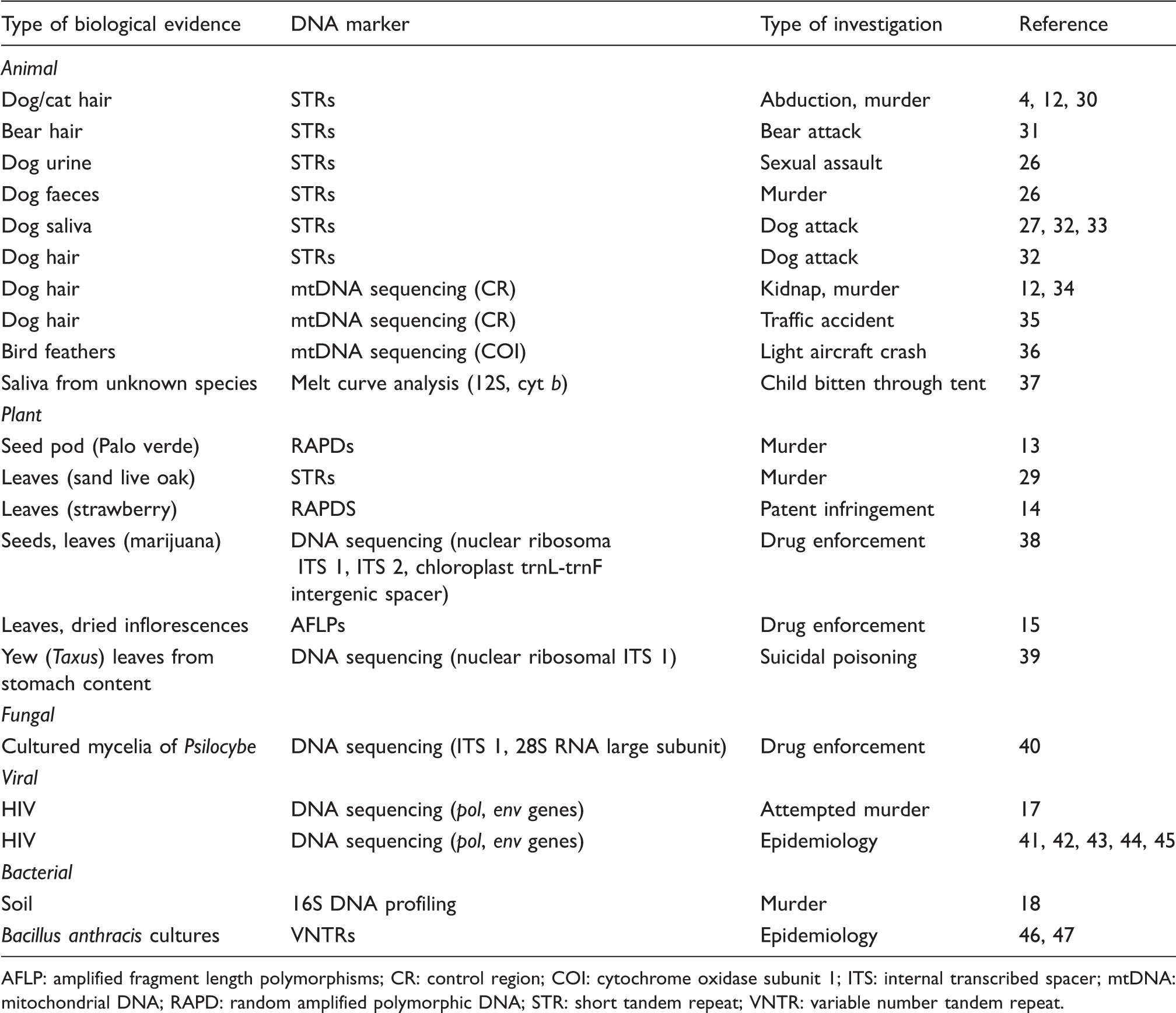
AFLP: amplified fragment length polymorphisms; CR: control region; COI: cytochrome oxidase subunit 1; ITS: internal transcribed spacer; mtDNA: mitochondrial DNA; RAPD: random amplified polymorphic DNA; STR: short tandem repeat; VNTR: variable number tandem repeat.
It is impossible to cover all aspects of non-human DNA analysis in forensic science within one review. Technical aspects of sample collection and DNA analysis/interpretation have been covered. 20 Molecular forensic entomology is a review in itself and will not be covered here. The use of non-human DNA in investigations into poaching, illegal collection/trade of plant and animal species within the rapidly growing field of wildlife forensics will also not be dealt with because inclusion of this content would make for a very lengthy review and because it has been the subject of a few recent reviews.21,22 Instead, we review exclusively the use of non-human DNA analysis in solving crimes involving humans, detailing cases involving investigations into kidnap, murder, drug enforcement, dog attack, epidemiology etc. from its inception in the early 1990s to the present time.
Types of non-human biological evidence
Considering the facts that there are an estimated 8 million pet cats and 8 million pet dogs in the UK, 47 million pet cats and 41 million pet dogs in Europe and 86 million pet cats and 78 million pet dogs in the USA (Society for companion animal studies, 2010; American pet products association, 2011), and that cats and dogs are frequently in close contact with humans, it is unsurprising that pet hair has been the most commonly detected trace evidence in crime scenes. 12 In a simulated study carried out by D'Andrea et al., 23 the transfer of pet hair to victim, suspect or crime scene was considered to be highly probable. However, since pet hairs found as forensic evidence typically tend to be naturally shed and not plucked i.e. they are in the telogen or non-growing dormant phase, they either contain no root ends (i.e. they are just hair shafts) or they sometimes contain root ends but no follicular material adhering to the root.24,25 Thus, STR profiling on DNA from such hair can be problematic and successful mtDNA analysis is more likely. In addition to hair, other biological material found as trace evidence has been used successfully in forensic investigations e.g. DNA from faeces and urine of dogs, 26 DNA from saliva around bite wound or bitten material27,28 and DNA from plant and soil evidence.29,19 See Table 1 for a full listing of types of non-human biological evidence and the various types of forensic investigations to date and sections below for further detail.
Types of investigations
Abduction/kidnap/murder
Analysis of animal STR DNA
The first use of animal DNA evidence in a criminal investigation was in Canada in 1994. When the Royal Canadian Mounted Police (RCMP) found the body of Shirley Duguay who had been missing from Prince Edward Island for 8 months, they suspected that her former husband, Douglas Beamish, was involved in her murder. Near Ms. Duguay's body, a blood stained leather jacket had been found, which was thought to belong to Beamish. While the blood on the jacket was confirmed to match Ms. Duguay's, a positive identification of the jacket's ownership proved difficult, but forensic scientists discovered a small number of white hair on this jacket, which were found to be from a cat. Since Beamish was living with his parents at the time and they owned a white cat called Snowball, investigators took a blood sample from Snowball and sent it for DNA testing along with the hair from the jacket. The results showed that 10 dinucleotide STR loci had the same alleles in both the DNA from Snowball's blood and the DNA recovered from the root of one hair found on the jacket. 30 This evidence implicated Beamish in Ms. Duguay's murder and he was later convicted.
The first such case in the UK was the investigation into the abduction and murder in 2002 of the former British boxer Brian Keating. Mr Keating was brutally beaten in his home in Pontefract while his wife and baby were held at gunpoint by the assailants. His unconscious body was then driven away and dumped in a disused church in Leeds. Investigators found numerous dog hair on Mr Keating’s clothing and in a van owned by one of the five key suspects, Daniel McGowan. Upon STR analysis, alleles from 16 loci were found to be identical between hair recovered from the victim's body and the van and McGowan’s pet bull mastiff, strongly suggesting that Mr Keating's body had been in contact with McGowan's van. McGowan and three other defendants were subsequently convicted and jailed for life. 12
Even in cases where only partial STR profiles are generated due to poor-quality DNA recovered from forensic samples, results can prove useful. For example, in the case of Commonwealth of Pennsylvania v. Stephen Treiber in 2002, the 2-year-old daughter of the defendant died in a house fire and Treiber was suspected of arson. Treiber denied the charges and had handed the police a threatening letter made of glued up words from newspaper cuttings. A forensic scientist noticed a single dog hair within the glue that had been used to stick one of the words and sent it for DNA analysis along with a sample from the defendant's dog which had also died in the fire but from which adequate biological material was obtained. Upon STR analysis, a partial profile from 7 loci failed to exclude the defendant's dog. This, along with other evidence suggested that Treiber had himself generated the letter and was convicted of first-degree murder and arson. 12
Since these high-profile cases, there have been others where dog or cat DNA was used to solve similar crimes. 4 These cases, however, used panels of STRs that had not been validated for forensic use i.e. they did not have standardised nomenclature, they did not contain allelic ladders and had not been tested for reliability and robustness or assessed for limitations. Improvements in subsequent years resulted in incorporation of standardised nomenclature, developmental validation studies and a commercially available kit.3,48,49 Very recently, the development of the DogFiler kit (15 tetranucleotide STR loci plus a sexing marker) 5 and mini-DogFiler kit (same 16 loci but specifically designed for degraded DNA with amplicons of <205 bp) 50 has been reported. Both kits consist of a novel set of markers selected for robustness, small allelic range and low mutation rates within a single multiplex and have been developed along with an allelic ladder. They have also been tested on a substantial number of dogs in the USA (n = 2234 and n = 1244, respectively) and been validated for forensic use following all guidelines of the Scientific Working Group on DNA Analysis Methods (SWGDAM), making these kits highly valuable for forensic casework. In addition, RMP values using both breed-specific allele frequencies and overall allele frequencies resulted in highly conservative values ranging from 1 in 1.8 × 10¹⁷ to 1 in 7.8 × 10¹⁵ when using overall allele frequencies (also incorporating FST and FIS corrections). These authors recommend routine usage of overall allele frequencies for RMP calculations even if breed-specific allele frequencies are known because of the existence of large numbers of mixed breed dogs and problems with accurate breed identification.
Improvements have also been made on the choice of STR markers in cats and a multiplex consisting of a panel of 11 tetranucleotide STR loci and a sex-identifying locus, appropriately called the “Meowplex,” 51 was reported by Menotti-Raymond et al. 52 and validated for forensic use. 53 Given this interest in canine and feline STR analysis in forensic science, the STR DNA internet database, STRbase (http://www.cstl.nist.gov/strbase/) has now incorporated extensive information on cat and dog STR loci within its resource collection..
Analysis of animal mtDNA
A number of mtDNA control region haplotype frequency databases have been reported for dogs in various countries e.g. Sweden, 54 Japan, 55 UK,11,56 USA, 57 Belgium, 58 with sequences ranging in length from 580 bp–1.4 kb (complete) in length. Although some haplotypes have been found to be common in dog populations, other rare haplotypes are considered to be significant in terms of evidentiary value. Despite some studies reporting that certain haplotypes are more frequently associated with certain breeds/regions, 59 the overwhelming finding of recent large-scale studies has been that there is not a good correlation between haplotype and breed or geographic location prediction in the UK or USA.56,60 Webb and Allard60,61 have taken these studies further and reported additional single-nucleotide polymorphisms (SNPs) both within and outside the control region and have developed the first public reference database of control region SNPs in dogs.
The first criminal case where inadequate DNA prevented STR analysis and necessitated the use of mtDNA was that of State of California v. David Westerfield, 2002. The defendant was accused of the kidnap and murder of 7-year-old Danielle Van Dam. On searching Westerfield's house and motor home, the police found blood stains on Westerfield’s jacket and in his motor home which were identified as being Danielle's. They also found dog hair on a quilt and in the lint trap of his dryer, which were similar to that of Van Dam's pet Weimaraner. When STR amplification was unsuccessful, the mtDNA control region was amplified and sequenced and a match was obtained between these dog hair and Van Dam's dog hair. The frequency of the haplotype was estimated at 9% (Questgen Forensics). This was used as evidence in court and David Westerfield was convicted of Danielle's kidnap and murder and sentenced to death.62,34 Recent cases continue to use animal mtDNA as evidence e.g. in the case of Illinois v. Cecil S. Sutherland, where the defendant was accused of kidnap, sexual assault and murder of 10-year-old Amy Schulz. A 655 bp region of mtDNA control region from eight animal hair found on the victim’s clothing was found to match that from the defendant’s dog Babe, with an estimated haplotype frequency of 2.6%. This, along with other evidence, resulted in Sutherland being convicted for the offences and sentenced to death. 63
Analysis of plant DNA
Plant DNA evidence has also been used in criminal investigations but to a very limited degree to date. In the first such case in 1992 in State of Arizona v. Bogan, a woman's strangled body was found near some Palo Verde (Cercidium floridum) trees and a pager recovered from the area was traced to Mark Bogan. During the investigation, in the back of Bogan's truck, detectives found a few seed pods from a Palo Verde tree, which were sent for DNA analysis. RAPD analysis was carried out and it was found that the banding pattern seen in these seed pods was identical to that obtained from the tree under which the woman's body was found and had shown signs of abrasion thought to have resulted from the suspect's truck. Moreover, each tree in the area was found to show unique banding patterns. This was the first instance for the admission of plant DNA evidence in court and the jury convicted Bogan of first-degree murder.13,64 However, since RAPDs are not considered sufficiently reliable, their use in forensic science has since diminished. The use of more reliable plant STR markers was subsequently reported by Craft et al. 29 in an investigation into the murder of a pregnant woman and her near-term unborn child in Florida in 1999. The victims were found buried in a shallow grave where three large sand live oak (Quercus germinata) trees were situated. Two leaves from the suspect's vehicle were identified as sand live oak and used for DNA analyses along with leaves from several other sand live oak trees 2–10 km from the crime scene. Four STR loci were analysed and the results showed that alleles from the plant material on the suspect's car did not match those obtained from the three trees near the burial site across four loci. Although in this specific case it did not provide the required physical evidence to link the suspect's car to the crime scene, the potential offered by the use of plant DNA evidence in forensic science was demonstrated.
Analysis of viral DNA
In a criminal case in the USA (State of Louisiana v. Dr. Richard Schmidt, 1998), a gastroenterologist, Dr Schmidt, who had been having an extramarital affair with his nurse Ms Trahan for a number of years, was accused of her attempted murder. It was alleged that when Ms Trahan ended their relationship, Dr Schmidt injected Ms Trahan with blood from one of his patients who was HIV-positive. Having cleared other possibilities of infection, in order to prove that Ms Trahan had been directly infected by Dr Schmidt's patient, sequences of two HIV genes were obtained from both individuals and compared to other HIV patients in the local area using phylogenetic analyses. A close relationship between the HIV sequences of Ms Trahan and Dr Schmidt's patient was discovered, while those from the local population sample were much more distant. 17 This represented the first time that phylogenetic analyses were used in a criminal court case and Dr Schmidt was convicted of attempted murder.
Some authors have suggested that while phylogenetic analyses can clearly exonerate a person by revealing that the strain of virus in the defendant is unrelated to that of the alleged victim, they cannot prove that HIV transmission occurred in a direct manner between the two individuals.65,66 However, more recently, Scaduto et al. 67 have argued that if a paraphyletic relationship is seen in the phylogenetic tree between source and suspected recipient sequences (i.e. they are more closely related to each other than to other source sequences), then one can legitimately conclude the direction of transmission being from source to recipient. Using blind anonymised samples from two criminal cases where the defendants were accused of knowingly infecting a number of women with HIV, they found that in both cases, their inferred source of the virus proved to be the defendant’s sample when the identity of the ‘source’ sample was revealed only during the trials.
Analysis of soil DNA
Identification of soil collected as trace evidence can provide vital clues leading to resolution of a case. Being an extremely complex matrix, soil characterisation is frequently carried out using DNA profiling of bacterial communities in the soil which exploits the length hypervariability of 16s ribosomal RNA domains, and the metagenomic profiles generated are then compared between regions. 68 In a murder investigation in Italy, Concheri et al. 19 reported the use of 16S DNA profiling of soil samples collected from the carpets of the suspect’s car, a corn field crime scene near the Alps and 0.3, 1.7, 3, 18 and 19 km distances from the crime scene, in addition to a far-away uncultivated area in the Alps and the island of Sardinia. Their results, which included phylogenetic analyses, and were also supported by elemental analysis of the samples, indicated high levels of similarity between the soil samples from the carpet and the crime scene with progressively decreasing similarity between samples obtained from further afield. The evidence obtained was subsequently used in the judicial trial that followed.
Epidemiology
The first case of a patient becoming infected with HIV from an infected healthcare worker was the famous case of the Florida dentist who during the course of dental surgery was thought to have infected five of his patients in the late 1980s. Sequencing of one of the HIV genes from 7 patients, the dentist himself and 35 infected local people revealed close genetic relationships between sequences from the dentist and 5 of his 7 patients as opposed to the other sequences, suggesting that these 5 patients had become infected from the dentist.41–43 The lack of similarity of viral sequences from the two other patients was thought to be because these patients had lifestyle risks for HIV infection and most likely became infected from other sources. There have been a number of other such studies reporting both evidence for and against HIV transmission from dentist/healthcare worker to patient (e.g. references 44 and 45, respectively).
The field of forensic epidemiology, which investigates the origin and spread of diseases within human populations in a forensic context is a rapidly growing field given recent threats of bioterrorism. In the first such act of bioterrorism, the Japanese cult Aum Shinrikyo released an aerosol of Bacillus anthracis (the causative agent of anthrax) from a roof top in Tokyo in 1993. This incident did not result in any casualties and in fact only came to light after the cult's subsequent Sarin gas attack in Tokyo in 1995. Retrospective variable number tandem repeat (VNTR) analysis on cultures revealed that an attenuated non-virulent strain of the bacterium used to vaccinate animals in Japan had been used, thus explaining the lack of casualties.46,47 In the more recent anthrax attacks in 2001 in the USA where envelopes containing the spores of B. anthracis were mailed to government and media officials, 22 people were infected and 5 died. Early studies carried out using VNTR analysis 69 although able to identify the isolates as the Ames strain, failed to differentiate between isolates. A whole genome sequencing project subsequently undertaken ‘Amerithrax’ resulted in the identification of a number of morphotypes containing unique mutations in the letter isolates, providing the FBI with a forensic tool for identifying the source of the letters. 70 Such molecular analyses can be invaluable in investigating similar epidemiological cases and increasingly, public health officials, forensic scientists and law enforcement officers are having to work together in tackling such cases in the emerging field of microbial forensics. 2
Patent infringement
In a patent infringement case, Congiu et al. 14 demonstrated using RAPDs that a patented variety of economically important strawberry (‘Marmolada'®) had been unlawfully commercialised by farmers in Italy. The RAPD results produced banding patterns in 13 of the 31 plants tested that were identical to the Marmolada® variety. This evidence was used in court against the farmers.
Drug enforcement
In drug enforcement cases, it is often difficult to identify controlled substances, particularly when dried or powdered. Marijuana (Cannabis sativa) is the most commonly used illegal drug of abuse in the world, and it is necessary for enforcement officers to carry out one of two types of investigations: (1) identify Cannabis within a confiscated sample and (2) establish the source of the Cannabis. DNA sequencing of the ribosomal internal transcribed spacer regions (ITS 1 and ITS 2) in the nuclear genome and the trnL-trnF intergenic spacer region in the chloroplast genome has been successfully used by Tsai et al. 38 to identify Cannabis within consignments disguised as legally imported plant products in Taiwan. Since Cannabis plants can be propagated either from seed or clonally by taking cuttings, 71 DNA methods able to distinguish between the two can assist investigations into identifying sources of Cannabis growers and connecting suspects to individual growing operations. Datwyler and Weiblen 15 have reported the use of AFLPs to pinpoint geographical origins of seized marijuana and to differentiate between marijuana and hemp (which is less psychoactive and widely grown legally for its fibre). More recent studies include that of Gilmore et al., 72 where the authors carried out DNA sequencing of 12 chloroplast and mitochondrial genes in 188 plants representing 76 worldwide populations of drug-type, fibre-type and wild plants and identified three haplotype groups that may be useful in inferring crop-use as well as geographical origin of samples, and Howard et al.,73,74 who carried out a full validation of 10 STR markers in Cannabis sativa using SWGDAM guidelines and created a population database of allele frequencies using 500 samples from Australia.
In addition to Cannabis, a growing problem for drug enforcement officers is abuse of hallucinogenic fungi such as Psilocybe. Nugent and Saville 40 reported the use of primers for both the ITS 1 and the more conserved nuclear large subunit of rRNA (nLSU, 28S) in seven genera (including Psilocybe), with both hallucinogen non-producing and producing species, and showed that these loci in combination could resolve even very closely related species.
Dog/bear attack
In cases where humans are attacked by dogs, DNA evidence can be recovered from saliva around the bite wound and used to bring the owners of a vicious dog to justice. In the first such case in 1999 in Tulsa, Oklahoma, an elderly lady in her 70s was mauled by a neighbour's pit bull terrier. The neighbours Chris Ohman and Venessa Alexandria Borja had denied that their dog was responsible, but DNA extracted from the saliva around the victim's clothing generated STR profiles that revealed that alleles at 10 loci matched those seen in their pet dog and they were convicted of harbouring a vicious animal. 27 There are also other cases where DNA evidence has been used to bring criminal cases against owners of dangerous dogs. 32
When a 3-month baby boy was found dead with extensive wounds to his head and face and missing his right ear in his home next to his father who was asleep from severe intoxication in Japan, one of the dogs in the household was suspected of either attacking and killing the child or biting the child after he had died. Samples from the crime scene (pool of blood around the body with pieces of ear tissue, bloody vomit from another room and a bloodstain on a rug next to the body) and from the euthanised suspect dog (swabs from forepaw and mouth, sample of gastric contents) used for human and canine STR analysis revealed the victim’s DNA profile in all three crime scene samples and the suspect dog’s DNA profile (9 STR loci) in the pool of blood. This provided evidence that the dog had attacked the baby and the baby had died from loss of blood. 33 For a recent review on the subject, see Clarke and Vandenberg. 75
In an extremely rare case of a fatal attack of a human by a bear in Europe, Frosch et al. 31 report the use of 12 STRs on bear hair collected from the scene of the attack and hair/tissue from the carcass of a shot bear to reveal that the wrong bear had been shot by officials in Bulgaria. The authors highlighted the need for rapid genetic analyses following such attacks so that correct management actions are taken after any such attack.
Other
Other cases include a case in 1999 where a dog was alleged to have caused a traffic accident and the driver sued the dog owner for compensation. Schneider et al. 35 analysed mtDNA control region sequences from three hair fragments that were recovered from the car along with saliva and hair samples from the alleged dog, as well as hair samples from four unrelated dogs. They found that the sequences between the alleged dog and the hair samples from the car were different, excluding this dog as having caused the accident.
In an investigation into the crash of a Cessna aircraft in Oklahoma in 2008, Dove et al. 36 reported the use of COI DNA sequencing on feathers recovered from the engine in order to identify the species of bird responsible for the crash. The species identified, the American white pelican, is known to be one of a number of large species of birds responsible for bird collisions resulting in light aircraft crashes within the USA.
A curious incident of a 7-year-old boy who was bitten through the tent by an animal was investigated by Naue et al. 37 by collecting pieces of tent fabric and swabs from the bite area and carrying out real-time PCR melt curve analysis using primers specific to mustelidae, canidae and humans. Results excluded mustelidae but showed clear presence of both canid and human DNA in the fabric samples. Further analysis using primers specific to dogs and foxes subsequently revealed the presence of fox DNA.
Finally, in a case of suspected suicidal poisoning of a 23-year-old female student whose body was discovered beside green vomit and red berries, an autopsy revealed presence of partially crushed yew (Taxus spp.) leaves in the stomach. Using ribosomal ITS 1 DNA sequencing, Gausterer et al. 39 were able to confirm presence of Taxus spp. in the stored gut contents, providing evidence for suicidal poisoning.
Conclusion
The potential offered by the use of non-human DNA in solving crime is clearly enormous. A huge variety of crimes have successfully been solved using non-human DNA from diverse species. DNA from domestic pets has proven especially beneficial in this regard, given the preponderance of these species in human society. As with human DNA profiling, STRs have become the markers of choice for individual identification in most cases except when DNA samples are compromised or STR markers are unavailable. Unfortunately, it appears that despite the tremendous potential offered by plant DNA found as trace evidence in solving crimes, there has been little progress to date. When species identification alone is required, the Consortium for the Barcode of life (CBOL) Plant Working Group has recommended sequencing of the plastid genes rbcL and matK. 19 However, individual identification in plants is more problematic given the lack of STR markers in most species, and although use of AFLP has been reported, it remains to be appropriately validated for forensic use. Admissibility of any evidence in court clearly requires a certain set of quality standards. In the USA, either the Frye standard (techniques generally accepted in the specific scientific community) or the Daubert standard (techniques generally accepted by the scientific community but also well-tested, been subject to peer review and with documentation of error rates) is used.76–78 Many cases with non-human DNA evidence have already undergone Frye’s hearings in the USA, and courts have routinely allowed such evidence. Examples include the Washington v. Tuilefano & Lealuaialii 1998 case which admitted canine STR data in a double-murder case, subsequently went to appeal with the defendants requesting a Frye’s hearing for this evidence, but finally held that the PCR and STR typing techniques used and the canine database applied for statistical calculations were standard and generally accepted by the scientific community, and therefore, did not require a Frye’s hearing. 79 Similarly, cat STR data in R v. Beamish,80 HIV sequence data in State v. Schmidt, 81 and canine mtDNA data in California v. Westerfield 82 have all been deemed admissible in court. However, there have recently been issues surrounding publication, peer review and accreditation of laboratories carrying out non-human DNA analyses, which have resulted in appeals being lodged and challenges being made by defense lawyers. Forensic laboratories generally require accreditation for quality assurance purposes but this can be an expensive process and impossible to obtain for many small laboratories. For example, in People v. Ige, 83 the lack of accreditation of the laboratory concerned and the lack of adequate peer review were raised, but evidence eventually declared admissible based on the credibility and reputation of the scientist involved. The ISFG has recently published its recommendations for the use of non-human DNA in forensic investigations 84 but just as with human DNA profiling, as diverse cases are brought to trial, further developments and refinements will no doubt follow.
Contributorship
Both authors contributed to this article.
Footnotes
Funding
This research received no specific grant from any funding agency in the public, commercial, or not-for-profit sectors.
Declaration of conflicting interest
The authors declare that there is no conflict of interest.