



Abstract
With modern civilization and the rise in literacy, cases of human sacrifice are rarely encountered by forensic practitioners. Human sacrifice, also called ‘Narabali’ in India, involves an act of deliberately killing an individual due to ritualistic beliefs for the appeasement of the Gods, spirits, or ancestors. Human sacrifice and ritual murder are often considered synonymous, but ritual murder further involves offering the body part to the deity after killing. Diverse methods were historically adopted for human sacrifice across the globe, strongly influenced by their superstitious, religious, and cultural beliefs. Cases of human sacrifice mostly involve children. We report the rare case of human sacrifice involving an adult victim assaulted by a sharp weapon over the posterior aspect of the neck. The deceased succumbed due to the transection of the cervical spine and corresponding spinal cord. Corroboration of circumstances of death and profiles of the deceased and the perpetrator with autopsy findings were essential in the investigation. This case report discusses extreme superstitions and beliefs, resulting in homicide.
Introduction
A human sacrifice is an act of deliberate killing of the individual as a part of rituals, usually intended to please Gods, spirits, or ancestors. 1 In India, human sacrifice is known as Narabali (“Nara” means human, and “Bali” means sacrifice). The tales of human sacrifices are mentioned throughout the historical record of early civilizations, religious texts, and indigenous world cultures, such as early Germanic, Arab, Turkic, Inuit, American, Austronesian, African, Chinese, and Japanese cultures. 1 Ritual murder is a close variant of human sacrifice. Ritual murder occurs when someone is murdered, and parts of the body are sacrificed or used for medicine to rid the community of evil or to confer special privileges on the murderers. 2 Human sacrifices and ritual murders are very rarely observed in modern civilizations. According to the National Crime Records Bureau (NCRB) of India, six cases of human sacrifice were reported in 2021, 11 cases in 2020, and 10 cases in 2019. 3 Amongst all these cases, most of the victims were children. Adult ritual killings are very rare. The present case is discussed with reference to injury characteristics, circumstantial evidence, and police investigation in sync with the act of murder accentuated in the background of superstitious beliefs. This case is presented for the extreme rarity of such cases and to discuss social and legal aspects of human sacrifice.
Case report
The Department of Forensic Medicine and Toxicology at a tertiary care centre in Central India received the body of an unknown young male with an alleged history of assault by a sharp weapon over the posterior aspect of his neck. As per the information furnished by police, the body was found lying in a prone position in a partially constructed temple away from the village's residential area at around 10 pm. In front of the body was a picture of a Hindu Goddess imprinted on porcelain tile along with black stones with Sindoor (Indian vermilion) applied over them (Figure 1). One black shirt was folded and neatly placed over the platform just beneath the picture of Goddess. One axe was found loosely placed below the left hand of the deceased. The pool of blood was present near the headend of the body, with blood stains over the face, neck, and upper limbs. (Figure 1). Sand, stones, and pieces of construction material were haphazardly dispersed beneath and around the body. The deceased had worn black coloured jean pants with a brown belt and a blue half-pant underneath the pant. There were no clothes over the upper half of the body. The police brought the body for a medico-legal autopsy after 36 h. On autopsy, the sand particles were noticed over the chest and abdomen. The signs of decomposition in the form of peeling of skin and blisters were present over the body. Pearly white eggs were laid by the flies over the body surface in places. A single horizontal chop wound of size 13 cm × 1 cm was present over the posterior aspect of the neck on the right side (Figure 2). It was situated at the level of the upper border of the third cervical vertebra, with its medial end situated along the midline and 9 cm below the occiput and the lateral end situated 6 cm below and medial to the right mastoid. Complete transection of the cervical spine and corresponding spinal cord was present at the level of the upper border of the third cervical vertebra (Figure 2). Both margins of the wound were sharp. Extravasation of blood was present in and around cut margins. There were no other injuries present over the body. The stomach contained about 20 mL of semi-digested food material with no abnormal smell, and the mucosa was unremarkable. All other internal organs were unremarkable. Chemical analysis of the viscera did not detect any intoxicants or poison. The cause of death was attributed to the transection of the spine and spinal cord. The manner of death was deemed as a homicide.
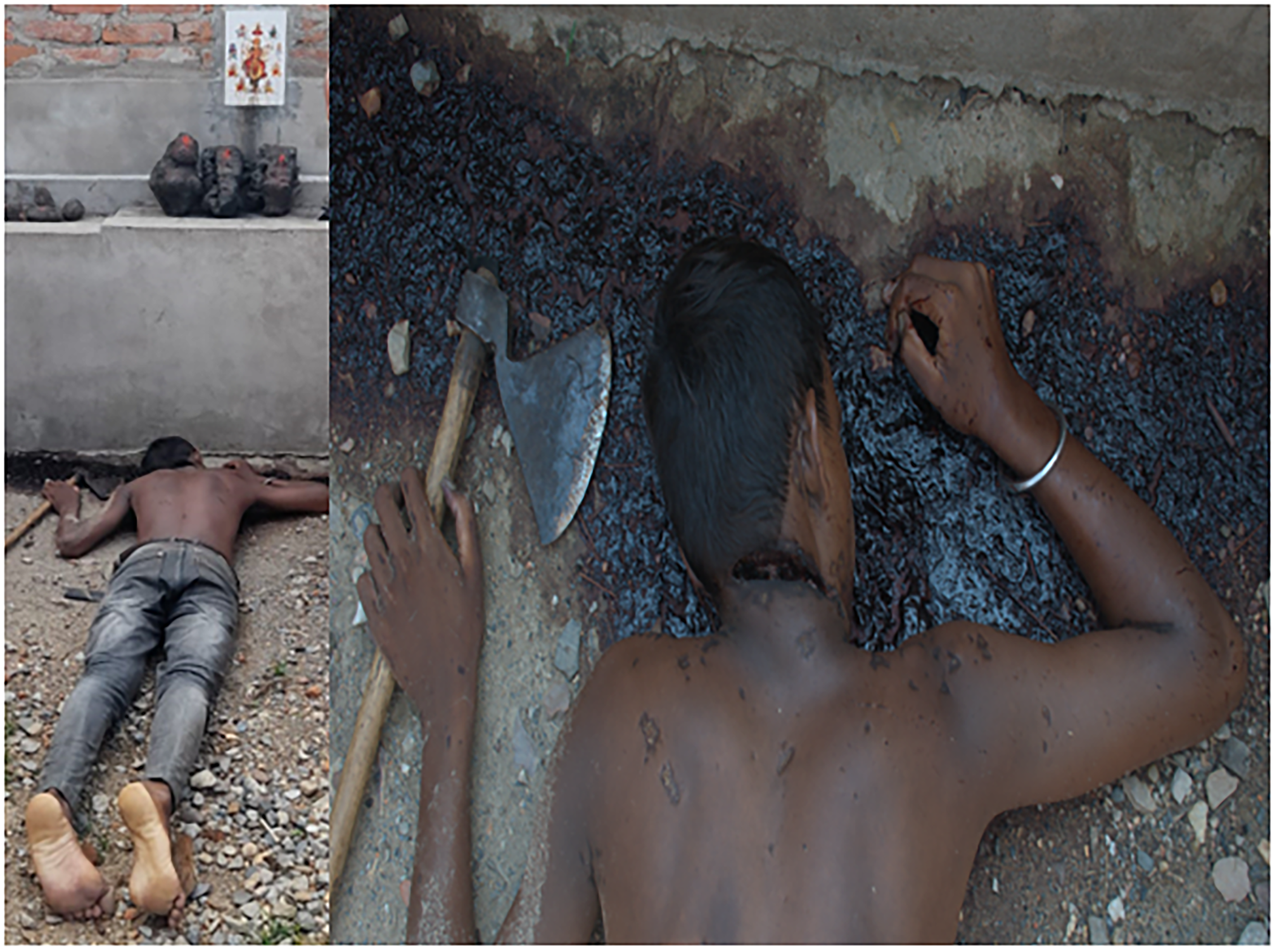
The scene of the incident showing the victim lying dead in front of an image of a Hindu Goddess with an axe placed beneath his left hand; The closeup photograph of the victim lying in a pool of blood and axe with the chop wound over the posterior aspect of the neck.

The upper image shows the chop wound over the posterior aspect of the neck. The lower image shows the complete transection of the spine and spinal cord at the level of the upper border of the third cervical vertebra corresponding to the external chop wound.
Police later identified the deceased person and arrested the deceased person's friend for committing the homicide. During police investigations, it was revealed that the victim and perpetrator resided in the same village. The victim was an avid worshipper of the Hindu Goddess Durga and a black magic practitioner since childhood. The perpetrator was his best friend and his disciple in black magic practices. The victim dreamed that Goddess Durga had promised him a male child and magical powers. In his dream, he pledged to Goddess Durga that if his wife gave birth to a male child, he would sacrifice one human life. On the evening of the penultimate day, the victim went to the perpetrator's house by cycle and asked the perpetrator to come along with him to practice black magic and other rituals. He was also carrying an axe. The victim was steering the cycle, and the perpetrator was sitting behind him. They reached the partially constructed temple, about 10 km away from their village, after about 3 h. The victim parked his cycle about 500 m away from the temple. On reaching the temple, the victim told the perpetrator that he would sacrifice the perpetrator in front of Goddess Durga. The perpetrator pleaded not to do so, as he has to care for his wife and children. They had a minor altercation. The victim then requested the perpetrator that if he is not ready to sacrifice himself, the victim should be sacrificed instead, as it is necessary to sacrifice a human life that night. The victim threatened to kill him if the perpetrator did not sacrifice the victim. The victim also assured the perpetrator that he would be reborn after 30 min with the blessings of Goddess Durga. The perpetrator agreed to kill the victim out of fear of being killed and the assurance that the perpetrator would be revived. The victim removed his shirt, neatly folded, and placed it on the platform below the image of the Goddess. He laid down in a prone position and prayed in front of the image of Goddess Durga. The perpetrator then chopped the neck of the victim from behind with a sharp axe and waited for the rebirth of the victim for 30 min. However, when there was no movement by the victim even after 1 h, he fled from the crime scene.
Discussion
Incidences of animal or human sacrifice were not uncommon in ancient times. Animal or human sacrifice is usually advocated by a traditional healer and carried out by a family member seeking supernatural powers or spiritual help. 2 In West Bengal, India, male goats are offered as a sacrifice to Goddess Kali. However, human sacrifices are very rarely observed. The reasons and methods adopted for the human sacrifice were influenced by religious, cultural, regional, and socioeconomic disparities. The acts of sacrifice were considered the means for fulfilling different beliefs. These superstitious beliefs included various reasons such as protection of the community; care of master in an afterlife; gift giving; in honour of or pleasing the god of worship; portals for entry into the underworld; protection and strengthening of the architecture; sacrifice of widows after the death of husband; Seppukku (semi-suicidal ritual). 4 The different methods used for these barbaric acts included burial, decapitation, strangulation, pushing into sinkholes, skinning, stabbing, burning, hanging, and drowning. 4
The present case highlights typical characteristics associated with human sacrifice. In this case, the victim was a traditional healer and practitioner of black magic. It is usual practice in India to wear black clothes at the time of sacrificial killings, and the victim had also worn black clothes. The motive behind human sacrifice in the present case was to obtain a male child and supernatural powers, which can be associated with cases of human sacrifice. In most cases of human sacrifice, both perpetrators and victims are males, and perpetrators are known to the victim. 5 In the present case, the perpetrator and victim were males and close friends.
Another similar term to human sacrifice is ritual murder. Ritual murders are violent and extreme types of criminal homicide in which the slayers excise the victims’ vital organs for use in sacred rites. 5 The pattern of injury in the present case suggests that it is a case of human sacrifice and not ritual murder, as all parts of the victim's body were intact apart from injury over the neck. Defence injuries can be seen in about 40% of homicidal attempts involving sharp weapons.6,7 We did not find any defence or other wounds except the chop wound on the posterior aspect of the neck of the deceased. This suggests that the victim may have suffered a blow by a heavy sharp object to the posterior aspect of the neck from behind. The absence of defence wounds in the present case further supports the idea that this human sacrifice was done with the knowledge and cooperation of the deceased.
Sharp force injuries are more commonly associated with homicide than suicide.8–10 Furthermore, stab injuries are more common than incised injuries in homicidal sharp force injuries.8–10 The kind of weapon can also give a clue about the manner of infliction of injuries. Kitchen knives, razors, etc., are commonly, although not always, associated with suicidal attempts, whereas heavy sharp weapons like axe, swords, etc., are often linked with homicidal attempts.6,9 Furthermore, male victims outnumber females in homicidal sharp force fatalities, with most of the incidences occurring outdoors, and the victims and perpetrators are known to each other.11,12 Apart from the presence of sharp force homicidal incised injury, most other facts are consistent with our case. Deep incised wounds over the posterior aspect of the neck, extending to the vertebral column, are most commonly homicidal wounds inflicted from behind. 13 The injury characteristics of the present case also support this inference.
Homicidal sharp-force injuries can be attempted to disguise as suicide, particularly in cases with a single fatal injury. Hence, investigations should also be focused on the presence or absence of characteristic traits of suicidal injury. Suicidal incised wounds over the neck are typically multiple and characterized by several trial cuts called ‘tentative incisions’. 14 These are mostly present over accessible parts of the neck like the front or sides.15,16 The current case reports the presence of a single chop wound over a non-accessible area like the posterior aspect of the neck without any hesitation cuts hence ruling out the act of suicide. Also, fatal suicidal injuries may be accompanied by cadaveric spasm with a weapon found firmly grasped in the victim's hand. It can be considered unequivocal proof of suicide. 13 Though the weapon was at the crime scene in the present case in the form of an axe, it was loosely placed in the deceased's left hand and not firmly grasped. The perpetrator later confessed that he put the weapon beneath the victim's left hand to disguise it as suicide.
Human sacrifice is a cruel practice that is an expression of a lack of respect for human life. It is considered an offence of murder in Indian laws. However, there must be a strong legal deterrent to discourage such superstitious practices to any extent. In India, the State of Maharashtra in 2013 passed the Maharashtra Prevention and Eradication of Human Sacrifice and other Inhuman, Evil, and Aghori Practices and Black Magic Act “to protect the common people in the society against the evil and sinister practices thriving on ignorance and to combat and eradicate human sacrifice and other inhuman, evil, sinister and Aghori practices propagated in the name of so-called supernatural or magical powers or evil spirits commonly known as black magic by conmen with the sinister motive of exploiting the common people in the society and thereby destroying the very social fibre of the society”. 17 A recent Kerala case of human sacrifice also raised a strong voice for stringent law to address the menace of harmful and deceitful practices in the name of faith. 18 However, law enactment is not itself sufficient. Comprehensive educational and enlightenment programs are required to emphasize the sacredness of human life to prevent such evil practices of human sacrifice.
The present case narrates the rare occurrence of adult human sacrifice in the era of modern civilization. The case narrates the extremes of superstitious beliefs leading to the act of homicide. In the present case, the injury characteristics, the weapon of offence and circumstantial evidence support the testimony of the alleged perpetrator and point towards the act of homicide. However, the fact that the case narrative is largely based on the testimony of the alleged perpetrator and there is no other witness to the act of the murder, is a limiting factor in the further legal course.
Footnotes
Declaration of conflicting interests
The author(s) declared no potential conflicts of interest with respect to the research, authorship, and/or publication of this article.
Funding
The author(s) received no financial support for the research, authorship, and/or publication of this article.
