



Abstract
Fingerprints are widely used as biometric parameters for identification purposes because of their uniqueness. Moreover, many digital devices have employed fingerprints for security purposes throughout the world. An automatic artificial intelligence-based classification system can reduce the time spent running through the database for fingerprint matching by arranging fingerprints into disjoint classes. It can also help classify fingerprints at the crime scene easily and quickly. The present study proposed a convolutional neural network (CNN) model for the multiclass classification of fingerprint patterns (Arches, Loops, Whorls, and Composites) according to Henry's classification. The model was trained on 2000 fingerprint patterns collected from the fingers of 200 participants. The dataset was split into train, test, and validation part with the ratio of 8:1:1, respectively. The presented CNN model was evaluated by using a confusion matrix for the testing process. Training, validating, and testing the accuracy of the CNN model for classifying fingerprint datasets into four main classes were 89%, 84%, and 85.5%, respectively. This model shows its application as an aiding tool for fingerprint analysis in crime scene investigation, forensic examinations, and fingerprint research.
Keywords
Introduction
Fingerprints are characterized by raised friction ridge skin and grooves, which form specific patterns on the fingers, palms, toes, and soles. 1 The fingerprints are formed during the development of the fetus and are unique to a person. 2 The fingerprint ridges formed during fetal growth remain constant throughout life with an increase in size. 3 The uniqueness in ridge patterns and persistence of friction ridge skin are the key features that make fingerprints valuable for identification.4,5
Fingerprint classification is the fundamental step in biometric and forensic fingerprint analysis. The most widely accepted classification based on morphological characteristics of fingerprints was given by E.R. Henry in his book “On Classification and Uses of Fingerprints.” 6 According to Henry's classification, fingerprints are classified into four main types (Arches, Loops, Whorls, and Composites) and these main types are further subdivided into 11 subtypes. Arches are divided into Simple arch, Tented arch; Loops into Ulnar loops, Radial loop; Whorls into Single spiral whorls, Double spiral whorls, Concentric whorls; and Composites into Lateral pocket loops, Twinned loops, Central pocket loops, and Accidentals.
The fingerprints are manually classified looking at the different pattern types. The expert identifies these peculiar characteristics of fingerprint introduced in Henry's classification and identifies it, 6 which forms the basis of forensic casework and fingerprint research. However, the manual classification of fingerprints is a cumbersome and time-consuming process and always requires an expert to perform the classification. The availability of a computer program, especially with the utilization of artificial intelligence, to perform fingerprint classification can provide a preliminary judgement on fingerprint matching for criminal and civil cases in less time with more accuracy.
Another application of a model trained for fingerprint classification is in Automatic Fingerprint Identification Systems (AFIS). AFIS runs through large databases of fingerprints for biometric identification. 7 Artificial Intelligence (AI) can analyze and classify fingerprints without expert supervision, making it crucial for AFIS systems. It classifies the fingerprints based on the ridge patterns and decrease the number of matches made during the identification process.
Artificial intelligence is a branch of computer science which allows computers and machines to simulate human intelligence and problem-solving capabilities. It encompasses machine learning (ML) and deep learning (DL). Artificial intelligence can help solve five types of problems more efficiently than human experts: Search, pattern recognition, Learning, Planning, and Induction.8,9
Fingerprint classification is a pattern recognition problem. The classification involves explicit extraction of features from a fingerprint image, and classification based on those extracted features. 10 Many studies have used ML for this classification; however, the ML approach is time-consuming and relies extensively on high-quality fingerprint images. 11 DL neural networks like convolutional neural networks (CNNs) perform better feature extraction from images. Moreover, real-time low-quality fingerprints such as wet, dry, and blurred fingerprint impressions can also be used to train a CNN model making this approach more robust and practical. 12 Crime scene investigators can use the trained model directly at crime scenes saving time and resources.
CNNs are among the best neural networks for image classification and pattern recognition because it performs feature extraction implicitly by sliding filters over the input image to generate feature maps.13,14 A typical structure of CNN consists of convolutional, max-pooling, and fully connected layers, also called dense layers to output the probabilities for different classes. The main issues of using CNN for image classification include overfitting and low performance for smaller datasets. This problem may be usually addressed by implementing hyper-parameter tuning, dropout layers, and data augmentation. 15
In the past, many studies have been conducted on the classification of fingerprint patterns using AI models; for instance, Peralta et al. 16 compared the performance of two models for the classification of fingerprint images obtained from two databases—NIST DB-4, and synthetic fingerprints generated from the SFinGe tool into five classes—Arches, Tented Arches, Right Loops, Left Loops, and Whorls. It gave an average accuracy of 85% on data from the NIST DB-4 database and 98% average accuracy on synthetic fingerprints.
Similarly, Michelsanti et al. 17 compared the performance of two pretrained models—VGG-F, and VGG-S for the classification of fingerprint images and obtained an accuracy of 94.4% on the VGG-F model and 95.05% accuracy on the VGG-S model. Moreover, Militello et al. 18 evaluated the performance of three preexisting CNN models—AlexNet, GoogleNet, and ResNet, on two databases—PolyU, and NIST. It gave the highest precision value of 99.79% with AlexNet for five-class classification.
All these studies used either three kinds of fingerprints or their subtypes; the studies have mixed “composites” (having four subdivisions such as Lateral pocket loop, Twinned loop, Central pocket loop and Accidentals) in loops and whorls types. However, the composites are different fingerprint pattern types as defined by Henry and are not morphologically similar to other pattern types—Arches, Loops, and Whorls. Therefore, there is a paucity of studies that classify fingerprints according to Henry's classification and with the use of primary dataset.
The present study proposes a customized CNN model for the classification of fingerprints based on broad classes of Henry's classification: Arches, Loops, Whorls, and Composites trained on primary data collected using the standard techniques described by Cummins and Mildo. 3 Data augmentation and regularization techniques were implemented to eliminate issues like overfitting and class imbalance that might arise while training the model.
Material and methods
Fingerprint dataset
For this study, a total of 200 participants (100 males and 100 females) aged between 18 and 25 years were selected using snowball sampling. Participants were recruited from Chandigarh, a city in northern India, and its surrounding regions. All the participants were provided with the informed consent before collecting the fingerprints which is a part of the ethical principles under the Declaration of Helsinki. 19 The signed consent of the participants was also obtained while collecting the dataset.
The individuals with an age range of 18 to 25 years were recruited as they are generally considered to provide good quality fingerprints, may be due to good skin elasticity and ridge prominence. While, the children, and the aged people may have the chances of providing smudged, unclear or blurred fingerprints which can interfere the AI model training process. Moreover, the data was collected from a particular area with convenience sampling as the young adult participants were expediently and easily available in the colleges and universities. In addition, all the participants were excluded with any injury, surgery, anomaly, scar especially on the fingers and who did not provide the signed consent.
Data acquisition
The rolled fingerprint impressions were collected from each participant using the standardized method outlined by Cummins and Midlo. 3 In total, 2000 fingerprint impressions were obtained from 200 participants and saved as images in a computer which were augmented later to collect the final dataset of 4000 images. For each participant, rolled prints of all 10 digits were captured on an A4 sheet (90 gsm) using premium oil-based ink. A fingerprinting pad was securely taped from the tip of the nail to the other end, ensuring even inking of the distal phalanx. Each finger was then carefully rolled from the ulnar to the radial side over designated boxes on the paper. A sample of the fingerprint pattern obtained using rolled method can be seen in Figure 1. Advantage of the “rolled print” over “press print” is that the rolled print is a complete print of the finger ball from nail to nail; it shows a complete pattern area with all the landmarks such as delta or tri-radius. However, in a press print, only a small central portion of the print is available; sometimes it is devoid of the delta which is usually found on the sides of the print. In addition, Figure 1 displays different fingerprint patterns collected during the study, categorized according to Henry's Classification. The impressions were captured using a Samsung Galaxy A13 smartphone and subsequently stored in a computer system.

A subset of the sample images of the fingerprint patterns collected during the study, categorized according to Henry's classification.
Data split
The fingerprint images were manually categorized into four classes and organized into relevant folders. To enhance the robustness of model training, some unclear fingerprint impressions were included in the dataset, while a few that were unusable were discarded.
Moreover, the dataset was divided into training, validation, and testing sets in a ratio of 8:1:1. To address potential issues of over-fitting and class imbalance due to the small dataset, we augmented the images using the flip, brightness adjustment, zoom, and rotation functions from the Python Augmentor library while maintaining the ratio. The number of fingerprint images for each class in the training, validation, and testing datasets increased after the process of augmentation (Supplemental Table S1). Multiple operations performed on the images of fingerprint patterns such as flip operation, rotate operation, zoom, and brightness operation (Supplemental Figure S1).
Data enhancement
Several editing operations were performed to enhance the readability of the fingerprint images, including reducing excess white space and increasing contrast. Each image was resized to a resolution of 256 × 256 pixels, a standard size that balances learning rate and model performance.
Using Keras's ImageDataGenerator, the images were converted to grayscale, and their pixel values were normalized between 0 and 1. This normalization reduces memory usage and improves processing efficiency.
CNN model configuration
The CNN model was customized for this classification problem through empirical testing and experimentation. Figure 2 illustrates the overall architecture of CNN Model, while Supplemental Table S2 shows the summary of model. The four-class model consists of eight convolutional layers, four max-pooling layers, one flattens layer, one dropout layer, one fully connected layer, and one output layer. The model receives grayscale images with a shape of 256 × 256 × 1 as an input. First convolutional layer utilizes eight filters to extract local features, such as lines and curves. Two convolutional layers with 32 filters each, preceded by a layer with 16 filters. Moreover, a layer with 48 filters follows, leading to three convolutional layers, each with 64 filters.

A schematic diagram of the proposed convolutional neural network architecture.
In addition, max-pooling layers of size 2 × 2 are applied after the second, fourth, fifth, and eighth convolutional layers to reduce the dimensionality of the feature maps. During experimentation, a significant loss in accuracy was observed when using 128 filters, prompting the decision to maintain a fixed architecture of eight convolutional layers and four pooling layers. Furthermore, the flatten layer transforms the two-dimensional feature maps into one-dimensional data, suitable for input into the subsequent dense layers. The output layer, consisting of four units with softmax activation, follows a fully connected layer with 64 units and a dropout layer. The dropout rate is set at 0.5 to mitigate the risk of overfitting. The optimal hyperparameters were changed and adjusted multiple times and final model with highest efficiency was constructed.
Training and testing of CNN model
All the experiments along with the training and testing of the model, were conducted on the workstation with the specification of a single system featuring an Intel(R) Core (™) i3-7020U processor and 8 GB RAM. The code was executed in Jupyter Notebook version 7.2.0, utilizing TensorFlow version 2.16.1 and Python 3.10.14. The model was trained for 54 epochs, using an optimal batch size of 32. Both training and validation data were processed simultaneously; the training data was enhanced for each epoch using the ImageDataGenerator from the Keras library. This approach allowed for real-time validation at the end of each epoch, with a validation set of samples. Supplemental Figure S2 illustrates the training process of the model.
Moreover, during the training process the Adaptive Moment Estimation (Adam) optimizer was employed to minimize the loss function, which is a well-known technique comparable to stochastic gradient descent with momentum and RMSprop. The model's performance was assessed using categorical cross-entropy loss, measuring the difference between the predicted and actual labels.
Once satisfactory accuracy and loss values were achieved, the trained model was saved and evaluated on the test dataset, which maintained the same input shape and batch size. A confusion matrix was generated, and performance metrics including accuracy, precision, recall, and F1-score were calculated for each class. The testing process is diagrammatically represented in Supplemental Figure S3.
Results
Training and validation results
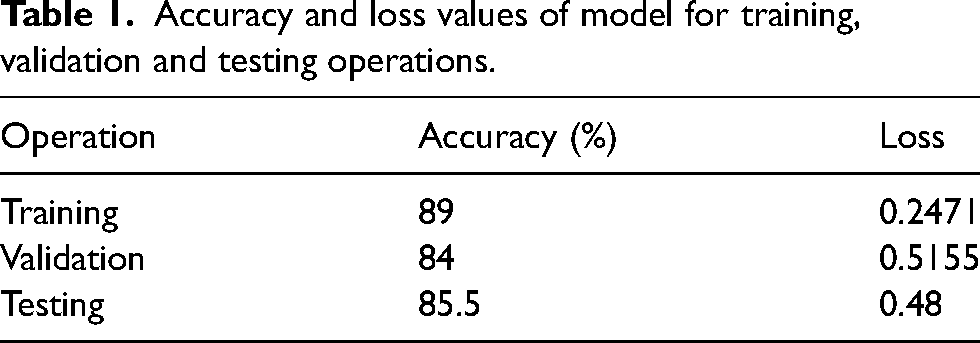
The model was trained for 54 epochs, achieving 84% accuracy on the validation data and 89% on the training data. Categorical cross-entropy loss and accuracy were tracked throughout the process. Figure 3(A) shows the accuracy and loss curves. Toward the final epochs, the model showed signs of over-fitting, as the validation loss increased while accuracy remained fairly constant. To address this, early stopping was applied as a regularization technique to prevent further over-fitting. These results were obtained on 4000 augmented fingerprint images classified into four types that is Arches, Loops, Whorls, and Composites.

Evaluation of the model; (A) accuracy and loss curves of the training process of the model (B) confusion matrix plotted for the results obtained after testing the model.
Testing results
Upon testing the model on the test dataset of 400 images, an accuracy of 85.5% was achieved, aligning closely with the validation performance. The loss and accuracy values for testing, as shown in Table 1, did not differ significantly from those during training and validation. The minimal difference between training, validation, and test accuracy values suggests that the model generalizes well to unseen data, reducing the likelihood of overfitting.
Accuracy and loss values of model for training, validation and testing operations.
Performance metrics and confusion matrix
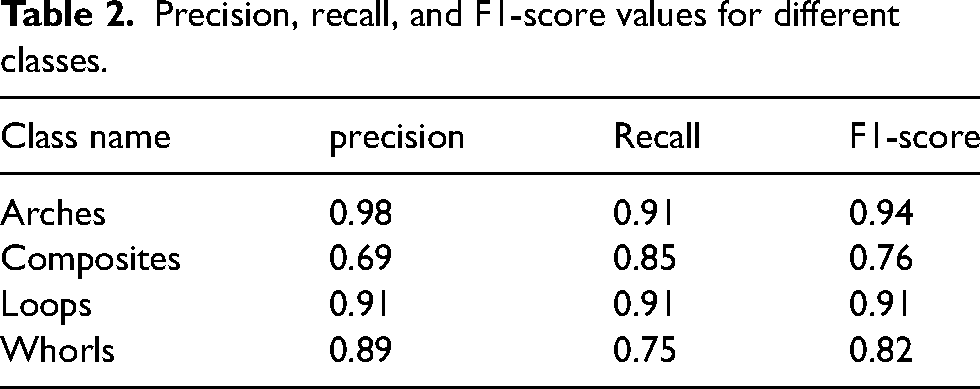
Precision, recall, and F1-score values for each fingerprint class (Arches, Loops, Whorls, and Composites) are listed in Table 2. The confusion matrix (Figure 3B) reveals that the model performs well across most classes, with a slight tendency to misclassify whorls as composites, suggesting further refinement could be explored in distinguishing these closely related categories.
Precision, recall, and F1-score values for different classes.
Discussion
The present method was based on developing and training a custom CNN model to classify fingerprints into four categories: Arches, Loops, Whorls, and Composites, based on Henry's Classification System. Rolled fingerprint impressions were collected during the study, digitized, and stored on a computer. The dataset was divided into training, validation, and testing sets, and further augmented to address overfitting and class imbalance. A CNN model was designed from scratch through empirical testing optimized to deliver the best performance on the fingerprint dataset. The model was trained on the fingerprint images, and both loss and accuracy were tracked during the validation process. The configuration yielding the best performance was saved and evaluated on the test dataset, achieving a testing accuracy of 85.5%.
Many previous studies show the use of DL methods for the purpose of fingerprint classification. For instance, Rim et al. 12 proposed a method to distinguish the specific fingerprint information such as left–right hand classification, sweat-pore classification, scratch classification and finger classification. A total of 1069 fingerprints were collected from 1008 Cambodian people and 61 Korean people. Five state-of-the-art DL models such as classic CNN, Alexnet, VGG-16, Yolo-v2 and Resnet-50 were adapted to be trained from scratch for those four categories. The Yolo-v2 model provided the highest accuracy of 90.98%, 78.68%, and 66.55% for the left-right hand, scratch and fingers classification, respectively. For sweat-pore classification, the Resnet-50 model provided the highest accuracy of 91.29%.
Unlike previous studies that relied on preexisting datasets like NIST-DB4 or artificially generated fingerprints, 18 the present study introduces a novel and primary dataset composed of rolled fingerprint impressions. This dataset offers more detailed information, particularly capturing lateral and medial ridge details because of rolled fingerprint impressions. The equal representation of male and female participants also ensures a more balanced and generalizable model. As data quality and diversity are critical to the performance of ML models, the introduction of this dataset marks a valuable contribution to fingerprint classification research.
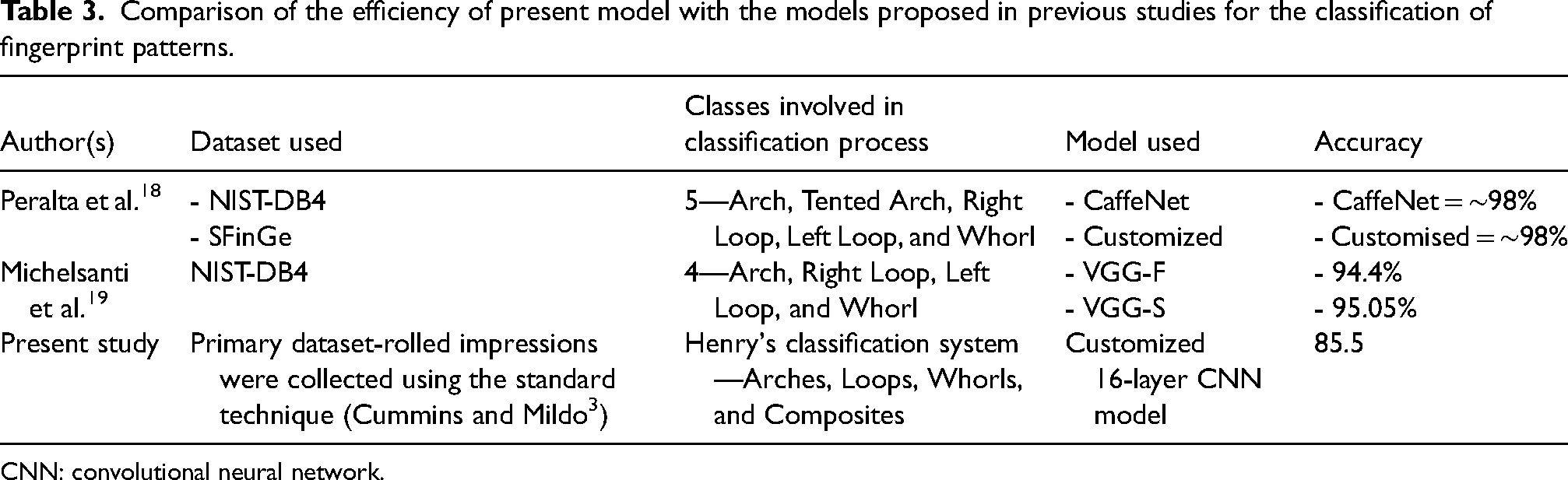
Moreover, Table 3 highlights the comparison of the models proposed in previous studies and the present study, along with the respective efficiency. Previous studies faced issues such as indiscernible classes and unequal distribution of fingerprints by sex, with some researchers excluding certain images. 16 Furthermore, previous studies classify the fingerprints either into five classes—Arch, Tented Arch, Right loop, left loop, and Whorl 18 or into four classes—Arch, Right Loop, Left Loop, and Whorls. 17 However, present study follows a standardized classification given by Henry, which includes composites along with other classes of fingerprint patterns; composites are morphologically different from Arches, Loops, and Whorls. Henry's morphological classification is the most used fingerprint classification system being followed in forensic education, research, training, and forensic case-work.
Comparison of the efficiency of present model with the models proposed in previous studies for the classification of fingerprint patterns.
CNN: convolutional neural network.
In addition, the CNN model in this study was built from scratch, using empirical testing to determine the optimal architecture for fingerprint classification. Unlike models relying on transfer learning,12,18,19 our approach is fully customized to the specific nuances of the fingerprint dataset, particularly the rolled impressions.
To mitigate the problem of overfitting, we utilized data augmentation techniques, increasing the number of images in each class to 1000 by random rotations, flips, brightness adjustments, and zooming. These augmentations preserved the readability of fingerprint patterns. Additionally, all the images are edited and augmented with same parameters which make the uniform dataset for training process. This process along with the practice of primary dataset collection can reduce the biases in present study. In addition, the number of layers in CNN model, the filters or weights used in each layer can also contribute to the reduction of biases. 20 Shorten and Khoshgoftaar 21 highlighted that test-time data augmentation improves model performance. Consequently, data in the validation and test sets were also augmented.
The classification of the fingerprint pattern is the first step of the fingerprint analysis in forensic examinations and crime scene investigation. This is a time consuming process and needs an expert which should have knowledge of different types of fingerprint patterns. However, the proposed model can act as an aid to complete this step and ease the process of fingerprint analysis in forensic investigation.
A limitation of the present study is that CNN model was trained only on 4000 images which can be a small dataset for the training of neural network models. Therefore, large dataset of the fingerprint images can be used in future for the same objective. In addition, CNN model has various advancements in recent era, therefore, these advanced versions of CNN or any other neural network models can be used for this classification process. Moreover, future research could explore the potential of an 11-class model based on Henry's classification by incorporating a larger dataset. Additionally, applying transfer learning techniques on top of the customized CNN architecture could be explored to enhance accuracy while maintaining the specific advantages of the rolled fingerprint impressions, and can give the real time use in forensic investigation. Although, the CNN is a flexible model and can work with different images captured from different cameras as well. However, in present study, it is emphasized that the same camera and the standard photographic parameters were used in a controlled environment for all the images, therefore, it may not influence the outcome of the CNN model.
Conclusion
The present study proposed a novel CNN model for the multiclass classification of fingerprint patterns (Arches, Loops, Whorls, and Composites) according to Henry's classification. The study successfully classified different fingerprint patterns with the help of a trained CNN model and obtained an accuracy of 89% for multiclass classification of fingerprint patterns (loops, whorls, arches, and composites), with validation and testing accuracy of 84% and 85.5%, respectively. Proposed model provided efficient amount of accuracy with the images of 2000 fingerprint patterns collected primarily from 200 participants. This shows the potential of the present customized CNN model to successfully classify fingerprint patterns. By increasing the number of patterns in the dataset, CNN can provide even higher accuracy with promising applications in fields such as Level 1 analysis of forensic fingerprint patterns, biometrics in fields like banking etc. The present model can be used effectively for fingerprint analysis in crime scene investigation, forensic examinations and fingerprint research. Moreover, the 11 classes of fingerprint patterns given in Henry's classification can also be detected by training the CNN model in sufficient dataset of these 11 classes. Therefore, we propose and encourage conducting further research on multiclass classification of fingerprint patterns using 11 pattern types using a large primary dataset.
Supplemental Material
sj-docx-1-msl-10.1177_00258024251355042 - Supplemental material for Deep learning-based CNN model for multiclass classification of fingerprint patterns
Supplemental material, sj-docx-1-msl-10.1177_00258024251355042 for Deep learning-based CNN model for multiclass classification of fingerprint patterns by Apurav Mahajan, Damini Siwan, Peehul Krishan, Akansha Rana, Ritika Verma, Ankita Guleria, Rakesh Meena, Nandini Chitara, Ayushi Srivastava and Kewal Krishan in Medicine, Science and the Law
Footnotes
Acknowledgments
The article is a part of dissertation submitted to the Department of Anthropology, Panjab University, Chandigarh, India. DS is thankful to the University Grant Commission (UGC) for awarding Junior Research Fellowship (JRF) for pursuing PhD. PK is grateful to Indian Institute of Technology, Mandi, India for providing HTRA fellowship for pursuing PhD. AR is indebted to Panjab University for providing Panjab University Research Scholarship for pursuing PhD. AG is thankful to Department of Science and Technology, Government of India, for awarding INSPIRE Fellowship (Grant No. IF190719) for pursuing PhD. NC is thankful to the NFSC, Ministry of Social Justice and Empowerment, Government of India, for funding the PhD in the form of a research fellowship. AS is thankful to the UGC for awarding JRF for pursuing PhD. KK is supported by UGC Centre of Advanced Study, awarded to the Department of Anthropology, Panjab University, Chandigarh, India.
Authors’ consent
All authors consented to be the coauthors and approved submission of the manuscript in this journal.
Authors’ contributions
AM, DS, and KK conceived the idea of conducting this research. AM, DS, PK, AR, RV, AG, RM, NC, AS, and KK wrote the initial draft of the manuscript and finalized the Manuscript. KK supervised the present work. AM, DS, PK, AR, RV, AG, RM, NC, AS, and KK read and approved the final manuscript.
Data availability
The research data presented in the work is available with AM and DS and can be made available on reasonable request.
Declaration of conflicting interests
The authors declared no potential conflicts of interest with respect to the research, authorship, and/or publication of this article.
Funding
The authors received no financial support for the research, authorship, and/or publication of this article.
ORCID iDs

Supplemental material
Supplemental material for this article is available online.
References
Supplementary Material
Please find the following supplemental material available below.
For Open Access articles published under a Creative Commons License, all supplemental material carries the same license as the article it is associated with.
For non-Open Access articles published, all supplemental material carries a non-exclusive license, and permission requests for re-use of supplemental material or any part of supplemental material shall be sent directly to the copyright owner as specified in the copyright notice associated with the article.
