




Abstract
Paper spray ionization (PSI) has emerged as a key ambient ionization technique in microanalysis over the past decade, valued for its ease of use and minimal sample preparation. This study reviews PSI's applications in forensic science, covering areas such as biomolecules, drugs of abuse, inks, explosives, toxicology, and trace evidence. To achieve these objectives, electronic searches were performed across several databases—Scopus, Web of Science, Science Direct, and PubMed—covering publications from 2010 through December 2023, with a focus on English-language articles. This search strategy yielded 40 relevant studies, which were reviewed to assess PSI-MS's current capabilities and advancements. The review underscores Paper Spray Ionization Mass Spectrometry's (PSI-MS) versatility, particularly its compatibility with various sampling methods like dried blood spots, which enhances its utility for rapid point-of-care (POC) analysis. This capability facilitates the efficient analysis of biochemical and forensic samples while bypassing lengthy separation procedures, marking a significant advancement in forensic analysis techniques.
Keywords
Introduction
Since the introduction of Direct Analysis in Real Time (DART) and Desorption Electrospray Ionization (DESI) techniques in 2005, 1 there has been a surge in the development of new ambient ionization mass spectrometry (MS) methods. Among these, Paper Spray Ionization (PSI) has recently gained prominence as a significant technique for the rapid analysis of biological samples. 2 PSI is an attractive instrumentation method because it can quickly analyse trace amounts of forensic-related analytes such as drugs, poisons, chemicals, explosives, weapons of mass destruction, inks, etc., with the flexibility of being coupled to various mass analyzers. Because of the smaller droplet size and the use of microliter volumes of spray solvent, PSI is more aptly described as an electrospray-like event that is most comparable to nano-electrospray (nESI).3,4
PSI allows direct examination of dried blood spots and isolated compounds from a thin-layer chromatography (TLC) strip, as well as surface analysis by collecting the surface samples with cotton swabs and carefully transferring to the paper substrates, which are suitable for biochemical, clinical, and forensic analysis. Biofluids can be directly deposited on the paper and analyzed. The method can achieve a significant increase in sample throughput and speed because of minimal sample preparation. The original PSI method described several applications, but its utilisation was limited because of strong ion suppression effects caused by the substrates and eluting solvents, leading to low sensitivity.
Consequently, the main focus of advancements in spray has been to enhance sensitivity and broaden the range of analytes that may be detected using this method. Different substrates, such as polymeric, non-porous materials, Teslin, Teflon, Nafion, glass, and poly (methyl methacrylate), infused with carbon nanotubes, have been utilised as substrates in paper spray, which enhances the sensitivity of the method severalfold. The use of these substrates results in a higher number of molecules being ionized compared to conventional cellulose paper substrates. Desalting paper spray (DPS) is introduced in paper spray by washing with a mixture of acetonitrile and water before doing the analysis. This method has now been extended to proteomics by employing a polymer substrate that is coated with the fluoropolymer Nafion. 5
Paper spray mass spectrometry, introduced in 2012, 6 has been employed as a forensic tool for detecting various substances in different contexts. This review examines its applications across several domains of forensic research, including the analysis of biomolecules, drugs of abuse, ink in questioned documents, agrochemicals, food and drink adulterants, explosives, toxicological samples, and chemical warfare agents. The technique demonstrates versatility and effectiveness in identifying and quantifying a wide range of compounds, enhancing its utility in forensic investigations.
Paper spray theory and mechanism
PSI-MS refers to a technique that involves the direct application of a sample onto a paper substrate for analysis. This relatively inexpensive technique involves samples within a solution deposited on a paper substrate positioned towards the orifice of a mass analyzer. 7 This triangle is subsequently placed at the entrance of the MS. An electric current is applied to the paper, causing ionization of the liquid sample from the tip of the paper. Tip angle and construction are also important factors in spray stability. Investigations on the optimal tip angle have revealed that signal intensity, spray current, and electric field at the tip are all affected by the angle of the paper, with 30° being the most commonly encountered angle due to the larger electric field at the tip. PSI substrates can also be laser-cut to achieve a consistent tip angle and structure. There is a great deal of versatility and robustness when employing PSI.
The analytical performance and the process for paper spray utilizing chromatography are determined by the paper used. The pneumatic force of the mass spectrometer vacuum at the inlet creates a spray. Both positive and negative ion signals are detected and compared to normal kV paper spray ionization and nano-electrospray ionization (nESI). The PS method can be applied to a similar range of analytes as the kV Paper Spray Ionization and nESI methods. However, differences in the mass spectra of mixtures are attributed to the more pronounced effects of analyte surface activity in the zero-volt experiment. This is due to the significantly lower charge used in this method. The signal strength of the power supply is likewise comparatively lower than in the other approaches. An implementation of a Monte Carlo simulation has been used to elucidate the generation of ions from droplets that were initially without charge by considering the statistical fluctuations of positive and negative ions in a solution. Initially, droplets without charge experience fragmentation as a result of aerodynamic forces, until they reach a size range of 2–4 μm. Subsequently, they suffer fissions caused by Coulombic interactions. A statistical charge fluctuation model in both phases predicts detection limits that are comparable to those found experimentally. Additionally, it provides an explanation for the influence of binary mixture components on relative ionization efficiency. The suggested mechanism may also have an impact on ionization through alternative techniques that do not involve voltage. 8
Search strategy
A comprehensive literature search was performed to identify relevant publications using web-based search engines such as Scopus, Web of Science, Science Direct, and PubMed. The search utilized the following keywords: “paper spray ionization mass spectrometry,” “inks,” “drugs of abuse,” “chemical warfare agents,” “explosives,” “toxicology,” “forensic,” and “application.” The search was broad, covering articles published from 2010 to 2023, with the final search conducted in December 2023. This systematic review includes 40 articles that met the search criteria.
Applications of paper spray ionization mass spectrometry (PSI-Ms)
PSI-MS, or paper spray ionization mass spectrometry, is a technique that offers both simplicity and versatility, making it particularly well-suited for analyzing complex forensic samples. The terms PSI, PS, and paper spray all refer to similar ionization techniques but can sometimes be used interchangeably or with slight differences in context.
Analysis of biomolecules
The viability of using carbon fibre paper (CFP) as a particular paper substrate in PSI-MS was investigated by Wang et al. 9 When used in negative ionization mode, CFP can significantly increase the signal stability and detection sensitivity of a variety of analytes. Target analytes such flavonoids and saccharides have their ion intensity enhanced 2–90 times. Using carbon fibre paper-secondary ion mass spectrometry (CFP-SIMS) at a high voltage of 2.5 kV, many nonpolar or low-polarity analytes, such as polycyclic aromatic hydrocarbons, which are challenging to ionize using normal PSI-MS, were successfully detected. Moreover, tivantinib, cyclic adenosine monophosphate (CAMP), and naringin ‘Limit of Detection’ (LOD) in whole blood were raised 2–100 times over standard PSI-MS. CFPSI-MS also exhibits high sensitivity in semiquantitative analysis. CFPSI-MS excels in human breath analysis and blood metabolomic profiling when it comes to real sample analysis.
Riboni et al. 10 provide a new setup called solvent-assisted paper spray ionisation (SAPSI), which can increase repeatability, data acquisition time, and signal stability in order to address conventional PSI shortcomings. To supply ionization potential and a consistent solvent flow to the paper tip, the arrangement relies on an integrated solution. Precise control over the ionization conditions was ensured by explicitly connecting the ion source to both the voltage supply systems and the instrument fluidics. The analysis of several biomolecules, such as proteins, N-glycans, and amyloidogenic peptides, was successfully conducted using SAPSI. The longer analytical period made it possible to watch processes on the paper tip in real time, such as the aggregation and disaggregation of amyloid peptides. They were able to differentiate between protein species with different post-translational modifications and adducts with electrophilic chemicals in aqueous solutions and biofluids, such as serum and cerebrospinal fluid, without the need for sample preparation thanks to the enhanced signal stability.
Proteinaceous toxins are harmful proteins derived from plants, bacteria, and other natural sources. They pose a risk to human health due to infection and also as possible biological warfare agents. PSI-MS with wipe sampling was used to detect proteins from surfaces as a potential tool for identifying the presence of these toxins. 11 Proteins ranging in mass between 12.4 and 66.5 kDa were tested, including a biological toxin simulant/vaccine for Staphylococcal enterotoxin B (SEBv). Low microgram quantities of the protein toxin simulant and other test proteins were successfully detected with good signal-to-noise from surfaces using a porous wipe.
Zhang et al. 12 have designed a straightforward cartridge using 3D printing technology for the purpose of detecting plasma proteins, including post-translational modifications (PTMs), by mass spectrometry (MS). The cartridge utilizes an integrated antibody enrichment column to concentrate the protein target and a unique built-in substrate to ionize the protein targets for detection using mass spectrometry. They present multiple instances of utilizing this cartridge for the swift identification of medically relevant protocorms from plasma samples.
Examination of ink
In forensic document examination, distinguishing between genuine and altered handwritten entries in various documents (like wills, agreements, certificates, invoices, and deeds) is crucial. While microscopy can sometimes identify differences in ink, chemical analysis at the molecular level often provides more definitive evidence regarding an ink's origin and age. To meet the growing need for reliable, innovative, and minimally destructive methods, several techniques based on Photoionization Mass Spectrometry (PSI-MS) have been developed. These PSI-MS methods offer rapid and precise chemical analysis, enhancing the ability to investigate and authenticate questioned documents.
Amador et al. 13 employed PSI-MS to examine black ink handwriting made with six of the most popular ballpoint pen brands: Pilot, Paper Mate, Faber Castell, Pentel, Compactor, and Bic. With a mass range of m/z 100–1000, MS in the negative ion mode made discrimination easy to do just by looking at the samples. On the other hand, differentiation using the positive ion mode (PIM) requires the concept of relative ion intensity (RII) and examination at additional mass ranges. The chemical composition of ink was tracked using PSI-MS and partial least squares (PLS) after exposure to light (artificial ageing research). The PLS model was optimised by variable selection, enabling the identification of the most influential ions during the deterioration process. Three distinct applications demonstrated the efficacy of the approach in the field of forensics: (1) identification of alterations (simulated forgeries) on archived documents; (2) examination of old inks from archived papers; and (3) examination of overlapping lines of fresh ink. Similarly, Ferreira et al. 14 developed a novel PSI-MS-based technique to identify inks written on regular paper using blue ballpoint pens. Pens from different manufacturers offer similar profiles, according to the results of the PIM, PS (+)-MS, which was used to evaluate the method on a range of pens. Four distinct combinations of dyes and chemicals in the inks were identified by a straightforward visual analysis of the PS (+)-MS. RII was used to further differentiate the dyes BV3 and BB26 due to their considerable variability when compared to their demethylated homologues. After the screening and differentiation experiments, the composition changes of the light-exposed ink entries were monitored using PSI-MS. These studies varied degradation behaviors, which were reflected in the distinctive chemical profiles of the tested inks, suggesting that PSI-MS might also be used to evaluate dye fading and distinguish between entries on a document.
Jurisch and Augusti 15 utilised PSI-MS to identify forgeries in signatures created with erasable pens, which erase ink chemically rather than physically. To simulate a forging process, a previously erased signature was signed over, and triangular portions of the paper were cut out for PSI-MS analysis. No sample preparation was required as the analysis was conducted directly on the triangular paper by simply wetting it with methanol and applying high voltage. The findings reveal that the original and faked signatures may be clearly discriminated by their mass spectrometry profiles. Hence, the emergence of diagnostic ions (of m/z 172 and m/z 321) in the mass spectrum of the counterfeit signature may be utilised to promptly and accurately describe this unusual and potentially hazardous kind of counterfeiting.
Domingos et al. 16 effectively utilized the PSI-MS approach to get the chemical profiles of numerous commercial blue pens. Measurements were made of the relative intensity (RII372) of the methylene blue dye in order to identify trace crossings and date questioned sheets. The chemical composition of Brazilian banknotes (reais; sign: R$; code: BRL) from the second generation was also studied.
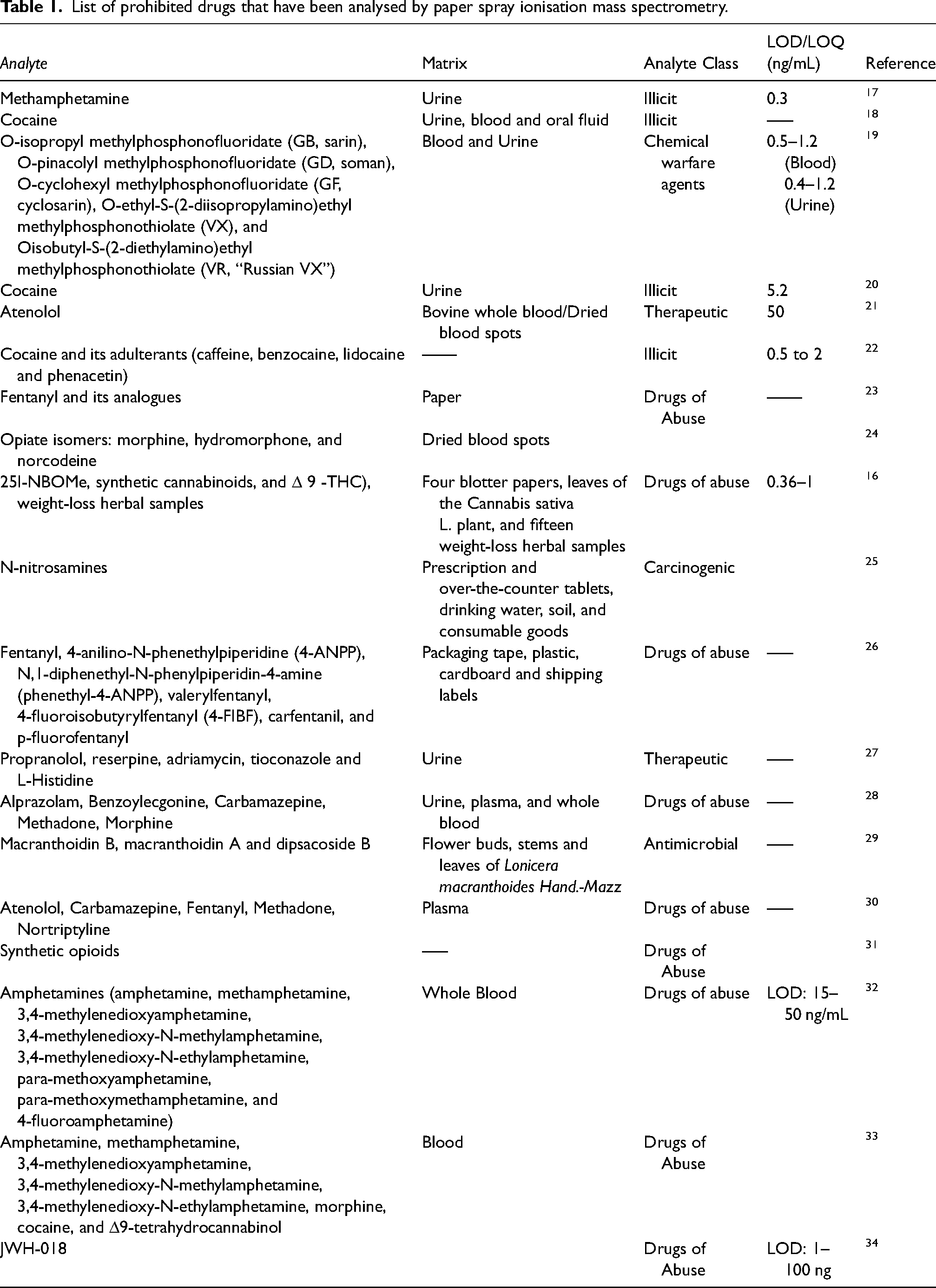
Drug analysis (
Table 1
)
Drug abuse is a pervasive global issue, with the misuse of pharmaceuticals, psychoactive substances such as alcohol, and illegal narcotics becoming more widespread. In response to this challenge, PSI-MS has emerged as a valuable tool over the past decade. PSI-MS has been instrumental in identifying a wide range of substances, including both legal and illicit drugs. Its ability to rapidly and accurately analyze drug samples has made it an important technique in both forensic investigations and clinical settings for detecting and quantifying drug abuse.
List of prohibited drugs that have been analysed by paper spray ionisation mass spectrometry.
Tungtananuwa 17 examined two methods for identifying methamphetamine in post-mortem urine samples: the Online-SPE-LC-MS/MS method and PSI-HRMS via orbitrap. The quantitative results showed that the methamphetamine concentrations were significantly higher than online-SPE-LC-MS/MS method (p value < 0.05), and the qualitative results showed that 21 methamphetamine positive urine cases passed all three PSI-MS method criteria parameters with a true positive rate of 100%. The PSI-MS method saves 7.5 times as much time as the online-SPE-LC-MS/MS method.
Graphene oxide (GO)-modified paper was employed by Santos et al. 18 to analyze creatinine in urine samples. The PSI-GO/MS approach showed acceptable linearity (0.1–100.0 mg/L) with R2 values better than 0.991. Analytes can be extracted and endogenous compounds eliminated all at once using restricted access materials (RAM). In the paper, an additional technique for protein exclusion in complex materials using MS analysis was employed, utilizing internal surface reversed phase (ISRP-RAM). With 98.9% protein exclusion, a linear range of 10.0–1000.0 ng/mL, lower precision values of 15%, accuracy and recoveries ranging from 85.6 to 101.9%, ISRP-RAM/MS was able to detect catecholamines and antidepressants. Molecularly imprinted polymers (MIP) that were synthesized directly on the surface of the paper (cellulose membrane) were also used in the analysis of cocaine utilizing PSI-MS. The membrane containing MIP outperformed chromatographic paper and non-imprinted polymers (NIP) in terms of selectivity and signal intensity as determined by PSI-MS. Good linearity (1–100 ppb) was demonstrated by the molecularly imprinted polymers-paper spray ionization-mass spectrometry (MIP-PSI-MS), with R2 values greater than 0.998. Conductive polymers (CP) have been utilized as a substrate in PSI-MS for a number of medications, illicit drugs, adulterants, and metabolites; CP-paper showed a higher absolute intensity signal than regular filter paper. It was shown that CP-coated sheets exhibit both linearity and performance for a range of analytes, indicating their potential application in qualitative and quantitative analysis.
The PSI-MS method for drug screening and negative ionization was created by McKenna et al.. 19 Because of its sensitivity to corona discharge, negative ionization has long been a problem for electrospray-based ion sources. However, methods for measuring and suppressing this electrical phenomenon are presented, preventing it from affecting qualitative and quantitative analysis. The method's validity is demonstrated for both the detection and quantification of hydrolyzed chemical warfare agent compounds, as well as for the straightforward screening of barbiturates and other acidic medications. In addition, post-mortem blood samples are analyzed using a positive ion drug screen, which facilitates the quick and effective screening of 137 different chemicals, ranging from prescription drugs to illegal narcotics.
Using a capillary polypropylene (PP) hollow fiber, Filho et al. 20 created fiber spray ionization-mass spectrometry (FSI-MS) to assess drug products confiscated from biological matrices in toxicological investigations, such as a tablet, blotter paper, hashish, and cocaine powder. By dipping the fiber directly into the solution, the complete urine sample was used to extract the cocaine. FSI-MS was used to analyze a urine sample that was taken from a suspect in drug misuse. A variety of synthetic drugs, including amphetamine, cathinones, phenethylamines, and opioids, were found in tablet and blotter paper samples according to the FSI (+) analysis, while pure cocaine and various coca alkaloids were identified from cocaine powder with high mass accuracy and sensitivity. Cannabinoids, cannabinoid acids, and cannabinoid derivatives were detected in the FSI (-) hashish analysis, primarily as [M-H]-ions or chlorine adducts [M + Cl]−. With linearity over 0.999, RSD less than 2.71%, and detection and quantification limits of 5.16 and 17.21 ng/mL, respectively, cocaine testing in whole urine has demonstrated great sensitivity and accuracy. A confiscated urine sample had more than 36% relative ion intensity of cocaine along with relative intensities of 1.4% and 6% for the metabolites benzoylecgonine and coca ethylene, respectively.
In their rather comprehensive evaluation of PSI-MS, Liu et al. 21 covered its application in a number of areas, such as whole blood sample monitoring for therapeutic drug administration and the examination of dried bio-fluid spots. Atenolol has detection limits of 50 ng/mL (or 20 pg absolute) in bovine blood. Rapid chemical screening with high sensitivity is also made possible by the combination of sample collection from surfaces with paper spray ionization; for instance, 100 pg of heroin dispersed on a surface and agrochemicals on fruit peels are detected. Online derivatization with a preloaded reagent for measuring cholesterol in human serum is demonstrated. The extensive application of mass spectrometry in nonlaboratory situations is greatly aided by the combination of paper spray and miniature mass spectrometers.
Carvalho 22 optimized TLC for the analysis of cocaine and its adulterants, assessing the selectivity (based on the examination of three distinct eluents: CHCl3: CH3OH: HCOOH glacial (75:20:5v%), (C2H5)2O: CHCl3 (50:50v%), and CH3OH: NH4OH (100:1.5v%)) as well as the sensitivity (visual determination of LOD from 0.5 to 14 mg/mL). Lower LOD values (> 1.0 μg/mL) were obtained by using PSI-MS to detect and quantify the TLC spots (linearity with R2 > 0.98), which improved the results’ merit. The technique created makes it possible to increase the dependability of routine, ordinary TLC analysis performed in forensic laboratory units. Forensic reports can give enhanced sensitivity, selectivity, and speed in addition to quantitative analysis. The PSI (+)-MS approach's ease of usage allows it to be easily connected to other separation methods, such as paper chromatography, and used in studies including LSD blotters, papers, and synthetic materials.
In order to enable in-situ analysis of suspect samples at the site of seizure, Fedick et al. 23 integrated paper SERS and PSI-MS on field-portable and commercial off-the-shelf (COTS) instruments for the quick and affordable detection and confirmation of fentanyl and its analogues. These devices’ commercial nature takes this technology out of academics and puts it in a practical usage of which the criminal justice system may take advantage.
High-field asymmetric waveform ion mobility spectrometry (FAIMS), combined with PSI, was studied by Manicke and Belford 24 to analyze morphine, hydromorphone, and norcodeine opiate isomers. These isomers cannot be distinguished by tandem mass spectrometry alone. Therefore, prior to mass spectrometry (MS) analysis, these compounds must be separated, as they are significant in clinical chemistry and toxicology. FAIMS was connected to a triple quadrupole mass spectrometer (TQMS), and ionization was carried out using paper spray, a direct analysis technique designed to analyze dried blood spots and other complicated samples, or a pneumatically assisted heated electrospray ionization source (H-ESI). They found that FAIMS could differentiate between the three opiate structural isomers using both H-ESI and PSI.
McKenna et al. 35 developed a PSI-HRMS drug screening assay using positive and negative ionization conditions. About 130 medications and drug metabolites were semi-quantitatively tested at sub-toxic amounts in a single 2.5-min examination. The PSI-MS/MS assay was performed on actual postmortem specimens, and its screening ability and semi-quantitative performance were shown to be in good agreement with independent LC-MS/MS screening and confirmation tests. Strong qualitative agreement was observed between PSI-MS/MS and LC-MS/MS; the real positive rate for PSI-MS/MS was 92%, and the true negative rate was higher than 98%. For a screening application, the quantitative results of the two methods were also acceptable; passing-Bablok regression yielded a slope of 1.17 and a Pearson's correlation value of 0.996. The potential of PSI-MS/MS negative ion screening for acidic drug identification and screening was highlighted when it was developed for a limited panel of barbiturates and structural analogues.
PSI-MS was used by Domingos et al. 15 in the forensic chemistry subarea of drug misuse to obtain the chemical profiles of illicit drugs, including blotter papers containing 25I-NBOMe, extracts and leaves of natural cannabinoids (Δ9-tetrahydrocannabinol) and synthetic cannabinoids (naphthalen-1-yl-(1-butylindol-3-yl)methanone, JWH-073); n-(adamantan-1-yl)-1-(4-fluorobutyl)-1H-indazole-3-carboxamide (5F-AKB48); 4-methyl-1-naphthyl-1-pentylindol-3-yl-methanone (JWH-122); 2-(2-methoxyphenyl)-1-(1-pentylindol-3-yl) ethanone (JWH-250); and 4-ethylnaphthalen-1-yl-(1-pentylindol-3-yl)methanone (JWH-210). In the end, an analytical technique was created to measure eight illegal substances: cocaine, MA, methoxy bromo amphetamine (DOB), lysergic acid diethylamide (LSD), meta-chloro phenylpiperazine (m-CPP), 3,4-methylenedioxy-N-ethylamphetamine (MDEA), 3,4-methylenedioxy-N-methylamphetamine (MDMA), and 3,4-methylenedioxyamphetamine (MDA), with a linearity R2 > 0.99.
A combination of complementary ambient ionization techniques, such as PSI and filter cone spray ionization (FCSI)- MS, was described by McDaniel et al. 25 as being useful for trace-level residue screening of specific NAMs (such as N-nitroso dimethylamine, N-nitroso diethyl amine, and N-nitroso dibutyl amine) straight from relevant matrices. In less than two minutes per sample, PSI-MS and FCSI-MS efficiently generated mass spectrum data that were characterized by their simplicity (e.g., primarily protonated molecule ions detected) and congruence with conventional electrospray ionization mass spectra. It was demonstrated that both methods could withstand the intricate matrices under investigation, yielding ion signatures for the target NAMs together with active pharmaceutical ingredients for tablets under investigation, flavorings in food products, and so forth.
Nguyen et al. 36 utilized commercially produced paper with a pressure-sensitive adhesive (PSA) coating to collect and analyze trace drug residues using PSI-MS. This modified substrate was utilized to gather drug residue samples from surfaces while also detecting them quickly with a single paper spray ticket. The all-in-one ticket was used to probe many surfaces found in forensic investigations, such as clothes, cardboard, glass, concrete, asphalt, and aluminium. A total of ten drugs (XLR-11, U-47700, methylone, methamphetamine, ketamine, heroin, cocaine, fentanyl, clonazolam, acetyl fentanyl, cocaine, heroin, and ketamine) were evaluated and found to be detectable in the picogram range using a benchtop mass spectrometer and in the low nanogram range using a portable ion trap MS. Similarly, Prunty et al. 26 used PSA-lined paper to recover drug residues from parcel-related surfaces for screening and analyzing seven fentanyl-related compounds: p-fluorofentanyl, alfentanil, 4-fluoroisobutyrylfentanyl (4-FIBF), valeryl- -fentanyl, N, 1-diphenethyl-N-phenylpiperidin-4-amine (phenethyl-4-ANPP), 4-anilino-N-phenethylpiperidine (4-ANPP), and fentanyl. Commercially available paper was used, commonly referred to as sticky notes or post-its. Mass spectra from this paper were obtained using PSI-MS, with PSA paper serving as both a substrate for analysis and sampling. Using PSA paper, these compounds were extracted and identified at 50 ng from packing tape and plastic, and at 100 ng from cardboard and shipping labels.
An agarose hydrogel conditioning method was created by Zhan et al. 27 to enhance PSI-MS performance. When using quick and easy hydrogel conditioning instead of direct PSI-MS analysis, the signal strength of medications excreted in urine was five to fifteen times higher. Consequently, the metabolites in urine were more sensitive after hydrogel conditioning, which led to a 9–15-fold decrease in potential of detection (POD) values. According to these results, ambient MS could benefit from the easy ionization strategy of agarose hydrogel conditioning in conjunction with PSI-MS. This could be useful for the quick screening of therapeutic medicines and metabolites in biofluids.
Matrix effects in small-molecule drug analysis from urine, plasma, and whole blood were examined by Vega et al. 28 Generally, the analyte was in the dried biofluid, and stable isotope-labelled analogues of each analyte were introduced into the spray solvent. While the analyte's intensity in the spray solvent is proportional to recovery, the labelled analogue's intensity is proportional to ionization efficiency. It was found that ions were matrix-dependent and subject to chemical suppression and recovery. When it comes to weak ionizers (such as analytes without basic aliphatic amine groups), urine ion suppression levels were around 90%. Ion suppression in dried blood spots was significantly decreased or absent altogether for excellent ionisers (analytes containing aliphatic amines). Recovery was often greatest in urine and lowest in blood. Additionally, they looked into how the spray solvent and sample location—that is, the distance the dried sample was spotted from the paper tip—affected ion suppression and recovery. Lastly, using a paper spray analysis of dried plasma spots for five minutes while continuously replenishing the spray solvent, the variance in ion suppression and analyte elution as a function of time was investigated.
Using aspero saponin VI (ASA VI, a structural counterpart) as an internal standard and target model compounds macranthoidin B (MaB), macranthoidin A (MaA), and dipsacoside B (DiB), Yang et al. 29 developed a rapid method for quantitatively identifying hemolytic triterpenoid saponins using PSI-MS. After the sample solution was quickly loaded and separated onto chromatographic paper, it was sprayed with a strong positive voltage to ionize it, and MS analysis was performed. The semi-quantitative analysis of the real samples showed no discernible change from the conventional high-performance liquid chromatography with diode-array detection (HPLC-DAD) approach, with the added advantages of less reagent use, faster analysis times, and no chromatographic separation procedure.
Bills 30 developed PSI-MS to obtain lower drug and narcotic detection thresholds. It is capable of gathering and analyzing whole blood plasma samples and produces quantitative results that are comparable to those obtained through more conventional methods. After the biofluids are absorbed onto a paper strip, sesame oil or powdered solid-phase extraction can be used to concentrate and preserve the strip (in the case of THC) and paper spray as ionization sources.
De Silva et al. (2021) 31 explored the use of PSI-MS, which may be employed for quick studies (60 s) with little sample preparation and handling. PSI-MS may be used with a synthetic microporous polyolefin silica matrix substrate called Teslin. PSI with a Teslin substrate is hydrophobic, allowing for quick and direct analysis with only 1 μg of material. The use of this unique synthetic substrate in PSI-MS has been demonstrated using a fentanyl analogue screening kit (FAS Kit) developed by the Centres for Disease Control (CDC) for screening 212 developing synthetic opioids, including more than 190 fentanyl analogues. The study's comparative fragmentation with precursor molecule mass data should help improve the accuracy of detection and structural characterization of complex samples while minimising interference from isobaric components.
Lawton et al. (2016) 37 performed significant analytical validation on a portable MS system with variable, ambient ionisation sources for on-site drug evidence screening. The validation categories evaluated, notably selectivity, error rate, and ruggedness, will help to fulfil the Daubert standard's requirements for future acceptance of field-collected MS data.
Teunissen et al. (2017) 32 optimised and fully validated PSI-MS to identify and quantify eight individual amphetamines (amphetamine, methamphetamine, 3,4-methylenedioxyamphetamine (MDA), 3,4-methylenedioxy-N-methylamphetamine (MDMA), 3,4-methylenedioxy-N-ethylamphetamine (MDEA), para-methoxyamphetamine (PMA), para-methoxymethamphetamine (PMMA), and 4-fluoroamphetamine (4-FA)) in whole blood in 1.3 min. Furthermore, a novel notion of intrinsic and application-based selectivity was explored, with enhanced confidence in the ability to distinguish amphetamines from other chemically identical substances using an ambient mass spectrometric approach without chromatographic separation. Accuracy was within ±15%, with average accuracy higher than 15% and greater than 20% at the LLOQ. Detection limits of 15–50 ng/mL were achieved with only 12 μL of whole blood.
Espy et al. (2014) 33 performed determination of eight drugs of abuse (amphetamine, methamphetamine, 3,4-methylenedioxyamphetamine (MDA), 3,4-methylenedioxy-N-methylamphetamine (MDMA), 3,4-methylenedioxy-N-ethylamphetamine (MDEA), morphine, cocaine, and Δ9-tetrahydrocannabinol (THC)) from a single blood spot using paper spray or extraction spray mass spectrometry in under 2 min with minimal sample preparation. The detection limits for all substances were lower than expected physiological and toxicological values. Paper and extraction sprays utilised less than 10 μL of whole blood. These approaches show promise for providing quick and high-throughput tests for selective on-site multicompound quantitative screening of illegal substances.
Burr et al. 34 combined SERS and PSI-MS with dual-purpose plasmonic paper substrates for on-site illegal substance detection. Both approaches are capable of ambient analysis using fieldable devices, however Raman is frequently confined to bulk analysis. The invention of a gold nanoparticle (AuNP)-embedded paper swab is critical to this study because it extends Raman spectroscopy's capacity to track evidence via surface-enhanced Raman scattering (SERS). Plasmonic papers are characterised in terms of SERS signals and PSI-MS compatibility. The identification of five typical pharmaceuticals establishes proof-of-principle, and both PSI-MS and SERS reach detection limits ranging from 1–100 ng. In a blind evaluation of 500 samples, the combined SERS-PSI-MS system identified chemicals with 99.8% accuracy. Furthermore, some JWH-018 isomers were easily distinguished using SERS, even when the MS and MS2 spectra were indistinguishable. The successful integration of SERS and PSI-MS to enable on-site chemical analysis by two independent approaches has the potential to result in a desirable paradigm change in pharmacological evidence management.
The collection, transportation, and processing of evidence collected at clandestine laboratory installations is a daunting task for forensic practitioners since samples are typically large and complicated, as well as placed in extremely dangerous situations. Direct sampling and portable mass spectrometers combined with ambient ionisation methods have been reported for forensic applications, and they have the potential to meet the requirements of clandestine laboratory evidence processing by allowing on-site identification of chemical evidence in its native state and expediting criminal investigations. To demonstrate this potential, O'Leary et al. 38 used a portable MS system combined with simplified DESI, PSI, and APCI ionisation sources to monitor two common synthetic routes for clandestine methamphetamine production and screen representative evidence types from these installations. Specific evidence examined in this research included bulk powdered precursor and product, reaction intermediate slurries, and gaseous headspace of used solvents originating from storage mediums and reaction vessels. It is worth noting that the tough and difficult nature of the obtained samples had no effect on molecular identification. Comparative investigations of the applied ionisation methods revealed that evidence analysis using PSI had a higher spectrum intensity than DESI. The results of this investigation show that ambient sampling and portable MS instruments may successfully identify clandestine methamphetamine activity, no matter what the synthesis stage.
Dowling et al. 39 developed PSI-MS screening procedures for detecting pharmaceuticals (Central nervous system depressants, opiates, stimulants, and tricyclic antidepressants), chemical warfare agent simulants, and chemical warfare agent hydrolysis products in soil without sample preparation. For both methods, an aliquot of soil was weighed into a well pressed against the paper spray substrate. A dual extraction/spray solvent was then applied to the soil, extracting the analytes and facilitating electrospray ionization from the paper. A quadrupole-orbitrap mass spectrometer was utilized in MS/MS mode for detection. The LOD for pharmaceuticals and drugs of abuse varied from 0.3 to 40 ng/g across three soil types. The CWA simulants exhibited a limit of detection (LOD) of 50 ng/g, whereas the hydrolysis products were detected at 1–5 ng/g. In order to improve quantitative performance, an offline salting-out liquid-liquid (SALLE) extraction with internal standardization was also performed.
Prunty et al. 40 demonstrated the combination of drug residue collection using pressure-sensitive adhesive paper, on-paper color testing, and post-reaction analysis by PSI-MS on both portable and benchtop ion trap MS. All stages, including residue collection, color testing, and paper spray analysis, were carried out on the same piece of paper. Three commonly used color tests were investigated: the Marquis test for phenethylamine stimulants and opioids, the Simon test for methamphetamine, and the cobalt thiocyanate test for cocaine. Color tests have a detection threshold of 1.25–10 μg on paper. PSI-MS properly confirmed drug residues at the color test threshold in all situations, with the exception of heroin following reaction with the Marquis reagent, when utilizing the portable MS. In this situation, the MS detection threshold was four times greater than the color test threshold. The stability of the color-test products was assessed through a time study. Drug residues may be identified by MS at least 24 h after the reaction. A variety of actual samples, including false positives, were examined to illustrate the technique's usefulness in real-world circumstances. Overall, integrating color tests with PS-MS provides a quick, low-cost technique for collecting and analyzing illegal substances.
Costa et al. 41 validated the use of fingerprint samples for detecting cocaine use via PSI-MS. Cocaine, benzoylecgonine, and methylecgonine were detected with limits of detection as low as 1 ng/mL, showing high accuracy (99% true-positive rate) and minimal false positives (2.5%). The method is rapid, non-invasive, and requires no sample preparation, offering an efficient screening tool for cocaine detection. O'Leary et al. 42 evaluated the use of portable mass spectrometers coupled with ambient ionization techniques for forensic chemical analysis. Tandem mass spectrometry (MS/MS) spectra of various forensically-relevant analytes were compared to the “Wiley Registry of Tandem Mass Spectral Data” to enable automated chemical identification. Of the 69 spectra collected from positive controls, 68 resulted in accurate identifications, with no false positives from negative controls. Powdered drug samples were also correctly identified, highlighting the potential of this system for routine drug evidence screening, though potential challenges with structural isomers were also explored. De Paula et al. 43 demonstrated the use of PSI-MS for rapid detection of cocaine in simulated street drug samples. The samples were prepared with common excipients and adulterants such as lidocaine and caffeine, and cocaine content ranged from 0.1% to 5.0%. Protonated cocaine (m/z 304) was easily detected, even in the most diluted samples, while lidocaine (m/z 235) served as an indicator of adulteration. A strong linear correlation (R² = 0.996) was found between cocaine content and the ratio of intensities of cocaine and lidocaine ions. The results highlight PSI-MS as a fast, reliable method for detecting and quantifying cocaine in real-world samples. Birk et al. 44 developed a low-voltage PSI method coupled with quadrupole time-of-flight mass spectrometry (QTOF-MS) for the qualitative analysis of new psychoactive substances (NPS) in street drug blotter samples. The technique successfully identified several NPS, including LSD, 25C-NBOH, 25E-NBOH, 25I-NBOMe, DOB, and 4′-fluoro-α-pyrrolidinohexanophenone. The method proved to be fast, accurate, and suitable for forensic screening, offering a minimal sample preparation approach with low solvent usage.
Examination of explosives
Tsai et al. 45 demonstrated the integration of PSI-FAIMS-MS, along with the optimization of experimental parameters, for the detection of explosives. Amounts of TNT, PETN, HMX, and RDX as low as 1 ng on paper were easily seen in the negative ionization mode. Additionally, a series of illegal substances, including cocaine, methamphetamine, and heroin, were successfully separated using positive ions. Furthermore, an assessment was conducted on the positive ion analysis of the chemical warfare agent surrogate's dimethyl methyl phosphonate (DMMP) and diiso propyl methyl phosphonate (DIMP). It has been demonstrated that PSI-FAIMS/MS integration is effective for analyzing explosives in NIM and illicit drugs and CW simulants in PIM.
Gonsalves et al. 46 used PSI-HRMS for the detection of peroxide explosives (triacetone triperoxide and hexamethylene triperoxide diamine, which are often used in criminal bombing) in biological matrices. Scientific evidence of peroxide explosive exposure can be identified in biological samples from blood or urine testing, as well as in peroxide explosives and/or their metabolites. By eliminating laborious sample preparation steps, PSI-HRMS makes in-situ sample analysis easier. On the other hand, it exacerbates matrix background issues, which are mitigated by the formation of numerous alkali metal adducts with peroxide explosives. Multiple-ion formation boosts confidence in the direct analysis and detection of these peroxides.
Examination of chemical warfare agents
Chemical warfare agents (CWAs) are highly destructive weapons designed to cause mass harm. While thousands of toxic substances exist, only a select few are categorized as CWAs due to their specific properties and are listed as scheduled chemicals under the Chemical Weapons Convention (CWC). 47 Detecting CWAs in their intact form requires sophisticated technologies that effectively capture these agents and then analyze them using various analytical methods. This process ensures the accurate identification and assessment of CWAs, which is crucial for both defense and regulatory purposes.
Dhummakupt et al. 48 showed that paper spray can be used to analyze as an MS ionisation approach for chemical threats since it is compatible with clinical and environmental samples contaminated with CWAs. CWA simulants were aerosolized at various concentrations in an in-house aerosol chamber. A customised 3D-printed container was created to help catch aerosol onto paper spray cartridges. The air flow through each collecting device was equalised to ensure that the same volume of air was sampled across procedures. Each technique produced linear calibration curves with R2 values ranging from 0.98–0.99 for each component and equivalent limits of detection in terms of dispersed aerosol concentration. Although the glass fibre filter disc has a greater capture efficiency (about 40%), the paper spray approach yields similar results with a lower capture efficiency (approx. 1%). Glass fibre filters were included as a substrate in the paper spray cartridge consumable. To reduce chemical interaction with simulants, glass fibre filters were coated with ammonium sulphate. This resulted in higher direct aerosol collection efficiency (> 40%). Finally, the detection limits were decreased to 1 × 10⁻⁶ mg/m3, which is equivalent to the current worker population limits.
McKenna et al. 49 used PSI-MS to evaluate CWA simulants of G-series nerve agents (sarin, soman, and tabun) as well as the main hydrolysis products of sarin, VX, soman, Russian VX, and cyclosarin in blood and urine matrices. Calibration curves were created for both positive and negative ion modes. The hydrolysis products (ethyl methylphosphonic acid (EMPA), isopropyl methylphosphonic acid (IMPA), isobutyl methylphosphonic acid (iBuMPA), cyclohexyl methylphosphonic acid (CHMPA), and pinacolyl methylphosphonic acid (PinMPA)) had detection limits ranging from 0.36 ng/mL to 1.25 ng/mL in both blood and urine. These values were far lower than those observed in victims of the Tokyo underground assault, which ranged from 2 to 135 ng/mL. The use of chlorinated solvents improved the stability and robustness of the paper spray method in the negative ion mode. These applications show that PSI-MS can identify CWAs and their hydrolysis products at physiologically relevant concentrations in biological samples quickly and without the need for sample preparation. Similarly, Dowling et al. 50 developed an on-cartridge PSI-MS approach for quick screening of pharmaceuticals and CWA hydrolysis products in soil without the need for offline extraction.
PSI-MS has been demonstrated to successfully analyse CWA simulants. However, due to volatility variations between the simulants and the real G-series (i.e., sarin, soman) CWAs, analysis on an untreated paper substrate proved challenging. Dhummakupt et al. 51 effectively integrated metalorganic frameworks (MOFs) onto paper spray substrates to improve adsorption and desorption, hence extending the analytical lifespan of these G-agents. Several MOFs and nanoparticles were investigated to increase the analytical lifespan of sarin, soman, and cyclosarin on paper spray substrates. It was discovered that adding either UiO-66 or HKUST-1 to the paper substrate extended the analytical lifespan of the G-agents from less than five minutes to at least fifty minutes.
Conclusion
Developed in 2009, PSI-MS is a notable ambient ionization technique renowned for its exceptional quantitative capabilities. It serves as a versatile, direct analytical tool for a range of forensic materials without the need for sample pre-treatment. PSI-MS has been successfully applied to analyze drug seizures, illegal narcotics, explosives, biomolecules, chemical weapons, toxicology samples, documents, and trace evidence. Unlike other methods, such as LC-MS/MS, which require larger sample volumes, PSI-MS operates effectively with volumes of less than 10 µL. This makes PSI-MS particularly advantageous for analyzing small or limited samples. For instantaneous in situ analysis, a few micrograms of solid traces or residues from a sample might be utilized. When compared to other approaches, the cost is moderate. Disposable cartridges were used just once before being thrown away. The PSI-MS methodology is compatible with current MS technology. It is highly sensitive for focused tests, with values in the ppt to ppm range. This strategy is easy to use and doesn't require a lot of training. The mass spectrometers that are currently in use can be equipped with commercial PSI attachments.
Many improvements are being developed to improve determination speed, precision, reproducibility, and accuracy. One such breakthrough is the use of 3D papers or other substrate materials that have been impregnated with nanomaterials, including carbon nanotubes. Furthermore, new portable microsystems that are suitable for the field are being created. It has been shown that PSI-MS is a viable tool for studying medicines, metabolites, dangerous substances, and other molecules in biological samples. By attaching different chemicals or practical polymers to the surface of paper, PSI-MS's capabilities have grown, enabling the profiling of metabolites or the discovery of novel biomarkers. The methodology is also interfaced with solid-phase micro-extraction-ion mobility spectrometry (SPME-IMS).
The PSI-MS technique, currently employed in research laboratories, holds significant promise for forensic and clinical applications due to its numerous advantages. It offers high sensitivity, accuracy, reliability, speed, portability, and cost-effectiveness. These benefits make PSI-MS particularly attractive for use in forensic science and clinical laboratories, where the ability to perform rapid, precise analyses on-site and with minimal sample preparation is crucial. Its potential for widespread adoption in these fields is substantial, given its practical and efficient performance in diverse analytical tasks.
Footnotes
List of abbreviations
Declaration of conflicting interests
The authors declared no potential conflicts of interest with respect to the research, authorship, and/or publication of this article.
Funding
The authors received no financial support for the research, authorship, and/or publication of this article.
