



Abstract
Applications of DNA databases, despite their vital importance to the judicial system, have sparked ethical debate for many years. The crimes for which DNA samples should be collected and the period for which they should be stored are all subject to ethical considerations, particularly regarding privacy, informed consent, data protection and overall ethical governance. The review covers issues such as privacy, confidentiality, informed consent, possible profiling errors, timelines for data sharing, international rules and public security in DNA databases. Recommendations based on literature are provided to address possible ethical issues. In this context, legal governance, transparency and accountability mechanisms are essential to prevent the misuse of DNA data in applications for DNA databases. It is stressed that public confidence will be boosted by DNA databases that will allow for the quick identification of offenders and the linking of related criminal events, thereby enhancing the value of forensic DNA databases in the justice system.
Introduction
DNA profiling is used for the identification of samples taken from suspects or victims or from investigations at the scene of crime. In cases of unidentified bodies, disaster victims and missing persons investigations, the DNA database records are of great value. DNA database play a crucial role in missing persons investigations, as well as in criminal and civil cases, by enabling reliable identification. Even when crime scene investigations are thoroughly conducted, cases may remain unresolved in the absence of a suspect's DNA profile for comparison. The existence of forensic DNA databases significantly increases the likelihood of solving cases by allowing rapid and systematic profile comparisons. Consequently, the widespread use of forensic DNA databases worldwide contributes to more efficient investigations, reducing both time delays and unnecessary financial expenditure. Every day, more and more DNA forensic databases are used worldwide. This will help avoid unnecessary time and financial waste by identifying victims of disasters, exonerating innocent persons and identifying criminals. DNA databases also allow the identification of serial offenders by linking them to multiple crimes. 2 In England, the first national DNA database was set up in 1995. 3 The UK was followed by Ireland and Scotland in 1996, Austria, the Netherlands and Slovakia in 1997, the USA and Germany in 1998, Finland and Norway in 1999, Denmark, Switzerland, Sweden, Croatia, Hungary and France in 2000, and Belgium in 2002. The United States, the United Kingdom and China each control the largest forensic DNA databases in the World. 4 The US National DNA Index (NDI) contained 1,244,255 additional forensic profiles in October 2021, 4,513,955 profiles of persons arrested or detained, and more than 14,836,490 criminal profiles 5 According to the Forensic Policy Map 6 (Figure 1), authorities have collected DNA profiles from over 5% of the population in nine of the 84 countries with forensic databases. In many countries, forensic science is facing major challenges in the form of DNA backlogs and delays when cases exceed the time limits set for the reporting of DNA results. This persistent problem creates widespread public concern and hampers efforts to achieve justice. Delays in the handling of cases have a far-reaching impact on many aspects of the legal system. For instance, delays in court cases due to backlogs could interfere with ongoing legal proceedings and delay the detention of innocent people seeking to be released. 7 The entry of data in the DNA database offers considerable advantages in this respect. However, one group opposing DNA databases, while acknowledging that the fundamental purpose of the legal system is to uncover the truth and protect the rights of innocent individuals, highlights the potential risks, costs and ethical issues of using these databases in criminal investigations. 8 The purpose of the study is to assess the ethical dimension of the forensic DNA database.
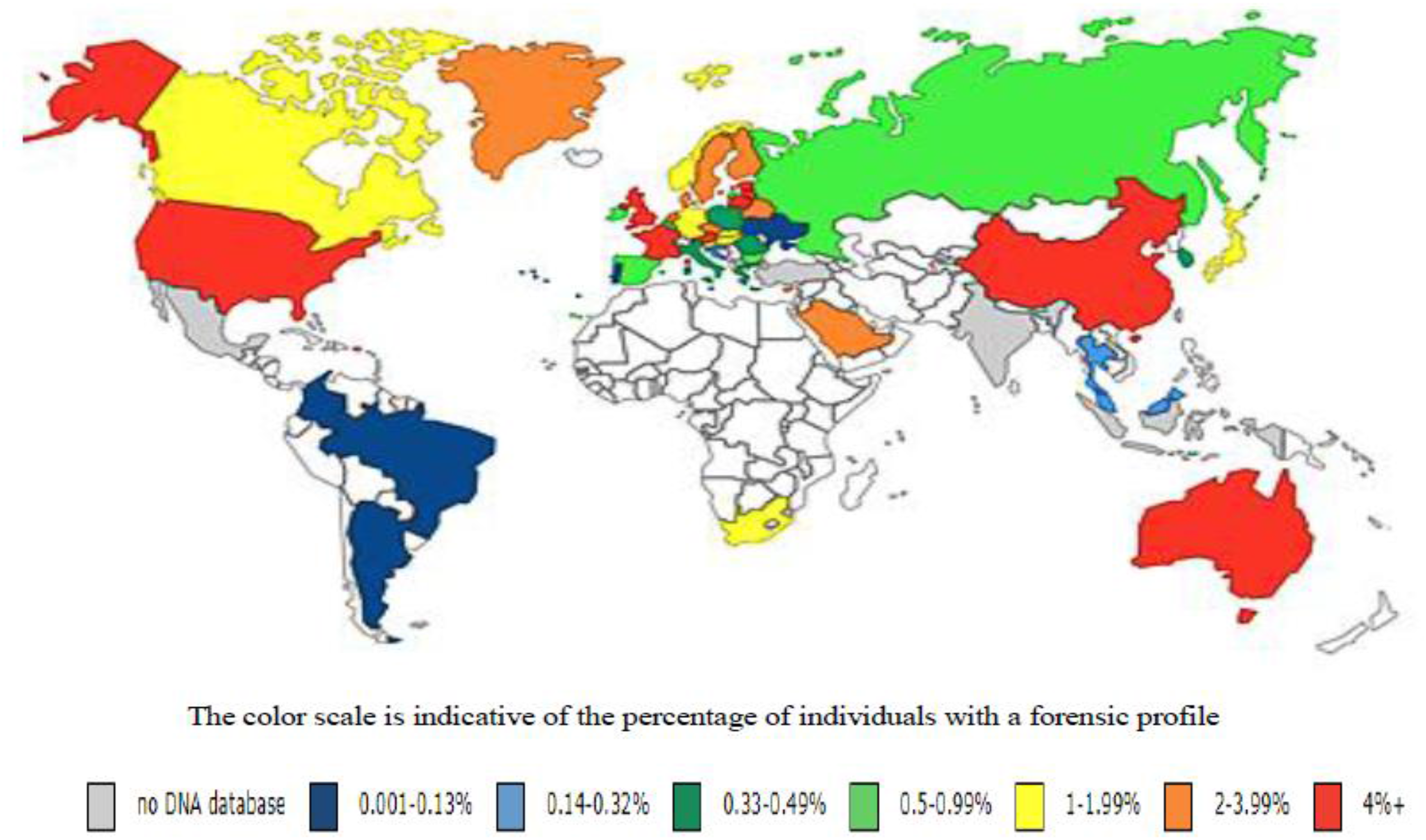
Expansion map of forensic DNA profile databases. 6
DNA database applications
DNA profiles of unidentified bodies, volunteers, staff and forensic experts may be included in the database, along with data collected at the scene and individual reference samples. Biological samples taken at the scene of the crime or from the person, such as blood and bloodstains, semen and semen stains, tissues and cells, bones and organs, hair with epidermal cells, urine, saliva and saliva (nuclear cells) may all be used for DNA isolation and analysis. It is preferable to use a swab from the oral mucosa for DNA analysis.
To obtain DNA, a sufficient number of biological samples are taken by swabbing the cheeks. Sampling does not pose any risk or compromise physical integrity. 1 When DNA samples are taken for forensic database, various data protection measures are implemented to safeguard personal information. These may include controlled laboratory workflows, restricted access, secure storage systems, etc. The specific security protocols differ between countries and determined by national legislation. 9 While Access control mechanisms may vary across jurisdictions and systems, many forensic DNA databases employ user-based authentication and logging procedures to ensure accountability, traceability and data security. Forensic laboratories do not require full genome profiling due to ethical, time and cost considerations. Only loci identified as polymorphic are analysed. DNA databases storing autosomal STR profiles have become powerful tools for solving crimes across the globe. 10 DNA databases are collections of DNA profiles of individuals who have been subject to a legal DNA sample and related information used for the identification of suspects in criminal investigations. 11 Matching or comparison of a set of baseline STR locus profiles collected at a crime scene with profiles stored in criminal DNA databases. 12
The combined DNA index system (CODIS) used of 13 STR loci: CSF1PO, FGA, TH01, TPOX, VWA, D3S1358, D5S818, D7S820, D8S1179, D13S317, D16S539, D18S51 and D21S11. In 2017, the FBI working group identified seven additional loci to boost the discrimination power in identification: D1S1656, D2S441, D2S1338, D10S1248, D12S391, D19S433 and D22S1045. The profile was established after a total of 20 loci were examined. 13 A person's race, ethnicity or health cannot be determined from these gene regions that have been added to the DNA database.
DNA databases typically contain indexes such as an index of convicted persons, an index of suspects, an index of crime scenes, and an index of missing persons. The Missing Persons Index is made up of DNA samples from unidentified bodies and biological remains as well as samples from missing persons and their relatives. This index is stored separately from other indices and is not comparable with them. There are significant differences between countries in the removal of data from the DNA database. 4 Some countries do not delete data once they are entered in the database, while others remove DNA data from the database after a certain period of time has elapsed after the sentence has been completed. There are also cases where the offender has been identified by profiling a DNA sample taken from the scene and identifying a profile which is partly similar to that of another person with whom he has a close relationship in the DNA database. 10
Ethical discussions
Genetic data authenticity and privacy
Forensic DNA databases can be subject to significant criticism for the potential for inappropriate processing and unauthorized sharing of personal data. Preventing the unintended use of DNA profiles by third parties, such as pharmaceutical compaies, health insurers and biomedical industries, is threfore a majör ethical and legal concern. Protecting data also entails defending against any cyberattacks. Another problem relates to the unintended social effects of identifying non-consenting individuals through familial searches. The potential of future misuse of DNA samples retained by state or private laboratories remains a fundamental ethical issue. Examining people based only on their genetic resemblance to those already listed in forensic databases is widely seen as inappropriate. However, significant ethical and investigative problems may be addressed and resolved. Significant privacy concerns may result from familial searches that unexpectedly exposes previously undiscovered biological connections or conflicts with legally or socially accepted family structures. Such revelations can produce psychological, social and even legal complications for the individuals and families related. 14
Genetic data constitutes personal information about an individual, raising societal concerns regarding its use in criminal investigations.15,16 Consequently, the appropriateness of utilizing DNA data to identify suspects, considering human rights and freedoms, continues to be a subject of debate. Comparing an individual's DNA profile with samples collected from a crime scene infringes on the privacy of their personal and family life, which is another drawback of employing DNA data in criminal investigations. 17 Furthermore, it has been noted that the use of genotyping may worsen racial discrepancies.18,19 However, these issues can be avoided by following legislative standards that protect human rights and freedoms when using DNA data in investigations. 20 Forensic DNA databases use STR markers that were particularly chosen to prevent phenotypic correlation. A systematic literature review of 107 articles associating a forensic STR with any genetic trait found no evidence of forensic STR variations directly causing or predicting disease. 21
It is essential to ascertain which crimes warrant the storage of DNA samples and which organizations are responsible for conducting DNA analyses. Issues that need to be addressed include how the results of these analyses will be documented, which individuals or institutions will have access to and utilize this information, whether the records of innocent individuals should be expunged, and the methodology for doing so. 20 Additionally, it is necessary to establish the duration for which biological samples should be retained, the appropriate timing for their destruction and the scientific standards that should govern these processes. Furthermore, considerations must be made regarding the conditions required for obtaining consent for sample collection, the safeguards and standards necessary to mitigate concerns, the feasibility of cross-border sharing, the relevant international agreements that should be incorporated and the evaluation of cost implications. These questions must be resolved prior to the creation of DNA databases to prevent ethical dilemmas. 22 Essential steps are taken to address potential issues through laws, regulations and ethical review boards in developed nations where DNA databases are established and used.
Voluntariness and informed consent
Obtaining informed consent is generally considered a fundamental ethical principle prior to the collection of a DNA sample for inclusion of a DNA sample for inclusion in a DNA database. However, in certin forensic contexts, DNA profiles may be documented without the explicit consent of the individual, as permitted under specific legal frameworks. Such practices may raise concerns regarding public trust and give rise to significant ethical and legal dilemmas, particulary with respect to the privacy of victims and minors.2,16 International guidelines acknowledge that individuals possess the right to retract consent at any point during the research process, and that such retraction should not adversely affect the individual's medical treatment. Nonetheless, the key concern in this situation revolves around the fate of the biological specimens that are currently preserved in the biobank, along with the information collected prior to the revocation of consent. 23 ‘Genetic information and biological materials associated with an individual should not be used unless their connection with the individual has been permanently terminated’ after the consent has been withdrawn, as stated in the ninth section of the International Declaration on Human Genetic Information released by UNESCO. 24 It suggests destroying data and samples if irreversible anonymization from the individual is not possible. The Forensic Databases Advisory Board (FDAB) recommends categorizing data samples by time, risk level (low, medium, high) and risks of ethical breaches, reidentification and the data's source. 11
These classifications were influenced by international standards, including the World Medical Association's Declaration of Helsinki (1964), UNESCO's Universal Declaration on the Human Genome and Human Rights (1997), and forensic genetics community guidelines adopted in 2010 and 2020.25–27
The ethical implications of forensic DNA databases are presented in Table 1. This table provides a comparative reference showing the evolution of ethical standards in forensic genetics over time. Criminal DNA databases, however, require additional information because they involve different legal frameworks, mandatory sampling processes and different privacy risks. Database administrators need to control easily individuals can be traced and use appropriate techniques depending on the specific data stored in their systems. Furthermore, the global distribution of genetic data in forensic science requires increased accountability, including improved professional standards. 28
Assessment of risk according to ethics compliance about forensic DNA database. 28
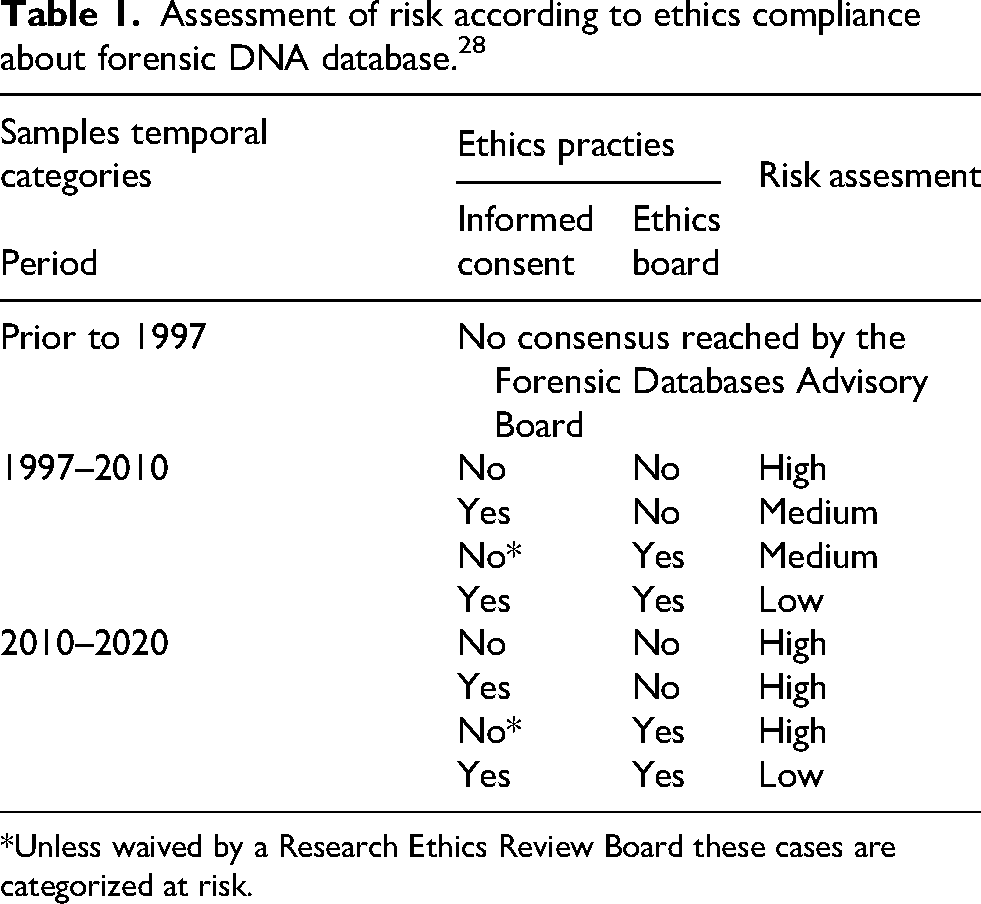
*Unless waived by a Research Ethics Review Board these cases are categorized at risk.
Discrimination and errors in profile matching
A contentious issue for racial and ethnic minorities revolves around the inclusion of DNA profiles in forensic databases. Scholarly discourse in bioethics and socio-legal studies suggests that such databases, due to their disproportionate representation of certain demographic groups, heighten the potential for ethnic profiling and societal stigmatization. 29
Questions also arise regarding the purpose and duration of DNA sample retention, alongside concerns about data security. Public perception of DNA databases is further influenced by apprehensions regarding potential errors in profile comparisons. The risk of false positive matches, leading to the potential wrongful implication of innocent individuals, warrants careful consideration. Furthermore, the pursuit of adequate discriminatory power may involve utilizing a limited number of STR loci, leading to misinterpretations of combined samples from multiple individuals and raising anxieties about conflating Y-STR profiles with those of male relatives sharing a paternal lineage. Because the Y chromosome is inherited only from the paternal line, multiple relatives may have the same Y-STR profile. 7 In this case, working with a limited number of STR loci in the database may result in false-positive results when profiling males of the same lineage.
Additionally, statistically inaccurate matching of DNA profiles to the same individual may result from contamination and laboratory errors during laboratory analysis. The size of the database and the number of loci employed have a direct impact on the possibility of false-positive matches. Weedn and colleagues found a false-negative match rate of 1 in 1,000,000,000 in their 13-locus STR analysis, but they also found that this rate increases with the number of data in the database. Currently, 20-locus STR panels are employed in forensic DNA databases. This reduces the potential of errors and significantly increases discriminatory power. Further, false-negative matches and failure to identify the true perpetrator are also concerns. 30 Quality assurance in all technical procedures is also an ethical problem because identification errors have grave and irreversible consequences. 31
Data storage and sharing periods
DNA samples can be taken for all reported crimes in the United Kingdom, Switzerland, Austria, Croatia and Slovenia. DNA sampling is permitted in Germany and Finland for sentences of 1 year, one and a half years in Denmark and 5 years or longer in Hungary. Serious offenses in Sweden, Belgium, France and the Netherlands are handled using this process. Those convicted of some heinous crimes, such rape and murder, have their profiles documented in Germany, the Netherlands, Norway and Belgium.
Samples of blood and saliva are not allowed to be stored; they are discarded once a DNA profile has been produced. Thirty one of 50 states have expanded their state SDIS to include arrestee database samples. All US states, as well as the UK, Austria, Finland and Switzerland, would rather store DNA samples than destroy them. This is due to the fact that the analysis can be repeated in the event that there is any suspicion and that new technology makes it possible to repeat the study in the event that the system is expanded to include more informative loci. However, after examining the profile, Germany, the Netherlands, Norway and Belgium destroy the DNA. This is due to the necessity to safeguard personal information and privacy as well as worries about possible DNA misuse. There are also different regulations regarding the deletion of DNA profiles taken for forensic purposes from DNA banks. For example, the UK, Austria, Finland and Norway never delete prisoner profiles from banks. 32 Most other countries require DNA profiles to be deleted within 5–20 years of release from prison. 33 Additionally, the extent and level of access to the DNA database vary by jurisdiction and are influenced by the type of crime committed, the severity of the punishment, the characteristics of the criminal and the likelihood of recurrence. 34
The criteria used to add and remove samples and profiles will have the biggest influence on how big these databases get. Regarding the creation of DNA databases, a country may be categorized as having an expansionist tendency if certain laws are in place (such as mandating that the DNA profile of every person suspected of committing a crime) and impose minimal limitations on the insertion of profiles into DNA databases for forensic purposes, regardless of whether the person is a suspect or a convicted individual.8,35
International legislation and practices
Mr S. and Mr Marper, both British citizens named in the 2008 European Court of Human Rights decision, were charged with various crimes in 2001. Their fingerprints and DNA samples were taken at the time of their arrest. However, they were not convicted at the trial. The Court concluded that ‘the general and indiscriminate storage of fingerprints, cell samples and DNA profiles of suspected but not yet convicted individuals, as in this case, fails to strike a fair balance between the public interest and private interests’. This case led to changes in the UK's legal regulations. In May 2013, the UK amended its laws to comply with the European Court of Human Rights’ decision by deleting approximately 1 million records from its database. 36 This was a positive step in protecting the privacy of personal data. The General Data Protection Regulation (GDPR), which entered into force in European Union member states in 2018, addresses the security of personal data held by large institutions and organizations in Europe Union member states within the framework of the rules set forth in the regulation. This protects information about race, ethnicity, and medical history. The Federal Bureau of Investigation (FBI) launched CODIS in 14 states, allowing states to share DNA profiles in 1990. The DNA Identification Act led to the establishment of the DNA database in 1994. CODIS was established as the official national database in 1998. CODIS consists of three levels: local, state and national. Local DNA Index System: A database established with DNA profiles examined by regional laboratories. State DNA Index System: A repository of DNA profiles collected by state labs. National DNA Index System: A database of DNA profiles maintained by the FBI at the national level.14–16
Public safety and ethical qualms
The use of DNA databases offers many public security advantages: by identifying links between related events in an early stage, it is possible to prevent further harm. Early detection of the offender and determination of the guilt of innocent defendants or suspects can deter crime and save the security forces time and money. After DNA samples were entered into the national database in England, the crime identification rate in England rose from 26% to 40%. 37 In countries where there is no DNA database, to determine the identity of people who died in natural disasters, cheek swab samples are taken from first-degree relatives and compared with the sample from the victim. 20 This identification process is long, costly and time-consuming. Moreover, in unsolved crime cases, many trials remain inconclusive without a suspect or DNA database that matches the biological evidence from the scene. However, despite all these advantages, the processes must be accurate, objective and ethical, including those related to privacy of individuals, lack of informed consent, inaccurate laboratory or analytical results, retention periods and compliance with international rules. DNA databases have been criticized by experts from different fields and scientific disciplines for not taking into account ethical considerations and the need for human rights, including autonomy, privacy and the presumption of innocence and equality in their use. 38
It is generally accepted that the interests of society are more important than those of individuals, and that the common justification for restricting individual rights is to ensure public security and the fight against crime. A society with more efficient policing and security procedures for its citizens is more valuable in this sense, as it is more efficient in catching those who are responsible for the crimes. 39
Studies have raised concerns about the risks to the physical integrity of citizens who may be subject to forced genetic sampling and the possible violation of privacy rights caused by tissue storage and use.40–42
To avoid ethical violations, Miller & Smith advocates the creation of quasi-universal forensic DNA databases. In this view, only DNA from persons convicted of serious crimes should be permanently collected and stored. DNA from persons apprehended and charged with but not convicted of a crime may be collected and stored for a reasonable period. 43
Conclusion
In forensic medicine, ethical and legal considerations always arise in the collection, storage and use of personal data. In this respect, it is important to consider the degree of confidentiality and privacy to be ensured during the storage and use of the DNA profile or sample. 44
It is considered that DNA data banks, which play a very important role in the fight against crime, in catching criminals and in proving the innocence of innocent people, should be provided with safeguards and a model to ensure a balance between public security and individual liberty, and that such a framework should be established. 45 Individual privacy has always been a major human rights issue, and recent advances in DNA technology have raised a number of new concerns. A comprehensive legal framework is therefore needed to govern the management of DNA databases. This is seen as the most important way to address societal concerns and to overcome ethical problems in countries where the use of DNA databases is not yet legal.8,46
Ethical and legal issues can be resolved by overcoming ethical issues (in which cases samples should be collected, how long to store isolates and samples, security of identification and analysis in accredited institutions (e.g., forensic medicine, police and gendarmerie laboratories). To improve the accuracy of genetic analysis, more loci (20 or more) should be investigated, the statistical threshold value for the DNA database should be updated and independent validation systems should be put in place at the laboratory. As a result, addressing ethical concerns about DNA databases and making them more widespread will facilitate the identification of perpetrators and the linking of related events.
