



Abstract
Bulldozer fatalities are usually due to accidental crushing of the body at the workplace. However, severance of the skull cap simulating a chopping injury to head is rare in the literature. Medico-legal investigation may be posed with different challenges when carrying out an autopsy of a victim with this devastating head injury. The police will seek an opinion about the type of weapon responsible for the injuries, the nature of injuries produced and manner of death. In the present case, the victim was hit at dusk by a protruding part of the bulldozer blade as he crossed in front of a bulldozer that was approaching his tractor from the opposite side of the road. His skull cap was severed and he died instantly. This report considers the circumstances of his death, its mechanisms and strategies for preventing such deaths.
Introduction
The calvarium of the skull constitutes an effective barrier to any low-energy non-missile injuries such as those from knives. However, the brain can be stabbed through different foramina of the skull or through the thin temporal bones by hand-held knives or long pointed objects like a screw driver blade, nails, needles or electric drill bits.1,2 In comparison to a stabbing injury, transcranial chopping is produced by a relatively sharp object hitting with tremendous force. It is characterised by scalp laceration, linear or comminuted fracture of skull, laceration or exoneration of the brain along with an exposed cranial cavity. The weapon is often heavy, with high velocity or with significant angular acceleration. A meat cleaver, axe, machete, etc. are examples of heavy instruments with sharp edges, capable of inflicting chop injuries to the head and these injuries are mostly homicidal. 3 Accidental chopping of the head is very rare. It has been occasionally reported in motor boat propeller injuries. 4 A heavy-duty bulldozer blade is a heavy object with a sharp edge that is capable of crushing and cutting, but severance of the skull cap secondary to high energy chopping of the head is rare and as described here the cranial cavity was exposed due to the high-energy impact of a bulldozer blade.
Case report
A 43-year-old farmer was driving his own tractor home at around 6-7 pm at a moderate speed (about 60 km/h).The driver’s seat of the tractor was equipped with a back rest. From the opposite direction, a heavy trailer was approaching at slow speed (about 30 km/h) carrying a heavy duty bulldozer with the blade facing forward, its lower margin about 2 m (6 ft 6 inches) above the ground. The side part of the blade was allegedly protruding by some 60 cm (2 ft) from the side of the truck (Figure 1). While passing the truck, the farmer failed to see or to notice the protruding edge of the bulldozer blade. He was allegedly hit by this blade and died on the spot.
Diagram of the position of the bulldozer and its blade during transportation.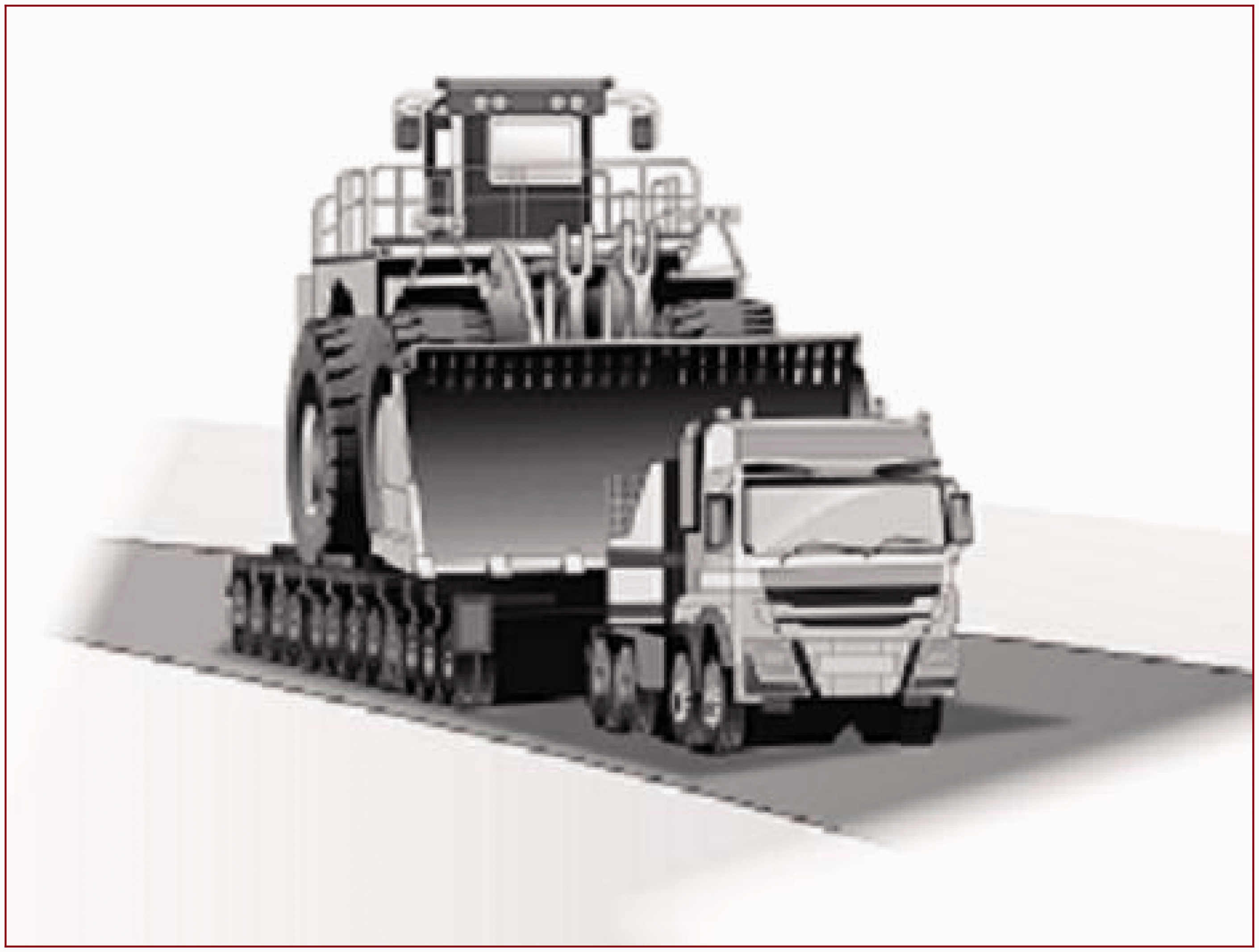
The autopsy was conducted the next day. Rigor mortis was present all over the body. Fixed postmortem hypostasis was present at the back and other dependent parts of the body except on the pressure areas. On examination, a horizontally placed chop wound was present around the head at the level of right eyebrow at the right side and 0.5 cm above the left eyebrow at the left side (Figure 2(a) to (c)) causing circumferential severing of skull cap. The wound extended horizontally backward on both sides of the skull and passed 2 cm above the right and 2.5 cm above left ear lobe and the posterior margin of the wound was continuous at the back of the scalp. The length of the wound around the circumference of the skull cap was 42 cm. Anteroposterior length of the wound was 15 cm and transverse length was measured as 13 cm. A sharp cut of the skin of the forehead and scalp tissue along with incision of frontal, both temporal and occipital bone were found around the wound edge. The brain was missing. Comminuted fracture of both the parietal bones and the skull cap along with scalp was present separately in the body bag. There was haemorrhage along with the remaining part of the dura mater. There was a comminuted fracture of the base of the brain associated with the haemorrhage. The posterior margin of the wound was everted associated with a comminuted fracture of the occipital bone. Graze abrasions were found over the right shoulder and right upper back. The toxicology report was negative.
(a) Severed skull cap of the deceased, (b) comminuted fracture of the occipital bone and base of the brain and (c) severed scalp and fragmented bones of the top of the head.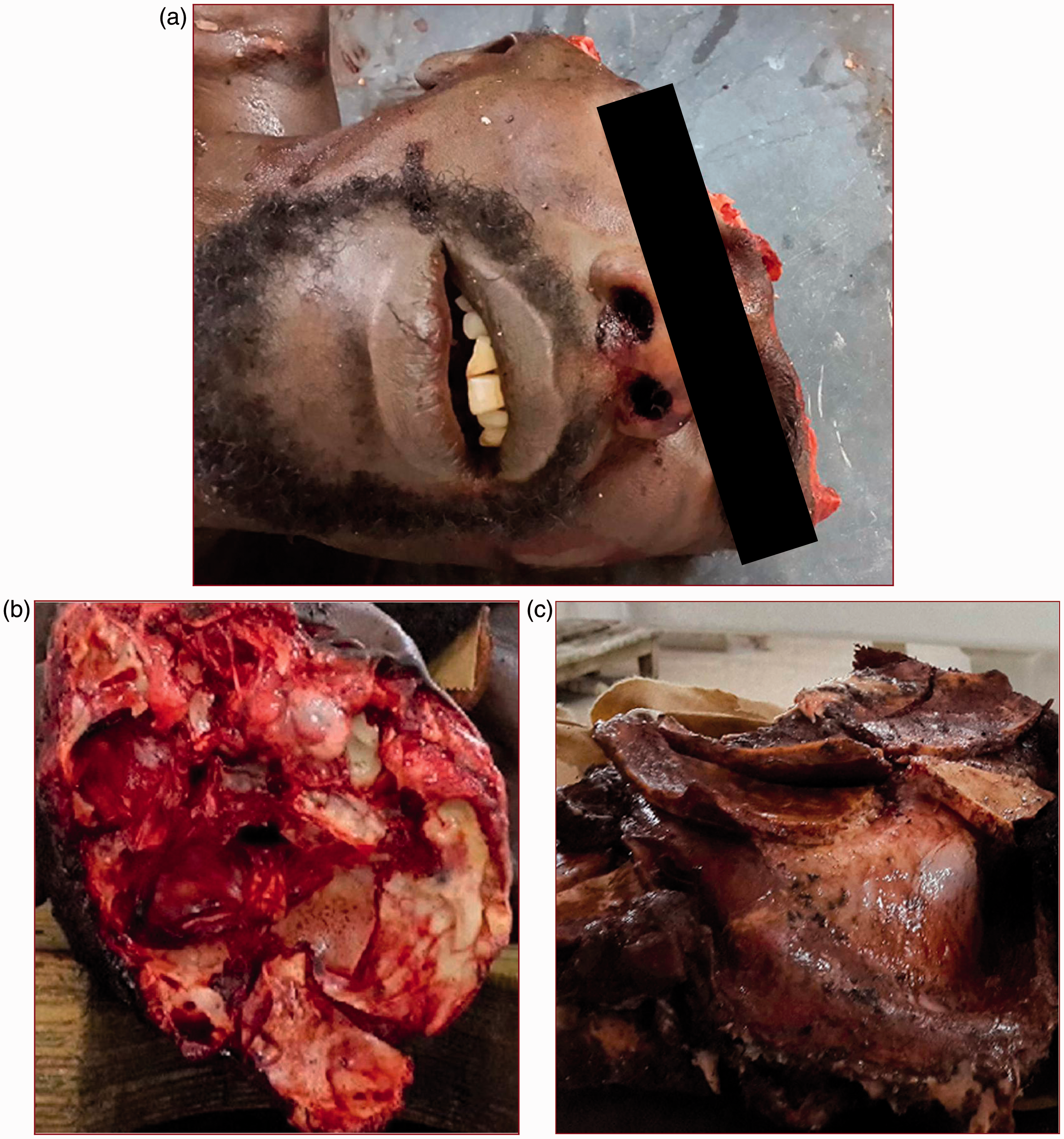
The cause of death was stated to be the craniocerebral injury caused by severing of skull cap by a heavy sharp cutting weapon. The bulldozer blade was presented for examination afterward. It was a straight type of blade with moderately sharp edge weighing about 100 kg. Its width was 4.5 m (15 ft) and height was 1.9 m (6.34 ft) (Figure 1). Given the circumstances and autopsy findings, the abovementioned craniocerebral injury of the deceased was considered to be consistent with a blow by the bulldozer blade.
Discussion
Accidents may result from multiple causes and are currently the ninth leading cause of death in the world and indeed may become second commonest cause of death around 2020. They may arise from human and environmental factors and lack of good quality roads, the increase in the traffic, careless driving by young people and lack of knowledge or obedience with regard to rules of the road. 5
The bulldozer is a continuous-tracked tractor equipped with a metal plate (blade) for pushing up and lifting of a large quantity of soil, sand, rubble, etc. at construction or conversion works and having a claw-like device (ripper) at the back to loosen densely compacted materials at mines and quarries, military bases, heavy industry factories, engineering projects, farms, etc. The bulldozer blade is a heavy plate made of metal (iron) on the front aspect of the tractor. It may be a straight blade (S blade), a universal curved blade (U blade) or an angle or a cushion blade. The straight blade (S blade) is stabilized vertically by a push arm and without any lateral curve and wings like the universal blade (U blade).6,7
Improper and negligent use by operators make them exceptionally dangerous and liable to cause significant injuries which are often made worse by the size and nature of the equipment and can be and often are fatal.
Overturning a bulldozer due to loss of control, inadequate maintenance or inadequate illumination frequently causes occupational fatality. 8
Other recent incidents reported include a bulldozer being used in homicidal and terrorist activities 9 causing fatal crushing injuries and traumatic brain injury, bone fractures, etc. Fatal or non-fatal soft tissue lacerations may also result from bulldozer injuries.10,11
Hacking traumas to the skull by common chopping instruments like an axe, or machete or cleaver can break bones, 3 but severing of the skull cap is a very rare trauma produced by a heavy instrument with sharp cutting edge applied with considerable force. Here, the horizontal margin of the scalp and skull defect indicates the wound was inflicted at a horizontal plane. The everted posterior margin along with direction of fracture line of the broken occipital bone suggests the direction of the force was from front to back. It corroborates the alleged history of penetration of skull of the victim by the heavy duty bulldozer blade facing forward, while the vehicles paths crossed. The force applied at impact must be very high to cause the complete removal of the skull cap from the remaining part of the head. In this case, very high kinetic energy was generated due to the heavy mass and movement of the dozer blade combined with the victim coming from the opposite direction. Usually, a motionless object is supportive for transcranial penetration injuries,12,13 but here the positioning and direction of both vehicles made the victim's head accessible to the blade and to the severing of the skull cap. In addition, the backrest of the victim’s seat provided additional support, preventing any backward movement of the upper body.
The bulldozer blade traversed a small distance (the anteroposterior length of the skull), but the transfer of high energy was facilitated by the flattened and broad surface area along with the rigidity of the blade and high resistance of the hard skull bone. In low energy stabbing, the damage of tissue is usually confined within the track of the wound. However, in the present case, the comminuted fracture of the base of the brain and cranial bones of head top, and the expulsion of the brain, suggest high-energy projectile injury due to dissipation of energy even outside the wound track.
It is important to prevent heavy-equipment-related fatalities. Bulldozers should not be left unattended or unlocked. Faulty defective machines should not be used as very often fatal accidents may result from mechanical faults without negligent operation. The operators should be properly guided, as when they are transporting equipment or materials the driver's line of sight or vision can be seriously impaired. Bulldozer operators should be properly insured for risk management. When transporting a dozer, the blade should be protected with a thick rubber or other covering to minimize accidental injury. The driver needs to inspect the position of the dozer from time to time. Increasing the visibility and proper restraining of the dozer improves the likelihood of safe transportation.
Footnotes
Declaration of conflicting interests
The author(s) declared no potential conflicts of interest with respect to the research, authorship, and/or publication of this article.
Funding
The author(s) received no financial support for the research, authorship, and/or publication of this article.