



Abstract
The deliberate killing of a foetus in the womb, or a child from the first 24 h of birth to one month of age, or within the first year of life, is called foeticide, neonaticide and infanticide, respectively. Socioeconomic stress, mental illness, gender selection, shame or fear of punishment of adultery or illegitimacy, grudge and jealousy with parents and negligent delivery by dai are major causative factors in such cases. This is a retrospective, descriptive, observational study, and the sample pool consisted of 35 cases. Foeticide cases were 42.9% of the total and the same percentage of cases were neonaticides, while 14.3% of cases were of infanticide. The male-to-female ratio was 1.26:1 and the major cause of death was head injury. The study shows a prevalence of foeticide and neonaticide as compared to infanticide. It also displays the prevalence of males in overall cases and a higher number of unknown cases in our setting.
Introduction
The deliberate or incidental act of killing an infant in the first year of life encompasses infanticide. 1 Neonaticide usually refers to the killing of a child during the first 24 h after birth or up to the age of one month. 2 Neonates are most vulnerable to this cruel act during the first few hours after birth. 3 Another term, foeticide, is the act of killing a foetus in the womb or causing an abortion. They are collectively dealt with under child homicide which has occurred throughout history all over the world. As a result of prenatal screening, the number of cases of late terminations of pregnancy is rising in Pakistan. 4 Almost 4 to 5 million neonates die annually in the world with most cases reported in low-income and middle-income countries. Pakistan is one of the fifth most populous countries in the world, with the infant mortality rate the second highest in the world. The rate of neonaticide here is almost 10 times that in developed nations. 5
Child homicide may be passive, in which the child is deprived of food and water allowing him to die, or active in which he is killed through suffocation, head injury and other means. 4 Most common executioners of this cruel act are the child’s parents, especially mothers. 1 Mothers who commit the crime of neonaticide are usually younger, unmarried and primiparous, as young mothers have a higher chance of replacing the dead child with subsequent pregnancies. But in most cases of infanticide, the mothers are older and are married. 6 The corpse of the dead child is mostly abandoned in a cool, deserted place and even after the child’s body is found, it is so decayed and mutilated that no conclusion can be drawn about time-lapse since the death and whether the child was born alive or dead. 2
The situations that lead to infanticide and neonaticide may vary in different settings, but the extreme socioeconomic vulnerability of the parents and financial issues are common to all. According to recent studies, female foeticide and neonaticide is more common in Southeast Asian countries due to the financial pressures imposed on the families of providing food, shelter and dowry for females. In the United States, the emotional and social isolation of the mother may lead to child homicide. When the parents don’t have the resources to raise their children, they kill them early in life rather than allowing them to die of hunger or abuse later. If the child suffers from some congenital anomaly at birth, parents prefer to deprive him of life rather than diverting their scarce financial resources from their healthy children to a child whose chances of surviving are minimal. 4
Concealment and denial of pregnancy are common when conception is the result of an illegitimate act. 1 Social stigma associated with an illegitimate birth may also force a mother to do this cruel act. Out of shame or fear of punishment for adultery or illegitimacy, women commit child homicide. 2
Rape is also very common in Pakistan and the survivors of rape prefer to perform neonaticide and infanticide rather than claim a legal abortion, because of the burden and emotional trauma of the legal procedures. 4 The mothers commit child homicide especially when the pregnancy is unplanned or the child is unwanted since conception. 1 Most common maternal risk factors associated with this act are postpartum psychosis, mental disturbance, depression and bipolar disorder. 6 Recent studies have shown that 26% of homicidal mothers suffer from postpartum psychosis. 1 But correlation between these psychological disorders and child homicide is not always present. 6
Aims and objectives
To determine the frequency of foeticide, neonaticide and infanticide in our setting. To determine which gender is more affected by child homicide. To determine major cause of death in cases of foeticide, neonaticide and infanticide.
Materials and methods
This is a descriptive, observational, cross-sectional study. The sampling was done by the non-probability purposive technique and the setting was the record room, Department of Forensic Medicine and Toxicology, King Edward Medical University, Lahore, Annexure and consents, for the year 2018 and 2019. The study was started after getting ethical approval from the Institutional Review Board, King Edward Medical University, Lahore, via letter no. 181/RC/KEMU dated 29 February 2020. Sample pool consisted of total 35 cases in two years (1 January 2018–31 December 2019). Data were collected via autopsy reports of all the included cases of autopsies done at the Department of Forensic Medicine and Toxicology, KEMU, Lahore, during the time of 1 January 2018 to 31 December 2019. Autopsy cases of children under one year of age were included and divided into three categories: foeticide, neonaticide and infanticide, while the autopsy cases of the subjects above one year of age were excluded. Statistical analysis was done by using the software, Statistical Package for Social Science. For the analysis, the following variables were considered:
Foeticide/Neonaticide/Infanticide Gender Cause of death Time-lapse between injury and death Known/Unknown Annual mean Age distribution Live birth/Stillbirth.
Results
Over two years from January 2018 to December 2019, we found a total of 35 cases related to the study. Out of these 35, 42.9% (n = 15) of cases were of foeticide and similarly 42.9% (n = 15) of cases were of neonaticide, while 14.3% (n = 5) of cases were of infanticide, as shown in Figure 1.
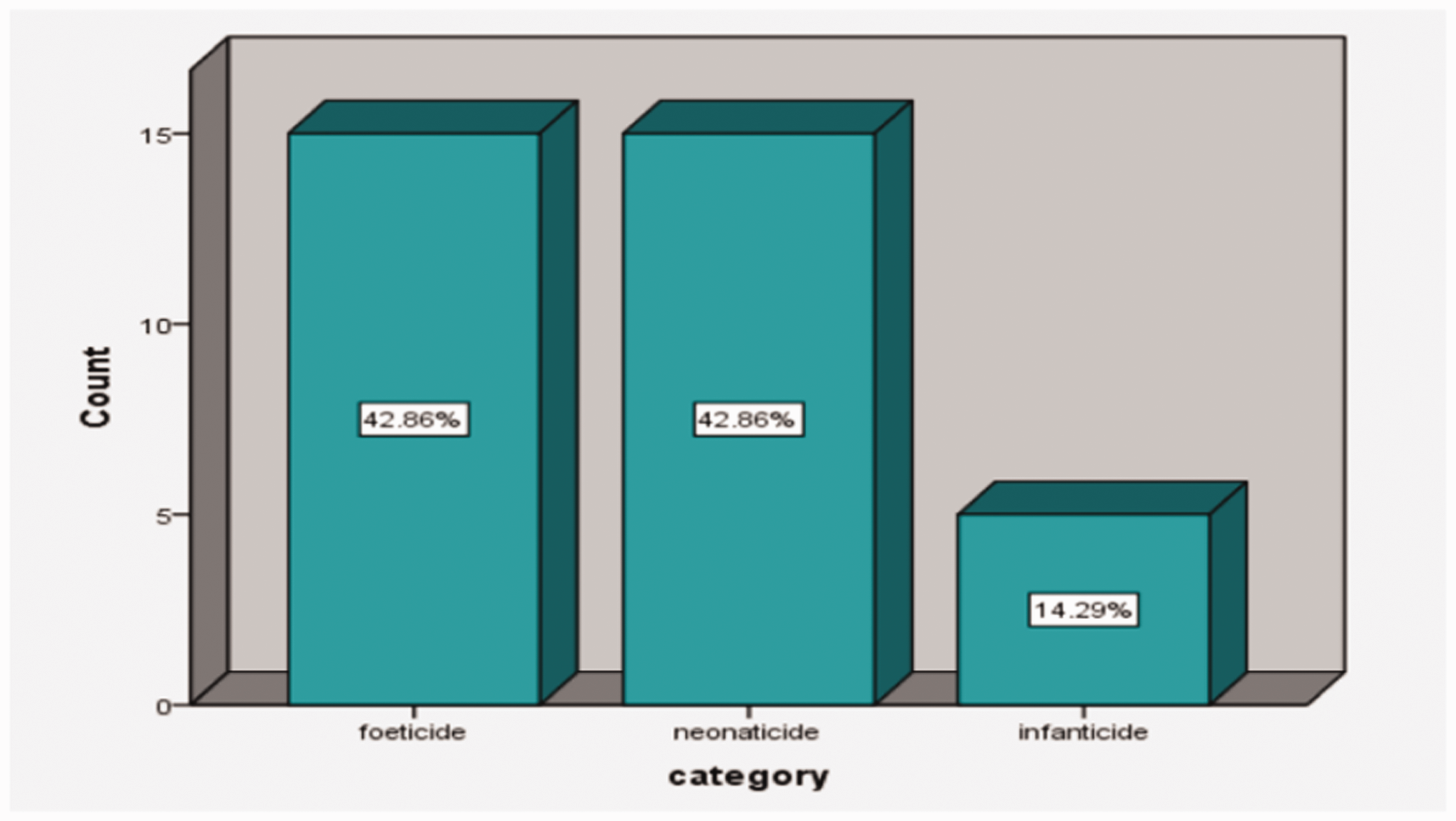
Prevalence of foeticide, neonaticide and infanticide.
The age group distribution was seen in such autopsies and was divided into six categories, as shown in Figure 2. The gestational age distribution in foetuses showed that 11.4% of cases (n = 4) were between three and five months of intra-uterine life and 8.6% of cases (n= 3) between five and seven months of Intra-uterine life. The highest per cent were in the range of seven to nine months of IU life showing 34.3% of cases (n = 12), the same incidence as seen in age from nine months of IU life to two months of life, i.e. 34.3% of cases (n = 12); 8.6% of cases (n = 3) were in the range of two months to six months and the remaining case (2.9%) was between six months and one year. These statistics show that most cases lie in the last trimester of IU life and the first two months of extra-uterine life.

Age distribution among the cases of foeticide, neonaticide and infanticide.
The gender distribution among such cases is shown in Figure 3. Males were predominant with 54.3% (n = 19) cases and females were 42.9% (n = 15). The remaining case (2.9%) was unidentified. Male-to-female (MTF) ratio is 1.26:1.

Gender distribution among the cases of foeticide, neonaticide and infanticide.
Male foetuses were 28.6% of cases (n = 10), while 11.43% (n = 4) were female foetuses; 17.1% (n = 6) were male neonates and 25.7% (n = 9) were female neonates. Male infants were 8.6% (n = 3) and 5.7% of cases (n = 2) were female infants. The remaining case (2.9%) was an unidentified foetus. This shows male predominance as given in Figure 4.

Distribution of cases of foeticide, neonaticide and infanticide according to gender.
The main causes of death were analysed, as shown in Table 1 and Figure 5. Head injury was the leading cause with a high occurrence of 51.4% (n = 18) of cases, out of which 3 were foetuses, 13 were neonates and 2 were infants; 34.3% (n = 12) cases were stillborn, out of which 10 were foetuses and 2 were neonates. The complication of foetus papyraceous was seen in 5.7% (n = 2) of cases, both were foetuses. Drowning leading to asphyxia was seen in 2.9% of cases (n = 1); that was an infant. Firearm injury was seen in the same 2.9% of cases (n = 1); that was also an infant. Road traffic accident was also seen in 2.9% of cases (n = 1); that was also an infant.
Cause of death in different cases according to age distribution.


Cause of death in different cases of foeticide, neonaticide and infanticide.
Another variable studied was the time-lapse between injury and death as shown in Figure 6; 45.7% of cases (n = 16) were of immediate deaths and only one case (2.9%) was a hospital death. In 48.6% of cases (n = 17) it was uncertain, and it was not mentioned in one case (2.9%).
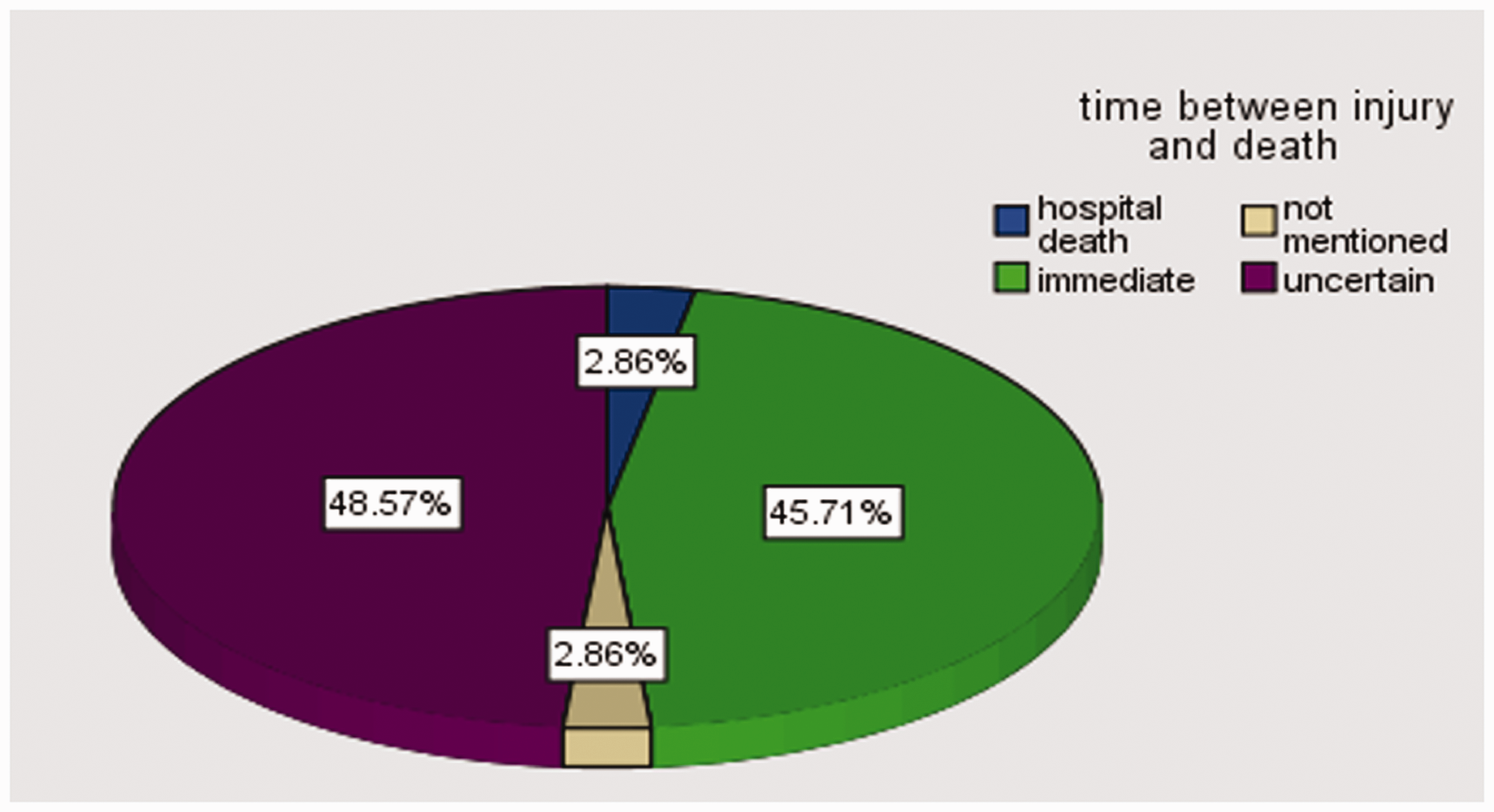
Time-lapse between injury and death in different cases.
Another important attribute studied was whether the cause was known or unknown; 82.9% of causes (n = 29) were unknown, while the remaining 17.1% of cases (n = 6) were known as seen in Figure 7.

Prevalence of known versus unknown cases.
Based on police reports and positive results of the hydrostatic test of lungs, out of 35 cases, 14 cases were liveborn (1 foetus and 13 neonates); 16 cases were stillborn (14 foetuses and 2 neonates). The remaining five were infants. This is shown in Table 2.
Frequency of stillbirth versus livebirth cases.

Table 3 shows that annual cases of 2018 were 11, out of which 4 were foetuses, 4 were neonates and 3 were infants. The annual cases of 2019 were 24, 11 of foetuses, 11 being neonates and 2 being infants.
Yearly distribution of cases of foeticide, neonaticide and infanticide.

Discussion
We studied 35 cases, from January 2018 to December 2019 at the Department of Forensic Medicine and Toxicology, King Edward Medical University, Lahore, Pakistan. Despite recent advances in the entire world, the incidence of infanticide and neonaticide is miscalculated, because the bodies can easily be concealed and the victims are unable to file a report against their murderers. 1 There are several concerns among the general public about the autopsy of the child, which include issues to transport foetal remains, problems faced during organ retention, aversion to invasiveness, lack of awareness, poor understanding of the autopsy procedure, fear of disfigurement, and religious or cultural objections. This leads to decreased rate of autopsies done to determine perinatal deaths. 7
The study shows that the total rate of foeticide (42.9%) and neonaticide (42.9%) is greater than infanticide (14.3%). Foeticide, neonaticide and infanticide can be the outcome of different homicidal, accidental and natural events. Preference for sons and lower status of girls in the society determines a high rate of sex-selective abortion or, more specifically, female foeticide, in South Asian countries like Pakistan. 8 But this is in contrast to the present study. Data summarised reveal an overall greater preponderance of male cases (54.3%). The MTF ratio was 1.26:1 in our study. Most of the stillbirths, early neonatal, neonatal and perinatal mortalities are prevalent in male babies as compared to female babies. It is also in line with the Pakistan Demographic and Health Survey (DHS) 2012/2013 that says higher neonatal mortality is seen in male children than female children in Pakistan. 9 Our findings correspond to research done in Hubei, China. 10 However, this contrasts with studies in India where female cases are predominant. Some studies have also shown the same ratio between both sexes. 11 A study in Turkey shows that this crime takes place regardless of sex. 12
The study shows that 93.33% of foeticide cases (14/15 cases) were still birthed. On the contrary, 13.33% of neonates (2/15 cases) were stillborn. This suggests that stillbirth is preponderant in foetuses and is probably caused due to intrauterine infections. This is consistent with a study in China. 10 Infanticide has a higher incidence in females (9/15 cases) because female children are more often abandoned in Pakistan as shown also in studies done in China, India, South Korea and Taiwan. 11
Investigation of whether the murdered child was viable or not is significant in most cases, especially neonaticide. 13 Lung flotation tests can be done to determine whether the child was born alive or not. 11 Although forensic autopsy is a reliable method to determine and diagnose perinatal death, it is not commonly accepted by parents or even healthcare professionals.
The study found that the last trimester of intrauterine life (34.3%) and the first two months of extra-uterine life (34.3%) constitute the most vulnerable age groups in such cases. Then two to five months of IU life comprise the second most prone age group (11.4%). A study claimed that the babies in the first four months of extra-uterine life are more vulnerable to infanticide, as seen in our study. 11
The study shows the major cause of death as head injury with an incidence of 51.4% and dominant in neonates (13/18 cases). Stillbirth with an incidence of 34.3% is prevalent in foetuses (10/12 cases). The next most common cause was the complication of foetus papyraceous with an incidence of 5.7%. Other major causes were road traffic accidents (2.9%), drowning leading to asphyxia (2.9%) and firearm injury (2.9%). The most common methods parents use to kill their innocent children are suffocation, drowning, burning, poisoning or inflicting serious head injuries. 6 A study also found traumatic head injuries to be the most common cause of death. 8 Some reasons for the increasing decline in autopsy rate is the disgust associated with the invasiveness of the procedure as well as the religious obligations especially in Muslim and Jewish parents. 14
Eighty-three per cent of the recorded autopsies were of unknown cases. This higher number of abandoned children points out the high incidence of poverty and illegitimate births. The time-lapse between injury and death suggests the time available to receive any emergency medical treatment; 45.7% of cases show immediate deaths with no time for such treatments. These immediate deaths were from head injuries. In 48.6% of cases, time-lapse was uncertain, and 2.9% of the cases were hospital deaths.
Limitations
The study was a retrospective, observational study, which did not enquire into the mental health state of the parents, especially in homicidal cases. Moreover, it does not include the socioeconomic backgrounds of the parents and their personal history.
Conclusion
The study illustrates overall male prevalence, the female prevalence in live infant deaths, and the prevalence of stillbirths in foetuses. Head injury causing immediate death was observed as the major cause of death. It describes a higher number of unknown cause of death in our set-up. Full-term neonates were found more susceptible to homicide. Further study is necessary to know the root cause of such cases and to investigate the mental health of parents committing this cruel act. Accidental and natural deaths are inevitable, but homicidal cases should be minimised. This study draws the attention of organisations working for the stability of the socioeconomic status of families and minimising these incidents. More effort is needed to provide better prevention of these calamities and should include improved sex education, safe sexual practices and contraceptive access.
Recommendations
Infanticide and neonaticide cases are not usually documented in statistical records, so researchers are encouraged to pay special attention to this important issue. To decrease the rate of child homicide, mothers should be screened for psychological disorders and other risk factors. New policies should be made on the national and international levels to prevent child homicide, and awareness should be raised regarding this issue among the public.
Footnotes
Declaration of conflicting interests
The author(s) declared no potential conflicts of interest with respect to the research, authorship, and/or publication of this article.
Funding
The author(s) received no financial support for the research, authorship, and/or publication of this article.