



Abstract
We describe two fatal Asian elephant attacks in Rajaji National Park, Uttarakhand. The first victim was a 65-year-old man found dead on a road leading to his village, which passed through a forest. He sustained multiple blunt force traumatic injuries, primarily in the upper part of the body, caused by stomping from an elephant’s feet. The second victim was a 28-year-old man found dead along the banks of the River Ganga. In addition to stomping injuries similar to those in the first case, he also had a fatal tusk penetrating wound in the abdomen. In both cases, death was sudden, resulting from shock and haemorrhage due to blunt force and penetrating trauma, respectively. Injuries typical of such attacks often involve blunt force trauma caused by stomping, squeezing or crushing by the elephant’s trunk and feet. In rare cases, penetrating wounds from male elephants’ tusks may also be observed.
Introduction
Wild elephants are native to the African and Asian continents, so most fatalities from elephant attacks are reported only in these regions. 1 In other parts of the world, human–elephant conflicts (HEC) are rare and typically occur in zoos and circuses.2,3 However, in India alone, elephant attacks have caused 2829 human deaths over the past five years. 4 Despite their frequency, published post-mortem studies remain scarce. 5
Elephants are peaceful, intelligent, and social animals. They live in highly structured and organised groups, usually composed of females and their young, led by a dominant female. Occasionally, multiple groups merge to form herds of hundreds of elephants. 6 Male elephants are solitary wanderers, though they may form bachelor groups. Older male elephants often live alone. 7
An adult elephant consumes approximately 150 kg of forage and drinks about 190 l of water daily, requiring vast areas to roam. However, due to increasing forest encroachment driven by human population growth, these herds are being confined to smaller, restricted areas near human settlements, commonly referred to as “pocket herds”. These pockets significantly increase the likelihood of HEC. 5 In their search for food, elephants frequently raid agricultural fields and destroy crops; when confronted, they may exhibit aggressive behaviour, sometimes resulting in human fatalities. 8 Additional factors contributing to conflicts include wildlife tourism and encounters with captive elephants in zoos.9,10
We present two fatalities caused by wild elephant attacks in the forested Rajaji National Park, Uttarakhand, which lies along the Ganga River and is home to a substantial population of Asian elephants. 11 The park is surrounded by human settlements, where residents engage in agriculture on lands bordering the forest. Elephants often stray into these fields and settlements, leading to frequent HEC. This case series aims to shed light on the injury patterns associated with fatal elephant attacks and the circumstances surrounding these incidents. Additionally, we suggest preventive strategies to mitigate HEC and enhance the accuracy of diagnosing fatalities caused by elephant attacks. All identifying information has been anonymised to ensure confidentiality. Our institution does not require ethical approval for reporting individual cases or case series.
Case 1
A 65-year-old man was found dead on a road leading to a village that passed through the forests of Rajaji National Park. His body was discovered in the morning, with an elephant standing some distance away from it. Signs of conflict were evident in the surrounding area, with nearby vegetation destroyed by the elephant. According to the victim’s relatives, he had left his house between 8 and 9 p.m. the previous night to defecate in the forested area near the village.
The post-mortem examination revealed the body of a male of average build, measuring 1.72 m in height and weighing 66 kg. His clothing was torn and stained with dirt and vegetation. The incident occurred in the first week of March 2021. Multiple grazed abrasions and contusions were present across the body, primarily on the face, chest, shoulders, abdomen, pelvis, genitalia and upper thighs (Figure 1(a) and (b)).
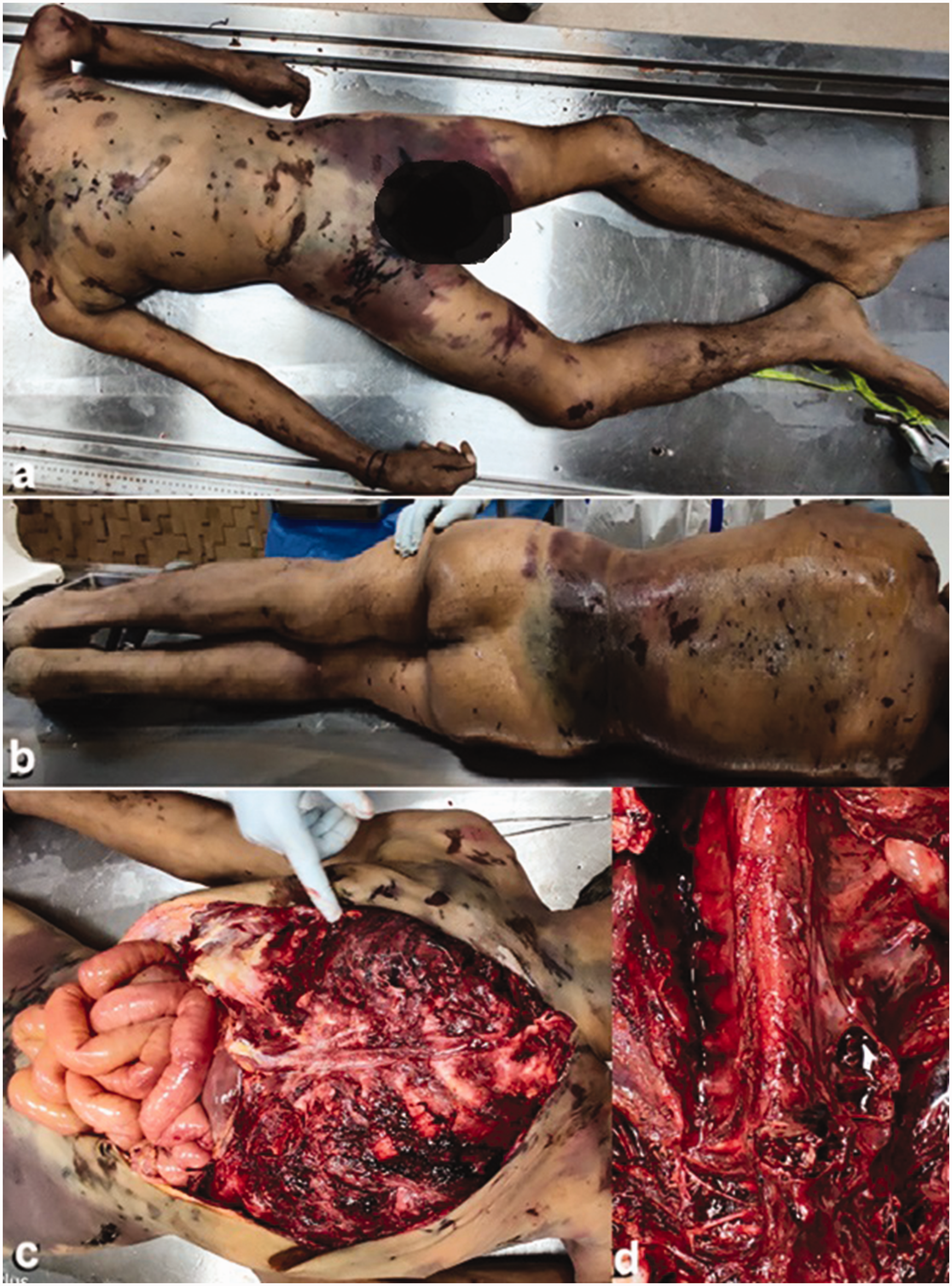
The pattern of injuries in Case 1. (a) Extensive blunt force injuries on the anterior aspect of the body caused by stomping by the elephant. (b) Injuries on the posterior aspect of the body due to stomping. (c) Rib cage fractures and (d) Fracture-dislocation of the D4-D5 vertebral body.
Internal examination revealed multiple linear, undisplaced fractures of the facial bones, along with a linear fracture of the left clavicle and sternum. Comminuted fractures of the rib cage were noted bilaterally (Figure 1(c)), along with a displaced fracture of the upper shaft of the right humerus, as well as comminuted fractures of both pelvic bones and the upper ends of both femurs. Additionally, a dislocation-fracture of the D4-D5 vertebrae (Figure 1(d)) was present, accompanied by spinal cord transection. Subarachnoid haemorrhage was observed in the brain. Multiple lacerations were found on the liver, both kidneys were contused, and multiple puncture wounds were noted in both lungs, caused by fractured rib ends. The pleural and peritoneal cavities contained approximately 600 ml and 200 ml of blood and blood clots, respectively. The stomach contained semi-digested food. Death was sudden, and the cause of death was determined to be shock and haemorrhage resulting from blunt force trauma.
Case 2
A 28-year-old man was found dead along the bank of the Ganga River in the Shivpuri range of Rishikesh. He had been camping in a temporary campsite on the riverbank the previous night. According to local residents, elephants frequently visit the area to drink water. The body was discovered by locals in the morning, who subsequently informed the police. Signs of conflict were present in the area surrounding the deceased, with elephant footprints and fresh dung found near the body.
External examination at post-mortem revealed the body of a male of muscular build, measuring 1.75 m in height and weighing 82 kg. His clothing was torn and stained with dirt and vegetation. The incident occurred in the last week of September 2021. Multiple grazed abrasions and contusions were present on the head, face, chest, abdomen, back, pelvis, genitalia and thighs. A puncture wound measuring 9 cm × 4 cm, penetrating into the peritoneal cavity, was present on the left flank of the abdomen, probably caused by an elephant’s tusk. A portion of the small intestine and omentum protruded through the defect (Figure 2(a) and (b)).
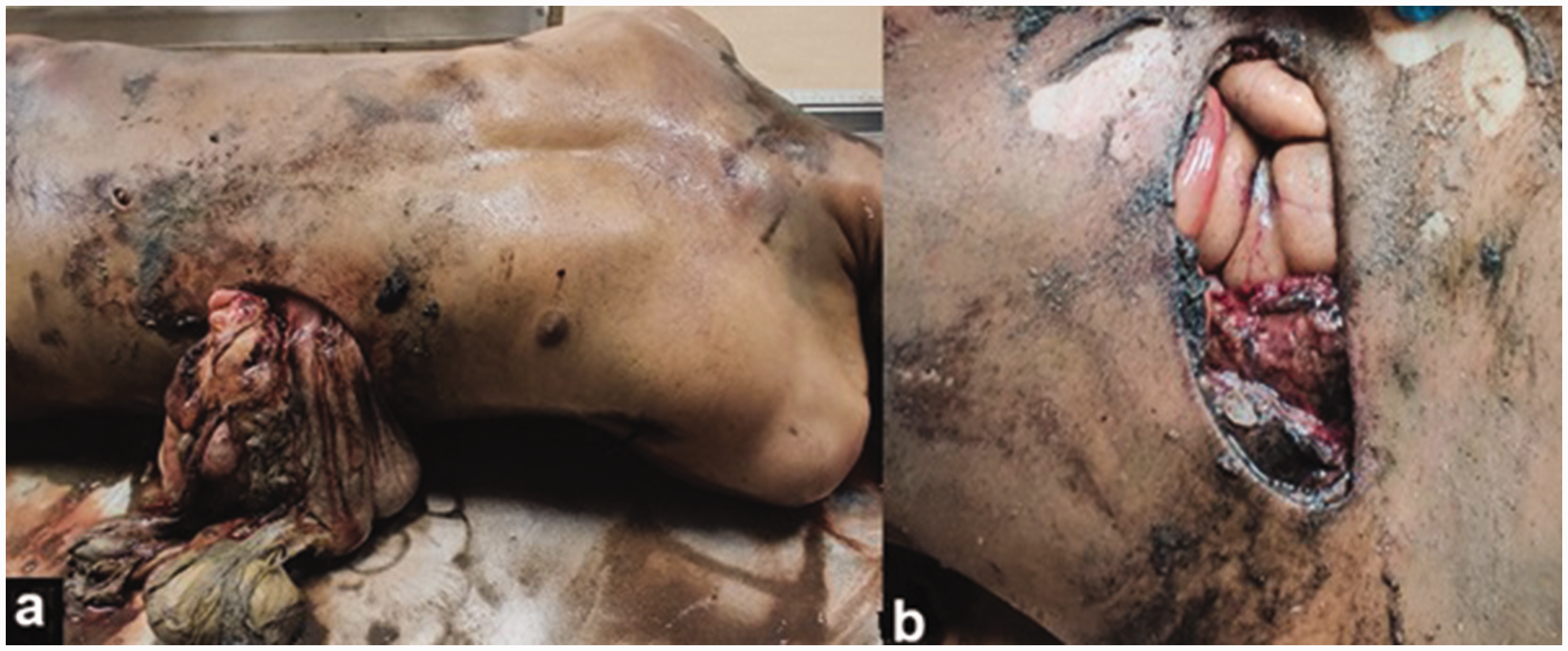
The injuries seen in Case 2. (a) Abdominal viscera protruding out from a penetrating wound caused by the tusk of the elephant. (b) Penetrating wound after repositioning the protruding abdominal viscera.
Internal examination revealed multiple linear, undisplaced fractures of the skull and facial bones, along with comminuted fractures of both clavicles and the sternum. The rib cage showed bilateral comminuted fractures, and comminuted fractures were also present in both pelvic bones and the upper ends of both femurs. Multiple puncture wounds were found in the right and left lungs, caused by fractured rib ends. Lacerations of the liver and contusions of both kidneys were also present. The pleural cavity and peritoneal cavity contained approximately 800 ml and 1,000 ml of blood and blood clots, respectively. Subarachnoid haemorrhage was observed in the brain. The stomach contained semi-digested food. Death was sudden, and the cause of death was determined to be shock and hemorrhage resulting from blunt force trauma and a penetrating abdominal wound.
Discussion
Elephants are large mammals that require vast territories to roam, with access to ample vegetation and substantial water sources for drinking, bathing and socialising. 12 Although elephants are generally peaceful, adult males, particularly during adolescence, can become violent and aggressive at certain times of the year. This aggression is due to physiological and behavioural changes caused by increased testosterone levels for breeding. This period, known as “musth”, lasts for several months and typically occurs in Asian countries during the winter season, from October to February. 13
HEC are common in areas adjacent to elephant habitats, including agricultural fields, travel routes, and locations where human activities encroach upon their natural environment.1,5,9,14 In 2002, Bisht reported that approximately 300 human fatalities in India were attributed to elephant attacks each year, 15 a figure that surged to 629 deaths in 2023–2024 alone. 4 Currently, the rising incidence of HEC is primarily attributed to the close proximity of numerous villages to elephant habitats, with several roads cutting through their territory. The government established a national park sanctuary to create a designated wildlife habitat by implementing boundary structures. However, confining elephants within these boundaries is highly challenging due to their extensive spatial requirements. Additionally, constructing effective barriers in a mountainous region, especially with the presence of the Ganga River, poses significant logistical difficulties.
Most of these incidents are caused by male elephants, often triggered during their musth phase. 1 Other contributing factors to aggressive behaviour include irritation or injury inflicted by villagers, as well as loud noises and music. 9 Female elephants may also become aggressive if they perceive a threat to their young. 12
Both incidents reported in this case series occurred during the winter season, coinciding with the musth period. 5 The victims in both cases were male, and the attacks took place at night when they were alone in areas bordering elephant territory. Similar findings have been reported by other researchers.5,12 In rural regions, people often go to isolated areas near their villages to defecate. Farmers and labourers, predominantly male, frequently work alone in agricultural fields, where most of these incidents occur. 5
When an HEC occurs, the elephant typically first grasps victims with its trunk, throws them to the ground, and then stomps on them. Sometimes, the elephant may fling the victim a significant distance or strike them against heavy objects, such as trees or the ground. Young male victims often show more signs of struggle and sustain more injuries compared to older individuals or females. The most common injuries in such attacks include blunt force trauma to the head or chest, usually resulting from stomping, squeezing, or crushing by the elephant's trunk or feet, and occasionally from being sat upon. Injuries may also occur from the impact of being thrown to the ground.16,17 Male elephants sometimes use their tusks to inflict fatal puncture wounds.10,18–20
There is an urgent need to control HEC and create an environment that fosters coexistence between communities and wildlife. However, managing these conflicts is a challenging task. Educating people about elephant behaviour and raising awareness about handling emergency situations play a key role. Various methods have been proposed to mitigate such conflicts, including barrier approaches such as the establishment of separate ecological zones, national parks, and sanctuaries, as well as the construction of electric fences and boundaries. Other deterrent strategies involve the use of firecrackers and loudspeakers in agricultural fields and villages, along with the relocation of uncontrolled elephants to more controlled environments. In addition to these methods, domestication and increasing awareness within communities about elephant behaviour are essential. 1
Conclusion
This case series outlines the detailed injury patterns associated with wild Asian elephant attacks, with particular emphasis on a rare tusk injury. We emphasise the importance of public awareness, conflict mitigation, and strengthening elephant habitat boundaries to prevent future fatalities, enhance human–elephant coexistence, and support both wildlife conservation and public safety. Farmer communities living near “pocket herds” are especially vulnerable to elephant attacks and should be made aware of these risks, particularly at night and during the “musth” season. Elephants often target vital organs, resulting in fatal injuries from trampling the head, chest and abdomen, though tusk injuries are relatively uncommon.
Footnotes
Acknowledgments
I would like to acknowledge all the senior faculty members and colleagues of Department of Forensic Medicine and Toxicology, AIIMS Rishikesh for their help and guidance.
Declaration of conflicting interests
The authors declared no potential conflicts of interest with respect to the research, authorship and/or publication of this article.
Funding
The authors received no financial support for the research, authorship and/or publication of this article.
Ethical approval
All identifying information has been anonymised to ensure confidentiality. Our institution does not require ethical approval for reporting individual cases or case series.
