Abstract
At its core, project-based learning is based on the idea that real-life problems capture student interest, provoke critical thinking, and develop skills as they engage in and complete complex undertakings that typically result in a realistic product, event, or presentation to an audience. This article offers a starting point for music teachers who might be interested in using project-based learning as a teaching strategy and also interested in “building” student competency and “bringing to life” student engagement in the music curriculum. To help music educators enact project-based learning in their classes and ensembles, we outline a process for designing and facilitating projects, provide vignettes that situate theory in practice, and discuss projects in relation to curriculum, standards, assessment, and teacher evaluation.
Project-based learning can transform a music program by offering genuine student-centered learning with long lasting results. I love the project-based approach to music teaching and learning because it allows my students to engage in music in very meaningful ways. Students in both my ensembles and classes design projects around their interests and explore open-ended questions that get at the core of musical ideas and content. Project-based learning is one of the most student motivating approaches I have ever used. Kids choose on their own to come in at lunchtime, as well as after and before school to work on their projects. Projects allow me as a teacher to touch on all areas of the music curriculum in holistic ways, by integrating performing, responding, creating, and connecting standards throughout. Projects even allow me to get at those hard to teach skills, such as collaboration, critical and analytical thinking, problem solving—which are so necessary for today’s learning and participation in musical culture.
Darryl Kniffen has been doing project-based learning in music ever since he began teaching seven years ago. Kniffen’s advocacy for project-based learning certainly serves to affirm its educational power and viability in today’s music classrooms. However, the current educational climate and circumstances under which teachers work make it difficult for them to feel that they can engage in much instructional creativity. Focus on data-driven instruction, scripted lessons, and top-down decision making, to name a few items, have created huge changes in our classrooms and significant challenges to our professional standing. Even in the face of increased surveillance and de-professionalization, corporatization and standardization, and the fragmentation of knowledge and skills into discrete behaviors for “objective” accountability purposes, 1 nothing prevents us from engaging project-based learning in our music classes and ensembles. We offer a starting point for music teachers seeking to expand their pedagogical repertoire and curricular expertise. By using project-based learning as a teaching strategy and building student competency, teachers can bring to life student engagement in the music curriculum. We also offer a rationale and a basis for enacting music programs that address students’ musical and creative lives in a comprehensive approach that has a long and illustrious tradition in American education.
Project-Based Learning
At its core, project-based learning is built on the idea that real-life problems capture student interest and provoke critical thinking and develop skills as they engage in and complete complex tasks that typically result in a realistic product, event, or presentation to an audience. 2 Scholar John W. Thomas describes project-based learning as (1) central to the curriculum; (2) organized around driving questions that lead students to encounter central concepts or principles of a discipline; (3) focused on a constructive investigation that involves inquiry and knowledge building; (4) student-driven, in that students are responsible for making choices and for designing and managing their work; and (5) authentic, by posing problems that occur in the real world and that people care about. 3
Vignettes
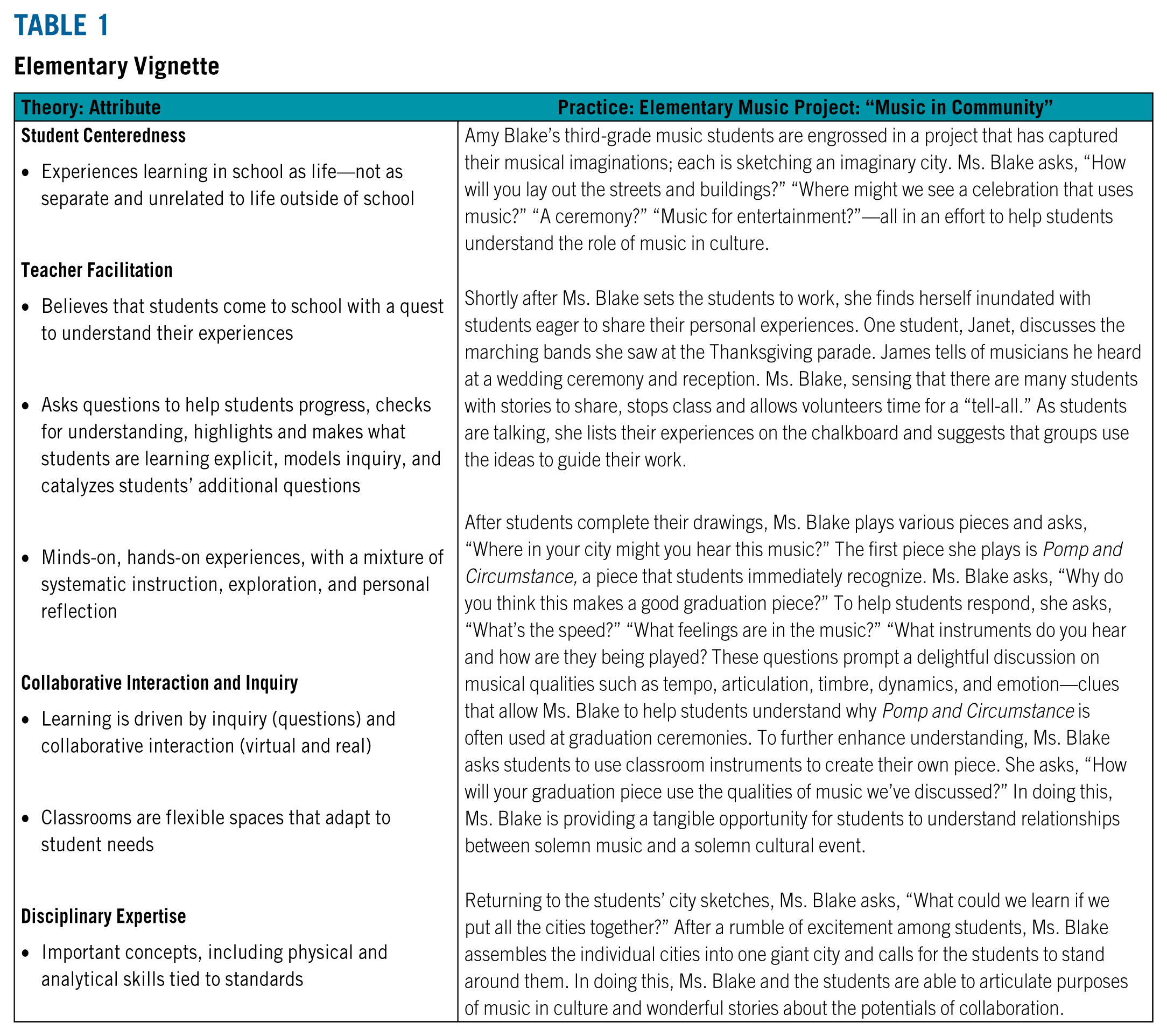
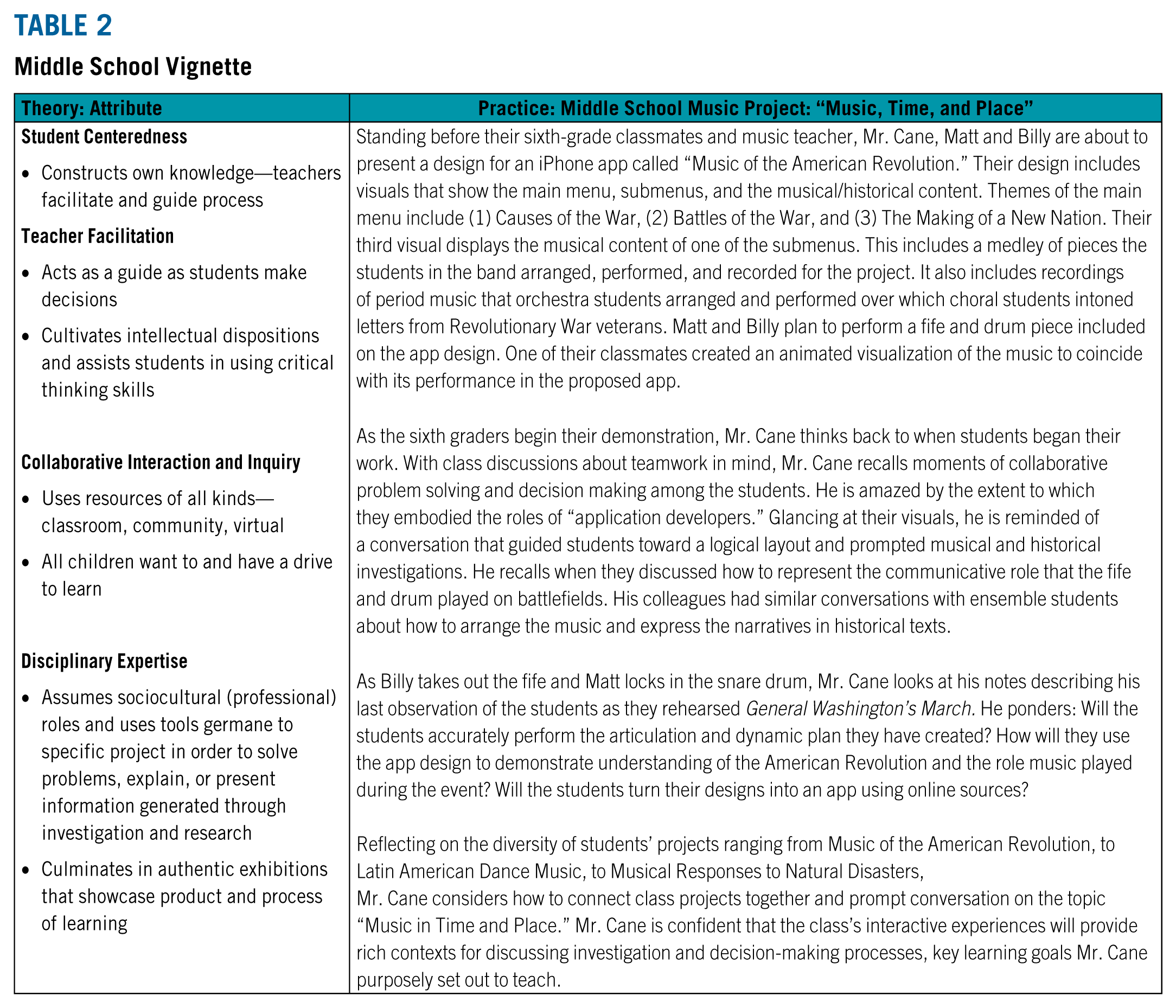
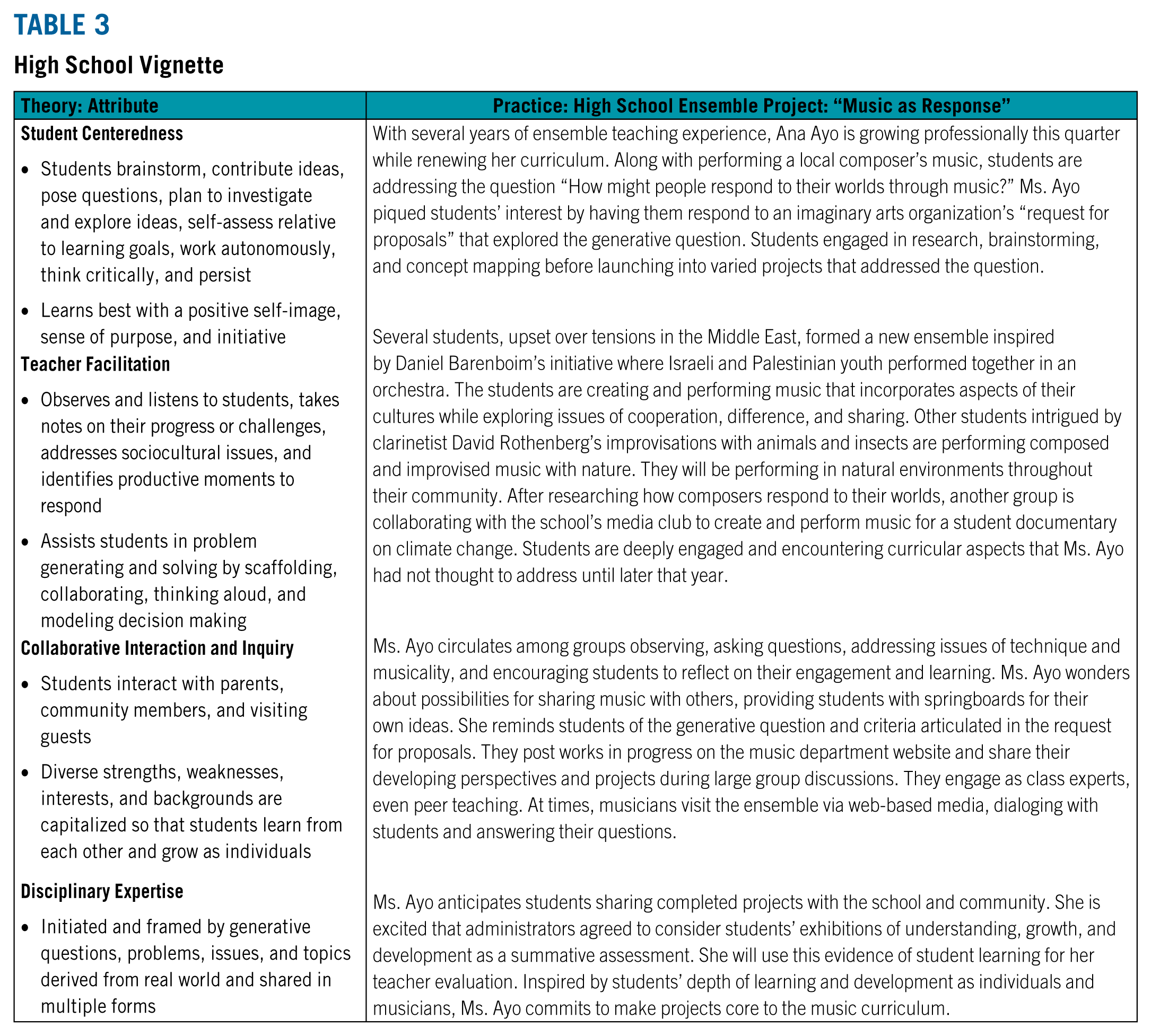
As a device to show how educational theory and pedagogical principles are embedded in project-based learning, we have created three vignettes (elementary, middle school, and high school; Tables 1–3, respectively). These vignettes illustrate four attributes of well-designed and well-taught projects: (1) student centeredness, (2) teacher facilitation, (3) collaborative interaction and inquiry, and (4) disciplinary expertise. The left side of the table illustrates key pedagogical ideas and practices associated with each attribute. The right side of the table shows what these pedagogical ideas and practices might look like in an actual music project. Although we show specific ideas and practices attached to each vignette, there is considerable crossover of ideas and practices among the three vignettes. Consider reading the attributes first and then identifying how they live out in the practices.
Elementary Vignette
Middle School Vignette
High School Vignette
Background
The proliferation and dissemination of project-based learning in the public schools during the twentieth century is often attributed to William Heard Kilpatrick and John Dewey. 4 As with most teaching innovations, project-based learning emerged out of a desire to rejuvenate education. At the time of its initial formation in the United States in the late nineteenth century, there were social, economic, technological, and cultural rationales calling for reform focused on invigorating and modernizing public education. Chief among these reform calls were greater participation in democracy and connecting academic studies of school to social and economic processes and forces found in work and life. These same rationales exist for its reinvigorated presence.
A review of professional writing in Music Educators Journal over the past hundred years reveals a large number of articles devoted to projects. 5 Most of these articles substantiate James Mursell’s 1932 assertion that “music education must proceed in and through musical projects.” 6 In other words, “doing a project” has a long-standing tradition in American music education. Curiously, however, the same review unearths only a handful of articles that provide historical and/or theoretical frameworks used to design projects that include the defining characteristics of project-based learning. 7
Today, project-based learning and its design draw its educational rationales from the “cognitive revolution” in learning theory beginning in the latter half of the twentieth century 8 and the revitalized thinking about skills for the twenty-first century, 9 standards that emphasize critical thinking, and inquiry-based learning. Differentiated from (although complementary to) teaching approaches that use behavioral instruction (i.e., following directions, behavioral objectives, task activities, or rehearsal strategies), project-based learning is firmly rooted in a framework of learning principles drawn from constructivist, social constructionist, and situated learning theories.
Designing Project-Based Learning
Realizing the full potential of projects in supporting students’ curiosity and problem solving requires thoughtful design and preparation. Attention to structure, topic selection, context, questions, critical thinking, dispositions, scope, and the nature of the experience inform how a project unfolds over time.
Structure and Design
The design framework we present suggests that what some people call “projects” we might describe as activities, tasks, or rehearsal strategies. We conceptualize projects as carefully planned sets of interrelated learning experiences built on substantive disciplinary ideas that involve inquiry and musical engagement, often emergent out of student learning needs or interests. The five features that Thomas uses to describe project-based learning 10 are central to any conception and facilitation of projects or project work.
To begin, music teachers might want to think about the instructional choices available to them, including their varying degrees of focus, intent, and scope. Figure 1 shows a continuum of teaching and learning options for music classes and ensembles—with single-focused activities at one end and open-ended projects at the other. Although projects provide rich contexts for musical learning, projects typically do not constitute the whole educational program. 11

A Continuum of Teaching and Learning Options
Excellently designed projects (whether thematic, blended, or open-ended) require structure and a solid understanding of human learning processes. They also require significant upfront planning that includes timelines and management strategies that take into consideration the uniqueness of specific schools and classrooms. A basic framework for designing projects includes (1) choosing a worthy topic, (2) finding a real-life context, (3) creating generative questions, (4) developing critical thinking and cultivating dispositions, (5) deciding the scope, and (6) designing the experience.
Worthy Topics
Choosing a topic is a serious consideration because it serves as the springboard for subsequent teacher planning and student learning. Worthy topic ideas can come from anywhere—current events, issues, professional or scholarly readings in music, or even the students themselves. For example, state or national arts standards provide a set of musical processes and questions that can form the basis for projects. Authors’ texts such as Alan P. Merriam’s The Anthropology of Music 12 and Andrew H. Gregory’s “Musical Roles in Societies” 13 offer descriptions of how music functions in society and have implications for how the personal and social aspects of music relate to students’ own lives. 14 Reimer’s musicianship roles 15 and Tobias’s possibilities of student engagement with music 16 also offer ideas on how students can engage in and study musical thinking and artistic processes more deeply, and they connect to the importance of situating learning in substantive disciplinary and students’ real-life contexts. Themes such as “Music in Time of War” or “People, Politics, Patriotism, and Music” also have great potential to engage students in important and big ideas in musical understandings. 17
In short, topics that encourage students to think imaginatively about music and develop skills as a component of artistic inquiry are likely to be of student interest, have long-lasting value, and meet curriculum requirements. As a point for all curriculum design in music, researchers Mark Robin Campbell, Linda K. Thompson, and Janet R. Barrett suggest that music education experiences be assessed as to their generativity (the extent to which experiences generate additional experiences by creating a need to know), vibrancy (the extent to which experiences are both minds-on and hand-on), and residue (the extent to which experiences provide a positive and affirming sense of achievement). 18 Whether used individually or collectively, these criteria can help music educators prioritize and make decisions as to the extent to which a project topic and the activities that grow out of it are likely to be musically educative, regardless of the duration or scope of a project.
Real-Life Context
Think about the sociomusical and cultural world in which we live. What is the range of roles people play in music? What do they do? Performers, listeners, songwriters, and critics, for example, approach their work in similar but different ways. All have a set of fundamental musical problems they must address and try to solve, and it is engaging in those problem-solving processes that unlocks the door to musical understanding. Situating a project in a real-life context brings both vividness and authenticity to students’ learning and introduces them to what educational theorists Jean Lave and Etienne Wenger call a “community of practice.” 19 For example, imagine how performers in a mariachi band approach their work—imagine them practicing, building repertoire, booking gigs, and marketing their work. Or consider how ethnomusicologists investigate musical practices and musical aesthetics within a specific community—imagine them deciding which tools to use, gaining insider information, checking the accuracy of their information, and deciding how to represent their findings. Planning for real-world engagement in a project helps situate learning in a sociomusical and cultural context. It also helps students see themselves as potential participants and contributors to different musical practices.
Questions
Generative questions lie at the heart of project-based learning and frame students’ learning throughout an entire project. What are generative questions? They are questions that are open-ended, not easily solved, and have the capacity to generate multiple pathways for student learning. Generative questions (also called driving or essential questions) encourage students to think deeply, to think across subject matters; they create a need to know and provide a relevant and meaningful context for learning. 20 Consider how students’ engagement changes when provided with questions that help them see connections between music as a discipline and their own lives. Consider, on the other hand, a question that is primarily factual, such as “Who composed ‘The Battle Hymn of the Republic’?” While important for ascertaining a specific response, its capacity to generate sustained inquiry, provoke thought, engender lively discussion, or analyze music in time in place is limited. Similarly, the question, “What scale or mode is used in this piece?” may be important for information recall, but it will not likely lead to students asking more questions or engender deep thought about musical structure.
When designing a project, try capturing its essence in one or two generative questions. For instance, consider a project focusing on music in the community such as the one described in Table 1. Generative questions might include “What roles might music play in community?” and “How might musical expression connect with or relate to community events?” Also consider providing students opportunities to articulate their own generative questions that might contribute to a project.
Critical Thinking and Dispositions
Critical thinking and the cultivation of intellectual dispositions are key elements to be considered in designing a project. Think about how you want your students to use their minds. Consider how you would create learning problems that tap into students’ abilities to think critically—to be analytical, explanatory, and interpretive. Decide how you would cultivate a student’s curiosity, wonderment, persistence, regard for evidence, or excellence in work. Consider how your project could have students:
explore a musical issue or develop a skill from multiple perspectives;
learn how to ask pertinent questions or make informed decisions;
determine how parts and wholes are related or compare, contrast, and predict;
identify “blank spots” in their musical skills or be playful and engage in wonderments;
gather and synthesize relevant information into solutions or articulate findings from research;
combine knowledge and skills across disciplines or play a role in local or global needs.
Scope
Considerable practicality must be given to deciding the scope of a project before carrying it out. Some reflective thought might help you answer the following questions when thinking about both the depth and breadth of a project: How ready are the students for project-based learning? How comfortable am I with it? How can I work with the existing school schedule? Investigations, field trips, time for practice, working with technology and digital media, involving community members, along with assembling materials and planning for end-of-project sharing and show-and-tells take time. Sometimes a short two-week project focused on a single topic, such as learning about the dances in a dance suite, can be sufficient. Other times, a more ambitious project lasting several months that involves multiple teachers, several standards, and extensive technology, such as responding to, creating, performing, and connecting dance music from around the world, will be necessary.
Design the Experience
Sketch out in narrative form what the project is. Include the key concepts, skills, and generative questions used to frame the project. Describe the context and activities that students will be doing. Visualize and indicate how students will share their learning and how they will represent their skills, findings, products. Articulate the ways that they might engage with music. After you sketch out the project, focus on the kinds of experiences that students are likely to undergo. That is, think like a director of museum education for a moment. How do places like San Francisco’s Exploratorium, Washington, D.C.,’s Smithsonian Institution, Chicago’s Field Museum of Science and Industry, or Phoenix’s Musical Instrument Museum draw visitors to their doors? 21 They all use marketing and motivational tools such as engaging titles that convey a sense of importance and specialness as setups. They provide grabbers in their descriptions of events and activities that provoke interest, make an emotional connection, or curate things in ways that seem novel. Some might refer to this as designing experiences.
Education scholar Kurt Squire explains how a video game “provides a set of experiences, with the assumption being that learners are active constructors of meaning with their own drives, goals, and motivations. Most good games afford multiple trajectories of participation and meaning making. Content is delivered just-in-time and on demand to solve problems.” 22 Music educators can plan projects in similar ways by creating opportunities for students to have certain experiences but leaving the plan or design open enough for “multiple trajectories of participation and meaning making.” 23 Setting up your project using these techniques can make your students feel like they will enjoy and learn something by engaging them in what the project has to offer.
Situating Project-Based Learning
Situating project-based learning within and across the curriculum requires attention to issues ranging from addressing standards to cultural relevance. By reflecting on issues related to learning, educators can engage in project-based learning while satisfying expectations related to assessment, evaluation, and accountability.
Curriculum, Standards, and Cultural Relevance
It can be thrilling to observe how aspects of one’s curriculum emerge organically from students’ musical engagement and conversations in projects. This occurs when providing students space to uncover or discover ideas and ways of being musical. 24 However, music educators may need to navigate through preset curricula or policies that challenge the emergent nature of project-based learning. 25 Challenges such as these can be treated as opportunities to engage as curriculum designers. 26 This includes reframing mandates or curricular structures that seem prescriptive to be more open-ended and conducive to project-based learning. This may also include infusing the cultural backgrounds of students and the sociocultural context of a music educator’s school setting throughout a project so as to create bridges between students’ home and school lives. Educators might even design projects that address sociocultural issues and help learners engage with music through critical inquiry. 27 Similarly, designing projects also provides educators with opportunities to examine curriculum with a critical lens and consider potential assumptions or biases.
Reframing curriculum images toward more project-based learning could begin by emphasizing anchor standards as contrasted with performance standards. Student learning objectives that focus on discrete behaviors or predetermined tasks might be recast in ways that emphasize musical understanding or how students demonstrate musical decision making. Project-based learning empowers educators to design their own curriculum and even co-generate projects with students in place of implementing preexisting or corporate-produced curriculum. Educators might also consider the types of pedagogy that are most resonant with project-based learning by embracing student centeredness and facilitating learning, collaborative interaction, and inquiry to help learners develop disciplinary expertise. This may feel different from instruction strategies that are more teacher-centered and emphasize direct instruction, task completion, and content acquisition. Addressing curricula and policies in such ways while balancing approaches along the continuum outlined in Figure 1 can help support comprehensiveness.
Assessment and Teacher Evaluation
Project-based learning provides countless opportunities for assessing and providing evidence of students’ growth and learning. Similarly, project-based learning invites assessment for learning in addition to assessment of learning. 28 Although this can include summative measures of accountability, project-based learning encourages students and educators to consider the role of formative assessment in supporting learning. 29 This means providing ongoing feedback and including self-, peer-, and teacher-led assessment throughout projects. Just as educators engage in ongoing reflection in terms of how projects are proceeding and what students are learning, they can encourage students to be reflective of their own musical engagement and learning.
Music educators might also position projects as components of teacher evaluation systems. For instance, projects might serve as summative or “cornerstone” assessments that demonstrate students’ growth and learning in real-life contexts. Music educators can also abstract components of projects as “performance tasks” if needed. When necessary, music educators may draw on teacher- and student-generated rubrics to translate students’ growth and learning in projects to quantitative data. Situating projects as forms of assessment that are connected and contextualized may stand in place of completion tasks that are used for the sake of assessment measurements or accountability.
Making It Happen!
Maxine Greene suggests that a primary goal of education is to “release” or “educate the imagination.” 30 A balanced combination of projects and systematic instructional approaches (as outlined in Figure 1) might help music educators achieve this goal while helping students develop musical understanding and skills. While projects provide rich contexts for musical learning, projects typically do not constitute the whole educational program. 31 When making pedagogical decisions, we might consider the degree to which the approaches we use (1) support the flexibility required for independent musical thought and engagement; (2) promote students’ inquiry, curiosity, and investment in their own education; (3) help students develop musical understanding and skills; and (4) afford evidence of students’ growth and learning. Reconceptualizing our classes and ensembles with this balance in mind can inform when and how we integrate project-based learning. Additionally, a culturally relevant pedagogy that “helps students to accept and affirm their cultural identity while developing critical perspectives” may help music educators facilitate projects in a comprehensive manner that accounts for students’ diversity. 32 As a starting point toward teaching music through projects, consider the steps outlined in this article and addressing the following questions:
Where might projects complement or modify current teaching approaches in my classes or ensembles?
What aspects of my curriculum might be addressed through project-based learning?
What types of generative questions might my students be interested in and lead to engaging musical projects?
Who might I collaborate with to help with designing and facilitating projects?
Our pedagogical choices reflect our values and beliefs about the role of education in young people’s lives. Including projects in our classes and ensembles demonstrates value for providing learners with opportunities to think critically, engage with music imaginatively, and approach the world with curiosity. How might project-based learning bring your curriculum to life?