




Abstract

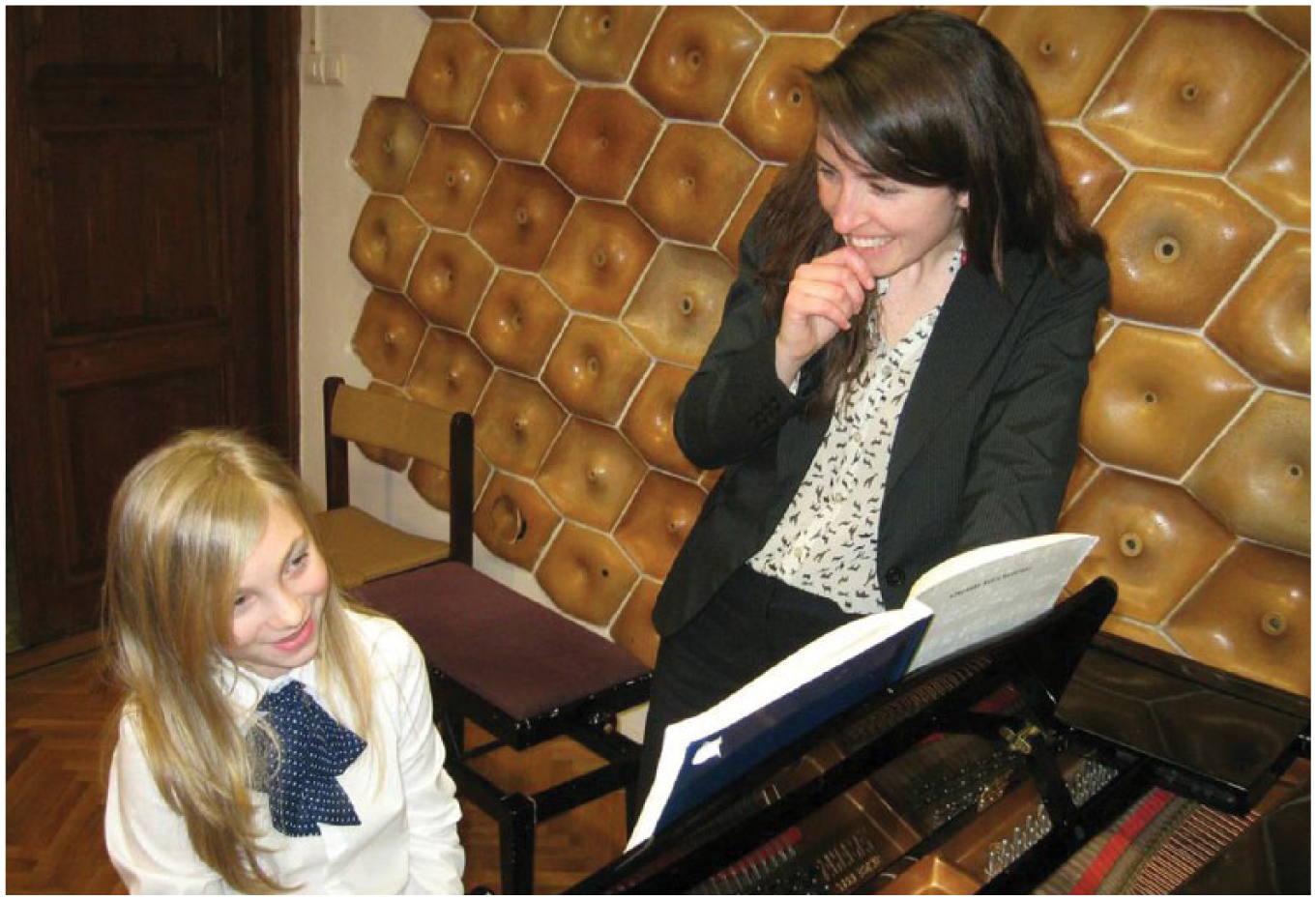
Photo of Kamilla Takacs and Theresa Chardos Camilli by András Körtesi.
Music education deserves a place in every student’s life. This belief is common in Hungary, where students are provided ample time to learn a chosen instrument. Hungary, comparable in size to the state of Indiana and with a population the size of Michigan, has approximately 700 registered community music schools offering a spectrum of music education experiences from moving and singing with music to private instrumental lessons. Hungary also has fourteen high school academies that accept students based on the results of an audition. However, the greatest assets to the Hungarian Music Education system are its many teachers. Like composer and ethnomusicologist Béla Bartók, who himself was a devoted pedagogue, Hungarian music educators spend considerable time with their students.
I spent most of my time in Hungary (February 2014) visiting and teaching in Pécs, a town of 160,000 that has a High School Performing Arts Academy and eleven music schools located in communities across its sixty-three square miles. The Pécs High School Performing Arts Academy (for students 14–18 years of age) is unique in that it also contains art, dance, and theater divisions. The population comprises some 334 students in all departments. The music division has 114 students and about 60 teachers (many of whom are part-time). Why so many faculty? Because each student receives at least three private lessons a week, theory/solfège classes, music history classes, literature classes, and common core education (math, science, etc.). Students who are not from Pécs or the immediate community board during the week and see their families o…n the weekend.
In the Pécs Franz Liszt Music School that I also visited, there were more than 700 students enrolled, ages 6 to 14 (sometimes up to 22 years old). According to standards required at all Hungarian community music schools, each teacher must hold a degree on the instrument he or she teaches. For example, a violin teacher cannot also teach cello. Their students each receive two weekly lessons, typically thirty minutes in length, unless the student has been given increased lesson time to prepare for Academy entrance. Two 45-minute solfège classes are also taught each week, as if a reminder were needed that Zoltán Kodály was Hungarian. At the Franz Liszt Music School (the oldest music school in the Pécs community), solfège lessons include theory, basic music history, harmony, some elements of form, some writing, and lots of singing and music listening. Instrumental/vocal group lessons do not exist in Hungary.
Throughout my time in Hungary, I found teachers who only emphasized the standard classical repertoire, teachers looking for alternative pieces to break from this canon of piano literature, teachers seeking strategies to motivate their students to practice, and teachers whose students had parents who ran the gamut from supportive to absent. Yes, we had much in common. But our approach to time was different. Teachers spent more time with students, resulting in students being able to declare their vocation early in life. Students who desired a musical career focused on entering a high school music academy. Those not accepted to one of Hungary’s fourteen competitive high school academies could continue learning in music schools if they chose to do so.
I can’t argue that this focused leveling and filtering system produces more musicians, but rather, it appears to produce a younger accomplished musician, even with six to eight years old being the national average age of starting instrumental training—hardly what Americans would call an “early” introduction.
Attending the High School Academy does not bind a student to a musical career. There is always room for students to change their minds and choose a new vocation to study at the university. But if the student remains committed to music, there are five universities and the esteemed Franz Liszt Academy in Budapest that offer training for future instrumental teachers and performers.
Certainly the amount of training Hungarian children receive, regardless of whether they desire to obtain university-level education, helps to cultivate a musical society. A Fulbright colleague at my university offered the idea of teaching music appreciation during his year in Hungary, but few institutions were interested. He learned that the society already appreciated music and that people didn’t need a class devoted to the topic.
In addition, every level of education is sponsored by the government. The music school and high school students pay a tuition that is basically a symbolic contribution as it does not even cover the total tuition cost. The government offers a significant per-student subsidy for art and music education. This is why students older than twenty-two are not accepted into the music school or high school programs. University education is free to a limited number of students. University students who do not receive a fee-free education take out loans to cover the cost of their studies.
Hungarians put time and other resources into what they value—music education. Developing a society whose members are appreciative of the arts and whose musical students flourish are the nation’s outcomes. If we too find value in increased lesson time, group theory experiences, additional performance opportunities, composition classes, or any other pedagogical focus, it is our duty to impress on parents, administrators, and students the necessity of more engaged participation. The Hungarians remind us that high-quality learning takes time.