




Abstract

Photo courtesy of the author.

Online technology has changed the job application process significantly in recent years. Although the customary hard-copy cover letter and résumé are still necessary when applying for some positions, these items are now often required to be in digital format. Employers are increasingly involved in online applicant screening. Not only can they view the candidate through the digital documents submitted, but they often peruse social media sites to learn more about the individual in question.
Many employers immediately do an Internet search for a candidate’s name to see what background information (good and bad) can be obtained. In many instances, this is the qualifying factor that will exclude a candidate immediately from a job search. A study by Microsoft found that 70 percent of human resources recruiters in the United States indicated that they rejected candidates for job positions because of reputation information they found online. Additionally, 79 percent of U.S. recruiters indicated that they reviewed online information as part of the hiring process. 1
For music education applicants, online identity provides a golden opportunity to present their wares using visual and audio media via the Internet. By tailoring online application materials to the desires of potential employers, job seekers have a better chance of being selected for a specific position. Developing an online presence is vital in today’s market for advertising your teaching skills and successfully obtaining a job that matches your qualifications.
Employer Expectations
What qualities do supervisors of music want as they observe online application materials of music teacher applicants? Using the “Best Communities for Music Education List” (developed through the NAMM Foundation), I attempted to determine some of these qualities via an unpublished research study. The subjects surveyed were public school music supervisors; I sought their observations/suggestions as they screened online applications for music education vacancies to select successful candidates. Sidebar 1 shows some of their responses to the question “What is the most important suggestion you would give to a music education applicant to make the online application so attractive you would say ‘WOW I will hire you!’?” Sidebar 1 shows the responses that were received from respondents to this study.
Sidebar 1
Strong videos on YouTube of performances that illustrate musicianship. A video of conducting would be highly valuable. A teaching video also would be useful.
An online presence via YouTube or a website dedicated to the applicant is very valuable.
Files that are not too large and open up correctly. Include information that supports what you are doing now and why you want this position.
Attention to the requested details. Follow procedures exactly.
Technology skills and expertise as exemplified by a high-quality e-Portfolio.
Illustrate your strengths in the classroom.
Fill in the required information with care—no typos or missed spaces.
Develop a mock-up of the information required and save this as a separate document. Scrutinize and correct your material for correct grammar, spelling.
Have another person look at your materials before you send them to a prospective employer.
Note the mentioned importance of applicant online image as mentioned by supervisors. For your own verification, run a search online of your name and see what you come up with. You might be surprised to discover the nature of your current Internet presence!
Avenues for Web Image Development
The saying “a picture is worth a thousand words” has real relevance to the online application process. With hundreds of applicants for some positions, a positive first impression can significantly assist in “getting the gig.” There are many ways to develop an online image. One of the best is creating a webpage on which you can place video, pictures, performance files, and support documents that can be quickly viewed by a potential employer. This “e-Portfolio” will be an asset as you apply online as the employer can immediately see your background and abilities.
Why an Online Application e-Portfolio?
By simply providing a web address for the e-Portfolio website in a cover letter or on a résumé, those applying online or in a traditional manner can provide potential employers with a unique multimedia experience that offers immediate visual/aural reinforcement of the applicant’s musical, personal, and educational qualities. A reviewing evaluator can quickly copy and paste the e-Portfolio web address for review. The effect is immediate: Pictures, short musical examples, a résumé, your teaching philosophy statement, and the performances of students are available for instantaneous scrutiny. Links to YouTube and SoundCloud performances can be provided as well, and the cost is minimal. The applicant can illustrate his or her organizational facility with information in addition to demonstrating knowledge of technology.
Many college music programs include online portfolio development support within the music curriculum. Penn State University provides guidelines for music education majors to develop a web-based music portfolio for online support possibilities (see https://music.psu.edu/musiced/e-portfolio.html for specifics and good student examples of how to develop such a site). More ideas are found in Sidebar 2.
Sidebar 2.
Social Media Online Support
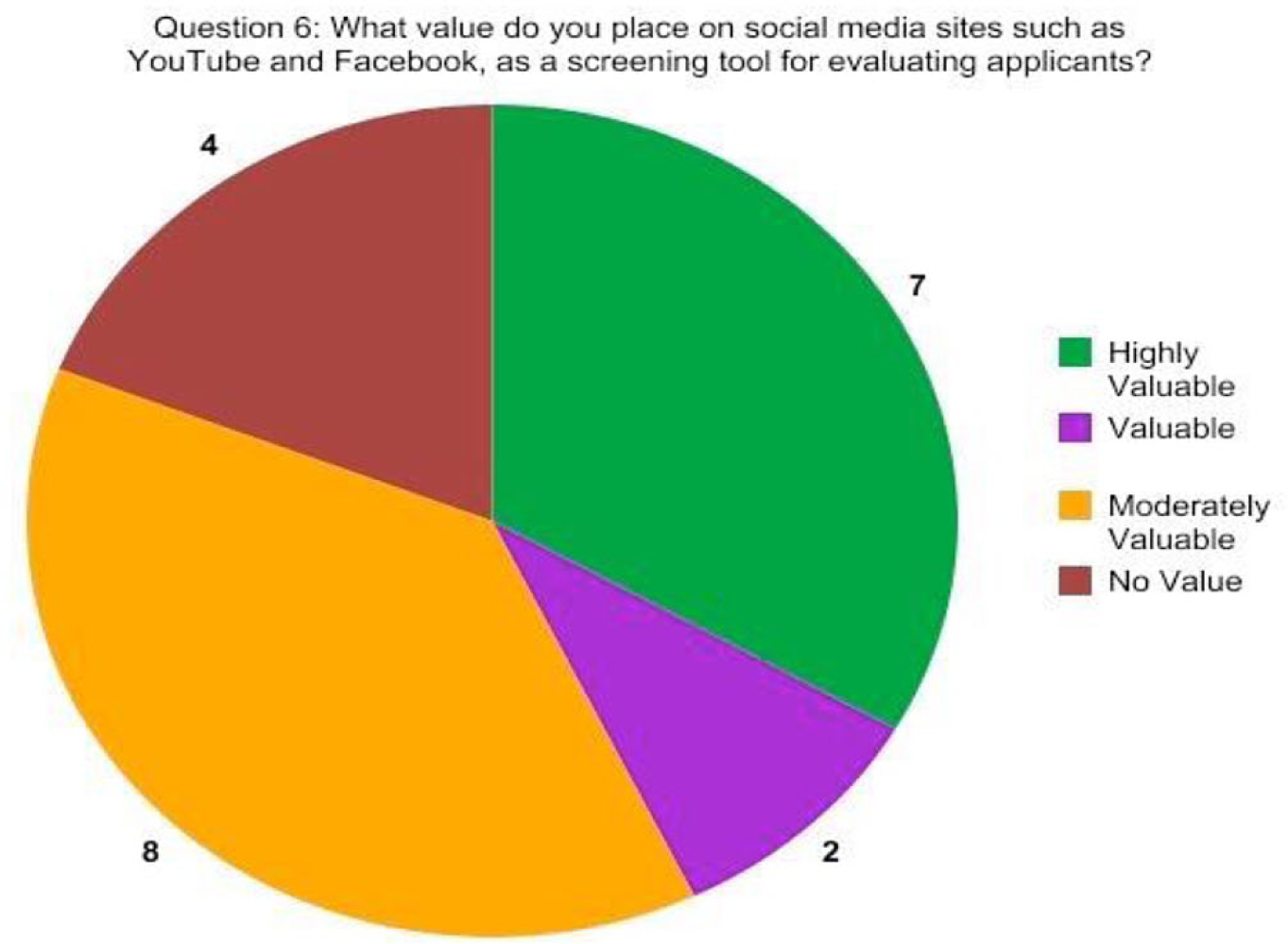
Many search committee members immediately look to social media sites for background on the candidate. Twitter, Facebook, and YouTube are sites for consideration. (In my study, only four people in my sample of twenty-one saw no value in these sites for assessing applicants. 2 See Sidebar 3 for a breakdown of responses.)
Be very careful what you place on the Internet. Your posts can be two-edged swords in supporting your opportunities for employment. What you view as supportive may be offensive to some prospective employers. It is a good idea to have someone else look over your posts before you put them up.
Facebook is an extremely popular site, and many employers approach this site first to search for background on an applicant. Alison Doyle, a job-search and employment expert for About.com, provides good advice as to the pros and cons of social media site support via Facebook for networking, as she indicates:
If you do decide to use the social networking sites for professional networking, and, a word of warning, some experts I spoke to suggested that Facebook and business don’t mix well, here are some suggestions on how best to utilize it:
First, make a decision whether to keep Facebook social or expand your use.
If you decide to use Facebook for professional networking, take a close look at your profile and decide what you want business contacts or prospective employers to see—and what you don’t.
Create a simple profile (or clean up with your existing one) with minimal graphics and widgets.
Limit the photos you post.
Post content relevant to your job search or career. 3
Hyper-Résumé/Hyper-Cover Letter
A potential employer can quickly see you in action from a hyper-résumé or hyper–cover letter. Once you have developed an e-portfolio or site that has a visual representation of your background, you can include numerous hyperlinks in your cover letter and résumé to locations on the e-Portfolio page. You might include links to performance clips, letters of reference, presentations, transcripts, certifications, and students’ or principals’ evaluations of your teaching.
Hyper-Cover Letter Brevity
Your digital cover letter should be one page and specific to the duties mentioned. Is there some aspect of the district that your abilities would enhance? Definitely mention this if applicable. Keep this letter short and direct. Find out who the director of personnel or chair of search committee is and include that individual’s name in the greeting. This is more professional than a “Dear Director” or “To whom it may concern” salutation. If you have state teaching certification, make sure that this is mentioned as it is an important quality for many positions.
Research the Job and District Online
Use the Internet to study the school district’s music program in depth to learn about aspects of the program and what you might bring to the program. Take a look on school websites to learn about music teacher backgrounds, concert activities, and shared school music duties.
Based on your research activities, redevelop your résumé and cover letter specifically to focus on the position and district to which you’re applying. (You might indicate at the top of the résumé: “In application to the ‘music position identity’ at ‘name of the district.’”) The résumé looks customized, and you illustrate a higher interest in the position. Focus your abilities to the job requirements. Conventional wisdom is that the initial scan of a résumé is approximately fifteen seconds. Specific opening headings that are directly relevant to the position you’re applying for will aid immeasurably in your being considered or further evaluation. (See Sidebar 4 for more tips on creating good résumé and cover letters.)
Sidebar 4.
Microsoft Office allows for download of templates that you can use for basic résumé development. https://templates.office.com/en-us/Resumes-and-Cover-Letters
Résumé-Writing Tips—Great site from About.com for “Top 10 Résumé-Writing Tips.” http://jobsearch.about.com/od/résumétips/tp/résumétips.htm
SMARTRésuméWizard—paste in information to create a résumé. https://www.resume-now.com
Résumés, Cover Letters, and Employment Related Letters—Comprehensive site related to job correspondence. http://jobsearch.about.com/od/résumés/u/résumésandletters.htm
Powerful Cover Letter Brochure (PDFs)—Great document from Montana State University, Billings Career Services. Valuable information for developing and assessing your application cover letter. http://www.msubillings.edu/careers/PDF/Powerful%20Cover%20Letter%20brochure%206.pdf
Microsoft Résumé and Cover Letter Templates. http://job\search.about.com/od/coverlettersamples/qt/microtemplateco.htm
Sample Request for a Letter of Recommendation. http://business.lovetoknow.com/wiki/Sample_Request_of_Letter_of_Recommendation
Request Reference Letter Format. http://jobsearch.about.com/od/referenceletters/a/reference-request-email.htm
Reference Letter for Employment Example and Tips—Superb information for writing a letter of reference and tips for effective development. https://www.thebalance.com/reference-letterfor-employment-example-and-tips-2058720
The Online Reference
An important new direction is the online reference request from employers as you apply for a position. Many schools and businesses use computerized e-mail reference request software that automatically submits a request to your references for a reference letter. Before you include the name of a reference in your online application, ask the person for permission to list his or her name. As imagined, such requests can become quite time-consuming if you are applying to numerous positions, so make sure you obtain approval from your references. Obtain the e-mail address that your reference-providers wish to use for this purpose and ask these individuals to develop a short reference that can be pasted into e-mail if the employer you are applying to automatically requests a reference. Make sure that your references know that they might receive e-mail from specific potential employers so they do not dismiss these requests as spam. As a convenience, you may wish to have your confidential letters saved through an online central source such as Interfolio Dossier (https://www.interfolio.com/dossier/). Your references can submit their letters one time, and then you can indicate to what potential employers you wish to have the compiled folder sent either in hard copy or electronically.
Developing the Best Reference
What will your references say about you? What are the strongest qualities that your employer/supervisor see in your work performance? What are your main strengths in communicating with people? What are your “in-front-of-group” strengths? Your personal attributes? Your personal weaknesses? Find out! Ask your parents, colleagues, college professors, and principal. Note these strengths and weaknesses, especially from references who are going to write for you. Mention these qualities in your application procedures. It is very helpful that the same information can be supported by two different sources—your references and yourself—when a potential employer inquires about your attributes. The effort that you expend in follow-up with these individuals will pay off hugely if you get the job. Check out Sidebar 5 for more ideas on this score.
Sidebar 5.
When Requesting a Letter of Recommendation
Remind the person of who you are.
If the letter is to be sent confidentially to a specific person, provide the address and due date.
Indicate some things that the recommender might include in the letter.
A “To Whom It May Concern” letter can be written for your placement file and sent to a placement office through your university or an independent placement office such as Interfolio Dossier. You might also request that a copy of this letter be sent to you for your e-Portfolio.
Be sure to check with the individual before you offer him or her as a reference and get a hearty indication of support before you use the person’s name.
Sending Your Files
It is critical that you provide files that are operational and documents that reflect high-quality writing. Before sending an application file to a potential employer, send this file to a friend or person you know in administration to make sure the file will open correctly and is not corrupted, and most important, ask for impression feedback! Listen to this and revise accordingly! As you apply online, make sure you provide all the requested information and fill out the required specifics in the boxes provided. Currently, many applications are initially screened to determine the completeness of the information requested and required. Your submission may be immediately excluded if the information required is not provided.
Transcript Modification with Blackout Techniques
If you are requested to provide nonofficial transcripts and are squeamish about including your Social Security number or date of birth, you can blackout this information by using photo software and masking the information on the transcript from view. You can indicate to the potential employer your reason for doing this and that you will send the information immediately upon request.
Identity Theft through Online Job Application Procedures
Be aware of scammers who e-mail you requesting confidential information for potential jobs. Sometimes this can happen if you have been applying to job lists that deal with education positions and your name has been included on a job-listing site. Before sending anything of a confidential nature (Social Security number, driver’s license identification, date of birth), make sure that the job is legitimate and the site reputable.
Follow-up
Beware of excessive telephone calls and e-mails requesting your status. If there are thirty applications for a position, that means there is a potential for thirty calls/e-mails to the advertising district if everyone follows up. Obviously if your inquiry is number thirty, it is not going to be very welcome. However, if you have been interviewed, you probably can contact the district to find out in a discrete manner what the timeline is for screening and appointment.
If you have been offered another position and accepted this, notify the districts that have interviewed you and indicate you have been accepted for a position and ask them to take you off the active applicant list. Thank them for considering you! Your courtesy will be noted, and there is always a possibility that you will apply to that district again and may be offered a position there in the future.
A Good Impression
The online presence you develop for your job application process is of vital importance as you apply for positions. You are talking directly to the interviewer in a virtual manner. An employer sees you visually and aurally—not just as a paragraph but also as a live and personable human being. You can control and enhance this image conversation with technology, and this kind of presentation will immeasurably help you to “get the gig!”
Footnotes
Fred Kersten is the instructor in charge of music education online technology courses, a graduate music education facilitator, and a doctoral proposal advisor at Boston University in Boston, Massachusetts. He holds five degrees in music, music education, and public school administration. His web page is  . He can be contacted at