



Abstract
Music students, their teachers, composers, and school communities experience deep, long-lasting growth in music-making and artistic perspective when provided with opportunities to engage in the commissioning of new musical works in conjunction with composer residencies. Through consideration of relevant literature and case-study examination, the article defines and articulates possible formats for commissioned works projects with composer residencies. A discussion of the beneficial outcomes of such projects for student musicians, music educators, composers, and constituent communities addresses reasons for coordinating projects of this nature. The article concludes with a step-by-step guide that lays out how educators can organize a commissioned work and composer residency project for their students that is appropriate for their specific educational context.
Consider commissioning a musical work—and finding a composer who will work directly with your students and teach them about the composing process.
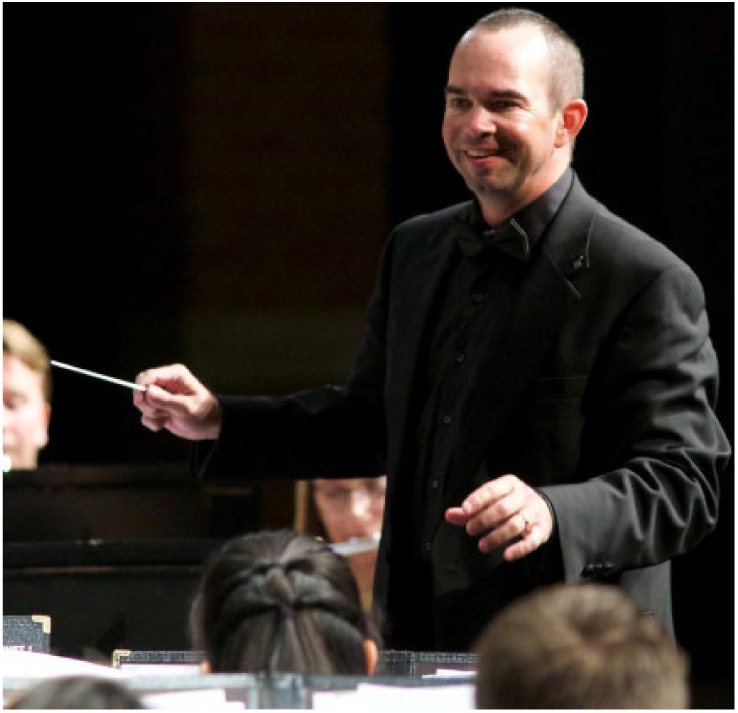
Photo of Micah Ewing by Tina Gutierrez.
Working with a composer allowed me to see a whole new perspective of musicianship. I had been involved with music my whole life, but never from the creating point of view. I was able to gain a new understanding and appreciation for this process which has impacted how I look at the music I perform. I am better able to understand the music from a composer’s point of view and work to do my best to give the music the quality it deserves.
Throughout my twenty-year career as an instrumental music educator in grades 4 through 12, the most consistently impactful artistic and educational experiences I have shared with my students centered on commissioned works and composer residencies. Whether the projects have involved first-year beginners or the most advanced high school musicians, I have learned that students who have the opportunity to perform a commissioned work and interact with the composer who wrote it emerge with new perspectives on musical creativity, a deeper connection with music’s meaning to the human experience, and lifelong memories of an extraordinary musical event. My regular engagement in these activities has driven me to continually pursue these opportunities for my students and to research the effects of these types of experiences on their growing musicianship. With this context in mind, the purpose of this article is to (1) share some understandings of the intricacies and positive outcomes of these projects that have been revealed through my research and (2) provide a step-by-step guide for music educators who are considering a commissioned work project and/or composer residency in the future.
NAfME is glad to offer one hour of professional development recognition to you for reading this article. Please follow the link below and complete a short quiz to receive your certificate of completion.
Commission versus Residency
What is a musical commission? The term commission is the act of suggesting, requesting, or inspiring the creation of a new musical work by a composer. An individual or a group of people known as the commissioning agent(s) can initiate the commissioning of new music. In most instances, the composer is compensated financially for the work that results from the commission; however, commissions can also be the result of admiration or an exchange of services, as opposed to being a paid commission. 1 The commissioning agent and the composer are essential personnel on the front end of a commissioned works project, but a third vital component brings the music to life—the performer. In a school setting, the student takes on the role of the performer, while the commissioning agent is most likely to be the teacher or ensemble director.
Any amount of time that a composer spends actively engaged with performing musicians or the school community can be viewed as a composer residency. Composer residencies in educational settings often last a day or two, or even a week, but might extend up to a year or longer. The duration of the residency depends on many factors, including the availability of the composer, the scope and goals of the project, and the extent of the funding for the project. While in residency, a composer might work with students in rehearsal, give lectures or master classes, coach aspiring composers, or serve as a resource to students, teachers, administrators, and community. 2 A composer residency can be organized around a newly commissioned work or in connection with an existing work from the composer’s catalog. 3
The commissioning of composers and residency of composers has been part of music education on the national and local levels both here and abroad for more than a hundred years. Early in twentieth-century England, prominent composers, including Gustav Holst, Michael Tippett, Harrison Birtwhistle, and Peter Maxwell Davies, served as music teachers in schools. 4 Benjamin Britten, through his experiences as a composer-in-residence, developed a strong belief in the importance of composing music for young people and amateur musicians. 5 In the United States in the late 1950s, the Ford Foundation, in conjunction with Music Educators National Conference (now the National Association for Music Education), funded a nationwide composer residency project that placed more than seventy professional composers in public school systems for renewable one-year terms between 1959 and 1973.
Young Composers Project chairman Norman Dello Joio, a composer himself, stated that the main objectives of this project were to provide opportunities for composers to develop their craft, receive performances of their work, and involve students in the study and performance of works created especially for them. The placement of composers in schools, many of whom with no training as teachers, presented some challenges. However, through the interchange of ideas between composers and educators, a new vitality was brought to the musical lives of the schools and communities. The project made possible a new body of music literature that affected the tastes of the students and the communities. 6 Commissioned works and composer residency projects in the United States have continued on since the end of the Young Composers Project, flourishing in more recent decades through collective efforts by professional music education associations and organizations as well as educational institutions in individual and consortia projects. 7
Entering into a commissioning project can be but is not always an expensive endeavor. Single institutions may engage in commissioning new music; however, many institutions defray the cost of commissioning activities by forming consortia to share the burden of cost with other institutions. In such an arrangement, a single person who serves as the organizer and point of communication often organizes the consortium. The consortium can consist of any number of member institutions, ranging from two to twenty or more. Commissioning through a consortium not only opens the door to projects that might not otherwise be financially feasible but also limits the individuality of the commissioning project since the resulting work will match the desired outcomes for multiple investors.
Benefits of Commissioning
Commissioning new music takes varying degrees of time, effort, money, and organizational capacity. With so much published music available just a few clicks away on the web, why undertake an extensive enterprise like commissioning? The answer sounds hyperbolic, but based on my research and personal experience, the answer is authentic: Commissioning new music makes a deep and wide-ranging impact on students, their teachers, composers, and the musical community at large. 8
Commissioned works projects influence students in a variety of beneficial ways. The opportunity to play a wholly new piece of music composed specifically for a commissioning project provides students with a truly unique musical experience. 9 The uniqueness of the experience is also reflected in the potential for the new work to be precisely tailored to meet the students’ musical skill set, their educational needs, and curricular goals. 10 The specificity of the project to the commissioning ensemble lends itself to strong feelings of pride and ownership for the students who have the opportunity to play the new music. 11 Performing commissioned works tends to be a positive and memorable experience for students, 12 particularly when connected to a composer residency. A composer residency that is organized in conjunction with a commissioned work project gives students insights into a composer’s creative process. 13 The experience of working with a composer sometimes leads to an increased interest in composing for the students themselves. 14 By way of composer residency projects, students also make meaningful connections with other people and their world through understanding that composers are living, breathing human beings. 15
There is a nexus of beneficial outcomes between students and ensemble directors/commissioning agents who experience commissioned works and composer residency projects. Commissioning ensemble directors, like their students, experience musical growth through insights into the creative processes of composers. 16 The meaningful personal connections made through the projects extend to the ensemble directors, manifesting themselves in stronger professional relationships with composers and, in some cases, school administrators. 17 Ensemble directors often experience newfound respect for their own creativity and the creativity of their students and the roles of contemporary arts and artists in society. Participation in commissioned works projects and composer residencies results in the development of new methods of instruction and stimulates new interest for many commissioning directors. 18
The common thread of personal and creative growth exists between all participants in commissioned works and composer residency projects. This statement is as true for composers as it is for student musicians and commissioning directors. 19 Through the preparation and rehearsal phases of residency, composers have an ensemble singing or playing their music that gives them a preview of its sound. This is an excellent environment for composers to make revisions in their compositions when the musical realities differ from their creative vision. 20 It is within this process that students and directors get a glimpse into the creative process of the composer. When a new musical work is commissioned, the composer receives a nearly guaranteed and almost always enthusiastic performance of his or her music. 21 The rehearsal and performance environment of commissioned works, composer residencies, and concert performances leave composers with feelings of fulfillment 22 and increased confidence. 23
These types of projects benefit the larger musical professional community by increasing the repertoire of new music. 24 The positive effects of repertoire growth are particularly impactful when underrepresented genres, ensembles, composers, or difficulty levels profit from the attention of a commissioned work. In this regard, the positive effects of commissioning new music extend beyond the student musicians, the composer, and the director involved to serve as a new possibility of creating musical material for others to experience. 25
Getting Involved
How can music educators be involved in a commissioned work/composer residency project? There are almost as many ways to be involved in a commissioned work project as there are composers to commission. The following paragraphs represent some suggested guidelines that an ensemble director can follow to bring the commissioned work and composer residency experience to the local level. These guidelines 26 are applicable to large-ensemble formats (band, chorus, orchestra) or a variety of chamber music configurations at any age (elementary, middle, high school, university). 27
Get to know many composers
Internet technology has made it possible to experience more music with greater ease than at any time in history. Find composers whose music resonates with you. Use web resources like YouTube, Vimeo, Issuu, and individual composer websites to explore their work and the work of others. Listen to genres of music that differ from your own area of expertise. For instance, it can be a rewarding venture to commission a composer whose work is primarily choral to compose a work for band. Make contact with composers through their websites, social media, and in person at conferences you attend. Develop professional friendships with composers. Commissioned works are often more meaningful when there is a deep personal connection between the composer and the commissioning agent. 28 Familiarity with a composer’s personality and musical/educational outlook can also be of benefit when selecting a composer who will work well with students. 29 When it is time to discuss a commission proposal with a composer, make personal contact by phone or set up an in-person meeting. This gives the project a free-flowing exchange of ideas through conversation and interpersonal connection.
Clearly define goals for each commissioning project
The conductors who commission works and the composers whom they commission need to work together to clearly articulate the desired outcomes of the project in order to focus the direction of the project and maximize the impact of the experience for the students. Among these outcomes, the objectives related to student growth and the development of musicianship are of paramount importance. 30 If there is a residency involved, the expected takeaways for the students and school community should be discussed. For commissioned works with a genesis in honoring a person, celebrating an event, featuring a soloist, or another special circumstance, the way those events might be best fulfilled should be agreed on beforehand. Funding of the project might also be included among the goals that require definition. Parent booster groups, grants, and school district budget lines can be counted as a few potential sources of project funding. Clear, detailed goal development leads to stronger organization and better project outcomes, especially when mutual understanding of the project objectives helps composers create musical works that fulfill those goals. 31
Select a format for the commission that suits the goals of the project and is appropriate for the budget
Individual and consortium commissions each possess characteristics that make them more or less appropriate as choices for commissioning projects. The duration of the work, the prominence of the composer, the time frame during which the composition will be completed, and the availability of the composer for residency or interaction are all issues that affect the cost, timeline, and educational value. For instance, a work of long duration is likely to cost more than one of short duration, and prominent composers often receive higher fees than less prominent composers do. Commissioned works in educational settings can range in cost from free to tens of thousands of dollars. It is also important to ensure that the composer can deliver performance materials on a schedule that will allow the commissioning ensemble to rehearse and perform the music at the desired time. With creative thought, a commission format can be designed to meet the needs of the range of specific goals and parameters for any given project.
Be realistic about the abilities of the ensemble and honest about the desired difficulty of the music; provide students with an achievable challenge
When discussing the technical and musical abilities of the commissioning ensemble, it is important for the commissioning director to be honest and clear in communications with the composer. In most cases, the composer’s goal is to make their music challenging but achievable. If the music is too easy or too difficult, the experience can be unfulfilling or frustrating for everyone involved. 32 In addition to information gathered through conversation with the commissioner, composers can use other tools to derive a difficulty level, including listening to past recordings of the ensemble and examining lists of recently performed repertoire.
Communicate goals and expectations clearly
Address every aspect of the commission project in conversation or by email. Any issue that is important to either the commissioner or composer should be part of the communication, whether it be instrumentation, difficulty level, strong or weak sections in the ensemble, duration of the piece, mood or character of the piece, deadlines, payments, dates of residency, particular arrangements for travel, structure of residencies, or any other expectations that the commissioning conductor or composer might have. Make no assumptions and address all unanswered questions.
Conversely, it is acceptable to leave some artistically related aspects of the commission open-ended. Some of the best creative and musical outcomes result when minimal artistic parameters are placed on the composer. If aspects of the commission are left open-ended, it is vital that the composer and commissioner agree about which these are. In these cases, there must be mutual trust that those open-ended aspects will be fulfilled satisfactorily, and the commissioner needs to be accepting of the results.
Communicate the particular character desired to satisfy the goals of the commission, if one exists
Celebrations, commemorations, and memorials are just a few of the most common occasions for commissioning a work. Music that is appropriate for a celebration is often inappropriate for a memorial and vice versa. If the occasion motivating the commission necessitates a certain character of music, it is vital that the composer understands those circumstances. However, if no specific character is needed, leave the work up to the composer.
Be willing to listen to and understand the needs, requests, and ideas of the composer
Composers, and more experienced composers in particular, can offer many creative solutions to resolve seemingly insurmountable obstacles with issues like budget constraints and timeline. As with other business arrangements, it is acceptable to negotiate and compromise to an end that is mutually agreeable. Composers might also have creative artistic ideas or solutions that have the potential to be very innovative. If you have sought out a composer’s expertise, be open to his or her ideas and suggestions.
Mutually create a written document that describes and tracks all details of the agreement
Some composers do not require a contract, and some even insist that one is not needed. Others have legal obligations to publishers who mandate a contract. Whether an agreement is to be viewed as a legally binding document or not, at the very least, all commissioning projects should proceed with a clear trail of documentation. The most thorough form of agreement is a contract, but even something as simple as a string of e-mail conversations can clarify many misunderstandings that might arise between the composer and the commissioning conductor. If the contract or communication records do not resolve misunderstandings, involving school administration may be necessary.
Stay in touch with the composer while the work is being composed
Dialogue during this time can be an opportunity to ask questions about the composition process and answer any questions the composer might develop as the piece begins to take shape, potentially leading to a more impactful residency and a lasting collegial relationship. Conversations with the composer during the process can assist with pacing of the project and meeting delivery deadlines by keeping the project in the forefront of the composer’s mind. Whether contributing to a consortium or executing an individual commission, making payments at agreed on times can help keep all parties happy and serve as a reminder to composers of the timeline for delivery.
The conductor and student performers must commit to outstanding performance preparation in order to maximize the impact of the experience
With a completely new score, the conductor needs to develop an artistic vision of the music through detailed score study. The conductor’s study period is also an excellent time to ask the composer questions about the music, resulting in personal growth for the conductor. Students must practice their parts, and rehearsals should have sharp focus. More rewarding composer residencies and concert performances result from diligent preparation. 33
Ensure the composer’s comfort with travel arrangements, and come to a mutual understanding of the residency format
Work out detailed travel arrangements with date and time confirmations, including meals and overnight accommodations, and communicate every detail with the guest composer. When structuring the residency time, contemplate various avenues of interaction (rehearsals, master classes, private lessons, meet and greet, etc.) with students, administrators, parents, and community members.
Consider the composer’s comfort level when planning the residency schedule
During rehearsals and performance, some composers are at ease conducting ensembles, while others would prefer to make comments at a distance. Determine who is to conduct prior to the composer’s arrival. A simple misunderstanding or a lack of clear communication can ruin a residency. If a residency is desired but budget or schedule constraints make one prohibitive, Skype or FaceTime technology can create a pathway for the students and the composer to interact.
Coach the students on how to engage with the composer during interactions
The opportunity to interact with a living composer is a rare occurrence for many students. Encourage students to ask questions and gather information on topics that pique their curiosity. Provide students with guidance about appropriate timing and content of questions and conversation.
Be open-minded and flexible
During a composer residency, the composer may ask the conductor or students to try things that are outside their comfort zone in terms of performance or musical interpretation. Openness to these requests can reveal new and valuable musical ideas to the learners. If the conductor and student performers accept that the composer’s requests are earnestly motivated and come from the perspective of the creator of the art, it can also alleviate feelings of defensiveness or territorial reactions. A willingness on the part of the conductor and the students to try new things as guided by the composer can lead to musical growth for both parties.
Make recordings; document the experience
Enjoy the music-making and the artistic moments. Document those moments by making high-quality recordings. Everyone involved, including parents, administrators, and audience members, may want to relive the world premiere of a new commissioned work. Additionally, high-quality recordings are of great value to composers for promotional reasons and as a reference for future revisions or works. For students and conductors, recordings serve a variety of purposes as historical markers, portfolio components, and memorabilia.
Evaluation of the process from a variety of angles can serve to inform further projects
Seek the input of the students, composers, and self-reflection to understand the aspects of the project that were impactful in a positive way and which aspects need to be further developed to improve for future ventures. A strong sense of self-efficacy in the organization of a commissioned works project is an important part of growth for commissioning conductors. 34
Do it again!
This short phrase captures the enthusiasm of those who have participated in commissioned works projects. The rewards of the process motivate commissioners to pursue subsequent projects and inspire composers to continue accepting commission proposals. Reflection on the process and repetition of the process produce refined efforts that may yield better results with each new endeavor.
Opportunities for Learning
Each new commission project provides opportunities to cultivate additional or more focused goals. Ensuing commission projects present the possibility for refined composer selection, improved communication, enhanced composer residency structure, more developed learning outcomes, and myriad other process improvements. Superior commissioned works projects are possible through the process of experience, reflection, and successive undertakings. When commissioners complete multiple projects, deeper learning is possible for the students and conductors, composers are further engaged in musical creation, and repertoire is expanded. These results can be visible with single commissioned-work project attempts but generate more value when informed by experience through multiple attempts.
Supplemental Material
MEJ818716_suppl_mat – Supplemental material for High-Impact Experiences through Commissioned Works and Composer Residencies
Supplemental material, MEJ818716_suppl_mat for High-Impact Experiences through Commissioned Works and Composer Residencies by Micah Ewing in Music Educators Journal
Footnotes
Notes
Micah Ewing is the supervisor of music at Sycamore Community Schools, Cincinnati, Ohio. He can be contacted at
Supplementary Material
Please find the following supplemental material available below.
For Open Access articles published under a Creative Commons License, all supplemental material carries the same license as the article it is associated with.
For non-Open Access articles published, all supplemental material carries a non-exclusive license, and permission requests for re-use of supplemental material or any part of supplemental material shall be sent directly to the copyright owner as specified in the copyright notice associated with the article.
