




Abstract

The Integrated String Player: Embodied Vibration
by Pedro de Alcantara. New York, Oxford University Press, 2018; https://global.oup.com/academic/product/the-integrated-stringplayer-9780199899333?cc=us&lang=en&
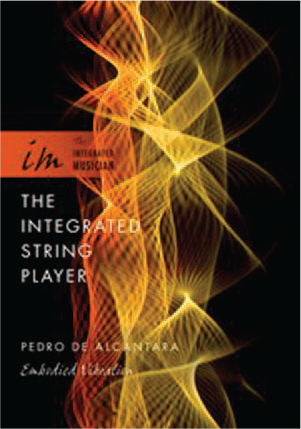
Throughout my training as a string player, I learned by copying and paying attention as closely as possible to my teachers or practicing exercises repeatedly until they were mastered. It took me some time to unfold the “secrets” of playing my instrument before realizing the connections between body, mind, and general physics. Pedro de Alcantara’s The Integrated String Player: Embodied Vibration, beyond offering a technical approach to string playing, drives you to the reconnection of your body, mind, and environment. He combines examples from daily life, references to specific musical works, and clearly explained principles of psychophysics. Alcantara explains the basics not just of playing but also of developing our senses toward achieving a rational musicality. For example, linking linguistics with motion, he states: “The only non-negotiable principle [to every bow stroke] is that there must be a linguistic command above and beyond the physical one” (p. 231). His down-to-earth descriptions embody different perceptions of the body, mind, acoustics, and sensations.
Alcantara breaks down musical elements and movements based in anatomy and physics. As in part one, “Before Everything Else,” he explains what happens before we play, how we prepare our body and mind to be able to perform, and how we sense a natural rhythm, achieve coordination, and master listening. Parts two and three describe the right and left sides of the body, respectively. If you teach, you will agree that this right/left division is a key factor in the learning process. The author encourages the learner to be more conscious, thoughtful, and efficient by focusing on one problem at a time. Finally, part four integrates all his points and relates them to physics, theory, and practice.
The complementary website has video and audio clips that clearly demonstrate the book’s principles and exercises. In addition, the Integrated String Player has two companion volumes, Indirect Procedures, in which the author approaches health and well-being based on the Alexander technique, and Integrated Practice (also with its own website) that delves into rhythm structure and musical language. All three books are stand-alone works, but the two companion books complement the first one and allow readers to explore the related subjects in greater depth.
Throughout the book, Alcantara provides exercises using open strings to help students at all levels and backgrounds better understand the principles he teaches. For example, when discussing bowing technique in chapter five (p. 65), he explains what he calls a foundational gesture using a short note on an open string. He follows this with a list of many different exercises and possibilities just using open strings. Later, on page seventy, he applies all the concepts he has described to a single musical excerpt.
The Integrated String Player is an accessible book for teachers, performers, and any string player who seeks to understand the root principles of how and why we play. The book offers a fresh approach to how we perceive music. It would be a welcome addition to the library of any string educator or learner.
Director of orchestral activities, University of Texas Permian Basin, Odessa, Texas;
Of Interest . . . A Way of Music Education: Classic Chinese Wisdoms
by C. Victor Fung, New York: Oxford University Press, 2018; https://global.oup.com/academic/search?q=a+way+of+music+education&cc=us&lang=en
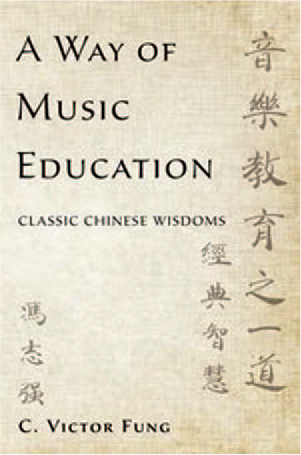
Many Western readers trace their ideas about music theory and teaching to the ancient Greek and other Western sources, and only recently have they begun to explore ideas outside this heritage. In A Way of Music Education: Classic Chinese Wisdoms, C. Victor Fung has written a fascinating book that relates music education to the traditions of ancient China found in the Yijing (The Book of Changes), classic Confucianism, and classic Daoism. This work, many years in the making, was inspired by scholars of both the past and the present. To supplement his own considerable knowledge of Chinese philosophies and Western music education, Fung studied with and consulted scholars, philosophers, and experts in Asian universities during his sabbaticals and throughout much of his career.
Fung, a professor of music education at the University of South Florida in Tampa, relates music teaching and learning concepts to the principles of yin and yang. Nothing occurs in the universe without a reason—anything that happen requires the giving and receiving of energy (yang = active energy; yin = passive energy). The author looks at qualities such as kindness, balance, harmony, nature, and flexibility and asks that we consider these in our teaching. His central premise argues for the connectedness of all things, and he offers implications from the past that are stunningly relevant to today’s world. He advocates for the cultivation of musical actions in proactivity, rather than passivity or avoidance, to support sustainable and prosperous lives.
Among the many fascinating passages in A Way of Music Education is the following snippet of dialogue between Confucius and a student, as related by the philosopher Mencius:
Zi Gong once asked Confucius, “Do you believe you are a sage?” Confucius replied, “I can never be a sage. I am only never tired of learning and never weary of teaching.” Zi Gong said, “Never tired of learning is wisdom; never tired of teaching is benevolence. Having wisdom and benevolence, you are a sage.” (p. 49)
His continual striving toward the goals of self-improvement and to share knowledge are two of the reasons that many Chinese today call Confucius “Great Teacher.” Being a wise and benevolent person is something that all of us, especially teachers, can aspire to in our work and life. Fung’s book helps us consider music teaching and learning from a number of new perspectives while maintaining that human beings remain at the center of music education philosophy in a connected and nature-driven universe.