



Abstract
In this article, we situate songwriting in elementary spaces as a vehicle for personal and musical expression and informed by popular music practices. We offer insights for how educators can anchor students’ work by encouraging them to create songs for a specific purpose like shedding light on social issues relevant to their lives. This article also addresses how community songwriters might support the creative musicianship of elementary students and the ways in which they can offer unique mentorship to students when they share musical interests and lived experiences. We offer pedagogical ideas and considerations for engaging elementary students in songwriting, and we connect these ideas to a recent elementary school songwriting project in partnership with community artists.
Elementary students can become songwriters if offered the encouragement from their teachers; the process can be enhanced by involving community musicians as mentors.
Photo of Donna Gallo is courtesy of T-Stagg Photography

Photo of Emily Kuchenbrod is courtesy of the author
In modeling his creative process with a group of fifth-grade students, Jarrel, a local hip-hop artist, chooses the topic of poverty as a social issue to address through songwriting. The students are drawn to Jarrel: He is warm and genuine and invites students to the conversation as he shares his perspectives on neighborhood poverty. Together, the students and Jarrel create a diagram on the board linking various societal challenges to poverty, such as environmental concerns and food insecurity. Jarrel references the diagram while modeling how he generates lyrics through freestyle rapping over a beat. Students are visibly impressed with Jarrel’s improvisational skills, and their excitement is palpable as they form small groups to experiment with or freestyle their own lyrics. Jarrel visits each group, writing down their improvised words, expressing his enthusiasm for their ideas, and assisting with additional lyrics as needed. By his next visit, the entire class has solidified a hook as they perform it together: “I done made it out of poverty; I’m giving up a lot of me; Everybody always doubting me; Everybody wanna count on me.”
Elementary music teachers in the United States foster children’s creativity in a multitude of ways, from exploring sounds on classroom instruments to creating notated and nonnotated melodies to improvising expressive movement. 1 Creating songs may be among the vast array of compositional activities in elementary music curricula, yet music education literature and professional development opportunities devoted to songwriting in elementary settings are relatively scarce. Contrastingly, songwriting for adolescents or teens in school music within the United States has been a popular topic for several years as educators seek to broaden the musical course options and opportunities for secondary students beyond participation in large ensembles. 2 Elementary students may engage in songwriting practices akin to those of secondary students and in doing so, can empower their critical perspectives, identities, and musicianship. In this article, we situate elementary school music songwriting experiences within popular music practices and pedagogies, offering insights for how educators can facilitate songwriting with elementary students to promote both musical and personal expression. We also address how community songwriters’ musical expertise may support the creative musicianship of elementary students and the ways in which they can offer powerful mentorship when both songwriters and students share musical interests and lived experiences.
Benefits of Songwriting
Songwriting in secondary school music contexts is often associated with popular music genres, styles, pedagogies, and practices. 3 Music education scholar Evan Tobias, for example, introduced the idea of “hyphenated musicianship,” where secondary students enrolled in a songwriting course formed their own creative musical identities by taking on various popular-music-related roles—and mixing or overlapping those roles—such as sound engineers, recordists, producers, songwriters, and performers. 4 Community-based programs and high school songwriting courses focused on hip-hop have shown to support students’ cultural, linguistic, racial, and ethnic identities 5 by empowering students to write songs about their personal experiences and relationships. 6 According to music education scholar John Kratus, secondary-level songwriting courses offer opportunities for students to create within known vernacular styles. 7 Kratus provides several suggestions for songwriting content, such as addressing musical forms (e.g., verse/chorus) and including fretted instruments that are often associated with some popular music genres. 8
Elementary students stand to benefit from similar experiences, processes, and orientations. Scholars have documented the complexity of young children’s musical creations or re-creations in nonformal settings, noting the various environmental and cultural influences in which popular music plays an integral role. 9 In the same vein, engagements with “informal music learning” strategies where elementary students rely on their aural musicianship and work in peer groups to cover or copy songs of their choice have illuminated the many benefits and possibilities of popular-music-related experiences in elementary school music. 10 Children’s musical inspirations and creative complexities may be similarly encouraged through songwriting experiences that center and affirm their vernacular musicianship. Educators should be cautious not to assume that all elementary students’ vernacular musicianship is influenced by popular music. However, many elementary students likely listen to or engage with some form of popular music. Therefore, we conceptualize songwriting in elementary school music as a creative process informed by students’ personal musicianship and associated with popular music genres and pedagogies. 11
Elementary Songwriters
Rena Upitis, in the book, Can I Play You My Song? The Compositions and Invented Notations of Children, uncovered the ways in which children invented notations to record and express their compositional meanings and as a visual representation to share their musical intentions with others. 12 Eventually, Upitis noted, children’s compositions and invented notations became increasingly complex and more challenging to convey musical meanings. Consequently, children established a need for a more widely familiar and available notational system (i.e., Western art music notation) as they sought to share their work and to learn others’ compositions. 13 Upitis centered children’s musical creativity through composition and provided access to learning Western art music notation through a process where children could understand its relevance and applicability.
Although we are not concerned with children notating their songs, because technologies are commonly available in classroom settings where students can easily record, listen to, access, and edit their work, Upitis’s perspectives prompted us to consider how we might teach songwriting with the same spirit and attention to creativity, relevance, and meaning making. Like learning standard notation without a particular need or real-world application, songwriting could be a rather inauthentic or irrelevant activity for elementary students. Scholars have documented the ways in which children can connect their out-of-school musical interests and knowledge through in-school experiences shaped by popular music pedagogies or informal music learning practices. 14 Similarly, educators can encourage elementary students to create songs within known musical styles and genres and that address topics most relevant to their lives. To that end, elementary students ought to be encouraged to write songs for the same purposes that professional songwriters might write songs: to express their personal identities, to convey a position or emotion, as a form of activism, and so forth.
Community Songwriting Partners
Western art music practices typically emphasize performance and the re-creation of musical works. Given that many collegiate schools of music across the United States continue to center Western art music through audition requirements and core music curricula (i.e., musicianship and musicology requirements), many music education graduates from these programs may not have much experience with songwriting, particularly within popular music styles. Elementary music educators who seek to facilitate songwriting and who are not songwriters themselves can form school-community partnerships with local artists that may strengthen these creative endeavors. Local songwriters may be well-known performers or mentors to students in a community, making partnerships more personal and exciting.
Songwriters who have knowledge of specific challenges and strengths of a community may offer feedback to students in ways that relate to their own perspectives. For example, scholar Juliet Hess documented the ways in which hip-hop artists local to the Detroit area “continually prompted youth to recognize the strengths of their city” as the young people also spoke out about their challenges with poverty and crime. 15 Songwriters may also support students’ musical identities or their personal musicianship through genre- or style-specific feedback and support. For example, local hip-hop artists who worked with elementary students, many of whom were interested in hip-hop, modeled freestyling, offered ideas for various rhyme schemes, and encouraged students to “speak their own truths” through their music. 16 Likewise, a bluegrass musician might assist with creating accompaniments that follow common bluegrass harmonic progressions, or a rock musician could mentor students in writing lyrics and melodies within typical pop/rock song forms. Finally, some songwriters could be familiar with genre-crossing, where several styles or practices inform their own creations even if they primarily compose within one genre or style. Experiences with fusing styles, borrowing ideas, or sampling could enable community songwriters to mentor students with the variety of musical interests represented in an elementary student population.
Music educators can easily become acquainted with their school’s local music scene through attending live shows, outdoor festivals, and performances at restaurants and coffeehouses. Parents, other educators, and staff members in the school community might be songwriters themselves or could provide recommendations of local artists. Fostering relationships of mutual respect with local artists and having some knowledge of a songwriter’s work is key to cultivating strategic partnerships. These relationships open opportunities for co-planning, developing instruction, and establishing or understanding roles and responsibilities. Fostering relationships of mutual respect also implicates educators to provide financial compensation to songwriters. Some artists may have to take time off from other employment during the school day and require financial compensation to prevent income loss. It is also important to acknowledge their expertise, qualifications, and time (both outside planning and contact time with students) through agreed-on stipends or hourly rates. Compensating artists may require strategic budgeting if an educator has a classroom budget, pursuing fundraising sources (e.g., Donors Choose, parent-teacher associations), or seeking out local grant-funding organizations.
Practices, Pedagogies, Partnerships
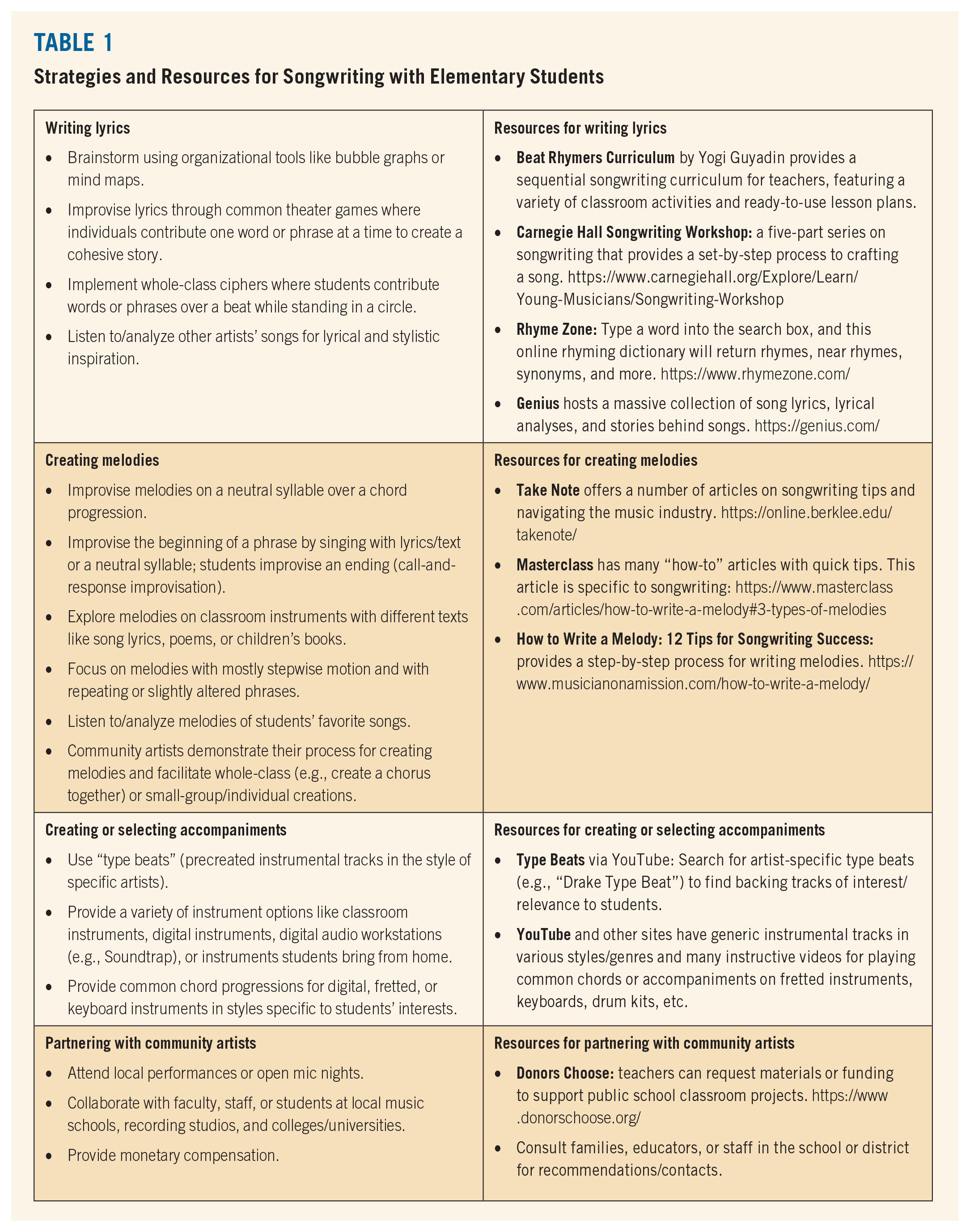
In this section, we provide ideas for facilitating songwriting experiences in elementary settings followed by examples from a recent songwriting partnership where we put these ideas into practice (see Table 1 for strategies and resources). Examples of student work illustrate the ways in which elementary students expressed their own identities, positions, or concerns regarding social issues relevant to their lives. We sought to include community artists in this work whose racial, ethnic, and gender identities and/or their lived experiences would likely share commonalities with at least some students involved in the project. As White, straight, middle-class, cisgender, and neuro- and physically typical females, we continuously revisited our positionalities as students wrote about deeply personal issues tied to their identities and experiences. We adopted co-learner roles with students, helping when needed while doing our best to avoid interactions where students might interpret our feedback as either affirming or discouraging their work or where we might subconsciously impose our musical values.
Strategies and Resources for Songwriting with Elementary Students
Songwriters’ roles as informal mentors also contributed to the fluid exchange of ideas that encouraged students to center their own values and musicianship. We encourage educators to avoid overformalizing instruction through a linear, teacher-led, sequential process. Instead, the ideas offered in the next section are potential starting places from which students may draw inspiration as they work autonomously, alone or in small groups, to develop their own unique songwriting approaches.
Inspirations for Lyric Writing
Students may struggle with starting points such as finding a topic of interest or developing content—musical or lyrical—in their songs. Music educators can scaffold this process for students by introducing themes or overarching concepts. Educators can pose questions like, “What’s something that’s important to you?” Students may choose to write about family, friends, or even a favorite video game. Educators could also narrow the focus, prompting students to address societal issues for which they are concerned, such as climate change, gun violence, or poverty. Alternatively, students might benefit from sharing their favorite artists or songs with personally meaningful messages. These selections may be relevant to students in a variety of ways, such as evoking certain feelings or emotions, illuminating personal identities, or conveying stories that parallel their lived experiences, and can inspire students to generate lyrics about similar or related topics.
Educators who are concerned about students sharing content that could be offensive or harmful to others can select musical examples for the entire class to analyze from artists, styles, or genres that are popular among students in a classroom. Students interested in country music might emulate the ways in which emotions are conveyed through lyrics in the song, “If I Didn’t Love You,” performed by Carrie Underwood and Jason Aldean. Students who prefer folk music, bluegrass, or fusions of many styles might be inspired by the ways in which Rhiannon Giddens weaves her stories, perspectives, and identities through music while also addressing a variety of social issues. For those who love reggae music, there are plentiful examples of social or political messages embedded in lyrics. Students might also draw inspiration from older, well-known reggae songs with simple, powerful lyrics like “Three Little Birds” by Bob Marley and the Wailers.
It’s important that educators know about students’ musical interests or curiosities to select songs that will serve as models and catalysts for writing lyrics and to partner with artists who represent their musical identities. Additionally, elementary music educators may want to pursue school community support for songwriting projects focused on specific issues or themes. Families who identify as Black or African American, for example, may prefer to address anti-Black racism issues with their children prior to their participation in school-based conversations or curricular experiences—including songwriting—where the topic of racism could be a focus. Elementary music educators might consider communicating the details of songwriting projects to parents/guardians and school administrators, offering opportunities for feedback and conversations that could inform potential modifications to instruction.
Students’ Lyrical Creations
Although songwriters have many starting places—a melody, a bass line, a beat, or a lyrical idea—the artists with whom we partnered typically begin with a message they want to emphasize, and they develop lyrics to express that message. During our planning meetings with the artists, we chose lyric writing as a logical starting place for our focus: music that addresses social issues or music created for activist purposes. The school district and the local community generally encourage projects that address activism and social issues; consequently, this fourth- and fifth-grade songwriting project was supported by families and the school principal. We introduced three songs, “Almost Like Praying” by Lin-Manuel Miranda, “Hijabi (Wrap My Hijab)” by Mona Haydar, and “Feels Like Summer” by Childish Gambino, that were created to bring awareness to social issues (i.e., Puerto Rico’s devastation from Hurricane Maria, gender discrimination and female empowerment in relation to Islam, and climate change, respectively). Most students were motivated to analyze the song lyrics because of their familiarity with these popular artists or musical styles. They worked in small groups to document their analyses through creating bubble graphs by placing the theme in the middle of the graph surrounded by evidence or details from the songs (see Figure 1, a bubble graph for “Hijabi”). The bubble graph strategy supported students’ own lyrical creations as they worked in small groups, chose themes of interest, and consulted their graph to freestyle or improvise lyrics.

Student Bubble Graph for Song “Hijabi (Wrap My Hijab)” by Mona Haydar
The artists with whom we partnered represented a variety of musical styles, such as folk, pop, rock, and hip-hop. Students easily distinguished these stylistic differences when listening to the artists’ music, yet each songwriter modeled how they express their personal identities and approach various social issues through their lyrics. For example, Emily, a local folk/pop artist, shared her song, “It’s My Body,” in which she calls for girls and women to embrace their physical attributes while rejecting societal body image expectations. The song prompted a class discussion about ways in which students can speak out against discrimination in dress code policies and disparaging social media messages where females face hypercriticism for their clothing style choices.
Two groups of female-identifying students were inspired to create their own “girl power” anthems. One group wrote the hook, “Girls, girls, girls, we rule the world; Girls, girls, girls, we rock this world,” channeling Beyonce’s message in “Run the World (Girls).” Another group addressed intersections of body image and racial identities, writing: “Don’t talk about people’s body shape; Don’t talk about people’s looks or weight; Doesn’t matter if you’re thick or thin; Doesn’t matter the color of your skin; Tells more about them than you; Because you know you’re pretty too.”
Song Forms and Melodies
Listening to many different genres or styles of music, preferably ones that are familiar to students in each class, and subsequently analyzing the forms as a full class is a helpful strategy for preparing students to create or organize their own melodies and lyrics. Examples of song forms could include pieces with clear verse/chorus structures or expansions of those forms such as those with bridges or ad libs. Creating a short song or a portion of a song (e.g., a chorus) as a full-class activity prior to individual work serves as a vital step in the process for students who are songwriting novices or who may lack confidence for creating original music. For example, educators or community artists can engage a full class of students in creating a chorus by providing lyrics and an accompaniment like a simple chord pattern played on the piano or guitar and modeling how they would create a melody while inviting students to contribute their melodic ideas during the process.
In our experience, elementary students often have melodic ideas in mind that are either inspired by music familiar to them or that they spontaneously create after they have written lyrics. We suggest allowing students time to create melodies and lyrics alone or in groups and assisting as needed rather than instructing students to generate lyrics prior to adding a melody or vice versa. As students consider their organizational structure, they should also have options to create songs with or without melodies or to include both (e.g., rapping and singing). Similarly, some students may be uninterested in singing or writing lyrics and may choose to create melodies with digital or acoustic instruments only.
The three songs we presented to students for lyrical analyses also served as great examples for how artists expand on or alter song forms to suit their expressive and musical intentions. The community artists also modeled their own processes of writing songs, particularly as they pertained to strategic differences between hooks (choruses) and verses. Jarrel modeled how hooks typically have fewer lyrics so that others can participate in singing/rapping with the performer while verses tend to have more words and often convey a detailed narrative. Students created a hook with Jarrel, and they performed it together as a class while individual students freestyled their own verses.
The experience of writing lyrics within a song form (hook/verse) as a whole-class activity in combination with analyzing the lyrics and forms of three known songs provided students with concrete starting places as they generated ideas in small groups. Most groups began with creating lyrics and subsequently added melodies if applicable to their song style. Their melodies developed haphazardly and organically as students solidified their lyrics and/or added accompaniments, and songwriters assisted by providing feedback or melodic choices when students expressed discouragement with feeling “stuck.”
Creating/Selecting Accompaniments
Allowing students to choose or create their own musical accompaniment style is another way to center their musical knowledge, strengths, and interests. Students who are learning to play instruments—at home, through private instruction, in school, or through some other means—may be motivated to create a solo accompaniment or collaborate with others to form a band. Students may have experience with making beats in digital audio workstations like GarageBand or Soundtrap, they may prefer selecting precreated type beats or instrumentals on platforms like YouTube, or they may choose to include something kinesthetic like step dancing or body percussion. Still other students’ preferences could lead them to disregard an accompaniment entirely and create an a cappella song. Unless students prefer to work individually, educators can thoughtfully assist students in forming small songwriting groups with friends who share complementary musical interests and skills. For students experiencing challenges with accompaniments, songwriters and educators may rely on their own musicianship, such as playing the guitar, piano, or producing an instrumental, to assist students with their creative visions. These accompaniments can be recorded for students to learn on their own or for independent practice.
Like the haphazard ways in which students created melodies during our project, their songs coalesced organically and with a variety of stylistic outcomes as they experimented with accompaniments. Some groups selected or created accompaniments as inspiration for writing lyrics or melodies, whereas others began with writing and organizing lyrics into a form before adding accompaniments or melodies. Students required significant class time to engage in these creative processes and to make musical decisions about which all group members agreed. Examples of students’ accompaniments are provided in the next section.
Songwriting Processes/Products
The following three examples illustrate the variety of students’ creative approaches to songwriting and the resulting songs that reflected both their musical and personal identities.
After brainstorming ideas about gun violence in a bubble graph, two students began improvising an accompaniment on a drum kit and a classroom glockenspiel. While the pair solidified their accompaniment, other group members freestyled until they agreed on lyrics that conveyed their compelling message: “We can’t make it stop, but we can keep trying; We don’t want people to keep on dying; It’s time to put down the guns, it’s time to put down the knives; Open your eyes, so you can see real life; Kids are dyin’, mamas are cryin’, and politicians not even tryin’.”
A student in a group experimented with playing tonic/dominant chords on the piano as group members improvised melodies that could fit with the chord progression. Referencing their bubble graph that identified LGBTQ issues, the group’s lyrics, melody, and accompaniment evolved together into a beautiful song with a powerful message. In their first verse, they chose to focus on gender identity and staying true to oneself (see Figure 2).

Student Group Song “Be Who You Want to Be,” Dealing with Gender Issues
In a different group, students created a lyric-rich rap (a hook) for their song, “Body,” and chose to sing the words “appreciate me” for added emphasis (see Figure 3). As they focused on how to support their lyrical message, they began experimenting with a body percussion accompaniment. Because movement and dance were central to their musical identities and cultures, they agreed that a body percussion accompaniment would best represent their musicianship. The accompaniment complemented the complex lyrical rhythms and connected their song’s message about body image and beauty to rhythms using their own bodies as percussion instruments.

Student Song “Body” with a Message about Body Image and Beauty
Sharing Songs in Public Spaces
Students may want to share the final versions of their songs either through recordings or live performances. Consider moving outside of the typical elementary school concert venue like the gymnasium stage, where musicians often face challenges with acoustics, and locate community spaces for students to perform their work. A change of venue from school spaces to the communal atmospheres of local parks, amphitheaters, recreation centers, or art galleries might strengthen students’ confidence in their roles as songwriters and performers. Nonschool venues and events like local parades or fairs may also be more familiar, inviting, or comfortable for families and community members who would not typically attend a school concert or who might be reticent to participate in school activities. Educators can reconfigure school spaces to resemble cafes, coffee shops, or other more intimate places where singer-songwriters often perform, or they might collaborate with the visual art teacher to create a gallery where students share their visual art and musical creations. Partnering local musicians may enjoy emceeing concerts or “song shares” as they perform their own song or a co-created song together with students. In lieu of live performances, students could produce a mixtape and host an event like a listening party, or the recorded album could be available to families, school community members, and local residents. There are endless possibilities for students to share their songs outside of the typical elementary school concert. These potentially meaningful and memorable experiences could play a vital role toward inspiring future musical pursuits beyond school walls.
Elementary Songwriting
Singing songs continues to be a prevalent and beloved communal activity in elementary music spaces. When working with several students in one classroom, and possibly hundreds of students each week, elementary music educators are challenged to select song literature that represents students’ musical knowledge, interests, and cultures. Songwriting is one curricular consideration that can potentially empower young students’ personal expressions through creative explorations steeped in familiar musical, cultural, and aesthetic qualities.
Music educators who seek to enliven their curricula can connect their classroom instruction to the cultural vibrancy within their communities by establishing meaningful partnerships with local musical artists. Through these various avenues, elementary school music curricula may evolve from experiences that are shaped primarily by the teacher or the values embedded in published curriculum materials to reflections and fusions of the cultural richness represented within the student population and the local community.
Footnotes

Notes
Donna Gallo is an assistant professor of music education at the University of Illinois at Urbana-Champaign; she can be contacted at