



Abstract
Songwriting pedagogy is in its infancy in music education. This article presents a new way to think about pedagogy that utilizes student workgroups that more closely align with the ways songs are written in the real world. Implications for music education’s connections to the world of contemporary commercial music are provided.
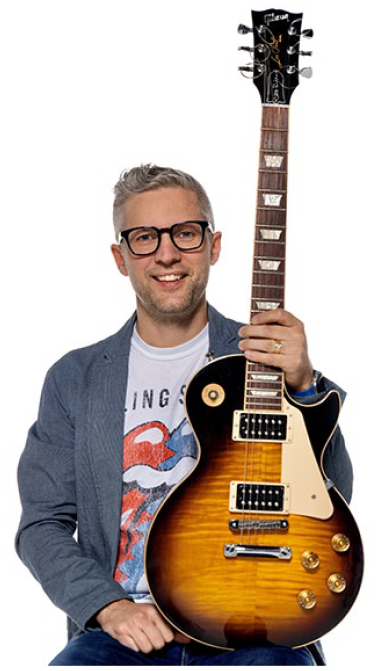
Photo of Clint Randles courtesy of the author
A number of myths surround the inclusion of authentic popular music-making experiences as a regular part of the music education of all students. 1 They center on negative perceptions of the simplicity of the musical forms represented and the novelty of informal music-making. Nevertheless, as John Kratus, Professor Emeritus of Music Education at Michigan State University, writes, “The song is humanity’s most universal and enduring form of music. In every known society and in all recorded history, songs have held an important place in human cultures.” 2 Songs provide us with the soundtrack to our lives. They mediate our lived experience, becoming collectively the sonic landscape that we all enjoy. Songwriting is an area of the music curriculum that is poised for dramatic expansion.
Consider for the purposes of this article that a way forward for songwriting in music classrooms, building on the work of a host of music educators, 3 might include borrowing some ideas from the greater world of music-making. Perhaps the best way to organize classroom songwriting experiences involves spreading the experience across groups of students in our classrooms. Maybe we could think of the small groups that form out of the membership of our classrooms differently. This article is about that idea and what it might mean for incorporating songwriting in practice.
Songwriting workgroups have a long history in popular music. The Brill Building in New York City housed the writers and performers of Tin Pan Alley of the late nineteenth and early twentieth centuries. Berry Gordy employed songwriting workgroups at Motown in Detroit, Michigan, in the 1960s. Capital Records worked this way throughout the 1960s and 1970s with the Wrecking Crew in Los Angeles. We have examples of compartmentalizing the creative process where songwriting is concerned scattered across the history of popular music. Stories from that history can help illuminate our present and future paths in music education as we seek to look a bit more like the musical world outside school walls. Here is what the idea looks like in practice.
Specialization
Rather than assigning the entire process of developing a song lyrically and musically to individuals in our classes, we can have some students pursue particular aspects of the songwriting process and hand their work on to other members of the community for input and collaboration. In other words, we can create a microcosm of the real world of songwriting. These ideas can be utilized in a weeklong unit or an individual performance cycle, or they can be employed as a standard operating procedure in your keyboard, guitar, or music theory classes, for example. These groups work simultaneously so that new material is produced constantly for the next part of the process. As the teacher, you can get each group started by doing a large-group demonstration of what each small group does and allow time for them to practice with your guidance.
What follows is a breakdown of some of the specific tasks that need to be completed for songs to be written, followed by how you might think of making each a specific task to be completed by particular students in a songwriting workgroup. It will take imagination on your part to be able to fit each of your students within specific groups. It is best if they can self-select these groups. However, in some cases you might have to help them choose. Here is a list of the songwriting groups, or teams, followed by a description of what each focuses on:
1. Idea Generation
2a. Lyric Writing
2b. Musical Writing
3a. Listeners’ Feedback
4. Recording Musicians
3b. Listeners’ Feedback
5. Production/Engineering
3c. Listeners’ Feedback
6. Performers
3d. Releasing
1. Idea Generation
Task a group of students to think of topics for songs. This group should focus almost entirely on object writing, noun–verb associations, and ideation. This work satisfies the National Core Arts Standards on Creating: Imagine. Their work should be purely imaginative and generative, short of coming up with musical lines that rhyme. A theme such as “tough relationships” will fill pages upon pages of thoughts on the topic. Have them develop thoughts on specific themes—love, God, peace, joy, patience, school, heroes, anxiety, politics, and so forth. The more ideas for songs and creative writing that leads to idea generation the better.
To prepare for using the workgroup idea in your classroom, you might start by generating ideas with the entire class. You could then produce a mass of ideas that can be sifted through by the lyric writing group. In any case, it may take time for this first group to come up with ideas. You will have to plan for that to occur within a set time: a day, week, unit, or performance cycle. With a well of ideas to draw from, your lyric writing team will be off to the races. Make sure to monitor the activity of the groups to see that individuals are not being left out and that each person is able to contribute ideas to the group.
Vignette 1: Motown
When Berry Gordy put up the sign “Hitsville USA” on his house in 1959 and turned his garage into a studio, his newly started label had yet to have any actual hits. However, his experience at the Ford factory served him well, and he was convinced that he could create a musical equivalent to the assembly line. It turned out to be a lesson in collaboration. Every day began with a 9:00 a.m. “quality control” meeting, where songwriters and producers would listen to each other’s songs and critique them. Then they would vote. Only the highest votes made it. Everything else went in the vault. If you arrived at 9:01 a.m., you would not get in, says Smokey Robinson, who had to wait until the next meeting to get a chance to share many of his songs. Since the house band, the Funk Brothers, was paid by the day, the primary goal was to record as many songs as possible each day. This was not a problem for Marvin Gaye, as the vocals on many of his biggest hits are first takes. Barry Gordy gave us a model for how we can do songwriting in our classrooms, borrowed from the world of automotive manufacturing.
2a. Lyric Writing
So much good work in the idea generation group has made the task of coming up with original lyrics that much more approachable. The lyric-writing team has some things to think about, in no specific order:
What will the song be about? Base this on one of the themes and collections of ideas the idea generation group has come up with.
What will the song structure be? Which song map will be used—thinking of the work of Simon Hawkins? 4 Hawkins is a songwriting pedagogue who has written about ways of mapping many of the songs that exist in the world as a strategy for helping songwriters think about the narratives that songs express.
How will a song lyric narrative be crafted so that it (1) speaks to a specific audience and (2) has something meaningful to say?
The lyric-writing group might be a collection of duos or a bigger group of four or five. The important thing to consider is that it will take several versions to be able to select from among them which songs will be suitable for recording or performing. 5 This work satisfies the National Core Arts Standards on Creating: Plan and Make. All the groups should aim to have their songs be the ones used but also accept the possibility that their song could be tabled for a bit. There is nothing saying that any one student could not take the lyrics and finish the song on their own. That sort of thing should be encouraged.
2b. Music Writing
Happening at the same time as the lyric-writing group is the music-writing group. With the collection of themes and ideas from the idea generation group in hand, the music-writing group plays with musical ideas, chorus and verse chord progressions, riffs, musical transitions, and timbres. They work to develop the feel for how the song might go. This group is keen to use all available performance and effects technologies. The idea is all about the impression that the music makes on listeners.
Once a critical mass of ideas has been developed in both the lyric-writing group and the music-writing group, bring them together. This should occur within the time constraint you provided: a day, week, unit, or performance cycle. Have each group share its best material. This work satisfies the National Core Arts Standards on Creating: Evaluate and Refine. Both groups will have ideas about what might fit with what. Let each voice be heard from each group. Ideas for combining the work of both groups will be proposed. It is better if these ideas come from them. Sometimes you will have to get things going with some of your own work. Write everything down. Develop a plan for combining that work for a preliminary performance for the whole class.
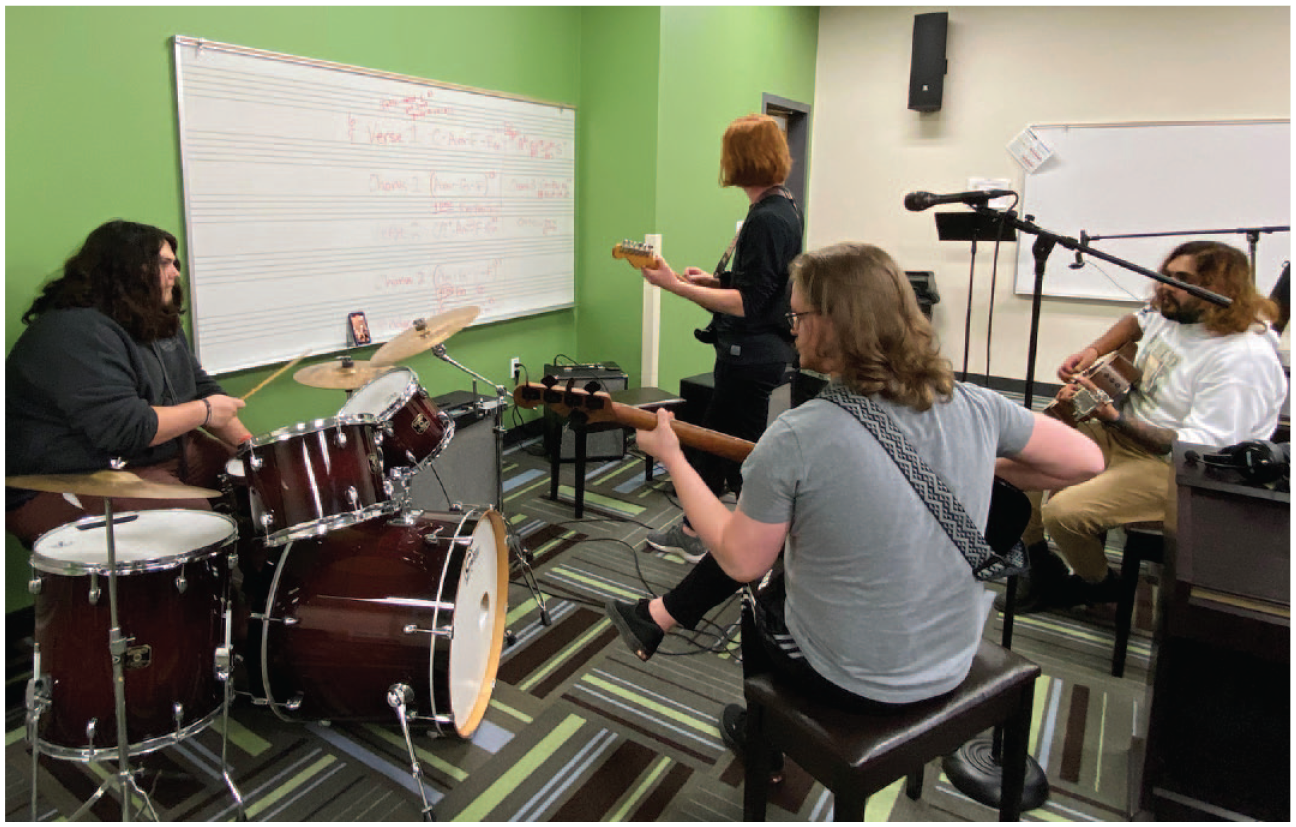
Student songwriting workgroup in action
3a. Listeners’ Feedback
Have a performance of new songs for the class. Individual students can do this, or you along with them. The goal here is to present preliminary versions of songs to the class. Performances at this stage might actually be worked up in DAW (digital audio workstation) environments, which is how I like to do it. What you want at this stage is for everyone to freewheel ideas for how they might approach the final version of the song. Harmony ideas? Hooks? Instrumentation? Performance ideas? Your classroom is a collection of musicians with different strengths. Try to get them all involved. Everyone has something to offer the group creative process. Handle the tone and quality of feedback, as that goes a long way toward determining the quality of the experience and the culture of the classroom. Look for inspiration on the nature of feedback in this style of teaching. 6 Make your initial feedback positive then gradually more prescriptive as classroom activity continues—this is important for students to feel safe to create.
4. Recordings
Now is the time to record tracks. Use the best musicians and your own skills at times to make this happen. Look for the people in your class who might want to be trained to be engineers and recordists. Your own skills as a recordist will determine how you proceed with recording. If you can use play-in-headphone environments in your classroom, then use them to record all the material that does not require silence during the recording process. If you can construct a vocal booth as part of your room set-up for recording vocals, that would be amazing. Booths make the quality of vocal tracks that much more professional sounding.
Recording is currently a wide-open frontier for music education. 7 We should be making recorded music in music classes half of the time and performing the other half. Performing and recording should go hand in hand as a part of a foundational music education. Assemble a team of your students to handle recording. This work satisfies the National Core Arts Standards on Creating: Present. At least one of the following types of technology will be required, depending on what you choose to do yourself.

Students collaborating on music writing
3b. Listeners’ Feedback
Once again, have a performance of new songs for the class. Share the latest of the greatest of the work. Times like these in the flow of your class will build confidence and be a source of celebration. They will also serve as a sounding board for improvement. Remember the volatility of creative work. 9 Lean on supportive and descriptive comments at first. Do your students feel safe to perform in front of each other and share ideas? Have you modeled the process for them? Develop a culture in your classroom where everyone knows that work presented is going to be valued greatly and supported by everyone. Be the lead example of positivity. You will know when they are ready for prescriptive feedback. Songwriting, recording, and performing is a marathon, not a sprint. Embrace the long-haul approach to it all. Your goal is for them to see in your daily process something they could continue doing for a lifetime. It is not about you, a program, or institutional goals. It is about them. Take time and be patient.
Vignette 2: The Wrecking Crew
Hal Blaine, Plas Johnson, Carol Kaye, Earl Palmer, Don Randi, and Tommy Tedesco played on hundreds of pop songs and albums, working with everyone from Frank Sinatra to the Beach Boys, Herb Albert to the Byrds, Phil Spector’s girl groups to Elvis and the Righteous Brothers. If you’ve seen the film Love and Mercy, the drama about Brian Wilson of the Beach Boys, they’re the band recording the tracks for the album Pet Sounds. They rarely received credit for their contributions, which meant that only the artists and engineers knew their legacy, at least until a few years ago. Your school could have its own “Wrecking Crew” of musicians who might play on numerous tracks and albums within a school music culture. Can you imagine it? I can, and I have seen it enacted. We could model the real world of collaborative music-making and production and be a conduit for young musicians who might continue on to work in the music industry. This is a music education practice that would capture the imagination of the masses.
5. Production/Engineering
By this point, a significant amount of production/engineering has happened, but after performing and getting feedback twice in class, you are ready to kick the production up a notch. 10 This is where you apply everything you have been able to glean from online resources, such as Mastering.com (formerly Musician on a Mission), on how to make tracks sound better. Think whole–part–whole in the process of making your tracks sound better: What do individual tracks sound like in the mix? What does the entire mix sound like with the changes you made in the individual track you were working on? Spend time working on EQ and gain/compression to ensure that all components can be heard. Then, depending on your style and sound aesthetic, you may work to simplify the arrangements. What really needs to be heard? And when? Consider the main points of Friedemann Findeisen’s The Addiction Formula regarding the role of hooks and hype in creating excitement. 11 Think about the narrative of the song and the major impact points as you tell the story. Learn how studios and engineers think about these aspects of the process.
3c. Listeners’ Feedback
Have another performance/sharing session for people who have a vested interest in the song(s). Building a sense of community has been a focal point. You have modeled supportive, descriptive, and prescriptive feedback that has at its core a sense of camaraderie and collaboration—everyone who works on developing their creativities in your classroom will be supported in every way that they desire until their song(s) are successfully completed. It is a way of life that you have nurtured above all else. This can take place in a day and be a performance or a sharing of recorded music. The main point is that there is another chance for students to share their work.
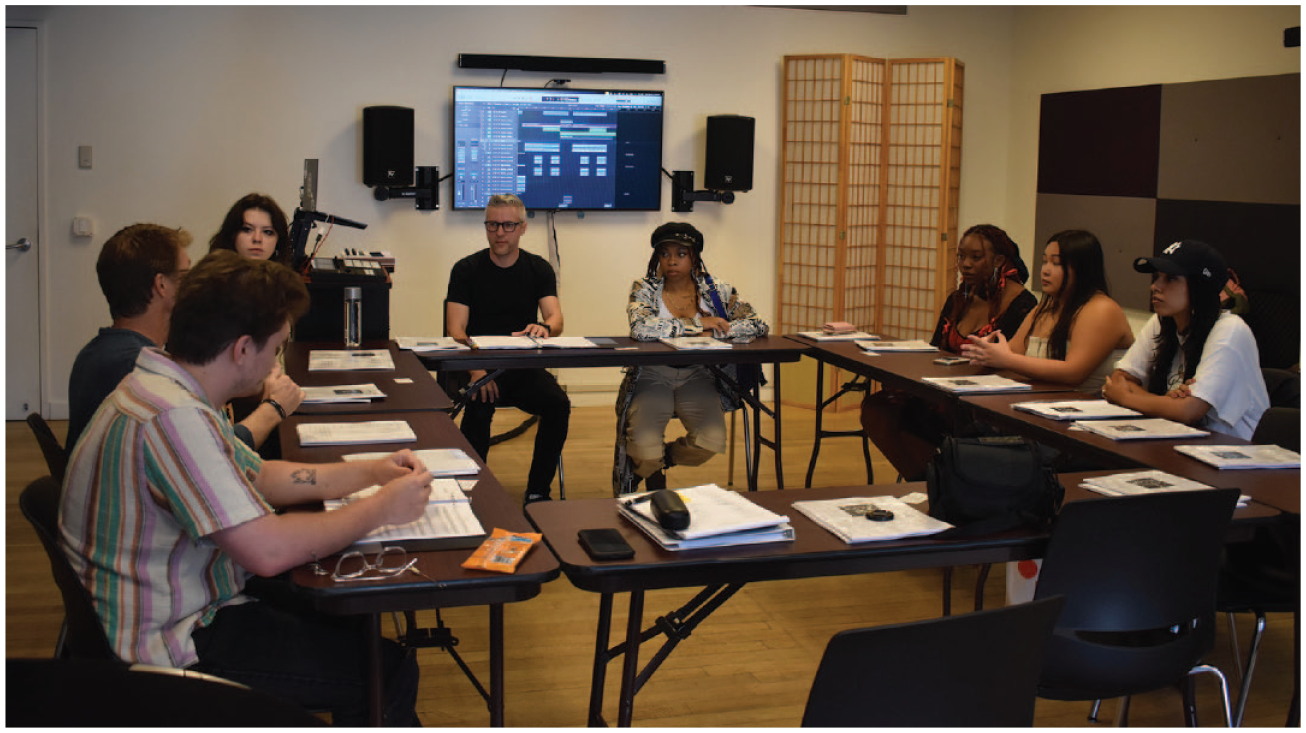
Students and the author discussing aspects of production
6. Performers
Who will perform the song(s)? This may have been established already. Will it be one of the primary idea generators or one of the primary lyric writers? Perhaps you are recording a cover version of a song written and performed previously by someone in your classroom. Let the students guide who you enlist to play for them. They should call the shots. You can be there for support and logistics. You can also enlist other performers and arrangers from among the broader school music community.
3d. Releasing
The final stage of listening should occur before you do the work to release the song into the world. Getting student work out could mean setting up ASCAP or BMI royalty accounts and releasing the songs via your school record label. It might also be doing the royalty work—which I always suggest that you do to protect your students—and then releasing the songs in one or more formats. Streaming is popular and will likely be the avenue your students are most interested in, but you might also want to make a vinyl record or compact disc. Having a tangible product at the end of the songwriting process is important in the music world at large. It might become even more important in the world of music education if we can borrow some of our creative process from the music industry.
Conclusion
The songwriting workgroups idea presented here leverages the power of collaboration and mirrors real-world processes in the music business. Although there are exceptions, people rarely work in isolation doing every step of the process themselves. Most of the time, the music we love to listen to is made in teams. Setting up your classroom in a way that leverages the power of teamwork is a good idea.
Assessment is important. Create categories for evaluating students’ overall creativity, performance quality, and the technicality of their recordings/performances, and make your assessments formative. We want them to write songs when they leave our classes. Focus on being positive and constructive.
Consider taking a field trip to a music studio in your area. Studios are typically welcoming to music educators and their students and open to their curiosities about what goes on there. Studio engineers and producers are incredibly knowledgeable about everything that goes into organizing the creative experience and capturing the best audio quality possible—we just need to be willing to reach out to them. Our students are worth the effort.
Finally, how could this songwriting workgroups idea be expanded? Do you have your own ideas that I have not mentioned? I hope this article has given you ideas for leveraging the unique power that engagement in the process of writing, recording, and releasing songs collaboratively can have on the musical life of the communities we serve. Imagine what might be possible by gaining inspiration from the professional studio world and its history. All you need is one idea to spark a series of initiatives with the capability of adding another impactful dimension to your students’ creative pursuits and your school’s music scene.
