



Abstract
One of the key issues facing the UK in the wake of the advisory referendum result to leave the European Union is the precise nature of its relationship with the European Union. At one extreme would be continued membership in the European Economic Area, including membership in the single market. Other options would be either no free trade agreement (FTA) with the EU at all or a less comprehensive FTA which stops short of single market membership. This paper compares the ability of EEA membership and less comprehensive FTAs to generate trade in goods and services. We investigate this question using empirical gravity model methodology and the most recent available data from 42 countries. We use recently developed econometric methods to deal with observations of zero trade flows and issues connected with endogeneity. The main finding is that while EEA membership is associated with substantial and statistically significant increases in bilateral services trade flows, membership in less comprehensive FTAs is not associated with any significant increase in bilateral services trade. For goods, EEA membership is associated with larger bilateral trade flows than are less comprehensive FTAs. These results suggest that it might be difficult to replace, on an exit from a European Union, lost trade flows with the EU by means of shallower FTAs with the EU or with third countries.
1. Introduction
One of the key issues facing the UK in the wake of the advisory referendum result to leave the European Union is the precise nature of its trading relationships. At one extreme would be what has come to be known as ‘soft Brexit’: continued membership in the European Economic Area, a status similar to that of Norway or Iceland, including membership in the single market, free movement of labour, and acceptance of most EU regulation. At the other extreme would be ‘hard Brexit’: either no free trade agreement (FTA) with the EU at all or a looser FTA which would not involve free movement of labour or the acceptance of EU regulation. In both cases, the UK would be outside the EU's customs union, and would have the ability to negotiate free trade agreements with third countries.
In order to distinguish between these alternatives, a key question arises: what, if any, are the benefits from membership in the EEA single market over and above those from a looser FTA with the EU? This paper focuses on the relative ability of the EEA single market and looser FTAs to generate trade. We investigate this question using empirical gravity model methodology and the most recent available data from 42 countries.
We investigate the impact of EEA and looser FTA membership on goods and services trade separately. Miroudot et al. (2013) find that implied barriers to trade are two to three times higher for services than for goods, and that barriers to trade in goods have fallen over the past decade. This may be due to the differing nature of barriers to trade for goods and services. While barriers to goods trade are often related to physical transport costs or tariffs, non-tariff barriers such as regulatory constraints might play a more important role for services, especially for high-value-added business services such as financial services, legal services or accountancy. As a result, we might expect the impact of standard measures of physical trade costs to differ across goods and services. We might also expect that deeper trade agreements, which include more regulatory harmonisation and tend to go further in addressing non-tariff barriers, might be particularly important in promoting services trade.
The main finding is that, after leaving the EU, it might be difficult to replace lost trade with other EEA members by means of less comprehensive FTAs, either with the EU or with third countries. The reason is that EEA membership is associated with larger trade flows than is membership in less comprehensive FTAs.
For services, the results are particularly stark. EEA membership is associated with substantial and statistically significant increases in services trade flows, while less comprehensive free trade agreements are not associated with any significant increases in services trade flows. The corresponding losses in bilateral trade with other EEA countries from leaving the single market are estimated to be around 60 per cent over the long run, and we find no evidence that signing less comprehensive free trade deals will be able to replace any of this. It should be emphasised, however, that the 60 per cent reduction in services trade refers to trade with other EEA members only. In 2014, 40 per cent of the UK's services trade was with other EEA members, so that the implied reduction in the UK's total services trade would be about 24 per cent.
For goods, the results are similar, if somewhat less stark. Both EEA membership and ordinary FTAs covering goods are associated with larger trade flows, but EEA membership is associated with larger increases in goods trade than are ordinary FTAs. Replacing membership in the EEA single market with a less comprehensive FTA is associated with a decline in trade with other EEA members of 35–44 per cent over the long run. About 56 per cent of the UK's goods trade is with other EEA members, corresponding to a decline in total trade of between 20 per cent and 25 per cent.
These results suggest that more work needs to be done to understand fully the implications of leaving the single market. First, these results are coming from a single year of data, 2014. It would be desirable to extend the analysis to a panel of data covering a longer timespan, also allowing the use of panel data methods to analyse the data. Second, the results indicate that the more comprehensive economic integration of the single market matters for trade. It would be important to understand which elements of the single market are important for trade: is it regulatory harmonisation, free movement of labour or perhaps rules on competition? Finally, the service sector is highly diverse, ranging from retailing to financial services and other high-value-added business services. It would be important to gain a better understanding of which aspects of the single market are important for which services industries.
This paper contributes to the literature which attempts to estimate the impact of membership in a free trade agreement on trade in goods and/or services. Two of the most prominent papers in this literature are Baier et al. (2008) and Egger et al. (2011). Baier et al. (2008) use a theoretically-based gravity model to compare the impact on trade of being a member of the EU to that of being a member of EFTA (i.e. being in the EEA but not the EU). Although Baier et al. (2008) use data on both goods and services in these estimates, they would seem to be mainly relevant for goods trade, because most of the variation in EU versus EFTA membership occurs before 1990, when goods trade was predominant. Egger et al. (2011) use data on goods and services trade, but do not differentiate between deep economic integration agreements such as the EEA or EU and less comprehensive free trade agreements. For services trade and using data from 2005, van der Marel and Shepherd (2013) differentiate between membership in the European Union and less comprehensive regional trade agreements (RTAs), and also find that EU membership is associated with greater bilateral trade flows, while membership in less comprehensive RTAs is not. In recent work, Anderson et al. (2015) estimate the barriers to services trade from border effects, and find that these vary even across EU members.
2. Gravity models: from theory to measurement
Gravity models have become the standard framework for investigating the impact of measures of trade costs and/or membership in trade agreements on trade flows. Estimated gravity models of trade can be derived from the theoretical trade model proposed by Anderson and van Wincoop (2003), 1 but also from more general models involving heterogeneous firms. Head and Mayer (2014) provide an overview of gravity models of trade.
2.1 Deriving the estimated gravity equation
Next, we derive the estimated gravity equation used in this paper. In the theoretical gravity model of trade presented in Anderson and van Wincoop (2003), bilateral exports between country i and country j, denoted as Xij, depend upon trade costs between the two countries tij, both countries' GDPs yi and yj, world GDP yW, and the average barriers to trading with all other countries, captured by the multilateral resistance terms Pj and ni:
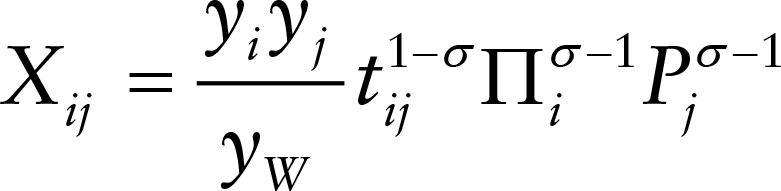
where σ is the elasticity of substitution across countries. Trade costs tij are difficult to observe directly. This is particularly true for the often subtle non-tariff barriers which may be especially important for services trade. Rather, a number of well-known proxy variables for trade costs are used, such as some measure of the distance between two countries distij, whether they share a border bordij, whether they share a common language langij, whether they have a common colonial past colonyij, whether they are on the same continent samecontij, and of course whether they have some sort of a preferential trade agreement PTAij. In this paper, we break down the preferential trade agreement indicator into two variables: EEAij which takes the value one when both countries belong to the European Economic Area, 2 and FTAij which takes the value one when the two countries have a free trade agreement, but at least one of them is not an EEA member. Thus, the trade cost term can be modelled as:

Rearranging, taking logs and then exponentiating both sides of equation (1) leads to the following version of equation (1):

Noting that –lnyW is a constant, and that the terms ln yi∏ i σ−1 and ln yiP j σ−1 are exporter and importer fixed effects for countries i and j respectively, and substituting (2) into (3) leads to an equation which can be estimated:

where αi and γ j are the exporter and importer fixed effects for countries i and j respectively, which capture the multilateral resistance terms.
2.2 Challenges in estimating the gravity equation
There are two key issues when estimating equation (4): observations of zero trade flows and endogeneity of free trade agreements and/or EEA membership.
Estimating the gravity model in its log of bilateral exports form (4) precludes including observations of zero bilateral exports between two countries, as the natural log of zero is undefined. Simply dropping observations of zero bilateral exports, however, leads to inconsistent estimates of the trade cost parameters.
Intuitively, dropping zero trade flows is similar to cutting off the sample to exclude those cases where trade costs are so high that trade does not occur. This might then tend to bias the estimates of the impact of trade costs on trade. 3 Heteroscedasticity is an additional source of bias when estimating log-linearised equations. To address both of these issues, Santos Silva and Tenreyro (2006) suggest converting (4) back into its non-linear form (3), and then using the explicitly non-linear Poisson Pseudo-Maximum Likelihood (PPML) estimator. In line with Santos Silva and Tenreyro (2006), we estimate:

A second important issue is the potential endogeneity of free trade agreements or EEA membership. That is, two countries which already trade a lot might be more likely to form a free trade agreement or similarly, a country with substantial trade flows with the EEA might be more likely to join the EEA. This type of endogeneity might bias the estimates of δ1 and/or δ2. One means of addressing this endogeneity is by using panel estimation methods with fixed effects, as suggested by Baier and Bergstrand (2007). Essentially, this is a differences-in-differences strategy which uses changes in trade observed after the implementation of trade agreements to identify their impact. The issue with using panel data for services is that for years prior to 2014 a great deal of mirroring of the data is required in order to achieve coverage of the countries in our sample. 4 For 2013, for example, 42 per cent of the export values in our dataset were obtained by mirroring, i.e. by using imports to j from i rather than exports from i to j. The issue with using mirrored data is that export data is considered by many researchers to be more reliable than import data, so that excessive mirroring may introduce an unacceptable amount of measurement error. Here, we choose to work with 2014 data, because only 11 per cent of export observations needed to be obtained by mirroring. 5
Egger et al. (2011) suggest addressing endogeneity in cross-sectional data using a two-stage IV approach. In section 5, we check for the robustness of our results on the impact on bilateral exports of both countries being EEA members by first estimating the probability of two countries being EEA members using a Probit approach as:
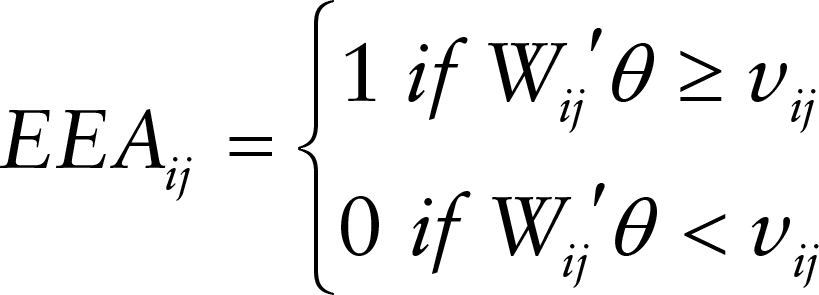
where EEAij takes the value one when both members of the country pair are EEA members, the explanatory variables in Wij are the trade cost variables, as well as three dyadic polity variables: political competition, durability and autocracy. 6 These polity variables are described in more detail in section 5.1. We then use fitted values for the probability of both countries being in the EEA to instrument for EEAij in (5).
3. Data
We use 2014 data from 42 countries: the 34 members of the OECD (Australia, Austria, Belgium, Canada, Switzerland, Chile, Czech Republic, Germany, Denmark, Spain, Estonia, Finland, France, UK, Greece, Hungary, Ireland, Iceland, Israel, Italy, Japan, Korea, Luxembourg, Mexico, Netherlands, Norway, New Zealand, Poland, Portugal, Slovakia, Slovenia, Sweden, Turkey, USA), the 6 BRIICS economies (Brazil, Russia, India, Indonesia, China and South Africa), Malaysia and Hong Kong. This gives us a total of N(N–1) = 1722 observations for bilateral exports. 7 The sample includes 23 EEA members, so there are 506 observations where both exporter and importer are EEA members. There are 428 observations involving a free trade agreement between the exporter and importer in goods, and of these 214 also involve a free trade agreement in services. This leaves 1722 – 506 – 428 = 788 observations without any free trade agreement at all between the exporter and importer.
We use four main types of data. Data on bilateral exports in goods and services, measured separately, comes from the OECD Trade in Services and STAN Bilateral Trade in Goods databases. 8 Data on free trade agreements covering goods and/or services was constructed from the WTO regional trade agreement (RTA) database. 9 Data on trade cost variables such as distance, common language, border and colonial history are taken from the Centre d'Etudes Prospectives et d'Informations Internationales (CEPII) database, the standard source. 10 Data on the political institutions variables used in the instrumental variables estimation are taken from the most recent update to the Polity IV database, originally compiled by Marshall and Jaggers (2007), and which has previously been used to address endogeneity of trade block formation by Egger et al. (2011). Details on each of these data types is presented next. We describe the Polity IV data in detail in Section 5.1.
3.1 Bilateral exports
We measure trade in goods and services separately as nominal bilateral exports in millions of US dollars between each country pair: X ij G and X ij S .
Some of the services data is ‘mirrored’, because in some cases we are missing export data from country i. In this case, bilateral exports between i and j are measured as:

where Mj←i S are imports of services to country j from country i. For example, UK exports data for services is not available for 2014. Hence, to measure bilateral exports between the UK and Sweden, we substitute data on country UK exports to Sweden (as reported by the UK) with data on Sweden's imports from the UK (as reported by Sweden), so that the UK's services exports are backed out from import data of its trading partners. For 2014, 11 per cent of bilateral services exports data points are mirrored, but none of the goods trade data points.
3.2 EEA and FTA membership
We use the WTO's regional trade agreement database to determine whether a free trade agreement exists between any pair of countries. We differentiate between agreements covering only goods, and those covering both goods and services. We also exclude any ‘partial scope agreements’, focusing on the relatively comprehensive ‘free trade agreements’ and ‘economic integration agreements’.
We construct three dummy variables:
‘EEA’ is a dummy variable which takes the value 1 whenever both members of the country-pair were members of the European Economic Area in 2014, and 0 otherwise. The EEA consists of the EU-28, plus Iceland, Norway and Liechtenstein. There are 253 country-pairs of EEA members in the data set and 506 observations for bilateral exports.
‘FTA_goods’ is a dummy variable which takes the value 1 whenever the country-pair has registered a free trade or economic integration agreement with the WTO covering goods which was in effect for the entire calendar year 2014, but at least one of the country pair was not a member of the EEA. There are 214 such country-pairs in the dataset.
‘FTA_services’ is a dummy variable which takes the value 1 whenever the country-pair has registered a free trade or economic integration agreement with the WTO covering services which was in effect for the entire calendar year 2014, but at least one of the members of the country pair was not a member of the EEA. There are 107 such country-pairs in the dataset.
This leaves 394 country-pairs corresponding to 788 observations for bilateral exports which have neither a free trade agreement in goods or services, nor are both members of the EEA.
3.3 Trade costs
We use the standard dataset for measuring proxies for trade costs, from the Centre d'Etudes Prospectives et d'Informations Internationales (CEPII). Bilateral trade costs are modelled as a linear function of the following variables, all of which are standard in the empirical gravity literature.
distij is the great circle distance between the capitals of countries i and j.
bordij is a dummy variable taking the value 1 whenever the two countries share a land border.
langij is a dummy variable taking the value 1 whenever countries i and j share a common language. We consider both a definition based on official languages and one based on the share of speakers in each country.
colonyij is a dummy variable taking the value 1 whenever countries i and j have ever had a colonial relationship.
samecontij is a dummy variable taking the value 1 whenever countries i and j are on the same continent
4. Results I: exogenous trade agreements
Assuming that trade agreements are formed exogenously, we can estimate the impact on trade of EEA membership and membership in ‘garden variety’ less comprehensive free trade agreements by estimating (5).
4.1 Impact of EEA and FTA membership
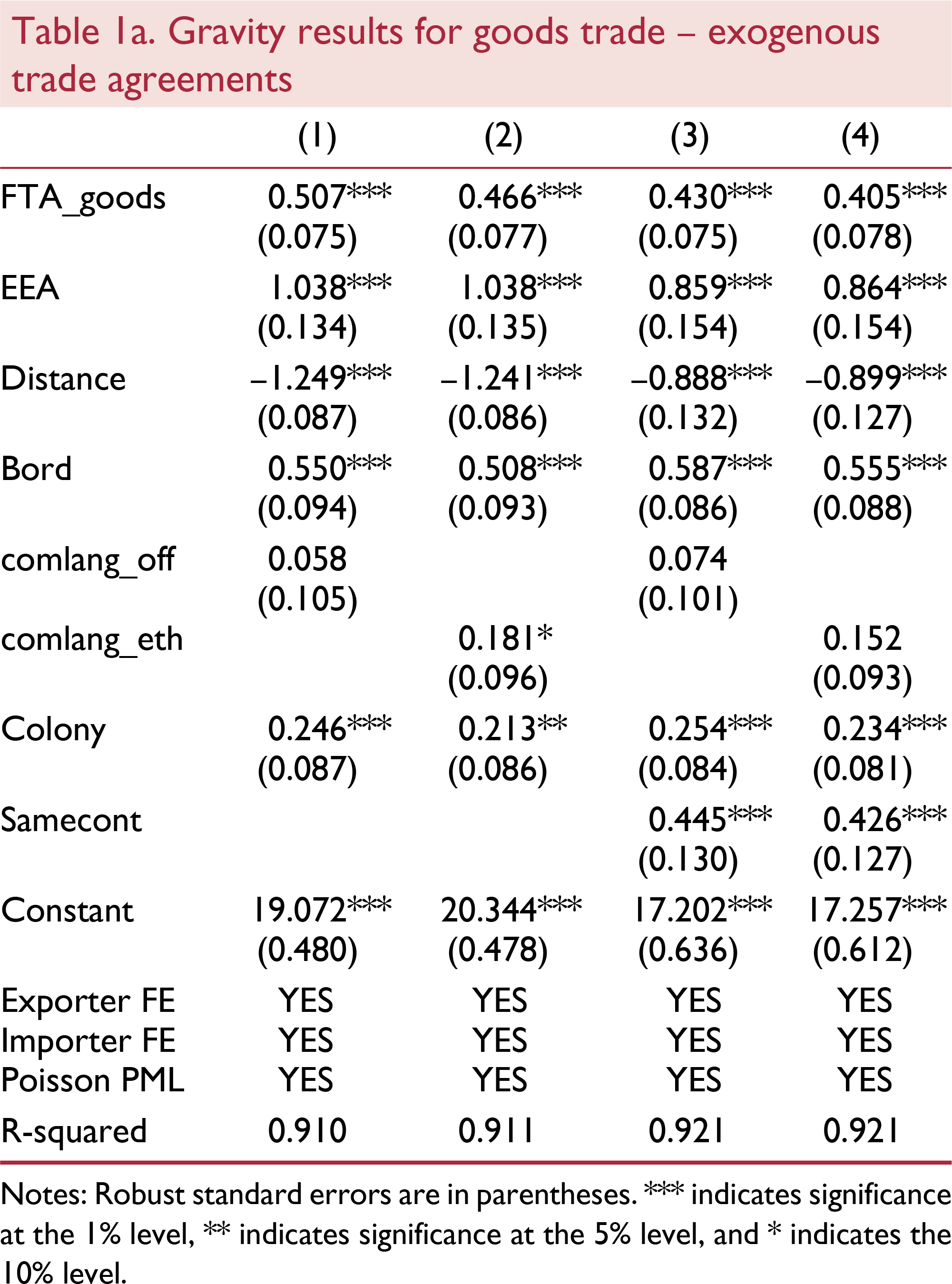
The headline result for both goods and services is that membership in a deep economic integration agreement like the EEA is associated with greater increases in bilateral exports than membership in less comprehensive FTAs. For goods (table 1a), both EEA and ordinary FTA membership are associated with significant increases in trade, but EEA membership is associated with larger increases in trade.
Gravity results for goods trade – exogenous trade agreements
Notes: Robust standard errors are in parentheses.
indicates significance at the 1% level.
indicates significance at the 5% level.
indicates the 10% level.
We are mainly interested in the decrease in bilateral exports when one member of the country pair leaves the EEA. When this occurs, the country pair can either negotiate an ordinary free trade agreement (FTA = 1) or have no trade agreement at all (FTA = 0).
The regression coefficients in table 1a indicate that replacing a country pair's common single market membership (EEA = 1 and FTA = 0) with a less comprehensive free trade agreement (FTA = 1 and EEA = 0) is associated with a long-run decline in bilateral goods exports with other EEA members of between 35 per cent and 44 per cent. 11 The results indicate that the scope for replacing lost goods trade with the EU by negotiating ordinary free trade agreements with third countries might be limited.
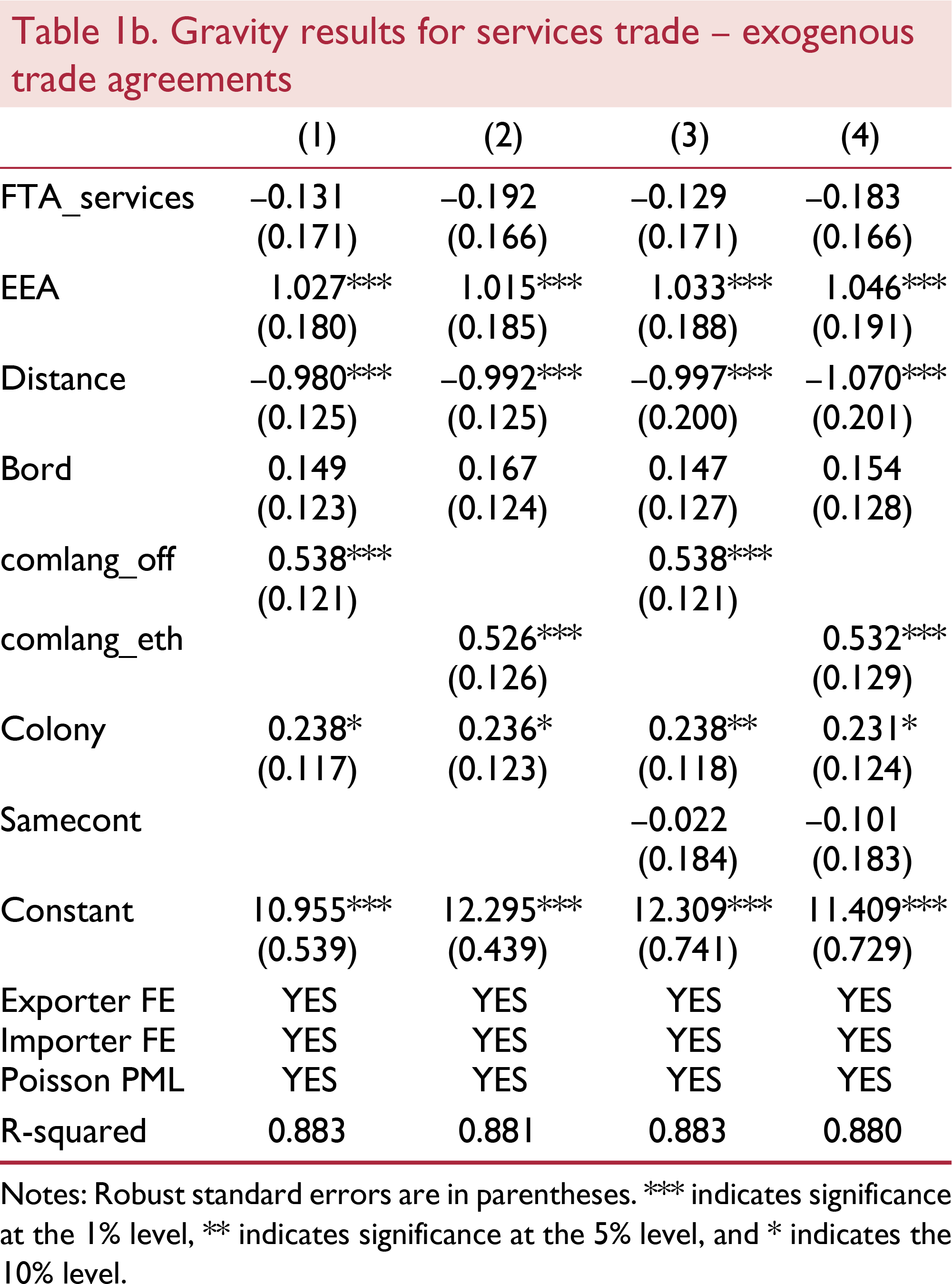
Similarly, replacing a country pair's common single market membership with no free trade agreement and trading under WTO rules would be associated with a long-run decline in bilateral goods exports of between 58 per cent and 65 per cent. 12 Transiting from an ordinary free trade agreement to WTO rules would be associated with a decline in bilateral goods exports with EEA members of between 33 per cent and 40 per cent. For services (table 1b), the results are even more striking. While membership in the EEA is associated with large and significant increases in bilateral trade, membership in an ordinary free trade agreement has no statistically significant impact on trade. This indicates that promoting services trade requires the deeper kind of integration offered by the EEA, including elements such as regulatory harmonisation and/or free movement of labour. This result is in line with the greater importance for services of non-tariff barriers to trade compared to tariffs or transport costs.
Gravity results for services trade – exogenous trade agreements
Notes: Robust standard errors are in parentheses.
indicates significance at the 1% level.
indicates significance at the 5% level.
indicates the 10% level.
The regression coefficients in table 1b indicate that if a country gives up EEA membership in favour of either a looser FTA or no FTA (i.e. WTO rules) with its trading partner, then this move is associated with a decline in bilateral services exports with EEA members of between 61 per cent and 65 per cent. Again, the results indicate that there may not be much scope for replacing lost services trade with the EU by negotiating ordinary free trade agreements, either with the EU or with third countries.
4.2 Trade costs
As to the impact of other kinds of trade costs on trade, we also find some intriguing distinctions between goods and services. Having a common border and being on the same continent has a statistically significant impact on goods trade, yet neither of these variables is significant for services trade. This makes sense, as both common border and common continent are measures which are related to proximity and physical transport costs. In addition, we find that bilateral services trade is significantly increased in country-pairs with a common language. In contrast, common language has no significant impact on bilateral goods trade except for a marginally significant impact in one specification. This is in line with services trade being dependent on communication.
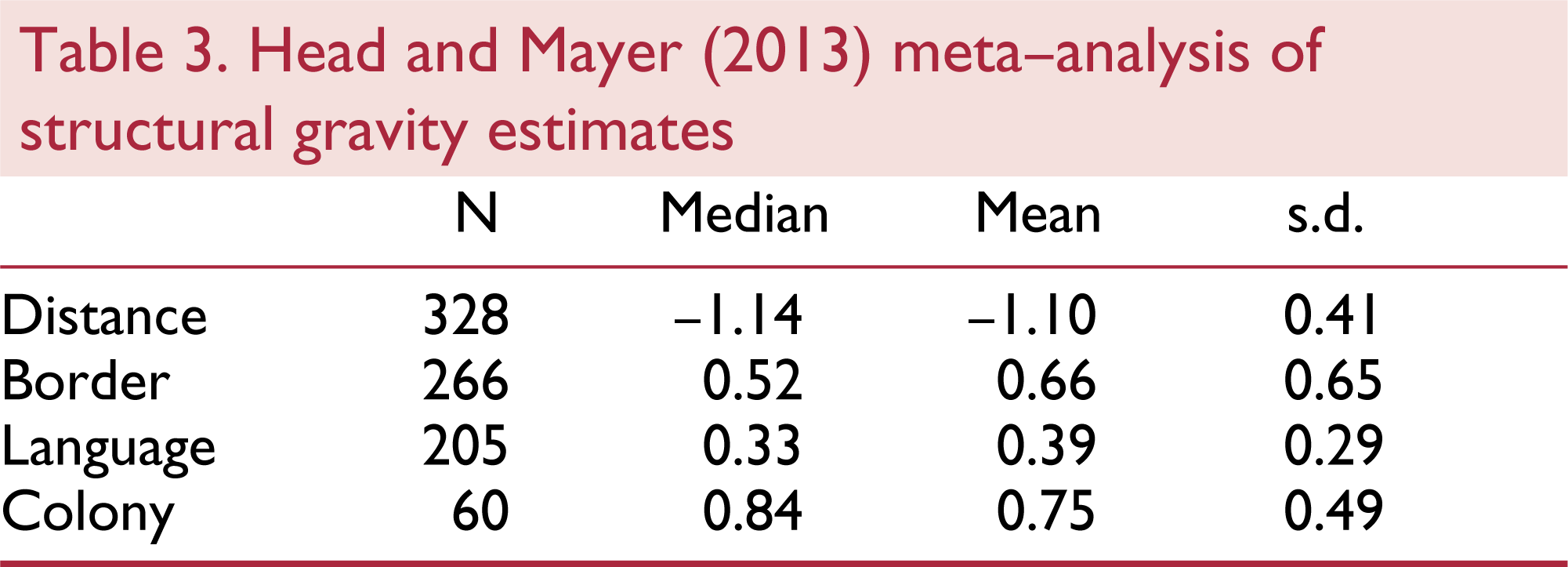
Next, we compare our regression results to other analyses of the impact of trade agreements and trade costs on trade. We also find that our estimates of the coefficients on standard trade cost variables such as distance or common language are well within the range estimated in the literature. We present the meta-analysis of gravity models results provided in Head and Mayer (2013) for the relevant coefficients. Head and Mayer (2013) compiled the results of over 159 papers with gravity model estimations published in top-5 journals, the Review of International Economics and the Review of Economics and Statistics between 2006 and 2012. A summary of their results is presented in table 3. We can see that our estimated coefficients on distance are quite close to the medians of Head and Mayer's (2013) sample for both goods and services. For services, our common language estimates are reasonably similar to those of the median as well, while for goods our coefficients on border are in line with those of Head and Mayer's (2013) sample. Our estimates for the impact of a colonial history between two countries are considerably smaller than the median for both goods and services. This might be because we have focused on high and medium income countries, while many other studies tend to include a larger sample of lower-income countries for whom a colonial past might be more relevant.
Reductions in bilateral trade with trade agreement partners from changes in trading arrangements
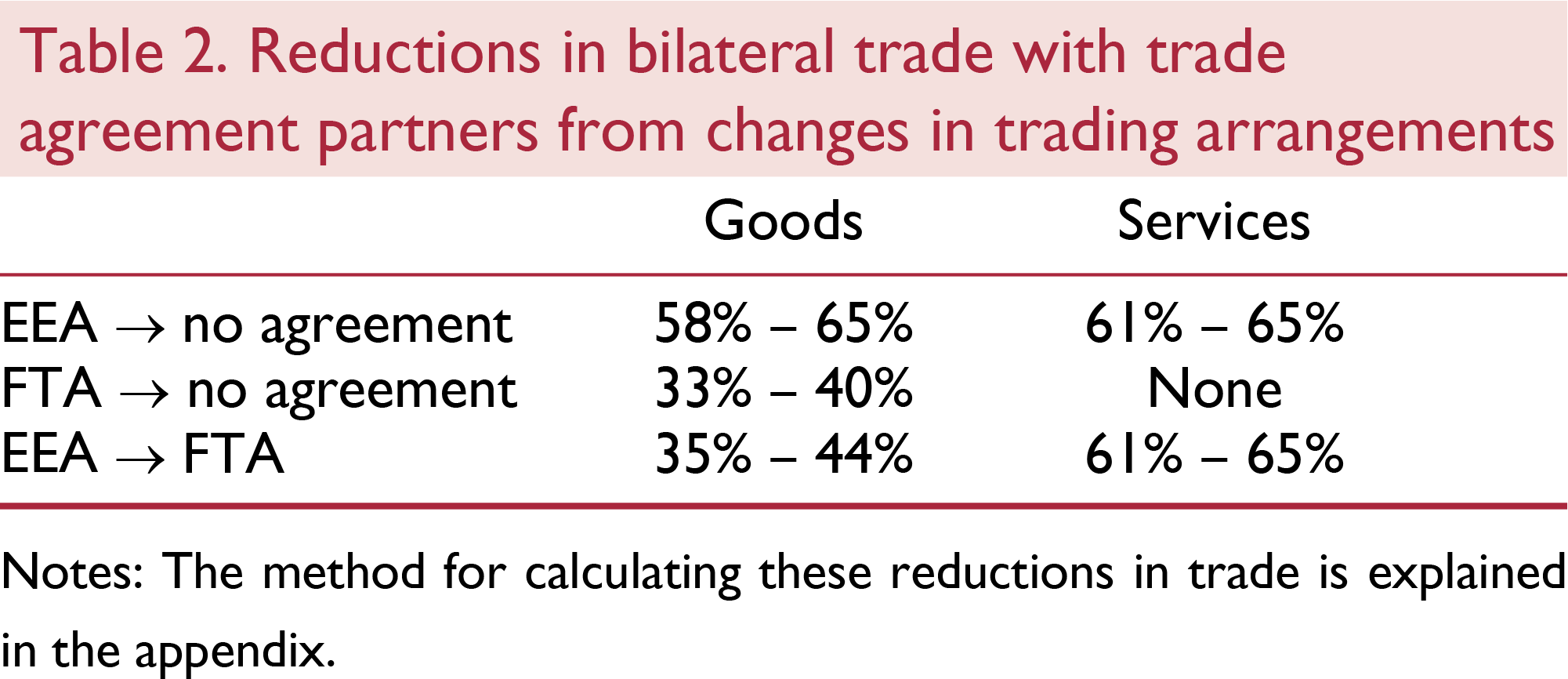
Notes: The method for calculating these reductions in trade is explained in the appendix.
Head and Mayer (2013) meta-analysis of structural gravity estimates
5. Robustness: endogeneity of EEA membership
As discussed in Section 2.2, membership in the EEA or in a FTA is likely to be endogenous. That is, two countries which already trade a lot might be more likely to form a trade agreement. Next, we perform a robustness check which aims to address the issue of endogeneity in EEA membership. We follow the two-stage instrumental variables methodology suggested by Egger et al. (2011), treating the polity variables suggested by these authors as potential instruments.
5.1 Data on political institutions
In order to account for the potential endogeneity of EEA and/or FTA membership, we run first-stage probit regressions, using variables which measure the similarity of political institutions for each country pair as explanatory variables. 13 Similarity between each country pair's political institutions is captured using the absolute value of the difference between the country pair's variables along three dimensions: autocracy, durability and political competition.
The first polity measure is ‘Autocracy’. At a country level, autocratic regimes (i.e. those with a high ‘Autocracy’ value) are ones with highly restricted political participation, in which leaders are chosen from a small elite, and leaders have few constraints on their power. The dyadic variable ‘Autocracy’ measures the difference between the country pair's autocracy scores.
At a country level, durability measures the length of time, in years, since the most recent regime change or the end of a period without any stable political institutions. The dyadic variable ‘Durable’ used in the IV regressions measures the difference between the country pair members' individual durability variables.
The country-level political competition variable is a composite of variables measuring the regulation of participation and the competitiveness of the political system. The degree of competitiveness can range from ‘repressed’, with no legal opposition, to ‘competitive’, with a multi-party system with regular transfers of power. Regulation of participation is a measure of the ability to participate in the political process, including whether groups are excluded from the political process. Again, the dyadic variable ‘Polcomp’ used in the IV regressions measures the difference between the country pair's members' political competition scores. We use this data to implement an instrumental variables (IV) approach to accounting for endogenous trade agreements, following Egger et al. (2011).
5.2 Instrumental Variables approach
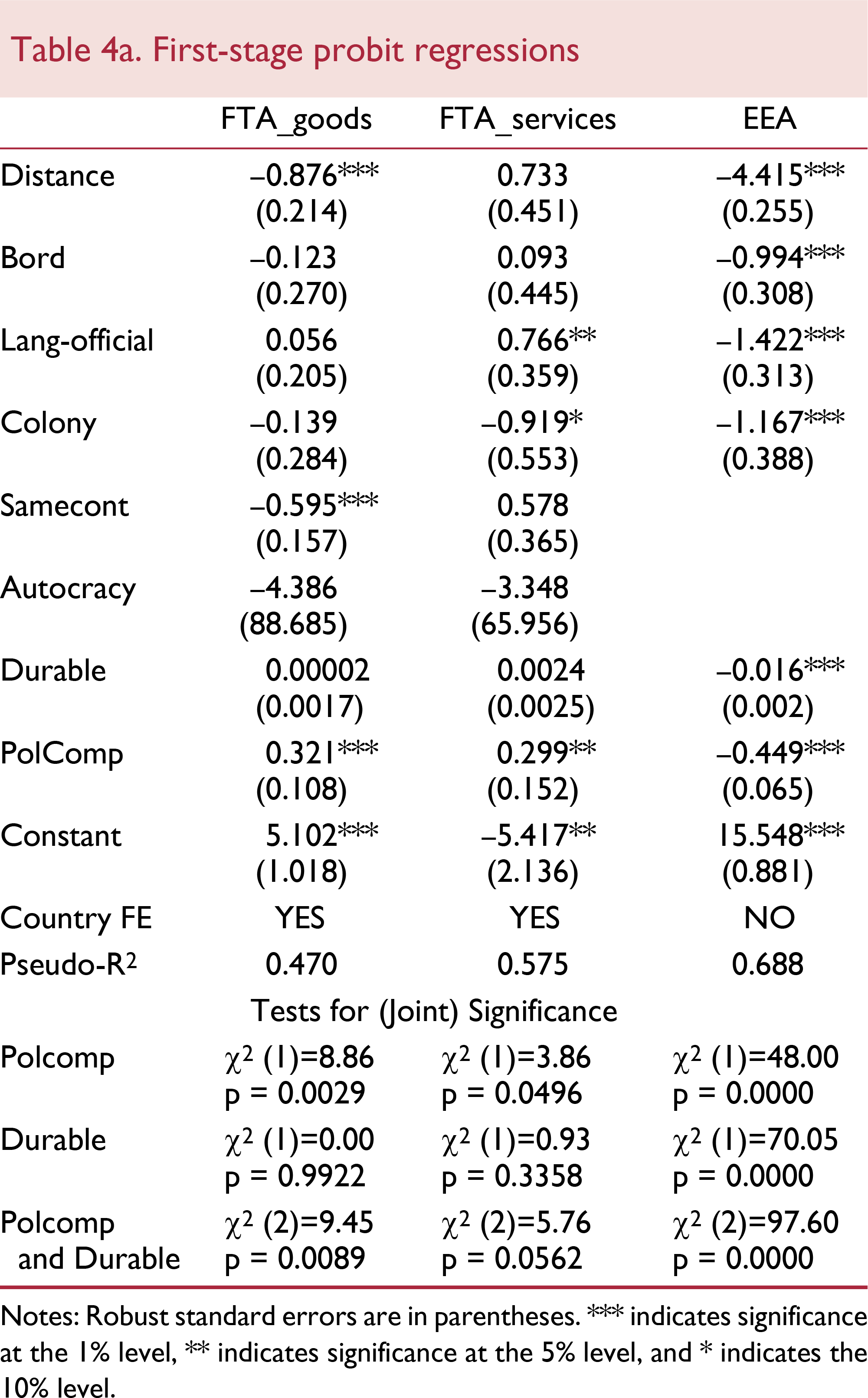
A valid instrument will be uncorrelated with trade, but will be correlated with the probability of a country pair both being EEA members or having an ordinary FTA. Our candidate instruments are the polity variables described in section 3.4. First, we use the gravity variables from equation (5) and the three dyadic polity variables to estimate first-stage probit regressions on EEA membership, FTA in services and FTA in goods. In the first-stage regression for EEA membership, it was necessary to drop the variables indicating whether the two countries were on the same continent (samecont) and the difference in their degrees of autocracy (Autoc). The reason is that when two countries are not on the same continent, they are never both EEA members, and similarly, no countries with a positive difference in their Autocracy scores were ever both EEA members, because all EEA members achieve the minimum Autocracy score. Obviously, it was also not possible to include country fixed effects in the EEA regressions either.
The results of the first-stage probit regressions are presented in table 4a. The coefficients on EEA membership are quite intuitive. A pair of countries is more likely both to be EEA members if they are geographically near to one another (negative coefficient on distance), but do not share a common border or language nor a common colonial past. Indeed, most EEA member-pairs do not share a border or a language or a colonial past.
First-stage probit regressions
Notes: Robust standard errors are in parentheses.
indicates significance at the 1% level.
indicates significance at the 5% level.
indicates the 10% level.
As for the polity variables, the negative coefficients on Durable and Polcomp indicate that the more similar are two countries' levels of political competition and stability, the more likely they are both to be EEA members. Deep integration, like that of the EEA single market, requires a high level of confidence in partners' political institutions. Indeed, stable and strong political institutions are a pre-condition for EU membership, so we would expect EEA country-pairs to have similarly durable and competitive political institutions.
Moreover, the polity variables Durable and Polcomp are strongly correlated with EEA membership. The joint tests for significance for Polcomp and Durable, as well as for Polcomp and Durable separately, indicate that these polity variables have strong predictive power for EEA membership at the 1 per cent level (table 4a). As a result, Durable, Polcomp and Durable and Polcomp jointly are all strong candidate instruments for EEA membership.
The polity variables do not turn out to be equally strong candidates for instruments for ordinary FTAs in goods or services, however. Durable on its own is not statistically significantly correlated with existence of a FTA in goods or services and hence fails as an instrument for FTAs. In addition, Polcomp is only relatively weakly correlated with FTAs in services at the 5 per cent level. Polcomp and Polcomp and Durable together are (jointly) significant for FTAs in goods at the 1 per cent level, so that they are potential instruments for FTAs in goods. The positive sign on Polcomp in the first-stage regressions on FTAs in goods and services indicates that countries with dissimilar political institutions may be more likely to form looser FTAs, with lower degrees of economic integration.
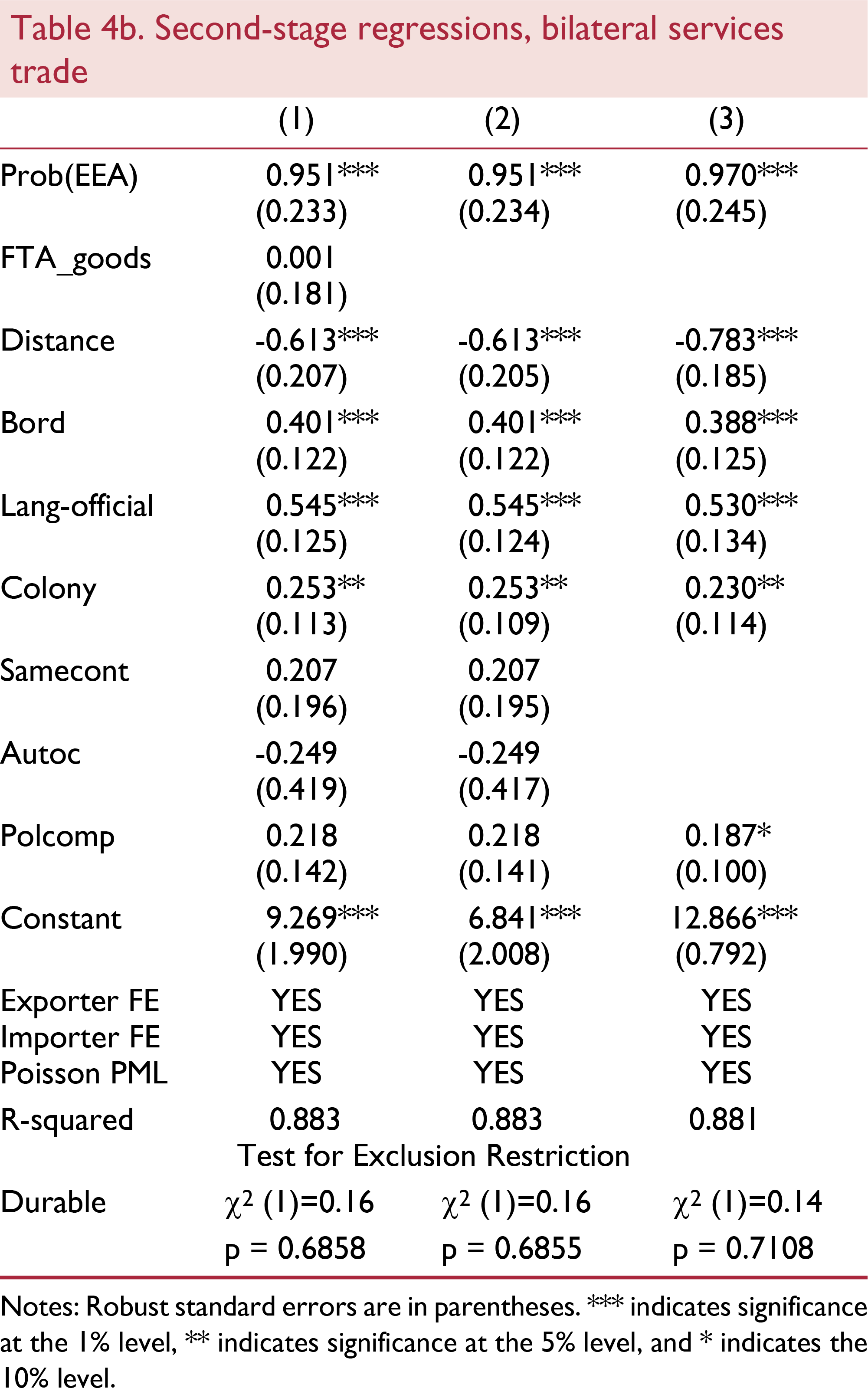
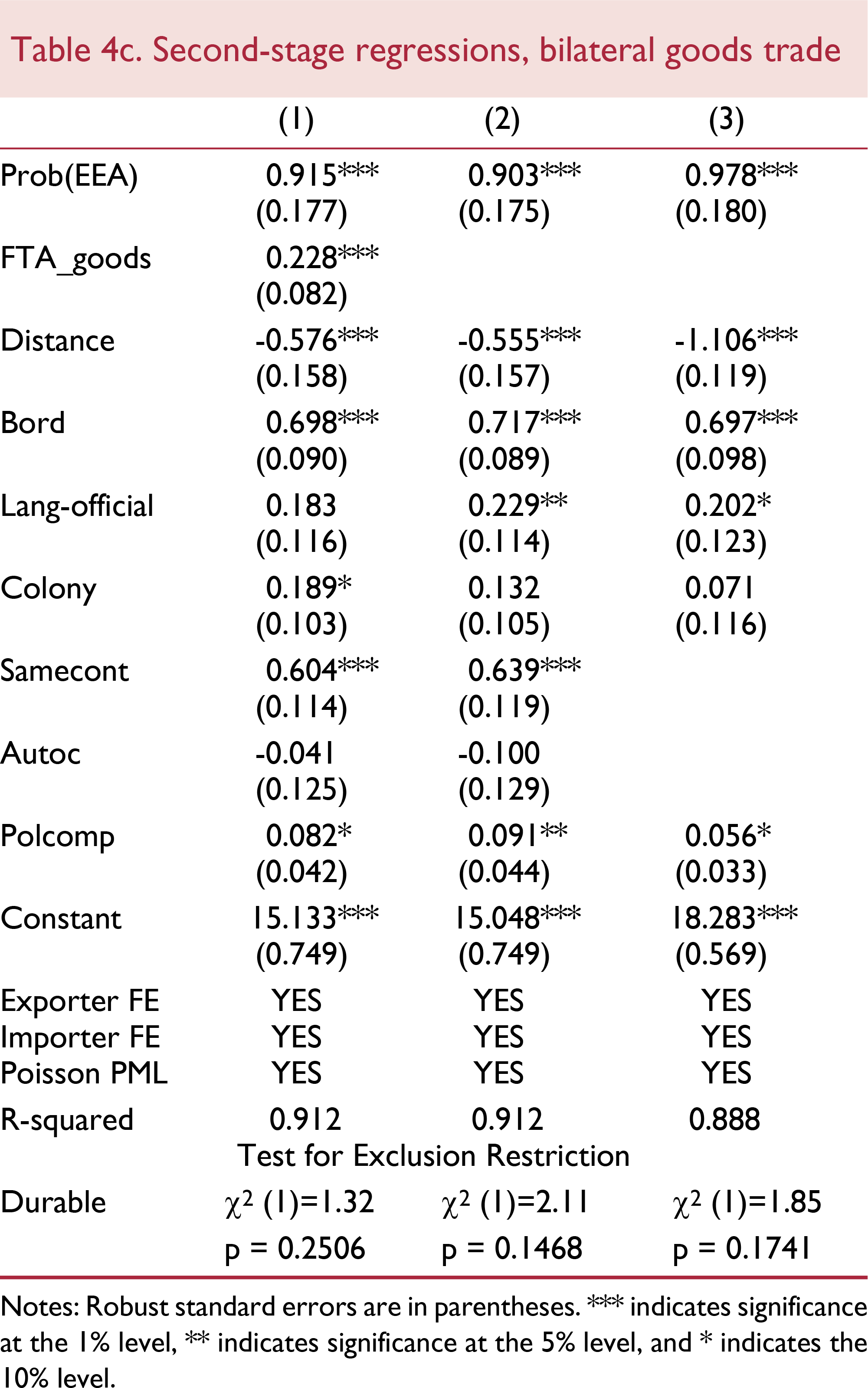
Next, we run second stage regressions, using the fitted probabilities of EEA membership to substitute for EEA in equation (5). Results are presented in table 4b for services trade and table 4c for goods trade, including the test for the exclusion restrictions that the candidate instruments are not correlated with trade. Unfortunately, Polcomp fails as an instrument in the second stage, as it turns out to be (marginally significantly) correlated with trade, both in goods and in services. The combination of Polcomp and Durable also fails the exclusion restriction, as these two variables also turn out to be (marginally) jointly significant for trade, both in goods and in services.
Second-stage regressions, bilateral services trade
Notes: Robust standard errors are in parentheses.
indicates significance at the 1% level.
indicates significance at the 5% level.
indicates the 10% level.
Second-stage regressions, bilateral goods trade
Notes: Robust standard errors are in parentheses.
indicates significance at the 1% level.
indicates significance at the 5% level.
indicates the 10% level.
Only Durable survives as a valid instrument for EEA membership: Durable is correlated with EEA membership, but not with trade in either goods or services. That is, the more similar is the political stability of two countries (i.e. the smaller the difference between their polity scores for Durability), the more likely they are both to be EEA members. This is intuitive, as most EU members have a similarly high degree of political stability, as political stability is a pre-condition for membership in the European Union, and the majority of EEA members are EU members. However, similarity in levels of political stability does not have any significant impact on trade over and above its predictive power for EEA membership. To see why this might be sensible, consider what might happen if the non-EU members Russia and Ukraine were to develop stable political institutions over time, but they did not join the EEA. If more stable political institutions were to promote exports or imports generally, then that would be picked up by exporter or importer fixed effects. A lack of a direct impact on bilateral trade merely indicates that Russia and Ukraine would not systematically increase trade more (or less) with countries with similarly durable political institutions than with countries whose political institutions are less competitive or durable.
Durable is not, however, a valid instrument for free trade agreements: Durable is not correlated with free trade agreements, either in goods or in services. That is, similar levels of political stability do not seem to be associated with a greater propensity to form an ordinary free trade agreement. Hence, we conclude that the polity variables are not valid instruments for FTAs in goods or services. As a result, we present 2nd stage regression results instrumenting only for EEA membership.
Table 4b presents the 2nd stage regressions for services trade, while table 4c presents results for goods trade. We present results both including the (uninstrumented) FTA dummy variables and excluding them. In all cases, the impact of EEA membership, instrumented by the dyadic polity variable Durable, remains strong, albeit somewhat smaller in magnitude than in the regressions of tables 1a and 1b. The main result is that, in all specifications, the coefficients on (instrumented) EEA membership on trade in goods and services are quite similar to those in the exogenous regressions presented in tables 1a and 1b.
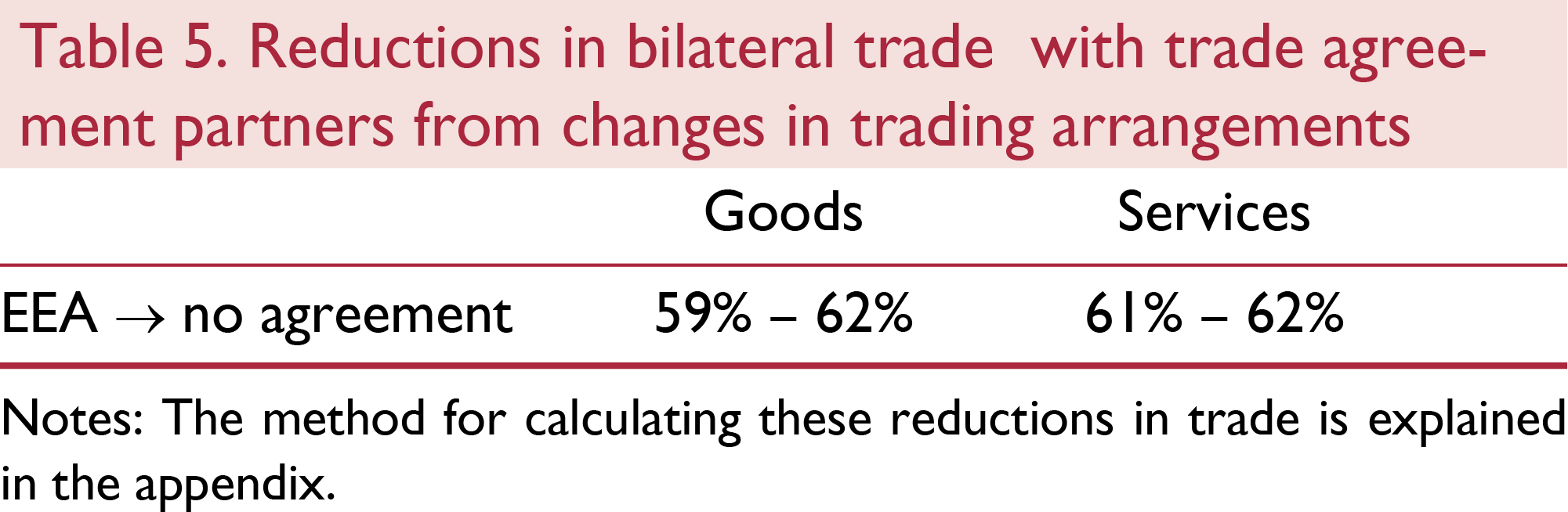
Table 5 gives the reductions in goods and services trade from leaving the EEA in favour of having no free trade agreement, using the coefficients from the second stage IV regressions to control for endogeneity of EEA membership from tables 4b and 4c. The ratio of fitted goods trade in the counterfactual of no free trade agreement with other EEA members to fitted goods trade in an EEA member pair is between 38 per cent and 41 per cent. 14 This indicates that having no free trade agreement with EEA members is associated with declines in goods trade of 59 per cent to 62 per cent. Similarly, the ratio of fitted services trade under no FTA with other EEA members to fitted services trade in an EEA member pair is between 38 per cent and 39 per cent, corresponding to a reduction in services trade with other EEA members of between 61 per cent and 62 per cent.
Reductions in bilateral trade with trade agreement partners from changes in trading arrangements
Notes: The method for calculating these reductions in trade is explained in the appendix.
The impact of EEA membership on bilateral exports in goods and services have large magnitude, but they are well within the range of the impact on bilateral exports of free trade agreements found elsewhere in the literature. The coefficients on the FTA variable in Egger et al. (2011) in a comparable specification is 1.1471, while the estimated coefficients on EEA in the present paper all lie between 0.80 and 1.05. Egger et al.'s (2011) estimated coefficient corresponds to a reduction in trade of 68 per cent from leaving a FTA. Baier, Bergstrand et al.'s (2008) estimated reductions from leaving the EU lie between 36 per cent and 48 per cent, relying on older data that stem largely from the pre–1992 single market period. Thus, the IV estimates presented here are consistent with reductions in trade from leaving the EEA single market that are somewhat smaller than those reported in Egger et al. (2011) for recent data, and somewhat larger than those reported in Baier, Bergstrand et al. (2008) for older data.
Of course, one should be aware of the limitations involved in using the econometric model employed here. All estimates are conditional on the restrictive model specifications used. In addition, our sample includes only countries who have either never joined the EEA or who are currently members, but it does not (yet) include any leavers. 15 The impact of leaving the EEA on trade might be greater or lesser than the impact of joining it. Further, the full impact on trade of leaving the EEA might take years to manifest itself, as might the benefits from any new trade agreements. At the same time, we can also expect that the decision to leave the EU might be flanked by stimulative fiscal, monetary or structural policies, which might lead the ultimately observed impact of leaving the EU on the UK's exports to be lower than those estimated here. Finally, services are very diverse, ranging from transport and retailing to financial services, business services, IT and technical services. Equally, the impact of leaving the single market might differ across service industries. More work would need to be done to understand the impact of leaving the EU on specific service industries.
Conclusions
This paper compares the increases in trade in goods and services which are associated with membership in the EEA to the increases in trade associated with membership in less comprehensive free trade agreements. The headline result for both goods and services is that, after leaving the EU, the UK might find it challenging to replace lost trade with EEA members by agreeing less comprehensive FTAs. That is, membership in the EEA is associated with greater increases in bilateral exports than membership in less comprehensive FTAs. For goods, the long-run reduction in goods trade with the EEA associated with replacing the UK's EEA membership with an ‘ordinary’ FTA with the rest of the EEA is estimated to be 35 per cent to 44 per cent, while replacing EEA membership with no free trade agreement at all is associated with a long-run decline of 58 per cent to 65 per cent. The results indicate that the scope for replacing lost goods trade with the EU by negotiating less comprehensive free trade agreements with third countries might be limited.
For services, the results are even more striking: only EEA membership is associated with increases in services trade, while ordinary services FTAs are not associated with any statistically significant gains in services trade. The regression coefficients indicate that replacing single market membership with either a looser FTA or no FTA with the rest of the EEA would be associated with a long-run reduction in services trade with the EEA of 61 per cent to 65 per cent. Again, the results indicate that the scope for replacing lost services trade with the EU by negotiating less comprehensive free trade agreements with third countries might also be limited.
In summary, our results indicate that the depth of trade agreements matters. This raises the question: which aspects of deep trade agreements are most important for generating trade? The answers might differ for goods and for services, and across individual goods or services industries. The answers to this question will be important for setting priorities in negotiating trade agreements, both with the EU and with third countries, in order to ensure that the UK continues to benefit fully from the opportunities of international trade after leaving the European Union.
Footnotes
2
The EEA consists of the 28 members of the European Union, plus Norway, Iceland and Liechtenstein.
3
For example,  estimate the bias from using OLS and dropping zeros. They find that the estimated coefficient on FTA membership increases from 0.310 in a log-linear OLS regression to 0.376 in the corresponding non-linear PPML regression. This corresponds to an increase in the trade losses from leaving a FTA from 26.7 per cent to 31.3 per cent.
4
‘Mirroring’ refers to the practice of replacing missing data on exports from country i to country j, as reported by the exporter, with data on the imports to country j from country i, as reported by the importing country.
5
Of course, it may be the case that even this relatively small amount of mirroring might be a source of some measurement error.
6
A dyad is a country-pair, and a dyadic variable is one which describes the relationship between the country-pair members. The polity variables used are dyadic, because they measure the similarity of the two countries’ political institutions.
7
There are N(N–1)/2=861 unique country pairs, but each unique country pair has two observations on bilateral exports. For example, the UK and Sweden are a unique country pair, with two observations, exports from the UK to Sweden and exports from Sweden to the UK.
8
The OECD Trade in Services data is available at http://stats.oecd.org/viewhtml.aspx?datasetcode=TISP_EBOPS2010&lang=en, while the OECD STAN bilateral trade in goods database is available at .
11
See the appendix for details of how to convert the regression coefficients of tables 1a and into declines in trade for various scenarios.
12
It should be emphasised that these are long-run effects, which might take years to manifest themselves.
13
14
See the appendix for details of the calculation of this ratio.
15
Break-ups of FTAs are also relatively rare.
Appendix: From regression coefficients to trade impacts
In this Appendix, we describe how to interpret the regression coefficients, and how to calculate their corresponding trade impacts. We begin with the regression equation (5), expressed as an expectation:
First, we are interested in finding the ratio between bilateral exports Xij when a country pair goes from involving two EEA members to having no trade agreement at all:
Note that as only the EEA variable changes, all other variables drop out.
Using the coefficient on EEA in the first column of table 1a, which is δ1=1.038, leads to the ratio:
That is, if trade between two EEA members was 100, then it would be expected to drop to 35.4 if one country counterfactually left the EEA and there was no ordinary FTA between the two countries. The percentage decline in trade is then (100–35.4)/100 = –64.6 per cent, corresponding to the entry 65 per cent in the top left corner of table 2 for the decline in trade when going from EEA → no agreement for goods.
Similarly, we can calculate the ratio between bilateral exports Xij when a country pair goes from having a loose free trade agreement to having no free trade agreement at all as:
Finally, we can calculate the ratio between bilateral exports Xij when a country pair goes from involving two EEA members to having a looser free trade agreement: